
Chia (Chia Seed)
Salvia hispanica
A newly emerging, low-water oilseed-type crop in India — the tiny seed of a Central American plant that fetches a far higher price than traditional oilseeds, grown on marginal black and sandy soils with almost no irrigation. Sown in the August–September window, harvested by sickle in about three to four months, and sold mostly through private contract-farming companies rather than an established mandi trade, since it is too new to have an ICAR-released variety or a government-notified price yet.
Quick Summary
The key points from this page in about two minutes — read it or have it read aloud.
Quick Summary
Chia (Salvia hispanica) is a small annual plant, originally from Mexico and Guatemala, now being tried by farmers in Madhya Pradesh, Gujarat, Rajasthan, Karnataka, Maharashtra and a few other states. It has come to Indian fields only in the last decade or so, on the back of demand for its seed as a health food — chia seed is sold whole in shops and used in drinks, porridge and baking, not crushed for oil the way mustard or groundnut are.
What makes it attractive to a farmer is how little it asks for. It grows on shallow, rocky, or sandy soils too poor for most other crops, needs very little water once established, and gets by on a modest fertiliser dose. It also fetches a considerably higher price per kilogram than a traditional oilseed, which is why it interests farmers even though the area sown is still small everywhere in the country.
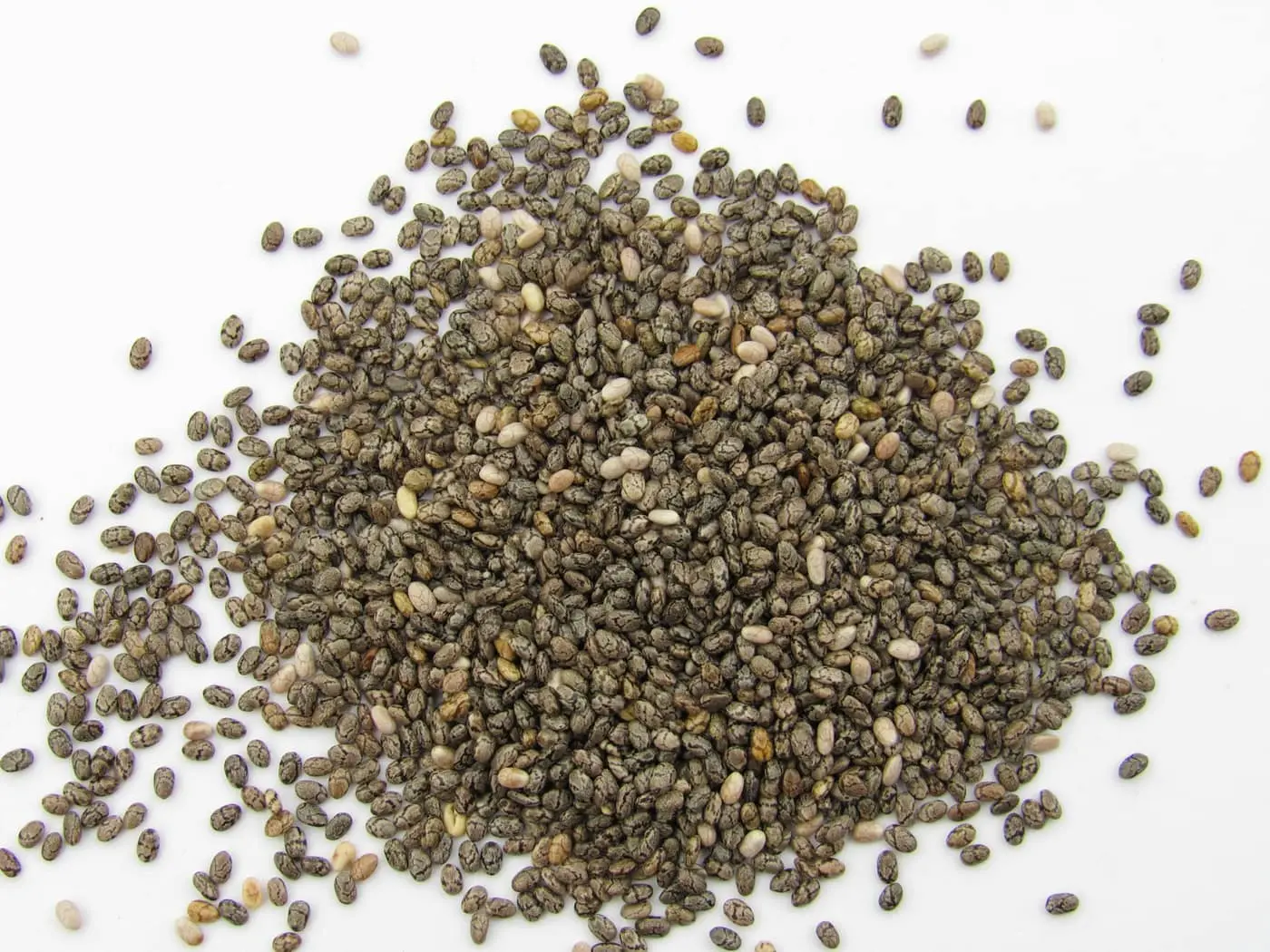
The catch is that chia in India is still a new crop, not a settled one. There is no government-released variety bred for Indian conditions yet — only two seed types, a lighter-coloured "white" chia and a darker "black" chia, sold commercially. There is also no government-fixed price and only a thin mandi trade reported so far from a handful of markets; nearly all chia grown in India today moves through a private contract-farming arrangement, where a company agrees in advance to buy the crop, rather than through the open market a farmer would use for wheat or rice. This page sets out what is actually known and tested about growing it, and is honest about what is not yet settled.
- Crop type
- Annual health-food seed crop (not processed for oil in India)
- Season
- Mainly kharif; sown early August to mid-September
- Suitable states
- Madhya Pradesh, Gujarat, Rajasthan, Karnataka, Haryana, Maharashtra
- Growing duration
- Roughly 90–120 days from sowing to harvest
- Water requirement
- Low — can be grown rainfed or with limited irrigation
- Temperature
- Warm-season crop; grows well in typical kharif temperatures
- Soil type
- Shallow black, rocky basaltic or sandy soils, even of low fertility
- Difficulty level
- Moderate — agronomically easy, but seed and market access still limited
- Expected yield
- Roughly 3–5 quintals/acre depending on seed type and management
- No MSP
- Not CACP-notified; sold mainly via private contract farming, with only a thin mandi presence
Overview
Chia (Salvia hispanica) is a member of the mint family, native to Mexico and Guatemala, grown for its tiny oval seed rather than for oil extraction or fodder. In India it is a genuinely new crop — cultivation has spread only over roughly the last decade, mainly in Madhya Pradesh, Gujarat, Rajasthan, Karnataka, Haryana, parts of Uttar Pradesh and, more recently, drought-prone tracts of Maharashtra, where ICAR's National Institute of Abiotic Stress Management at Baramati has been developing a package of practices for shallow black soils.
The reason farmers are interested is straightforward: chia asks for very little. It tolerates rocky, basaltic, sandy or shallow black soils of low fertility that would struggle to carry most field crops, needs only a modest amount of water, and can be grown rainfed or with limited irrigation. Against that low cost, it sells for considerably more per kilogram than a traditional oilseed like mustard or groundnut, since it is bought as a whole-seed health food rather than crushed for oil.
Because it is so new here, chia in India does not yet have the settled infrastructure that an established crop like wheat has. No Indian institute has released a named chia variety bred for local conditions — what is sold is simply "white" or "black" chia seed, a colour distinction rather than a bred variety. There is no government MSP and only a thin mandi trade so far (reported mainly from a handful of APMC yards); almost all of the crop moves through private contract-farming arrangements, where a company supplies seed and guarantees to buy the harvest at an agreed rate. A farmer considering chia should treat it as a contract crop to be arranged in advance, not a commodity to sow first and sell later at whatever the market offers.
Crop timeline, sowing to harvest
A quick visual map of the season — jump to any section below for the detail behind each stage.
- Day 0
Sowing
Sow in the first half of August to mid-September on prepared, weed-free land, either broadcast or in shallow lines.
- Day 5–10
Germination
Tiny seedlings emerge; because the seed is minute, a fine, well-settled seedbed and shallow sowing matter far more here than for a normal-sized field crop seed.
- Day 10–30
Early establishment
The most weed-vulnerable stage — young chia seedlings compete poorly, and since chia is sensitive to most common herbicides, this window needs hand or mechanical weeding rather than a chemical spray.
- Day 30–45
Vegetative growth & first nitrogen split
The plant branches and grows taller; the first top-dressing of nitrogen after the basal dose is applied here.
- Day 45–60
Second nitrogen split
A further nitrogen top-dressing supports the plant through to flower initiation.
- Day 60–90
Flowering
Small purple or white flower spikes appear; chia is a short-day plant, so flowering timing shifts with sowing date and location rather than following a fixed calendar.
- Day 90–120
Seed maturity & harvest
Flowers wilt and the seed heads turn brown — the sign to harvest promptly, since mature chia seed is very easily shaken loose by wind or rain and lost in the field.
Suitable states
States where this crop is grown at scale, highlighted below. Your local Krishi Vigyan Kendra is still the final word for your specific block.
- Jammu and Kashmir
- Himachal Pradesh
- Punjab
- Uttarakhand
- Haryana
- Delhi
- Uttar Pradesh
- Rajasthan
- Bihar
- Jharkhand
- West Bengal
- Sikkim
- Assam
- Arunachal Pradesh
- Meghalaya
- Nagaland
- Manipur
- Mizoram
- Tripura
- Gujarat
- Madhya Pradesh
- Chhattisgarh
- Maharashtra
- Odisha
- Goa
- Telangana
- Andhra Pradesh
- Karnataka
- Kerala
- Tamil Nadu
- Puducherry
- Ladakh
- Chandigarh
- Lakshadweep
- Andaman and Nicobar Islands
- Dadra and Nagar Haveli and Daman and Diu
Grown here
Climate requirements
Chia's appeal in India rests heavily on tolerating conditions — poor rainfall, marginal soil — that defeat most other crops, which is exactly why the current push (including ICAR-NIASM's trial work) targets drought-prone areas rather than India's better-watered farming belts.
Ideal temperature
A warm-season plant that grows well through India's kharif temperature range; it does not tolerate frost
Rainfall
Low overall rainfall need is one of its main selling points — it is being promoted specifically for drought-prone tracts where higher-water crops struggle
Humidity
No unusual humidity sensitivity has been reported in the limited Indian trial literature so far; ordinary kharif humidity levels are not flagged as a concern
Sunlight
Full sun suits normal vegetative growth, though as a short-day plant, flowering timing is driven by day length shortening after the monsoon rather than by sunlight intensity alone
Soil requirements
The soils chia is being grown on in India are, almost by design, the ones other crops are grown on reluctantly — shallow, stony or sandy ground with low fertility and unreliable rain. This is a deliberate strategy to find a paying use for marginal land, not an indication that chia performs best there compared with better land.
Suitable soil
Shallow black soils, rocky basaltic soils and sandy soils, including land of low natural fertility that would give a poor return under a more demanding crop
pH range
Neutral to mildly alkaline soils are typical of the tracts where it is currently grown in India; it has not shown a need for a narrow, specific pH range in trial reports
Drainage
Good drainage is preferred, in line with the light, often shallow soils it is grown on — these soils rarely hold excess water for long in any case
Organic matter
Performs acceptably even on low-organic-matter, marginal land, which is part of why it is being tried on ground not considered good enough for other crops
Land preparation
Same four steps whichever region you are in — only the timing shifts with the sowing window.
- 1
Prepare a fine, well-settled seedbed
Because chia seed is extremely small, plough and harrow the field to a fine tilth and let it settle before sowing — a cloddy or loose bed gives poor, patchy emergence.
- 2
Clear the field of perennial weeds beforehand
Since chia tolerates very few herbicides once sown, remove perennial weeds during land preparation rather than planning to spray them out later in the standing crop.
- 3
Level the field for even moisture
A reasonably level field prevents the tiny, shallow-sown seed from washing into low patches after the first rain, which would leave gaps in the stand.
Seed information
How the main varieties compare, so you can pick by duration, yield, disease pressure or what you are growing for.
| Variety | Duration | Yield | Disease resistance | Best state | Suitable for |
|---|---|---|---|---|---|
The lighter-coloured seed type, generally commanding a higher retail price than black chia, though it is reported to yield somewhat less per unit area in comparative trials. Sold as whole seed for the health-food market. | 90–120 days | Roughly 3 q/acre (lower of the two types) | No separate resistance data reported; standard field hygiene applies | Karnataka, Gujarat, Madhya Pradesh | Kharif sowing, health-food market sale |
The darker-coloured, more widely cultivated seed type in current Indian trials, generally giving a higher yield than white chia though selling for a somewhat lower price. Sold as whole seed for the health-food market. | 90–120 days | Roughly 5 q/acre (higher of the two types) | No separate resistance data reported; standard field hygiene applies | Karnataka, Madhya Pradesh, Rajasthan | Kharif sowing, health-food market sale |
- Seed rate
- About 2.0 kg/ha for line sowing, or 2.5–3.0 kg/ha for broadcasting — a very low seed rate, since the seed is tiny and each plant branches out to cover a fair amount of ground.
- Certified seed
- There is no ICAR-released chia variety and no certified-seed system for it in India yet — seed is simply sold as "white" or "black" chia. Nearly all chia grown in India today is sourced through a private contract-farming arrangement rather than an open seed market: companies such as Maatitatva Agro Industries (Madhya Pradesh), K V Agro Products, Orgrain India, Organic India and Seasons International are among the known private buyers and seed suppliers running contract-farming programmes for chia. A farmer new to the crop should arrange seed and a buy-back agreement with such a company before sowing, rather than sourcing seed independently with no confirmed buyer.
- Spacing
- 60 × 30 cm for the main kharif sowing window (August–September); a closer 50 × 30 cm spacing is used where sowing is delayed into October–November. Wider spacing has been shown to give a better seed yield than crowding plants closer together.
- Seed treatment
- No specific seed treatment is established practice for chia in Indian trials so far; growers use plain, clean seed as supplied.
Sowing guide
The sowing depth is the detail most likely to be got wrong by a farmer used to bigger-seeded crops — chia seed is roughly the size of a sesame seed, and burying it deep the way one would maize or groundnut simply prevents it from emerging at all.
- Best time
- First half of August to mid-September for the main kharif window, which Indian trial work has found gives the best yield; a later, October–November sowing is used in some areas but takes closer spacing.
- Row spacing
- 60 cm for August–September sowing; 50 cm for a later October–November sowing
- Plant spacing
- 30 cm within the row for either sowing window
- Sowing depth
- Very shallow — the seed is tiny and cannot emerge from any real depth, so it is sown just below the surface or lightly pressed in after broadcasting
- Method
- Line sowing with a fine seed metering or broadcasting by hand, followed by a light covering; line sowing at the lower 2.0 kg/ha seed rate is preferred where equipment allows, for more even spacing
Fertilizer schedule
A split dose beats one large dose applied at sowing — nitrogen especially is lost to the air and to leaching if it all goes in on day one.
- 1
Basal dose
At sowing
Apply the full recommended phosphorus and potash (roughly 60 kg P2O5 and 75 kg K2O per hectare) along with half the nitrogen dose (about 45 kg N/ha) at sowing, as part of an overall 90:60:75 kg/ha N:P2O5:K2O programme.
- 2
First nitrogen top-dressing
About 30 days after sowing
Apply roughly a quarter of the total nitrogen dose as a top-dressing, ideally with adequate soil moisture so it is taken up rather than lost.
- 3
Second nitrogen top-dressing
About 45 days after sowing
Apply the remaining nitrogen. Avoid pushing fertiliser beyond the recommended dose — excess fertiliser has been found to reduce the oil content that gives chia seed much of its nutritional value, so more is not better here.
Irrigation schedule
1. Establishment irrigation (if rainfed sowing fails to get moisture)
At or soon after sowing
A light irrigation to ensure even germination where the monsoon has not yet properly set in at sowing time.
2. Life-saving irrigation during a dry spell
Vegetative to flowering stage, as needed
A limited irrigation during a prolonged dry spell in the growing season protects the crop, though chia is being promoted specifically for its ability to get by without this in many seasons.
Critical stages
- Germination — needs adequate moisture in the seedbed to establish evenly
- Flowering — a severe, prolonged dry spell here can affect seed set
Water-saving tips
- Chia is being trialled precisely because it needs less water than most alternative crops on the same marginal land — sowing timed to the monsoon captures most of what it needs without added irrigation in many seasons.
- A well-settled, weed-free seedbed reduces the moisture lost to competing weeds in the crop's first month, when it is most vulnerable.
Weed management
Common weeds
Organic control
- Hand weeding or light mechanical weeding in the first 30 days, while the crop is establishing and most vulnerable to weed competition, is the standard approach.
- A well-prepared, weed-free field at sowing reduces how much weeding is needed later, since chia has no effective post-emergence chemical option to fall back on.
Chemical control
- Chemical weed control is generally avoided in chia — the crop is reported to be sensitive to most commonly used herbicides, so a herbicide programme risks damaging the crop itself rather than just the weeds.
Nutrient deficiency identification
What a shortage of each nutrient actually looks like on the plant, so you can tell a deficiency apart from a disease before you spray the wrong thing.
Nitrogen
Visible symptom
General pale-green to yellow older leaves and reduced branching — the most likely deficiency to show up given chia's modest but real nitrogen requirement across its two top-dressing splits.
Phosphorus
Visible symptom
Dull, darker-green leaves and slow early root and branch development, more likely on the low-fertility marginal soils the crop is often grown on.
Potassium
Visible symptom
Yellowing and scorching along the margins of older leaves and weaker stems, which matters for a branching plant carrying many light seed heads.
Diseases to watch for
Symptoms, likely cause and what actually treats it — not just a spray name.
Pests to watch for
What to look for before the damage is visible, and organic options before you reach for a chemical.
Ants near seed maturity
- Identification
- Ant activity concentrated on ripening seed heads as the crop nears harvest, reported as an occasional issue in trial plots rather than a major established threat.
- Damage
- Localised seed loss on affected heads if left unmanaged close to harvest, though Indian trial reports so far describe chia as having few serious pest problems overall.
- Organic control
- Timely harvest as soon as seed heads brown reduces the window during which ants can access ripening seed.
- Chemical control
- Not generally required; reported infestations have not been described as needing a chemical spray in the available trial literature.
Common mistakes to avoid
The mistakes that cost growers the most, ranked by how often they show up in the field — not in the order you might expect.
- 1
Sowing without a confirmed buyer or contract-farming agreement
Why it hurts
Since chia has no MSP and only a thin, patchy mandi trade (reported so far mainly from a handful of APMC yards such as Neemuch in Madhya Pradesh), a farmer who grows it without an arranged buyer can struggle to sell the crop at a fair price, unlike wheat or rice, which always have a reliable mandi outlet.
- 2
Sowing the seed too deep
Why it hurts
Chia seed is extremely small and cannot push up through more than a shallow covering — sowing it the way one would a bigger-seeded crop gives poor, patchy emergence.
- 3
Spraying a general-purpose herbicide on the standing crop
Why it hurts
Chia is sensitive to most commonly used herbicides, so a chemical weed-control programme borrowed from another crop can damage chia itself rather than just clearing weeds.
- 4
Delaying harvest after the seed heads brown
Why it hurts
Ripe chia seed is very easily shaken loose by wind or rain — a delayed harvest can lose a meaningful share of the crop to shattering in the field.
- 5
Over-applying fertiliser beyond the recommended dose
Why it hurts
Excess fertiliser has been found to reduce the seed's oil content, which is a large part of what buyers are paying for in a health-food seed — more fertiliser does not mean a better crop here.
Harvesting
When the flowers have wilted and the seed heads have turned brown, roughly 90–120 days after sowing. Do not delay once this stage is reached — mature seed detaches very easily and a late harvest loses seed to wind and rain.
Signs it is ready
- Flower spikes have wilted and dried
- Seed heads have turned from green to brown
- Seed inside the heads feels firm, not soft or milky
Tools
- Sickle, since chia is currently harvested by hand in India rather than by machine
- A tarpaulin and sticks for threshing — spikes are gently beaten on a tarpaulin to release the tiny seed
- A standard thresher fitted with a small screen can also be used, adapted for the very small seed size
Expected yield
Roughly 3 quintals/acre for white chia and about 5 quintals/acre for black chia under typical management reported from Karnataka trials; wider-spaced, well-managed plots in other trial work have reported yields at the higher end of this range or slightly above it.
Post-harvest & storage
Storage
Dry threshed seed thoroughly before storage — chia seed absorbs moisture readily and can spoil or clump if stored damp. Keep it in a sealed, moisture-proof container away from humidity.
Packaging
Sold as clean, dried whole seed, typically in sealed bags for the health-food market; buyers under contract-farming arrangements usually specify their own packaging and cleanliness requirements.
Transportation
Being a light, dry, whole seed, chia transports easily provided it is kept dry and sealed against moisture pickup in transit.
Shelf life
Properly dried whole chia seed, kept cool, dry and sealed, has a long shelf life, similar to other small dry oilseeds — moisture control, not time alone, is what determines how long a lot stays sellable.
Market prices
Today's mandi price near you, pulled live from the government's own Agmarknet data.
Live daily mandi prices from the government Agmarknet dataset.
Synced from data.gov.in (Agmarknet). Rates are ₹ per quintal.
Weather
Current conditions and a 5-day outlook for your selected location, with one line of stage-aware advice.
Pick your state for current conditions and a 5-day outlook.
Live data from Open-Meteo
Profit calculator
Your own cost sheet, expected yield and selling price — not ours.
Where the money goes
Share of the total cost per acre, using the calculator’s own default cost sheet below — adjust the numbers there to match your field and this picture will no longer apply to you exactly, but the ranking rarely changes.
- Land rent38% (₹8,000)
- Labour24% (₹5,000)
- Fertiliser14% (₹3,000)
- Irrigation10% (₹2,000)
- Machinery7% (₹1,500)
- Interest4% (₹800)
- Pesticide & weedicide2% (₹500)
- Seed1% (₹200)
Official downloads
Government and ICAR documents only — everything below is hosted on an official server.
ICAR-National Institute of Abiotic Stress Management (NIASM), Baramati
Developed and is refining the package of practices for chia cultivation on shallow black soils in drought-prone areas — the primary Indian research source for this crop.
Soil Health Card portal
Useful for judging fertility on the marginal land chia is often sown on, before deciding how much fertiliser it actually needs.
mKisan — SMS advisory portal
Register for free SMS advisories relevant to your district and season.
Frequently asked questions
Is chia grown in India for oil, like mustard or groundnut?
No. Although chia is often grouped with oilseeds because of its seed-oil content, in India it is grown and sold as a whole-seed health food — for drinks, porridge and baking — not crushed for cooking oil. That is also why its price per kilogram is much closer to a specialty food ingredient than to a bulk edible oilseed.
Is there a government-approved chia variety in India?
Not yet. Chia is still a new crop here, and no ICAR institute or state agricultural university has released a named variety bred for Indian conditions. What is sold commercially is simply "white" chia or "black" chia, a colour-based distinction rather than a formally released variety, and research institutes such as ICAR-NIASM Baramati are still developing standard package-of-practices guidance.
Where can I sell chia after harvest?
There is no government MSP for chia, and mandi trade in it is still thin — reported so far mainly from a handful of APMC yards such as Neemuch in Madhya Pradesh — so it should not be sown speculatively the way wheat or paddy can be. Almost all chia grown in the country today moves through private contract-farming arrangements with companies that supply seed and agree in advance to buy the harvest; arranging this before sowing, or at minimum checking a live mandi price checker for your nearest reporting market, is essential, not optional.
How much water does chia need?
Very little compared with most alternative crops, which is its main appeal on marginal, drought-prone land. It can be grown rainfed in many seasons, with at most a light establishment irrigation at sowing and an occasional life-saving irrigation during a severe dry spell at flowering.
Why can't I spray a normal herbicide on my chia crop?
Chia has been found to be sensitive to most commonly used herbicides, so a standard weed-spray programme risks damaging the chia plants themselves along with the weeds. Hand or mechanical weeding in the first month after sowing, when the crop is most vulnerable to weed competition, is the recommended approach instead.
White chia or black chia — which should I grow?
It depends on what you value more. Black chia has generally given a higher yield in Indian trials (around 5 quintals/acre against roughly 3 for white), while white chia has typically fetched a higher per-kilogram price. Since almost all chia in India is sold under a contract-farming agreement, the buying company's preference and price offer usually decides which type makes sense to grow.
Why does chia need to be harvested so promptly once it turns brown?
Mature chia seed detaches from the seed head very easily — a trait that helps the plant reseed itself in the wild but works against a farmer, since wind or rain can shake a meaningful share of a ripe crop onto the ground before it is even cut. Harvesting promptly once the heads brown, rather than waiting, is the main defence against this loss.
Still have questions?
The FAQs above cover the common ones. For anything specific to your field and soil, your nearest Krishi Vigyan Kendra is the authoritative answer.