
Clove (Laung)
Syzygium aromaticum
A long-lived tropical spice tree grown from seedlings, picked bud by bud by hand, and grown in India almost only on the humid Western Ghats hills of Kanyakumari (Tamil Nadu), Kerala and Karnataka — the whole game is patience and protection: shade and steady moisture while young, first buds only after about four to six years, and no formally released variety, so the quality of the seedling and the mother tree it came from matters more than any brand name.
Quick Summary
The key points from this page in about two minutes — read it or have it read aloud.
Quick Summary
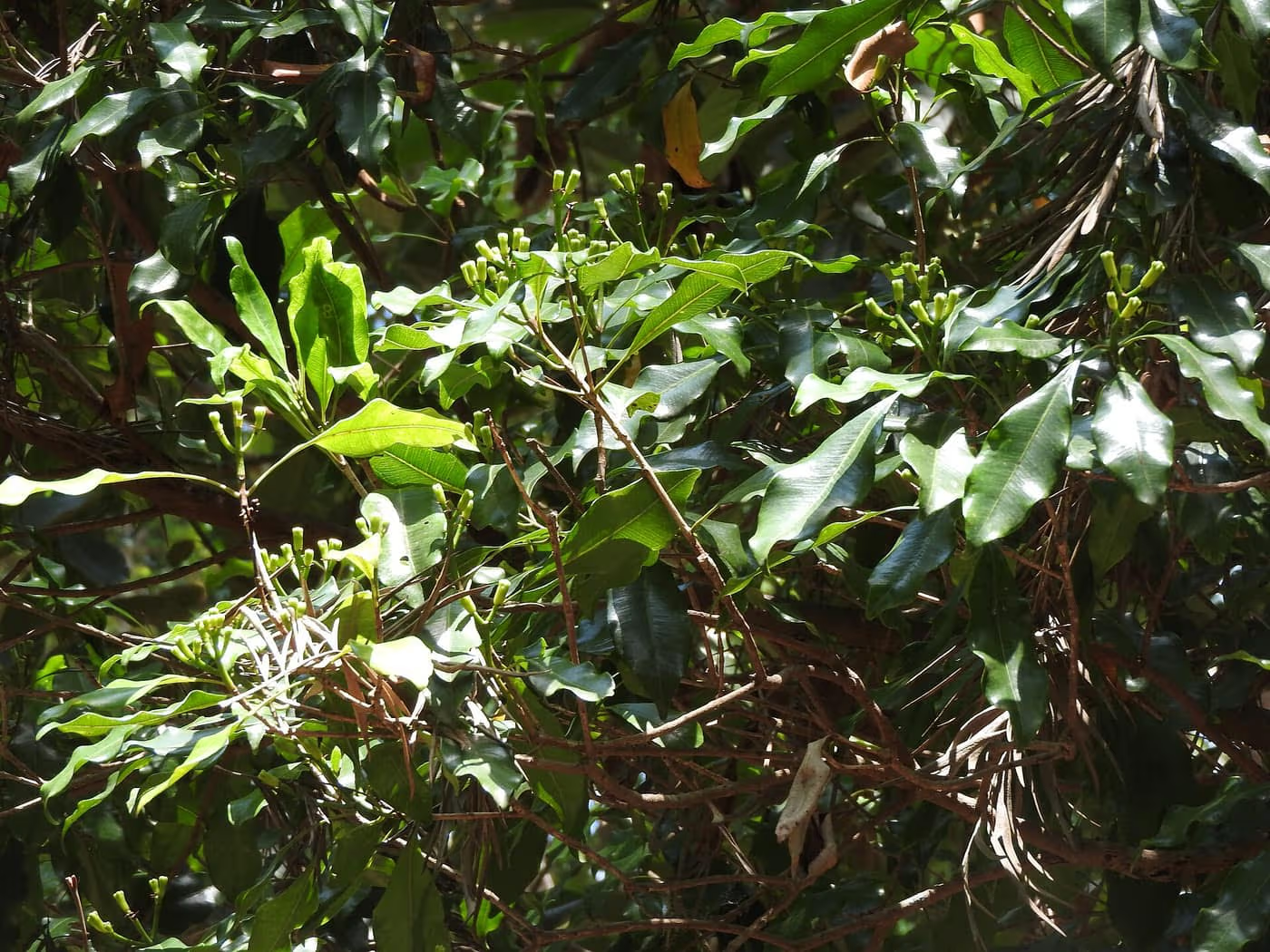
Clove (laung, Syzygium aromaticum) is the dried, unopened flower bud of a tropical evergreen tree. In India it grows only in a few humid hill pockets of the Western Ghats — most famously Kanyakumari district in Tamil Nadu, whose clove carries a Geographical Indication registration — plus parts of Kerala, Karnataka and the Andaman and Nicobar Islands. India grows only a small fraction of the clove it uses; most of the world crop comes from Indonesia.
Clove is a slow, patient crop. It is grown from seed, which must be sown fresh because it does not keep, raised in a shaded nursery for about two years, and planted out in the rainy season with shade already in place. Young trees are tender and need shade and regular water through the dry months. The first buds appear only after several years, and the tree reaches full bearing much later, but a well-kept tree keeps producing for decades.
India has no formally released clove variety. Growers plant local seedlings from good, heavy-bearing mother trees, and research groups are still evaluating bold-bud and dwarf selections collected in Kanyakumari. What decides success is the site — warm, humid, well-drained, sheltered — and early care, not a variety name.
Buds are picked by hand in several rounds while still closed, then sun-dried for a few days until dark and brittle. The main risks are sudden wilting after drought or waterlogging, leaf rot in young plants, and trunk borers. There is no MSP; the crop is sold to traders and a few Kerala markets, and prices swing widely.
- Crop type
- Perennial tropical evergreen spice tree
- Season
- Planted in the rainy season (June–December); buds picked from about September to February
- Suitable states
- Tamil Nadu (Kanyakumari), Kerala, Karnataka
- First buds
- Flowering from about year 4; useful picking from about year 6
- Water requirement
- Steady moisture; drip or basin watering in the dry months
- Temperature
- Warm and humid; about 20–30°C mean
- Soil type
- Deep, humus-rich, well-drained loam or laterite; never waterlogged
- Difficulty level
- Moderate (long wait, site and shade matter most)
- Expected yield
- About 2–4 kg dried buds per mature tree
- Key risk
- Sudden wilting after drought or waterlogging; young plants need shade
Overview
Clove (Syzygium aromaticum), called laung in Hindi and kirambu or lavangam in Tamil, is the dried flower bud of an evergreen tree native to the Maluku islands of Indonesia. Buds are picked before they open, when fully grown with a pink tint, then dried in the sun. India's own production is small — research literature puts it at around 1,183 tonnes a year against roughly 1.8 lakh tonnes worldwide, with Indonesia the leading producer — so a good Indian clove garden is a specialist crop, not a mass-market one.
In India clove is confined to the humid hills of the Western Ghats and the Andaman and Nicobar Islands. Kanyakumari district in Tamil Nadu (the Maramalai, Karumparai and Vellimalai forest belts around Veerapuli and Mahendragiri) supplies the large majority of the national crop, and Kanniyakumari clove is registered as a Geographical Indication. Kerala's midland red soils and the higher hills of Karnataka carry the rest. The trees are usually grown in mixed gardens, often under the partial shade of arecanut, coconut and other trees, with banana used as temporary shade for young plants.
Because every seedling comes from seed, and the tree is largely self-pollinating, Indian clove has a narrow genetic base and no formally released variety. Surveys in Tamil Nadu and Kerala have collected superior-yielding accessions, and "king" bold-bud types and a dwarf type from Kanyakumari have been reported as under evaluation by Tamil Nadu Agricultural University research stations — but these are research selections, not varieties you can order today. For a farmer, the real choices are the site, the shade plan and the mother trees the seed comes from.
Crop timeline, sowing to harvest
A quick visual map of the season — jump to any section below for the detail behind each stage.
- Before planting (6–12 months)
Shade first
Shade plants such as banana, acacia or albizia are established well before the clove seedlings go in, so the young trees land in shade rather than in open sun.
- Nursery (about 2 years)
Seed to seedling
Fresh seed is sown at once because it does not keep; germination takes roughly 5–6 weeks. Seedlings stay in the shaded nursery for about two years before field planting.
- Year 0 (June–December)
Field planting
Two-year-old seedlings are planted in prepared pits at about 6–7 m apart in the rainy season, with banana or a temporary pandal for shade.
- Year 1–3
Establishment
Regular watering through the dry months (January–May), mulch, shade, weeding and a small first feed build the young tree. Losses to drought and waterlogging are highest here.
- Year 4–6
First buds
Flowering begins from about the fourth year and first useful picking comes around the sixth, with small crops at first.
- Year 7–15+
Rising crop
Yield builds steadily and trees reach full production around year 15. A well-kept tree keeps producing for many decades.
- Each season
Bud rounds and drying
Buds form in early (September–October), mid (November–December) and late (January–February) waves, so picking runs in rounds. Picked buds are dried in the sun for about 4–7 days.
Suitable states
States where this crop is grown at scale, highlighted below. Your local Krishi Vigyan Kendra is still the final word for your specific block.
- Jammu and Kashmir
- Himachal Pradesh
- Punjab
- Uttarakhand
- Haryana
- Delhi
- Uttar Pradesh
- Rajasthan
- Bihar
- Jharkhand
- West Bengal
- Sikkim
- Assam
- Arunachal Pradesh
- Meghalaya
- Nagaland
- Manipur
- Mizoram
- Tripura
- Gujarat
- Madhya Pradesh
- Chhattisgarh
- Maharashtra
- Odisha
- Goa
- Telangana
- Andhra Pradesh
- Karnataka
- Kerala
- Tamil Nadu
- Puducherry
- Ladakh
- Chandigarh
- Lakshadweep
Grown here
Climate requirements
Suitable altitude runs from near sea level up to about 1,000 m in the Western Ghats. Outside a warm, humid, well-watered belt, clove is a poor bet however good the seedling.
Ideal temperature
Clove is a strictly tropical tree that wants a warm, humid climate — a mean temperature of about 20–30°C. It does not do well in cold, frosty or very dry places, which is why it is confined to the Western Ghats hills and the islands.
Rainfall
Well-distributed rainfall of about 1,500–2,500 mm a year suits it (TNAU quotes 150–250 cm). Plants still need watering in the dry months, but the tree does badly if roots sit in water.
Humidity
High humidity, above about 70%, is part of the tree's natural niche and helps buds develop. The same humidity favours leaf rot and other fungal problems in nurseries and young plants.
Sunlight
Young plants need shade — banana or a temporary pandal — and clove is commonly grown under the partial shade of arecanut, coconut and fruit trees. Older trees tolerate more light, but sheltered, non-windy sites are best.
Soil requirements
Choose a sheltered, well-drained, humus-rich spot with a reliable water source for the dry months. If you must choose between good soil and a shade plan, get both — clove does not forgive either mistake in the early years.
Suitable soil
Deep, humus-rich loams and laterite soils are the best suited (TNAU); deep red loam and gravelly soils with a deep subsoil also work. Kerala's red midland soils and the hill soils of Kanyakumari are the traditional homes of the crop.
pH range
A slightly acidic to near-neutral soil reaction, as found in humus-rich forest and laterite soils, suits clove; avoid strongly alkaline or saline patches.
Drainage
Free drainage is essential. Waterlogging is unwelcome, and both drought and waterlogging are linked to sudden wilting of the tree, so slopes with good drainage plus mulch and steady water do best.
Organic matter
Heavy organic matter is part of the recommended routine — compost or farmyard manure goes into the pit at planting and is repeated every year, rising with tree age.
Land preparation
Same four steps whichever region you are in — only the timing shifts with the sowing window.
- 1
Plant the shade first
Establish shade plants — banana, acacia, albizia or similar — 6 to 12 months before the clove seedlings go in, so the young trees land in shade and have windbreak protection.
- 2
Mark the grid and dig pits
Space trees about 6–7 m apart in both directions (roughly 80–110 trees per acre). Dig pits well ahead of the rains; TNAU quotes 30 cm cubes and the Karnataka Spices Board 75 cm cubes, so make the pit larger on hard, gravelly or laterite ground.
- 3
Fill with topsoil and organic matter
Fill each pit with topsoil mixed with compost or farmyard manure (TNAU: about 10 kg per pit) and let it settle before planting.
- 4
Arrange water for the dry months
Plan drip or basin irrigation before you plant. Tender young trees cannot be left to depend on the weather through January–May.
Seed information
How the main varieties compare, so you can pick by duration, yield, disease pressure or what you are growing for.
| Variety | Duration | Yield | Disease resistance | Best state | Suitable for |
|---|---|---|---|---|---|
The standard planting material in India: seedlings raised from seed collected from good, heavy-bearing mother trees in the Kanyakumari–Western Ghats belt, sold by state and university nurseries such as those of Kerala Agricultural University and by private nurseries. Indian clove came from a narrow founding stock, which is why there is so little variation between trees. | First buds about year 4–6; full bearing by about year 15 | About 2–4 kg dried buds per mature tree | No variety-level resistance documented; site, shade and moisture management decide losses | Tamil Nadu, Kerala, Karnataka | Mixed gardens under partial shade in humid hill and midland belts |
King clove (KC-1, KC-2) and dwarf (DC-1) selections — under evaluation Bold-bud "king" types and a dwarf type collected from the Maramalai and Keeriparai areas of Kanyakumari and reported as being evaluated by Tamil Nadu Agricultural University research stations. These are research selections, not formally released varieties; ask a state nursery whether seedlings from bold-bud mother trees are available rather than expecting a named variety. | Under evaluation | Not established — evaluation data not published in available sources | Not documented in available sources | Tamil Nadu (Kanyakumari) | Growers who want to select bold-bud mother trees |
- Seed rate
- Clove is planted as two-year-old nursery seedlings, not sown in the field. Plan for roughly 80–110 seedlings per acre at 6–7 m spacing, plus extra for gap-filling in the first two years.
- Certified seed
- There is no certified clove variety or seed standard to look for. Buy seedlings from a state horticulture or university nursery (Kerala Agricultural University sells clove seedlings), check that they are healthy and dark-green with no leaf-edge spots, and if you collect your own seed, take it only from healthy, heavy-bearing trees and sow it fresh.
- Spacing
- About 6–7 m in both directions, in pits filled with topsoil and compost, with shade in place beforehand.
- Seed treatment
- Clove seed is short-lived: extract it from ripe fruit (the "mother of clove") and sow it at once. In the nursery, remove and destroy wilted seedlings and drench the bed with copper oxychloride at 0.25% as TNAU advises, since nursery mortality can be high.
Sowing guide
Plant only after the shade plants are up and the pit soil has settled; a seedling planted into bare sun in a dry spell is the most common way to lose a clove plant in its first year.
- Best time
- Plant out two-year-old seedlings in the rainy season — TNAU finds June to December best — once the shade is established and the soil is well wet.
- Row spacing
- About 6–7 m between rows
- Plant spacing
- About 6–7 m between trees in the row
- Sowing depth
- Set the seedling at the same depth it grew in the nursery, with the soil firmed lightly around it and no water left standing in the pit.
- Method
- One healthy seedling per prepared pit, watered in immediately, then shaded with banana, a pandal or leaf cover and kept moist through the first dry season.
Fertilizer schedule
A split dose beats one large dose applied at sowing — nitrogen especially is lost to the air and to leaching if it all goes in on day one.
- 1
At planting (basal)
Year 0
Topsoil mixed with compost or farmyard manure in the pit (TNAU: about 10 kg). The Karnataka Spices Board quotes the Kerala Agricultural University schedule of about 20:18:50 g N:P:K per plant per year with about 15 kg compost for a young plant.
- 2
Young trees
Years 1–6
Increase the dose steadily each year as the tree grows. Split feeding into two rounds, at the start and end of the monsoon, and mulch the basin.
- 3
Bearing trees
About year 7 onward
TNAU gives roughly 300:300:960 g N:P:K with about 50 kg farmyard manure per tree for a seven-year-old bearing tree; the KAU schedule quoted by the Karnataka Spices Board is about 300:250:750 g plus 50 kg compost for a mature tree (year 15+). Potash is the heaviest need.
- 4
Biofertilisers
One month after manuring
TNAU advises about 50 g each of Azospirillum and Phosphobacterium per tree, applied a month after the manure.
Irrigation schedule
1. Young trees
Dry months (January–May)
TNAU advises about 8 litres of water per tree, through drip or a basin, during January to May; the Karnataka Spices Board reports the best growth with about 8 litres per plant daily in a drip trial.
2. Bearing trees
Dry spells
Keep the root zone evenly moist through long dry spells. Both drought and waterlogging are linked to sudden wilting of the tree.
Critical stages
- First two dry seasons after planting
- Dry months before and during bud formation
- Long dry spells at any age
Water-saving tips
- On slopes, use drip irrigation rather than flooding basins.
- Mulch the basin with leaves or crop residue to hold moisture and keep roots cool.
- Keep shade trees and windbreaks in place to cut water loss.
Weed management
Organic control
- Keep a clean basin around each young tree and use mulch to hold weeds down.
- Slash Lantana and Parthenium before they seed, and use the slashings as mulch.
- A shade-tolerant intercrop such as banana in the young years keeps the ground covered.
Chemical control
- Weed by hand or hoe in the basin around each young tree; avoid herbicide on or near the thin bark of young plants.
- If a herbicide is needed in the inter-row of a larger garden, confirm a currently registered product and dose with your state horticulture department or KVK.
Nutrient deficiency identification
What a shortage of each nutrient actually looks like on the plant, so you can tell a deficiency apart from a disease before you spray the wrong thing.
Nitrogen
Visible symptom
Pale, yellow-green older leaves and slow, thin shoot growth on young trees, most often on poor or leached hill soils.
Phosphorus
Visible symptom
Slow establishment of young trees and a dull, purplish tinge on older leaves.
Potassium
Visible symptom
Scorched or yellowed leaf edges and poor bud set; clove takes a large quantity of potash, which is why its recommended doses are potash-heavy.
Diseases to watch for
Symptoms, likely cause and what actually treats it — not just a spray name.
Clove leaf rot
- Symptoms
- Dark spots at the leaf margin that spread and rot the leaf, which then drops; worst on nursery seedlings and young plants.
- Cause
- The fungus Cylindrocladium quinquiseptatum, favoured by warm, wet, humid weather and crowded nursery beds.
- Treatment
- TNAU advises spraying seedlings and young plants with carbendazim at 0.1%, or a preventive spray of 1% Bordeaux mixture; confirm the current product and dose with your KVK.
- Prevention
- Keep nursery beds well drained and uncrowded, burn badly affected seedlings early and plant only healthy seedlings.
Clove quick wilt (sudden death)
- Symptoms
- A tree that suddenly wilts and dries out, sometimes after a first yellowing of the leaves; death can come in days or take months.
- Cause
- Linked by TNAU to drought or waterlogging stress around the roots; a fungus (Valsa eugeniae) is reported on clove, though sources differ on the exact organism.
- Treatment
- TNAU advises drenching the root zone with carbendazim or mancozeb at 1 g per litre of water on threatened trees; a tree that has already dried cannot be saved.
- Prevention
- Shade, regular irrigation in the dry months, mulch, windbreaks and good drainage; use drip irrigation on slopes.
Anthracnose leaf spot and twig blight
- Symptoms
- Leaf spots that spread, withering and drooping foliage, dried twigs and, in heavy rain, shedding of flower buds.
- Cause
- A Colletotrichum (Gloeosporium) fungus, worst in wet weather.
- Treatment
- TNAU advises copper oxychloride at 0.25% at monthly intervals, starting before bud formation and continuing to harvest; a pre-monsoon spray of Pseudomonas fluorescens with leaf extract is also listed.
- Prevention
- Prune out dried twigs, avoid overcrowding and start protective sprays before the wet season.
Pests to watch for
What to look for before the damage is visible, and organic options before you reach for a chemical.
Common mistakes to avoid
The mistakes that cost growers the most, ranked by how often they show up in the field — not in the order you might expect.
- 1
Planting seedlings into open sun without shade in place.
Why it hurts
Young clove trees are tender; the shade plants (banana, acacia, albizia) should be up 6–12 months before planting, or the seedlings scorch and die in the first dry season.
- 2
Letting the root zone swing between drought and waterlogging.
Why it hurts
Both extremes are linked to sudden wilting and death of the tree, and once a tree has dried out it cannot be saved. Water evenly, mulch, and fix drainage.
- 3
Storing or sowing clove seed after it has dried.
Why it hurts
Clove seed has short viability and must be sown fresh; old seed germinates poorly and wastes two years of nursery time.
- 4
Expecting a named variety or quick income.
Why it hurts
India has no formally released clove variety, and a tree gives its first buds only after about four to six years and its best crops much later. Buying a "special variety" at a premium price is a red flag; buy healthy seedlings from a known nursery.
- 5
Planting outside a warm, humid belt.
Why it hurts
Clove is strictly tropical and is confined to the Western Ghats hills and islands in India; in a cold, dry or windy site it will stay weak however well it is managed.
- 6
Picking after the flower has opened.
Why it hurts
The value is in the closed, fully developed bud. Once the petals open, the bud is no longer a clove and sells poorly, so pick in rounds before opening.
Harvesting
Flowering begins from about the fourth year and useful picking from about the sixth. Buds take about four to six months to mature and are picked when fully developed but still closed, with a pink tint. They form in early (September–October), mid (November–December) and late (January–February) waves, so picking is done in several rounds through the season.
Signs it is ready
- Buds are fully grown but still closed, with a pinkish tint
- Cluster is ready before the petals open
- A round of buds has matured after the flowering wave for that part of the tree
Tools
- Sturdy ladders or safe climbing support for tall trees
- Clean tarpaulin or mats to catch and sort clusters
- A clean drying yard or racks in full sun
Expected yield
TNAU cites about 2–3 kg of dried buds per tree, and the Karnataka Spices Board about 3–4 kg per mature tree after year 15. Yields build slowly with age, so treat any per-acre figure as a rough estimate — at 6–7 m spacing a mature acre holds roughly 80–110 trees.
Post-harvest & storage
Storage
Dry the buds until they are dark and brittle, then store in clean, dry, airtight containers away from damp; dried cloves keep well when kept dry.
Packaging
Separate the buds from the cluster stalks, sort out any opened or broken buds, and pack the dry buds in clean bags or containers for sale.
Transportation
Dry cloves are compact and light to move; the crop is usually sold to local traders and regional spice markets rather than through a formal mandi chain.
Shelf life
Properly dried and stored dry, cloves keep their aroma for a long time; moisture is the enemy.
Market prices
Today's mandi price near you, pulled live from the government's own Agmarknet data.
Live daily mandi prices from the government Agmarknet dataset.
Synced from data.gov.in (Agmarknet). Rates are ₹ per quintal.
Weather
Current conditions and a 5-day outlook for your selected location, with one line of stage-aware advice.
Pick your state for current conditions and a 5-day outlook.
Live data from Open-Meteo
Profit calculator
Your own cost sheet, expected yield and selling price — not ours.
Where the money goes
Share of the total cost per acre, using the calculator’s own default cost sheet below — adjust the numbers there to match your field and this picture will no longer apply to you exactly, but the ranking rarely changes.
- Labour56% (₹40,000)
- Fertiliser11% (₹8,000)
- Land rent11% (₹8,000)
- Irrigation8% (₹6,000)
- Seed6% (₹4,000)
- Pesticide & weedicide4% (₹3,000)
- Interest3% (₹2,000)
- Machinery1% (₹500)
Official downloads
Government and ICAR documents only — everything below is hosted on an official server.
Spices Board India — Clove
Official crop facts, uses and regional names
ICAR-Indian Institute of Spices Research (IISR), Kozhikode
Clove germplasm and spice research
TNAU Agritech Portal — Clove
Cultivation, manuring and plant-protection package
Kisan Call Centre — 1800-180-1551
Free crop advice in your language
Frequently asked questions
Which clove variety should I plant?
India has no formally released clove variety. Clove is planted as local seedlings raised from seed of good, heavy-bearing mother trees, sold by state and university nurseries and private nurseries. Bold-bud "king" types (KC-1, KC-2) and a dwarf type (DC-1) from Kanyakumari have been reported as under evaluation by Tamil Nadu Agricultural University research stations, but they are research selections, not varieties you can order. Buy healthy seedlings from a reliable nursery and be wary of anyone selling a "special variety" at a premium.
How long before a clove tree gives a crop, and how much?
Flowering begins from about the fourth year and useful picking from about the sixth, with small crops at first. TNAU cites about 2–3 kg of dried buds per tree, and the Karnataka Spices Board about 3–4 kg per mature tree after year 15. The tree lives and bears for decades, but the first years are pure investment, so plan for a long wait.
Where can clove be grown in India?
Only in warm, humid hill and island belts. Tamil Nadu's Kanyakumari district supplies most of the national crop, and Kanniyakumari clove is a registered Geographical Indication. Kerala and Karnataka carry the rest, and parts of the Andaman and Nicobar Islands also grow it. The tree wants about 1,500–2,500 mm rain, mean temperatures near 20–30°C and altitudes up to about 1,000 m, so it is not a crop for the plains or dry regions.
Is there an MSP or a fixed mandi price for clove?
No. Clove is not covered by an MSP. It is sold to traders and regional spice markets, and prices swing widely: wholesale quotes were around ₹900 per kg in September 2026, and Kerala markets such as Thodupuzha, Kattappana and Munnar report cloves only occasionally. A live check of the government Agmarknet data on the day this page was written returned no clove rows, so treat mandi data as thin and check current trader rates before you sell.
Can I grow clove as an intercrop under coconut or arecanut?
Yes. Clove is usually grown as an intercrop or a component of mixed gardens, often under the partial shade of arecanut, coconut and fruit trees. Young plants need shade, and banana is the usual temporary shade crop. Make sure the young trees still get regular water in the dry months.
Why does my clove tree suddenly wilt?
Sudden wilting is a known problem of clove, linked to drought or waterlogging stress around the roots. Prevention works far better than treatment: shade, mulch, steady irrigation (drip on slopes), windbreaks and good drainage. If yellowing has just started, TNAU advises drenching the root zone with carbendazim or mancozeb at 1 g per litre; a tree that has fully dried cannot be saved.
Still have questions?
The FAQs above cover the common ones. For anything specific to your field and soil, your nearest Krishi Vigyan Kendra is the authoritative answer.