
Finger Millet (Ragi / Mandua)
Eleusine coracana
India's hardiest nutri-cereal — a dryland kharif grain of Karnataka, the eastern plateau and the Uttarakhand hills that yields dependably on poor soil and uncertain rain, stores for years without a weevil touching it, and carries more calcium than any other cereal. It is grown either transplanted from a nursery or line-sown, needs very little bought input, and the one problem that decides the crop is blast disease.
Quick Summary
The key points from this page in about two minutes — read it or have it read aloud.
Quick Summary
Finger millet — ragi in the south, mandua or madua in the hills, also called nachni — is the most drought-hardy and food-secure of India's cereals. It is grown on land and rainfall that would not carry rice or maize, gives a reliable grain where other crops fail, and once dried it stores for five to ten years without insect damage because the grain is tiny and hard-coated. Nutritionally it stands out for calcium, and it has a low glycemic index, which is behind its renewed demand in cities.
Karnataka grows by far the most, followed by Tamil Nadu, Uttarakhand, Odisha, Jharkhand, Andhra Pradesh, Maharashtra and the north-eastern states. It is mainly a rainfed kharif crop, but in southern India it is also grown in the rabi and summer seasons under irrigation.
There are two ways to establish it. Transplanting — raising seedlings in a nursery for three to four weeks and moving them to the main field — gives the highest and most reliable yield and is the traditional method in Karnataka. Line sowing with a drill is quicker and cheaper and suits a larger area or a shorter monsoon. Broadcasting is the lowest-effort and the lowest-yielding.
The crop needs little: a basal dose of compost and a modest amount of fertiliser, one or two weedings in the first month while the small seedlings are slow, and protective irrigation only if the monsoon breaks at flowering. The disease that matters is blast, which attacks the leaf, the neck below the ear and the fingers themselves, and can empty the grain in a bad, wet year. There is a notified MSP for ragi, and the page below carries the nursery and sowing method, the seed rate, the fertiliser schedule, blast management and the yields to expect.
- Crop type
- Nutri-cereal (millet), highest calcium of any cereal
- Season
- Kharif (rainfed); rabi/summer under irrigation in south India
- Suitable states
- Karnataka, Tamil Nadu, Uttarakhand, Odisha, Jharkhand, Andhra Pradesh, Maharashtra
- Growing duration
- 100–130 days
- Water requirement
- Low — mostly rainfed; 1–2 protective irrigations on managed land
- Temperature
- 20–35°C; tolerates heat and short dry spells well
- Soil type
- Red loam, sandy loam and lateritic soils; pH 5.0–8.0
- Difficulty level
- Easy
- Expected yield
- 20–25 q/ha rainfed (improved); up to 40 q/ha irrigated
- MSP (Ragi, KMS 2025–26)
- ₹4,886 / quintal
Overview
Finger millet (Eleusine coracana) — ragi across southern India, mandua/madua in Uttarakhand and the central hills, nachni in Maharashtra — is the most drought-tolerant and storage-stable cereal grown in India. It is deliberately placed on the shallow, red, lateritic and hill soils, and the low or erratic rainfall, that cannot profitably carry rice, maize or wheat, and it produces a dependable grain there year after year. Karnataka accounts for the largest area and production by a wide margin, followed by Tamil Nadu, Uttarakhand, Odisha, Jharkhand, Andhra Pradesh, Maharashtra, Chhattisgarh and the north-eastern states.
It is grown mostly as a rainfed kharif crop sown with the monsoon, but in the southern states it is also a rabi and summer crop under irrigation, and a well-managed irrigated ragi crop yields far more than the rainfed one. Two establishment methods are used: transplanting nursery-raised seedlings, which is more work but gives the highest and steadiest yield and is standard in Karnataka; and line sowing with a seed drill, which is faster and cheaper and suits a bigger area or a late, short monsoon. Broadcasting is still common on marginal land but yields least.
The crop is valued for two things beyond drought tolerance. First, nutrition: finger millet has the highest calcium content of any cereal, useful amounts of iron and dietary fibre, a good amino-acid balance and a low glycemic index — the reasons behind its policy push under the National Food Security Mission's nutri-cereals programme and its growing urban demand as malt, flour and health food. Second, storability: the small, hard grain resists storage pests so well that farmers hold it for years as a food reserve. This page follows the crop in field order — nursery, transplanting or sowing, nutrition, water, blast and weed control, harvest and storage.
Crop timeline, sowing to harvest
A quick visual map of the season — jump to any section below for the detail behind each stage.
- Day 0 (nursery)
Nursery sowing
For a transplanted crop, sow into a well-prepared nursery bed from mid-June to mid-July at the monsoon onset. About 5 kg of seed raises enough seedlings for one hectare. A line-sown crop skips this step and is drilled straight into the main field.
- Day 21–28
Transplanting
Move 3–4 week old seedlings to the puddled or moist main field, 2 seedlings per hill, at 22.5–30 cm between rows and about 10 cm within the row. Gap-fill any misses within a week.
- Day 30–45
Tillering
The crop tillers freely and the canopy begins to close. This is the critical weed-free period — the first one or two weedings go on here, because the small plants compete poorly early.
- Day 45–65
Panicle initiation
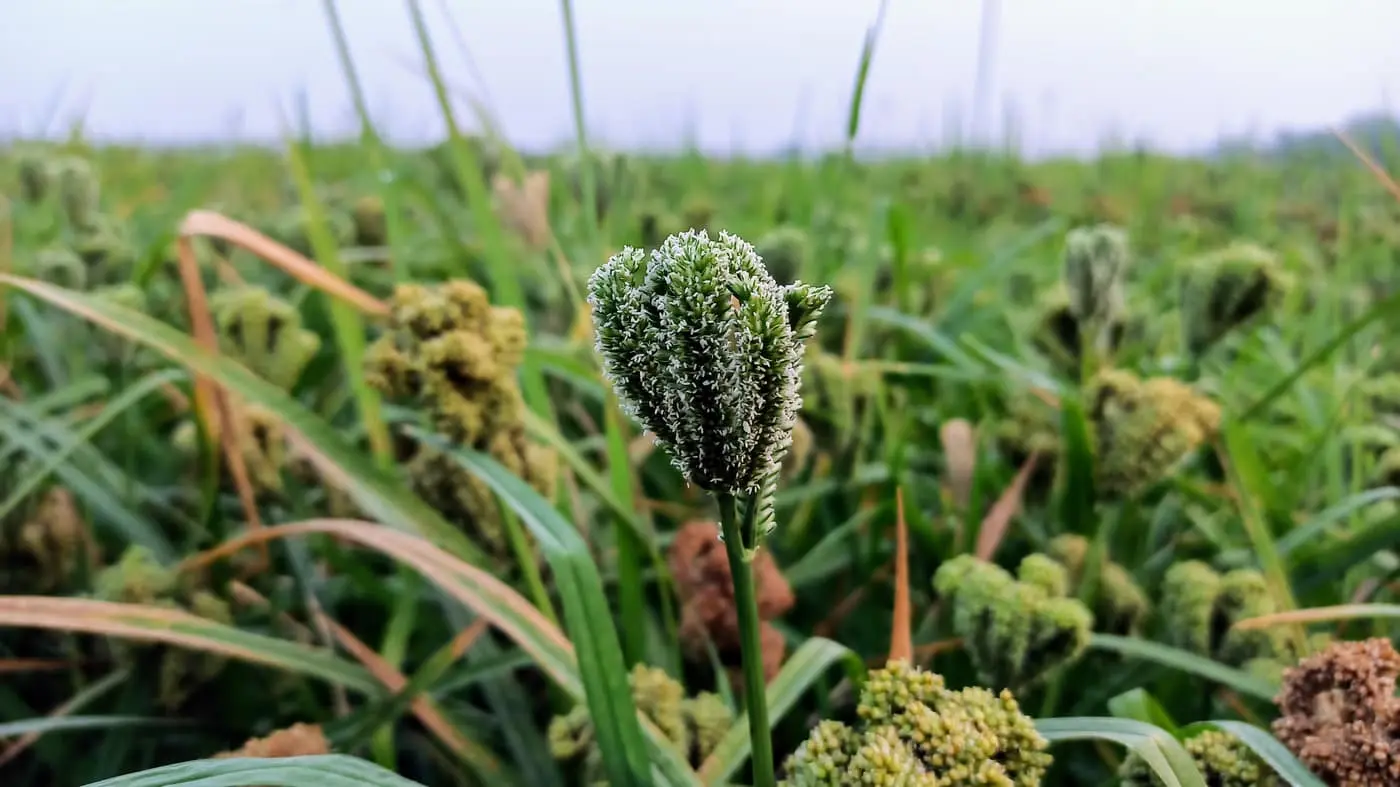
The ear (a fist of curved "fingers") starts to form inside the boot. Nitrogen top-dressing and, if the monsoon has failed, the first protective irrigation go on at this stage — the crop's most moisture-sensitive point.
- Day 60–80
Flowering & grain set
The fingers emerge and flower. Wet, overcast weather now is when neck and finger blast strike hardest and can hollow the grain.
- Day 80–110
Grain filling & dough
Grain fills and hardens through the dough stage. A second protective irrigation, if water is available and the season is dry, protects grain weight here.
- Day 100–130
Maturity & harvest
Ears turn brown and the grain is hard. Harvest the ear-heads first (the straw is cut separately as fodder), then stack, dry and thresh. Early-maturing varieties finish nearer 100 days, late ones nearer 130.
Suitable states
States where this crop is grown at scale, highlighted below. Your local Krishi Vigyan Kendra is still the final word for your specific block.
- Jammu and Kashmir
- Himachal Pradesh
- Punjab
- Uttarakhand
- Haryana
- Delhi
- Uttar Pradesh
- Rajasthan
- Bihar
- Jharkhand
- West Bengal
- Sikkim
- Assam
- Arunachal Pradesh
- Meghalaya
- Nagaland
- Manipur
- Mizoram
- Tripura
- Gujarat
- Madhya Pradesh
- Chhattisgarh
- Maharashtra
- Odisha
- Goa
- Telangana
- Andhra Pradesh
- Karnataka
- Kerala
- Tamil Nadu
- Puducherry
- Ladakh
- Chandigarh
- Lakshadweep
- Andaman and Nicobar Islands
- Dadra and Nagar Haveli and Daman and Diu
Grown here
Climate requirements
Finger millet's whole value is that it yields where the weather is against other cereals. It shrugs off heat and a broken monsoon, but it does not tolerate waterlogging, and a wet, cloudy flowering is its one real weather risk because of blast — so field drainage and a blast-resistant variety matter more than chasing rainfall.
Ideal temperature
20–35°C suits the crop; it tolerates higher temperatures and short dry spells better than almost any other cereal, which is why it holds a yield where rice or maize would fail. Cool weather at grain-fill favours a plump grain
Rainfall
500–900 mm well distributed over the season is ideal for the rainfed crop. Finger millet is sensitive to waterlogging — a few days of standing water yellows and stunts it — but recovers from a dry spell better than most cereals
Humidity
Moderate humidity suits it; long humid, overcast, drizzly spells at flowering are the classic trigger for a blast flare on the leaf, neck and fingers
Sunlight
Full sun through tillering and grain-fill gives the best tillering and grain weight; a heavily shaded or over-dense crop tillers poorly and holds humidity that favours blast
Soil requirements
Land selection plays to the crop's strength — it is put on the shallow, light, low-fertility fields that cannot carry a more demanding cereal. On such land a basal dose of compost and a fine, firm, clod-free seedbed (the seed is very small) matter more than the soil's starting fertility.
Suitable soil
Red loam, sandy loam, shallow lateritic and hill soils are the classic finger-millet lands; it also does well on better alluvial and black soils under irrigation. It is grown successfully on soils too poor or too shallow for rice or maize
pH range
5.0–8.0 — finger millet tolerates mildly acidic hill soils and mildly alkaline soils alike, a wider range than most cereals
Drainage
Good drainage is essential. Finger millet tolerates drought well but not waterlogging — standing water for even a few days at any stage yellows and stunts the crop and invites foot rot
Organic matter
Low to medium is workable; the crop responds strongly to 5–10 t/ha of farmyard manure or compost worked in before sowing, which also improves moisture-holding on the light soils it is usually grown on
Land preparation
Same four steps whichever region you are in — only the timing shifts with the sowing window.
- 1
Two or three ploughings to a fine tilth
Finger-millet seed is tiny, so the seedbed must be finer and more level than for a coarse cereal — plough or harrow two or three times with the early rains and follow with a plank. A cloddy bed gives a broken, gappy stand or a failed nursery.
- 2
Work in farmyard manure
Incorporate 5–10 t/ha of well-rotted farmyard manure or compost during the last ploughing. On the light soils the crop is usually grown on, this does as much for moisture-holding as it does for nutrition.
- 3
Prepare a raised nursery bed for a transplanted crop
For transplanting, make raised nursery beds near a water source, about one-tenth of the area to be planted, enriched with compost. Sow thinly so seedlings are stocky, not thin and drawn.
- 4
Open a drainage channel
Because the crop cannot take waterlogging, open a shallow field drain before sowing on any land that ponds after heavy rain — the low patch is where foot rot and yellowing start.
Seed information
How the main varieties compare, so you can pick by duration, yield, disease pressure or what you are growing for.
| Variety | Duration | Yield | Disease resistance | Best state | Suitable for |
|---|---|---|---|---|---|
A UAS Bengaluru variety and for years the single most widely grown ragi in Karnataka — medium duration, high tillering, good finger blast resistance and a semi-compact ear that is easy to thresh. The default benchmark for a rainfed kharif crop in the southern plateau. | 110–115 days | High | Good resistance to leaf and finger blast | Karnataka | Rainfed kharif, wide adaptation |
A later UAS Bengaluru release, medium-to-late, with strong blast resistance and good grain and straw yield; widely grown alongside GPU 28 and often preferred where blast pressure is high. | 115–120 days | High | High resistance to blast | Karnataka | Blast-prone rainfed tracts |
An early UAS Bengaluru variety for shorter monsoons and late-sown situations, escaping late-season drought by maturing quickly, with moderate blast resistance. | 100–105 days | Medium–High | Moderate blast resistance | Karnataka | Late sowing, short-monsoon tracts |
A VPKAS Almora release bred for the Uttarakhand and central Himalayan hills — early, cold-tolerant and suited to the short hill season and rainfed terrace fields. | 105–110 days in the hills | Medium–High for the hills | Moderate blast resistance | Uttarakhand | Hill and mid-altitude rainfed fields |
A TNAU Coimbatore variety for Tamil Nadu, suited to both irrigated and rainfed conditions with a bold grain and good response to management. | 110–115 days | High under management | Moderate; follow local blast advisories | Tamil Nadu | Irrigated and rainfed ragi in Tamil Nadu |
A widely adapted medium-duration variety grown across several southern states, valued for stable yield, non-lodging habit and easy threshing; a common choice for line sowing. | 110–120 days | Medium–High | Moderate blast resistance | Karnataka, Andhra Pradesh | Line-sown rainfed crop, wide adaptation |
A long-standing variety popular in northern and eastern ragi tracts including parts of Uttarakhand and the plains, medium duration with a good straw yield for fodder. | 115–120 days | Medium | Moderate; confirm locally | Uttarakhand, Bihar | Northern and eastern rainfed tracts, dual grain–fodder use |
A UAS Bengaluru (Mandya) variety with high yield potential and good blast tolerance, grown under both irrigated and better-rainfed management in Karnataka. | 110–115 days | High | Good blast tolerance | Karnataka | Irrigated and assured-rainfall ragi |
A newer VPKAS Almora hill finger-millet variety in the VL Mandua series, grown in Uttarakhand alongside VL 352 for improved yield on terrace fields. | About 100–110 days in the hills | Around 20–26 q/ha on hill fields under improved management | Moderate blast resistance; selected for hill adaptation | Uttarakhand | — |
One of the Indaf ("Indo-African") finger-millet varieties from UAS Bengaluru that first lifted ragi yields in the 1970s–80s; still grown and valued as a benchmark improved type. | About 115–125 days | Around 25–35 q/ha; one of the older high-yielding improved types | Moderate blast resistance | Karnataka | — |
A Dr. Balasaheb Sawant Konkan Krishi Vidyapeeth (Dapoli) finger-millet variety for the high-rainfall lateritic Konkan tract of Maharashtra, where ragi (nachni) is a staple. | About 110–120 days | Around 22–30 q/ha on the Konkan lateritic soils | Moderate blast resistance; bred for high-rainfall Konkan conditions | Maharashtra | — |
- Seed rate
- Transplanted crop: about 5 kg/ha to raise the nursery. Line (drill) sowing: 8–10 kg/ha. Broadcasting: 10–12.5 kg/ha to offset poorer establishment. The seed is very small, so a little goes a long way — over-thick sowing gives weak, drawn seedlings.
- Certified seed
- Use certified or truthfully-labelled seed of a blast-resistant variety recommended for your state and season — GPU 28 and GPU 67 in Karnataka, VL Mandua types in the hills, CO 15 in Tamil Nadu. Ragi seed reaches farmers mainly through state seed corporations, the National Seeds Corporation and KVKs rather than private brands; there is very little branded private finger-millet seed. Treat seed with a fungicide against seed-borne blast before sowing.
- Spacing
- Transplanted: 22.5–30 cm between rows and about 10 cm within the row, 2 seedlings per hill. Line-sown: 22.5–30 cm rows, thinned to about 10 cm within the row.
- Seed treatment
- Treat seed with carbendazim or a Trichoderma formulation (about 2–3 g/kg) against seed-borne blast and seedling blight before sowing the nursery or drilling the main crop. A biofertiliser (Azospirillum) seed treatment is also recommended in the southern package of practices.
Sowing guide
Transplanting versus line sowing is the main decision. Transplanting reliably out-yields the other methods and lets a farmer time the main-field planting to the monsoon, but it needs labour and a nursery near water. Line sowing trades some yield for speed and lower cost and is the better fit for a large area or a late, short monsoon.
- Best time
- Nursery sowing (for a transplanted crop) from mid-June to mid-July with the monsoon onset, transplanting at 3–4 weeks. A line-sown rainfed crop is drilled from mid-June to July once the soil has enough moisture. In southern India, the rabi crop is sown around September–October and the summer crop around December–January under irrigation.
- Row spacing
- 22.5–30 cm, both transplanted and line-sown
- Plant spacing
- About 10 cm within the row; 2 seedlings per hill when transplanting
- Sowing depth
- 2–3 cm — shallow, because the seed is very small and cannot emerge from deep placement or through a crust
- Method
- Transplanting 3–4 week old nursery seedlings for the highest, steadiest yield (standard in Karnataka); line sowing with a seed drill for a faster, cheaper crop over a larger area; broadcasting only on marginal land
Fertilizer schedule
A split dose beats one large dose applied at sowing — nitrogen especially is lost to the air and to leaching if it all goes in on day one.
- 1
Basal (at transplanting or sowing)
Day 0
Apply 5–10 t/ha of farmyard manure worked in before planting, plus a basal dose of about half the nitrogen with the full phosphorus and potash. A common rainfed dose is 50:40:25 kg N:P2O5:K2O per hectare; an irrigated crop takes more nitrogen, up to about 60–90 kg N/ha.
- 2
Nitrogen top-dressing
Day 25–35 (active tillering)
Apply the remaining nitrogen at active tillering, ideally after a weeding and with adequate soil moisture so it is taken up rather than lost.
- 3
Panicle-initiation boost (irrigated / assured-rainfall crop only)
Day 45–55
Where the crop is irrigated or rainfall is assured, a small additional nitrogen split at panicle initiation supports ear size. Skip this on a purely rainfed crop with no moisture to carry it.
- 4
Zinc correction
As needed, basal
Zinc deficiency is common on the light and lateritic soils finger millet is grown on; apply 25 kg/ha of zinc sulphate as a basal dose where a soil test or past crop shows a shortage.
Irrigation schedule
1. Establishment (transplanted crop)
Day 0–7
A light irrigation right after transplanting, and again a few days later if the rain holds off, to set the seedlings and reduce transplant shock.
2. Panicle-initiation irrigation
Day 45–55
If the monsoon breaks at this stage, one protective irrigation here protects ear formation — the single most moisture-sensitive point in the crop.
3. Grain-filling irrigation
Day 70–85
A second protective irrigation during grain filling, where water is available and the season has turned dry, protects grain weight and final yield.
Critical stages
- Transplant establishment
- Panicle initiation
- Flowering and early grain filling
Water-saving tips
- Most finger millet is grown entirely on the monsoon; where any water is available, one protective irrigation at panicle initiation captures most of the possible gain.
- Farmyard manure worked into the light soils the crop grows on markedly improves moisture-holding and buffers a short dry spell.
- Transplanting lets the farmer wait for the monsoon to settle before committing the main field, avoiding a failed dry sowing.
Weed management
Common weeds
Organic control
- One or two hand weedings or wheel-hoeings in the first 30–40 days cover the crop's critical weed-free period; after that the canopy closes and suppresses most late weeds.
- A stale seedbed — irrigating or letting the first rains flush the weeds, then destroying them before sowing — greatly reduces the Echinochloa problem.
- Rogue out barnyard grass by hand before it heads, since its seed is the main way the infestation carries over and it also contaminates the grain lot.
Chemical control
- A pre-emergence herbicide such as oxyfluorfen or a suitable isoproturon/2,4-D-based programme, applied per the state package of practices within a few days of sowing, holds the early flush; the transplanted crop can also take a directed post-emergence spray.
- There is no fully selective spray that removes Echinochloa from a young ragi crop without risk — it is mainly managed by clean seed, a stale seedbed and hand weeding.
Nutrient deficiency identification
What a shortage of each nutrient actually looks like on the plant, so you can tell a deficiency apart from a disease before you spray the wrong thing.
Nitrogen
Visible symptom
Uniform pale-green to yellow older leaves, thin tillers and small ears; the most common yield-limiter on the poor soils finger millet is grown on, and the reason a top-dressing at tillering pays even on a low-input crop.
Phosphorus
Visible symptom
Dull bluish-green leaves, sometimes a reddish or purplish tinge on older leaves and stems, poor root and tiller development; common on acidic hill and lateritic soils.
Potassium
Visible symptom
Scorching and browning along the margins of older leaves, weak stems that lodge in wind or rain, and poorly filled grain; shows up on light, heavily cropped soils.
Zinc
Visible symptom
Small, narrow, pale leaves with a bronzed or rusty cast, shortened internodes and a stunted, bunchy look from the tillering stage; very common on the light and lateritic finger-millet soils.
Iron
Visible symptom
Yellowing between the veins of the youngest leaves while the veins stay green, worst on high-pH or lime-rich soils and in a cold, wet early spell.
Diseases to watch for
Symptoms, likely cause and what actually treats it — not just a spray name.
Blast (leaf, neck and finger blast)
- Symptoms
- Spindle-shaped grey-centred, brown-bordered spots on leaves (leaf blast); a black, shrivelled, often broken zone on the stalk just below the ear (neck blast); and dark, shrivelled, poorly filled fingers (finger blast). Neck and finger blast are the damaging phases — they choke off grain filling and can empty the ear.
- Cause
- The fungus Pyricularia grisea (Magnaporthe grisea), favoured by long humid, overcast, drizzly weather at flowering, heavy nitrogen and a dense canopy; it is seed-borne and also carries over on stubble and grasses.
- Treatment
- Spray a recommended fungicide (tricyclazole, or a carbendazim/mancozeb combination) at boot-leaf to ear-emergence stage when blast weather sets in, and repeat once at flowering if it stays wet.
- Prevention
- Grow a blast-resistant variety (GPU 28, GPU 67), treat seed with a fungicide, avoid excess nitrogen and over-dense stands, destroy infected stubble, and keep the field drained — a waterlogged, lush, over-fertilised crop in humid weather is the classic blast situation.
Brown spot (Helminthosporium leaf spot)
- Symptoms
- Oval to elongated brown spots with a yellow halo on the leaves, sometimes coalescing to dry large patches of leaf; usually a mid-to-late season problem that reduces the green leaf area feeding the grain.
- Cause
- Bipolaris / Drechslera species, favoured by humid weather and by nutrient-stressed, potassium-short plants; carries over on seed and residue.
- Treatment
- Usually does not need a separate spray — a blast fungicide covers it. Correct nutrient deficiencies, especially potassium, which keeps the crop able to shrug it off.
- Prevention
- Clean, treated seed, balanced nutrition and residue sanitation; it is rarely a stand-alone yield threat where blast is being managed.
Foot rot / seedling blight
- Symptoms
- Nursery or newly transplanted seedlings rot at the base, damp off and collapse in patches; older plants in a waterlogged patch yellow, wilt and pull up easily with a rotted base.
- Cause
- Soil- and seed-borne fungi (Sclerotium, Fusarium and others), worst in a wet, poorly drained nursery or field patch and in warm, humid weather.
- Treatment
- No in-season cure for affected plants — remove them, improve drainage on the patch, and drench the nursery with a recommended fungicide if damping-off is spreading.
- Prevention
- A raised, well-drained nursery bed, treated seed, thin sowing so seedlings are not crowded and drawn, and a field drain on any land that ponds.
Pests to watch for
What to look for before the damage is visible, and organic options before you reach for a chemical.
Pink stem borer and shoot fly
- Identification
- A central "dead heart" — the youngest leaf whorl dries and pulls out easily — in a young plant (shoot fly), or a bored, tunnelled stem and a whitehead (an empty, upright ear) later in the season (stem borer). Finger millet is far less borer-prone than sorghum or maize, but a late or thin crop can be hit.
- Damage
- Dead hearts thin the stand at the seedling stage; stem tunnelling later causes lodging and whiteheads that carry no grain. Usually a minor pest in finger millet, occasionally significant in a delayed crop.
- Organic control
- Timely sowing so the crop is past the seedling stage before egg-laying peaks, removing and destroying dead-heart plants and whiteheads, and conserving the natural parasitoids that keep numbers down.
- Chemical control
- A need-based application of a recommended granular or spray insecticide into the whorl only where dead hearts exceed the local action threshold in an early crop.
Ear-head caterpillar and armyworm
- Identification
- Green to brown caterpillars feeding on the developing fingers and grain at the ear stage, sometimes in sudden numbers after a wet spell; damage shows as chewed fingers and frass in the ear.
- Damage
- Direct grain loss at the ear stage; a heavy, sudden armyworm attack can strip fingers over a few nights.
- Organic control
- Scout the ears from flowering onward, spray Bt or a neem formulation against young larvae, encourage predatory birds with perches, and dig a trench to stop a marching armyworm front.
- Chemical control
- A need-based spray of a recommended insecticide targeted at the ears when caterpillar numbers or finger damage cross the local threshold.
White grub and cutworm (seedling stage)
- Identification
- Creamy C-shaped grubs in the soil that chew roots so plants yellow and pull up loose, or grey cutworm caterpillars that cut young seedlings at the soil line at night — patchy gaps in the early stand, worst near field bunds and in fields after grass or pasture.
- Damage
- Thins the stand at establishment; white grub can clear patches of a rainfed crop in a bad year, especially after the first heavy rains bring the beetles out.
- Organic control
- Deep summer ploughing to expose grubs and pupae to sun and birds, collecting and destroying the adult beetles on nearby trees on the first rains, and flooding an affected patch briefly where possible.
- Chemical control
- A soil or seed-furrow application of a recommended insecticide where white-grub history is bad; spot-treat affected patches rather than the whole field.
Common mistakes to avoid
The mistakes that cost growers the most, ranked by how often they show up in the field — not in the order you might expect.
- 1
Sowing or transplanting late
Why it hurts
A late crop meets blast weather at flowering, runs into end-of-season drought at grain-fill, and is more exposed to stem borer and armyworm. Timeliness is the cheapest yield protection finger millet has.
- 2
Letting weeds run in the first month
Why it hurts
The small seedlings compete very poorly early, and barnyard grass in particular mimics the crop and steals the field. One or two weedings in the first 30–40 days often make the difference between a full and a half crop.
- 3
Ignoring blast until the fingers are already black
Why it hurts
By the time neck and finger blast are visible, grain filling is already lost. A resistant variety plus a fungicide at boot-to-ear stage when the weather turns humid is far cheaper than the crop lost waiting.
- 4
Over-doing nitrogen on a lush, dense crop
Why it hurts
Heavy nitrogen and a crowded canopy in humid weather is the textbook blast situation, and also causes lodging. Finger millet gives its best return on a modest, balanced dose, not a heavy one.
- 5
Sowing into a cloddy or crusted seedbed
Why it hurts
The seed is tiny and cannot push through a crust or emerge from deep placement — a rough bed gives a broken, gappy stand or a failed nursery that costs a fortnight to redo.
- 6
Growing it on a patch that waterlogs
Why it hurts
Finger millet tolerates drought but not standing water — a few days of ponding at any stage yellows and stunts the crop and starts foot rot. Pick a draining field or open a drain first.
- 7
Broadcasting when the field and labour allow transplanting or line sowing
Why it hurts
Broadcasting is the lowest-yielding method by a wide margin. On any land that can be prepared properly, transplanting or drilling in lines is worth the extra effort.
- 8
Treating it as a crop that needs no inputs at all
Why it hurts
Finger millet is low-input by nature, but a basal dose of compost, a modest fertiliser dose and a nitrogen top-dressing at tillering routinely lift a 10–12 q/ha traditional crop to 20–25 q/ha or more.
Harvesting
When the ear-heads have turned brown and the grain is hard, usually 100–130 days after sowing depending on the variety. The ear-heads are cut first and the straw is cut separately a little later as fodder. Do not delay a mature crop through unseasonal rain, which sprouts grain in the ear and darkens it.
Signs it is ready
- Ear-heads turn brown and the fingers curl inward
- Grain is hard and cannot be dented with a thumbnail
- Lower leaves and stems dry to straw-yellow
- Grain at about 12% moisture or lower after drying
Tools
- Sickle for cutting the ear-heads, and again for the fodder straw
- Threshing floor or tarpaulin; ears are dried a few days then threshed by beating, trampling or a thresher
- Winnowing to clean the small grain, and a sieve for the final grading
Expected yield
A rainfed crop of an improved variety with basic management gives 20–25 q/ha of grain; an irrigated or assured-rainfall crop 30–40 q/ha or more. A traditional, unimproved, unfertilised crop yields 10–15 q/ha. Straw yield is roughly 40–60 q/ha of a fodder valued for its keeping quality.
Post-harvest & storage
Storage
Finger millet is the best-storing cereal grown in India — dried to about 12% moisture, the small, hard grain resists weevils and other storage pests so well that farmers routinely keep it for five to ten years as a food reserve. Store clean, fully dried grain in gunny bags, bins or traditional structures away from damp.
Packaging
Bagged in clean, dry jute or woven bags; keep the lot free of barnyard-grass seed and other contaminants, which buyers discount.
Transportation
A stable, durable grain that transports without special care once dried; keep it dry and covered so it does not take up moisture in transit.
Shelf life
Whole grain: several years in dry storage, far longer than wheat or maize. Finger-millet flour, by contrast, goes rancid and musty within a few weeks because milling exposes the germ oil — so the grain is usually stored whole and milled in small lots as needed.
Market prices
Today's mandi price near you, pulled live from the government's own Agmarknet data.
Live daily mandi prices from the government Agmarknet dataset.
Synced from data.gov.in (Agmarknet). Rates are ₹ per quintal.
Weather
Current conditions and a 5-day outlook for your selected location, with one line of stage-aware advice.
Pick your state for current conditions and a 5-day outlook.
Live data from Open-Meteo
Profit calculator
Your own cost sheet, expected yield and selling price — not ours.
Where the money goes
Share of the total cost per acre, using the calculator’s own default cost sheet below — adjust the numbers there to match your field and this picture will no longer apply to you exactly, but the ranking rarely changes.
- Land rent40% (₹7,000)
- Labour28% (₹5,000)
- Machinery11% (₹2,000)
- Fertiliser9% (₹1,600)
- Pesticide & weedicide4% (₹700)
- Irrigation3% (₹600)
- Seed2% (₹400)
- Interest2% (₹400)
Official downloads
Government and ICAR documents only — everything below is hosted on an official server.
ICAR-Indian Institute of Millets Research (IIMR)
Package of practices, released finger-millet varieties, and nutri-cereal advisories from the national millets institute.
National Food Security Mission — Nutri-Cereals
The scheme that supports millet area, seed minikits and cluster demonstrations, including for finger millet.
Soil Health Card portal
Get a free, crop-wise fertilizer and micronutrient recommendation for your own field before finalising the schedule above.
mKisan — SMS advisory portal
Register for free SMS advisories timed to your crop stage and district.
Frequently asked questions
Is finger millet the same as ragi and mandua?
Yes. Finger millet (Eleusine coracana) is called ragi across southern India, mandua or madua in Uttarakhand and the central hills, nachni in Maharashtra and marwa in parts of the east. It is one crop with many regional names, distinct from pearl millet (bajra) and from the small millets like foxtail or little millet.
Does ragi have an MSP?
Yes. Ragi (finger millet) is one of the crops for which the Government of India notifies a Minimum Support Price each Kharif Marketing Season, and it is procured in some states — Karnataka in particular runs active ragi procurement. The MSP for ragi has been raised sharply in recent years as part of the millets push; check the current KMS notification for the exact figure, as it changes every year.
Should I transplant ragi or sow it in lines?
Transplanting nursery-raised seedlings gives the highest and most reliable yield and lets you time the main-field planting to the monsoon, but it needs labour and a nursery near water — it is the traditional method in Karnataka. Line sowing with a drill is faster and cheaper and suits a larger area or a late, short monsoon, at some cost in yield. Broadcasting yields least and is best avoided where the field can be prepared properly.
What is blast in finger millet and how serious is it?
Blast, caused by the fungus Pyricularia grisea, is the one disease that decides a finger-millet crop. It attacks the leaves, the neck of the stalk just below the ear (neck blast) and the fingers themselves (finger blast). Neck and finger blast are the damaging phases — they cut off grain filling and can empty the ear in a wet, cloudy year. Management is a resistant variety such as GPU 28 or GPU 67, treated seed, moderate nitrogen, and a fungicide at boot-to-ear stage when the weather turns humid.
How much seed do I need per acre?
About 2 kg per acre (5 kg/ha) to raise the nursery for a transplanted crop, 3–4 kg per acre (8–10 kg/ha) for line sowing, and 4–5 kg per acre (10–12.5 kg/ha) for broadcasting. The seed is very small, so a small quantity covers a large area — sowing too thickly gives weak, drawn seedlings.
Why does finger millet store so much better than other grains?
The grain is very small and has a hard, tight seed coat, which makes it physically difficult for storage weevils and other pests to bore into and breed in. Dried properly to about 12% moisture, whole finger millet keeps for five to ten years with little or no insect damage, which is why it has long been used as a household food reserve. Finger-millet flour does not keep — it should be milled in small lots as needed.
How much water does ragi need?
It is mainly a rainfed crop and does well on 500–900 mm of well-distributed rain, tolerating heat and short dry spells better than almost any other cereal. Where water is available, one protective irrigation at panicle initiation and a second during grain filling capture most of the possible extra yield. The crop does not tolerate waterlogging — a few days of standing water at any stage sets it back.
Which ragi variety should I grow?
It depends on your state and season. In Karnataka, GPU 28 and GPU 67 are the mainstays for rainfed kharif, with GPU 45 for late sowing and KMR 301 for irrigated management. In the Uttarakhand and central Himalayan hills, the VL Mandua types (such as VL 352) are bred for the short, cool hill season. In Tamil Nadu, CO 15 suits both irrigated and rainfed fields. Choose a blast-resistant variety recommended for your zone rather than a generic one.
Is finger millet good for diabetics?
Finger millet has a lower glycemic index than polished rice or refined wheat, is high in dietary fibre, and releases its carbohydrate more slowly, so it is widely recommended as part of a diabetic-friendly diet. It is also the richest cereal source of calcium and provides useful iron and a good amino-acid balance. This is nutritional information, not medical advice — dietary changes for a health condition should be discussed with a doctor or dietitian.
What yield can I expect from finger millet?
A rainfed crop of an improved, blast-resistant variety with a basal compost dose, a modest fertiliser dose and one nitrogen top-dressing typically gives 20–25 quintals of grain per hectare. An irrigated or assured-rainfall crop gives 30–40 q/ha or more. A traditional crop with no improved seed or fertiliser yields 10–15 q/ha. The crop also gives a large quantity of straw that is valued as a keeping-quality fodder.
Still have questions?
The FAQs above cover the common ones. For anything specific to your field and soil, your nearest Krishi Vigyan Kendra is the authoritative answer.