
Coffee
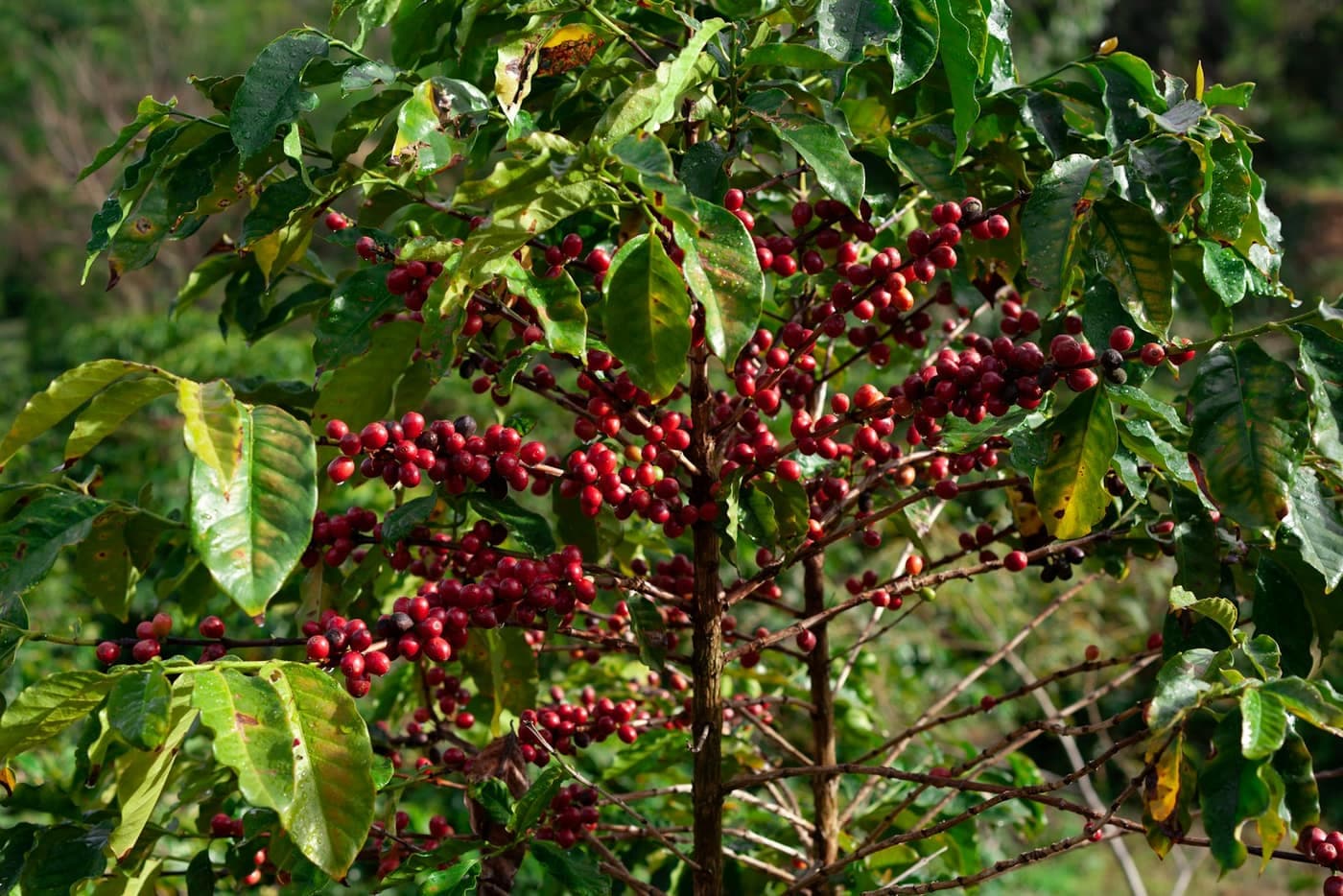
Coffea arabica
A shade-grown perennial shrub — India is one of the only major origins that grows it entirely under a two-tier forest canopy, often intercropped with pepper. Arabica (cool, high-altitude, prized cup, more disease-prone) and Robusta (hardier, lower-altitude, 2.5–3× the yield at a lower price) are two different crops wearing one name, and Karnataka alone grows over 70% of India’s coffee.
Quick Summary
The key points from this page in about two minutes — read it or have it read aloud.
Quick Summary
Coffee in India is really two crops sharing one name. Arabica is cool-loving, grown above about 1,000 m for its prized, delicate cup, and more prone to disease; Robusta is hardier, grown lower and warmer, and yields two-and-a-half to three times as much bean at a lower price. About seventy per cent of India’s coffee is actually Robusta, even though Arabica gets most of the attention, and Karnataka alone grows more than seventy per cent of the national crop.
What makes Indian coffee distinctive is that it is grown entirely under shade — a deliberate, managed two-tier canopy of silver oak or native trees, unlike the full-sun estates of Brazil or Vietnam — and that canopy very often carries a pepper vine as well, so a well-run estate is a three-layer system of shade trees, coffee and pepper on one piece of land.
Coffee is planted once and cropped for decades. Nursery seedlings go into the field at eight to twelve months, the bush bears a first light crop after three or four years, and reaches full bearing a couple of years later. A mature crop then runs on rain, not the calendar: a pre-monsoon "blossom shower" triggers synchronised flowering, a "backing shower" about a fortnight later sets the berries, and a missed backing shower has to be replaced with sprinkler irrigation. Ripe red cherries are hand-picked over several rounds, since a bunch never ripens all at once.
Coffee has no MSP and no ICAR institute behind it; it is sold through the Coffee Board of India at auction and export prices. Coffee berry disease on Arabica and the white stem borer are the problems that most decide yield. The page below carries the shade-canopy plan, the species-and-altitude guidance, the blossom-and-backing-shower rhythm, pest management and expected Arabica and Robusta yields.
- Crop type
- Perennial shade-grown shrub
- Species grown
- Arabica & Robusta
- Suitable states
- Karnataka, Kerala, Tamil Nadu
- First bearing
- 3–4 years
- Water requirement
- Blossom + backing showers, some irrigation
- Temperature
- Arabica >1,000 m cool; Robusta lower, warmer
- Soil type
- Deep, well-drained loam, pH 6–6.5
- Difficulty level
- Hard
- Expected yield
- Arabica 400–500, Robusta 1,000–1,300 kg/ha
- MSP
- None — Coffee Board auction/export price
Overview
Coffee in India is really two crops sharing one name. Coffea arabica — cool-loving, grown above roughly 1,000 m for its prized, delicate cup — and Coffea canephora (“Robusta”) — hardier, grown lower and warmer, yielding two-and-a-half to three times as much bean at a lower price per kilogram — together make up the country’s coffee estates. Roughly 70% of India’s coffee is actually Robusta, even though Arabica gets most of the attention. Karnataka (Chikkamagaluru, Kodagu/Coorg, Hassan) alone grows over 70% of national production; Kerala’s Wayanad district grows almost entirely Robusta, and Tamil Nadu’s Nilgiris and Pulney hills grow both.
The single most distinctive feature of Indian coffee is that it is grown entirely under shade — a deliberate, managed two-tier canopy, typically silver oak (Grevillea robusta) or native trees overhead, unlike the full-sun systems common in Brazil or Vietnam. That same canopy very often also carries a pepper vine as an intercrop, so a well-run Karnataka or Kerala coffee estate is really a three-layer system: shade trees, coffee, and pepper, all on the same land.
Coffee is planted once and cropped for decades: nursery-raised seedlings go into the field at 8–12 months old, the bush bears its first light crop after 3–4 years, and reaches full bearing a couple of years after that. Once mature, the crop runs on an annual rhythm set by rain, not the calendar — a pre-monsoon “blossom shower” triggers flowering, a “backing shower” a fortnight later sets the fruit, and the cherries are then selectively hand-picked over several rounds. Unlike every food crop on this site, coffee has no MSP and no ICAR mandate institute behind it — it is regulated and sold through the Coffee Board of India, a statutory body under the Ministry of Commerce and Industry, and priced by auction and export demand. This guide follows the shade system, the species/altitude choice, coffee berry disease and white stem borer as the levers that decide yield, quality and price.
Crop timeline, sowing to harvest
A quick visual map of the season — jump to any section below for the detail behind each stage.
- Year 0
Nursery
Selected seed is sown in raised, shaded nursery beds; seedlings are raised for 8–12 months before they are hardy enough to move to the field.
- Year 1 (Jun–Jul)
Transplanting
8–12 month old hardened seedlings are transplanted into prepared pits at the monsoon onset, under a shade canopy established a year or two earlier.
- Year 1–3
Establishment
Young plants are shaped, staked and mulched while the two-tier shade canopy — and often an intercropped pepper vine — fills in around them; no crop is taken yet.
- Year 3–4
First bearing
The bush flowers and sets its first light crop of cherries; yields are still well below the plant’s eventual potential.
- Year 5–6 onward
Full bearing
The plant reaches full, economic bearing and, with proper pruning and shade management, keeps cropping every year for 20–30+ years.
- Feb–Mar (annual)
Blossom-shower flowering
Once mature, every year a precisely timed pre-monsoon “blossom shower” triggers synchronised, fragrant white flowering across the estate.
- Mar–Apr (annual)
Backing shower & fruit set
A second rain spell 10–15 days later, the “backing shower”, sets the pinhead berries; a missed backing shower has to be made up with sprinkler irrigation.
- Apr–Oct (annual)
Berry development
Cherries swell and mature over roughly 7–9 months, turning from green to yellow to ripe red.
- Nov–Feb (annual)
Selective picking
Ripe red cherries are hand-picked in multiple rounds as they colour, since a single bunch never ripens all at once — then this annual flowering-to-picking cycle repeats for the life of the plant.
Suitable states
States where this crop is grown at scale, highlighted below. Your local Krishi Vigyan Kendra is still the final word for your specific block.
- Jammu and Kashmir
- Himachal Pradesh
- Punjab
- Uttarakhand
- Haryana
- Delhi
- Uttar Pradesh
- Rajasthan
- Bihar
- Jharkhand
- West Bengal
- Sikkim
- Assam
- Arunachal Pradesh
- Meghalaya
- Nagaland
- Manipur
- Mizoram
- Tripura
- Gujarat
- Madhya Pradesh
- Chhattisgarh
- Maharashtra
- Odisha
- Goa
- Telangana
- Andhra Pradesh
- Karnataka
- Kerala
- Tamil Nadu
- Puducherry
- Ladakh
- Chandigarh
- Lakshadweep
Grown here
Climate requirements
Altitude is the single biggest climate call in Indian coffee: Arabica for the cool, misty upper slopes (finer cup, more disease-prone), Robusta for the warmer, lower ground (hardier, far higher yield, lower price). Shade cover and the timing of the blossom and backing showers then decide how well either performs in a given year.
Ideal temperature
Arabica wants cool, high-altitude air — roughly 15–28°C above ~1,000 m; Robusta is hardier and tolerates warmer, lower elevations of roughly 300–800 m at 20–30°C — matching species to altitude is the founding climate decision.
Rainfall
1,500–2,500+ mm a year, but distribution matters as much as total: a pre-monsoon “blossom shower” (Feb–Mar) and a “backing shower” 10–15 days later are what trigger and set the flowering — without them on schedule, growers irrigate to substitute.
Humidity
High humidity through the monsoon favours berry swell but also drives coffee berry disease and leaf rust; the same wet months that fill the bean are the disease-watch months.
Sunlight
Coffee in India is deliberately shade-grown — 40–50% filtered light under a two-tier canopy suits it; unlike the full-sun systems of Brazil or Vietnam, harsh direct sun here stresses the bush, scorches berries and worsens pest and disease pressure.
Soil requirements
Good coffee land is built as much as it is found: the shade canopy above and the organic matter it drops below are what keep a Western Ghat slope productive for decades, alongside the drainage that stops the abundant monsoon rain from waterlogging the roots.
Suitable soil
Deep, friable, well-drained forest loam rich in organic matter — the classic Western Ghat estate soils built up over decades under shade-tree leaf litter.
pH range
6.0–6.5 (slightly acidic to near-neutral)
Drainage
Excellent drainage on a gentle slope is essential; coffee roots rot quickly in waterlogged or compacted ground, so contour terracing and drains are standard on estate land.
Organic matter
High organic matter is central to coffee soil health — shade-leaf litter, mulch and compost (often made from coffee pulp itself) maintain the humus the crop depends on.
Land preparation
Same four steps whichever region you are in — only the timing shifts with the sowing window.
- 1
Shade-tree establishment (1–2 years ahead)
Plant silver oak (Grevillea robusta) or other native shade species a year or two before the coffee itself, so a working two-tier canopy is overhead by the time seedlings go in.
- 2
Slope preparation & terracing
Clear the site and lay out contour terraces, trenches and drains on the Western Ghat slope to control erosion and stop the monsoon rain from waterlogging the ground.
- 3
Pit digging
Dig pits (roughly 45 × 45 × 45 cm) at the chosen spacing ahead of the monsoon, and refill them with topsoil mixed with well-rotted compost or farmyard manure.
Seed information
How the main varieties compare, so you can pick by duration, yield, disease pressure or what you are growing for.
| Variety | Duration | Yield | Disease resistance | Best state | Suitable for |
|---|---|---|---|---|---|
The most widely planted Arabica selection since the 1940s — bold beans, a balanced cup with subtle notes, and moderate tolerance to leaf rust. | Bears for decades | High | Moderate rust tolerance, weak on CBD | Karnataka | Quality-focused Arabica, export lots |
A semi-dwarf, Catimor-derived selection bred specifically to close the rust-resistance gap S.795 has developed over 80 years of field exposure — the modern pick wherever rust races beyond I and II are already a problem. | Bears for decades | Higher than S.795 at full bearing | Combined resistance to multiple leaf rust races via Catimor parentage | Karnataka, Kerala | High-rainfall, disease-prone blocks |
A Tafarikela × Hybrido-de-Timor derivative prized for inheriting Tafarikela’s superior cup quality; one of the more popular Arabica selections today. | Bears for decades | Medium–high | Moderate | Karnataka | Specialty, quality-graded lots |
A Sarchimor (Villa Sarchi × Hybrido-de-Timor) selection released in 2007, fairly rust-resistant and now widely planted. | Bears for decades | High | Good rust resistance | Karnataka | Rust-prone Arabica tracts |
The premium Robusta selection behind the Coffee Board’s “India Kaapi Royale” grade — vigorous, high-yielding, hardy. | Bears for decades | Very high | Hardy, low disease pressure | Kerala/Karnataka | High-volume Robusta, blends |
CxR hybrids (Robusta) Robusta selections crossed with Congensis parentage for extra vigour — widely used clones for new planting and replanting. | Bears for decades | Very high | Hardy | Kerala/Karnataka | Replanting, estate expansion |
- Seed rate
- About 1,600 plants/ha for Arabica at 2.5 × 2.5 m spacing; Robusta is planted wider at 3 × 3 m, roughly 1,100 plants/ha, with a bigger canopy and fewer plants.
- Certified seed
- Source seed or seedlings from Coffee Board-recommended nurseries or reliable estates, and choose the species and selection to match your estate’s altitude — Arabica for the cool upper slopes, Robusta for the warmer lower ground — since a species-altitude mismatch is very hard to fix once the plant is already bearing.
- Spacing
- Arabica: 2.5 × 2.5 m (~1,600 plants/ha); Robusta: 3 × 3 m, wider, with a bigger canopy and fewer plants/ha.
- Seed treatment
- Not a direct seed-sown field crop — raise seedlings from selected seed in a shaded nursery for 8–12 months, harden them off, and transplant only vigorous, disease-free plants.
Sowing guide
Coffee is planted once and cropped for decades, so the transplanting operation is worth doing right: pits ready ahead of the monsoon, shade already overhead, and healthy nursery stock. A rushed or badly timed planting shows up as poor establishment for years afterward, not just one lost season.
- Best time
- Transplant hardened, 8–12 month old nursery seedlings at the onset of the monsoon (June–July) so they establish on the rains before the next dry season.
- Row spacing
- 2.5 m between rows for Arabica; 3 m for Robusta
- Plant spacing
- 2.5 m within the row for Arabica; 3 m for Robusta
- Sowing depth
- Plant at nursery collar depth into the pre-filled, prepared pit, firming the soil around the root ball without burying the collar.
- Method
- Transplant seedlings into prepared pits under the already-established shade canopy, on contoured rows, and stake and mulch each plant immediately after planting.
Fertilizer schedule
A split dose beats one large dose applied at sowing — nitrogen especially is lost to the air and to leaching if it all goes in on day one.
- 1
Establishment (Year 1–3)
Split, per year
Graduated NPK doses build the young plant’s frame and root system while the shade canopy overhead is still developing.
- 2
Pre-blossom
Jan–Feb
A dose ahead of the blossom shower supports flowering, timed to the same pre-monsoon window that triggers it.
- 3
Berry development
Apr–May and Aug–Sep splits
The main split NPK doses of the year, timed to the rains, sustain the 7–9 month berry-filling period.
- 4
Post-harvest recovery
Oct–Nov
A recovery dose with organic manure or compost after picking rebuilds reserves ahead of the next year’s flowering.
- 5
Micronutrients
As needed
Zinc and boron deficiencies are common, especially on Robusta; foliar sprays correct them alongside the main soil schedule.
Irrigation schedule
1. Establishment
Yr 1–2
Protect young plants through their first dry seasons with mulch, shade and irrigation where available.
2. Blossom irrigation
Feb–Mar
Where the pre-monsoon blossom shower fails to arrive on time, sprinkler irrigation is used to trigger synchronised flowering.
3. Backing-shower irrigation
10–15 days after blossom
A second irrigation round substitutes for the natural backing shower to set the pinhead berries if the rain does not come.
4. Berry development
Apr–Oct, dry spells
Supplemental watering in dry spells during fruit swell — more common on Robusta — keeps berries filling evenly.
Critical stages
- Blossom-shower flowering (Feb–Mar)
- Backing-shower fruit set
- Berry development in dry spells
Water-saving tips
- Heavy mulching with shade-leaf litter and coffee-pulp compost conserves soil moisture and feeds the soil at the same time.
- A well-managed shade canopy cuts evaporation and moderates temperature, reducing the plant’s water stress between showers.
- Contour trenches and terracing capture and hold monsoon rain on the slope instead of letting it run off.
Weed management
Common weeds
Organic control
- Mulching with shade-leaf litter and coffee-pulp compost suppresses weeds and builds soil organic matter at the same time.
- Regular hand slashing/weeding around young plants until the canopy closes and shades out most weed growth on its own.
Chemical control
- Selective/spot herbicide use between mature rows where hand weeding is costly, kept away from young plants and the drip zone.
Nutrient deficiency identification
What a shortage of each nutrient actually looks like on the plant, so you can tell a deficiency apart from a disease before you spray the wrong thing.
Nitrogen
Visible symptom
Pale yellow-green leaves and thin, weak growth flushes — a heavy-demand nutrient through the berry-filling months.
Potassium
Visible symptom
Marginal scorch on older leaves and poorly filled, lighter berries — potassium is critical through fruit development.
Zinc
Visible symptom
Small, narrow leaves with shortened internodes (“rosetting”) on new growth, especially common on Robusta.
Boron
Visible symptom
Distorted, hook-shaped young leaves and poor fruit-set at the shoot tips.
Magnesium
Visible symptom
Interveinal yellowing of older leaves while the veins stay green, worse on light, leached soils.
Diseases to watch for
Symptoms, likely cause and what actually treats it — not just a spray name.
Coffee berry disease (CBD)
- Symptoms
- Sunken, dark, anthracnose-like lesions on green and ripening cherries that spread and rot the berry from the outside in, often before the bean fully forms.
- Cause
- The fungus Colletotrichum kahawae, favoured by cool, wet weather at higher elevation — it attacks Arabica hard and can cut a crop by half or more if left unmanaged.
- Treatment
- A scheduled protectant and curative fungicide programme (copper-based sprays plus systemic fungicides) timed to the wet flowering-to-berry-set window.
- Prevention
- Plant CBD-tolerant selections such as Cauvery/Catimor on high-risk, high-altitude blocks, keep the canopy open enough for air movement, and start spraying before symptoms appear, not after.
Leaf rust
- Symptoms
- Orange-yellow powdery pustules on the underside of leaves that cause premature leaf fall and dieback of bearing wood.
- Cause
- The fungus Hemileia vastatrix — historically the disease that devastated Arabica across South and Southeast Asia and pushed many origins toward Robusta.
- Treatment
- Copper-based protectant sprays timed ahead of the monsoon, repeated through the wet season on susceptible blocks.
- Prevention
- Favour rust-tolerant selections (S.795, Chandragiri) on Arabica blocks, maintain plant vigour with balanced nutrition, and keep shade regulated rather than dense and stagnant.
Black rot
- Symptoms
- Blackened, matted leaves, twigs and berries bound together by fungal threads, usually in dense, poorly ventilated patches of the canopy.
- Cause
- The fungus Koleroga (Pellicularia koleroga), spreading fast in prolonged wet, humid, still conditions.
- Treatment
- Prune out and destroy affected branches, open up the canopy for airflow, and spray a recommended copper fungicide on affected blocks.
- Prevention
- Prune and regulate shade to avoid a dense, humid, still canopy, and improve drainage so the wettest patches do not stay saturated.
Brown eye spot
- Symptoms
- Circular brown spots with a paler centre and yellow halo on leaves, and dark sunken spots on berries, worst in shaded, humid blocks.
- Cause
- The fungus Cercospora coffeicola, worse on nutrient-stressed plants and in over-dense shade.
- Treatment
- Correct nutrient deficiencies (especially nitrogen), thin the shade where it is too dense, and spray a recommended fungicide on badly affected blocks.
- Prevention
- Balanced nutrition and well-regulated shade keep plants vigorous enough to shrug off routine leaf-spot pressure.
Root rot
- Symptoms
- Patches of yellowing, wilting, declining bushes with rotted roots and fungal strands visible when the soil is dug away.
- Cause
- Soil-borne fungi (Rosellinia and others), often spreading from old tree stumps and infected roots left in the ground.
- Treatment
- Isolate the patch with a trench, uproot and destroy the affected bushes and stumps, and rehabilitate the soil before replanting.
- Prevention
- Clear old stumps and roots thoroughly before planting and maintain drainage so waterlogging does not predispose roots to infection.
Pests to watch for
What to look for before the damage is visible, and organic options before you reach for a chemical.
White stem borer
- Identification
- A long-horned beetle (Xylotrechus quadripes) whose grubs bore into the main stem near the collar, visible as sawdust-like frass and cracking bark.
- Damage
- The single most destructive pest of Arabica in India — an infested stem is girdled and the whole plant dies, often in spreading patches through a block if left untreated.
- Organic control
- Whitewashing the stem base to deter egg-laying, prompt removal and burning of dead/infested plants, and shade regulation, since the pest favours plants stressed by excess direct sun.
- Chemical control
- Timed insecticide swabbing/spraying of the stem during the beetle’s flight and egg-laying periods, on a schedule matched to the block’s infestation history.
Coffee berry borer
- Identification
- A tiny black beetle (Hypothenemus hampei) that bores a single hole into the ripening or ripe cherry and tunnels into the bean itself.
- Damage
- Damaged, tunnelled beans lose weight and grade, directly cutting both the yield and the sale price of the clean coffee.
- Organic control
- Strict, timely picking with no cherries left on the bush or the ground after the season removes its breeding habitat, backed by alcohol-baited traps.
- Chemical control
- A recommended insecticide spray timed to early berry development where infestation has been a recurring problem.
Mealybug
- Identification
- Small, white, waxy, cottony insects clustered on shoots, leaf axils and berry clusters, often tended by ants.
- Damage
- Sap removal weakens shoots and berries, and the honeydew it excretes fosters sooty mould that blackens leaves and cuts photosynthesis.
- Organic control
- Conserve natural predators (ladybird beetles), control the attending ant colonies, and hose off light infestations.
- Chemical control
- A recommended systemic insecticide where infestation is heavy, targeted at the ant-tended colonies.
Green scale
- Identification
- Small, flat, greenish, immobile scale insects clustered along the underside of leaves and young shoots.
- Damage
- Sap removal weakens the plant, and the honeydew it produces attracts sooty mould that reduces photosynthesis and vigour.
- Organic control
- Conserve natural parasites and predators, and prune out heavily infested twigs.
- Chemical control
- A recommended insecticide on badly infested blocks, avoiding routine blanket spraying that also kills natural enemies.
Common mistakes to avoid
The mistakes that cost growers the most, ranked by how often they show up in the field — not in the order you might expect.
- 1
Planting with no shade canopy, or letting it thin out over time.
Why it hurts
Indian coffee is a shade crop by design — full sun stresses the bush, scorches berries, and worsens pest and disease pressure; the two-tier canopy has to be established a year or two before the coffee and then actively maintained, not treated as optional.
- 2
Ignoring white stem borer until the infestation is advanced.
Why it hurts
It is the single worst pest of Arabica in India — by the time bark-cracking and dieback are obvious, the stem is often already girdled and the plant is lost; whitewashing and prompt removal of infested plants have to start before symptoms are visible, not after.
- 3
Mismatching species to altitude — Arabica too low, or Robusta where Arabica-level pricing was expected.
Why it hurts
Arabica planted below its cool-altitude comfort zone struggles and is hit harder by CBD and rust; growers who plant Robusta expecting Arabica-level prices are disappointed, since Robusta yields far more but sells for less per kilogram.
- 4
Poor or inconsistent pruning discipline.
Why it hurts
Coffee bears heavily on new wood, so skipped or badly timed pruning lets the bush grow tall, thins out the bearing surface and makes picking and spraying harder — yield drops steadily over a few seasons of neglect.
- 5
Missing the blossom-shower and backing-shower irrigation window.
Why it hurts
Flowering is triggered by a precisely timed pre-monsoon shower and set by a second one 10–15 days later; growers who do not irrigate to substitute for a missed shower get patchy, uneven flowering and a smaller, staggered crop.
- 6
Reacting to coffee berry disease and leaf rust instead of spraying on schedule.
Why it hurts
Both fungi move fast in wet weather and attack the crop itself (CBD) or defoliate bearing wood (rust); a protectant spray programme timed to the wet season is far cheaper than the yield lost waiting for visible symptoms.
- 7
Ignoring the Arabica/Robusta spacing difference and planting too close.
Why it hurts
Robusta needs the wider ~3 × 3 m spacing for its bigger canopy; using Arabica’s tighter 2.5 × 2.5 m spacing for Robusta crowds the canopy, increases humidity-driven disease, and complicates picking.
- 8
Planting on a slope without terracing or drainage.
Why it hurts
Coffee roots rot fast in waterlogged ground, and an unterraced Western Ghat slope erodes under the monsoon — contour terraces and drains have to go in before planting, not after.
- 9
Picking green or unripe cherries along with ripe red ones to save a round.
Why it hurts
Mixed-ripeness picking drags down cup quality and the price the lot fetches at auction; selective, multiple-round picking of only ripe red cherries costs more labour but is what the grade and the price are built on.
- 10
Delaying or mishandling processing after picking.
Why it hurts
Cherries left unprocessed for even a day start to ferment and spoil the cup; mixing wet (washed) and dry (natural) process lots, or drying unevenly, drops the grade and the price the whole harvest fetches.
Harvesting
Coffee is selectively hand-picked, not harvested in one pass: as cherries ripen from green through yellow to red over roughly 7–9 months, only the ripe red cherries are picked, in multiple rounds spaced a few weeks apart through the main Nov–Feb picking season (Robusta often finishing a little later), since a single bunch never ripens all at once.
Signs it is ready
- Cherries fully coloured deep red (a few selections turn yellow/orange at ripeness)
- Cherry gives slightly to gentle pressure without being mushy or shrivelled
- A picking round due roughly every 10–20 days as fresh cherries colour up
Tools
- Skilled hand-picking into waist baskets for selective, quality picking
- Strip-picking at the final round on some Robusta blocks, for a lower-grade lot
- Fast transport of picked cherry to the pulper or drying yard the same day
Expected yield
Arabica: roughly 400–500 kg of clean (green) bean per hectare; Robusta: roughly 1,000–1,300 kg of clean bean per hectare — Robusta yields two-and-a-half to three times as much as Arabica but sells for less per kilogram, which is the core species trade-off.
Post-harvest & storage
Storage
Freshly picked cherry cannot wait — it has to be pulped (wet/washed process) or spread out to dry (dry/natural process) the same day or within hours; the choice of processing method is made at picking, not after storage.
Packaging
Dried parchment or cherry is hulled to clean green bean, graded by size and defect count, and bagged in breathable jute or moisture-proof bags for sale or auction.
Transportation
Cherry moves fast and fresh from field to pulping yard or drying patio; the finished, dried, graded green bean is a stable, durable product that ships to curers, exporters and the Coffee Board’s auction system without special cold-chain needs.
Shelf life
Fresh cherry: hours (process the same day); dried parchment/cherry: some weeks before hulling; clean, dry green bean at the right moisture (~11%): a year or more in proper storage, though cup quality is best used fresh of the season.
Market prices
Today's mandi price near you, pulled live from the government's own Agmarknet data.
Live daily mandi prices from the government Agmarknet dataset.
Synced from data.gov.in (Agmarknet). Rates are ₹ per quintal.
Weather
Current conditions and a 5-day outlook for your selected location, with one line of stage-aware advice.
Pick your state for current conditions and a 5-day outlook.
Live data from Open-Meteo
Profit calculator
Your own cost sheet, expected yield and selling price — not ours.
Where the money goes
Share of the total cost per acre, using the calculator’s own default cost sheet below — adjust the numbers there to match your field and this picture will no longer apply to you exactly, but the ranking rarely changes.
- Labour39% (₹25,000)
- Fertiliser16% (₹10,000)
- Land rent16% (₹10,000)
- Pesticide & weedicide8% (₹5,000)
- Seed6% (₹4,000)
- Irrigation6% (₹4,000)
- Machinery5% (₹3,000)
- Interest4% (₹2,500)
Official downloads
Government and ICAR documents only — everything below is hosted on an official server.
Coffee Board of India
The statutory body (Coffee Act, 1942) under the Ministry of Commerce & Industry — variety recommendations, extension advisories, grower registration and the e-auction platform.
Farmer Portal — crop advisories
Government of India’s farmer portal, including season-specific advisories and market information.
Soil Health Card portal
Get a free, crop-wise fertilizer recommendation for your own field before finalising the fertilizer schedule above.
mKisan — SMS advisory portal
Register for free SMS advisories timed to your crop stage and district.
Frequently asked questions
Does coffee have an MSP?
No. Coffee is not a CACP-notified crop and has no Minimum Support Price. It is regulated by the Coffee Board of India (a statutory body under the Ministry of Commerce and Industry), and price is set by auction and export demand — shaped by international benchmarks such as ICE/London coffee futures, Vietnam’s Robusta supply and Brazil’s Arabica supply. Most small growers in India sell their crop through the Coffee Board’s e-auction platform, through cooperatives, or to registered curing works, rather than at an APMC mandi.
Should a new grower plant Arabica or Robusta?
It depends mainly on altitude. Arabica wants cool, high-altitude land (above roughly 1,000 m) and gives the finer, more prized cup, but it is more disease-prone (coffee berry disease, leaf rust) and yields less — about 400–500 kg clean bean/ha. Robusta tolerates warmer, lower elevations, is hardier, and yields two-and-a-half to three times as much (1,000–1,300 kg/ha), but sells for less per kilogram. A grower whose land sits below Arabica’s comfort altitude is generally better off with Robusta than fighting the climate.
Why is Indian coffee grown under shade when many origins grow it in full sun?
Indian coffee estates deliberately use a two-tier shade canopy — usually silver oak (Grevillea robusta) or native trees — unlike the full-sun systems common in Brazil or Vietnam. Shade moderates temperature and moisture, reduces stress on the bush, and cuts pest and disease pressure that worsens in harsh direct sun. The same canopy very often also carries a pepper vine as an intercrop, making a well-run estate a three-layer system of shade trees, coffee and pepper on the same land.
What is a “blossom shower” and why does the timing matter so much?
The blossom shower is a specific pre-monsoon rain spell, usually in February–March, that triggers synchronised, fragrant white flowering across a coffee estate. A second rain spell 10–15 days later, the “backing shower”, sets the pinhead berries that follow. If either shower is late or missed, growers substitute with sprinkler irrigation — because flowering that is not properly triggered and set gives a patchy, uneven, smaller crop for the whole year.
What is coffee berry disease (CBD) and how serious is it?
CBD is caused by the fungus Colletotrichum kahawae, which produces sunken, dark, anthracnose-like lesions on green and ripening cherries and can rot the berry before the bean fully forms. It is one of the most damaging diseases on Arabica and can cut a crop by half or more if left unmanaged, especially in cool, wet conditions at higher elevation. Management combines CBD-tolerant selections like Cauvery/Catimor with a scheduled fungicide programme timed to the wet flowering-to-berry-set window.
Why is white stem borer such a feared pest?
White stem borer (Xylotrechus quadripes) is considered the single most destructive pest of Arabica coffee in India. Its grubs bore into the main stem near the collar; by the time the sawdust-like frass and bark cracking are obvious, the stem is often already girdled and the plant dies. Because there is no cure once a plant is badly infested, control is preventive — whitewashing stems, prompt removal of infested plants, and timed insecticide application during the beetle’s flight periods.
How long before a coffee plant bears, and how long does it keep bearing?
A coffee plant gives its first light crop 3–4 years after transplanting and reaches full, economic bearing a couple of years after that. Once mature, with proper pruning and shade management, the same plant keeps cropping every year for 20–30 years or more — the annual cycle of blossom shower, backing shower, berry development and picking repeats each year of that productive life.
What is the difference between wet (washed) and dry (natural) processing?
In wet/washed processing, the outer skin and pulp are removed from the cherry mechanically soon after picking, the beans are fermented to remove the mucilage, washed, and then dried — this generally gives a cleaner, brighter cup. In dry/natural processing, the whole cherry is spread out and dried in the sun before hulling, which is simpler but needs even drying and careful handling to avoid off-flavours. The method chosen at picking has a major effect on the cup quality and price the lot fetches.
Can pepper be grown together with coffee?
Yes — pepper vines trained up the shade trees are a very common intercrop on Karnataka and Kerala coffee estates. The shade tree becomes a living stake for the pepper vine, so the land effectively grows three crops — shade timber/fuel, coffee and pepper — at once, giving the grower an additional income stream from the same canopy.
Which states grow coffee in India?
Karnataka is by far the largest producer, growing over 70% of India’s coffee, concentrated in Chikkamagaluru, Kodagu (Coorg) and Hassan districts, and growing both Arabica and Robusta. Kerala is the second-largest producer, mostly in Wayanad, and grows almost entirely Robusta. Tamil Nadu, mainly the Nilgiris and Pulney hills, is a smaller producer that grows both species.
What yield can I expect, and how does it differ between the two species?
Arabica typically yields about 400–500 kg of clean (green) bean per hectare, while Robusta yields about 1,000–1,300 kg per hectare — roughly two-and-a-half to three times as much. Robusta’s much higher yield is offset by a lower price per kilogram than Arabica, so the two species land in a similar range on overall estate income, and the right choice depends more on your altitude than on which number looks bigger.
What spacing should I use when planting coffee?
Arabica is typically planted at 2.5 × 2.5 m, giving roughly 1,600 plants per hectare. Robusta needs more room for its bigger canopy and is planted wider, at about 3 × 3 m, giving roughly 1,100 plants per hectare. Using Arabica’s tighter spacing for Robusta crowds the canopy, raises humidity-driven disease risk, and makes picking and spraying harder.
Still have questions?
The FAQs above cover the common ones. For anything specific to your field and soil, your nearest Krishi Vigyan Kendra is the authoritative answer.