
Imli (Tamarind)
Tamarindus indica
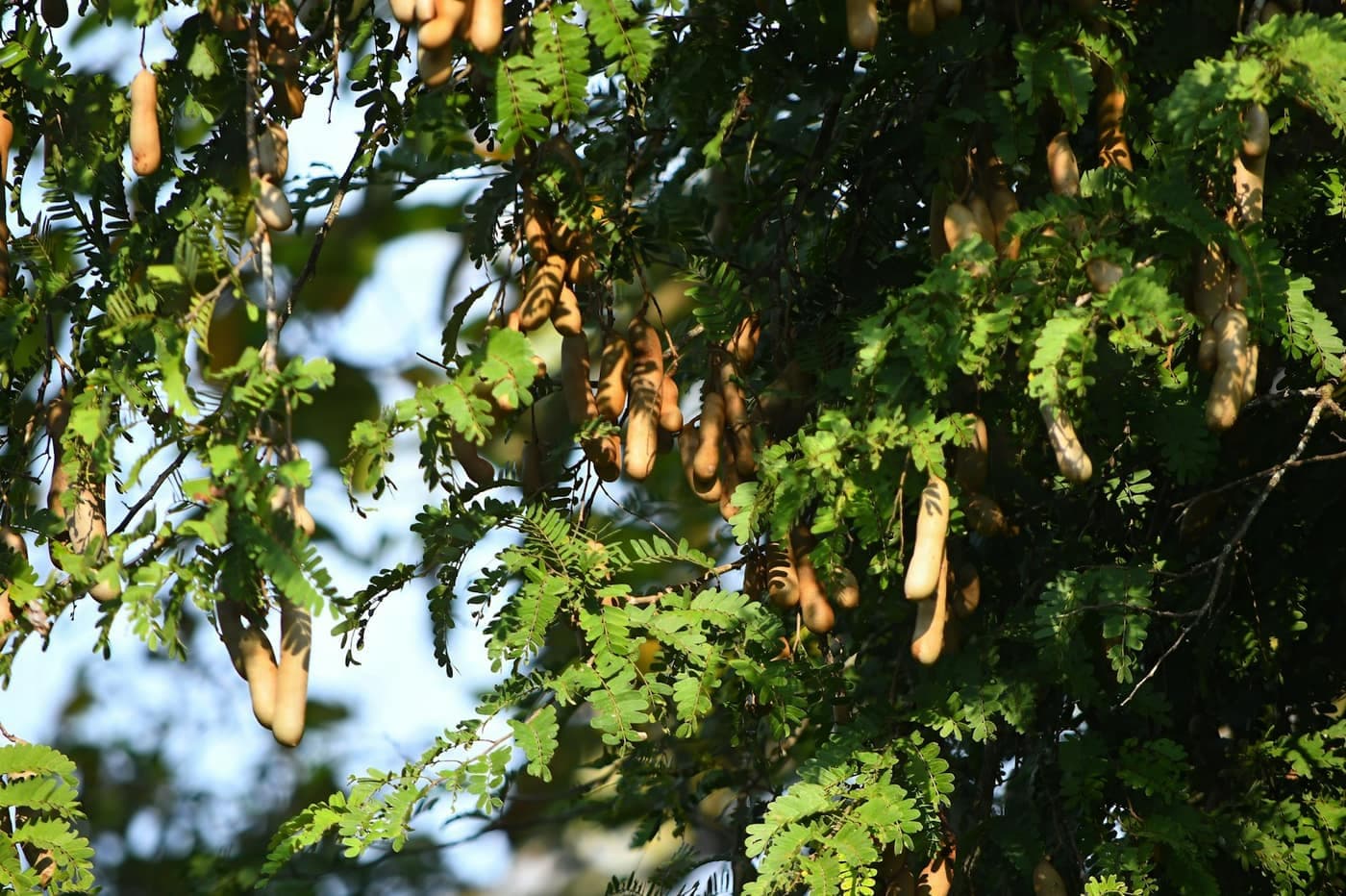
A hardy, very long-lived evergreen tree that grows on poor, dry, even saline land other fruit trees refuse — India is the world's largest tamarind producer, led by Tamil Nadu, Karnataka, Andhra Pradesh and Maharashtra — where the one decision that changes everything is planting a grafted improved variety (PKM-1, Yogeshwari and the like) instead of a seedling, cutting the wait for fruit from 10–12 years to about 4–5 and keeping the tree small enough to spray and pick.
Quick Summary
The key points from this page in about two minutes — read it or have it read aloud.
Quick Summary
Tamarind (imli) is a large, hardy evergreen tree grown for its brown, sour pod pulp, used in almost every Indian kitchen and traded as pulp, concentrate and tamarind kernel powder. India grows more tamarind than any other country, mostly in Tamil Nadu, Karnataka, Andhra Pradesh, Telangana, Maharashtra and Madhya Pradesh, almost all of it rainfed.
The tree is famously undemanding. It grows on shallow, gravelly, dry and mildly salt-affected land where other fruit trees fail, needs a long dry spell to ripen its pods well, and once established asks for very little water or care. It is frost-sensitive only while young, and a mature tree can keep bearing for a hundred years or more.
The single decision that matters most is planting material. A seedling tamarind takes 10–15 years to bear and grows into a huge tree that is hard to spray or harvest. A grafted plant of an improved variety — PKM-1 and PKM-2 from Tamil Nadu, Yogeshwari, Pratishthan and Ajanta from Maharashtra, DTS-1 from Dharwad, Goma Prateek from Gujarat — bears in about 4–5 years, stays smaller, and gives a known pulp colour and taste that buyers pay for.
The main problems come at flowering and on the pods: bud webber and pod borer damage the crop on the tree, and the tamarind seed beetle attacks stored pods. Sound spraying at flowering, timely harvest when the shell turns brittle, and proper drying and airtight storage protect most of the value.
- Crop type
- Perennial semi-evergreen fruit tree
- Season
- Planted at monsoon onset (June–July); harvest Jan–April
- Suitable states
- Tamil Nadu, Karnataka, Andhra Pradesh, Maharashtra, Madhya Pradesh
- Time to bearing
- 4–5 years (grafted); 10–15 years (seedling)
- Water requirement
- Low; rainfed once established, a needs a dry spell to cure pods
- Temperature
- Tropical–subtropical; mature trees tolerate 0–47°C, young plants frost-sensitive
- Soil type
- Deep loam is best but tolerates shallow, gravelly, dry and mildly saline soil; pH 5.5–8.5
- Difficulty level
- Easy (bud webber and pod borer at flowering, seed beetle in storage)
- Expected yield
- 150–500 kg pods per mature grafted tree per year
- Key risk
- Planting a seedling instead of a grafted improved variety
Overview
Tamarind, or imli (Tamarindus indica), is a large, hardy, semi-evergreen tree grown for its brown, sour pod pulp. India is the world's largest producer, with the crop concentrated in Tamil Nadu (the leading state), Karnataka, Andhra Pradesh, Telangana, Maharashtra, Madhya Pradesh, Chhattisgarh and Odisha. Almost all of it is grown rainfed, on field bunds, wastelands, roadsides and in orchards.
The tree is valued precisely because it is not fussy. It grows on shallow, gravelly, dry and even mildly saline or alkaline land where mango or citrus would fail, tolerates a wide temperature range once mature, and needs a distinct dry season to ripen and cure its pods properly. It is only frost-sensitive as a young plant; a mature tree is wind-firm and can bear for over a hundred years.
The choice between a seedling and a grafted improved variety changes the whole economics. A seedling tree takes 10–15 years to start bearing and grows very large; a grafted plant of a released variety such as PKM-1, PKM-2, Yogeshwari, Pratishthan, Ajanta, DTS-1 or Goma Prateek bears in about 4–5 years, stays a manageable size for spraying and picking, and produces a consistent pulp colour and acidity that processors and traders will pay a premium for.
Crop timeline, sowing to harvest
A quick visual map of the season — jump to any section below for the detail behind each stage.
- Year 0
Planting
A grafted plant of a named variety set into a large FYM-filled pit at the start of the monsoon (June–July), staked against wind and basin-irrigated until the rains take over.
- Year 1–3
Establishment & training
The young tree is trained to a single clear stem to about 0.75–1 m, then allowed 3–4 well-spaced main branches; it is protected from frost and grazing and given a few life-saving waterings each summer.
- Year 4–5
First bearing
A grafted improved variety begins flowering and setting a small crop of pods; a seedling tree gives nothing useful until 10–15 years.
- April–June
Flowering
Pale yellow, red-streaked flowers open over several weeks; this is the key window for controlling bud webber and for any available irrigation.
- June–February
Pod development
Pods take 8–10 months to fill and mature on the tree, the pulp changing from green and pasty to brown and firm as a long dry spell cures it.
- January–April
Harvest
Pods are picked when the shell is brittle and the pulp is fully brown — usually February to March — either by hand-picking mature pods or by a single shake-down harvest of the whole tree.
Suitable states
States where this crop is grown at scale, highlighted below. Your local Krishi Vigyan Kendra is still the final word for your specific block.
- Jammu and Kashmir
- Himachal Pradesh
- Punjab
- Uttarakhand
- Haryana
- Delhi
- Uttar Pradesh
- Rajasthan
- Bihar
- Jharkhand
- West Bengal
- Sikkim
- Assam
- Arunachal Pradesh
- Meghalaya
- Nagaland
- Manipur
- Mizoram
- Tripura
- Gujarat
- Madhya Pradesh
- Chhattisgarh
- Maharashtra
- Odisha
- Goa
- Telangana
- Andhra Pradesh
- Karnataka
- Kerala
- Tamil Nadu
- Puducherry
- Ladakh
- Chandigarh
- Lakshadweep
Grown here
Climate requirements
The tree's hardiness is real but works only after establishment — the 2–3 years after planting still need frost protection, weeding and a few summer waterings before the tree can be left to look after itself.
Ideal temperature
A tropical to subtropical tree. A mature tamarind tolerates a very wide range, from near 0°C up to about 47°C, and shrugs off hot dry winds. Young grafted plants, though, are killed or set back by frost and need protection in their first two or three winters in north and central India.
Rainfall
Low water need. The tree does well on 500–1500 mm a year and is grown almost entirely rainfed once established. It specifically needs a long, dry, rain-free spell while the pods are maturing — heavy rain at flowering or near harvest causes flower drop, poor set and dark, poor-quality or mouldy pulp.
Humidity
Prefers a dry atmosphere during pod maturity and harvest. High humidity at flowering encourages bud webber, powdery mildew and sooty mould.
Sunlight
Full sun. Tamarind is a large, spreading tree that must not be crowded or shaded; close planting for early yield has to be thinned later or the inside of the canopy goes bare and unproductive.
Soil requirements
Deep soil grows a bigger, faster tree, but tamarind's real value is that it turns shallow, dry, low-value land into a bearing orchard — matching it to that kind of land, not to your best field, is the point.
Suitable soil
Grows on a very wide range of soils — deep alluvial and red loams give the best growth, but tamarind also does genuinely well on shallow, gravelly, stony, dry and mildly saline or alkaline land where most fruit trees cannot be grown at all. That is much of the reason it is planted where it is.
pH range
Wide tolerance, roughly pH 5.5–8.5, including the mildly alkaline soils common across its dry-zone belt.
Drainage
Needs free drainage. The tree is drought-hardy but not flood-hardy — a low, waterlogging-prone site causes root rot and dieback, so plant on higher, free-draining ground.
Organic matter
Low requirement. A pit well filled with farmyard manure at planting sets the young tree up; a mature tree on poor land keeps bearing with only a yearly dose of manure and a light NPK ring.
Land preparation
Same four steps whichever region you are in — only the timing shifts with the sowing window.
- 1
Mark the spacing and dig pits
Seedling orchards are planted 10–12 m apart (about 70–100 trees/ha); grafted improved varieties are planted closer at 6–8 m, or 5 × 5 m for an early high-density block that is thinned later. Dig 1 m cube pits a month ahead and leave them open to weather.
- 2
Fill pits with manure
Refill each pit with topsoil mixed with 15–20 kg well-rotted farmyard manure, about 1 kg single super phosphate and, in termite-prone areas, a recommended soil insecticide.
- 3
Plan for wind and frost
On exposed sites plan a windbreak row; in frost-prone north and central India keep grass mulch, a thatch screen or a tree-guard ready for the young plant's first two or three winters.
Seed information
How the main varieties compare, so you can pick by duration, yield, disease pressure or what you are growing for.
| Variety | Duration | Yield | Disease resistance | Best state | Suitable for |
|---|---|---|---|---|---|
The most widely planted improved tamarind in India, released by TNAU's Horticultural Research Station, Periyakulam. A precocious, prolific, semi-dwarf grafted type with reddish-brown pulp, coming into bearing early and giving very heavy crops on a manageable-sized tree. | Bears from year 4–5 | Very high — mature trees commonly give 250+ kg pods a year | No special resistance claimed; standard bud webber and pod borer watch | Tamil Nadu, Karnataka, Andhra Pradesh | Culinary pulp, concentrate, high-density grafted orchards |
A later TNAU Periyakulam selection, a grafted improved type valued for long pods and good pulp recovery, planted as an alternative or companion to PKM-1 in the same belt. | Bears from year 4–5 | High; long pods give good pulp-to-pod ratio | Not separately documented | Tamil Nadu, Karnataka | Culinary pulp, table use, processing |
A Tamil Nadu selection known for unusually long pods with sweetish, less-sour pulp, giving it a table-fruit and premium-pulp niche alongside the standard sour types. | Bears from year 5–6 (grafted) | Good; prized more for pod length and taste than sheer weight | Not separately documented | Tamil Nadu | Table use, premium sweetish pulp |
A leading Maharashtra variety with deep red pulp and high, regular yields, widely grown in Marathwada and preferred by processors for the strong colour it gives sauces and concentrates. | Bears from year 4–5 (grafted) | High and regular | Not separately documented | Maharashtra, Karnataka | Industrial pulp and concentrate, culinary use |
A semi-dwarf Maharashtra release (MPKV, Rahuri) with an acidic-sweet pulp and a compact frame that suits closer planting and easier harvesting. | Bears from year 4–5 (grafted) | Good on a compact tree | Not separately documented | Maharashtra | Closer-spaced grafted orchards, culinary pulp |
DTS-1 (Dharwad Tamarind Selection-1) A University of Agricultural Sciences, Dharwad selection with sweetish, good-quality pulp, promoted for the Karnataka dry belt as a table-and-pulp type. | Bears from year 5–6 (grafted) | Good; selected for pulp quality as much as yield | Not separately documented | Karnataka | Table use, quality pulp in the Karnataka dry zone |
An ICAR-CIAH (Godhra) release bred for the hot semi-arid west — a dwarf, precocious, high-yielding grafted type that fruits early and stays small on poor, dry land. | Bears from year 3–4 (grafted) | High for a dwarf tree on semi-arid land | Not separately documented | Gujarat, Rajasthan, Madhya Pradesh | Hot semi-arid dryland orchards, early returns |
Ajanta A Maharashtra selection grown alongside Yogeshwari in the state's tamarind belt, giving regular crops of good culinary pulp. | Bears from year 4–5 (grafted) | Good and regular | Not separately documented | Maharashtra | Culinary and processing pulp |
- Seed rate
- Grown from planting material, not a field seed rate: about 70–100 grafted plants per hectare at 10–12 m for a standard orchard, or 250–400 per hectare at 5–8 m for a high-density grafted block. Seed is used only to raise rootstock in the nursery — roughly 400–500 g of seed gives enough seedlings to graft one hectare.
- Certified seed
- Buy grafted plants of a named, released variety from a state horticulture department nursery, an ICAR institute or a registered nursery — never plant an unknown seedling if fruit sale is the goal. A seedling is slow to bear, grows too large to manage, and gives an unpredictable pulp colour and taste that fetches a lower price.
- Spacing
- Standard seedling orchard 10–12 m × 10–12 m; grafted improved varieties 6–8 m; early high-density grafted blocks 5 × 5 m with alternate trees removed once the canopies meet.
- Seed treatment
- For rootstock: soak seed in water for 24 hours (or briefly in warm water) before sowing in the nursery to speed and even out germination. At field planting, dip the grafted plant's root ball in a Trichoderma or recommended bio-fungicide slurry and keep the graft union above the soil.
Sowing guide
Keeping the graft union clear of soil and rubbing off rootstock suckers in the first two years is what makes sure the tree that grows is the variety you paid for.
- Best time
- Plant grafted plants with the first steady monsoon rain, June to July, so the tree roots well before its first dry season. In assured-irrigation orchards, February–March planting is also done.
- Row spacing
- 10–12 m for seedlings; 6–8 m for grafted improved varieties
- Plant spacing
- Equal to row spacing (square planting)
- Sowing depth
- Set the plant so the root collar and the graft union sit just above the finished soil level; firm the soil and make a broad watering basin.
- Method
- One grafted plant per pit, staked against wind. Remove any shoots that come from below the graft union as soon as they appear, so all growth goes into the improved variety.
Fertilizer schedule
A split dose beats one large dose applied at sowing — nitrogen especially is lost to the air and to leaching if it all goes in on day one.
- 1
Young trees (pre-bearing)
Years 1–4
Roughly 100 g N, 50 g P and 75 g K per tree in year 1, increased each year, split into two doses at the start and end of the monsoon, with 10–15 kg farmyard manure per tree per year worked into the basin.
- 2
Bearing trees
Year 5 onward, yearly
About 500 g N, 250 g P and 500 g K per full-grown bearing tree per year, plus 25–50 kg farmyard manure, applied in a ring under the canopy edge just before flowering and again after fruit set.
- 3
Micronutrients on poor land
As needed
On shallow, alkaline or very poor soils, a foliar spray of zinc and boron before flowering improves flower retention and pod set; confirm the dose with your KVK.
Irrigation schedule
1. Establishment
First 2–3 years
Water every 10–15 days through the dry months for the first two or three summers; this is the only stage at which a tamarind really needs irrigation.
2. Bearing trees
Year 4 onward
Mostly rainfed. Where irrigation is available, one or two waterings at flowering and early pod set lift yield, but the tree must then be left dry while the pods mature and cure.
Critical stages
- First 2–3 years after planting
- Flowering and early pod set
Water-saving tips
- Tamarind is grown specifically because it does not need irrigation once established — building an irrigation schedule around a mature tree defeats the purpose of planting it on dryland.
- A basin mulch of leaves or crop residue holds the little rain the tree gets and cuts the number of establishment waterings needed.
- Stop all irrigation well before the pods start to mature — water at that stage darkens the pulp and lowers its market grade.
Weed management
Common weeds
Organic control
- Keep a weed-free 1 m circle around each young tree by hoeing 2–3 times a year for the first three years; once the canopy closes it shades out most weeds on its own.
- Grow a short intercrop — a pulse, groundnut, vegetable or fodder — between the wide rows in the first 4–6 years to earn from the land and keep weeds down while the trees are small.
- Slash Lantana and Parthenium before they seed and use the cut material as basin mulch.
Chemical control
- In the first 3–4 years, a directed post-emergence herbicide can be used in the inter-row of a larger orchard, kept off the young trees; most growers rely on hand and mechanical weeding.
- Confirm any herbicide with your local KVK before spraying near young grafted trees.
Nutrient deficiency identification
What a shortage of each nutrient actually looks like on the plant, so you can tell a deficiency apart from a disease before you spray the wrong thing.
Nitrogen
Visible symptom
Pale, small older leaves, thin new shoots and a poor flush of growth after the monsoon, worst on the sandy, low-organic-matter soils tamarind is often grown on.
Zinc
Visible symptom
Small, narrow, bunched leaves at the shoot tips ("little leaf") and heavy flower drop, common on the alkaline dry-zone soils in the crop's belt.
Boron
Visible symptom
Poor flower retention, low pod set and mis-shapen or cracked pods; corrected by a pre-flowering foliar spray.
Diseases to watch for
Symptoms, likely cause and what actually treats it — not just a spray name.
Powdery mildew
- Symptoms
- A white, powdery coating on young leaves, flower stalks and tender shoots during cool, dry, humid weather, causing flower and young-pod drop.
- Cause
- Oidium fungi, worst on soft flush growth during the flowering season in a humid spell.
- Treatment
- A wettable sulphur or a recommended fungicide spray at the first sign, repeated once if the weather stays favourable, focused on the flowering shoots.
- Prevention
- Avoid pushing soft growth with excess nitrogen near flowering, and keep the canopy open by regular thinning of crowded, crossing branches.
Sooty mould
- Symptoms
- A black, soot-like film over leaves, twigs and pods that rubs off, always following an infestation of scale, mealybug or aphid.
- Cause
- Capnodium and related fungi growing on the sugary honeydew excreted by sap-sucking insects — a symptom of the insect problem, not a primary disease.
- Treatment
- Control the underlying scale or mealybug; the mould then weathers off. A starch or mild soap spray can loosen a heavy coating on valuable young trees.
- Prevention
- Regular scouting for scale and mealybug at the nodes, and conserving ladybird beetles and parasitic wasps.
Leaf spot
- Symptoms
- Small brown to reddish angular or round spots on the leaflets, sometimes merging, with early leaf yellowing and drop in a wet year.
- Cause
- Pestalotiopsis, Cercospora and related leaf-spot fungi, favoured by prolonged leaf wetness.
- Treatment
- Usually not economic to spray on a mature tree; on young trees a protective copper or mancozeb spray checks a bad outbreak.
- Prevention
- Rake up and remove heavily infected fallen leaves, and keep the canopy open for airflow.
Stem and wood rot / dieback
- Symptoms
- Branches dying back from the tip, cankered or hollow patches on the trunk and main limbs, and a soft, punky rot in the heartwood of old trees.
- Cause
- Wood-rotting fungi entering through pruning cuts, sun-scald cracks, borer holes or storm wounds, worse on stressed or waterlogged trees.
- Treatment
- Cut back dead branches to healthy wood, clean out rotted pockets, and paint large cuts and wounds with Bordeaux paste; there is no cure for advanced heart rot.
- Prevention
- Prune cleanly in the dry season, protect the trunk of young trees from sun-scald, control bark and stem borers, and never plant on a waterlogging-prone site.
Pests to watch for
What to look for before the damage is visible, and organic options before you reach for a chemical.
Tamarind bud webber (inflorescence webber)
- Identification
- Small caterpillars that web together buds, flowers and young leaves at the shoot tips and feed inside the webbing, leaving frass and dried, un-opened flower clusters.
- Damage
- Direct loss of the flower crop — a heavy attack at flowering can wipe out most of the potential pods on that flush.
- Organic control
- Scout the flowering flush closely, clip and destroy webbed clusters, spray neem, and release Trichogramma egg parasitoids where available.
- Chemical control
- A recommended insecticide timed to the start of flowering and repeated as flowers keep opening; confirm the current product with your KVK.
Tamarind pod borer (fruit borer)
- Identification
- Caterpillars boring into developing and mature pods, hollowing the pulp and packing the cavity with silk and dark frass; a small hole in the pod shell is the outward sign.
- Damage
- Bored pods lose pulp weight and are rejected by graders; damage continues on the tree and into stored pods.
- Organic control
- Harvest promptly as pods mature rather than leaving them long on the tree, collect and destroy fallen and bored pods, and encourage birds.
- Chemical control
- A recommended insecticide from early pod set where borer pressure is known to be high, observing the pre-harvest interval.
Scale insects and mealybugs
- Identification
- Brown or waxy-white encrustations along twigs, leaf midribs and pods, tended by ants, with sticky honeydew and sooty mould following.
- Damage
- Sap loss weakens young trees and downgrades pods; the sooty mould on the pulp lowers its grade.
- Organic control
- Prune out and burn the worst-infested twigs, spray horticultural mineral oil or neem, and conserve ladybird beetles and parasitic wasps.
- Chemical control
- A systemic insecticide or oil-insecticide mix where the infestation is spreading through a young orchard.
Tamarind seed beetle (stored-pod beetle)
- Identification
- Small brown beetles (Caryedon serratus) whose grubs bore through the pod shell and into the seeds and pulp of stored pods, leaving round exit holes and powdery dust.
- Damage
- The main storage pest of tamarind — it can ruin a large share of a stored lot within a few months of harvest.
- Organic control
- Sun-dry pods thoroughly before storage, deseed and press the pulp into tight cakes, store in clean airtight containers, and keep new stock away from last year's residue.
- Chemical control
- Fumigation or an approved storage-protectant treatment of the deseeded pulp for large quantities, following the label and safe-storage rules.
Common mistakes to avoid
The mistakes that cost growers the most, ranked by how often they show up in the field — not in the order you might expect.
- 1
Planting an unknown seedling instead of a grafted improved variety.
Why it hurts
A seedling takes 10–15 years to bear, grows into a tree too large to spray or pick safely, and gives an unpredictable pulp colour and acidity that sells for less — a grafted PKM-1 or Yogeshwari bears in 4–5 years on a manageable tree.
- 2
Leaving rootstock suckers on a grafted plant.
Why it hurts
Shoots from below the graft union are the wild rootstock, not the improved variety; left to grow they take over and the tree reverts to a slow, oversized seedling.
- 3
Irrigating while the pods are maturing.
Why it hurts
Tamarind needs a dry spell to cure its pods — water at the maturity stage darkens the pulp, encourages mould and drops the crop into a lower price grade.
- 4
Missing the flowering-stage spray for bud webber.
Why it hurts
Bud webber destroys flowers inside its webbing before they can set pods; if it is not controlled as flowering starts, most of that flush's crop is simply gone.
- 5
Storing pods without proper drying and airtight containers.
Why it hurts
The tamarind seed beetle multiplies in under-dried, loosely stored pods and can destroy a large part of the lot within months — sun-drying, deseeding and airtight storage are what protect the harvest.
- 6
Planting improved grafted trees too close and never thinning.
Why it hurts
A 5 × 5 m block gives good early yield but the canopies soon meet, the inside of each tree goes bare and unproductive, and disease builds up — alternate trees have to be removed once the branches touch.
Harvesting
Harvest when the pod shell has turned brittle and cracks easily and the pulp inside is fully brown and firm — usually January to April, peaking in February–March. Fully ripe pods for long storage are left until the shell is dry and loose; pods for the fresh sour market are picked a little earlier.
Signs it is ready
- Pod shell brittle and cracking when pressed
- Pulp fully brown, not green or pasty
- Pods rattle slightly and feel light and dry
- Some pods beginning to drop naturally
Tools
- Long harvesting poles with a hook or cutter for tall trees
- Ladders and picking bags for grafted, low-headed trees
- Tarpaulins spread under the tree for a shake-down harvest
- Gloves — the pod shell dust irritates skin for some pickers
Expected yield
A mature grafted improved tree gives roughly 150–500 kg of pods a year (PKM-1 commonly 250+ kg); a full-grown seedling tree gives 150–200 kg but only from about 12–15 years. Dried, de-shelled pulp is roughly 30–40% of fresh pod weight.
Post-harvest & storage
Storage
Sun-dry the pods for several days after harvest, then shell and remove the fibre. The pulp can be stored with the seed in or de-seeded; de-seeded pulp keeps better. Press it into tight cakes or balls, mix in a little salt for long storage, and keep it in clean, dry, airtight containers away from last season's stock to keep the seed beetle out.
Packaging
Pack pressed pulp cakes in food-grade lined bags or boxes; keep moisture out. Tamarind kernel powder and seed are bagged separately for their industrial buyers.
Transportation
Move dried pulp protected from rain and damp. Most tamarind reaches processors and traders through APMC markets in Karnataka, Tamil Nadu, Andhra Pradesh, Maharashtra and Madhya Pradesh; grade (pulp colour, cleanliness, moisture) decides the rate.
Shelf life
Well-dried, salted, airtight pulp keeps 8–12 months or more; check stored lots for seed-beetle exit holes and re-sun any lot that has taken up moisture.
Market prices
Today's mandi price near you, pulled live from the government's own Agmarknet data.
Live daily mandi prices from the government Agmarknet dataset.
Synced from data.gov.in (Agmarknet). Rates are ₹ per quintal.
Weather
Current conditions and a 5-day outlook for your selected location, with one line of stage-aware advice.
Pick your state for current conditions and a 5-day outlook.
Live data from Open-Meteo
Profit calculator
Your own cost sheet, expected yield and selling price — not ours.
Where the money goes
Share of the total cost per acre, using the calculator’s own default cost sheet below — adjust the numbers there to match your field and this picture will no longer apply to you exactly, but the ranking rarely changes.
- Labour30% (₹9,000)
- Land rent23% (₹7,000)
- Fertiliser13% (₹4,000)
- Pesticide & weedicide13% (₹4,000)
- Seed7% (₹2,000)
- Irrigation7% (₹2,000)
- Machinery4% (₹1,200)
- Interest4% (₹1,200)
Official downloads
Government and ICAR documents only — everything below is hosted on an official server.
Frequently asked questions
Why plant a grafted tamarind instead of just growing one from seed?
A grafted plant of an improved variety bears in about 4–5 years, stays small enough to spray and harvest, and gives a known pulp colour and acidity buyers pay more for. A seedling takes 10–15 years to bear, grows into a very large tree, and gives unpredictable fruit — for a farm meant to sell tamarind, grafted improved varieties are the only sensible choice.
Which tamarind variety should I choose?
PKM-1 (and PKM-2) from Tamil Nadu are the most widely grown, prolific and early-bearing. Yogeshwari, Pratishthan and Ajanta suit Maharashtra, with Yogeshwari preferred by processors for its deep red pulp. DTS-1 suits the Karnataka dry belt, and Goma Prateek is bred for hot semi-arid Gujarat, Rajasthan and Madhya Pradesh. Confirm the local recommendation with your horticulture department.
Can tamarind be grown without irrigation?
Yes, once established. A tamarind needs watering only through its first two or three summers; after that it is grown almost entirely rainfed, and it actually needs a long dry spell while the pods mature to cure the pulp properly. Water at pod maturity darkens the pulp and lowers its grade.
What is the biggest pest problem in tamarind?
On the tree, the bud webber at flowering and the pod borer on developing pods do the most damage. After harvest, the tamarind seed beetle is the main storage pest — it can destroy a large part of an under-dried, loosely stored lot within a few months. Timely flowering sprays and proper drying plus airtight storage protect most of the crop.
Does tamarind have an MSP or a mandi price?
There is no MSP for tamarind. It is genuinely traded, though — Agmarknet lists "Tamarind Fruit" and "Tamarind Seed" with regular records from Karnataka, Tamil Nadu, Andhra Pradesh, Maharashtra and Madhya Pradesh mandis. The rate depends heavily on grade: pulp colour, cleanliness and moisture.
How long does a tamarind tree keep bearing?
A very long time. A grafted tree starts bearing at 4–5 years, reaches full production by about 12–15 years, and a healthy tree can keep bearing for over a hundred years — tamarind is a plant-once, harvest-for-generations crop.
Still have questions?
The FAQs above cover the common ones. For anything specific to your field and soil, your nearest Krishi Vigyan Kendra is the authoritative answer.