
French Bean
Phaseolus vulgaris
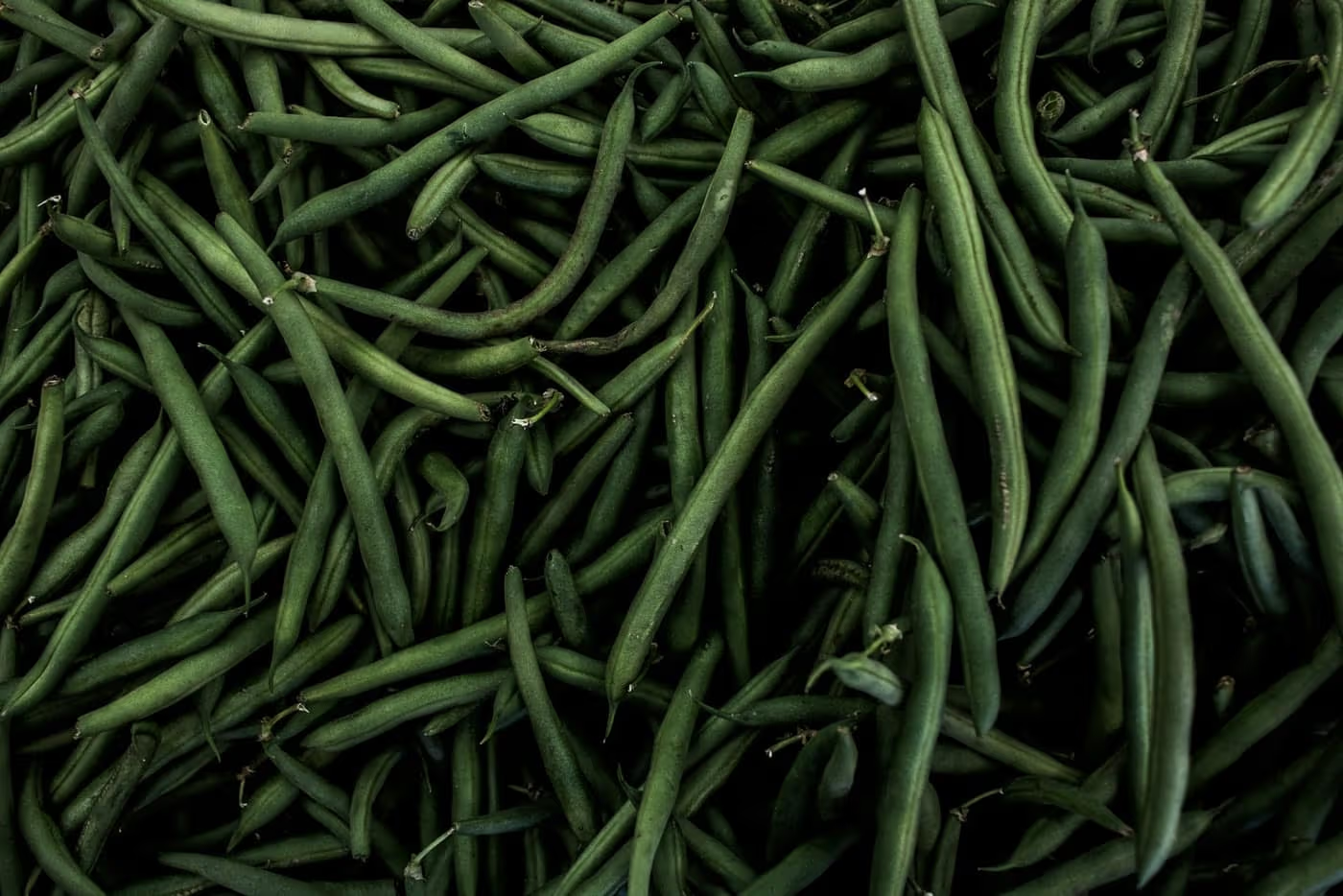
A quick, cool-loving pod vegetable picked young every two to three days for a month or more, where the crop is made by using clean, disease-free seed (because the worst diseases travel inside the seed itself, not just in the soil), by never letting the bed waterlog even for a day, and by picking the pods tender before the seed inside swells and the pod turns fibrous and unsellable.
Quick Summary
The key points from this page in about two minutes — read it or have it read aloud.
Quick Summary
French bean (farasbean or "French beans") is a cool-season legume grown for its tender green pods, quite different from rajma, which is the same species (Phaseolus vulgaris) grown instead for its dry seed. It is a rabi crop in the plains and a summer crop in the hills — Karnataka, Maharashtra, Himachal Pradesh, Uttarakhand, West Bengal and the north-eastern hills grow most of the commercial crop, split between compact bush types and taller pole types that need staking.
Two things decide how clean the crop stays. The first is seed health: the worst French bean diseases — bacterial blight and anthracnose — travel inside the seed itself, so a crop grown from bought seed of unknown history can start the season already carrying disease that no amount of spraying later will fully control. The second is drainage: French bean roots rot within a day or two of waterlogging, so it is always grown on ridges or raised beds, never on the flat where water can pool.
As a legume it fixes some of its own nitrogen through root-nodule bacteria, but on Indian soils that are rarely already well-inoculated it still responds well to a modest starter dose of nitrogen plus phosphorus and potash. The crop is short and quick — pods are ready from about 45–55 days for bush types and a little later for pole types — and once picking starts it must be kept up every 2–3 days, because pods left on the vine toughen fast and also signal the plant to stop flowering.
The main pest and disease risks are bean stem fly at the seedling stage, aphids and whitefly (which also spread virus), pod borer, and — beyond bacterial blight and anthracnose — angular leaf spot and rust in humid weather. None of these are difficult to manage on a crop this short, provided clean seed, good drainage and timely picking are already in place.
- Crop type
- Cool-season annual legume, grown for tender pods (bush or pole habit)
- Season
- Plains: rabi (Oct–Dec sowing); hills: summer/monsoon
- Suitable states
- Karnataka, Maharashtra, Himachal Pradesh, Uttarakhand, West Bengal
- Growing duration
- First pick 45–55 days (bush); 55–70 days (pole); picking 3–10 weeks
- Water requirement
- Moderate; even moisture, never waterlogged
- Temperature
- Cool, 16–24°C ideal; poor pod set below 10°C and above 30°C
- Soil type
- Well-drained sandy loam to loam, pH 6.0–7.0, moderate organic matter
- Difficulty level
- Easy — quick, simple crop provided seed is clean and drainage is good
- Expected yield
- 8–12 t/ha (bush, OP); 12–18 t/ha (pole/hybrid types)
- Key risk
- Seed-borne bacterial blight and anthracnose spreading from infected seed
Overview
French bean (Phaseolus vulgaris), called farasbean or simply "French beans" in Indian markets, is grown for its tender, immature green pod — the same species that gives rajma (kidney bean) when the pods are instead left to mature and dry for their seed. It is a cool-season annual legume, sensitive to both frost and real heat, grown in two distinct plant forms: bushy, compact, self-supporting types that crop fast and all at once, and taller, vining pole types that need staking, crop over a longer period, and often yield more per plant.
It is a rabi crop in the northern and central plains (sown October–December) and a summer (kharif-season, monsoon-timed) hill crop in Himachal Pradesh, Uttarakhand, the Nilgiris and the north-east, where the cool hill climate lets it be grown well outside the plains window. Karnataka, Maharashtra, West Bengal, Himachal Pradesh and Uttarakhand together account for most of the commercial crop grown for fresh pods and for the frozen/processing trade.
The crop is defined by two vulnerabilities that good management removes almost entirely: seed-borne bacterial blight and anthracnose, which is why disease-free, treated seed of a known source matters more here than on most vegetables; and a very low tolerance for waterlogging, which is why the crop always goes on ridges or raised beds. Get those two right, pick every 2–3 days once pods start, and French bean is one of the quickest, most reliable vegetable crops to grow.
Crop timeline, sowing to harvest
A quick visual map of the season — jump to any section below for the detail behind each stage.
- Day 0
Sowing
Treated seed dibbled 2–3 cm deep on ridges or raised beds, 30–45 cm between rows for bush types (wider, with a support structure, for pole types), into a well-drained, well-manured bed.
- Day 5–10
Germination
Seedlings emerge; this is the bean stem fly danger window, when the maggot bores into the stem at the collar and can kill or badly stunt young seedlings.
- Day 15–25
Vegetative growth
Plants build leaves and, for pole types, start to run and need training onto the support; one hand-weeding and the first top-dressing go on.
- Day 30–40
Flowering
White, pink or purple flowers open along the stem; even soil moisture now is critical, since a dry check at flowering causes flower and young-pod drop.
- Day 45–55
First pick (bush types)
The first pods reach picking size — long, tender, snapping cleanly, seeds inside barely showing through the pod wall.
- Day 45–90
Repeat picking
Bush types crop hard over 3–4 weeks; pole types crop more lightly but over 6–10 weeks. Pods are cut or snapped every 2–3 days throughout.
Suitable states
States where this crop is grown at scale, highlighted below. Your local Krishi Vigyan Kendra is still the final word for your specific block.
- Jammu and Kashmir
- Himachal Pradesh
- Punjab
- Uttarakhand
- Haryana
- Delhi
- Uttar Pradesh
- Rajasthan
- Bihar
- Jharkhand
- West Bengal
- Sikkim
- Assam
- Arunachal Pradesh
- Meghalaya
- Nagaland
- Manipur
- Mizoram
- Tripura
- Gujarat
- Madhya Pradesh
- Chhattisgarh
- Maharashtra
- Odisha
- Goa
- Telangana
- Andhra Pradesh
- Karnataka
- Kerala
- Tamil Nadu
- Puducherry
- Ladakh
- Chandigarh
- Lakshadweep
Grown here
Climate requirements
Because the flowering-to-pod-set window is short and temperature-sensitive, timing the sowing date so this stage lands in the coolest, most settled part of the season matters more for French bean than for most vegetables.
Ideal temperature
A cool-season crop that also dislikes real cold. It grows and sets pods best at 16–24°C. Frost kills the plant outright, and below about 10°C flowering and pod set fail; above about 30°C flowers and young pods drop and pod quality drops. This narrow band is why the plains crop is a rabi crop and the hill crop runs through the cooler monsoon months.
Rainfall
Grown mostly on irrigation as a dry-season crop in the plains; the hill monsoon crop relies more on rainfall but still needs the field to drain fast, since standing water for even a day rots the roots.
Humidity
Moderate humidity suits it. Long humid, wet spells favour angular leaf spot, rust and anthracnose, and slow drying after rain or dew keeps disease pressure up.
Sunlight
Full sun for the best pod set and yield; pole types on a trellis get better light penetration than a sprawling bush crop.
Soil requirements
On land growing French bean or another legume for the first time, or after a long gap, treating the seed with a Rhizobium culture before sowing helps nodulation establish faster and can noticeably lift early growth and yield.
Suitable soil
A well-drained sandy loam to loam with moderate organic matter suits it best. French bean does not need especially rich soil — as a legume it fixes some of its own nitrogen — but it is unusually intolerant of poor drainage, so soil structure matters more than raw fertility.
pH range
Best at pH 6.0–7.0. It does poorly on strongly acid soil (below pH 5.5), where nodulation and nutrient uptake both suffer, and on strongly alkaline soil.
Drainage
This is the single most important soil factor. French bean roots and the nitrogen-fixing nodules on them are killed by even a day or two of waterlogging, which also opens the door to root rot. The crop is always sown on ridges or raised beds, never on the flat in anything but the lightest, fastest-draining soil.
Organic matter
A moderate dose of well-rotted farmyard manure or compost — 10–15 t/ha — improves structure and moisture-holding without over-feeding nitrogen, which the crop mostly makes for itself once nodulation is under way.
Land preparation
Same four steps whichever region you are in — only the timing shifts with the sowing window.
- 1
Plough to a fine tilth and form ridges or raised beds
Two or three ploughings to a fine tilth, then ridges or raised beds with clear drainage channels between them — this is non-negotiable given how fast the crop rots in waterlogged soil.
- 2
Mix in moderate organic manure and basal fertiliser
Work 10–15 t/ha of well-rotted FYM or compost into the bed, along with a basal (starter) dose of nitrogen, phosphorus and potash — the phosphorus in particular supports early root and nodule development.
- 3
Put up support for pole types before sowing
Erect a trellis, stakes, or a cane-and-string frame for pole varieties before or immediately after sowing, so the vine can be trained on as soon as it starts to run rather than left to sprawl and tangle.
Seed information
How the main varieties compare, so you can pick by duration, yield, disease pressure or what you are growing for.
| Variety | Duration | Yield | Disease resistance | Best state | Suitable for |
|---|---|---|---|---|---|
A widely grown, dependable bush variety with pink flowers and round, long, stringless, green pods that snap cleanly. Noted for field tolerance of mosaic virus and powdery mildew, which makes it a safe general-purpose choice. | First pick ~50–55 days | ~20 t/ha | Tolerant of mosaic and powdery mildew | North Indian plains, Karnataka | General-purpose bush crop, fresh market |
An IARI bush variety bred by irradiation and selection from a wax-podded line, with pink flowers and long, round, green pods. Bred with resistance to mosaic and powdery mildew, giving strong, reliable field performance. | First pick ~50–55 days | 22–25 t/ha | Resistant to mosaic and powdery mildew | North Indian plains | Disease-pressure areas, fresh market |
An ICAR-IIHR bush variety, originally an introduction from Afghanistan, with straight, flat, green pods and large brown seed. Valued for good transport and keeping quality, useful where the crop must travel to a distant market. | First pick ~65–70 days | ~19 t/ha (plus seed ~3 t/ha if left to mature) | No special resistance claimed | Karnataka, southern plateau | Transport to distant markets, dual pod/seed use |
An ICAR-IIHR bush variety with round, fleshy, stringless green pods and good early vigour, widely recommended alongside Arka Komal for the south Indian market-garden belt. | First pick ~50–55 days | ~18–20 t/ha | No special resistance claimed | Karnataka, Tamil Nadu, Andhra Pradesh | Southern market-garden crop |
An ICAR-IIHR pole variety needing staking, with long, round, stringless, tender pods borne over a longer picking window than the bush types. A good choice where labour for staking is available and a longer harvest spread is wanted. | First pick ~55–60 days; picking continues longer | ~22–25 t/ha | No special resistance claimed | Karnataka, hill and plateau belts | Staked pole crop, extended picking |
A GBPUAT (Pantnagar) bush variety bred with resistance to several of French bean's major diseases — angular leaf spot, common blight and mosaic — making it a strong choice in the hills and the tarai belt where humid weather favours these diseases. | First pick ~50–55 days | ~16–18 t/ha | Resistant to angular leaf spot, blight and mosaic | Uttarakhand, hill and tarai belts | Humid hill conditions, disease-pressure fields |
A long-established, internationally known pole variety, vigorous and productive with long, slightly curved, stringless pods, sold by several Indian seed companies and popular in kitchen and market gardens where a trellis is already in use. | First pick ~60–65 days; long picking window | ~18–22 t/ha | No special resistance claimed | Hills and kitchen-garden belts nationwide | Home and market-garden trellised crop |
- Seed rate
- 60–80 kg/ha for bush types, 25–35 kg/ha for pole types (fewer plants, wider spacing, more pods per plant). On an acre that is roughly 24–32 kg for bush and 10–14 kg for pole.
- Certified seed
- Because bacterial blight and anthracnose both travel inside the seed, always buy fresh, disease-free seed of a known, reputable source each season rather than saving seed from a field of unknown health — this single decision does more to prevent these diseases than any spray programme after sowing.
- Spacing
- Bush types: rows 30–45 cm apart, plants 8–10 cm apart in the row. Pole types: rows 60–90 cm apart, plants 20–30 cm apart, trained onto a trellis or stakes.
- Seed treatment
- Treat seed with a fungicide such as thiram or carbendazim against seed-borne fungal disease and seedling rots, and with a Rhizobium culture (especially on land new to legumes) to speed nodulation — the two treatments do not conflict and are commonly used together.
Sowing guide
Do not sow into a field that still holds moisture from a recent heavy irrigation or rain — waterlogged sowing conditions are one of the fastest ways to lose a stand to seed and seedling rot before it even emerges.
- Best time
- Plains: mid-October to November for the main rabi crop (a September sowing risks late-season heat, a January sowing risks a cold check at flowering). Hills: March to July, timed so flowering lands in the cooler part of the season and avoids the heaviest monsoon downpours.
- Row spacing
- 30–45 cm (bush); 60–90 cm (pole)
- Plant spacing
- 8–10 cm (bush); 20–30 cm (pole)
- Sowing depth
- 2–3 cm
- Method
- Dibble treated seed directly on the prepared ridge or bed — French bean does not transplant well, so it is always direct-sown. For pole types, sow close to the base of the support structure so training can start as soon as the vine begins to run.
Fertilizer schedule
A split dose beats one large dose applied at sowing — nitrogen especially is lost to the air and to leaching if it all goes in on day one.
- 1
Basal (at sowing)
Day 0
A starter dose of about 20–25 kg N, 50–60 kg P₂O₅ and 40–50 kg K₂O per hectare mixed into the ridge, along with well-rotted FYM. The modest nitrogen is a starter only — the crop fixes more of its own once nodules develop.
- 2
Top-dressing
25–30 days (early flowering)
A light top-dressing of nitrogen (10–15 kg N/ha) if the crop looks pale or slow, timed just before flowering to support pod set — heavier nitrogen than this pushes leafy growth at the cost of pods.
Irrigation schedule
1. Sowing to germination
Day 0–10
Light irrigation right after sowing if the bed is not already moist, then as needed to keep germination even — but never enough to pool water on the ridge.
2. Vegetative growth
Day 10–30
Water every 7–10 days, keeping the soil moist but well short of saturated.
3. Flowering to pod fill
Day 30–70
The critical period — water every 5–7 days so the crop never dries out at flowering or while pods are filling. A dry check now causes flower and young-pod drop; the same period is when waterlogging does the most damage, so irrigation must be enough but never excessive.
Critical stages
- Flowering
- Pod development and picking
Water-saving tips
- Drip on the ridge delivers the steady, moderate moisture French bean needs while keeping the root zone from ever waterlogging — a good match for this crop's two opposite risks (drought stress and root rot).
- A light mulch between rows evens out soil moisture and keeps developing pods off wet soil, reducing rot.
- Never irrigate right before a forecast heavy rain — French bean's intolerance of waterlogging means the field must be able to shed extra water fast.
Weed management
Common weeds
Organic control
- One or two hand-weedings with light earthing-up before flowering; after the canopy closes the crop shades most weeds itself, especially bush types sown reasonably close.
- A straw mulch on the ridge suppresses weeds and keeps pods clean where they touch the ground on bush types.
Chemical control
- A pre-emergence herbicide cleared for beans, where used on larger areas, applied right after sowing, followed by one hand-weeding and earthing-up at 20–25 days.
- Confirm the product and pre-harvest interval with the local KVK — French bean pods are picked repeatedly and eaten fresh, so herbicide timing matters.
Nutrient deficiency identification
What a shortage of each nutrient actually looks like on the plant, so you can tell a deficiency apart from a disease before you spray the wrong thing.
Nitrogen
Visible symptom
Pale, small, slow plants and reduced flowering — usually a sign that nodulation has not established well (common on land new to legumes, or where Rhizobium inoculation was skipped), not a soil-fertility problem alone.
Phosphorus
Visible symptom
Dark green but stunted plants, delayed flowering, and poor early root and nodule development — a phosphorus shortfall at sowing sets the crop back from the start.
Potassium
Visible symptom
Scorched, browning margins on older leaves, and pods that are smaller and less crisp.
Manganese/Iron
Visible symptom
Yellowing between the veins of younger leaves on alkaline soil, which also depresses nodule activity and nitrogen fixation.
Diseases to watch for
Symptoms, likely cause and what actually treats it — not just a spray name.
Common bacterial blight
- Symptoms
- Water-soaked spots on leaves that turn brown with a narrow yellow halo, spreading and merging into large dead patches; on pods, water-soaked, greasy-looking spots that turn brown and sunken.
- Cause
- The bacterium Xanthomonas axonopodis pv. phaseoli, carried inside and on the seed coat and spread further by rain splash and handling in wet foliage — a genuinely seed-borne disease.
- Treatment
- A copper-based bactericide from the first spots can slow spread, but there is no cure once established; badly affected plants are best removed. The real control point is before sowing.
- Prevention
- Sow only certified, disease-free seed; avoid working in the field when the foliage is wet; rotate away from beans for 2 years on a field with a blight history.
Anthracnose
- Symptoms
- Dark, sunken, angular spots on leaves along the veins; on pods, dark, sunken, circular cankers with a pinkish spore mass in the centre in humid weather — the classic disfiguring pod disease of French bean.
- Cause
- The fungus Colletotrichum lindemuthianum, carried inside the seed and spread by rain splash; favoured by cool, wet, humid weather, unlike most other bean diseases which prefer warmth.
- Treatment
- A protective fungicide (mancozeb or a copper product) from the first spots, repeated in wet weather with the pre-harvest interval observed; badly spotted pods cannot be salvaged for the fresh market.
- Prevention
- Sow only certified, disease-free seed — this is the single biggest lever, since a clean field can still be seeded with the disease; rotate away from beans for 2 years and avoid overhead irrigation in cool, wet weather.
Angular leaf spot
- Symptoms
- Angular, brown spots bounded by the leaf veins, giving a distinctive "stained-glass" pattern, with a grey fungal growth on the underside in humid weather; heavy spotting causes early leaf drop.
- Cause
- The fungus Pseudocercospora griseola, spread by wind and rain splash, favoured by warm, humid conditions and dense stands.
- Treatment
- A protective fungicide (mancozeb) from the first spots, repeated at 10–14 day intervals in wet weather.
- Prevention
- Choose a resistant variety (Pant Anupama) in humid hill/tarai areas, use wider spacing for airflow, and rotate away from beans.
Bean rust
- Symptoms
- Small, raised, rust-red pustules on the underside of leaves (and sometimes pods), turning dark brown to black as they age; heavy infection yellows and drops the leaves early.
- Cause
- The fungus Uromyces appendiculatus, spread by wind-blown spores, favoured by moderate temperatures and high humidity or dew.
- Treatment
- A protective fungicide (a triazole or mancozeb) from the first pustules, repeated in favourable weather.
- Prevention
- Avoid dense planting and overhead irrigation late in the day, rotate away from beans, and remove and destroy crop debris after harvest.
Pests to watch for
What to look for before the damage is visible, and organic options before you reach for a chemical.
Bean stem fly (bean fly)
- Identification
- Tiny maggots boring into the stem near the soil line on young seedlings, causing a swollen, cracked collar; affected seedlings wilt, turn yellow, and often die or stay badly stunted.
- Damage
- The most damaging pest at the seedling stage — a heavy attack can kill a large share of a young stand before it is established, sometimes forcing re-sowing.
- Organic control
- Earth up around the base of seedlings to encourage adventitious roots above the damage, remove and destroy badly wilted seedlings, and treat seed with an approved seed-dressing insecticide as a preventive measure.
- Chemical control
- A seed-dressing or soil-applied insecticide at sowing is the standard preventive control, since spraying after damage is visible is largely ineffective on a pest that feeds inside the stem.
Aphids
- Identification
- Colonies of small green or black soft-bodied insects on the undersides of leaves and growing tips, with sticky honeydew and sooty mould.
- Damage
- Direct sap loss curls and stunts new growth, but aphids also spread bean common mosaic and other viruses, which is the bigger long-run risk.
- Organic control
- Strong water jets on hotspots, neem sprays, yellow sticky traps, and conserving ladybird beetles and lacewings.
- Chemical control
- A recommended systemic insecticide only when colonies are heavy or virus pressure is high.
Whitefly
- Identification
- Tiny white insects flying up in a cloud when the plant is disturbed, clustering on leaf undersides, with honeydew and sooty mould below.
- Damage
- A vector for some bean viruses and a direct sap-feeder on heavy infestations; more of a problem in warmer sowings and in the hills during the humid monsoon.
- Organic control
- Yellow sticky traps, neem sprays, and removing weed hosts around the field.
- Chemical control
- A recommended systemic insecticide only where populations are high.
Pod borer (Helicoverpa / Maruca)
- Identification
- A round entry hole in the pod with visible frass, and a caterpillar feeding inside on the developing seed, hollowing and spoiling the pod.
- Damage
- A bored pod is a direct loss and cannot be sold fresh; a heavy infestation late in the picking window can take a meaningful share of the remaining crop.
- Organic control
- Handpick and destroy visibly bored pods at each picking, use pheromone traps to monitor moth activity, and encourage natural parasitoids by avoiding broad-spectrum sprays.
- Chemical control
- A CIB&RC-registered insecticide for pod borer on beans at the first sign of entry holes, observing the pre-harvest interval strictly since pods are picked every 2–3 days.
Common mistakes to avoid
The mistakes that cost growers the most, ranked by how often they show up in the field — not in the order you might expect.
- 1
Sowing saved or unknown-source seed instead of certified, disease-free seed.
Why it hurts
Bacterial blight and anthracnose both travel inside the seed coat — a field sown with infected seed can show disease within weeks even with no obvious source nearby, and no spray programme afterward fully controls it. Buy fresh seed of a known, reputable source every season.
- 2
Sowing on the flat instead of ridges or raised beds.
Why it hurts
French bean roots and their nitrogen-fixing nodules die within a day or two of waterlogging, and root rot follows. Always sow on ridges or raised beds with clear drainage, whatever the local convention for other crops.
- 3
Skipping picking for a few days when other work is pressing.
Why it hurts
Pods left on the vine toughen and become fibrous within days, and mature pods signal the plant to slow or stop flowering — a missed picking round can cost several rounds of future yield, not just the pods that overgrew.
- 4
Over-applying nitrogen at sowing.
Why it hurts
Heavy nitrogen pushes leafy growth and delays or reduces flowering; French bean makes much of its own nitrogen once nodules develop, so a starter dose is enough on most soils.
- 5
Skipping Rhizobium seed treatment on land new to legumes.
Why it hurts
Without an existing population of the right Rhizobium bacteria in the soil, nodulation is slow or weak and the crop is more dependent on applied nitrogen than it should be. A cheap seed-applied Rhizobium culture fixes this at almost no cost.
- 6
Not staking pole types promptly.
Why it hurts
An untrained pole variety sprawls, tangles, and sets fewer, dirtier, harder-to-pick pods than the same variety properly trained onto a support. Put the trellis or stakes up before or right at sowing, not after the vine has already started to run.
Harvesting
Pick pods when they are full length for the variety, tender, and snap cleanly, with the seed inside only just beginning to show as a slight bulge through the pod wall — waiting for the seed to swell fully makes the pod fibrous and unsellable fresh. Bush types are ready from about 45–55 days and crop hard over 3–4 weeks; pole types start a little later and crop more lightly over a longer 6–10 week window. Pick every 2–3 days by hand, snapping or cutting the pod without pulling on the stem.
Signs it is ready
- Pod at full length for the variety, still slender
- Snaps cleanly and crisply, not bending or fibrous
- Seed only just visible as a slight bulge, not swollen
- Bright, uniform green colour with no yellowing
Tools
- Clean hands or small scissors for a gentle snap/cut
- Shallow baskets or crates — pods bruise if piled deep
- Shade at the field edge for holding picked pods before they move to market
Expected yield
About 8–12 t/ha for bush open-pollinated varieties, 12–18 t/ha for pole types and hybrids under good management. On an acre that is roughly 32–70 quintals across the picking period.
Post-harvest & storage
Storage
French bean pods are moderately perishable — they keep about 1–2 days at room temperature and up to 7–10 days at 4–7°C with high humidity (colder storage causes chilling injury with pitting and discolouration).
Packaging
Pack in shallow, ventilated crates or perforated bags, not deep sacks — pods bruise and discolour under weight and heat up in a tight pack.
Transportation
Move in the cool of the day in ventilated crates; for distant or export markets, pre-cool the pods soon after picking and hold the cold chain through transport.
Shelf life
1–2 days at room temperature; 7–10 days at 4–7°C and high humidity. Pods held too cold (below about 4°C) develop pitting and off-flavours within days.
Market prices
Today's mandi price near you, pulled live from the government's own Agmarknet data.
Live daily mandi prices from the government Agmarknet dataset.
Synced from data.gov.in (Agmarknet). Rates are ₹ per quintal.
Weather
Current conditions and a 5-day outlook for your selected location, with one line of stage-aware advice.
Pick your state for current conditions and a 5-day outlook.
Live data from Open-Meteo
Profit calculator
Your own cost sheet, expected yield and selling price — not ours.
Where the money goes
Share of the total cost per acre, using the calculator’s own default cost sheet below — adjust the numbers there to match your field and this picture will no longer apply to you exactly, but the ranking rarely changes.
- Labour35% (₹11,000)
- Land rent20% (₹6,500)
- Seed11% (₹3,500)
- Pesticide & weedicide8% (₹2,500)
- Machinery8% (₹2,500)
- Irrigation8% (₹2,500)
- Fertiliser6% (₹2,000)
- Interest4% (₹1,300)
Official downloads
Government and ICAR documents only — everything below is hosted on an official server.
ICAR-IIHR, Bengaluru — Vegetable Crops
Arka Komal, Arka Suvidha, Arka Anoop and French bean package of practices
ICAR-IARI, New Delhi — Division of Vegetable Science
Pusa Parvati and rabi vegetable-legume advisories
GBPUAT, Pantnagar
Pant Anupama and hill/tarai French bean disease management
Kisan Call Centre — 1800-180-1551
Free crop advice in your language
Frequently asked questions
Is French bean the same crop as rajma?
Yes and no. Both are Phaseolus vulgaris — the same species — but grown for different products. French bean is picked young and tender for its green pod; rajma is the same plant left to mature so the pod dries and the seed inside (the kidney bean) is harvested and eaten dry. Some varieties can be used either way, but most named varieties are bred specifically for one purpose or the other.
Why do people insist on certified seed for French bean specifically?
Because its two worst diseases — bacterial blight and anthracnose — travel inside the seed coat itself, not just in the soil or air. A field sown with infected seed can develop disease within weeks even if no other source of infection is anywhere nearby, and once established neither disease has a real cure. Buying fresh, disease-free seed of a known source each season is the single most effective disease-prevention step for this crop.
Why did my French bean seedlings wilt and die soon after coming up?
The most likely cause at that stage is bean stem fly, whose maggots bore into the stem near the soil line. Treating seed with an approved insecticidal seed-dressing before sowing is the standard prevention, since spraying after the maggot is already inside the stem does little good. Earthing up around the base can help surviving seedlings put out new roots above the damage.
Why can't I grow French bean where water sometimes stands after rain?
French bean roots, and the nitrogen-fixing nodules on them, die within a day or two of waterlogging, and root rot quickly follows. This is a much lower tolerance for standing water than most vegetables have. Always sow on ridges or raised beds with clear drainage, and if the field is prone to pooling, improve drainage before sowing rather than after the crop is in trouble.
How often should I pick, and why does it matter so much?
Every 2–3 days, without exception once picking starts. Pods left on the vine toughen and turn fibrous within days, and — just as importantly — a plant carrying maturing pods slows or stops setting new flowers. Skipping even one picking round can cost several future rounds of yield, not just the overgrown pods themselves.
Does French bean have an MSP or a mandi price?
There is no MSP for French bean. It is traded as "French Beans" on Agmarknet, with daily price and arrival data from APMC markets, and much of the hill crop also moves through contracts for the fresh-export and frozen-vegetable processing trade. Price is best for the off-season crop and lowest at the peak of the main rabi plains harvest.
Still have questions?
The FAQs above cover the common ones. For anything specific to your field and soil, your nearest Krishi Vigyan Kendra is the authoritative answer.