
Papaya
Carica papaya
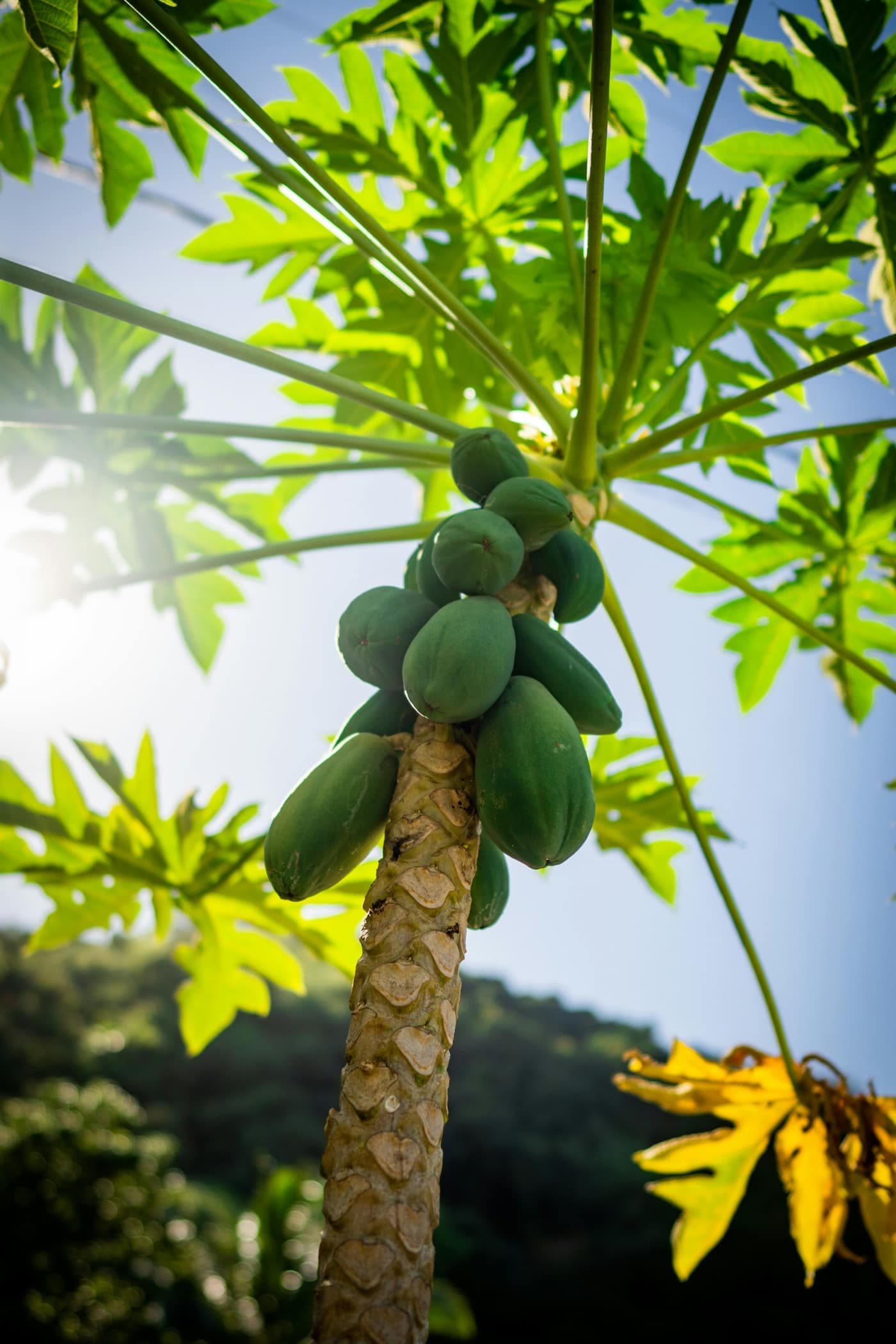
The fastest fruit to a return — planted and picking inside a year — but the most virus-exposed. Papaya ring spot virus, spread by aphids, is the crop’s ceiling, so a clean, isolated, well-drained block, hybrid seed and quick roguing matter more than any other single practice.
Quick Summary
The key points from this page in about two minutes — read it or have it read aloud.
Quick Summary
Papaya is the quickest fruit a grower can plant for a return — seed to first picking in eight to ten months, and then a rolling harvest for a year or more from one planting. It is fast and forgiving in every way but one: virus. Papaya ring spot virus, spread by aphids, is the ceiling on the crop everywhere it is grown — it stunts the plant, mottles the leaves and rings the fruit, and there is no cure. A block’s whole economics turn on keeping the virus out, so a clean, isolated, well-drained plot, hybrid seed, early aphid control and quick removal of any infected plant matter more than anything else.
The other quirk is sex. Papaya plants are male, female or hermaphrodite, and only the last two bear fruit, so growers either plant several seedlings per pit and thin to a fruiting plant once the sex shows, or use a gynodioecious hybrid that sets reliable, uniform, market-shaped fruit.
Two climatic rules are non-negotiable: the block needs a frost-free window long enough to crop, because a light frost kills the plant outright, and a soil that never stands water, because waterlogging rots the collar in days. Feed it steadily by fertigation and keep the moisture even to hold the fruit set. Pick at colour-break — a yellow tinge at the tip of the lowest fruit — in continuous rounds until virus or declining yield ends the crop. The page below carries the planting layout, the fertigation schedule, the virus-avoidance and roguing plan, sex-management guidance, the harvest indicator and expected yields.
- Crop type
- Fast-bearing fruit
- Planting
- Feb–Mar / Jun–Jul / Oct–Nov
- Suitable states
- 12+ major states
- To first harvest
- 8–10 months
- Water requirement
- Moderate; never waterlogged
- Temperature
- 25–35°C, frost-free
- Soil type
- Light, very well-drained loam
- Difficulty level
- Moderate
- Expected yield
- 400–800 q/ha
- Key practice
- Virus avoidance + drainage
Overview
Papaya (Carica papaya) is the quickest-returning fruit a grower can plant — seed to first picking in eight to ten months, and then a rolling harvest for a year or more from a single planting. Andhra Pradesh, Gujarat, Karnataka and Madhya Pradesh lead a crop grown both fresh and for papain and processing.
It is also a fast, forgiving crop in every way but one: virus. Papaya ring spot virus (PRSV), spread by aphids, is the ceiling on the crop everywhere it is grown — it stunts the plant, mottles the leaves and rings the fruit, and there is no cure. A block’s whole economics turn on keeping virus out and the plant growing ahead of it.
The other quirk is sex. Papaya plants are male, female or hermaphrodite, and only the last two bear fruit, so growers plant several seedlings per pit and thin to a fruiting plant once sex shows — unless they use a gynodioecious hybrid that sets reliable, uniform, market-shaped fruit. This guide follows the crop with virus avoidance, drainage and sex management as the levers.
Crop timeline, sowing to harvest
A quick visual map of the season — jump to any section below for the detail behind each stage.
- Day 0
Nursery / transplant
Hybrid seed raised in pro-trays or planted; seedlings transplanted at 1.8 × 1.8 m onto raised beds/pits.
- Month 1–3
Vegetative growth
The single stem grows fast on regular fertigation; drainage and early aphid control protect it from virus.
- Month 3–4
Flowering & sex sorting
Plants flower and their sex shows; extra males are removed, leaving hermaphrodite/female plants for fruit.
- Month 4–6
Fruit set
Fruit sets in the leaf axils up the stem in a continuous column; steady moisture holds the set.
- Month 7–9
Fruit development
The fruit column fills up the trunk; the plant keeps flowering and fruiting at the top as it grows.
- Month 8–10
Maturity
The lowest fruit shows colour-break (a yellow tinge at the tip) — the sign to start the long, rolling harvest.
- Month 8–20
Harvest
Fruit is picked at colour-break in continuous rounds for a year or more until virus or yield decline ends the crop.
Suitable states
States where this crop is grown at scale, highlighted below. Your local Krishi Vigyan Kendra is still the final word for your specific block.
- Jammu and Kashmir
- Himachal Pradesh
- Punjab
- Uttarakhand
- Haryana
- Delhi
- Uttar Pradesh
- Rajasthan
- Bihar
- Jharkhand
- West Bengal
- Sikkim
- Assam
- Arunachal Pradesh
- Meghalaya
- Nagaland
- Manipur
- Mizoram
- Tripura
- Gujarat
- Madhya Pradesh
- Chhattisgarh
- Maharashtra
- Odisha
- Goa
- Telangana
- Andhra Pradesh
- Karnataka
- Kerala
- Tamil Nadu
- Puducherry
- Ladakh
- Chandigarh
Grown here
Climate requirements
Papaya is a fast, warm, frost-free crop that cannot take cold or wet feet. A light frost kills it outright and waterlogging rots the collar in days, so the two climatic non-negotiables are a frost-free window long enough to crop and a soil that never stands water.
Ideal temperature
25–35°C is ideal; growth and fruit quality fall below 15°C, and even a light frost kills the plant, so it is strictly frost-free
Rainfall
Wants moderate, steady moisture supplied by irrigation on well-drained land; heavy rain and waterlogging rot the collar and roots
Humidity
Moderate; the plant likes warmth but very humid weather worsens fruit rots and some diseases
Sunlight
Full sun for fast growth, high fruit set and sweetness; shade thins the plant and drops sugar
Soil requirements
No fruit is less forgiving of wet feet than papaya. Its succulent stem and shallow roots collapse to collar rot in waterlogged soil, so it must go on a raised bed or mound on light, free-draining land, and the water must always drain away from the plant base.
Suitable soil
Light, fertile, very well-drained loam or sandy loam; avoid heavy, poorly-drained, saline or shallow soils
pH range
6.0–7.0
Drainage
Excellent drainage is critical — papaya’s soft, shallow collar and roots rot fast in standing water, killing the plant
Organic matter
Responds strongly to FYM and compost worked into the pit; but avoid over-wet, heavy conditions whatever the fertility
Land preparation
Same four steps whichever region you are in — only the timing shifts with the sowing window.
- 1
Raised beds / pits
Form raised beds or mounds and dig pits filled with topsoil, FYM and phosphorus so water drains away from the collar.
- 2
Isolation from old papaya
Site a new block away from old, virus-infected papaya — proximity to a virus source is the surest way to lose a crop early.
- 3
Hybrid seed & nursery
Raise gynodioecious hybrid seed in pro-trays for uniform, fruitful, transplant-ready seedlings.
Seed information
How the main varieties compare, so you can pick by duration, yield, disease pressure or what you are growing for.
| Variety | Duration | Yield | Disease resistance | Best state | Suitable for |
|---|---|---|---|---|---|
The dominant gynodioecious hybrid — vigorous, tolerant, early and heavy-bearing with uniform red-fleshed fruit; the commercial default. | First pick ~8 months | Very high | PRSV-tolerant (not immune) | Andhra Pradesh | Commercial fresh market |
From IARI — a dwarf, compact release bred for kitchen gardens and high-density planting, fruiting close to the ground where Pusa Delicious and CO 7 both grow much taller. | First harvest 8–9 months after planting | 400–450 q/ha | Moderate papaya ring spot virus tolerance | Delhi, Uttar Pradesh | High-density, easy picking |
A sweet, good-quality selection popular in the south for the fresh table market. | Mid | High | Moderate | Karnataka | Sweet table fruit |
From IARI — dioecious, medium-large, deep-orange-fleshed fruit good for both the table and the processing trade, with true seed that breeds reasonably true if isolated. | First harvest 10–11 months after planting | 600–700 q/ha | Moderate papaya ring spot virus tolerance | Uttar Pradesh, Bihar, West Bengal | Table, fresh market |
From TNAU Coimbatore — gynodioecious with a heavier per-hectare yield than Pusa Delicious, the release most south Indian commercial growers plant. | First harvest 9–10 months after planting | 900–1,000 q/ha | Moderate papaya ring spot virus tolerance | Tamil Nadu, Andhra Pradesh, Karnataka | Commercial, south India |
CO-series / papain types Selections grown for high latex (papain) yield as well as fruit, for the enzyme and processing trade. | Mid–late | High | Moderate | Tamil Nadu | Papain & processing |
- Seed rate
- About 250–300 g/ha of hybrid seed for a nursery, giving roughly 2,500–3,000 plants/ha at 1.8 × 1.8 m
- Certified seed
- Use fresh, certified gynodioecious hybrid seed (e.g. Red Lady) from a reliable source — it gives uniform, self-pollinating, fruitful plants and saves the trouble of sex-thinning. Old or open-pollinated seed gives variable sex and shape and a weaker, more virus-prone crop.
- Spacing
- 1.8 × 1.8 m (about 2,500–3,000 plants/ha); closer for dwarf/high-density systems
- Seed treatment
- Treat seed with a fungicide and raise in clean pro-trays; harden seedlings before transplanting and set them slightly high to keep the collar dry.
Sowing guide
Time the transplant so the plant’s soft early growth avoids both frost and the heaviest rains, and set it slightly high on the bed — a collar even a little too deep or too wet rots. With hybrid seed you keep one plant per pit; with open-pollinated seed, plant two or three and thin to a fruiting plant once sex shows.
- Best time
- Transplant in February–March, June–July or October–November, timed so the crop’s tender early months miss frost and peak rains
- Row spacing
- 1.8 m between rows
- Plant spacing
- 1.8 m within the row
- Sowing depth
- Transplant at nursery depth on a raised bed, keeping the collar slightly above the finished soil to avoid rot
- Method
- Transplant hardened hybrid seedlings (one per pit, or thin to one) onto raised beds/mounds and irrigate lightly
Fertilizer schedule
A split dose beats one large dose applied at sowing — nitrogen especially is lost to the air and to leaching if it all goes in on day one.
- 1
Basal (at transplant)
Month 0
FYM with phosphorus and part of the potash in the pit; papaya is a heavy, continuous feeder.
- 2
Vegetative & flowering
Month 1–5
Regular split nitrogen and potash (fertigation is ideal) every few weeks to drive fast growth and early set.
- 3
Continuous fruiting
Month 6 onward
Keep feeding through the long harvest — because the plant flowers, fruits and grows at once, it never stops needing nutrients.
Irrigation schedule
1. Establishment
Month 0–1
Light, frequent irrigation to settle the transplant; keep the collar moist but never waterlogged.
2. Vegetative & flowering
Month 2–5
Regular drip irrigation for steady, fast growth; water stress now cuts set and fruit size.
3. Fruiting
Month 6 onward
Even moisture through the continuous harvest for size and sweetness; avoid the dry-wet swings that drop fruit.
Critical stages
- Flowering & set
- Continuous fruiting
Water-saving tips
- Drip irrigation is ideal — it meets the steady demand, keeps the collar dry, and lets you fertigate the continuous crop.
- A raised bed with basin mulch holds moisture and, crucially, keeps water off the rot-prone collar.
- Even watering prevents the fruit drop that erratic irrigation causes in a continuously-fruiting crop.
Weed management
Common weeds
Organic control
- Bed/basin mulch suppresses weeds and conserves moisture while keeping the collar dry.
- A short intercrop of vegetables in the first two months uses the open space and shades weeds.
Chemical control
- A pre-emergence herbicide in the inter-space early on, kept off the collar and shallow roots.
- Spot weeding of the bed by hand; avoid deep cultivation near the shallow roots.
Nutrient deficiency identification
What a shortage of each nutrient actually looks like on the plant, so you can tell a deficiency apart from a disease before you spray the wrong thing.
Nitrogen
Visible symptom
Uniform pale, small leaves and slow growth with fewer, smaller fruit on the continuous column.
Potassium
Visible symptom
Marginal scorch of older leaves and small, low-sugar fruit.
Boron
Visible symptom
“Bumpy” fruit with lumpy, distorted skin and latex flecks, and poor set — a classic papaya disorder.
Zinc
Visible symptom
Small, mottled new leaves and shortened growth on light soils.
Magnesium
Visible symptom
Interveinal yellowing of older leaves while the veins stay green.
Diseases to watch for
Symptoms, likely cause and what actually treats it — not just a spray name.
Papaya ring spot virus (PRSV)
- Symptoms
- Mottled, distorted, “shoestring” leaves, oily streaks on the stem, and concentric rings on the fruit; the plant stunts and fruit becomes small and inedible.
- Cause
- A virus spread non-persistently by aphids from infected papaya; there is no cure, and it is the crop’s single biggest limitation.
- Treatment
- No cure — rogue and destroy infected plants at once to slow spread to the rest of the block.
- Prevention
- Use tolerant hybrids (Red Lady), isolate new blocks from old infected papaya, rogue early, control aphids and grow a fast crop that fruits before virus builds up — avoidance is everything.
Collar rot / foot rot (Phytophthora / Pythium)
- Symptoms
- Water-soaked rot at the collar and stem base, the plant wilting and toppling; roots and lower fruit rot in wet weather.
- Cause
- Soil fungi in waterlogged or over-wet soil, entering the succulent collar.
- Treatment
- Improve drainage, drench with a recommended fungicide, and remove collapsed plants.
- Prevention
- Raised beds, a collar kept slightly high and dry, and never letting water stand at the plant base — this is a drainage disease.
Anthracnose & fruit rots
- Symptoms
- Sunken, dark, spreading spots on ripening fruit, worst in humid weather and during storage and transit.
- Cause
- Colletotrichum and other fungi infecting the fruit, developing as it ripens.
- Treatment
- Pre-harvest fungicide sprays and a post-harvest hot-water dip to control latent infection in stored fruit.
- Prevention
- Harvest at colour-break, handle gently, and keep the crop and fruit dry and well-aired.
Powdery mildew & leaf spots
- Symptoms
- White powdery growth or leaf spots on foliage that reduce the leaf area feeding the continuous crop.
- Cause
- Fungi favoured by humid, mild weather on the canopy.
- Treatment
- A recommended fungicide (sulphur/systemic) on the foliage when it appears.
- Prevention
- Good spacing, airflow and balanced nutrition to keep the canopy healthy.
Pests to watch for
What to look for before the damage is visible, and organic options before you reach for a chemical.
Aphids
- Identification
- Small soft green/black aphids on the tender growing point and young leaves, often winged and moving between plants.
- Damage
- Direct feeding is minor, but aphids are the vectors of PRSV — so aphid control is really virus management.
- Organic control
- Reflective/silver mulch to repel aphids, neem sprays, border crops, and roguing virus-struck plants to remove the source.
- Chemical control
- A recommended insecticide/oil on the growing point where aphid pressure is high; combine with roguing, as spraying alone will not stop virus.
Papaya mealybug
- Identification
- Clusters of white, waxy mealybugs coating the leaves, stem and fruit, with sooty mould on their honeydew.
- Damage
- Heavy infestation cakes the plant white, sucks it dry, distorts fruit and can kill young plants — a serious invasive pest.
- Organic control
- Release of the introduced parasitoid (Acerophagus) has given excellent classical biocontrol; support it by conserving natural enemies and avoiding broad-spectrum sprays.
- Chemical control
- Spot treatment where needed, but favour the parasitoid — broad sprays kill it and make mealybug worse.
Red spider mite
- Identification
- Fine webbing and stippled, bronzed leaves in hot, dry weather, especially on stressed plants.
- Damage
- Leaf scorching that reduces the canopy feeding the continuous crop.
- Organic control
- Keep the plant unstressed and well-watered; neem or sulphur sprays reduce numbers.
- Chemical control
- A recommended miticide if mites build up in a hot, dry spell.
Fruit fly
- Identification
- Maggots inside ripening fruit from eggs laid under the skin, causing soft rot and drop.
- Damage
- Infested fruit is unsellable; a problem mainly in fruit allowed to ripen on the plant.
- Organic control
- Harvest at colour-break rather than ripe, use bait traps, and collect and destroy fallen fruit.
- Chemical control
- Bait sprays near maturity where fly pressure is high.
Common mistakes to avoid
The mistakes that cost growers the most, ranked by how often they show up in the field — not in the order you might expect.
- 1
Planting next to old, virus-infected papaya.
Why it hurts
PRSV has no cure and aphids carry it straight from an old block to a new one — isolating a fresh planting from any virus source is the single most important thing you can do.
- 2
Using old or open-pollinated seed instead of a tolerant hybrid.
Why it hurts
You get variable sex and fruit shape, weaker plants and more virus — a gynodioecious tolerant hybrid like Red Lady gives uniform, self-pollinating, fruitful plants and a fighting chance against PRSV.
- 3
Planting in heavy or waterlogged soil, or setting the collar too deep.
Why it hurts
Papaya’s soft collar rots fast in wet soil and topples the plant — it must go slightly high on a raised bed on light, free-draining land.
- 4
Not roguing virus-struck plants early.
Why it hurts
Every infected plant left standing is a source aphids spread to its neighbours — rogue and destroy them the moment symptoms show, not at the end of the season.
- 5
Ignoring aphids until virus appears.
Why it hurts
By the time you see ring spot the virus is already spreading — manage aphids (reflective mulch, control, roguing) from the start as virus prevention, not pest control.
- 6
Not thinning to a fruiting plant (with open-pollinated seed).
Why it hurts
A male papaya bears no fruit — where you plant several seedlings per pit, you must thin to a hermaphrodite/female once sex shows, or lose the spot to a barren male.
- 7
Under-feeding the continuous crop.
Why it hurts
Papaya flowers, fruits and grows all at once, so it never stops needing nutrients — a single early dose is not enough; feed it through the whole harvest.
- 8
Ignoring boron.
Why it hurts
Boron deficiency gives lumpy, bumpy, latex-flecked, distorted fruit that will not sell — a small, well-timed boron application prevents it.
- 9
Letting fruit ripen fully on the plant for market.
Why it hurts
Tree-ripe papaya is soft, fruit-fly-prone and will not travel — pick at colour-break (a yellow tinge at the tip) and ripen it off the plant.
- 10
Rough handling at harvest.
Why it hurts
Papaya bruises and leaks latex easily, and bruised fruit rots in transit — pick and pack gently, and let the cut latex dry before packing.
Harvesting
Pick at colour-break: when the lowest, most mature fruit shows the first yellow tinge at the blossom (tip) end and streaks begin, usually 8–10 months from planting. Twist or clip the fruit gently and let the latex drain. Fruit for a distant market is picked at first colour-break; for a local one, a little more coloured. Harvest continues in rolling rounds for a year or more.
Signs it is ready
- First yellow tinge/streak at the tip of the lowest fruit
- Fruit full-sized and firm
- Latex turning watery rather than milky at the cut
Tools
- Clean hands or clippers; a picking bag as the plant gets tall
- Padded crates to prevent bruising
- A shaded area to drain latex and grade
Expected yield
400–800 q/ha over the crop’s life (a good hybrid plant can carry 40–60+ kg of fruit), higher under intensive drip-fed cultivation
Post-harvest & storage
Storage
Papaya is picked at colour-break and ripens in a few days; mature-green to breaker fruit holds about 1–3 weeks under cool storage (around 10–13°C, not colder — it is chilling-sensitive) then ripens at ambient.
Packaging
Let the latex dry, grade by size, and pack in single layers in ventilated cartons with cushioning; a hot-water dip controls anthracnose for distant markets.
Transportation
Move breaker-stage fruit promptly with cushioning; cool-chain at papaya-safe temperatures extends the reach without chilling injury.
Shelf life
A few days once ripe; 1–3 weeks at colour-break under correct cool storage.
Market prices
Today's mandi price near you, pulled live from the government's own Agmarknet data.
Live daily mandi prices from the government Agmarknet dataset.
Synced from data.gov.in (Agmarknet). Rates are ₹ per quintal.
Weather
Current conditions and a 5-day outlook for your selected location, with one line of stage-aware advice.
Pick your state for current conditions and a 5-day outlook.
Live data from Open-Meteo
Profit calculator
Your own cost sheet, expected yield and selling price — not ours.
Where the money goes
Share of the total cost per acre, using the calculator’s own default cost sheet below — adjust the numbers there to match your field and this picture will no longer apply to you exactly, but the ranking rarely changes.
- Labour27% (₹20,000)
- Fertiliser19% (₹14,000)
- Land rent16% (₹12,000)
- Irrigation12% (₹9,000)
- Pesticide & weedicide9% (₹7,000)
- Seed8% (₹6,000)
- Interest5% (₹3,500)
- Machinery4% (₹3,000)
Official downloads
Government and ICAR documents only — everything below is hosted on an official server.
Frequently asked questions
What is papaya ring spot virus and how do I deal with it?
Papaya ring spot virus (PRSV) is the single biggest limitation on the crop everywhere it is grown. Aphids carry it from infected papaya, and it mottles and distorts the leaves, streaks the stem, and rings the fruit, stunting the plant so the fruit becomes small and inedible. There is no cure. You manage it by avoidance: plant a tolerant hybrid like Red Lady, isolate a new block well away from any old infected papaya, rogue and destroy infected plants the instant symptoms show, control aphids, and grow the crop fast so it fruits before the virus builds up.
Why are some of my papaya plants not bearing fruit?
Papaya plants can be male, female or hermaphrodite, and a male plant never bears fruit — it only flowers on long stalks. If you used open-pollinated seed, that is why growers plant two or three seedlings per pit and thin to a fruiting (hermaphrodite or female) plant once the sex shows at flowering. The simplest fix is to use a gynodioecious hybrid such as Red Lady, which gives self-pollinating, fruitful, uniform plants and removes the guesswork.
Why did my papaya plants suddenly wilt and topple?
That is almost always collar (foot) rot — a fungal rot of the soft stem base that sets in when the collar stays wet, in heavy or waterlogged soil or when the plant is set too deep. Papaya’s succulent stem and shallow roots collapse fast in standing water. Prevent it by planting on a raised bed or mound in light, free-draining soil, keeping the collar slightly high and dry, and never letting water pond at the base.
When should I pick papaya?
Pick at colour-break — when the lowest, most mature fruit shows the first yellow tinge or streak at the blossom (tip) end — not tree-ripe. Twist or clip it gently and let the milky latex drain. Fruit for a distant market is picked at first colour-break and ripens in transit; for a local market you can let it colour a little more. Tree-ripe fruit is soft, fruit-fly-prone and will not travel. Harvest goes on in rolling rounds for a year or more.
How soon does papaya start paying, and how long does the crop last?
Papaya is the fastest-returning fruit you can plant — first picking comes in about eight to ten months from planting, and then you harvest in continuous rounds for a year or more from the same planting. In practice the crop is usually replanted after 18–30 months, when virus, height and declining yield make a fresh block more profitable than nursing the old one.
Does papaya have an MSP?
No. Papaya is a market fruit with no Minimum Support Price — the rate is set by grade, season and demand, and a clean, well-shaped hybrid crop fetches far more than a virus-struck one. Use the live mandi prices and the profit calculator on this page when planning; papain (latex) extraction and processing are additional income streams on some varieties.
Still have questions?
The FAQs above cover the common ones. For anything specific to your field and soil, your nearest Krishi Vigyan Kendra is the authoritative answer.