
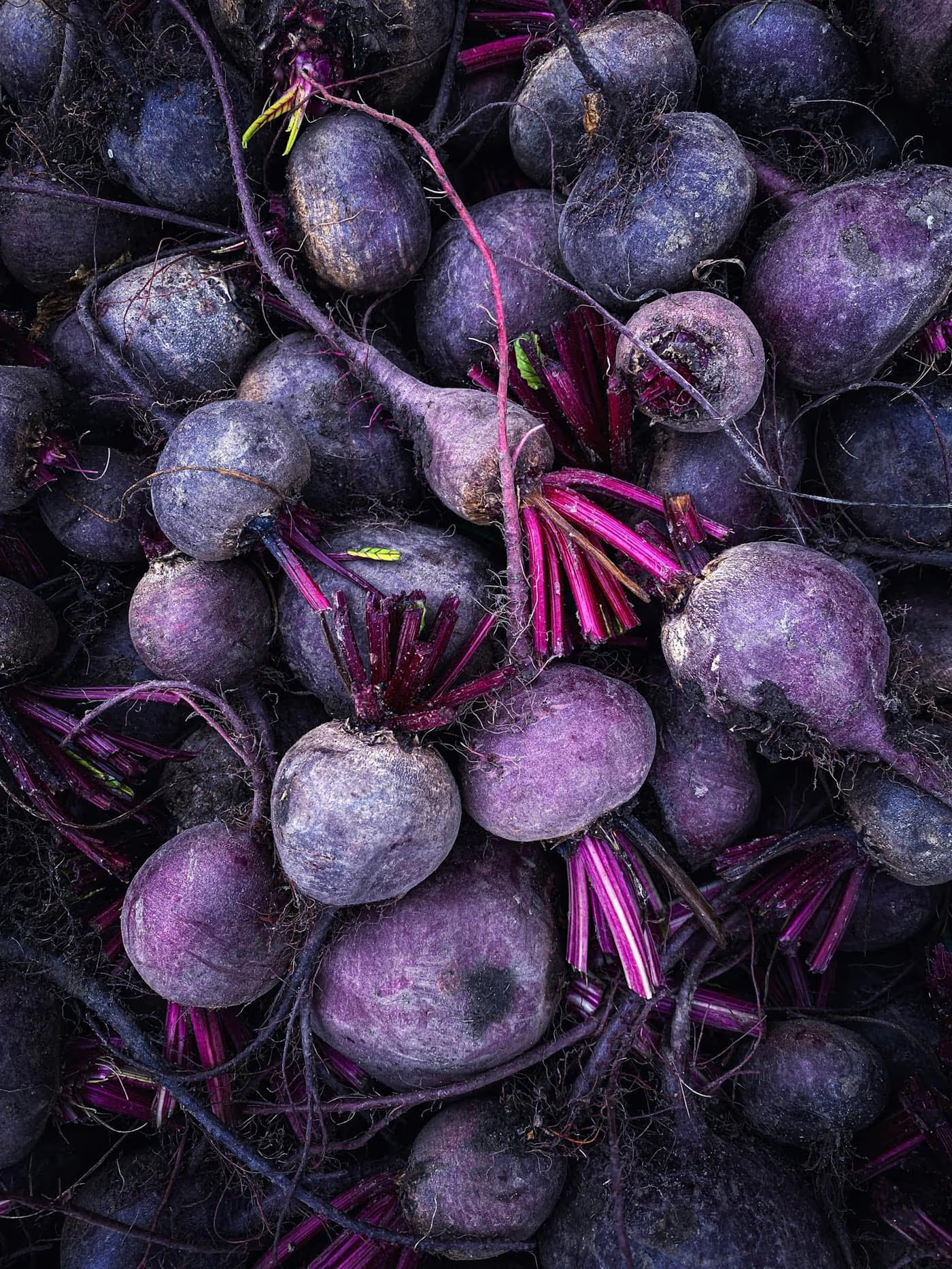
Beetroot (Chukandar)
Beta vulgaris subsp. vulgaris
A cool-season root vegetable that succeeds or fails on the seedbed and the sowing date — a deep, loose, stone-free bed with only well-rotted manure gives round, smooth, deep-red roots, while clods, fresh dung or compaction give forked, hairy, woody roots — and sowing early enough that the root fills out in cool weather, before warmth turns the flesh pale and zoned with white rings.
Quick Summary
The key points from this page in about two minutes — read it or have it read aloud.
Quick Summary
Beetroot (chukandar) is a cool-season root vegetable grown as a winter (rabi) crop across the plains and much of the year in the hills and the south. Uttar Pradesh, Maharashtra, Karnataka, West Bengal, Punjab, Haryana and the peri-urban belts around big cities grow most of it, for the fresh salad and juice market and for processing.
Two things decide the crop. The first is the seedbed. Beetroot forms a swollen root just below the surface, and it needs a deep, finely worked, loose, stone-free bed with only well-rotted manure or compost. Clods, stones, a hard pan, or fresh farmyard manure all make the root fork, grow side roots, and turn woody and misshapen — and a forked or hairy beet will not sell however good the flavour.
The second is the sowing date. Beetroot grows best and colours deepest when the root fills out in cool weather (15–21°C). Sown late and caught by warm days, the flesh comes pale, the internal colour breaks into light and dark rings ("zoning"), and the sugar content drops. Very cold spells early on can also make the plant bolt to seed the same season.
The rest is straightforward: beetroot is one of the more salt- and alkali-tolerant vegetables, needs steady but not heavy watering, and benefits from a little extra boron on light soils (a boron shortage causes black, corky patches inside the root). The main problems are Cercospora leaf spot, damping-off in the young stand, and aphids and leaf miner on the foliage — but the biggest single loss is usually forked, low-grade roots from a poor seedbed.
- Crop type
- Cool-season root vegetable (biennial grown as an annual)
- Season
- Plains: September–December sowing (rabi); hills and south: much of the year
- Suitable states
- Uttar Pradesh, Maharashtra, Karnataka, West Bengal, Punjab, Haryana, Tamil Nadu
- Growing duration
- 55–70 days (early types) to 90–120 days (main crop)
- Water requirement
- Moderate and steady — every 6–10 days; even moisture matters more than the total
- Temperature
- Cool, 15–21°C for root fill; colour and sugar drop above about 25°C
- Soil type
- Deep, loose, stone-free sandy loam to loam, pH 6.0–7.5; among the most salt- and alkali-tolerant vegetables
- Difficulty level
- Easy to moderate — simple crop, but the seedbed must be right
- Expected yield
- 20–30 t/ha of roots on a well-prepared bed (up to ~35 t/ha for the best varieties)
- Key risk
- Forked, hairy, woody roots from a cloddy, stony or freshly manured seedbed
Overview
Beetroot, or chukandar (Beta vulgaris subsp. vulgaris, the garden-beet form), is a cool-season biennial root vegetable grown as an annual for its swollen, deep-red, sweet root. It is eaten raw in salads, boiled, pickled, and juiced, and the deep colour (from betalain pigments) is also used as a natural food colour.
It is a winter (rabi) crop in the plains — sown from about September to November in the north and October to December further south — and can be grown for much of the year in the hills and under mild southern weather. Uttar Pradesh, Maharashtra, Karnataka, West Bengal, Punjab, Haryana and the market-garden belts around large cities grow most of the commercial crop.
The crop turns on two things: a deep, loose, stone-free seedbed with only well-rotted manure (so the root grows round and smooth instead of forked and hairy), and sowing early enough that the root fills out in cool weather (so the flesh comes deep red and sweet instead of pale, ringed and low in sugar).
Crop timeline, sowing to harvest
A quick visual map of the season — jump to any section below for the detail behind each stage.
- Day 0
Sowing
Seed sown 1.5–2 cm deep in rows 30–45 cm apart on a deep-ploughed, stone-free, well-manured bed. Each seed is a corky cluster of 2–4 true seeds, so several seedlings come up together per point.
- Day 7–14
Germination
Seedlings emerge; germination is slow and uneven if the bed dries out or crusts, so the surface is kept just moist through this stage.
- Day 15–25
Thinning
The seedling clusters are thinned to one strong plant every 8–12 cm — done on time and not late, or the roots crowd and stay small and misshapen.
- Day 25–45
Leaf growth
Plants build a rosette of leaves; one or two hand-weedings and the first nitrogen top-dressing go on, and steady moisture keeps growth even.
- Day 45–75
Root swelling
The root swells rapidly just at and below the soil surface; this is the critical period for even moisture and for boron on light soils. Cool weather now gives deep colour and high sugar.
- Day 70–110
Harvest
Roots reach 4–7 cm across (5–8 weeks for early types, up to 3–4 months for the main crop) and are lifted before they get large, woody and over-zoned.
Suitable states
States where this crop is grown at scale, highlighted below. Your local Krishi Vigyan Kendra is still the final word for your specific block.
- Jammu and Kashmir
- Himachal Pradesh
- Punjab
- Uttarakhand
- Haryana
- Delhi
- Uttar Pradesh
- Rajasthan
- Bihar
- Jharkhand
- West Bengal
- Sikkim
- Assam
- Arunachal Pradesh
- Meghalaya
- Nagaland
- Manipur
- Mizoram
- Tripura
- Gujarat
- Madhya Pradesh
- Chhattisgarh
- Maharashtra
- Odisha
- Goa
- Telangana
- Andhra Pradesh
- Karnataka
- Kerala
- Tamil Nadu
- Puducherry
- Ladakh
- Chandigarh
- Lakshadweep
Grown here
Climate requirements
The climate rule for beetroot in the plains: sow so that the root-swelling phase (roughly days 45–90) lands in the coolest part of the winter. That is when the colour goes deep and the sugar goes up.
Ideal temperature
A cool-season crop. The seed germinates from about 10°C upward and the root fills out best at 15–21°C. Above roughly 25°C the flesh comes pale, the internal colour breaks into light and dark rings (zoning), and the sugar drops. A spell of cold (below about 10°C) on a well-grown young plant can trigger it to bolt to seed the same season, especially with some varieties.
Rainfall
Grown almost entirely on irrigation as a dry-winter crop. Heavy rain on a swelling crop cracks the roots and brings on leaf spot and root rot; the crop wants steady soil moisture, not downpours.
Humidity
Moderate humidity suits it. Long damp, overcast spells favour Cercospora leaf spot, which can strip the foliage and stall root growth.
Sunlight
Full sun gives the best root size and colour. Shade makes the plants run to leaf with small, pale roots.
Soil requirements
The seedbed is the whole crop. Plough deep, break every clod, pick out stones, and use only old, crumbly manure. A beet grown in a fine, loose, stone-free bed comes out round and smooth; the same variety in a cloddy or freshly dunged bed comes out forked and unsaleable.
Suitable soil
A deep, loose, well-drained sandy loam to loam is ideal. The root is shallow and swells at the surface, so the top 20–25 cm must be finely worked and free of clods, stones and a hard pan. Beetroot is also one of the most salt- and alkali-tolerant vegetables and is often used to bring problem land back into production.
pH range
Best at pH 6.0–7.5, but it tolerates alkaline soil up to about pH 8.0–8.5 better than almost any other vegetable. It does poorly on strongly acid soil (below pH 6.0), where the leaves scorch and growth stalls.
Drainage
Free drainage is needed. A waterlogged bed rots the root and crown and brings on damping-off in the seedling stage; sow on slightly raised flat beds so surplus water runs off.
Organic matter
Responds to well-rotted farmyard manure or compost — 15–25 t/ha worked in before sowing. The manure must be fully rotted: fresh or half-rotted farmyard manure is the classic cause of forked, hairy, multi-legged roots, so raw dung is applied to the previous crop, not to the beet.
Land preparation
Same four steps whichever region you are in — only the timing shifts with the sowing window.
- 1
Plough deep and work to a fine tilth
Two or three deep ploughings, breaking the pan, followed by harrowing and planking until the top 20–25 cm is loose, fine and free of clods and stones. This is the single most important operation for beetroot.
- 2
Mix in fully-rotted manure and basal fertiliser
Work 15–25 t/ha of old, crumbly FYM or compost into the bed — never fresh dung — along with a basal dose of phosphorus and potash, part of the nitrogen, and borax on light soils.
- 3
Form flat, raised beds
Lay out flat beds about 1–1.5 m wide, slightly raised, with irrigation channels between, so each light irrigation wets the bed evenly and surplus water drains off the crown.
Seed information
How the main varieties compare, so you can pick by duration, yield, disease pressure or what you are growing for.
| Variety | Duration | Yield | Disease resistance | Best state | Suitable for |
|---|---|---|---|---|---|
The standard main-crop beet across India and much of the world. Round, smooth, dark blood-red roots about 5–7 cm across with fine internal colour and little zoning, on a compact plant with dark green, red-veined leaves. Open-pollinated, widely available, and the safe default choice. | ~80–90 days | 25–30 t/ha | No special resistance; good field tolerance of leaf spot | All India | Main winter crop, fresh market and processing |
A popular main-crop open-pollinated variety with globe-shaped, smooth, medium-large roots of deep crimson flesh and a sweet, mild flavour. Similar in use to Detroit Dark Red, sometimes a little quicker and with slightly larger roots. | ~75–85 days | 25–32 t/ha | No special resistance claimed | North and central India | Main-crop market, salad and juice trade |
A quick early open-pollinated variety with slightly flattened-globe (top-shaped) roots and tall, upright, bronzy-green tops that make a good "bunching beet" sold with the leaves on. Grown for an early first crop and for the young-beet market. | ~55–60 days | 18–25 t/ha | No special resistance claimed | North Indian plains, peri-urban belts | Early crop, bunching beet with tops |
An old, very early open-pollinated variety with flattened, top-shaped, smooth dark red roots and small tops. Fast to a marketable size, which suits catch-cropping and the earliest sowings, though the roots become woody if left in the ground. | ~50–55 days | 15–22 t/ha | No special resistance claimed | North Indian plains | Earliest catch crop, quick turnaround |
A TNAU (Horticultural Research Station, Ooty) selection with round roots and a uniform deep blood-red flesh, bred for the Nilgiris and hill conditions. High-yielding under cool hill weather; roots hold their colour and sweetness well. | ~110–120 days (hill conditions) | ~28 t/ha | No special resistance claimed | Tamil Nadu hills, Nilgiris, Kodaikanal | Hill cultivation, uniform deep-colour roots |
A widely sold variety (an AAS-winner internationally, marketed in India by several seed companies) with small-to-medium, smooth, round roots of tender, sweet, deep-ruby flesh with little zoning even when slightly over-mature. Good for the tender young-beet and salad trade. | ~55–65 days | 20–28 t/ha | No special resistance claimed | North and central India, peri-urban belts | Tender salad beet, uniform small roots |
MSH-102 / hybrid types Several F1 hybrid beetroots (from Indo-American, Nunhems, Syngenta and others) sold under names like MSH-102, are grown by larger commercial and processing growers. They give very uniform, high-yielding, round roots with strong internal colour, but the seed is costlier and must be bought new every season. | ~80–95 days | 30–40 t/ha | Varies by hybrid; generally good vigour and field tolerance | Commercial belts, contract and processing crops | High-uniformity commercial crop, processing supply |
Private-company F1 hybrid beetroots (from Indo-American, Nunhems, Syngenta and others), sold under names like MSH-102, grown by larger commercial and processing growers for very uniform, high-yielding roots. | ~80–95 days | 30–40 t/ha | Varies by hybrid; generally good vigour and field tolerance | Maharashtra | — |
- Seed rate
- 6–9 kg/ha sown in lines (about 2.5–3.5 kg/acre). Each "seed" is a dry corky fruit holding 2–4 true seeds, which is why a cluster of seedlings comes up at each point and thinning is essential. Pelleted single-seed (monogerm) seed of hybrids is sown at a lower rate.
- Certified seed
- Buy fresh seed of a named variety each season — beet seed loses vigour within a year or two and old seed comes up thin and slow. The open-pollinated varieties (Detroit Dark Red, Crimson Globe and the rest) can have seed saved from a healthy, non-bolted crop, but that needs a proper seed-to-seed cycle in a cool area; most growers buy fresh.
- Spacing
- Rows 30–45 cm apart; thin to one plant every 8–12 cm in the row. Closer spacing gives smaller, more uniform roots for the tender/salad trade; wider spacing gives larger main-crop roots.
- Seed treatment
- Soak the seed clusters in water for 12–24 hours to soften the corky fruit and speed germination. Treat with a fungicide such as thiram or captan, or with Trichoderma, against damping-off and seedling rots.
Sowing guide
Do not sow the plains crop late (after November in the north). A late crop fills its root in warm weather, comes out pale and white-ringed with low sugar, and grades poorly.
- Best time
- Northern plains: September to November, so the root swells through the coldest months. Central and southern plains: October to December. Hills: February to September. Small successive sowings 15–20 days apart spread the harvest and keep the market supplied with young, tender roots.
- Row spacing
- 30–45 cm between rows
- Plant spacing
- 8–12 cm between plants after thinning
- Sowing depth
- 1.5–2 cm
- Method
- Sow the soaked seed clusters in shallow lines on the prepared bed, cover lightly, and firm the soil. Thin the seedling clusters to one strong plant per station at 15–20 days — thinning late is a common reason for small, crowded, misshapen roots.
Fertilizer schedule
A split dose beats one large dose applied at sowing — nitrogen especially is lost to the air and to leaching if it all goes in on day one.
- 1
Basal (at sowing)
Day 0
Fully-rotted FYM worked into the bed, plus a basal dose of about 30–40 kg N, 50–60 kg P₂O₅ and 60–80 kg K₂O per hectare, and 10–15 kg/ha borax on light soils. Beetroot is a potash-responsive crop.
- 2
After thinning
20–25 days
The first nitrogen top-dressing, about 30–40 kg N/ha, placed beside the rows and lightly earthed in as the leaf rosette builds.
- 3
Start of root swelling
40–50 days
The remaining nitrogen at the start of root swelling. Keep total nitrogen moderate — an over-fed crop makes big leafy tops and small roots, and excess nitrogen late can hollow the crown.
Irrigation schedule
1. Sowing to germination
Day 0–14
Light, frequent watering to keep the surface just moist — the corky seed clusters germinate slowly and unevenly if the bed dries or crusts. In winter this may be every 4–6 days.
2. Leaf growth
Day 15–45
Irrigate every 7–10 days in winter to keep the soil evenly moist. A mild moisture stress here keeps the plant from running to all leaf, but do not let it wilt.
3. Root swelling
Day 45–90
The critical period — water every 6–8 days so the soil never dries out. A heavy irrigation after a dry spell splits the swelling root; even, steady moisture keeps it smooth and stops the flesh going pithy. Ease off water in the last week before harvest.
Critical stages
- Germination and stand establishment
- Root swelling (days 45–90)
Water-saving tips
- Drip on the flat bed holds steady shallow moisture on this shallow-rooted crop and avoids the wet–dry swings that split the roots.
- A light straw mulch between the rows holds moisture, keeps the crown cool, and stops rain-splash spreading leaf spot.
- Level the bed well so each light irrigation wets it evenly — an uneven bed gives woody roots at the high end and cracked, rotting roots at the low end.
Weed management
Common weeds
Organic control
- One or two careful hand-weedings in the first month, combined with thinning. After the leaf canopy closes the crop shades most weeds itself.
- Pull out bathua and wild Chenopodium early — they look almost identical to young beetroot and are easy to leave in by mistake.
- A stale-seedbed flush before sowing (irrigate, let weeds germinate, hoe them off, then sow) greatly cuts early weeding on this slow-starting crop.
Chemical control
- A pre-emergence herbicide cleared for beet/root vegetables (such as pendimethalin) applied right after sowing, followed by one hand-weeding and thinning at 15–20 days, is used on larger areas.
- Confirm the product, dose and pre-harvest interval with the local KVK — the beet tops are also eaten in many households, so herbicide choice matters.
Nutrient deficiency identification
What a shortage of each nutrient actually looks like on the plant, so you can tell a deficiency apart from a disease before you spray the wrong thing.
Boron
Visible symptom
Black, dry, corky patches and cavities inside the root ("internal black spot" / heart rot), rough dark cankers on the skin, and death of the growing point — worst on light, sandy or over-limed soils. The classic beetroot deficiency.
Nitrogen
Visible symptom
Pale, small, upright leaves that redden early, slow growth and small roots; the oldest leaves yellow and die first.
Potassium
Visible symptom
Scorched, browning margins on the older leaves, and roots that are smaller, less sweet and store poorly.
Magnesium
Visible symptom
Yellowing between the veins of the older leaves, veins staying green, on light sandy soils and after heavy potash use.
Diseases to watch for
Symptoms, likely cause and what actually treats it — not just a spray name.
Cercospora leaf spot
- Symptoms
- Small round spots with an ash-grey centre and a distinct reddish-purple to brown border on the leaves; spots run together, the older leaves brown and die, and the plant keeps pushing small new leaves from the crown at the cost of root growth.
- Cause
- The fungus Cercospora beticola, spread by wind-blown spores and rain splash, favoured by warm, humid, wet weather and dense stands.
- Treatment
- A protective spray of mancozeb or a copper fungicide, or a triazole, from the first spots, repeated at 10–14 day intervals in wet weather, observing the pre-harvest interval.
- Prevention
- Rotate away from beet, spinach and chard for two seasons, use wider rows for airflow, avoid overhead irrigation late in the day, and clear and destroy the leaf debris after harvest.
Damping-off and seedling root rot
- Symptoms
- Patches of seedlings that fail to emerge or topple with a pinched, water-soaked, brown stem at soil level; older seedlings with blackened, rotting root tips and a gappy stand.
- Cause
- Soil fungi (Pythium, Rhizoctonia, Aphanomyces), worst in cold, wet, poorly drained beds and where seed is sown too deep and thick.
- Treatment
- No cure for a collapsed patch; drench the surrounding area with a recommended fungicide or Trichoderma and re-sow the gaps once the bed has dried a little.
- Prevention
- Sow on raised, well-drained beds, do not over-water the young stand, treat the seed with thiram/captan or Trichoderma, and avoid sowing into cold waterlogged soil.
Collar rot and Rhizoctonia crown rot
- Symptoms
- Dark, sunken, firm-to-dry rot at the crown and shoulder of the swelling root, sometimes with a web of pale fungal threads or small tan seed-like bodies; affected plants wilt and the root is worthless.
- Cause
- Soil-borne fungi (Rhizoctonia solani, Sclerotium rolfsii) that build up under continuous beet/vegetable cropping, warm soil and waterlogging around the crown.
- Treatment
- Remove and destroy affected plants; a fungicide drench of the surrounding root zone can slow spread but will not save a rotted root.
- Prevention
- Rotate with cereals for 2–3 years, plant on raised beds with the crown above standing water, add Trichoderma-enriched compost, and avoid injuring the crown during weeding and earthing.
Beet curly top / mosaic (virus)
- Symptoms
- Young leaves that curl, pucker, thicken and turn brittle with clearing or swelling of the veins, stunted plants, and small, woody, hairy roots; or a light-and-dark green mottle and distortion on mosaic-affected plants.
- Cause
- Leafhopper-borne curly top virus and aphid-borne mosaic viruses; spread by the insect vector rather than by contact.
- Treatment
- No cure. Rogue out affected plants early before the vector spreads the virus from them.
- Prevention
- Control leafhoppers and aphids early, remove weed hosts (especially wild Chenopodium and other beet relatives) around the field, and avoid planting next to an older infected beet or spinach crop.
Pests to watch for
What to look for before the damage is visible, and organic options before you reach for a chemical.
Aphids
- Identification
- Colonies of small green or black soft-bodied insects on the undersides of leaves and on the crown, with sticky honeydew, sooty mould and ants; the leaves curl and pucker.
- Damage
- Direct sap loss curls and stunts the tops and slows the root, but the bigger risk is that aphids spread beet mosaic and other viruses. Heavy honeydew also fouls beet sold with the tops on.
- Organic control
- Strong water jets on hotspots, neem sprays, yellow sticky traps, a reflective mulch to deter landing, and conserving ladybird beetles and lacewings, which usually keep aphids in check on a root crop.
- Chemical control
- A recommended systemic insecticide only when colonies are heavy and virus pressure is high; early control matters more for virus prevention than for the direct feeding damage.
Leaf miner (beet / serpentine leaf miner)
- Identification
- Pale, winding, snake-like tunnels and large blotchy blisters inside the leaves; tiny black-and-yellow flies around the plants and pinprick feeding spots on the leaf.
- Damage
- Heavy mining destroys leaf area, stalls root growth, and ruins beet marketed with the tops on. Rarely kills the plant but can badly cut yield.
- Organic control
- Remove and destroy mined leaves, use yellow sticky traps, spray neem, and avoid the broad-spectrum sprays that kill the parasitic wasps which normally control leaf miner.
- Chemical control
- A recommended insecticide with translaminar action only when mining is spreading fast, observing the pre-harvest interval.
Beet webworm (Spodoptera caterpillars)
- Identification
- Webbed and skeletonised leaves, green or greenish-yellow caterpillars among the webbing, and dark frass; damage spreads outward from patches.
- Damage
- Defoliates the tops in patches, cutting the leaf area that drives root growth; a heavy attack on a young crop can force replanting.
- Organic control
- Handpick caterpillars and egg masses, spray neem or Bt in the evening, and conserve natural predators and parasitoids.
- Chemical control
- A recommended insecticide directed at the foliage only when defoliation is spreading, with the pre-harvest interval observed.
Cutworm at the seedling stage
- Identification
- Young seedlings cut off at ground level and lying on the soil in the morning; fat, greasy, grey-brown caterpillars curled up just under the surface near the damage.
- Damage
- Thins the young stand in patches before the crop is established, sometimes badly enough to need re-sowing.
- Organic control
- Flood the bed to bring the caterpillars up, handpick in the evening, keep field edges weed-free where moths lay, and use a bran-and-neem bait along the rows.
- Chemical control
- A soil-directed recommended insecticide or bait along the rows at the seedling stage only.
Common mistakes to avoid
The mistakes that cost growers the most, ranked by how often they show up in the field — not in the order you might expect.
- 1
Sowing into a cloddy, stony or shallow seedbed.
Why it hurts
The swelling root hits obstructions and grows forked, multi-legged, hairy and misshapen. A forked beet will not sell whatever its flavour. Plough deep, break every clod, pick out stones, and work the top 20–25 cm to a fine tilth.
- 2
Applying fresh or half-rotted farmyard manure to the beet crop.
Why it hurts
Raw dung is the classic cause of forked, hairy, rough roots and of nitrogen release at the wrong time. Apply raw manure to the previous crop; give the beet only old, crumbly, fully-rotted manure or compost.
- 3
Sowing the plains crop too late.
Why it hurts
The root fills out in warm weather, so the flesh comes pale, the internal colour breaks into light and dark rings (zoning), and the sugar is low. Sow the northern plains crop by November so the root swells in the cold.
- 4
Thinning late or not at all.
Why it hurts
Each corky seed cluster gives 2–4 seedlings; left un-thinned they crowd each other and all stay small, twisted and low-grade. Thin to one strong plant every 8–12 cm at 15–20 days.
- 5
Ignoring boron on light soils.
Why it hurts
A boron shortage causes black, dry, corky patches and cavities inside the root (internal black spot / heart rot) — the beet looks fine outside and is ruined within. Apply 10–15 kg/ha borax at sowing on sandy or over-limed soils.
- 6
Letting the crop swing between dry and heavy watering.
Why it hurts
A heavy irrigation after a dry spell splits the swelling root and can start a rot. Keep the soil evenly moist through the root-swelling period and ease off water only in the final week.
Harvesting
Lift the roots when they are 4–7 cm across — about 55–70 days after sowing for early types and 90–120 days for the main crop. Do not wait for maximum size: a beet left too long turns woody, over-zoned and pithy, and can crack or bolt. Lift by loosening the soil with a fork and pulling by the tops; twist or cut the tops off about 2–3 cm above the crown (do not cut into the crown, or the root "bleeds" and loses colour).
Signs it is ready
- Root shoulder 4–7 cm across, showing at the soil surface
- Skin firm and smooth, deep red
- Flesh (test one) deep and evenly coloured, not pale or heavily ringed
- Before the root gets large, woody or starts to crack
Tools
- A digging fork to loosen the soil so roots lift without breaking
- A sharp knife for topping about 2–3 cm above the crown
- Crates or baskets — beet bruises and a bruised patch rots in store
- Water and a brush at the shed if roots are to be washed for the fresh market
Expected yield
About 20–30 t/ha of topped roots on a well-prepared bed (up to ~35 t/ha for the best open-pollinated varieties and 30–40 t/ha for hybrids). On an acre that is roughly 80–140 quintals.
Post-harvest & storage
Storage
Topped beetroot with the skin intact keeps well — 2–3 weeks at room temperature in the shade, and up to 3–4 months at 0–2°C with 95–98% humidity (in sand, a cold store, or a well-ventilated clamp). Beet sold with the tops on keeps only 2–4 days because the leaves wilt fast and pull moisture from the root.
Packaging
Pack topped roots in ventilated crates or net bags in single or double layers. If sold bunched with tops, tie small bunches, keep them cool and moist, and move them fast. Do not wash roots that are going into storage — washing shortens their keeping life.
Transportation
Move topped roots in ventilated crates, out of the sun. Bunched beet must travel cool and covered with a damp cloth and reach the market the same day.
Shelf life
Topped: 2–3 weeks at room temperature, 3–4 months at 0–2°C. Bunched with tops: 2–4 days. Topping and keeping the roots cool is the key to holding the crop for a better price.
Market prices
Today's mandi price near you, pulled live from the government's own Agmarknet data.
Live daily mandi prices from the government Agmarknet dataset.
Synced from data.gov.in (Agmarknet). Rates are ₹ per quintal.
Weather
Current conditions and a 5-day outlook for your selected location, with one line of stage-aware advice.
Pick your state for current conditions and a 5-day outlook.
Live data from Open-Meteo
Profit calculator
Your own cost sheet, expected yield and selling price — not ours.
Where the money goes
Share of the total cost per acre, using the calculator’s own default cost sheet below — adjust the numbers there to match your field and this picture will no longer apply to you exactly, but the ranking rarely changes.
- Labour31% (₹10,000)
- Land rent25% (₹8,000)
- Fertiliser11% (₹3,500)
- Machinery9% (₹3,000)
- Irrigation9% (₹3,000)
- Seed6% (₹2,000)
- Pesticide & weedicide5% (₹1,500)
- Interest5% (₹1,500)
Official downloads
Government and ICAR documents only — everything below is hosted on an official server.
ICAR-IIHR, Bengaluru — Vegetable Crops
Beetroot variety recommendations and package of practices
TNAU Agritech Portal — Beetroot
Ooty 1 and the beetroot cultivation guide for the south and the hills
National Horticulture Board — Vegetable profiles
Beet varieties, spacing and production practices
Kisan Call Centre — 1800-180-1551
Free crop advice in your language
Frequently asked questions
Why are my beetroots forked and hairy instead of round and smooth?
Almost always the seedbed. A swelling beet that meets a clod, a stone, a hard pan or a lump of fresh manure splits and grows side roots. Plough deep, break every clod, pick out the stones, work the top 20–25 cm to a fine tilth, and use only old, fully-rotted manure — raw dung applied to the beet crop is the classic cause of forked, hairy roots.
When should I sow beetroot?
In the northern plains, September to November, so that the root swells through the coldest months of the winter — that is when the flesh colours deep red and the sugar goes up. Central and southern plains, October to December. Hills, February to September. A late plains crop fills its root in warm weather and comes out pale, white-ringed and low in sugar.
Why is the inside of my beetroot pale with white rings?
That is "zoning", and it comes from the root filling out in weather that is too warm, or from moisture stress. Sow early enough that the root swells in cool weather (15–21°C), keep the soil evenly moist, and lift the roots on time — a beet left too long in warm soil zones more heavily.
What causes black, corky patches inside an otherwise good-looking beet?
A boron shortage — the deficiency is called internal black spot or heart rot. It is common on light, sandy and over-limed soils. Apply 10–15 kg/ha of borax mixed into the seedbed at sowing on those soils; a foliar spray of a boron product at the start of root swelling can also help on a standing crop.
Can I grow beetroot on my salty or alkaline field?
Yes — beetroot is one of the most salt- and alkali-tolerant vegetables and is often used to bring problem land back into production. It will crop on soil up to about pH 8.5 and tolerates moderate salinity. It still needs a deep, loose, stone-free seedbed and steady moisture to give good roots.
Does beetroot have an MSP or a mandi price?
There is no MSP for beetroot. It is traded as "Beetroot" on Agmarknet, with daily price and arrival data from APMC markets across the country. Prices are usually best for the early crop and in the off-season, and lowest at the peak of the winter supply; the juice and processing trade also buys steadily.
Still have questions?
The FAQs above cover the common ones. For anything specific to your field and soil, your nearest Krishi Vigyan Kendra is the authoritative answer.