
Eucalyptus (Safeda / Nilgiri)
Eucalyptus tereticornis (also E. camaldulensis and clonal hybrids)
A fast-growing evergreen tree grown on a 5-7 year clonal pulpwood rotation from tissue-culture plantlets planted at monsoon onset — known across Uttar Pradesh and the north as safeda for its smooth, whitish-grey peeling bark and straight trunk, and in the south as nilgiri after the Nilgiri Hills where it was first planted at scale and where its oil ("nilgiri tel") is distilled. Unlike poplar, a felled eucalyptus block coppices back from the stump for two more cuttings, and its wood moves mainly to ITC, JK Paper, TNPL and local pulp/plywood traders rather than through a fixed written buy-back.
Quick Summary
The key points from this page in about two minutes — read it or have it read aloud.
Quick Summary
Eucalyptus is a hardy, very fast-growing evergreen tree grown across India as a farm/agroforestry tree for pulpwood, plywood core, poles and fuelwood. It is planted from tissue-culture or rooted-cutting clonal plantlets raised in nursery polybags, not bare-root winter stock, and goes into the field at the start of the monsoon (June-July) rather than in the leafless winter that poplar needs. The main belts are Punjab, Haryana and western Uttar Pradesh in the north (the safeda country) and Andhra Pradesh, Telangana, Tamil Nadu, Karnataka, Gujarat, Madhya Pradesh, Chhattisgarh, Maharashtra and Odisha for industrial pulpwood blocks, with the Nilgiri hills of Tamil Nadu and Kerala the historic home of eucalyptus-oil distillation that gave the tree its southern name.
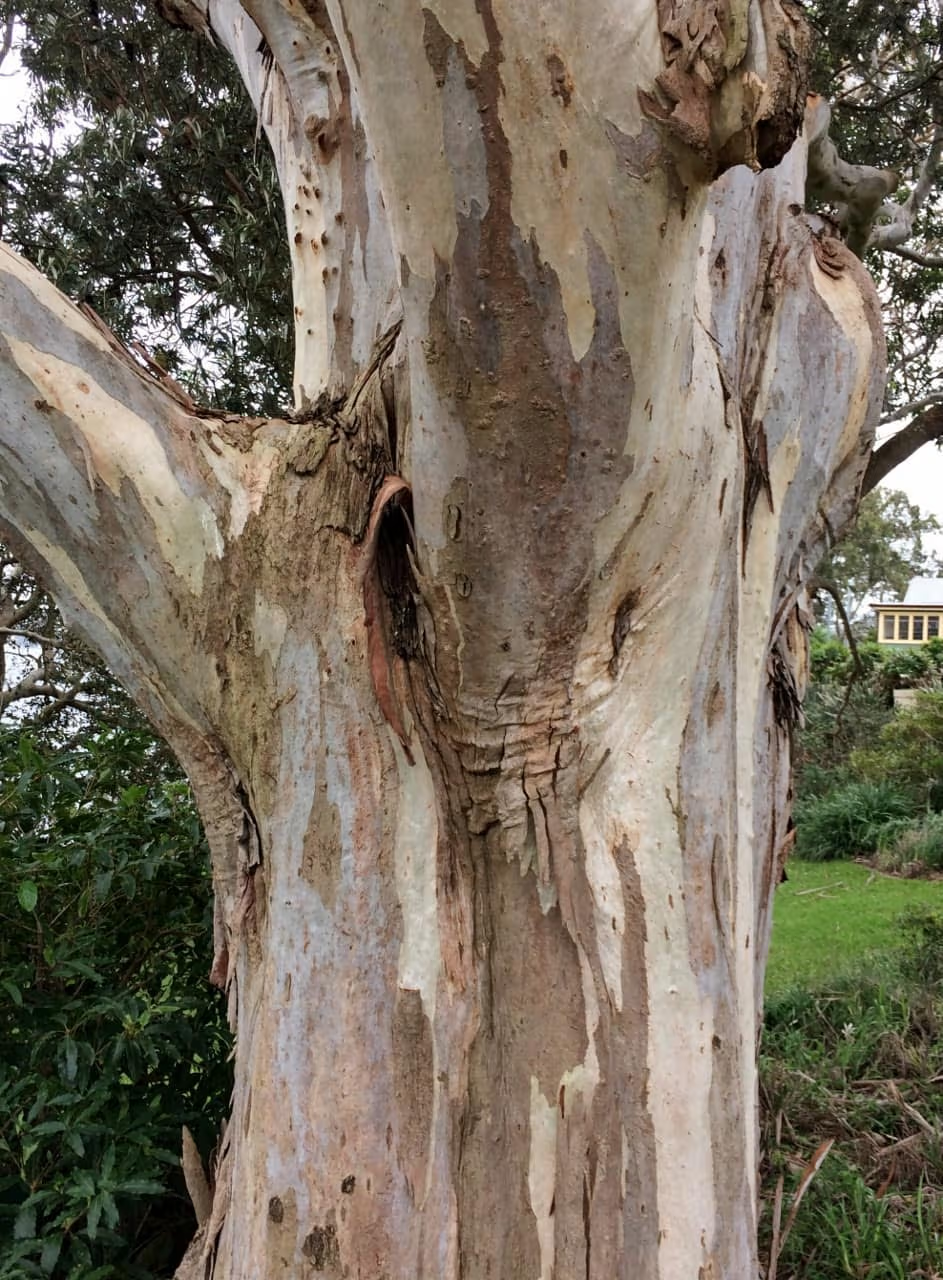
The two vernacular names carry real information. Safeda ("the white one") describes the bark: eucalyptus sheds its outer bark in irregular sheets through the year, leaving a smooth trunk mottled white, grey and cream where fresh bark is exposed — the single easiest field mark to tell it apart from poplar or any other farm tree. Nilgiri refers to the Nilgiri ("blue mountain") Hills of Tamil Nadu, where eucalyptus was planted extensively from the mid-1800s and where its leaf oil has long been steam-distilled as "nilgiri tel", a household name for eucalyptus oil across India regardless of where the tree itself is grown.
Unlike poplar, there is no single dominant company running a written, girth-linked buy-back contract. ITC (through its Bhadrachalam clonal programme), JK Paper, TNPL and other pulp and paper mills run farm-forestry programmes that supply subsidised or purchased clonal saplings and then buy the felled wood back at the prevailing farm-gate rate against a purchase order, usually paid within about ten days — but a farmer is equally free to sell to a local pulp trader, plywood core unit or, in parts of Uttar Pradesh, at an APMC mandi that genuinely trades "Wood (Eucalyptus)". The clone matters just as much as it does for poplar: PAU-recommended clones (C-413, C-2045), the salinity-tolerant PE-11, IFGTB's EC-series clones and ITC's own Bhadrachalam clones consistently out-yield ungraded seedling stock, and — a genuine advantage over poplar — a felled eucalyptus stump coppices and can be harvested for two further rotations before replanting is needed.
- Crop type
- Evergreen short-rotation industrial tree (agroforestry/pulpwood)
- Also known as
- Safeda (north India, from its bark); Nilgiri (south, from the Nilgiri Hills)
- Season
- Planted at monsoon onset (June-July)
- Suitable states
- Punjab, Haryana, Uttar Pradesh, Andhra Pradesh, Telangana, Tamil Nadu, Karnataka, Gujarat
- Rotation length
- 5-7 years to clear-felling; coppices for 2 further rotations
- Water requirement
- Moderate — establishment-year irrigation helps; largely rainfed after year 2
- Temperature
- Wide tolerance; grows from subtropical plains to hill tracts, best 15-35°C
- Soil type
- Wide tolerance — sandy loam to clay loam, pH 5.5-8.0; some clones (PE-11) tolerate saline/waterlogged soil
- Difficulty level
- Easy (hardier and less water-demanding than poplar)
- Expected yield
- Roughly 60-80 tonnes green pulpwood per acre over a 5-6 year rotation
- Key risk
- Gall wasp (Leptocybe invasa) on an unresistant clone; planting unlabelled seedling stock instead of a named clone
Overview
Eucalyptus (mainly Eucalyptus tereticornis, with E. camaldulensis and E. grandis-parentage clonal hybrids also planted) is a hardy, evergreen, very fast-growing tree grown across most of India as a short-rotation industrial and agroforestry species. In the north — Punjab, Haryana and western Uttar Pradesh — it is grown much like poplar, on farm bunds and in blocks, and is universally called safeda there for its smooth, whitish-grey bark that peels in patches through the year. In the south, especially around the Nilgiri Hills of Tamil Nadu and Kerala where it was first planted at scale in the 19th century, it is called nilgiri, and the same name attaches to the eucalyptus oil ("nilgiri tel") long distilled from its leaves.
Eucalyptus is planted very differently from poplar. Instead of bare-root Entire Transplants lifted in the leafless winter, eucalyptus goes into the field as a tissue-culture or rooted-cutting clonal plantlet, about 25-30 cm tall, raised in a nursery polybag and planted with its root ball intact at the onset of the monsoon (June-July) so the rains carry it through establishment. Spacing is closer than poplar's — 3 x 2 m or 2 x 2 m (roughly 600-750 plants/acre) for a dense pulpwood block, wider at 4 x 4 m or on bunds for poles and agroforestry.
There is no single WIMCO-style buy-back company for eucalyptus. ITC's Bhadrachalam clonal programme (Andhra Pradesh, Telangana, Odisha), JK Paper (Gujarat, Madhya Pradesh, Chhattisgarh, Maharashtra, Andhra Pradesh, Telangana, Odisha) and TNPL (Tamil Nadu) run farm-forestry schemes that supply clonal saplings and buy back the wood at the prevailing farm-gate rate on a purchase order, but a farmer can equally sell to a local pulp/plywood trader or, in western Uttar Pradesh, at an APMC mandi that genuinely lists "Wood (Eucalyptus)" — a real, if thin, Agmarknet trade that poplar and rubber do not have. Clone choice (PAU's C-413/C-2045, the saline-tolerant PE-11, IFGTB's EC clones, or ITC's Bhadrachalam clones) decides growth rate and mill acceptance, and a felled block coppices back from the stump for two further cuttings before the land needs replanting.
Crop timeline, sowing to harvest
A quick visual map of the season — jump to any section below for the detail behind each stage.
- Year 0 (June-July)
Clonal planting at monsoon onset
Tissue-culture or rooted-cutting clonal plantlets (25-30 cm, raised in nursery polybags) are planted at the start of the monsoon in pits with the root ball intact, and watered in.
- Year 1
Establishment
Rapid early height growth through the first monsoon and following dry season; light irrigation if the monsoon breaks and gall-wasp watch on the new flush.
- Year 2-3
Rapid height and girth gain
Eucalyptus puts on some of the fastest growth of any Indian farm tree in these years; canopy closes and most intercropping stops.
- Year 4-5
Girth build-up
Height growth slows and girth builds toward pulpwood/pole size; termite and stem-borer watch continues on stressed trees.
- Year 5-7
Clear felling
The block is clear-felled at ground level and the wood sold to a mill farm-forestry programme, a local pulp/plywood trader, or an APMC mandi where one trades eucalyptus wood.
- Year 7+ (coppice rotations)
Coppice regrowth
Unlike poplar, eucalyptus stumps sprout vigorous coppice shoots. Two or three of the strongest shoots per stump are retained and grown through one or two further 5-7 year rotations before the stumps are finally cleared and the land replanted.
Suitable states
States where this crop is grown at scale, highlighted below. Your local Krishi Vigyan Kendra is still the final word for your specific block.
- Jammu and Kashmir
- Himachal Pradesh
- Punjab
- Uttarakhand
- Haryana
- Delhi
- Uttar Pradesh
- Rajasthan
- Bihar
- Jharkhand
- West Bengal
- Sikkim
- Assam
- Arunachal Pradesh
- Meghalaya
- Nagaland
- Manipur
- Mizoram
- Tripura
- Gujarat
- Madhya Pradesh
- Chhattisgarh
- Maharashtra
- Odisha
- Goa
- Telangana
- Andhra Pradesh
- Karnataka
- Kerala
- Tamil Nadu
- Puducherry
- Ladakh
- Chandigarh
- Lakshadweep
Grown here
Climate requirements
The tree's wide climatic tolerance — subtropical plains, semi-arid tracts and hill country all support it — is the main reason its planting footprint in India runs from Punjab to the Nilgiris, far broader than poplar's single north-Indian belt.
Ideal temperature
Eucalyptus tolerates a far wider temperature range than poplar — it does not need winter dormancy and grows across subtropical plains, semi-arid tracts and hill regions alike, with the fastest growth around 15-35°C. This tolerance is exactly why it spread so widely across such different agro-climatic zones of India, from Punjab's plains to the Nilgiri hills.
Rainfall
Grows well from about 600 mm (drought-hardy species/clones such as E. camaldulensis) up to 2500 mm a year. Irrigation through the first one to two dry seasons after monsoon planting speeds establishment, but a well-rooted block from year 2-3 onward is largely rainfed — a genuine advantage over poplar's year-round irrigation demand.
Humidity
Tolerates both dry and humid conditions, though dense, humid canopies are where pink disease and dieback fungi are more likely to establish. Adequate spacing and thinning of weak coppice shoots keep the canopy aired.
Sunlight
Full sun; it is a light-demanding pioneer species like poplar and will not tolerate shade once past the nursery stage.
Soil requirements
Because named clones exist for saline and waterlogged conditions, eucalyptus is one of the few farm trees that can be matched to genuinely difficult land rather than needing land improved to suit it.
Suitable soil
Adapts to a wide range — sandy loam, loam and clay loam are all workable, and specific clones (PE-11 from PAU) are recommended precisely because they tolerate saline and seasonally waterlogged soils that would kill poplar or most other farm trees. Very shallow, hardpan or extremely saline soils still limit growth and should be avoided or matched to a tolerant clone.
pH range
Broadly tolerant, roughly pH 5.5-8.0 depending on species/clone; E. camaldulensis and the PE-11 clone specifically extend that tolerance toward saline and alkaline conditions.
Drainage
Prefers free drainage for fastest growth, but tolerant clones (PE-11) and species (E. camaldulensis) cope with periodic waterlogging far better than poplar does.
Organic matter
Responds to farmyard manure at planting and to its own leaf litter, which builds up steadily under an established block and returns some nutrients, though eucalyptus leaf litter breaks down slowly and can suppress ground flora under a dense canopy.
Land preparation
Same four steps whichever region you are in — only the timing shifts with the sowing window.
- 1
Mark the grid and dig planting pits
A dense 3 x 2 m or 2 x 2 m grid (roughly 600-750 plants/acre) is standard for a pulpwood block; 4 x 4 m or bund/boundary planting is used for poles and agroforestry. Dig pits about 30-45 cm deep and wide a few weeks ahead of the monsoon.
- 2
Fill the pit with topsoil and manure
Refill each pit with topsoil mixed with 2-3 kg well-rotted farmyard manure and a small dose of single super phosphate; in termite-prone belts mix in a recommended soil insecticide or a Metarhizium bio-formulation.
- 3
Book clonal plantlets from a recognised nursery
Order tissue-culture or rooted-cutting polybag plants of a named clone (PAU's C-413/C-2045, the saline-tolerant PE-11, an IFGTB EC clone, or an ITC/JK Paper farm-forestry clone) well before the monsoon so plants are ready at 25-30 cm height for June-July planting. Reject stunted, root-bound or unlabelled stock.
Seed information
How the main varieties compare, so you can pick by duration, yield, disease pressure or what you are growing for.
| Variety | Duration | Yield | Disease resistance | Best state | Suitable for |
|---|---|---|---|---|---|
A clone released by Punjab Agricultural University and recommended for commercial farm-forestry cultivation across Punjab's agro-climatic zones — straight growth and good pulpwood yield under the region's canal-irrigated plains. | 5-7 year rotation | High under Punjab conditions | Moderate; standard gall-wasp and termite watch needed | Punjab, Haryana | Pulpwood, plywood core, poles |
Another PAU-recommended commercial clone for Punjab, evaluated alongside C-413 as a leading choice for farm bunds and block plantings in the state's farm-forestry programme. | 5-7 year rotation | High under Punjab conditions | Moderate | Punjab, Haryana | Pulpwood, plywood core, poles |
PE-11 (PAU, saline/waterlogged-tolerant) A clone specifically recommended by Punjab Agricultural University for planting under saline and seasonally waterlogged conditions in south-western Punjab, where most other clones and poplar itself perform poorly. | 5-7 year rotation | Moderate to high on difficult land where other clones fail | Moderate | South-western Punjab and similar saline/waterlogged tracts | Pulpwood on marginal saline/waterlogged land |
IFGTB EC clones (EC-1 to EC-4) High-productivity clones released by the Institute of Forest Genetics and Tree Breeding (IFGTB), Coimbatore, and broadly cultivated in Andhra Pradesh and Tamil Nadu for industrial pulpwood plantations. | 5-6 year rotation | High; developed specifically for pulpwood productivity | Moderate; screen for gall-wasp tolerance locally | Andhra Pradesh, Tamil Nadu | Pulpwood, paper-grade timber |
A family of over a hundred high-yielding clonal hybrids developed by ITC's Bhadrachalam research programme since 1989 and supplied to farmers under its farm-forestry scheme in Andhra Pradesh, Telangana and Odisha, with the mill buying the wood back on a purchase order at the prevailing farm-gate rate. | 5-6 year rotation | High — published trial productivity of 20-58 m3/ha/year against 6-10 m3/ha/year for unimproved seedling stock | Bred with disease/pest tolerance in mind; still needs local gall-wasp monitoring | Andhra Pradesh, Telangana, Odisha | Pulp and paper-grade pulpwood |
Eucalyptus tereticornis (Mysore Gum, seed-origin) The most widely planted eucalyptus species in India by area, grown from seed-origin nursery seedlings rather than a named clone where clonal stock is not available — the traditional safeda of the northern plains and a common species in social/agroforestry planting nationwide. | 6-8 year rotation (slower and more variable than named clones) | Moderate; lower and less uniform than a named clone | Variable, since seedling stock is not selected for resistance | Widely grown; Punjab, Haryana, Uttar Pradesh, and across peninsular India | Pulpwood, fuelwood, general farm timber |
Eucalyptus camaldulensis (River Red Gum) A hardier alternative species valued for tolerating drier and more saline sites than E. tereticornis, planted where water availability or soil salinity limits other eucalyptus stock. | 6-8 year rotation | Moderate; prioritises hardiness over maximum yield | Generally hardy; still susceptible to gall wasp | Drier and saline-affected tracts of Punjab, Haryana, Gujarat, Rajasthan margins | Fuelwood, pulpwood on marginal/saline land |
- Seed rate
- Eucalyptus is planted from vegetative clonal material — tissue-culture or rooted-cutting plantlets raised in nursery polybags — or, where clonal stock is unavailable, from seed-origin nursery seedlings. Plan for roughly 600-750 plants/acre at a dense 3 x 2 m or 2 x 2 m pulpwood spacing, or about 270 plants/acre at a wider 4 x 4 m spacing for poles and agroforestry bunds.
- Certified seed
- Source tissue-culture or rooted-cutting plantlets of a named clone (PAU's C-413, C-2045 or PE-11; an IFGTB EC clone; or an ITC/JK Paper-supplied Bhadrachalam clone) from a recognised state forest department, ICFRE/IFGTB or company-linked nursery. Unlabelled seedling-origin stock is cheaper but grows far less uniformly and yields less pulpwood per acre over the same rotation.
- Spacing
- 3 x 2 m or 2 x 2 m (roughly 600-750 plants/acre) is standard for a dense commercial pulpwood block; 4 x 4 m (about 270/acre) or single/double-row bund planting suits poles, fuelwood and agroforestry where the tree shares the field with a field crop.
- Seed treatment
- Clonal plantlets are transplanted from the polybag with the root ball intact — no bare-root handling or fungicide dip is needed the way poplar's ETPs require, since the roots are never exposed. Water the polybag well before transplanting so the root ball lifts out cleanly.
Sowing guide
Because planting rides the monsoon rather than depending on stored winter soil moisture like poplar's ETPs, a delayed or weak monsoon onset is the main establishment risk — plan the planting window around the local monsoon date, not a fixed calendar date.
- Best time
- Plant at the onset of the monsoon (June-July), when the plantlet is about 25-30 cm tall — the opposite window to poplar, which is planted bare-root in the leafless winter.
- Row spacing
- 2-3 m for dense pulpwood blocks; 4 m for pole/agroforestry planting
- Plant spacing
- 2-3 m within the row for pulpwood; 4 m for poles and bund planting
- Sowing depth
- Set the polybag plant so the top of its root ball sits level with the surrounding soil surface — planting too deep buries the collar and encourages collar rot; too shallow exposes roots to drying out before the monsoon establishes them.
- Method
- Remove the polybag carefully to keep the root ball intact, place one plant per pit, backfill with the topsoil-manure mix, firm gently and water immediately. A light irrigation a few days later helps if the monsoon breaks after planting.
Fertilizer schedule
A split dose beats one large dose applied at sowing — nitrogen especially is lost to the air and to leaching if it all goes in on day one.
- 1
At planting (basal)
Year 0
2-3 kg well-rotted farmyard manure plus a small dose of single super phosphate mixed into each pit before the clonal plantlet goes in.
- 2
Young trees
Years 1-2, split in the growing season
A modest urea, SSP and MOP top-dressing in two splits during the monsoon and again post-monsoon, worked into a shallow basin around each plant — eucalyptus needs noticeably less fertiliser than poplar to establish.
- 3
Established block
Year 3 onward, yearly
A light annual maintenance dose applied at the start of the monsoon; on most soils a well-managed eucalyptus block relies more on its own leaf-litter return than on repeated synthetic fertiliser once established.
Irrigation schedule
1. Establishment
First 1-2 dry seasons after monsoon planting
A few irrigations during the dry spells of the first year or two after monsoon planting significantly improve establishment and early growth, especially on lighter soils.
2. Growing block
Year 2-3 onward
Mostly rainfed. On very light soils or in low-rainfall tracts, occasional supplementary irrigation in the hottest, driest months helps growth, but eucalyptus does not carry poplar's year-round irrigation dependency.
3. Mature block
Year 4 onward
Little to no irrigation needed on most sites; an established eucalyptus block runs almost entirely on rainfall.
Critical stages
- First monsoon after planting
- First one to two dry seasons of establishment
Water-saving tips
- Plant strictly at monsoon onset so the rains, not stored irrigation, do the bulk of the establishment work.
- A shallow basin around each young plant concentrates any supplementary watering over the root zone and cuts wastage.
- Leave the tree's own leaf litter in place as mulch — it conserves soil moisture and slowly returns nutrients, though it breaks down more slowly than poplar's leaf fall.
Weed management
Common weeds
Organic control
- Two or three hand or hoe weedings a year in a 1 m circle around each young tree for the first two years is usually enough — the fast-closing canopy then shades most weeds out.
- Slash Lantana and Parthenium before they seed and spread the slashings as mulch around the tree base.
- Leaving the eucalyptus's own leaf litter undisturbed under the canopy further suppresses weed germination as the block matures.
Chemical control
- Weed control in years 1-2 is mostly manual hoeing in a basin around each young plant, since eucalyptus is rarely intercropped as heavily as poplar.
- A directed pre- or post-emergence herbicide cleared for plantation crops can be used along the row in a large block, kept well off the young stem.
- Confirm any herbicide and its dose with your state agriculture university or KVK before spraying near young trees.
Nutrient deficiency identification
What a shortage of each nutrient actually looks like on the plant, so you can tell a deficiency apart from a disease before you spray the wrong thing.
Nitrogen
Visible symptom
Pale, yellow-green older leaves and a slow annual height flush in an otherwise healthy block — less pronounced than in poplar since eucalyptus is a lighter feeder.
Phosphorus
Visible symptom
Slow establishment of the clonal plantlet in the first year and poor root spread, especially on phosphorus-fixing acidic soils.
Potassium
Visible symptom
Scorched brown leaf margins and weak, thin-walled shoots on light sandy soils with no leaf-litter return.
Diseases to watch for
Symptoms, likely cause and what actually treats it — not just a spray name.
Pink disease
- Symptoms
- A pinkish-white fungal encrustation on the bark of forks and main branches in prolonged wet weather, with bark cracking and dieback of the shoot or branch beyond the infected point.
- Cause
- The fungus Corticium salmonicolor (Erythricium salmonicolor), documented on eucalyptus plantations in India, favoured by prolonged wet weather and dense, humid canopies; surrounding vegetation is a recognised source of inoculum.
- Treatment
- Cut out and destroy the affected branch or bark well below the visible infection at the first sign, and paint the cut with a recommended fungicide (Bordeaux paste or a systemic fungicide), repeating after rain.
- Prevention
- Keep the canopy open enough to dry through regulated spacing and removal of weak coppice shoots, improve drainage in the wettest parts of the block, and inspect forks and main branches during and after the monsoon.
Die-back & branch canker
- Symptoms
- Drying-back of shoots and branches from the tip inward, often with sunken, discoloured cankers on the wood beneath the bark, most visible on stressed or wounded trees.
- Cause
- Botryosphaeriaceae fungi (Botryosphaeria dothidea and related species) and other wound-invading fungi documented as a serious cause of stem and branch cankers on eucalyptus in India, entering through pruning cuts, sun-scorch cracks and insect-wound damage, especially under water or establishment stress.
- Treatment
- Cut affected branches back to healthy wood and burn the trimmings; paint the fresh cut with Bordeaux paste or a recommended wound sealant. Widespread dieback across a block usually points to an underlying stress (poor establishment, waterlogging or drought) that needs fixing first.
- Prevention
- Avoid establishment stress by planting strictly at monsoon onset with healthy clonal stock, prune only with clean tools in the dry season and seal every cut, and control gall wasp and termite damage promptly so their wounds do not open the way for these fungi.
Pests to watch for
What to look for before the damage is visible, and organic options before you reach for a chemical.
Eucalyptus gall wasp
- Identification
- Small, hard, reddish or greenish bump-like galls forming on the leaf midrib, petiole and young stem, distorting new growth; the tiny black wasp itself is rarely seen, but heavily galled nursery plants and young shoots are unmistakable.
- Damage
- A serious pest of eucalyptus nurseries and young plantations across India since it was first recorded in Tamil Nadu in 2001 and later spread north, including outbreaks in Punjab. Heavy galling distorts and stunts young shoots, reduces planting-material quality in nurseries, and can measurably cut growth and productivity in a young block.
- Organic control
- Deploy gall-tolerant clones (trials in Punjab found clones such as C-526, P-23 and P-103 among the least attacked) as the first line of defence, since resistant planting material avoids the problem rather than treating it. Conserve and, where available through your state forest department, release the native larval parasitoids (Megastigmus dharwadicus, Aprostocetus gala and related species) that have been used to bring infestation levels down in Punjab.
- Chemical control
- Chemical control of gall wasp is difficult once galls have formed, since the larvae are protected inside the plant tissue; nursery-stage systemic insecticide use is sometimes attempted on heavily infested stock but clone choice and biological control are the recommended approach. Confirm the current recommendation for your area with the nearest ICFRE institute or KVK.
Termites
- Identification
- Mud sheeting on the trunk and cut stumps, with the soft inner bark and root collar eaten away; worst on freshly planted clonal stock, on sandy soils, and in dry spells.
- Damage
- Termites can kill freshly planted plantlets before they root, girdle young stems at the collar, and eat the roots of stressed older trees; they also attack cut stumps and stored logs after felling.
- Organic control
- Plant into a well-decomposed pit (fresh undecomposed manure attracts termites), drench the pit with a Metarhizium bio-insecticide at planting in known termite-prone belts, and keep the field clear of dead wood and old stumps.
- Chemical control
- Mix a recommended soil insecticide (chlorpyriphos granules or emulsion) into the pit at planting in termite-prone belts, and drench around the collar of any affected young plant.
Common mistakes to avoid
The mistakes that cost growers the most, ranked by how often they show up in the field — not in the order you might expect.
- 1
Planting unlabelled seedling-origin stock instead of a named clone to save on planting-material cost.
Why it hurts
The block still takes 5-7 years to grow but yields noticeably less, more variable pulpwood than a named clone, and may be more susceptible to gall wasp — the saving on cheap seedlings is lost several times over at felling.
- 2
Planting outside the monsoon-onset window because nursery stock happened to be ready earlier or later.
Why it hurts
Plantlets set out well before or after the monsoon establishes poorly and needs far more irrigation to survive, eroding eucalyptus's main cost advantage over poplar.
- 3
Ignoring early gall-wasp galling on nursery or young-block plants.
Why it hurts
Untreated heavy galling distorts and stunts the growing shoot system, permanently setting back the tree's growth for that season.
- 4
Leaving too many coppice shoots on a felled stump.
Why it hurts
A crowded coppice clump grows thin, weak stems competing for the same root system — thinning to two or three strong shoots per stump gives a far better second rotation.
- 5
Assuming eucalyptus has no market like poplar and accepting whatever price is offered.
Why it hurts
Farm-forestry programmes (ITC, JK Paper, TNPL), local pulp/plywood traders and, in parts of western Uttar Pradesh, genuine APMC mandi trade all exist — checking more than one outlet before felling avoids leaving money on the table.
- 6
Planting a water-thirsty clone on genuinely saline or waterlogged land instead of a tolerant one like PE-11.
Why it hurts
Growth on such land is poor regardless of management once the wrong clone is in the ground — matching the clone to the site before planting is far cheaper than replanting later.
Harvesting
Clear-fell the block when trees reach the girth/diameter the intended buyer (a mill's farm-forestry programme, a local trader, or a mandi) is paying for, typically in year 5-7 of the rotation; coppice regrowth from the same stumps is then grown through one or two further rotations before final clearing.
Signs it is ready
- Trees have reached the girth/diameter class the buyer is paying for
- Annual girth gain has visibly slowed, indicating the block has reached full commercial size
- A mill farm-forestry programme, local trader or mandi is quoting a favourable current rate
Tools
- Chainsaw or two-person crosscut saw for felling and cross-cutting
- Tractor-trolley or truck for transporting the logs
- Sharp cutting tools for a clean, low stump cut that encourages even coppice regrowth
Expected yield
A well-managed clonal block on a 5-6 year rotation typically gives roughly 60-80 tonnes of green pulpwood per acre, with named ITC/PAU/IFGTB clones toward the higher end and unselected seedling stock well below it. Coppice regrowth in the second and third rotations from the same stumps generally yields somewhat less than the first felling.
Post-harvest & storage
Storage
Felled eucalyptus logs lose moisture and value over time — dispatch to the mill or trader within a few weeks where possible. If held, stack logs off the ground on cross-battens under shade and keep the site clear of termite mounds.
Packaging
Wood is sold by weight (tonnes/quintals) or, for pole-grade material, by length and girth class. Sort and stack by the buyer's grading requirement before transport.
Transportation
As with poplar, felling and transit rules for farm-grown eucalyptus on private, non-forest land have been progressively simplified under central and state agroforestry notifications, but the exact permit requirements differ by state and change over time — confirm the current position with your state forest department (Range Officer or nearest DFO office) before felling or moving logs, especially for pole-length or larger-diameter material.
Shelf life
Green logs are best moved within a few weeks of felling. Once processed, the wood goes mainly into pulp and paper, plywood core veneer, poles and fuelwood — none of which need long on-farm storage.
Market prices
Today's mandi price near you, pulled live from the government's own Agmarknet data.
Live daily mandi prices from the government Agmarknet dataset.
Synced from data.gov.in (Agmarknet). Rates are ₹ per quintal.
Weather
Current conditions and a 5-day outlook for your selected location, with one line of stage-aware advice.
Pick your state for current conditions and a 5-day outlook.
Live data from Open-Meteo
Profit calculator
Your own cost sheet, expected yield and selling price — not ours.
Where the money goes
Share of the total cost per acre, using the calculator’s own default cost sheet below — adjust the numbers there to match your field and this picture will no longer apply to you exactly, but the ranking rarely changes.
- Land rent35% (₹9,000)
- Labour24% (₹6,000)
- Seed12% (₹3,000)
- Fertiliser8% (₹2,000)
- Irrigation8% (₹2,000)
- Machinery5% (₹1,200)
- Interest5% (₹1,200)
- Pesticide & weedicide4% (₹1,000)
Official downloads
Government and ICAR documents only — everything below is hosted on an official server.
ICAR — Central Agroforestry Research Institute (CAFRI, Jhansi)
National institute for agroforestry, including eucalyptus-based systems
Institute of Forest Genetics and Tree Breeding (IFGTB), Coimbatore
Eucalyptus clone research and the EC-series releases
Kisan Call Centre — 1800-180-1551
Free crop advice in your language
Frequently asked questions
Why is eucalyptus called safeda in some places and nilgiri in others?
Both names describe the same tree, seen through different features. Safeda ("the white one") is the name used mainly in Uttar Pradesh and the northern plains, describing the tree's smooth, whitish-grey bark, which peels off in irregular patches through the year to reveal fresh pale bark underneath — the single easiest way to identify the tree in the field. Nilgiri comes from the Nilgiri ("blue mountain") Hills of Tamil Nadu, where eucalyptus was first planted at scale in British-era plantations in the 1800s; the eucalyptus oil distilled from its leaves has long been sold across India as "nilgiri tel", and the name stuck to the tree itself in much of the south.
Does eucalyptus have a WIMCO-style buy-back agreement like poplar?
Not in the same fixed, written, girth-linked form. ITC (through its Bhadrachalam clonal research and farm-forestry programme), JK Paper and TNPL supply clonal saplings to farmers in their operating states and buy the felled wood back at the prevailing farm-gate rate against a purchase order, typically paying within about ten days — but this is a farm-forestry relationship, not an exclusive contract, and a farmer is equally free to sell to a local pulp or plywood trader or, in parts of western Uttar Pradesh, at an APMC mandi that trades eucalyptus wood.
Is there really a mandi price for eucalyptus wood?
Yes, on a limited scale — unlike poplar and rubber, some APMC mandis in western Uttar Pradesh (for example Mahoba, Bhehjoi, Babrala and Viswan) do record genuine trade in "Wood (Eucalyptus)", with modal rates typically in the range of ₹430-580 per quintal depending on the mandi and season. It is a thin trade compared to a major foodgrain commodity, and most eucalyptus in India still moves through mill farm-forestry programmes or local pulp/plywood traders rather than an APMC yard, but it is a real, checkable price point that poplar does not have.
Which clone should I plant?
In Punjab, PAU's C-413 and C-2045 are the standard recommended commercial clones, with PE-11 specifically for saline or seasonally waterlogged land. In Andhra Pradesh and Tamil Nadu, IFGTB's EC-series clones or an ITC Bhadrachalam clone supplied under a farm-forestry programme are the widely planted options. Wherever you are, a named clone from a recognised state forest department, ICFRE/IFGTB or company-linked nursery consistently out-yields unlabelled seedling stock — check what your state's forest department or nearest KVK is currently distributing.
Does eucalyptus need as much water as poplar?
No — this is one of the real differences between the two. Poplar needs assured canal or tubewell irrigation through its whole rotation, especially the first two summers. Eucalyptus establishes with a few supplementary irrigations in its first one to two dry seasons after monsoon planting and then runs largely on rainfall from year 2-3 onward on most sites, which is why it is grown across a much wider range of rainfall zones than poplar.
What happens to the stump after felling — do I have to replant every time?
Not immediately. Unlike poplar, which does not coppice usefully, a eucalyptus stump sprouts vigorous new shoots after felling. Thin the coppice down to two or three strong shoots per stump, and that regrowth can be grown through one or two further 5-7 year rotations before the stumps are finally cleared and the land replanted with fresh clonal stock.
Still have questions?
The FAQs above cover the common ones. For anything specific to your field and soil, your nearest Krishi Vigyan Kendra is the authoritative answer.