
Walnut (Akhrot)
Juglans regia
A genuinely established Himalayan nut tree — Jammu & Kashmir alone grows the great majority of India's crop, with Himachal Pradesh and Uttarakhand a distant second and third — that bears on its own (male and female flowers sit on the same tree, unlike dioecious pistachio), yet still needs a real winter chill, well-drained ground it will not tolerate waterlogged, and a spring copper-spray programme against bacterial walnut blight.
Quick Summary
The key points from this page in about two minutes — read it or have it read aloud.
Quick Summary
Walnut (Juglans regia), locally akhrot, is a genuine, long-established Indian crop, not an experimental one: Jammu & Kashmir's Kashmir valley and Jammu hill districts alone account for the great majority of national output, with Himachal Pradesh's Kinnaur, Kullu and Chamba and Uttarakhand's Pithoragarh, Nainital and Almora belts a distant second and third, and a few scattered plantings further east in Arunachal Pradesh. SKUAST-Kashmir and ICAR-CITH Srinagar have released real, named varieties bred and evaluated for these conditions, and Kashmir's kernel is a genuine premium export product once properly graded.
Walnut's single most important biology fact, and the one most often confused with other nut trees on this site, is that it is monoecious, not dioecious: male (catkin) and female flowers grow on the very same tree, so a single grafted walnut tree bears nuts entirely on its own, with no separate pollinator tree needed the way pistachio requires. What walnut does have is dichogamy — on an individual tree, its own male catkins and female flowers usually mature a few days apart rather than together, so planting a second variety nearby with complementary timing genuinely improves cross-pollination, nut set and fill, even though it is not strictly required the way it is for a self-incompatible tree like almond.
The tree still carries real demands: a substantial winter chill is needed to break dormancy properly, it is markedly intolerant of waterlogged ground, and grafted material cuts the long wait to bearing dramatically versus raising a tree from seed. Walnut blight, a bacterial disease favoured by wet spring weather at bud-break and flowering, is the single biggest disease risk and needs a timed copper-spray programme, while walnut aphid and codling moth are the main pests to watch through the season.
- Crop type
- Perennial deciduous nut tree, monoecious (self-fertile)
- Season
- Planted in the dormant season (Nov–Mar)
- Suitable states
- Jammu & Kashmir, Himachal Pradesh, Uttarakhand
- Time to bearing
- 4–5 years grafted; 10–12 years from seed
- Chilling requirement
- Roughly 800–1,500 hours below 7°C
- Pollination
- Monoecious, wind-pollinated, self-fertile — a second variety helps but is not required
- Soil type
- Deep, well-drained loam; genuinely intolerant of waterlogging
- Difficulty level
- Hard (narrow high-altitude climate fit, walnut blight risk)
- Expected yield
- Roughly 5–8 kg dry in-shell nut/mature grafted tree
- Key risk
- Walnut blight (bacterial) in wet spring weather
Overview
Walnut (Juglans regia), called akhrot in Hindi and Urdu, is a temperate deciduous nut tree of the Juglandaceae family and a genuinely established Indian crop — unlike pistachio's scattered experimental plantings, walnut has real production, real named varieties and a real (if thin) domestic market. Jammu & Kashmir is overwhelmingly the largest producer, accounting for the great majority of national output from the Kashmir valley's Anantnag, Kulgam, Kupwara, Shopian, Baramulla and Pulwama districts and the Jammu region's hill districts of Doda, Reasi, Rajouri, Kishtwar, Kathua, Udhampur and Ramban. Himachal Pradesh's Kinnaur, Kullu and Chamba districts and Uttarakhand's Pithoragarh, Nainital and Almora belts follow as a distant second and third, with a few scattered plantings further east in Arunachal Pradesh.
The tree's defining biological fact, and the one most worth getting right, is that it is monoecious rather than dioecious: male catkins and female flowers both grow on the same individual tree, so a single grafted walnut bears nuts entirely on its own — no separate male pollinator tree is ever needed, unlike the dioecious pistachio also grown in India's hills. Walnut does show dichogamy, meaning an individual tree's own male and female flowers commonly mature a few days apart rather than at exactly the same time, so interplanting a second variety with complementary timing improves cross-pollination, nut set and fill even though it is not a strict requirement the way it is for self-incompatible almond.
SKUAST-Kashmir (Hamdan and Sulaiman, released 2001), SKUAST-Jammu (Parbat/JWSP-06, released 2022 and bred for anthracnose resistance) and ICAR-CITH Srinagar (a series of CITH Walnut selections) have released real, named varieties evaluated specifically for Indian conditions, and these grow alongside long-established international cultivars such as Franquette and Eureka that Himachal Pradesh orchards have carried for decades. Walnut has no MSP and, on a live check of the Agmarknet mandi dataset, shows only a thin genuine trade — real but limited to a producer-belt market in Kashmir rather than a wide mandi network — so most of the crop moves through direct and cooperative trade toward the dry-fruit and kernel-export market instead. The single biggest disease risk is walnut blight, a bacterial disease that spreads fastest in wet weather right at bud-break and flowering and needs a timed protective copper-spray programme, since there is no cure once tissue is infected.
Crop timeline, sowing to harvest
A quick visual map of the season — jump to any section below for the detail behind each stage.
- Year 0
Planting
Certified grafted saplings are planted in the dormant season (November–March), on a genuinely well-drained site at the right altitude for real winter chilling.
- Year 1–3
Establishment
The young tree is trained to a strong framework; no nuts are expected while the root system and canopy establish through the first winters, and avoiding waterlogging matters throughout.
- Year 4–5
First bearing
A grafted tree typically gives its first light nut crop in this window — a raw seedling tree instead takes 10–12 years and does not breed true to the parent.
- Year 8–10 onward
Full commercial bearing
The grafted tree reaches full, economic bearing and continues cropping for decades with proper care; a seedling tree does not reach full production until 18–20 years.
- Feb–Apr (annual)
Flowering
Male catkins and female flowers open on the same tree, usually a few days apart (dichogamy) rather than together; wind carries the pollen, and a second, complementary-timed variety nearby improves cross-pollination.
- Apr–Aug (annual)
Nut development
Nuts fill through summer inside their green outer husk; this is also when walnut aphid and codling moth pressure builds and needs watching.
- Sep–Oct (annual)
Harvest
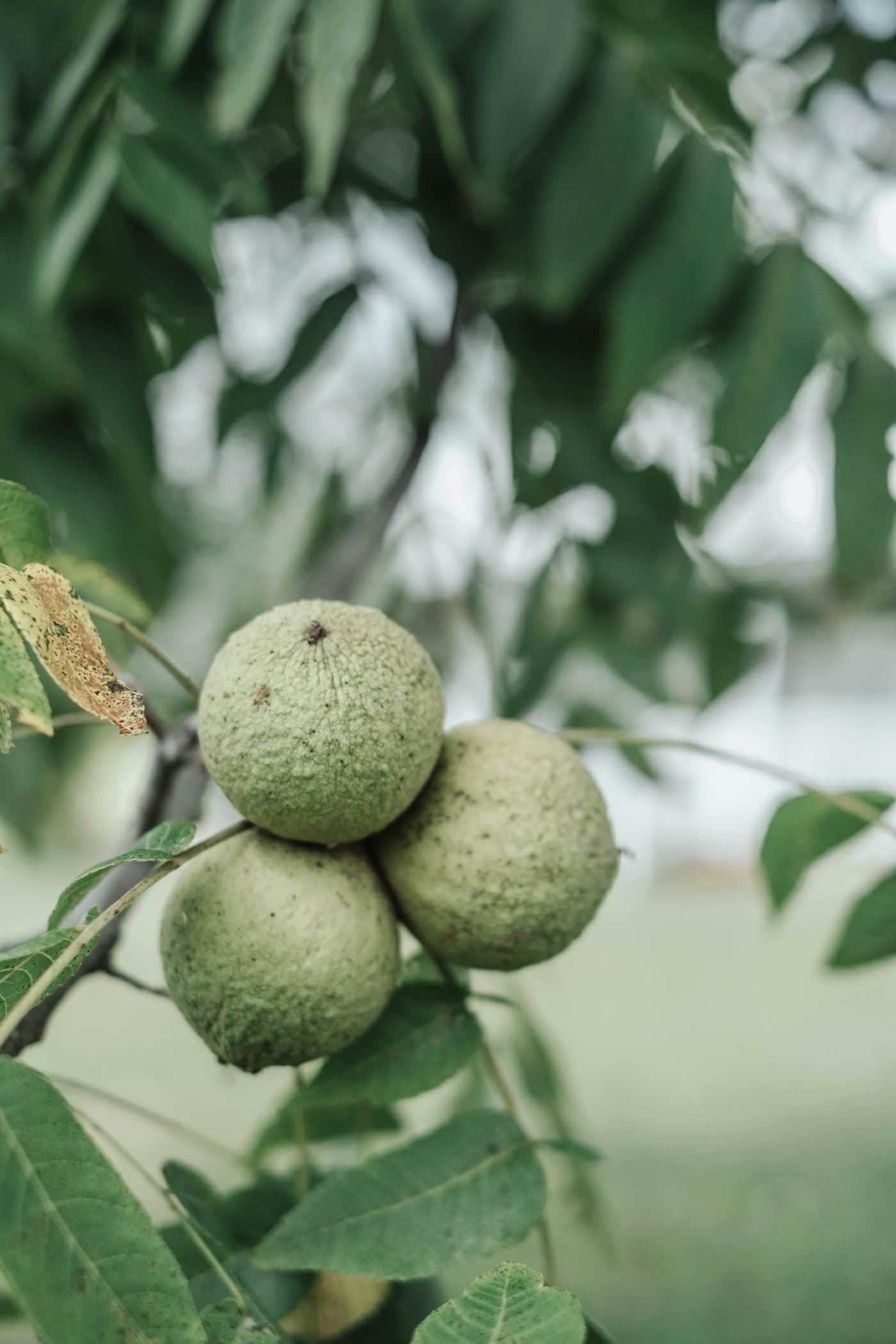
The green husk splits or softens as the nut inside matures, the signal to knock or shake nuts down, followed promptly by husking and drying.
Suitable states
States where this crop is grown at scale, highlighted below. Your local Krishi Vigyan Kendra is still the final word for your specific block.
- Jammu and Kashmir
- Himachal Pradesh
- Punjab
- Uttarakhand
- Haryana
- Delhi
- Uttar Pradesh
- Rajasthan
- Bihar
- Jharkhand
- West Bengal
- Sikkim
- Assam
- Arunachal Pradesh
- Meghalaya
- Nagaland
- Manipur
- Mizoram
- Tripura
- Gujarat
- Madhya Pradesh
- Chhattisgarh
- Maharashtra
- Odisha
- Goa
- Telangana
- Andhra Pradesh
- Karnataka
- Kerala
- Tamil Nadu
- Puducherry
- Ladakh
- Chandigarh
- Lakshadweep
Grown here
Climate requirements
Altitude is doing real work in India's walnut belt: the 1,200–2,500 m range across Kashmir, Himachal Pradesh and Uttarakhand is specifically what delivers the winter chilling the tree needs, which is why walnut orchards sit in these hill tracts rather than the plains regardless of how suitable soil or summer warmth might otherwise look lower down.
Ideal temperature
A genuinely temperate tree needing a real winter chill — roughly 800–1,500 hours below 7°C by the figures commonly cited for Kashmir — to break dormancy properly, followed by a moderately warm growing season; India's walnut belt sits mostly at 1,200–2,500 m altitude specifically to get this combination
Rainfall
Moderate rainfall through the growing season suits the tree well, but wet, humid weather right at bud-break and flowering is the single biggest risk window, since that is exactly when walnut blight spreads fastest
Humidity
Lower humidity at bud-break and flowering genuinely helps, since prolonged leaf and catkin wetness is what lets the walnut blight bacterium establish and spread
Sunlight
Full sun for good flowering, nut fill and general vigour — walnut is not a shade-tolerant tree
Soil requirements
Because walnut is this sensitive to waterlogging, a site's drainage deserves at least as much scrutiny as its chilling and altitude before planting — a technically cold-enough site with poor drainage is still a bad choice for walnut.
Suitable soil
Deep, well-drained loam is strongly preferred; walnut is notably intolerant of waterlogged or heavy, poorly drained ground even by orchard-tree standards, and wet feet are a fast route to root and crown problems
pH range
Roughly 6.0–7.5 (neutral to slightly acidic or slightly alkaline)
Drainage
Excellent drainage is essential, not just preferred — this is one of walnut's most consistently repeated agronomic warnings, and a poorly drained site is a common reason a planting fails to thrive regardless of variety choice
Organic matter
Responds well to farmyard manure worked into the planting pit and topsoil at establishment, and to regular organic mulching around, not against, the trunk
Land preparation
Same four steps whichever region you are in — only the timing shifts with the sowing window.
- 1
Choose a genuinely well-drained site at the right altitude
Confirm both real winter chilling (roughly 1,200–2,500 m altitude in Kashmir, Himachal Pradesh or Uttarakhand) and excellent natural drainage before planting — walnut's intolerance of waterlogging rules out low-lying, heavy or poorly drained ground even where the altitude and chill look right.
- 2
Plan a second, complementary-timed variety nearby, even though it is optional
Because walnut is monoecious and self-fertile, a single grafted variety will bear nuts on its own — but since its own male and female flowers usually mature a few days apart (dichogamy), planting a second variety with overlapping-but-offset bloom timing genuinely improves cross-pollination and nut fill.
- 3
Source certified grafted saplings, not seedling stock
A grafted sapling of a named variety bears in 4–5 years and reproduces the parent variety's nut quality true-to-type; a raw seedling takes 10–12 years to first bearing, 18–20 years to full production, and its nuts can vary widely from the parent tree.
Seed information
How the main varieties compare, so you can pick by duration, yield, disease pressure or what you are growing for.
| Variety | Duration | Yield | Disease resistance | Best state | Suitable for |
|---|---|---|---|---|---|
A SKUAST-Kashmir release (2001) with a semi-dwarf, terminal-and-lateral-bearing growth habit, medium nut weight (around 14 g) and a good kernel recovery of about 54%. | First bearing in 4–5 years (grafted) | High — around 5 kg dry in-shell nut/mature tree by SKUAST-Kashmir's own evaluation figures | Not specifically documented | Jammu and Kashmir | General commercial planting in the Kashmir valley's established walnut belt |
A SKUAST-Kashmir release (2001), the companion selection to Hamdan, evaluated for similarly strong yield and kernel quality under Kashmir valley conditions. | First bearing in 4–5 years (grafted) | High — around 5–6 kg dry in-shell nut/mature tree by SKUAST-Kashmir's own evaluation figures | Not specifically documented | Jammu and Kashmir | General commercial planting in the Kashmir valley's established walnut belt |
A SKUAST-Jammu release (2022) from the Jammu region's hill districts, notable for being bred specifically for anthracnose resistance alongside high yield and late maturity, which also lets it partly dodge spring frost risk at flowering. | First bearing in 4–5 years (grafted); late-maturing | High, with the added benefit of documented anthracnose resistance | Bred and evaluated specifically for anthracnose resistance | Jammu and Kashmir (Jammu hill districts) | Sites with a real anthracnose history, and sites at some frost risk during flowering |
An ICAR-CITH Srinagar release, a chance-seedling selection prized for high yield and superior nut quality with a strong shelling percentage of about 51%, recommended across the wider north-western Himalayan temperate belt rather than one district alone. | First bearing in 4–5 years (grafted) | High, among the better-shelling ICAR-CITH releases | Not specifically documented | Jammu and Kashmir, Himachal Pradesh, Uttarakhand | General commercial planting across the north-western Himalayan temperate belt |
An ICAR-CITH Srinagar release bearing a notably large nut (around 20.4 g) and kernel (around 11.0 g) with a good kernel recovery of about 54% and a light, export-friendly kernel colour. | First bearing in 4–5 years (grafted) | Good, with an emphasis on large nut and kernel size | Not specifically documented | Jammu and Kashmir | Growers prioritising large, light-coloured kernels for the premium export trade |
A long-established French cultivar widely planted in Himachal Pradesh, valued internationally for its distinctly late leafing and flowering, which helps the young growth dodge spring frost damage at altitude. | First bearing in 4–5 years (grafted); late-leafing/flowering | Good, internationally proven, though no India-specific yield figure is confirmed here | Not specifically documented for Indian conditions | Himachal Pradesh | Frost-prone high-altitude Himachal Pradesh sites where late flowering is a real advantage |
An internationally established cultivar long grown in Himachal Pradesh orchards alongside Franquette, cited in regional variety comparisons for the state's hill districts. | First bearing in 4–5 years (grafted) | Good under Himachal Pradesh conditions | Not specifically documented for Indian conditions | Himachal Pradesh | Established Himachal Pradesh orchards alongside other proven cultivars |
- Seed rate
- Not a seed crop — certified grafted saplings, planted at roughly 60–70 trees/acre at a traditional 8 × 8 m spacing (closer, high-density plantings at 6 × 6 m are increasingly used with precocious grafted cultivars)
- Certified seed
- Source certified grafted saplings of a named variety from SKUAST-Kashmir, ICAR-CITH Srinagar or another reputable nursery — because walnut is monoecious and self-fertile, a single well-chosen grafted variety can bear entirely on its own, but planting a second, complementary-bloom variety nearby genuinely improves cross-pollination and nut fill. Avoid raw seedling stock: it takes far longer to bear and does not reproduce the parent variety's nut quality true-to-type.
- Spacing
- 8 × 8 m under traditional planting (roughly 60–70 trees/acre); 6 × 6 m in high-density plantings with precocious grafted cultivars; wider spacing up to 10–12 m is still used for vigorous seedling trees
- Seed treatment
- Not a seed crop — inspect the graft union and root system before planting, and confirm the chosen variety's chilling need and bloom timing genuinely fit the planting site's altitude before committing.
Sowing guide
Site drainage deserves the same scrutiny as altitude and chilling before a single pit is dug — walnut's intolerance of waterlogging means a technically cold-enough site with heavy, poorly drained ground is still a bad planting choice.
- Best time
- Plant certified grafted saplings in the dormant season, from November through March while the tree is fully dormant, so the young root system begins establishing before spring growth resumes
- Row spacing
- 8 m under traditional planting; 6 m in high-density plantings with precocious grafted cultivars
- Plant spacing
- 8 m within the row, matching row spacing (6 m for high-density plantings)
- Sowing depth
- Set the graft union above the soil line; plant no deeper than the sapling stood in the nursery
- Method
- Plant certified grafted saplings into prepared, genuinely well-drained pits enriched with farmyard manure, stake against wind, and give a basin irrigation immediately after planting
Fertilizer schedule
A split dose beats one large dose applied at sowing — nitrogen especially is lost to the air and to leaching if it all goes in on day one.
- 1
Young trees (Year 1–3)
Split through the growing season
A balanced NPK dose supports frame-building and root establishment without pushing excessive soft growth that winter cold can damage.
- 2
Mature, bearing trees
Split before spring growth and after harvest
A higher dose split around these two windows supports flowering, nut fill and the next season's bud development, following general temperate nut-tree practice.
- 3
Micronutrients
As needed, based on soil/leaf test
Zinc and boron deficiencies are commonly reported on temperate fruit and nut trees generally; correct on the basis of a test rather than routinely.
Irrigation schedule
1. Establishment (Year 1–3)
Regular, light irrigation
Keep the young root zone consistently moist but never waterlogged through the first growing seasons — this is the single easiest mistake to make on a tree this intolerant of wet feet.
2. Flowering and nut set
Feb–Apr
Adequate but not excessive soil moisture supports flowering and fruit set; avoid wetting the canopy itself during this window, since damp catkins and leaves favour walnut blight.
3. Nut development
May–Aug
Regular irrigation through nut fill supports kernel size and quality, tapering off as harvest approaches in September–October.
Critical stages
- Establishment (Year 1–3)
- Flowering and nut set (Feb–Apr)
- Nut development (May–Aug)
Water-saving tips
- Drip irrigation delivers water efficiently to the root zone without wetting the canopy or catkins, which also helps against walnut blight.
- Mulch around, not against, the trunk to conserve soil moisture and moderate root-zone temperature.
- Avoid overhead irrigation specifically during flowering, since wetting the open catkins and young leaves is exactly what lets walnut blight establish and spread.
Weed management
Common weeds
Organic control
- Keep the basin around each tree clear by hand weeding or shallow hoeing rather than deep cultivation, which can damage feeder roots.
- Mulching the basin suppresses weeds and helps conserve moisture through the drier summer months.
Chemical control
- Herbicide use around walnut basins should stay conservative and away from the trunk and root flare, consistent with general orchard-tree practice.
- Confirm any herbicide is cleared for use around walnut with your local KVK or state horticulture department before applying near young trees.
Nutrient deficiency identification
What a shortage of each nutrient actually looks like on the plant, so you can tell a deficiency apart from a disease before you spray the wrong thing.
Nitrogen
Visible symptom
Pale, sparse foliage and weak shoot growth, most noticeable on young, establishing trees.
Zinc
Visible symptom
Small, narrow, rosetted new leaves with shortened internodes — a commonly reported micronutrient issue on temperate fruit and nut trees.
Boron
Visible symptom
Poor nut set and distorted young growth at the shoot tips, especially noticeable around the flowering period.
Diseases to watch for
Symptoms, likely cause and what actually treats it — not just a spray name.
Walnut blight
- Symptoms
- Small, dark, water-soaked spots on leaflets that enlarge and turn black, often with a yellow halo; blackened, dead catkins; dark, sunken lesions on young shoots; and dark, sunken spots on developing nuts that can rot the kernel inside or cause premature nut drop.
- Cause
- The bacterium Xanthomonas arboricola pv. juglandis, which overwinters in dormant buds and old cankers and spreads by wind-driven rain and splash, infecting through natural openings and wounds. It is strongly favoured by wet, humid weather right at bud-break and flowering, when catkins and young leaves stay damp for extended periods.
- Treatment
- A protective copper-based spray programme timed from bud-break through the flowering and early nut-development period is the standard control; because the bacterium can develop copper resistance with long-term, repeated use, rotating or combining copper with another cleared bactericide where recommended helps sustain control.
- Prevention
- Avoid overhead irrigation and any unnecessary wetting of the canopy during flowering, prune to open up the canopy for faster drying after rain, remove and destroy old cankered wood in the dormant season, and confirm the current copper-spray schedule for your area with SKUAST-Kashmir, ICAR-CITH or your local KVK. Some newer varieties bred for anthracnose resistance are not necessarily resistant to walnut blight specifically, since the two are different diseases caused by different organisms — check a variety's documented resistance carefully rather than assuming one covers the other.
Die-back & branch canker
- Symptoms
- Shoots and branches drying back from the tip inward, sometimes with sunken cankers on the bark — see the dedicated die-back guide for full identification.
- Cause
- A group of wound- and stress-associated fungi, favoured by humid conditions and worse on stressed, wounded or neglected trees.
- Treatment
- Prune affected wood well back into healthy tissue and protect the cuts; see the dedicated guide for full detail.
- Prevention
- Keep trees vigorous and unstressed with balanced nutrition and proper irrigation, avoid unnecessary wounding, and prune and sanitise promptly when die-back appears.
Pests to watch for
What to look for before the damage is visible, and organic options before you reach for a chemical.
Walnut aphid
- Identification
- Small, pale yellow, soft-bodied aphids clustering on the underside of leaves, distinguishable from other orchard aphids mainly by the host and their pale colour.
- Damage
- Feeding weakens leaves and can cause leaf drop under heavy infestation, most damaging in spring and early summer when nuts are filling rapidly, reducing both yield and nut quality that season.
- Organic control
- Conserve natural predators and parasitic wasps, which keep walnut aphid below damaging levels in most established orchards, and avoid routine early-season sprays that would kill them along with the aphid.
- Chemical control
- Where a spray is genuinely needed, delaying it until later generations helps protect the aphid's natural parasites; confirm the current recommended insecticide and timing with your local KVK.
Codling moth
- Identification
- A small moth whose caterpillar bores directly into the developing nut; frass (excrement) at a small entry hole on the husk is the main visible sign, since the damage itself happens out of sight inside the nut.
- Damage
- Larvae feeding inside the nut damage or destroy the kernel and can cause premature nut drop; this is a genuinely important walnut pest internationally, though no dedicated identification guide for it exists yet on this site — treat the description here as a starting point and confirm current local advice with your KVK.
- Organic control
- Pheromone traps to monitor and time control, and orchard sanitation (removing fallen, infested nuts promptly) to reduce the next generation's numbers, are standard non-chemical practices.
- Chemical control
- A well-timed insecticide application targeting egg-hatch, based on pheromone-trap monitoring rather than a fixed calendar date, is the standard chemical approach; confirm the current recommended product and timing for your area with your local KVK.
Common mistakes to avoid
The mistakes that cost growers the most, ranked by how often they show up in the field — not in the order you might expect.
- 1
Assuming walnut needs separate male and female trees, like pistachio.
Why it hurts
Walnut is monoecious, not dioecious — male catkins and female flowers grow on the very same tree, so a single grafted walnut bears nuts entirely on its own. Confusing this with pistachio's dioecious system leads to unnecessary planting decisions that walnut simply does not need.
- 2
Planting on a low-lying or poorly drained site because the altitude and chilling look right.
Why it hurts
Walnut is notably intolerant of waterlogging, more so than many other fruit and nut trees — a technically cold-enough site with heavy, wet ground still predisposes the tree to root and crown problems regardless of how well the climate otherwise fits.
- 3
Raising trees from seed to save money, expecting quick, true-to-type bearing.
Why it hurts
A seedling tree takes 10–12 years to first bearing and 18–20 years to full production — far longer than a grafted tree's 4–5 years — and its nuts can vary widely from the parent tree's quality. Certified grafted saplings are worth the extra upfront cost.
- 4
Waiting until walnut blight symptoms are obvious before spraying.
Why it hurts
Walnut blight spreads fastest in wet weather right at bud-break and flowering, and there is no cure once tissue is infected — a protective copper programme timed from bud-break onward protects healthy tissue, while a reactive spray after lesions appear cannot undo that season's damage.
- 5
Overhead-irrigating or otherwise wetting the canopy during flowering.
Why it hurts
Prolonged wetness on open catkins and young leaves is exactly what lets the walnut blight bacterium establish and spread — keep the flowering period as dry as the weather allows and avoid unnecessary overhead watering at this specific time.
- 6
Assuming a variety bred for anthracnose resistance is also resistant to walnut blight.
Why it hurts
Anthracnose and walnut blight are different diseases caused by different organisms — a fungus and a bacterium respectively — and resistance to one does not imply resistance to the other. Check a variety's documented resistance to the specific disease you are managing.
Harvesting
Harvest runs September–October, when the green outer husk splits or softens as the nut inside matures — this husk change is the clearest sign of readiness. Nuts are typically knocked or shaken from the tree onto a ground sheet or net, then husked and dried soon after collection, since delayed husking stains the shell and can affect kernel quality.
Signs it is ready
- The green outer husk has split or softened and separates easily from the shell
- The shell inside has hardened and turned its mature colour
- A sample nut, cracked open, shows a firm, well-filled kernel
Tools
- A pole or mechanical shaker to dislodge nuts from higher branches
- Ground sheets or nets spread under the canopy to catch falling nuts cleanly
- A husking tool or machine to remove the outer husk promptly after collection
Expected yield
Roughly 5–8 kg of dry, in-shell nut per mature grafted tree under typical management, with published variety trials reporting a range from about 4.8 kg/tree (Hamdan) to over 12 kg/tree for the best-performing selections, varying with variety, tree age, pollination success and how well walnut blight was managed that season.
Post-harvest & storage
Storage
Husk the nuts promptly after collection to avoid shell staining, then dry the in-shell nuts to a safe storage moisture before bagging; well-dried nuts store for many months in a cool, dry place.
Packaging
Dried in-shell walnut is typically bagged in breathable sacks for the local and wholesale trade; shelled kernels for the premium export market are graded by size and colour — large, light-coloured kernels command the best price — and packed in moisture-proof containers to protect flavour and prevent rancidity.
Transportation
Dried, in-shell nuts are a stable product that ships without special cold-chain needs; kernels should be kept cool and dry in transit to protect against oil rancidity over longer storage or export shipment.
Shelf life
Well-dried in-shell walnut keeps for a year or more in cool, dry storage; shelled kernels have a shorter practical shelf life and are best used within several months unless kept refrigerated or frozen.
Market prices
Today's mandi price near you, pulled live from the government's own Agmarknet data.
Live daily mandi prices from the government Agmarknet dataset.
Synced from data.gov.in (Agmarknet). Rates are ₹ per quintal.
Weather
Current conditions and a 5-day outlook for your selected location, with one line of stage-aware advice.
Pick your state for current conditions and a 5-day outlook.
Live data from Open-Meteo
Profit calculator
Your own cost sheet, expected yield and selling price — not ours.
Where the money goes
Share of the total cost per acre, using the calculator’s own default cost sheet below — adjust the numbers there to match your field and this picture will no longer apply to you exactly, but the ranking rarely changes.
- Land rent26% (₹9,000)
- Labour24% (₹8,000)
- Fertiliser15% (₹5,000)
- Pesticide & weedicide12% (₹4,000)
- Irrigation9% (₹3,000)
- Seed6% (₹2,000)
- Machinery4% (₹1,500)
- Interest4% (₹1,500)
Official downloads
Government and ICAR documents only — everything below is hosted on an official server.
ICAR-CITH (Central Institute of Temperate Horticulture), Srinagar
The ICAR institute responsible for temperate fruit and nut research across the Himalayan region, including walnut variety releases and quality planting material
SKUAST-Kashmir (Sher-e-Kashmir University of Agricultural Sciences and Technology)
Variety releases, orchard agronomy and disease-management advisories for walnut and other temperate fruit and nut crops in Kashmir
Directorate of Horticulture, Jammu & Kashmir
State horticulture department guidance, schemes and extension support for walnut growers
Kisan Call Centre — 1800-180-1551
Free crop advice in your language
Frequently asked questions
Does a walnut tree need a separate male and female tree, like pistachio?
No — this is a common mix-up between two different Himalayan nut trees. Walnut is monoecious: male catkins and female flowers grow on the very same tree, so a single grafted walnut bears nuts entirely on its own. Pistachio, by contrast, is genuinely dioecious and needs a separate male pollinator tree. Planting a second walnut variety nearby with slightly offset flowering time can still improve cross-pollination and nut fill, but it is a yield improvement, not a requirement the way it is for pistachio.
Where in India is walnut actually grown?
Jammu & Kashmir's Kashmir valley — Anantnag, Kulgam, Kupwara, Shopian, Baramulla and Pulwama — and the Jammu region's hill districts together account for the great majority of India's walnut production, with Himachal Pradesh's Kinnaur, Kullu and Chamba and Uttarakhand's Pithoragarh, Nainital and Almora belts a distant second and third, plus scattered plantings further east in Arunachal Pradesh. This is a genuinely established Indian crop, not an experimental one.
How much faster does a grafted walnut tree bear compared to growing one from seed?
A grafted sapling typically gives its first light nut crop in 4–5 years and reaches full commercial bearing by 8–10 years. A tree raised from seed takes far longer — 10–12 years to first bearing and 18–20 years to full production — and its nuts can vary widely from the parent tree's quality, since seedlings don't reproduce a named variety true-to-type. Certified grafted planting material is worth the extra cost for this reason alone.
My walnut leaves have dark, water-soaked spots and some catkins have turned black. What is it?
That combination — dark spots on leaflets, blackened catkins, and sometimes dark sunken spots on developing nuts — is the classic picture of walnut blight, a bacterial disease (Xanthomonas arboricola pv. juglandis) that spreads fastest in wet weather right at bud-break and flowering. There is no cure once tissue is infected, so a protective copper-spray programme timed from bud-break onward, combined with avoiding overhead wetting of the canopy during flowering, is the standard management approach.
Does walnut have an MSP or genuine mandi trade in India?
No MSP — walnut is not a CACP-notified crop. A live check of the Agmarknet mandi dataset found genuine but thin trade: real records from a Kashmir producer-belt market (Bumhama, Kupwara), rather than a wide mandi network across the growing districts. Most of the crop instead moves through direct and cooperative trade toward the dry-fruit trade and the premium kernel-export market, where Kashmir walnut is a genuinely recognised product once properly graded.
What is the biggest risk to a young walnut planting?
Two things matter most: site drainage and disease timing. Walnut is notably intolerant of waterlogged or poorly drained ground, more so than many other fruit trees, so a wet site is a common reason a planting struggles regardless of variety. Once trees are established and bearing, walnut blight — a bacterial disease favoured by wet spring weather at bud-break and flowering — is the single biggest disease risk and needs a timed copper-spray programme rather than a reactive one.
Still have questions?
The FAQs above cover the common ones. For anything specific to your field and soil, your nearest Krishi Vigyan Kendra is the authoritative answer.