
Turnip (Shalgam)
Brassica rapa subsp. rapa
A fast, cool-season root where the one choice that decides everything is made at sowing time — an Asiatic (desi) type sown in August–September for a quick, mild, warm-tolerant root, or a European type sown only once real cold arrives in October–November for a firmer, sweeter root that keeps far better — and after that, pulling every root on time, because a shalgam left a week too long in the ground turns woody, pithy and sharply bitter.
Quick Summary
The key points from this page in about two minutes — read it or have it read aloud.
Quick Summary
Turnip (shalgam) is a quick cool-season root vegetable grown across the northern and eastern plains and the hills, valued for its speed — the first roots are ready within six to ten weeks of sowing — and for being one of the easiest, lowest-input vegetables a smallholder can grow on a rabi plot or as a catch crop between two main crops.
The whole crop turns on one choice made at sowing: which of the two turnip types to grow, and when. Asiatic (desi) varieties are bred for the warmer plains — they tolerate sowing in the last heat of August and September, grow fast, and give a mild, tender root suited to everyday cooking. European (temperate) varieties need real cold to size up and sweeten properly, so they are sown later, from October to December, and reward growers with a firmer root that keeps much longer in storage. Sowing a European type too early, into warm soil, gives a poor, pithy, bolting-prone crop — matching the type to the season is not optional.
Once the crop is up, turnip asks for very little: a loose, stone-free, well-manured bed so the root grows round and smooth instead of forked, thinning to the right spacing early so roots do not crowd each other into odd shapes, and steady moisture through root swelling. A boron shortage on light or over-limed soils causes a hidden defect — a brown, corky, sometimes hollow patch inside an otherwise normal-looking root — so a light boron application is cheap insurance on soils known to be short of it.
The single most costly mistake is leaving mature roots in the ground. A turnip pulled on time is tender and mild; the same root left even a week past maturity turns woody, fibrous, pithy in the centre and unpleasantly sharp-tasting, and cannot be sold. Because the crop matures so fast and unevenly across a bed, timely, staggered pulling — not a single harvest date — is what keeps a planting profitable from first root to last.
- Crop type
- Cool-season annual root vegetable (Brassica)
- Season
- Rabi; Asiatic types Aug–Sept, European types Oct–Dec
- Suitable states
- Uttar Pradesh, Bihar, Punjab, Haryana, West Bengal, hill states
- Growing duration
- 40–60 days (Asiatic); 60–90 days (European)
- Water requirement
- Low–moderate; light, frequent irrigation, evenly moist at root swelling
- Temperature
- Cool, 10–20°C best; Asiatic types tolerate more warmth than European
- Soil type
- Loose, well-drained sandy loam to loam, stone-free, pH 5.5–7.0
- Difficulty level
- Easy (matching type to season, timely pulling)
- Expected yield
- 15–25 t/ha (Asiatic); 25–35 t/ha (European)
- Key risk
- Roots left in the ground past maturity turn woody, pithy and bitter
Overview
Turnip, or shalgam (Brassica rapa subsp. rapa), is a cool-season root vegetable of the mustard family, grown for its swollen root — eaten boiled, in curries, pickled, or fed as fodder — and, in some regions, for its leafy tops as a green. It is one of the fastest vegetables grown in India: the first roots of a quick Asiatic type are ready within six to eight weeks of sowing.
It is grown across the northern plains (Uttar Pradesh, Bihar, Punjab, Haryana, Rajasthan), West Bengal and the eastern states, and in the hills of Himachal Pradesh, Uttarakhand and Jammu & Kashmir, where the cooler climate suits the slower, larger-rooted European types for a much longer season. In the plains it is a classic rabi (winter) vegetable and a popular quick catch crop between two main crops.
Two turnip types are grown, and choosing the right one for the season and place is the crop's central decision. Asiatic (desi) varieties are quick, heat-tolerant enough for an August–September sowing, and give a mild, tender root for everyday cooking. European (temperate) varieties need sustained cool weather to size up and develop their characteristic firmness and sweetness, so they are sown later — October to December in the plains, or through much of the growing season in the hills — and store considerably better than Asiatic types. Beyond that choice, a loose stone-free bed, timely thinning, even moisture, and — on light or over-limed soils — a boron application against internal browning carry most of the rest of the crop.
Crop timeline, sowing to harvest
A quick visual map of the season — jump to any section below for the detail behind each stage.
- Day 0
Sowing
Seed sown shallow in rows on a fine, well-manured, stone-free bed; Asiatic types from August, European types only once real cold sets in from October.
- Day 5–10
Germination
Seedlings emerge quickly in warm soil; the bed is kept lightly moist so the fine seed does not crust over and fail to emerge.
- Day 15–20
Thinning
Seedlings are thinned to their final in-row spacing early — crowded roots turn small, forked and misshapen, and thinnings can be sold or eaten as greens.
- Day 20–40
Root formation
The root begins to visibly swell above the soil line; steady moisture and a first light nitrogen top-dress now decide the final root size.
- Day 40–60
Root swelling and maturity (Asiatic)
Asiatic types size up and reach pulling maturity; roots are checked regularly by size, not by a fixed date, since a crowded bed matures unevenly.
- Day 60–90
Root swelling and maturity (European)
European types take longer to bulk up in sustained cool weather but reach a firmer, sweeter, better-keeping root; harvest continues in successive pulls as roots reach size.
Suitable states
States where this crop is grown at scale, highlighted below. Your local Krishi Vigyan Kendra is still the final word for your specific block.
- Jammu and Kashmir
- Himachal Pradesh
- Punjab
- Uttarakhand
- Haryana
- Delhi
- Uttar Pradesh
- Rajasthan
- Bihar
- Jharkhand
- West Bengal
- Sikkim
- Assam
- Arunachal Pradesh
- Meghalaya
- Nagaland
- Manipur
- Mizoram
- Tripura
- Gujarat
- Madhya Pradesh
- Chhattisgarh
- Maharashtra
- Odisha
- Goa
- Telangana
- Andhra Pradesh
- Karnataka
- Kerala
- Tamil Nadu
- Puducherry
- Ladakh
- Chandigarh
- Lakshadweep
Grown here
Climate requirements
Sowing a European (temperate) turnip too early, while the soil is still warm, is the single biggest climate mistake — the plant bolts to seed or gives a small, pithy, poorly-flavoured root instead of sizing up properly.
Ideal temperature
A cool-season crop, growing best at 10–20°C; root quality, flavour and texture are all best when the root fills out in genuinely cool weather. Asiatic (desi) types tolerate the residual warmth of late August and September in the plains, while European (temperate) types need sustained cool weather below about 20°C to size up properly and avoid a pithy, poorly-flavoured root.
Rainfall
Turnip is almost always grown under irrigation in the plains rabi season, with light, frequent watering rather than heavy irrigation. It does not tolerate waterlogging, which rots the root and encourages disease.
Humidity
Moderate humidity is fine; prolonged damp, overcast weather favours leaf diseases such as Alternaria leaf spot and white rust.
Sunlight
Full sun gives the best root development. Shaded or crowded plants put energy into leafy top growth at the expense of the root.
Soil requirements
On light sandy soils, or soils known to be short of boron, a light boron application before sowing prevents brown heart — a corky, sometimes hollow internal patch that leaves the root looking normal from outside but spoils it inside.
Suitable soil
A deep, loose, well-drained sandy loam to loam free of stones and clods gives round, smooth roots; heavy, cloddy or compacted soil forks and roughens the root. Only fully rotted farmyard manure should go into the bed — fresh or half-rotted manure causes forked, hairy roots, exactly as in radish and beetroot.
pH range
Best at pH 5.5–7.0; turnip tolerates mildly acid soil better than most vegetables, which is part of why it does well in the hills.
Drainage
Good drainage is essential — a waterlogged bed rots the swelling root and invites soft rot. Raised beds or ridges are worthwhile on heavier soils.
Organic matter
Responds well to 20–25 t/ha of well-rotted farmyard manure or compost worked into the bed well ahead of sowing, giving time for it to break down fully before the roots start to swell.
Land preparation
Same four steps whichever region you are in — only the timing shifts with the sowing window.
- 1
Deep-plough and break clods finely
Plough two to three times and rake the bed to a fine, loose, stone-free tilth — any clod or stone in the root zone forks or roughens the growing root.
- 2
Work in only fully rotted manure
Mix 20–25 t/ha of well-rotted FYM or compost into the bed at least three to four weeks ahead of sowing, along with the basal phosphorus and potash dose. Fresh manure causes forked, hairy roots.
- 3
Form beds or ridges for drainage
Lay out flat beds or low ridges with clear channels so excess water drains away quickly — standing water around the shoulder of a swelling root causes rot.
Seed information
How the main varieties compare, so you can pick by duration, yield, disease pressure or what you are growing for.
| Variety | Duration | Yield | Disease resistance | Best state | Suitable for |
|---|---|---|---|---|---|
An IARI Asiatic (desi) variety with smooth, round, pure white roots and mild flavour, bred for the northern plains. Quick to mature and a heavy, reliable cropper for the everyday market. | 45–50 days | 20–25 t/ha | No special resistance widely documented | Uttar Pradesh, Bihar, Punjab, Haryana | Plains rabi crop, everyday fresh market |
An IARI Asiatic variety with attractive purple-topped, white-based roots and good early vigour, suited to an early rabi sowing in the plains. | 45–55 days | 18–22 t/ha | No special resistance widely documented | Uttar Pradesh, Bihar, Delhi | Early rabi crop, fresh market with purple-top appeal |
An IARI Asiatic variety bred from a Golden Ball (European) × Local Red Round (Asiatic) cross, combining faster plains adaptability with a firmer root than most desi types. A dependable dual-purpose choice. | 50–55 days | 20–24 t/ha | No special resistance widely documented | Northern plains | Plains rabi crop, slightly firmer keeping root |
A Punjab Agricultural University Asiatic release with pure white, round, medium-sized roots and a mild taste, recommended for Punjab and Haryana conditions. | 45–55 days | 18–22 t/ha | No special resistance widely documented | Punjab, Haryana | North-west plains, mild-flavour fresh market |
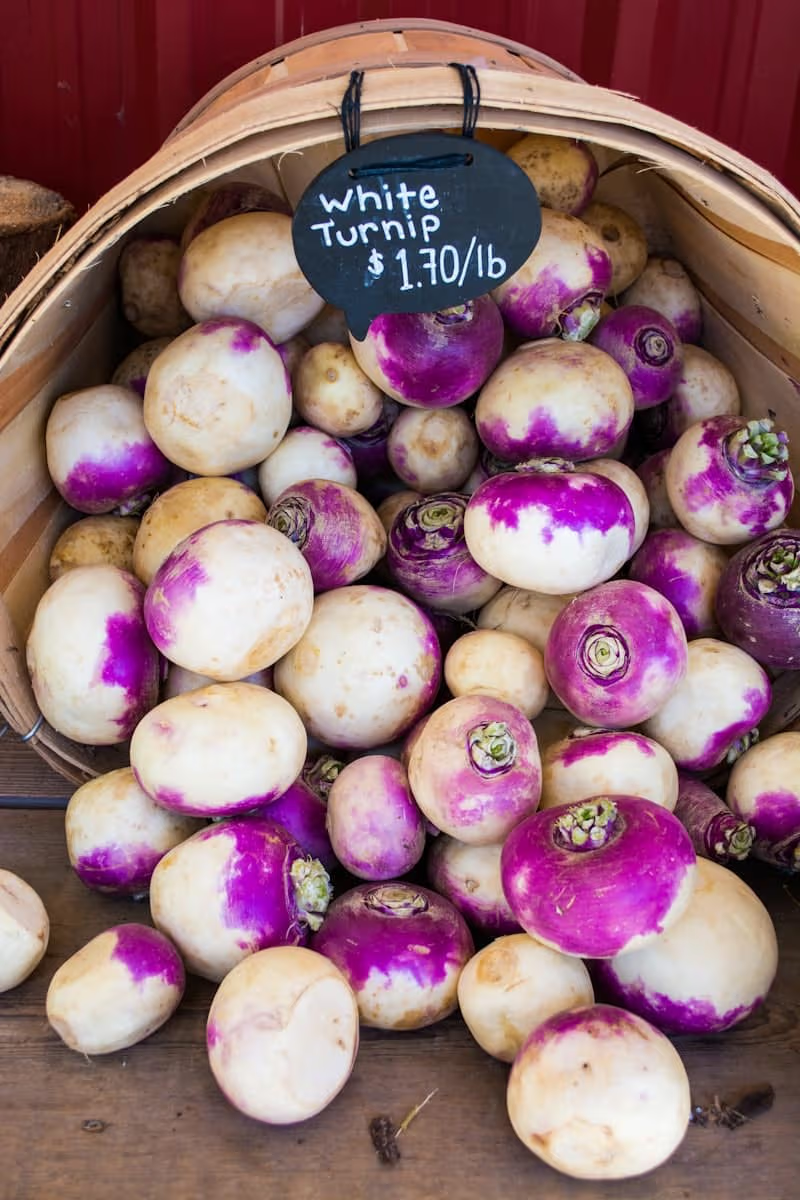
A long-established European (temperate) open-pollinated variety, widely sold by Indian seed companies, with a globe-shaped root — white below, purple-red where the shoulder is exposed to light — prized for its firm texture and sweeter flavour after cool weather. The classic hill and late-rabi turnip. | 60–70 days | 25–30 t/ha | No special resistance claimed; open-pollinated, seed can be saved | Hill states, late-sown northern plains | Cool-season crop, better storage life than Asiatic types |
A European open-pollinated variety with round, golden-yellow-skinned, yellow-fleshed roots, valued for a sweeter, less pungent flavour than white European types and reasonable keeping quality. Sold by several Indian seed companies for the hill and late-rabi market. | 60–70 days | 22–28 t/ha | No special resistance claimed; open-pollinated | Hill states, late-sown plains | Cool-season crop, distinctive yellow-fleshed root |
A fast-maturing European open-pollinated variety with small, smooth, pure white round roots and a mild flavour, harvested young for the freshest, most tender eating quality. Popular as a quick catch crop in cooler weather. | 50–60 days | 18–22 t/ha | No special resistance claimed; open-pollinated | Hill states, cool-season plains sowing | Quick catch crop, tender small roots |
- Seed rate
- 3–4 kg/ha (roughly 1.2–1.6 kg/acre), sown thinly in rows and thinned after emergence. European types are sometimes sown a little thicker since a smaller share of seed establishes in cooler soil.
- Certified seed
- Buy fresh seed of a named variety each season from a state seed corporation, an ICAR institute or a reputed seed company, and match the type — Asiatic or European — to your sowing window and climate. Open-pollinated varieties let seed be saved from a true-to-type root, but isolation from other Brassica crops in flower is needed to keep it pure.
- Spacing
- Rows 30–45 cm apart; plants thinned to 8–12 cm apart in the row once seedlings are established. Wider spacing suits the larger-rooted European types.
- Seed treatment
- Treat seed with thiram or carbendazim against damping-off in the seedbed, especially in a warm, humid early sowing.
Sowing guide
Never sow a European variety while the soil is still warm — it bolts to seed or gives a small, pithy root instead of sizing up. Wait for real cold before switching from an Asiatic to a European sowing.
- Best time
- Asiatic (desi) types: mid-August to September in the northern plains. European (temperate) types: October to December in the plains, sown only once real cold has set in; in the hills, European types can be sown through spring and summer for a long cool-season supply.
- Row spacing
- 30–45 cm
- Plant spacing
- 8–12 cm after thinning
- Sowing depth
- 1–2 cm
- Method
- Broadcast or sow in shallow lines on a fine, firmed, well-manured bed and cover lightly with soil; keep the bed evenly moist until germination, then thin to the final spacing as soon as seedlings can be handled.
Fertilizer schedule
A split dose beats one large dose applied at sowing — nitrogen especially is lost to the air and to leaching if it all goes in on day one.
- 1
Basal (at sowing)
Day 0
Well-rotted FYM worked in ahead of sowing, plus the full phosphorus and potash dose and about half the nitrogen — roughly 40–50 kg N, 50 kg P₂O₅ and 50 kg K₂O per hectare as the basal share.
- 2
First top-dressing
18–25 days (after thinning)
About a quarter of the remaining nitrogen, worked in lightly along the rows once the crop is thinned to its final spacing.
- 3
Second top-dressing
35–40 days (start of root swelling)
The rest of the nitrogen as the root visibly begins to swell — this final dose has the biggest effect on final root size.
Irrigation schedule
1. Sowing to germination
Day 0–10
Light, frequent watering to keep the fine seed and the top of the bed moist until the stand is fully up.
2. Seedling to thinning
Day 10–20
Irrigate every 6–8 days; even moisture now sets up a uniform stand for thinning.
3. Root formation and swelling
Day 20–maturity
The critical period — irrigate every 8–10 days so the soil stays evenly moist. A dry spell followed by heavy watering splits and coarsens the root; irregular moisture is the main cause of poor root shape and sharp flavour.
Critical stages
- Germination and stand establishment
- Root formation and swelling
Water-saving tips
- Light, frequent irrigation suits this shallow-rooted crop far better than infrequent heavy watering, which cracks and coarsens the root.
- A straw mulch between rows conserves moisture, keeps the soil temperature even and suppresses weeds through the short growing period.
- Cut back on water a few days before pulling — a slightly firmer, drier soil at harvest makes cleaner, less-bruised roots.
Weed management
Common weeds
Organic control
- One or two shallow hand-weedings, timed with thinning so both jobs are done together.
- A straw or light organic mulch between rows suppresses weeds and conserves moisture through the short season.
- Because the crop is in the ground for only six to ten weeks, weed pressure is naturally lower than in longer-duration vegetables — early control is usually enough.
Chemical control
- A pre-emergence herbicide cleared for root vegetables can be used on larger plantings, followed by one hand-weeding at thinning time.
- Confirm product, dose and pre-harvest interval with your local KVK before spraying a crop eaten so soon after sowing.
Nutrient deficiency identification
What a shortage of each nutrient actually looks like on the plant, so you can tell a deficiency apart from a disease before you spray the wrong thing.
Boron
Visible symptom
Brown heart — a corky, sometimes hollow brown patch inside an otherwise normal-looking root, common on light sandy or over-limed soils. The defect is invisible until the root is cut open.
Nitrogen
Visible symptom
Pale green, small older leaves and slow, weak root swelling.
Potassium
Visible symptom
Scorched, browning leaf margins on older leaves and smaller, poorly filled roots.
Diseases to watch for
Symptoms, likely cause and what actually treats it — not just a spray name.
Alternaria leaf spot
- Symptoms
- Small dark spots with concentric target-like rings on the leaves, enlarging and merging in humid weather until the leaf yellows and dies back from the edges.
- Cause
- The fungi Alternaria brassicae and A. brassicicola, spread by wind and rain-splash and favoured by humid, overcast weather.
- Treatment
- A protective mancozeb spray at first sign, repeated at 10-day intervals in humid weather.
- Prevention
- Use clean, treated seed, rotate away from Brassica crops, and avoid dense, poorly-ventilated sowing.
White rust
- Symptoms
- White, blister-like pustules on the underside of leaves, with a faint yellow patch directly opposite on the upper surface; the leaf later distorts and the pustules turn powdery as they age.
- Cause
- The oomycete Albugo candida, spread by wind-borne spores and favoured by cool, humid weather.
- Treatment
- A protective mancozeb or metalaxyl-based spray at first sign.
- Prevention
- Rotate away from Brassica crops, destroy infected residue, and avoid overhead irrigation late in the day.
Club root
- Symptoms
- Stunted, wilting plants with swollen, distorted, club-shaped roots instead of a clean single root, worst on acid soils.
- Cause
- The soil-borne slime mould Plasmodiophora brassicae, which persists in the soil for years once established.
- Treatment
- No cure once established; remove and destroy affected plants to slow spread.
- Prevention
- Avoid short rotations of Brassica crops on the same land, raise soil pH with lime on acid fields, and improve drainage — the organism thrives in wet, acid soil.
Pests to watch for
What to look for before the damage is visible, and organic options before you reach for a chemical.
Aphids
- Identification
- Colonies of small green or grey soft-bodied insects clustered on the underside of young leaves and the growing point, often with a dusty grey waxy coating on cabbage-family aphids.
- Damage
- Sap loss curls and stunts young leaves and slows root growth; heavy infestation coats leaves with sticky honeydew and sooty mould.
- Organic control
- A strong water jet, yellow sticky traps, neem oil spray, and conserving ladybird beetles and lacewings.
- Chemical control
- A recommended systemic insecticide only where infestation is heavy, observing the pre-harvest interval on a crop eaten so soon after treatment.
Diamondback moth
- Identification
- Small, pale-green caterpillars that wriggle vigorously when disturbed, feeding on the leaf underside and leaving small irregular window-like holes without damaging the upper leaf surface.
- Damage
- Heavy feeding on young leaves slows growth and, on badly infested plants, reduces root size.
- Organic control
- Bacillus thuringiensis (Bt) sprays, pheromone traps for monitoring, and rotating away from other Brassica crops to break the pest cycle.
- Chemical control
- Rotate insecticide groups carefully — diamondback moth develops resistance quickly to any single mode of action used repeatedly.
Common mistakes to avoid
The mistakes that cost growers the most, ranked by how often they show up in the field — not in the order you might expect.
- 1
Leaving mature roots in the ground.
Why it hurts
A turnip left even a week past maturity turns woody, fibrous, pithy in the centre and sharply bitter, and cannot be sold. Pull roots as soon as they reach size rather than waiting for a fixed calendar date.
- 2
Sowing a European variety too early, into warm soil.
Why it hurts
The plant bolts to seed or gives a small, pithy, poorly-flavoured root instead of sizing up. Wait until real cold has set in before switching from an Asiatic to a European sowing.
- 3
Skipping thinning, or thinning too late.
Why it hurts
Crowded seedlings compete for space and produce small, forked, oddly-shaped roots. Thin to the final spacing as soon as seedlings can be handled.
- 4
Working fresh or half-rotted manure into the bed.
Why it hurts
Undecomposed organic matter in the root zone causes forked, hairy, rough-skinned roots. Use only fully rotted FYM or compost, worked in weeks ahead of sowing.
- 5
Irregular watering through root swelling.
Why it hurts
A dry spell followed by heavy irrigation splits and coarsens the root and sharpens its flavour. Keep the soil evenly moist with light, frequent watering instead.
- 6
Ignoring boron on light sandy soils.
Why it hurts
Brown heart — a corky, sometimes hollow internal patch — spoils the root invisibly from outside. A light boron application before sowing on soils known to be short of it is cheap insurance.
Harvesting
Pull roots as soon as they reach a usable size for the variety — about 5–8 cm across for most Asiatic types, larger for European types grown for storage. Check by size rather than a fixed number of days, since a crowded or unevenly germinated bed matures at different rates across the plot. Loosen heavier soil with a fork before pulling to avoid snapping the root.
Signs it is ready
- Root shoulder visibly swollen above the soil line to the expected size for the variety
- Leaves still green and healthy, not yet yellowing from age
- Root firm to the touch, not soft or cracked
- For European types grown for storage: cool weather has set in and roots have firmed up
Tools
- A hand fork or spade to loosen the soil on heavier ground
- A sharp knife to trim tops, leaving a short stub
- Crates or baskets for the field-to-market move
Expected yield
About 15–25 t/ha for Asiatic types in a quick plains crop, and 25–35 t/ha for European types given a full cool season to size up. On an acre that is roughly 60–140 quintals depending on type and management.
Post-harvest & storage
Storage
Asiatic types are best sold and eaten fresh within a few days — they do not keep well. European (temperate) types keep considerably better: several weeks at cool room temperature with tops removed, and up to a few months in cold storage (0–4°C, high humidity).
Packaging
Trim tops to a short stub, brush off loose soil, and pack in ventilated crates or gunny bags — not sealed sacks, which trap moisture and encourage rot.
Transportation
Move to market promptly for Asiatic types; European types tolerate a longer haul and short-term storage before sale.
Shelf life
A few days at room temperature for Asiatic types; several weeks for European types at cool room temperature; up to a few months in proper cold storage.
Market prices
Today's mandi price near you, pulled live from the government's own Agmarknet data.
Live daily mandi prices from the government Agmarknet dataset.
Synced from data.gov.in (Agmarknet). Rates are ₹ per quintal.
Weather
Current conditions and a 5-day outlook for your selected location, with one line of stage-aware advice.
Pick your state for current conditions and a 5-day outlook.
Live data from Open-Meteo
Profit calculator
Your own cost sheet, expected yield and selling price — not ours.
Where the money goes
Share of the total cost per acre, using the calculator’s own default cost sheet below — adjust the numbers there to match your field and this picture will no longer apply to you exactly, but the ranking rarely changes.
- Labour34% (₹8,000)
- Land rent21% (₹5,000)
- Fertiliser13% (₹3,000)
- Machinery8% (₹2,000)
- Irrigation8% (₹2,000)
- Seed6% (₹1,500)
- Pesticide & weedicide5% (₹1,200)
- Interest4% (₹1,000)
Official downloads
Government and ICAR documents only — everything below is hosted on an official server.
ICAR-IARI, New Delhi — Division of Vegetable Science
Pusa Sweti, Pusa Chandrima, Pusa Kanchan and turnip package of practices
Punjab Agricultural University (PAU), Ludhiana
Punjab Safed-4 and Punjab package of practices for vegetable crops
Kisan Call Centre — 1800-180-1551
Free crop advice in your language
Frequently asked questions
What is the difference between Asiatic and European turnip types?
Asiatic (desi) types are bred for the warmer plains — they tolerate an August–September sowing, mature quickly in six to eight weeks, and give a mild, tender root. European (temperate) types need sustained real cold to size up properly; they are sown later (October–December) or grown through a hill-station season, take longer to mature, but give a firmer, sweeter root that keeps far better in storage. Sowing the wrong type for your season and climate is the single biggest mistake in turnip growing.
Why is my turnip woody and bitter inside?
It was left in the ground too long. A turnip must be pulled as soon as it reaches usable size — a root left even a week past maturity turns fibrous, pithy in the centre and sharply bitter, and cannot be sold. Check roots by size rather than by a fixed number of days, and pull as they reach it.
What is brown heart in turnip, and how do I prevent it?
Brown heart is a boron-deficiency defect — a corky, sometimes hollow brown patch inside the root that is invisible from outside until the root is cut. It is most common on light sandy soils or soils that have been heavily limed. A light boron application worked into the bed before sowing prevents it on soils known to be short of the nutrient.
Why did my turnip bolt to seed instead of forming a good root?
This usually happens when a European (temperate) variety is sown too early, while the soil is still warm from summer. The plant reads the warmth as a signal to flower rather than to bulk up its root. Wait until real cold has set in before sowing a European type, or use a heat-tolerant Asiatic variety for an early sowing.
How much water does turnip need?
Turnip is a shallow-rooted crop that responds far better to light, frequent irrigation than to infrequent heavy watering. Water every 8–10 days through root formation and swelling, keeping the soil evenly moist — a dry spell followed by heavy watering splits and coarsens the root and makes it taste sharper.
Does turnip have an MSP or a mandi price?
There is no MSP for turnip. It trades on Agmarknet under the commodity name "Turnip", though volumes are thinner and more localised than for radish or carrot — it is grown widely for home and local-market use but is a smaller commercial crop overall.
Still have questions?
The FAQs above cover the common ones. For anything specific to your field and soil, your nearest Krishi Vigyan Kendra is the authoritative answer.