
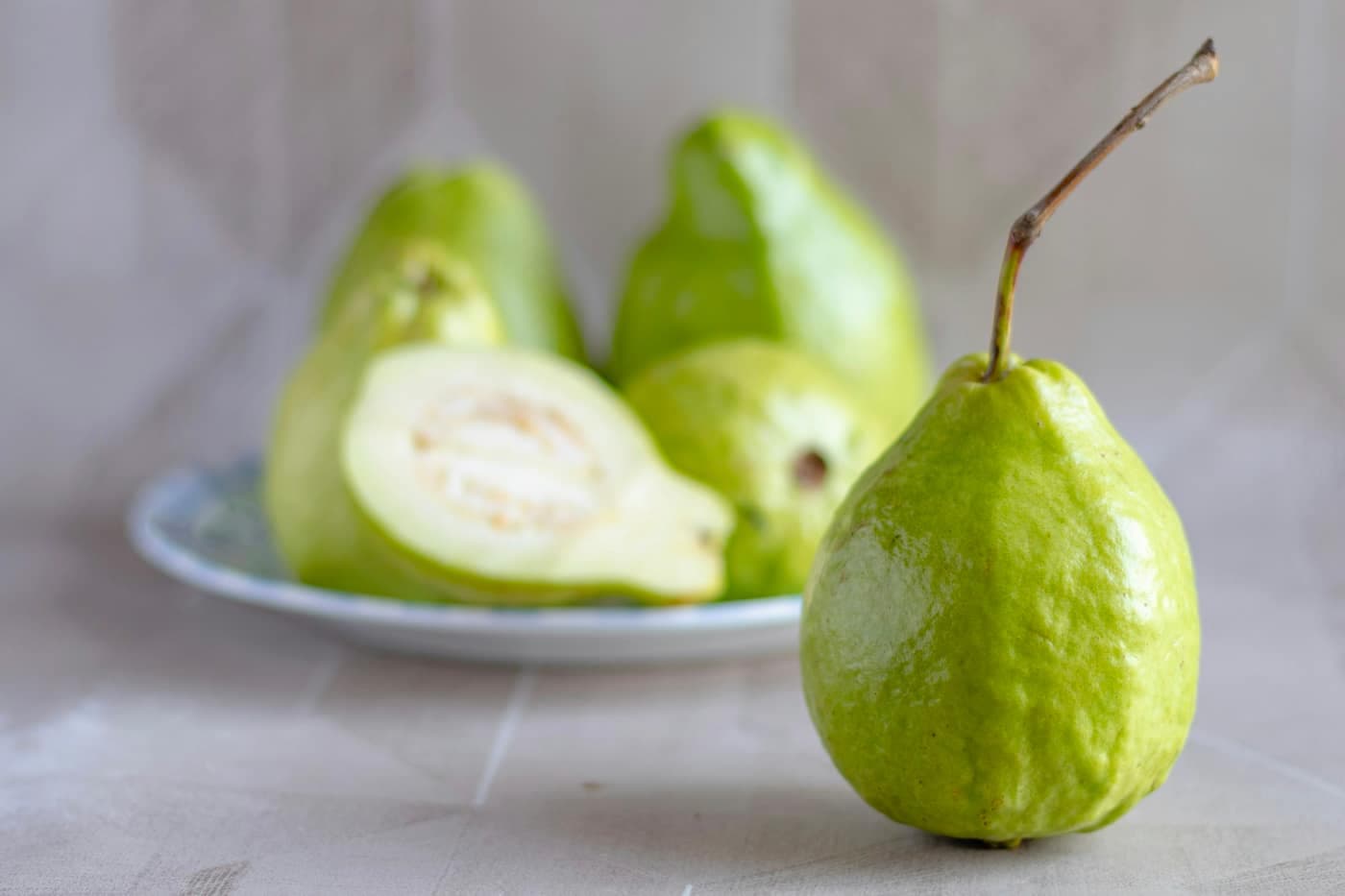
Guava
Psidium guajava
The hardiest of India’s major fruits — it crops on poor soils with little care, which is exactly why growers under-manage it. Regulating the crop to the winter (mrig bahar) by withholding water and pruning gives bigger, sweeter, less fly-struck fruit than the rainy-season flush.
Quick Summary
The key points from this page in about two minutes — read it or have it read aloud.
Quick Summary
Guava is the hardiest and most forgiving of India’s major fruits — it bears on poor soils, tolerates heat into the mid-40s and light frost, and starts cropping in two or three years. That toughness is also its trap: because it fruits even when neglected, many growers never really manage it and take a small, fly-struck, low-value rainy-season crop. The tree naturally flowers two or three times a year, and left alone it spreads a poor crop thinly across all of them.
The one practice that changes this is bahar regulation. By deliberately withholding water and pruning in one season, the tree is forced into a single, concentrated flowering — usually aimed at the winter crop, the mrig bahar, which is bigger, sweeter, firmer and far less troubled by fruit fly than the humid rainy-season flush. The climatic decision with guava is not survival but which crop you choose to take.
From flowering on, watch for fruit fly and fruit borer through fruit development, and bag premium fruit where it pays. Keep the canopy open — a crowded one shades the inside and drops quality — and train young trees to an open frame from the start. Pick the winter crop over several rounds through the cool months, mature but still firm, as the skin lightens from dark to yellowish-green. The page below carries the planting layout, the bahar-regulation method, the fruit-fly control plan, the canopy plan and bearing-tree yields.
- Crop type
- Perennial fruit
- Main crop
- Winter (mrig bahar)
- Suitable states
- 12+ major states
- First bearing
- 2–3 years
- Water requirement
- Low–moderate; regulated
- Temperature
- 23–30°C; hardy to heat
- Soil type
- Wide range; tolerates poor soil
- Difficulty level
- Easy
- Expected yield
- 150–250 q/ha
- Key practice
- Bahar (crop) regulation
Overview
Guava (Psidium guajava) is the most widely grown and forgiving of India’s major fruits, cropping across Uttar Pradesh, Madhya Pradesh, Bihar and Maharashtra on soils and with a level of care that would fail most other orchards. It is rich in vitamin C, cheap to establish and quick to bear.
That hardiness is also its trap: because guava fruits even when neglected, many growers never manage it, and take a small, fly-struck, rainy-season crop worth little. The tree naturally flowers two or three times a year, and left alone it spreads a poor crop thinly across all of them.
The lever that transforms guava is bahar regulation — deliberately withholding water and pruning in one season to force the tree into a single, concentrated flowering, usually for the high-quality winter (mrig bahar) crop. This guide follows the crop with bahar treatment, fruit-fly control and canopy management as the things that separate a real orchard from a neglected one.
Crop timeline, sowing to harvest
A quick visual map of the season — jump to any section below for the detail behind each stage.
- Year 0
Planting
A grafted/layered sapling of a known variety set at 6 × 6 m in a monsoon-filled pit, staked and irrigated.
- Year 1–2
Training & framing
The young tree is trained to an open frame; the first light crop comes in year 2–3.
- Apr–May
Bahar regulation
For a winter crop, water is withheld and the tree lightly pruned to force flowering on the new flush.
- May–Jun
Flowering
Flowers open on the current-season shoots after the crop is regulated; light irrigation resumes.
- Jul–Sep
Fruit development
Fruit swells over the monsoon and post-monsoon; fruit fly and fruit borer are watched and premium fruit is bagged.
- Oct–Nov
Maturity
The skin lightens from dark to yellowish-green and the fruit gives slightly — the sign of a mature winter crop.
- Nov–Feb
Harvest
The prized winter crop is picked over several rounds through the cool months, mature but still firm.
Suitable states
States where this crop is grown at scale, highlighted below. Your local Krishi Vigyan Kendra is still the final word for your specific block.
- Jammu and Kashmir
- Himachal Pradesh
- Punjab
- Uttarakhand
- Haryana
- Delhi
- Uttar Pradesh
- Rajasthan
- Bihar
- Jharkhand
- West Bengal
- Sikkim
- Assam
- Arunachal Pradesh
- Meghalaya
- Nagaland
- Manipur
- Mizoram
- Tripura
- Gujarat
- Madhya Pradesh
- Chhattisgarh
- Maharashtra
- Odisha
- Goa
- Telangana
- Andhra Pradesh
- Karnataka
- Kerala
- Tamil Nadu
- Puducherry
- Ladakh
- Chandigarh
Grown here
Climate requirements
Guava’s strength is its tolerance — it fruits across a huge range of climate and soil. The climatic decision that matters is not survival but quality: the cool, dry winter crop is sweeter, firmer and far less fly-struck than the humid rainy-season one, which is why bahar regulation aims at winter.
Ideal temperature
23–30°C is ideal, but guava tolerates heat up to the mid-40s and light frost when established — one of the most climate-tolerant fruits
Rainfall
Grows from 500 to 2,000 mm; the rainy-season crop is watery and fly-prone, so the drier winter crop is preferred for quality
Humidity
Adaptable; high humidity in the rains favours fruit fly and disease, which is another reason the winter crop is prized
Sunlight
Full sun for sweet, well-coloured fruit; an over-crowded canopy shades the inside and drops quality
Soil requirements
Few fruits tolerate as wide a soil range as guava, including saline and alkaline patches where little else fruits. This is a genuine advantage — but do not confuse tolerance with indifference: it still crops far better on a deep, well-drained, manured loam than on a neglected poor one, and prolonged waterlogging brings on guava wilt.
Suitable soil
Very wide range — from light sandy to heavy clay and even mildly saline/alkaline soils; deep well-drained loam gives the best crop
pH range
4.5–8.5 (tolerant), 6.0–7.5 ideal
Drainage
Prefers good drainage but tolerates heavier soils than most fruits; still avoids prolonged waterlogging, which causes wilt
Organic matter
Responds to FYM but crops even on poor soils; moderate organic matter is plenty
Land preparation
Same four steps whichever region you are in — only the timing shifts with the sowing window.
- 1
Layout & pits
Mark a 6 × 6 m grid and dig pits ahead of the monsoon, refilling with topsoil, FYM and a little phosphorus.
- 2
Drainage on heavy land
On heavy or wilt-prone soil, plant on a slight mound and ensure the block drains — guava wilt follows waterlogging.
- 3
Quality planting material
Source grafted or layered plants of a known variety (not seedlings) from a reliable nursery.
Seed information
How the main varieties compare, so you can pick by duration, yield, disease pressure or what you are growing for.
| Variety | Duration | Yield | Disease resistance | Best state | Suitable for |
|---|---|---|---|---|---|
The benchmark white-fleshed table guava — round, sweet, good keeping quality; the standard of the north. | Winter crop | High | Moderate | Uttar Pradesh | Table, north India |
A heavy-bearing, widely-adapted white guava, one of the most planted commercial varieties in India. | Winter crop | Very high | Moderate | Uttar Pradesh / Maharashtra | Commercial, wide belt |
An early, regular-bearing selection with good-quality fruit. | Early winter | High | Moderate | Uttarakhand | Early market |
A CISH pink-fleshed variety, attractive and good for both table and processing. | Winter crop | High | Moderate | Uttar Pradesh | Table & processing |
A high-value pink hybrid type grown intensively for premium and export markets. | Managed cropping | Very high | Moderate | Maharashtra, Chhattisgarh | Premium, high-density |
A high-value jumbo hybrid type grown intensively for premium and export markets. | Managed cropping | Very high | Moderate | Maharashtra, Chhattisgarh | Premium, high-density |
Grafted planting material, not true seed. A traditional spotted-skin landrace still grown in old Uttar Pradesh orchards for its hardiness, even where the smoother-skinned Lucknow-49 has taken over new planting. | Bearing from year 2–3 (grafted plant) | 130–160 q/ha at full bearing | Comparatively hardier against wilt than Allahabad Safeda | Uttar Pradesh | Hardy landrace, old orchards |
- Seed rate
- About 275 grafted/layered plants/ha at 6 × 6 m; high-density meadow orchards use far closer spacing with pruning
- Certified seed
- Plant grafted, layered or budded plants of a named variety, not seedlings — seedling guava is variable and slow. For premium hybrids and high-density systems, buy true-to-type tissue-culture or nursery plants from a reliable source.
- Spacing
- 6 × 6 m for standard orchards (about 275 plants/ha); 3 × 2 m or closer for high-density meadow systems with regular pruning
- Seed treatment
- Not a seed crop — select healthy, wilt-free planting material and protect the young graft/layer union after planting.
Sowing guide
Plant at the monsoon’s onset for cheap establishment, keeping the graft union above the soil. Decide from the start which bahar (season) you will crop and lay the orchard out for it — most commercial growers target the high-quality winter crop and regulate the tree accordingly.
- Best time
- Plant grafted/layered saplings at the onset of the monsoon (July–September), or February–March where water is assured
- Row spacing
- 6 m between rows
- Plant spacing
- 6 m within the row
- Sowing depth
- Keep the graft/layer union above the soil line; plant at nursery depth
- Method
- Plant true-to-type saplings into FYM-filled pits, stake, and irrigate immediately
Fertilizer schedule
A split dose beats one large dose applied at sowing — nitrogen especially is lost to the air and to leaching if it all goes in on day one.
- 1
With bahar treatment
Apr–May
Apply the main FYM and NPK dose when the bahar is taken and irrigation resumes, to feed the flush that will flower and fruit.
- 2
Fruit development
Jul–Sep
A supporting dose, often with potash, during fruit swell for size and sweetness; avoid heavy late nitrogen that softens fruit.
- 3
Micronutrients
As needed
Foliar zinc and boron correct the common deficiencies that cause bronzing and poor set on light or alkaline soils.
Irrigation schedule
1. Bahar rest
Apr–May
Withhold irrigation for a few weeks to stress the tree and drop leaves — the deliberate check that forces a concentrated flowering.
2. Flowering & set
May–Jun
Resume irrigation with the fertiliser dose; steady moisture now sets and holds the crop.
3. Fruit development
Jul–Oct
Regular irrigation through fruit growth for size; ease off near maturity for better sweetness and keeping quality.
Critical stages
- Flowering & set
- Fruit development
Water-saving tips
- The bahar “rest” period is itself a water-saver — the tree is deliberately kept dry to force flowering.
- Drip with basin mulch meets the crop’s modest water need efficiently.
- Guava’s drought tolerance means it needs far less water than most fruits between crops.
Weed management
Common weeds
Organic control
- Basin mulching suppresses weeds and conserves moisture.
- Intercropping vegetables or a legume in the early years uses the space and smothers weeds.
Chemical control
- Keep tree basins clean with a spot herbicide in young orchards, kept off the trunk.
- Mow or slash the alleyways rather than cultivating close to the surface roots.
Nutrient deficiency identification
What a shortage of each nutrient actually looks like on the plant, so you can tell a deficiency apart from a disease before you spray the wrong thing.
Zinc
Visible symptom
Small, narrow, bronzed “little-leaf” new growth and short internodes — very common on light/alkaline soils.
Boron
Visible symptom
Corky, cracked, deformed fruit and poor set on deficient soils.
Nitrogen
Visible symptom
Pale, small leaves and weak growth on hungry trees.
Iron
Visible symptom
Yellowing of young leaves with green veins, on calcareous soils.
Potassium
Visible symptom
Marginal leaf scorch and small, poorly-sweet fruit.
Diseases to watch for
Symptoms, likely cause and what actually treats it — not just a spray name.
Guava wilt
- Symptoms
- Sudden yellowing, bronzing and wilting of one side or the whole tree, with root and collar decay; the tree declines and dies, often after the monsoon.
- Cause
- A soil-borne fungal complex (Fusarium and others), worst on waterlogged, heavy or repeatedly-cropped soils.
- Treatment
- No reliable cure once advanced — remove and destroy dead trees and improve drainage; do not replant guava in the same spot immediately.
- Prevention
- Good drainage, avoiding waterlogging, resistant rootstocks/varieties where available, and orchard sanitation — this is the crop’s most serious disease.
Anthracnose / fruit canker
- Symptoms
- Sunken dark spots and cankers on fruit and dieback of shoot tips, worst in the humid rainy-season crop.
- Cause
- Colletotrichum and related fungi, favoured by warm, wet, humid weather.
- Treatment
- Prune out dead wood and spray a recommended fungicide in wet weather; the winter crop largely escapes it.
- Prevention
- Grow the drier winter crop, keep the canopy open, and remove diseased fruit and shoots.
Fruit rots (stylar-end / phytophthora)
- Symptoms
- Soft, brown, spreading rot on maturing and stored fruit, often from the blossom end, in wet weather.
- Cause
- Various fungi entering wet, mature fruit, especially the rainy-season crop lying near wet soil.
- Treatment
- Harvest promptly, cull affected fruit and improve air movement; fungicide sprays help in a wet crop.
- Prevention
- Grow the winter crop, bag or lift fruit off wet soil, and do not let ripe fruit sit in humid conditions.
Algal leaf/fruit spot
- Symptoms
- Rusty, velvety green-grey spots on leaves and fruit that downgrade appearance in humid orchards.
- Cause
- Parasitic alga (Cephaleuros), favoured by shade and humidity.
- Treatment
- Improve light and airflow by pruning; a recommended copper spray checks it.
- Prevention
- Open, well-pruned canopies and good spacing reduce the humidity it needs.
Pests to watch for
What to look for before the damage is visible, and organic options before you reach for a chemical.
Fruit fly
- Identification
- Maggots inside ripening fruit from eggs laid under the skin; punctured fruit softens, rots and drops — the classic scourge of the rainy-season crop.
- Damage
- The number-one guava pest — it makes the rains crop nearly worthless and is the single biggest reason to grow the drier winter crop.
- Organic control
- Methyl-eugenol traps, prompt collection and destruction of fallen fruit, bagging of fruit, and cropping in the low-fly winter season.
- Chemical control
- Protein-bait spot sprays and a recommended cover spray near maturity where fly pressure is high.
Fruit borer / bark-eating caterpillar
- Identification
- Caterpillars boring into fruit, or bark-eating caterpillars sheltering under silk-and-frass tunnels on the trunk and branches.
- Damage
- Fruit borers ruin individual fruit; bark eaters weaken and can ring branches over time.
- Organic control
- Remove and destroy bored fruit, clean out and swab bark-eater tunnels, and keep the trunk sound.
- Chemical control
- Inject/swab a recommended insecticide into bark-eater tunnels; spray for fruit borer where established.
Mealybug & scale
- Identification
- White waxy mealybugs and scales on shoots, leaves and fruit, with sooty mould on their honeydew.
- Damage
- Sap-sucking weakens growth and honeydew-borne sooty mould blackens and downgrades fruit.
- Organic control
- Trunk banding against climbing mealybug, conserving natural enemies, and neem sprays.
- Chemical control
- A recommended insecticide on hotspots where colonies build up.
Tea mosquito bug & thrips
- Identification
- Tea mosquito bug feeding causes dark scabby spots on shoots and fruit; thrips scar and rust the fruit skin.
- Damage
- Both blemish and scar the fruit, downgrading table and export quality.
- Organic control
- Open canopies, monitoring and neem sprays; conserve predators.
- Chemical control
- A recommended insecticide timed to new flush and young fruit where these pests are a problem.
Common mistakes to avoid
The mistakes that cost growers the most, ranked by how often they show up in the field — not in the order you might expect.
- 1
Never regulating the crop (no bahar treatment).
Why it hurts
An unregulated tree spreads a small, watery, fly-struck crop thinly across two or three flowerings a year — withholding water and pruning to force one concentrated winter crop is what turns guava into a paying orchard.
- 2
Cropping the rainy season for quality fruit.
Why it hurts
The rains crop is watery, insipid and hammered by fruit fly and rots — target the cool, dry winter (mrig bahar) crop for sweetness, firmness and clean fruit.
- 3
Ignoring fruit fly.
Why it hurts
Fruit fly can make an entire rains crop unsellable and still hits the winter crop — hang traps, collect fallen fruit and bag premium fruit rather than reacting after damage.
- 4
Planting seedlings instead of grafted/layered plants.
Why it hurts
Seedling guava is variable and slow to bear true-to-type — always plant a named grafted or layered variety.
- 5
Planting on waterlogged or poorly-drained land.
Why it hurts
Guava tolerates poor soil but not standing water, which brings on guava wilt — the one disease that kills the tree outright — so ensure drainage on heavy land.
- 6
Letting the canopy grow dense and unpruned.
Why it hurts
A crowded canopy shades the inside, drops fruit quality, raises humidity for disease and makes spraying and picking hard — prune to keep an open, workable tree.
- 7
Over-feeding late nitrogen.
Why it hurts
Heavy late nitrogen gives soft, watery, poorly-keeping fruit and lush growth prone to pests — feed the main dose with the bahar and keep late feeding light.
- 8
Ignoring zinc and boron on light/alkaline soils.
Why it hurts
Zinc deficiency gives bronzed little-leaf growth and boron deficiency gives corky, cracked fruit — a foliar spray corrects both cheaply.
- 9
Picking fruit fully soft/ripe for market.
Why it hurts
Tree-soft guava bruises and rots in transit — pick mature but still firm, when the skin lightens, and let it soften off the tree.
- 10
Never replacing or renovating old, wilt-hit trees.
Why it hurts
Declining, wilt-struck trees drag down the block’s yield and harbour disease — rogue them, improve the soil and replant on clean ground.
Harvesting
Harvest mature but still firm: when the dark green skin lightens to a yellowish-green and the fruit gives only slightly to the thumb. Pick over several rounds a week apart through the winter, clipping or twisting the fruit with a short stalk. Fruit for a distant market is picked firmer; for a local one, a little softer.
Signs it is ready
- Skin colour lightening from dark to yellowish-green
- Fruit gives only slightly to gentle pressure
- Full-sized fruit through the winter crop
Tools
- Clippers or careful hand-twisting with a short stalk
- Padded crates to avoid bruising
- Bags/sleeves for premium fruit on the tree
Expected yield
150–250 q/ha in a well-managed bearing orchard, and considerably more in intensive high-density plantings
Post-harvest & storage
Storage
Guava is perishable and best moved fast; mature-firm fruit holds a few days at ambient and up to 2–3 weeks under cool storage (around 8–10°C), softening once out.
Packaging
Grade by size and pack in single or double layers in ventilated cartons with cushioning; bagged winter fruit needs the least cleaning.
Transportation
Move mature-firm fruit promptly with cushioning; cool-chain transport extends the reach for distant markets.
Shelf life
A few days ripe at ambient; 2–3 weeks mature-firm under correct cool storage.
Market prices
Today's mandi price near you, pulled live from the government's own Agmarknet data.
Live daily mandi prices from the government Agmarknet dataset.
Synced from data.gov.in (Agmarknet). Rates are ₹ per quintal.
Weather
Current conditions and a 5-day outlook for your selected location, with one line of stage-aware advice.
Pick your state for current conditions and a 5-day outlook.
Live data from Open-Meteo
Profit calculator
Your own cost sheet, expected yield and selling price — not ours.
Where the money goes
Share of the total cost per acre, using the calculator’s own default cost sheet below — adjust the numbers there to match your field and this picture will no longer apply to you exactly, but the ranking rarely changes.
- Labour28% (₹14,000)
- Land rent20% (₹10,000)
- Fertiliser14% (₹7,000)
- Pesticide & weedicide10% (₹5,000)
- Irrigation10% (₹5,000)
- Seed8% (₹4,000)
- Machinery5% (₹2,500)
- Interest4% (₹2,000)
Official downloads
Government and ICAR documents only — everything below is hosted on an official server.
Frequently asked questions
What is bahar regulation and why does guava need it?
Guava naturally flowers two or three times a year, so left alone it spreads a small crop thinly across all of them — and the rainy-season part of that crop is watery and fly-struck. Bahar regulation means deliberately forcing the tree into a single, concentrated flowering by withholding water (and lightly pruning) in one season, usually to take the high-quality winter (mrig bahar) crop. It is the single practice that separates a paying guava orchard from a neglected tree.
Why is the winter guava crop better than the rainy-season one?
The winter (mrig bahar) crop develops in cool, dry weather, so the fruit is sweeter, firmer, better coloured and — crucially — far less attacked by fruit fly and rots than the humid rainy-season crop, which tends to be watery, insipid and maggoty. That is exactly why growers withhold water in April–May to push flowering towards a winter harvest.
How do I control fruit fly in guava?
Fruit fly is guava’s worst pest, especially in the rains. Manage it without relying on spraying after the fact: crop the low-fly winter season, hang methyl-eugenol traps, collect and destroy every fallen fruit so the maggots cannot complete their cycle in the soil, and bag premium fruit on the tree. A protein-bait spot spray near maturity helps where pressure is high.
Can I really grow guava on poor or saline soil?
Yes — guava is one of the most soil-tolerant fruits and will crop on light, heavy, and even mildly saline or alkaline soils where many fruits fail. But tolerance is not the same as indifference: it still yields far better on a deep, well-drained, manured loam, and it will not tolerate waterlogging, which brings on guava wilt, the one disease that kills the tree. So use its toughness, but still drain the land and feed the tree.
When should I pick guava?
Pick mature but still firm — when the dark green skin lightens to a yellowish-green and the fruit gives only slightly to gentle thumb pressure — and let it soften off the tree. Fruit for a distant market is picked a touch firmer, for a local one a little softer. Tree-soft fruit bruises and rots in transit, so do not wait for full softening on the tree.
Does guava have an MSP?
No. Guava is a market fruit with no Minimum Support Price — the rate is set by grade, season and demand, and the clean, sweet winter crop and premium pink/hybrid varieties fetch far more than a watery rains crop. Use the live mandi prices and the profit calculator on this page when planning the crop and deciding which bahar to take.
Still have questions?
The FAQs above cover the common ones. For anything specific to your field and soil, your nearest Krishi Vigyan Kendra is the authoritative answer.