
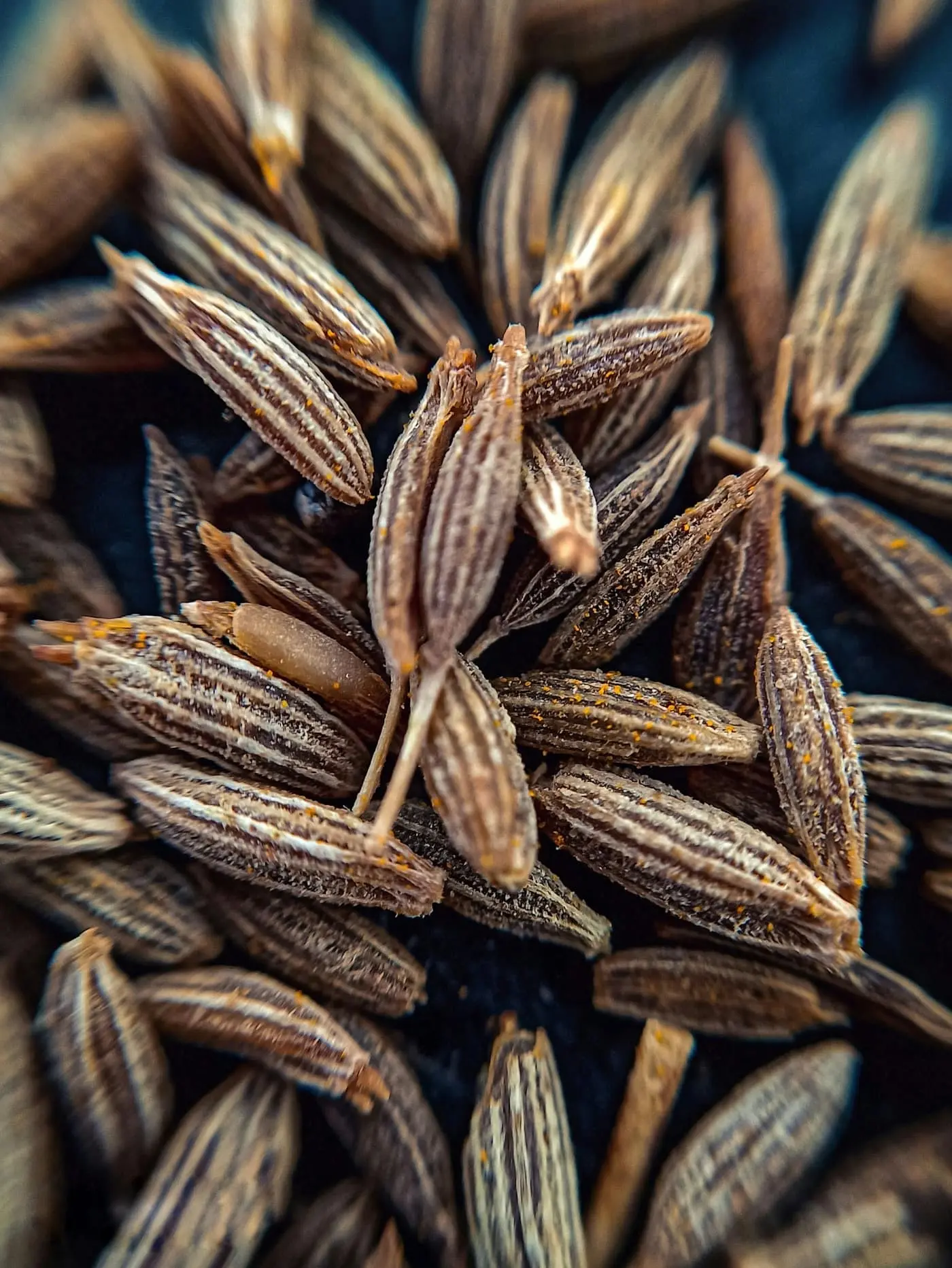
Jeera (Cumin)
Cuminum cyminum
A cool-season rabi seed spice that Gujarat and Rajasthan grow more of than the rest of the world combined — and the one decision that makes or breaks the crop is picking a wilt-resistant variety, since Fusarium wilt can wipe out a susceptible field before it ever flowers.
Quick Summary
The key points from this page in about two minutes — read it or have it read aloud.
Quick Summary
Jeera (cumin) is a cool, dry-season rabi spice concentrated in Gujarat and Rajasthan, sown in November and cut in February–March for its small, ridged, aromatic seed. Unlike most crops on this site, the single biggest decision here is not sowing date or fertiliser — it is variety choice, because Fusarium wilt can kill a susceptible crop outright, especially where cumin has been grown in the same field year after year.
From the day it goes in, cumin wants dry, cool weather and very little else. It is a modest feeder on light desert soils and needs only a handful of light irrigations, spaced well apart, through its life. Its real enemies are humidity and cloud cover at flowering, which bring on Alternaria blight and powdery mildew, and standing water at any stage, which invites root rot on top of wilt. Aphids build up on the flowering heads and need watching as the crop matures.
Because wilt lives in the soil and builds up with repeated cropping, rotation away from cumin for a few years is as important as the variety itself. Harvest is a narrow window too: cut once the plant turns brownish and the seed hardens, before it shatters in the field. The page below carries the exact seed rate, fertiliser split, irrigation timing, the full list of wilt- and blight-tolerant varieties, and expected yields.
- Crop type
- Spice (seed)
- Season
- Rabi
- Suitable states
- Gujarat, Rajasthan (dominant)
- Growing duration
- 100–140 days
- Water requirement
- Low; 4–6 light irrigations
- Temperature
- 20–25°C, cool & dry
- Soil type
- Well-drained sandy loam
- Difficulty level
- Medium (wilt risk)
- Expected yield
- 5–12 q/ha
- Key practice
- Grow a wilt-resistant variety
Overview
Cumin (Cuminum cyminum), known as jeera, is India's most valuable seed spice by trade volume — Gujarat and Rajasthan between them grow the large majority of the world's crop, mainly for export and the domestic spice market.
The crop's defining challenge is Fusarium wilt, a soil-borne fungal disease that can destroy a susceptible field outright, especially where cumin follows cumin year after year. Picking a wilt-tolerant variety and rotating away from cumin are the two biggest levers a grower has, well before fertiliser or irrigation matter.
Beyond wilt, cumin is a modest, dry-weather crop grown on light desert soils with only a handful of irrigations. Its other main risks — Alternaria blight, powdery mildew and aphids — all worsen in cloudy, humid weather at flowering, so this guide follows the crop with those risks, and the narrow harvest window before the seed shatters, in mind.
Crop timeline, sowing to harvest
A quick visual map of the season — jump to any section below for the detail behind each stage.
- Day 0
Sowing
Seed drilled shallow, 1–2 cm deep, in lines 30 cm apart into a fine, moist rabi seedbed.
- Day 7–15
Emergence
Seedlings emerge; a light irrigation now, 7–10 days after sowing, is critical for an even stand.
- Day 20–45
Vegetative growth & branching
The plant branches and builds leaf; this is when Fusarium wilt first shows up in a susceptible field.
- Day 45–70
Flowering
Small white or pink flowers open in umbels; cloudy, humid weather now brings on blight and powdery mildew, and aphids start building up.
- Day 70–95
Seed set & fill
Seeds set and fill in the umbels through the cool weather; the field still needs to stay on the dry side.
- Day 95–120
Maturity
The plant turns brownish and the seed hardens and turns aromatic brown-green; a narrow window before it shatters.
- Day 100–140
Harvest
Cut in the cool early morning once the crop has dried down, timing varies by variety from about 100 to 140 days.
Suitable states
States where this crop is grown at scale, highlighted below. Your local Krishi Vigyan Kendra is still the final word for your specific block.
- Jammu and Kashmir
- Himachal Pradesh
- Punjab
- Uttarakhand
- Haryana
- Delhi
- Uttar Pradesh
- Rajasthan
- Bihar
- Jharkhand
- West Bengal
- Sikkim
- Assam
- Arunachal Pradesh
- Meghalaya
- Nagaland
- Manipur
- Mizoram
- Tripura
- Gujarat
- Madhya Pradesh
- Chhattisgarh
- Maharashtra
- Odisha
- Goa
- Telangana
- Andhra Pradesh
- Karnataka
- Kerala
- Tamil Nadu
- Puducherry
- Ladakh
- Chandigarh
- Lakshadweep
- Andaman and Nicobar Islands
- Dadra and Nagar Haveli and Daman and Diu
Grown here
Climate requirements
Cumin is a cool, dry-weather crop through and through. Cloudy or humid weather at flowering is its worst enemy — it brings on blight, mildew and aphids together, and can cut the crop badly in a single bad week. Sow so the crop is not still young when the soil is warm, since Fusarium wilt is worse in warm soil.
Ideal temperature
20–25°C, cool and dry, suits the crop best; a spell of frost damages flowers, and warm soil at sowing favours wilt
Rainfall
A dry rabi season on light irrigation is ideal; rain or heavy dew at flowering brings on blight and mildew and spoils seed colour
Humidity
Low humidity through the season; a cloudy, humid spell at flowering is the trigger for both Alternaria blight and powdery mildew
Sunlight
Full sun in cool, dry weather for good flowering and seed fill
Soil requirements
Choose a light, well-drained field with no history of waterlogging. Where the field has grown cumin in recent years and wilt has shown up before, that history matters more than the soil test — rotate away from cumin for at least two to three years and pick a wilt-tolerant variety for that field.
Suitable soil
Well-drained sandy loam and light loam; the crop is traditionally grown on the light desert soils of Gujarat and Rajasthan
pH range
7.0–8.5 (tolerates mild alkalinity)
Drainage
Good drainage is essential — standing water for even a day or two brings on root rot on top of wilt
Organic matter
Low to moderate; cumin is a modest feeder that does well on residual fertility from a well-manured previous crop
Land preparation
Same four steps whichever region you are in — only the timing shifts with the sowing window.
- 1
Fine, moist seedbed
Two to three ploughings and planking to a fine tilth; clear old crop stubble, which can carry over wilt inoculum.
- 2
Basal farmyard manure
Work 15–20 t/ha of well-rotted farmyard manure into the soil ahead of sowing — the crop is light on chemical fertiliser but responds to organic matter.
- 3
Level the field
A well-levelled field gives even, light irrigation without pockets of standing water, which is where wilt and root rot start.
Seed information
How the main varieties compare, so you can pick by duration, yield, disease pressure or what you are growing for.
| Variety | Duration | Yield | Disease resistance | Best state | Suitable for |
|---|---|---|---|---|---|
Released 1988 by Gujarat Agricultural University — an early, still-grown release tolerant of wilt, blight and powdery mildew together, unusual for covering all three. | 105–110 days | 7.0 q/ha | Tolerant to wilt, blight and powdery mildew | Gujarat | General cultivation, multi-disease risk fields |
The most widely grown high-yielding release from Sardarkrushinagar Dantiwada Agricultural University — resistant to Fusarium wilt, with bold seed and high volatile-oil content. | 105–110 days | 8.7–12.5 q/ha | Resistant to Fusarium wilt | Gujarat, Rajasthan | High-yield, main wilt-prone belt |
A short-duration, wilt-resistant release reported to out-yield GC-2 by roughly a third, for growers wanting an early-maturing, high-yield option. | ~92 days | About 38% higher than GC-2 | Resistant to Fusarium wilt | Gujarat | Short-duration, high-yield |
From SKN College of Agriculture (Rajasthan Agricultural University), Jobner, released 1988 by selection from a local collection — a long-standing, widely grown Rajasthan variety. | 120–140 days | 5–6 q/ha | Moderate | Rajasthan | General cultivation, Rajasthan |
Also from SKN College of Agriculture, Jobner, identified 1995 — a longer-duration variety with genuine wilt tolerance. | 140–150 days | 6.5 q/ha | Tolerant to wilt | Rajasthan | Wilt-prone fields, longer season |
A variety valued for tolerating both of the crop's major diseases together — wilt and blight — with a solid oil content. | ~115 days | ~5.8 q/ha | Tolerant to wilt and blight | Gujarat, Rajasthan | Fields with both wilt and blight history |
The newest release, from ICAR-Central Arid Zone Research Institute (CAZRI), Jodhpur — bred for a much shorter duration than older varieties, escaping the terminal heat of February–March and needing fewer irrigations and sprays. | 100–105 days | Not separately published; grown commercially in arid Rajasthan since Rabi 2021–22 | Resistant to Alternaria blight | Rajasthan (arid, non-conventional areas) | Short season, low-water, low-spray fields |
- Seed rate
- 10–12 kg/ha for line sowing; 15–20 kg/ha where broadcast
- Certified seed
- In a field with any wilt history, the variety is the single biggest lever a grower has — GC-4, GC-5, RZ-209, MC-43 and CZC-94 all carry genuine wilt tolerance. Always use fresh, certified seed rather than saved seed from a wilt-affected field, since the fungus can travel with it.
- Spacing
- 30 cm between rows; plants are usually thinned to a few centimetres apart rather than sown to an exact plant spacing
- Seed treatment
- Treat seed with Carbendazim or Thiram (2 g/kg) plus a bio-agent such as Trichoderma viride before sowing, to cut seed-borne wilt inoculum at the source.
Sowing guide
Sowing date is a disease decision as much as a calendar one. Too early into warm soil favours Fusarium wilt; too late risks the crop still filling seed when February–March heat arrives. Mid-November to early December is the window that avoids both.
- Best time
- Mid-November to early December — early enough to avoid a late-season heat spell at maturity, late enough that the soil has cooled, since warm soil favours wilt
- Row spacing
- 30 cm
- Plant spacing
- Thinned to a few centimetres within the row after emergence
- Sowing depth
- 1–2 cm
- Method
- Drill treated seed shallow into a moist, fine seedbed at 30 cm rows and cover lightly; broadcasting is also common but line sowing weeds and irrigates more evenly
Fertilizer schedule
A split dose beats one large dose applied at sowing — nitrogen especially is lost to the air and to leaching if it all goes in on day one.
- 1
Basal (at sowing)
Day 0
Half the nitrogen with the full phosphorus — roughly 15 kg N and 15 kg P₂O₅ per hectare on top of the farmyard manure already worked in.
- 2
Top-dressing
25–30 days after sowing
The remaining nitrogen (about 15 kg N/ha), applied with an irrigation during active vegetative growth.
- 3
Keep the total dose light
Through the crop
Cumin is a modest feeder on light soil — do not push nitrogen beyond the recommended total, since soft, over-fed growth is more prone to disease.
Irrigation schedule
1. Pre-sowing / at sowing
Day 0
A light irrigation to settle the seedbed, if the soil is not already at good moisture.
2. Germination
7–10 days after sowing
A light irrigation now is critical for even germination and establishment.
3. Through the season
Every 20–25 days
Light irrigations at this interval through branching, flowering and seed fill, totalling about 4–6 for the crop.
Critical stages
- Germination (7–10 days)
- Branching
- Flowering & seed fill
Water-saving tips
- Cumin needs relatively little water — over-irrigating does more harm than good by favouring wilt and root rot.
- Keep irrigations light and well-spaced rather than heavy and infrequent; standing water for even a short spell is dangerous.
- A well-levelled field avoids the low pockets where excess moisture collects and disease starts.
Weed management
Common weeds
Organic control
- One or two hand weedings, at roughly 25–30 and 45–50 days, before the crop canopy closes.
- A clean, weed-free field also improves air movement around the plants, which helps keep humidity-loving blight and mildew down.
Chemical control
- A pre-emergence herbicide such as Fluchloralin or Pendimethalin, applied on moist soil, controls early weeds in the slow-establishing crop.
- One hand weeding at around 25–30 days backs up the pre-emergence spray during the critical early weeks.
Nutrient deficiency identification
What a shortage of each nutrient actually looks like on the plant, so you can tell a deficiency apart from a disease before you spray the wrong thing.
Nitrogen
Visible symptom
Pale, small older leaves and thin, weak plants with poor branching.
Phosphorus
Visible symptom
Stunted plants with dull, dark-green leaves and delayed flowering.
Zinc
Visible symptom
Small, pale, interveinally chlorotic new leaves and stunted growth — common on the light, calcareous soils cumin is grown on.
Iron
Visible symptom
Yellowing of the youngest leaves with the veins staying green, on alkaline soil.
Diseases to watch for
Symptoms, likely cause and what actually treats it — not just a spray name.
Fusarium wilt
- Symptoms
- Sudden yellowing, drooping and drying of plants in patches, at any stage from seedling to flowering; roots and the stem base turn brown and rot.
- Cause
- Fusarium oxysporum f. sp. cumini, a soil-borne fungus that survives for years in the soil and builds up where cumin follows cumin.
- Treatment
- No effective in-crop cure once wilt appears; remove and destroy affected plants to slow spread.
- Prevention
- This is the single biggest decision in cumin: grow a wilt-tolerant variety (GC-4, GC-5, RZ-209, MC-43, CZC-94), treat seed with Trichoderma and a fungicide, and rotate away from cumin for at least two to three years in any field with a wilt history.
Alternaria blight
- Symptoms
- Dark brown to black spots on leaves and stems that enlarge and merge into blighted patches, defoliating the plant in severe cases; losses can run as high as 80% in a bad outbreak.
- Cause
- Alternaria burnsii, favoured by cloudy, humid weather at flowering.
- Treatment
- Spray Mancozeb (Dithane M-45) at first appearance, typically around 40 days after sowing, repeated at 15-day intervals through the risk period.
- Prevention
- Use healthy, treated seed, rotate crops, harvest on time, and where the field is blight-prone, grow a tolerant variety such as CZC-94 or MC-43.
Powdery mildew
- Symptoms
- A white powdery coating on leaves and stems, worst in cloudy, humid weather, weakening the plant and shrivelling the seed.
- Cause
- Fungal, favoured by the same cloudy, humid conditions that trigger blight.
- Treatment
- Spray wettable sulphur or Dinocap (Karathane) at first sign, often combined with the blight spray schedule.
- Prevention
- Sow on time so flowering and seed fill fall in drier weather, and grow a tolerant variety where the field has a history of the disease.
Pests to watch for
What to look for before the damage is visible, and organic options before you reach for a chemical.
Aphids
- Identification
- Small green or grey soft-bodied insects clustering on tender shoots, flowering heads and developing seed.
- Damage
- The key cumin pest — heavy colonies at flowering and seed-fill suck sap, cut seed set, and foul the crop with sticky honeydew that invites sooty mould, cutting both yield and grade.
- Organic control
- Neem oil sprays and conserving natural predators like ladybird beetles by avoiding early broad-spectrum insecticide use.
- Chemical control
- Imidacloprid at label rate has been found highly effective against cumin aphid; spray only once colonies cross a damaging threshold, timed to spare pollinators.
Thrips
- Identification
- Tiny, slender insects in the flowers, causing silvering of petals and poor seed set.
- Damage
- Reduced seed set and blemished seed under heavy attack at flowering.
- Organic control
- Blue sticky traps and neem sprays; keep field borders clean of alternate host weeds.
- Chemical control
- A recommended insecticide at flowering if thrips numbers are high, ideally the same round as the aphid spray.
Common mistakes to avoid
The mistakes that cost growers the most, ranked by how often they show up in the field — not in the order you might expect.
- 1
Growing a non-wilt-tolerant variety on a field with a wilt history.
Why it hurts
Fusarium wilt can wipe out a susceptible crop outright — GC-4, GC-5, RZ-209, MC-43 and CZC-94 all carry genuine tolerance and are the cheapest insurance a grower has.
- 2
Growing cumin after cumin, year after year, on the same field.
Why it hurts
Wilt inoculum builds up in the soil with repeated cropping until even a tolerant variety struggles — rotate away from cumin for at least two to three years.
- 3
Sowing into still-warm soil in October or early November.
Why it hurts
Warm soil favours Fusarium wilt at the vulnerable seedling stage — wait until mid-November so the soil has properly cooled.
- 4
Over-irrigating, or letting water stand even briefly.
Why it hurts
Excess moisture invites root rot on top of wilt — cumin wants light, well-spaced irrigation, not a heavy hand.
- 5
Ignoring cloudy or humid weather at flowering.
Why it hurts
That is exactly when Alternaria blight, powdery mildew and aphids all take hold together — watch the crop closely through this window and spray promptly.
- 6
Delaying the first blight spray until damage is already visible.
Why it hurts
Blight can cause losses as high as 80% once established — the first Mancozeb spray around 40 days after sowing is meant to get ahead of it, not react to it.
- 7
Sowing too late in the window.
Why it hurts
A late-sown crop is still filling seed when February–March heat arrives, cutting both yield and seed quality — sow by early December.
- 8
Leaving the crop standing too long after it matures.
Why it hurts
Mature cumin shatters easily and drops seed in the field — harvest promptly once the plant browns and the seed hardens, ideally in the cool of early morning.
- 9
Leaving old crop stubble and volunteer plants in the field.
Why it hurts
Stubble and self-sown plants from a previous cumin crop can carry over Fusarium wilt inoculum into the new season — clear the field before sowing.
Harvesting
When the plant turns brownish and the seed hardens and turns aromatic, usually 100–140 days after sowing depending on variety, most commonly in February–March. Cut in the cool of early morning to reduce shattering.
Signs it is ready
- Plant and foliage turning brownish
- Seed hard and aromatic, not soft or green
- Umbels drying but not yet shattering
Tools
- Sickle for cutting whole plants
- Tarpaulin for drying and gentle threshing
- Shade or mild sun for final drying
Expected yield
5–7 q/ha for older, local-type varieties; up to 8.7–12.5 q/ha for high-yielding releases like GC-4 under good management
Post-harvest & storage
Storage
Dry the seed down to a safe moisture level before storage; well-dried cumin keeps its aroma and colour for many months in a cool, dry, airy store. Damp storage invites mould and loses the volatile oil that gives cumin its value.
Packaging
Pack clean, well-dried seed in clean bags kept off the floor in a dry godown, away from moisture and pests.
Transportation
Move dry seed protected from moisture and direct sun, which both degrade colour and aroma over time.
Shelf life
Many months to about a year for seed dried and stored correctly; quality (colour, aroma, oil content) still fades gradually, so selling within a season is best.
Market prices
Today's mandi price near you, pulled live from the government's own Agmarknet data.
Live daily mandi prices from the government Agmarknet dataset.
Synced from data.gov.in (Agmarknet). Rates are ₹ per quintal.
Weather
Current conditions and a 5-day outlook for your selected location, with one line of stage-aware advice.
Pick your state for current conditions and a 5-day outlook.
Live data from Open-Meteo
Profit calculator
Your own cost sheet, expected yield and selling price — not ours.
Where the money goes
Share of the total cost per acre, using the calculator’s own default cost sheet below — adjust the numbers there to match your field and this picture will no longer apply to you exactly, but the ranking rarely changes.
- Land rent35% (₹8,000)
- Labour26% (₹6,000)
- Pesticide & weedicide9% (₹2,000)
- Fertiliser8% (₹1,800)
- Irrigation8% (₹1,800)
- Machinery7% (₹1,500)
- Seed5% (₹1,200)
- Interest3% (₹700)
Official downloads
Government and ICAR documents only — everything below is hosted on an official server.
Frequently asked questions
Why is Fusarium wilt such a big deal for cumin?
Fusarium wilt is a soil-borne fungal disease that can kill a susceptible cumin crop outright at any stage, and it survives in the soil for years, building up wherever cumin follows cumin. Because there is no effective cure once it appears in the field, the two real defences are growing a wilt-tolerant variety (GC-4, GC-5, RZ-209, MC-43 or CZC-94) and rotating away from cumin for at least two to three years on any field with a history of the disease.
When should I sow cumin?
Mid-November to early December is the ideal window. Sowing earlier, while the soil is still warm, favours Fusarium wilt at the vulnerable seedling stage. Sowing later risks the crop still filling seed when the heat of February–March arrives, which cuts both yield and seed quality.
How much water does cumin need?
Very little — cumin is a dry-season crop grown mostly on light, arid soils. A light irrigation at sowing, another 7–10 days later for germination, and then light irrigations roughly every 20–25 days through the season (about 4–6 in total) are enough. Over-irrigating, or letting water stand even briefly, favours wilt and root rot.
What causes Alternaria blight and how do I control it?
Alternaria blight, caused by the fungus Alternaria burnsii, produces spreading dark brown to black spots on leaves and stems in cloudy, humid weather at flowering, and can cut yield by up to 80% if left unchecked. Spray Mancozeb (Dithane M-45) at first appearance, typically around 40 days after sowing, and repeat at 15-day intervals through the risk period. Tolerant varieties like CZC-94 and MC-43 help on blight-prone fields.
When should I harvest cumin?
Harvest when the plant turns brownish and the seed has hardened and turned aromatic — usually 100 to 140 days after sowing depending on variety, most often in February–March. Cut in the cool of early morning to reduce shattering, since mature cumin drops seed easily if left standing too long.
Does cumin have an MSP?
No. Cumin (jeera) has no Minimum Support Price — it is a market seed-spice crop, though one of India's most actively traded, with Unjha in Gujarat serving as the country's largest cumin market alongside significant trade in Rajasthan. Use the live mandi prices and the profit calculator on this page to plan the crop and time your sale.
Still have questions?
The FAQs above cover the common ones. For anything specific to your field and soil, your nearest Krishi Vigyan Kendra is the authoritative answer.