
Natural Rubber
Hevea brasiliensis
India's main industrial plantation crop — a tree planted once as a budded clone, brought into tapping only after six or seven years, and then yielding latex for a quarter-century. Kerala grows the bulk of it, but the fastest growth now is in Tripura and the north-east. There is no MSP: income rides the international rubber price, so clone choice, tapping discipline and rain-guarding decide whether the plantation pays.
Quick Summary
The key points from this page in about two minutes — read it or have it read aloud.
Quick Summary
Natural rubber (Hevea brasiliensis) is a tree crop grown for the latex that bleeds from a shallow cut in its bark. It is India's most important plantation crop after tea and coffee by value, and unlike them it is an industrial raw material, not a beverage — most of the crop goes to the tyre industry. Kerala, especially Kottayam and the central Travancore belt, has long grown the great majority; Tamil Nadu's Kanyakumari district and coastal Karnataka add a little, and Tripura is now the second-largest producer, with planting spreading across the north-east and into Goa, the Konkan and Odisha under Rubber Board projects.
Rubber is a long commitment. A budded clone — a bud of a selected high-yielding clone grafted onto a seedling rootstock — is planted with the monsoon and tended for six or seven years before the trunk is thick enough to tap. It then yields for about twenty-five to thirty years before it is felled for timber and replanted. Through the immature years a leguminous cover crop is grown between the rows to fix nitrogen, hold the soil on the slope and smother weeds.
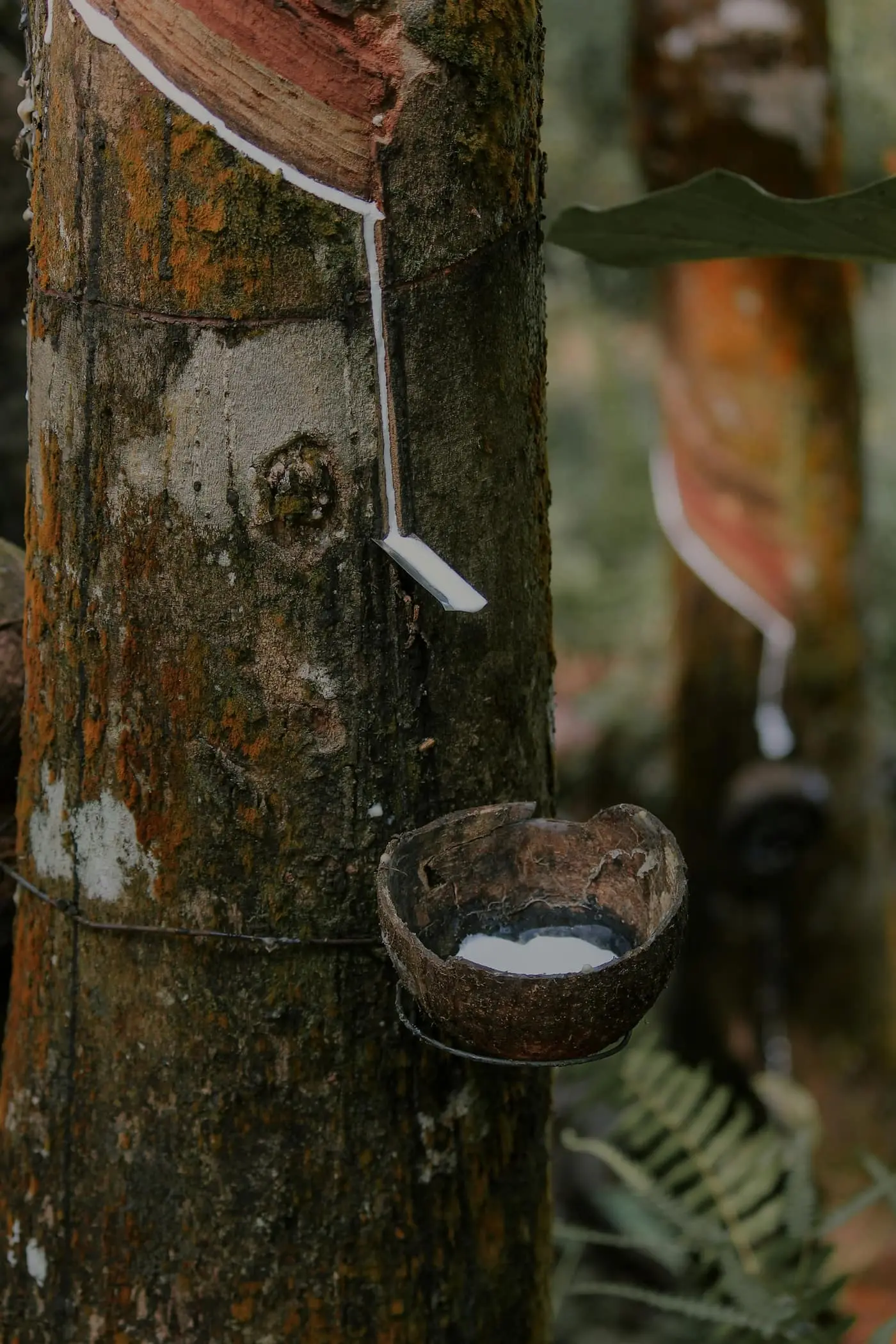
Once mature, the tree is tapped by paring a thin shaving of bark from a sloping cut, usually every second or third day, letting the latex run down to a cup. The cut is lowered gradually down the panel over years, then moved to a fresh panel. Over-tapping or heavy chemical stimulation causes tapping panel dryness, a disorder that shuts the latex off. The monsoon is the disease season: abnormal leaf fall, caused by a Phytophthora fungus, defoliates untreated trees and cuts yield, so prophylactic spraying before the rains is standard.
Rubber has no Minimum Support Price. The Rubber Board notifies a daily market price, and grower income swings with international rubber, crude oil and tyre demand. The page below carries clone choice, planting and spacing, the immature-phase cover crop and manuring, the tapping systems, rain-guarding, abnormal leaf fall control and the yields to expect.
- Crop type
- Perennial plantation tree, tapped for latex
- Planting material
- Budded clone (bud-grafted stump or polybag plant)
- Suitable states
- Kerala, Tamil Nadu, Karnataka, Tripura, Assam & the north-east
- Immature period
- 6–7 years to first tapping
- Productive life
- 25–30 tapping years, then felled for timber
- Water requirement
- High — 2,000–4,500 mm rain; irrigation only in dry non-traditional tracts
- Temperature
- 25–34°C, humid; poor above ~600 m in the traditional belt
- Soil type
- Deep, well-drained laterite / lateritic loam, acidic pH 4.5–6.0
- Difficulty level
- Hard
- Expected yield
- 1,400–1,800 kg dry rubber/ha/year at maturity
- No MSP
- Rubber Board daily market price; no CACP MSP
Overview
Natural rubber comes from Hevea brasiliensis, a native of the Amazon basin brought to Asia through Kew in the 19th century; the first commercial planting in India was in Kerala in 1902. It is a warm, wet, lowland tropical tree, and its Indian range reflects that: the traditional belt is Kerala (which still grows the large majority of the crop, concentrated around Kottayam and central Travancore), with smaller areas in Kanyakumari district of Tamil Nadu and Dakshina Kannada in Karnataka. The "non-traditional" area — Tripura, Assam, Meghalaya, Nagaland, Manipur, Mizoram, and more recently Goa, the Konkan, Odisha and parts of the north-east and east — is where the Rubber Board has driven most new planting, and Tripura is now the country's second-largest producing state.
The crop is defined by its long unproductive period and its long productive one. A budded clone is planted with the monsoon and tended for six or seven years — fertilised, weeded, and grown with a leguminous cover crop between the rows — before the trunk reaches the ~50 cm girth at which it can be opened for tapping. It then yields latex for roughly 25–30 years before it is slaughter-tapped, felled for timber and replanted. Clone choice made at planting therefore locks in the plantation's yield potential and disease profile for a generation.
Tapping is a skilled daily operation: a thin shaving of bark is pared from a sloping cut, the latex runs to a cup, and the cut is lowered gradually down the panel over years before the panel is changed. Over-tapping or excessive yield stimulation causes tapping panel dryness, a physiological disorder that partially or completely stops latex flow. The south-west monsoon is the disease season — abnormal leaf fall (a Phytophthora disease) is the major threat and is managed by prophylactic spraying before the rains, along with rain-guarding the tapping cut so the plantation can still be worked in the wet months. Rubber has no MSP; the Rubber Board publishes daily market prices and grower income tracks the international rubber and crude-oil markets.
Crop timeline, sowing to harvest
A quick visual map of the season — jump to any section below for the detail behind each stage.
- Year 0 (nursery)
Rootstock & bud-grafting
Seedling rootstocks are raised in a nursery and bud-grafted with a bud of the chosen clone. Budded stumps or, more commonly now, polybag plants are grown on until they are hardy enough to field-plant.
- Year 1 (Jun–Jul)
Field planting
Budded stumps or advanced polybag plants go into 75 cm pits at the monsoon onset, at about 4.9 × 4.9 m spacing (roughly 445 trees per hectare). A leguminous cover crop is sown between the rows at the same time.
- Year 1–3
Early immature phase
Young plants are staked, the cover crop is established and managed, and the trees are given graduated fertiliser. Weeding, especially around the young plant, is the main task; no yield is taken.
- Year 4–6
Canopy closure
The trees close canopy, the cover crop dies back under shade and is replaced by a natural leaf-litter mulch, and the trunks put on girth toward the tappable size.
- Year 6–7
Opening for tapping
When about 70% of the trees in a block reach 50 cm girth at 125 cm from the ground, the block is opened: a tapping panel is marked and the first sloping cut is made.
- Year 7 onward (annual)
Tapping season
Trees are tapped through most of the year on an alternate-day or third-day system, rested during the leafless refoliation period (roughly Feb–Mar), and rain-guarded through the south-west monsoon.
- Every few years
Panel change
The tapping cut works down one bark panel over several years; the panel is then changed to the other side or to renewed bark, so a well-managed tree keeps yielding for 25–30 years.
- Year 28–32
Slaughter tapping & replanting
Toward the end of its economic life the tree is tapped intensively ("slaughter tapping"), then felled for rubber-wood timber and the area is replanted with an improved clone.
Suitable states
States where this crop is grown at scale, highlighted below. Your local Krishi Vigyan Kendra is still the final word for your specific block.
- Jammu and Kashmir
- Himachal Pradesh
- Punjab
- Uttarakhand
- Haryana
- Delhi
- Uttar Pradesh
- Rajasthan
- Bihar
- Jharkhand
- West Bengal
- Sikkim
- Assam
- Arunachal Pradesh
- Meghalaya
- Nagaland
- Manipur
- Mizoram
- Tripura
- Gujarat
- Madhya Pradesh
- Chhattisgarh
- Maharashtra
- Odisha
- Goa
- Telangana
- Andhra Pradesh
- Karnataka
- Kerala
- Tamil Nadu
- Puducherry
- Ladakh
- Chandigarh
- Lakshadweep
- Andaman and Nicobar Islands
- Dadra and Nagar Haveli and Daman and Diu
Grown here
Climate requirements
Rubber is a lowland equatorial tree grown near its climatic limits in India. In Kerala the constraint is elevation and monsoon disease; in the north-east it is winter cold and, in places, a marked dry season. Matching the clone to the tract — a proven traditional-belt clone for Kerala, a cold-tolerant one for the hills of the north-east — is the founding climate decision.
Ideal temperature
25–34°C with high humidity is ideal; growth and latex flow slow below about 20°C, and in the traditional belt the crop does poorly above roughly 600 m elevation. Cold-tolerant clones and shelter matter in the north-eastern tracts, where winter temperatures fall lower than in Kerala
Rainfall
2,000–4,500 mm a year, spread over about 150 or more rainy days, suits rubber; the crop is essentially rainfed in the traditional belt. Very heavy, prolonged monsoon rain drives abnormal leaf fall and pink disease, while a long dry spell in the non-traditional tracts can need supplementary irrigation in the immature phase
Humidity
Consistently high humidity favours the tree but also the monsoon leaf and panel diseases; the wettest months are the disease-watch months
Sunlight
About 2,000 hours of sunshine a year, with bright weather outside the monsoon, gives good growth and latex yield; deep shade slows immature trees, though light intercropping is practised in the early years
Soil requirements
Slope and drainage decide a rubber site as much as soil type. On the sloping lateritic land rubber is usually grown on, contour planting, terracing or platforms, silt pits and a vigorous cover crop are what keep the soil in place and the trees healthy through 30 years of rain.
Suitable soil
Deep, well-drained lateritic and lateritic-loam soils on gentle to moderate slopes are the classic rubber lands of Kerala; the tree also grows on red loams and alluvial soils where drainage is good. A deep soil matters because the tap root goes down several metres
pH range
4.5–6.0 — rubber is one of the few crops that positively suits a strongly acidic soil, which is part of why the leached lateritic soils of the Western Ghat foothills grow it so well
Drainage
Free drainage is essential; rubber will not tolerate a high water table or a waterlogged patch, and root diseases (brown and dry root disease) take hold on poorly drained or previously forested land with buried infected wood
Organic matter
Built up over the plantation's life by the leguminous cover crop in the immature years and then by the tree's own heavy leaf fall; a young plantation on a cleared slope starts low and the cover crop is the main tool for raising it
Land preparation
Same four steps whichever region you are in — only the timing shifts with the sowing window.
- 1
Clearing and contour layout
Clear the site, remove old stumps and infected roots (a source of root disease), and lay out the field on the contour — with terraces or platforms on steeper slopes — to control erosion under monsoon rain.
- 2
Pitting ahead of the monsoon
Dig pits about 75 × 75 × 75 cm at the planned spacing well before planting, and refill them with topsoil mixed with rock phosphate and compost or farmyard manure so the pit is settled before the plant goes in.
- 3
Sowing the leguminous cover crop
Establish a cover of Pueraria phaseoloides, Calopogonium or Centrosema (usually a mix) between the rows at planting; it fixes nitrogen, smothers weeds, cuts erosion and builds soil organic matter through the immature years.
- 4
Silt pits and drains
Open silt pits along the contour between rows on sloping land to trap run-off and eroded soil, and cut drainage channels on any land that could pond in the monsoon.
Seed information
How the main varieties compare, so you can pick by duration, yield, disease pressure or what you are growing for.
| Variety | Duration | Yield | Disease resistance | Best state | Suitable for |
|---|---|---|---|---|---|
The Rubber Research Institute of India's most planted clone for decades and long the industry benchmark in the traditional belt — very high yield potential under good management, but slow to come into tapping and susceptible to abnormal leaf fall, powdery mildew and, increasingly, Corynespora leaf fall. | Tapped for ~25–30 years | Very high at full maturity | Susceptible to abnormal leaf fall, powdery mildew and Corynespora | Kerala | Traditional-belt estates with a full disease-management programme |
An RRII 400-series clone (RRII 105 × RRIC 100) released to improve on RRII 105 — earlier tapping, faster immature growth and higher early yield, with better tolerance to Corynespora; now a leading choice for new planting in the traditional belt. | Tapped for ~25–30 years | High, with strong early yield | Better Corynespora tolerance than RRII 105 | Kerala | New planting and replanting in the traditional belt |
Another RRII 400-series clone from the same RRII 105 × RRIC 100 cross, combining vigorous growth and high yield with a good general disease profile; planted alongside RRII 414 in the traditional belt. | Tapped for ~25–30 years | High | Good general tolerance | Kerala | Traditional-belt new planting |
An RRII 400-series clone valued for high yield with a relatively wind-firm, well-branched crown; recommended where wind damage has been a problem for RRII 105. | Tapped for ~25–30 years | High | Good general tolerance | Kerala | Wind-exposed sites in the traditional belt |
A high-yielding RRII 400-series clone from the RRII breeding programme, with good vigour and yield in traditional-belt trials; a newer option for replanting. | Tapped for ~25–30 years | High | Good general tolerance | Kerala | Replanting in the traditional belt |
A clone identified by RRII for the cooler, drier non-traditional tracts, with better cold tolerance and establishment than the traditional-belt clones in the north-east. | Tapped for ~25–30 years | Medium–high in non-traditional conditions | Selected for hardiness in the north-east | Tripura, Assam & the north-east | Cold-prone and dry non-traditional areas |
An old Indonesian (Gondang Tapen) primary clone, wind-tolerant, hardy and remarkably stable across sites; a mother clone in many pedigrees and widely planted in the north-east and on marginal sites for its reliability rather than top yield. | Tapped for ~25–30 years | Medium, very stable | Hardy; wind-tolerant | Tripura & the north-east | Wind-prone and marginal sites, north-eastern planting |
A Malaysian Prang Besar clone (PB 5/51 × PB 49) grown internationally for early, high yield and quick immature growth; used in India in both traditional and non-traditional areas, with some susceptibility to wind damage and tapping panel dryness under hard tapping. | Tapped for ~25–30 years | High, early | Moderate; watch panel dryness under hard tapping | Kerala & the north-east | Growers wanting early yield with disciplined tapping |
A Malaysian Prang Besar clone known for a strong yield response later in life and to stimulation, with a sturdy trunk; slower to start than PB 260 but long-lived and productive. | Tapped for ~25–30 years | High, builds with age | Moderate general tolerance | Kerala | Long-rotation estates managing yield with stimulation |
A classic Malaysian Rubber Research Institute clone (Tjir 1 × PB 86), one of the most widely planted clones in the world historically — moderate but very dependable yield, good secondary characters, and still common in the north-east and older Indian estates. | Tapped for ~25–30 years | Medium, dependable | Moderate; wind-tolerant | Tripura, Assam & the north-east | Dependable yield on non-traditional and older estate land |
- Seed rate
- Not a seed-sown crop. About 445 budded plants per hectare at 4.9 × 4.9 m spacing for normal planting; hedge or high-density systems use different layouts. Raise or buy about 10–15% extra plants for gap-filling in the first two years.
- Certified seed
- Buy budded stumps or polybag plants only from a Rubber Board-licensed nursery, of a clone in the Board's current recommended list for your tract — a proven traditional-belt clone (RRII 414/417, RRII 105) for Kerala, a cold-tolerant clone (RRII 208, GT 1, RRIM 600) for the north-east. A wrong or unauthenticated clone locks a generation of the plantation into low yield or high disease risk.
- Spacing
- Normal planting: 4.9 × 4.9 m, about 445 trees/ha. Some growers use rectangular spacings (e.g. 6.7 × 3.4 m) or hedge planting to allow intercropping or mechanised operations.
- Seed treatment
- Not applicable. Instead, dip or drench polybag plants against Phytophthora before field planting in a high-rainfall site, plant only vigorous plants with two or more mature leaf whorls, and protect the young stem with a whitewash or shade against sun scorch.
Sowing guide
Rubber is planted once for a 30-year rotation, so the planting operation carries a lot of weight: pits ready and settled before the monsoon, an authenticated Board-recommended clone, healthy polybag plants, and the cover crop in from day one. A poor establishment year shows up as uneven girth and a delayed, patchy opening for tapping six years later.
- Best time
- Plant with the first steady rains of the south-west monsoon (roughly June–July in Kerala), so the plant has the whole wet season to establish before its first dry period. In the north-east, plant early in the monsoon so the young plant is well rooted before winter cold.
- Row spacing
- 4.9 m between rows for normal planting
- Plant spacing
- 4.9 m within the row (about 445 trees/ha)
- Sowing depth
- Plant so the bud union sits clearly above the soil and the collar is not buried; firm the soil around the root column of a stump or the intact ball of a polybag plant.
- Method
- Plant budded stumps or polybag plants into pre-dug, refilled 75 cm pits on a contour layout, stake immediately, mulch the plant basin, and sow the leguminous cover crop between the rows at the same time.
Fertilizer schedule
A split dose beats one large dose applied at sowing — nitrogen especially is lost to the air and to leaching if it all goes in on day one.
- 1
Planting (pit application)
Year 1
Rock phosphate and compost or farmyard manure mixed into the refilled pit before planting give the young root system phosphorus and organic matter to start on.
- 2
Immature phase
Years 1–6, split each year
Graduated doses of an NPK-Mg mixture formulated for immature rubber, applied in split rounds each year (usually pre- and post-monsoon), build girth toward tappable size. The leguminous cover crop supplies much of the nitrogen in this phase.
- 3
Mature phase
From opening, once or twice a year
A mature-rubber NPK-Mg mixture applied once or twice a year, based on soil and leaf analysis where available, sustains yield through the tapping years. Magnesium matters on the leached lateritic soils.
- 4
Correction as needed
Any year
Leaf analysis guides correction of magnesium, potassium or minor-element shortfalls; over-liming is avoided because rubber suits an acidic soil.
Irrigation schedule
1. Immature phase (non-traditional tracts)
Dry season, Years 1–3
In the drier non-traditional areas, life-saving irrigation or heavy mulching through the first two or three dry seasons prevents heavy casualty of young plants; the traditional Kerala belt plants rainfed.
2. Mature phase (non-traditional tracts)
Dry-season stress
Supplementary irrigation during a severe dry spell helps maintain latex flow and reduces tapping panel dryness in tracts with a marked dry season.
Critical stages
- Immature establishment in the first dry seasons
- Dry-season latex flow in non-traditional tracts
Water-saving tips
- A dense leguminous cover crop and, later, the tree's own leaf-litter mulch conserve soil moisture and cut dry-season stress with no irrigation.
- Silt pits and contour terracing on sloping land capture monsoon run-off and recharge the soil profile for the dry months.
- Rain-guarding the tapping panel lets the plantation be worked through the monsoon without waiting for dry spells, so water management is really about the dry season, not the wet one.
Weed management
Common weeds
Organic control
- A vigorous leguminous cover crop (Pueraria, Calopogonium, Centrosema) established at planting is the main weed-control tool — it smothers most weeds through the immature years and is far cheaper than repeated weeding.
- Ring weeding around each young plant and slashing the inter-row until the canopy closes; once the trees shade the ground, weed pressure falls away on its own.
Chemical control
- Spot or strip herbicide use along the planting row in the immature phase where hand weeding is costly, kept off the young stem; Mikania in particular often needs a directed herbicide as it climbs and smothers young trees.
Nutrient deficiency identification
What a shortage of each nutrient actually looks like on the plant, so you can tell a deficiency apart from a disease before you spray the wrong thing.
Nitrogen
Visible symptom
Uniformly pale, small leaves and slow girth increment on immature trees; usually least limiting where the leguminous cover crop is well established, since it fixes nitrogen.
Phosphorus
Visible symptom
Dull, small leaves and poor root and girth development on young plants, especially on the leached lateritic soils; addressed by rock phosphate in the planting pit.
Potassium
Visible symptom
Marginal yellowing and scorch on older leaves and reduced latex yield; potassium demand rises once the tree is in tapping.
Magnesium
Visible symptom
Interveinal yellowing spreading from the leaf tip and margins of older leaves, very common on the acidic, leached lateritic rubber soils and corrected with a magnesium-containing mixture.
Manganese / minor elements
Visible symptom
Interveinal chlorosis of young leaves and, for boron, distorted new growth; picked up by leaf analysis and corrected with a foliar or soil micronutrient application.
Diseases to watch for
Symptoms, likely cause and what actually treats it — not just a spray name.
Abnormal leaf fall
- Symptoms
- Sudden heavy fall of green leaves and immature fruit during the monsoon, with dark water-soaked lesions and a white fungal bloom on leaf stalks and green pods; badly affected trees are half-bare by mid-monsoon.
- Cause
- The fungus Phytophthora (several species), spread by wind-driven monsoon rain — the single most damaging disease of rubber in the traditional belt, capable of cutting annual yield by a fifth or more on susceptible clones.
- Treatment
- Prophylactic spraying before the monsoon is the standard approach — an oil-based copper fungicide or mancozeb applied by high-volume sprayer, mist blower or, on large estates, aerially, timed to cover the canopy before the rains set in.
- Prevention
- Plant less susceptible clones where the disease is severe, complete the prophylactic spray round before the monsoon rather than after symptoms appear, and keep trees vigorous with balanced nutrition.
Powdery mildew
- Symptoms
- A white powdery coating on young refoliating leaves in the dry season (roughly January–March), causing the new flush to crinkle, blacken at the edges and shed, so the tree refoliates two or three times and loses vigour and early-season yield.
- Cause
- The fungus Oidium heveae, favoured by cool nights, morning mist and dew during the leafless refoliation period.
- Treatment
- Dusting with fine sulphur (or spraying a recommended fungicide) during refoliation, repeated at intervals through the susceptible flush, timed to the wintering pattern of the block.
- Prevention
- Anticipate the refoliation window and start dusting as the new flush appears rather than after damage; vigorous, well-nourished trees refoliate faster and escape more of the disease.
Pink disease
- Symptoms
- A pinkish-white fungal encrustation on the bark of the fork and main branches, with cracking, gumming (latex bleeding down the bark) and dieback of the branch beyond the infection; worst in high-rainfall pockets and shaded, humid canopies.
- Cause
- The fungus Corticium salmonicolor (Erythricium salmonicolor), spreading in prolonged wet, humid weather, usually entering at the branch fork.
- Treatment
- Cut out and destroy affected branches well below the infection, and paint the fork and wound with a recommended fungicide (Bordeaux paste or a systemic) at first sign; repeat after rain.
- Prevention
- Inspect forks in and after the monsoon, treat early lesions before the branch is girdled, and avoid the dense, humid, poorly lit canopy conditions the fungus favours.
Corynespora leaf fall
- Symptoms
- Fishbone-patterned dark veins and brown, papery lesions on mature and young leaves, leading to repeated defoliation outside the normal wintering period; a serious and spreading problem on RRII 105 in some tracts.
- Cause
- The fungus Corynespora cassiicola, which can attack through much of the year and is not confined to the monsoon; some clones are far more susceptible than others.
- Treatment
- Fungicide sprays (as recommended by RRII for the current situation) on affected blocks, though repeated spraying of tall mature rubber is difficult and costly.
- Prevention
- Clone choice is the main defence — avoid highly susceptible clones where the disease is established, and plant tolerant RRII 400-series clones for new areas.
Brown / dry root disease
- Symptoms
- Patches of declining trees with yellowing, sparse crowns and, on digging, rotted roots bound in dark or white fungal strands and rhizomorphs; the disease spreads tree to tree along root contacts.
- Cause
- Soil-borne fungi (Rigidoporus, Phellinus and others), typically carried on infected wood and old stumps left in the ground when forest or an old plantation is cleared.
- Treatment
- Isolate the patch with a deep trench, uproot and burn affected trees and their roots and any buried infected wood, and treat neighbouring trees' collars with a recommended fungicide.
- Prevention
- Thorough removal of old stumps and roots before planting, an isolation trench around any focus that appears, and drainage so waterlogging does not predispose roots.
Pests to watch for
What to look for before the damage is visible, and organic options before you reach for a chemical.
Scale insects and mealybugs
- Identification
- Brown or white waxy encrustations along the veins and undersides of leaves and on green shoots of young plants, often with sooty mould on the honeydew below.
- Damage
- Sap removal weakens nursery and young immature plants and can cause leaf fall; mature rubber is rarely affected enough to matter.
- Organic control
- Conserve ladybird beetles and other natural enemies, control the attendant ants, and prune out and destroy heavily infested nursery shoots.
- Chemical control
- A recommended systemic or contact insecticide on nursery and young immature plants where infestation is heavy; not usually warranted on mature trees.
Mites
- Identification
- Fine stippling, bronzing and premature fall of leaves, worst in hot dry weather on young plants and nursery stock; the mites themselves are barely visible without a lens.
- Damage
- Loss of leaf area and vigour on immature plants during dry spells; a nursery problem more than an estate one.
- Organic control
- Maintain plant vigour and soil moisture through dry spells, avoid dusty conditions, and conserve predatory mites.
- Chemical control
- A recommended acaricide on nursery or young plants during a severe dry-weather outbreak.
Termites and white grubs (young plants)
- Identification
- Wilting or dead young plants with the collar and roots eaten away, earthen runways on the stem (termites), or creamy C-shaped grubs in the soil around the roots (cockchafer / white grub).
- Damage
- Kills newly planted stumps and polybag plants in patches, especially on newly cleared land and in the first dry season after planting.
- Organic control
- Remove old stumps and woody debris that harbour termites, keep the plant basin mulched but not with fresh wood, and flood-check affected patches where possible.
- Chemical control
- A recommended soil insecticide in the planting pit or as a basin drench on land with a known termite or white-grub history.
Common mistakes to avoid
The mistakes that cost growers the most, ranked by how often they show up in the field — not in the order you might expect.
- 1
Planting an unauthenticated or unsuited clone
Why it hurts
The clone chosen at planting fixes the plantation's yield ceiling and disease profile for 30 years. A wrong clone — highly Corynespora-susceptible in an affected tract, or a traditional-belt clone in a cold north-eastern site — cannot be corrected later without replanting.
- 2
Skipping or neglecting the leguminous cover crop
Why it hurts
The cover crop fixes nitrogen, controls erosion and smothers weeds through the six immature years. Without it, the immature phase costs far more in fertiliser and weeding, the slope erodes, and girth increment slows so tapping is delayed.
- 3
Opening trees for tapping before they reach girth
Why it hurts
Tapping an under-girth tree stunts it, invites tapping panel dryness and disease, and gives poor yield for the life of the panel. Open a block only when about 70% of trees have reached 50 cm girth at 125 cm height.
- 4
Over-tapping or over-stimulating for short-term yield
Why it hurts
Frequent tapping (daily instead of alternate-day) and heavy ethephon stimulation raise yield briefly, then cause tapping panel dryness — trees that yield little or no latex for years. Follow a recommended tapping and stimulation system.
- 5
Spraying for abnormal leaf fall after the monsoon has started
Why it hurts
The prophylactic fungicide has to be on the canopy before the monsoon rain spreads the Phytophthora. A spray round completed after symptoms appear largely wastes the cost and the crop is already defoliating.
- 6
Ignoring pink disease at the fork until the branch dies back
Why it hurts
Pink disease girdles a branch quietly at the fork in wet weather; by the time dieback is obvious the branch, and sometimes the tree top, is lost. Inspect forks in the monsoon and treat the first pink encrustation.
- 7
Poor tapping technique — cutting too deep or too much bark
Why it hurts
Wounding the cambium causes bark burrs and uneven renewal, and consuming bark too fast shortens the panel's and the tree's productive life. Tapping is a skilled job and pays to do well.
- 8
Neglecting rain-guarding and monsoon tapping
Why it hurts
Untapped rain days through the long south-west monsoon are lost crop. A simple rain-guard (a skirt and shield above the cut) lets tapping continue through wet weather and materially lifts annual yield.
- 9
Treating rubber as having a price floor
Why it hurts
Rubber has no MSP. Grower income tracks the international rubber price, crude oil and tyre demand, and can fall below the cost of tapping in a slump — plantation decisions have to account for that price risk, not assume a backstop.
Harvesting
Rubber is not harvested once — it is tapped. A block is opened when about 70% of its trees reach 50 cm girth at 125 cm from the ground, usually in year 6–7. From then the trees are tapped through most of the year on an alternate-day (S/2 d2) or third-day system, rested during the leafless refoliation period (roughly February–March), and rain-guarded through the monsoon. Tapping is done in the early morning, when latex flow is highest.
Signs it is ready
- About 70% of trees in the block at 50 cm girth measured 125 cm from the ground
- Bark thick enough (about 6–7 mm) to tap without wounding the cambium
- Latex flows freely and clots in the cup — a poor or quick-clotting flow signals stress or panel dryness
- Refoliation complete and the new leaf flush hardened, before tapping resumes after the annual rest
Tools
- A sharp tapping knife (gouge or jebong) and a skilled tapper
- Spout, cup and cup-hanger on each tree; a rain-guard above the cut for monsoon tapping
- Collection buckets, and either a smokehouse and sheeting battery (for RSS) or a bulking tank (for latex sold to a factory)
Expected yield
A mature plantation of a good clone under proper tapping yields roughly 1,400–1,800 kg of dry rubber per hectare per year, and a well-managed RRII 105 or RRII 400-series block can exceed 2,000 kg/ha in its best years. Yield builds over the first several tapping years, peaks in mid-life, and tapers toward replanting.
Post-harvest & storage
Storage
Field latex must be processed within hours — it is either preserved with ammonia for sale as latex concentrate, or coagulated the same day with formic acid to make sheet or block rubber. Dried sheet and block rubber are then stable and stored under cover away from direct sun and heat.
Packaging
Ribbed smoked sheet (RSS) is graded visually (RSS 1–5), baled and wrapped; centrifuged latex is drummed; block/technically specified rubber (ISNR) is baled in polythene and boxed to a tested specification.
Transportation
Preserved latex moves in tankers or drums; dried sheet and block rubber are robust and ship without special conditions to tyre and product factories. Most small growers sell coagulated sheet or field latex to a dealer or a co-operative processing factory rather than exporting directly.
Shelf life
Ammonia-preserved latex concentrate keeps for months if kept sealed and cool; properly dried and smoked sheet and block rubber keep for a year or more under cover, though prolonged sun, heat and ozone slowly harden and degrade the raw rubber.
Market prices
Today's mandi price near you, pulled live from the government's own Agmarknet data.
Live daily mandi prices from the government Agmarknet dataset.
Synced from data.gov.in (Agmarknet). Rates are ₹ per quintal.
Weather
Current conditions and a 5-day outlook for your selected location, with one line of stage-aware advice.
Pick your state for current conditions and a 5-day outlook.
Live data from Open-Meteo
Profit calculator
Your own cost sheet, expected yield and selling price — not ours.
Where the money goes
Share of the total cost per acre, using the calculator’s own default cost sheet below — adjust the numbers there to match your field and this picture will no longer apply to you exactly, but the ranking rarely changes.
- Labour43% (₹22,000)
- Land rent17% (₹9,000)
- Seed12% (₹6,000)
- Fertiliser10% (₹5,000)
- Pesticide & weedicide8% (₹4,000)
- Interest5% (₹2,500)
- Machinery4% (₹2,000)
- Irrigation2% (₹1,000)
Official downloads
Government and ICAR documents only — everything below is hosted on an official server.
Rubber Board (Ministry of Commerce & Industry)
The statutory body for natural rubber — clone recommendations, planting and tapping guidance, daily market prices, grower registration and planting/replanting assistance.
Rubber Research Institute of India (RRII)
Research arm of the Rubber Board — clone evaluation, disease advisories (abnormal leaf fall, Corynespora) and the package of practices.
Farmer Portal — crop advisories
Government of India's farmer portal, including plantation-crop advisories and market information.
Soil Health Card portal
Get a free soil-test-based nutrient recommendation for your plot before finalising the manuring schedule above.
Frequently asked questions
Does natural rubber have an MSP?
No. Natural rubber is not a CACP-notified crop and has no Minimum Support Price. It is regulated by the Rubber Board (a statutory body under the Ministry of Commerce and Industry), which publishes daily market prices for the various grades. Grower income tracks the international rubber price, crude-oil prices and tyre-industry demand, and can fall below the cost of tapping during a price slump. Some state governments, notably Kerala, have run a rubber price-support or incentive scheme in certain years, but that is a state measure, not a national MSP.
How many years before a rubber tree can be tapped?
About six to seven years from planting. A block is opened for tapping when roughly 70% of its trees have reached 50 cm in girth measured 125 cm above the ground. Good clone choice, a well-managed leguminous cover crop, adequate fertiliser and a good establishment year bring that forward; poor management or a bad site pushes it out to eight years or more.
How long does a rubber plantation keep yielding?
Roughly 25 to 30 years of tapping after opening. Yield builds over the first several tapping years, peaks in mid-life, and then declines. Toward the end the tree is tapped intensively ("slaughter tapping"), felled for rubber-wood timber — which is now a significant part of plantation income — and the area is replanted with an improved clone.
What is tapping panel dryness?
Tapping panel dryness (TPD) is a physiological disorder, not an infectious disease, in which part or all of the tapping cut stops yielding latex — the tree looks healthy but bleeds little or nothing. It is brought on mainly by over-tapping (tapping too frequently), excessive chemical stimulation with ethephon, and tapping trees that were opened before they reached girth. The main protection is to follow a recommended, moderate tapping and stimulation system rather than chasing short-term yield.
What is abnormal leaf fall and how is it controlled?
Abnormal leaf fall is the most damaging disease of rubber in the Kerala belt, caused by Phytophthora fungi spread by wind-driven monsoon rain. It strips green leaves and young fruit during the monsoon and can cut annual yield by a fifth or more on susceptible clones such as RRII 105. It is managed by prophylactic spraying — an oil-based copper fungicide or mancozeb — applied to cover the canopy before the monsoon sets in, using high-volume sprayers, mist blowers or aerial spraying on large estates.
Which rubber clone should I plant?
Plant a clone from the Rubber Board's current recommended list for your tract, bought from a Board-licensed nursery. In the traditional Kerala belt, RRII 414 and RRII 417 are leading choices for new planting and replanting, with RRII 105 still widely grown where its full disease-management programme can be followed. For the cooler, sometimes drier non-traditional areas of the north-east, cold-tolerant and hardy clones such as RRII 208, GT 1 and RRIM 600 are used. The clone fixes the plantation's yield and disease profile for 30 years, so it is worth getting right.
Can rubber be grown outside Kerala?
Yes. While Kerala still grows most of India's rubber, Tripura is now the second-largest producing state, and the crop has been extended across Assam, Meghalaya, Nagaland, Manipur and Mizoram, and into Goa, the Konkan, Odisha and parts of Andhra Pradesh and the east under Rubber Board projects. The main constraints outside the traditional belt are winter cold and, in some tracts, a pronounced dry season — both addressed with cold-tolerant clones, shelterbelts, mulching and, where needed, immature-phase irrigation.
How is the latex turned into rubber?
Field latex collected in the cup is processed the same day. For ribbed smoked sheet (RSS), it is sieved, diluted, coagulated with formic acid into slabs, rolled through a sheeting battery, and dried in a smokehouse, then graded by eye (RSS 1 to RSS 5). Alternatively the latex is preserved with ammonia and sold as latex concentrate, or processed into block (technically specified) rubber. Many small growers sell coagulated sheet or raw field latex to a dealer or a co-operative factory rather than processing to a finished grade themselves.
How much does a rubber plantation yield?
A mature plantation of a good clone under proper alternate-day tapping yields roughly 1,400–1,800 kg of dry rubber per hectare per year on average, and a well-managed RRII 105 or RRII 400-series block can exceed 2,000 kg/ha in its best years. Yield is low in the first tapping years, builds to a mid-life peak, and tapers toward the end of the rotation.
Why is rain-guarding important?
The south-west monsoon overlaps months of the tapping year, and a tree cannot be tapped in the normal way when rain washes the latex off the panel. A rain-guard — a simple skirt and shield fixed above the tapping cut, sometimes with a polythene apron — keeps the cut and cup dry enough to tap through wet weather. On a plantation that would otherwise lose many tapping days to rain, rain-guarding materially increases the annual crop.
Still have questions?
The FAQs above cover the common ones. For anything specific to your field and soil, your nearest Krishi Vigyan Kendra is the authoritative answer.