
Sheesham (Shisham)
Dalbergia sissoo
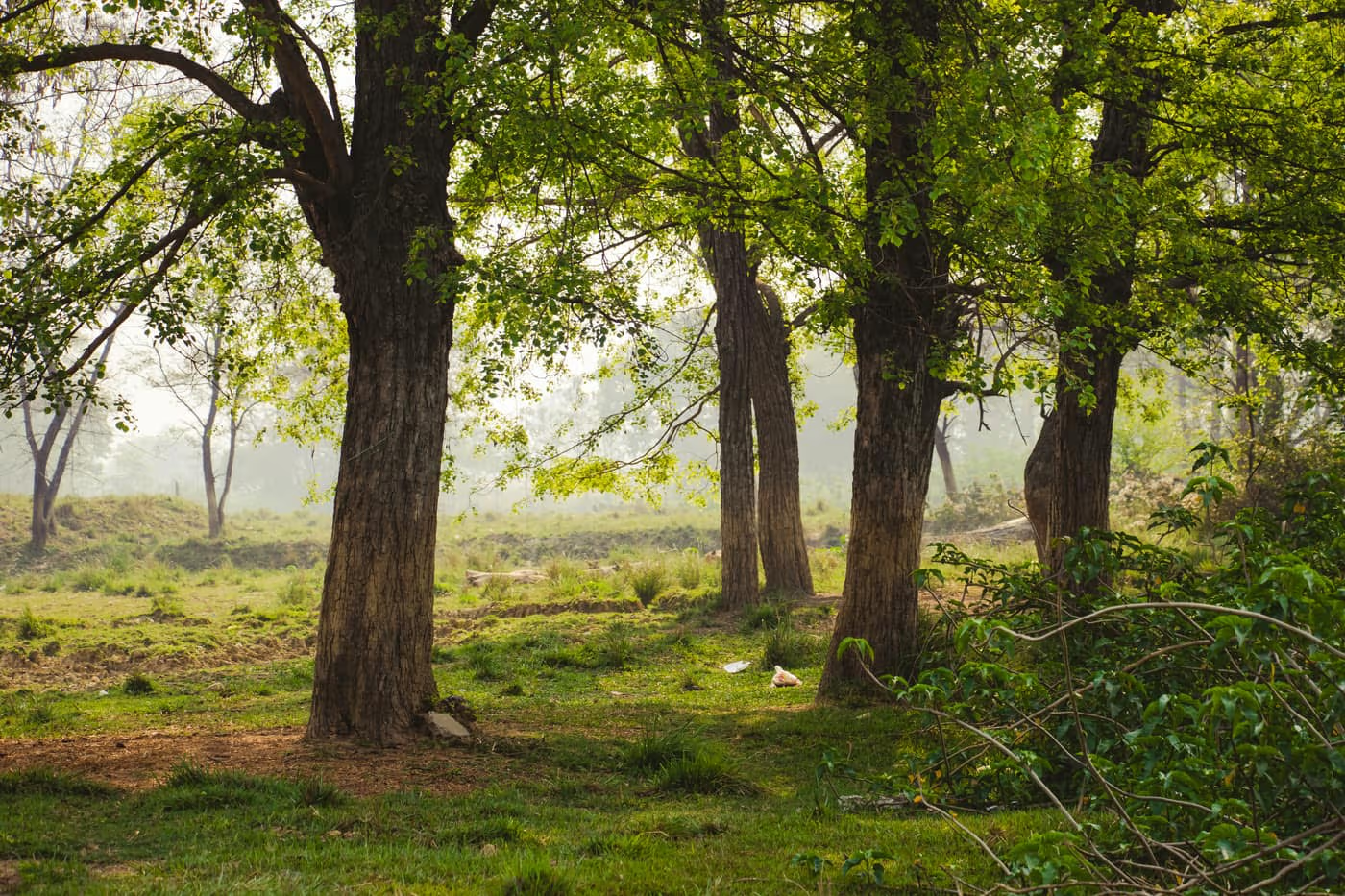
A fast-growing, farmer-friendly timber tree planted on canal banks, roadsides, field boundaries and in block plantations across north India, valued for strong, richly-grained furniture and plywood wood — held back less by growing difficulty than by two real risks: a well-documented wilt/dieback disease that can kill trees of any age once their roots meet a fluctuating water table, and CITES export controls on the whole rosewood genus that affect anyone selling finished sheesham products abroad.
Quick Summary
The key points from this page in about two minutes — read it or have it read aloud.
Quick Summary
Sheesham (Dalbergia sissoo), also called shisham or North Indian rosewood, is one of the most familiar farm trees of the Indo-Gangetic plain — planted on canal banks, roadsides, field bunds and in block plantations across Punjab, Haryana, Uttar Pradesh, Uttarakhand, Bihar and Rajasthan. It grows faster than teak and tolerates a wider range of conditions, including some waterlogging, which is exactly why it has long been the tree of choice along canals and irrigation channels.
Most sheesham is still raised from ordinary seed-origin nursery seedlings rather than any single named commercial variety — the varietal landscape is genuinely thin, built mostly on state forest-research plus-tree selections (Punjab Agricultural University's conserved plus trees, CCS Haryana Agricultural University's breeding work) and a small number of individually documented clones such as the Gonda clones from FRI's Lachhiwala clonal seed orchard in Uttarakhand. A farmer buying planting stock is usually choosing a reputable state forest-department or university-linked nursery over a specific brand-name variety.
The single biggest risk to a sheesham block is a well-studied wilt and dieback disease caused mainly by the fungus Fusarium solani, which becomes far more dangerous once a tree's roots reach a fluctuating water table — a real problem for exactly the canal-side and low-lying plantings sheesham is normally chosen for. Large-scale sheesham mortality from this disease has been documented across Punjab, Haryana and neighbouring states for decades, and there is no cure once a tree is infected; site drainage and early removal of dying trees are the only real defences.
Sheesham is also the one Indian timber tree caught up directly in international wildlife-trade law: the entire rosewood genus (Dalbergia) was placed on CITES Appendix II in 2017 because customs officials cannot easily tell sheesham timber apart from rarer, genuinely endangered rosewoods once it is cut and finished. This does not restrict growing or domestic sale, but it does mean any furniture, handicraft or timber consignment leaving India needs to account for the CITES rules — a 2022 relaxation now lets items under 10 kg move without a permit, but larger consignments still need one.
- Crop type
- Deciduous farm/boundary timber tree
- Season
- Planted at monsoon onset (June–July)
- Suitable states
- Punjab, Haryana, Uttar Pradesh, Uttarakhand, Bihar, Rajasthan
- Rotation length
- 15+ years; canal-side and boundary trees are often left standing longer
- Water requirement
- Moderate; tolerates more soil-moisture variation than most timber trees, including some waterlogging
- Temperature
- Subtropical to tropical; 15–40°C range, tolerant of a real winter
- Soil type
- Adaptable — alluvial loam to sandy soils; less fussy about drainage than teak
- Difficulty level
- Moderate (wilt/dieback disease watch, more than field management)
- Expected yield
- Timber volume builds for over a decade; value depends on girth and heartwood grain, not weight
- Key risk
- Fusarium wilt/dieback near a fluctuating water table, and CITES rules on any export sale
Overview
Sheesham (Dalbergia sissoo), known as shisham across north India and as North Indian rosewood in the international timber trade, is a medium-sized deciduous tree grown for its strong, dense, beautifully-grained heartwood — the classic wood of Indian furniture, plywood, sports goods and turnery. It is the most widely planted farm timber tree of the Indo-Gangetic plain, found along canal banks, roadsides and field boundaries as much as in dedicated block plantations, across Punjab, Haryana, Uttar Pradesh, Uttarakhand, Bihar and Rajasthan.
Unlike teak, sheesham does not depend on a small set of named commercial clones — most planting stock is still ordinary seed-origin nursery seedlings raised from locally collected seed, and the improvement work that exists (Punjab Agricultural University's conserved Punjab plus trees, CCS Haryana Agricultural University's breeding and floral-biology research, and FRI Dehradun's Lachhiwala clonal seed orchard in Uttarakhand, which yielded the individually-documented Gonda clones C196 and C198) has not yet produced a widely branded, farmer-recognised variety the way poplar's G-48 or Uday has. Choosing a state forest-department or agricultural-university-linked nursery over an unknown roadside seedling source is the practical equivalent of variety choice for this crop.
The tree's real defining risk is disease, not planting material. A wilt and dieback syndrome caused mainly by the soil fungus Fusarium solani has caused large-scale, well-documented sheesham mortality across Punjab, Haryana and neighbouring states for decades, and it strikes hardest exactly where sheesham is usually planted — on canal banks and low-lying ground where the roots eventually meet a fluctuating water table, the condition that makes trees most vulnerable to infection. On top of this domestic disease risk, sheesham is also the only common Indian farm-timber species directly affected by international CITES trade rules, since the entire Dalbergia (rosewood) genus was placed on CITES Appendix II in 2017 — growing and selling sheesham inside India is unaffected, but any furniture, handicraft or timber leaving the country needs to account for the CITES permit rules on rosewood.
Crop timeline, sowing to harvest
A quick visual map of the season — jump to any section below for the detail behind each stage.
- Year 0 (June–July)
Seedling / clonal planting
One-year-old nursery seedlings, or a documented clone where available, are planted in pits at the start of the monsoon on canal banks, boundaries or in a block layout.
- Year 1–3
Establishment
Young trees establish quickly — sheesham is noticeably faster-growing than teak in its first few years — and tolerate more soil moisture variation, including some waterlogging, than most other timber trees.
- Year 3–8
Rapid growth & first thinning
A block layout is thinned as the canopy closes, removing crooked or suppressed stems for poles and fuelwood; this is also the period when wilt/dieback symptoms most often first appear on stressed trees.
- Year 8–15
Girth build-up
Surviving trees build girth and start developing the dark, richly-grained heartwood that gives sheesham its furniture value; canal-side and boundary trees are usually left standing rather than clear-felled.
- Year 15+
Selective or final felling
Trees are felled selectively as they reach a marketable girth-class, or the whole block is felled together where it was planted as a dedicated timber crop rather than a boundary/canal planting.
Suitable states
States where this crop is grown at scale, highlighted below. Your local Krishi Vigyan Kendra is still the final word for your specific block.
- Jammu and Kashmir
- Himachal Pradesh
- Punjab
- Uttarakhand
- Haryana
- Delhi
- Uttar Pradesh
- Rajasthan
- Bihar
- Jharkhand
- West Bengal
- Sikkim
- Assam
- Arunachal Pradesh
- Meghalaya
- Nagaland
- Manipur
- Mizoram
- Tripura
- Gujarat
- Madhya Pradesh
- Chhattisgarh
- Maharashtra
- Odisha
- Goa
- Telangana
- Andhra Pradesh
- Karnataka
- Kerala
- Tamil Nadu
- Puducherry
- Ladakh
- Chandigarh
- Lakshadweep
Grown here
Climate requirements
Sheesham's tolerance of poorer sites and canal-side conditions is exactly what makes it so widely planted — and exactly what puts many of its plantings in the water-table-fluctuation zone that triggers its one serious disease.
Ideal temperature
Sheesham is subtropical to tropical and grows across a wide 15–40°C range; unlike teak it tolerates a real winter with light frost once established, which is part of why it thrives across the Indo-Gangetic plain as far north as Punjab and Uttarakhand.
Rainfall
Grows successfully across a wide 500–2000 mm rainfall range and tolerates supplemental canal irrigation, which is exactly why it has long been the standard tree planted along irrigation-canal banks throughout north India.
Humidity
Tolerant of a wide humidity range; the bigger climate-linked risk is not humidity itself but standing or fluctuating groundwater at the root zone, which is strongly linked to wilt/dieback disease.
Sunlight
Full sun once established; sheesham is commonly grown in single or double rows along canals and roads rather than dense blocks, so shade competition is rarely the limiting factor it is in a closed plantation.
Soil requirements
Because sheesham is so often planted specifically where other trees will not grow — canal banks, waterlogged margins, roadside cuttings — site selection matters less for growth than for disease risk; a site with a genuinely fluctuating water table is the one to watch most closely for wilt.
Suitable soil
Adaptable across a range of soils from alluvial loam to sandy soils, and noticeably less fussy about drainage than teak — sheesham is one of the few common timber trees that tolerates periodic waterlogging, which is why it is planted on canal banks and low-lying field margins that would not suit teak or many other trees.
pH range
Grows across a broad pH range, roughly 6.0–8.5; tolerates the mildly alkaline soils common across the Indo-Gangetic plain reasonably well.
Drainage
More waterlogging-tolerant than most timber species, but this tolerance is a double-edged sword: sites where roots repeatedly meet a fluctuating water table are exactly where Fusarium wilt/dieback takes hold most severely, so "tolerant" does not mean "risk-free".
Organic matter
Responds to organic matter worked into the planting pit and its own leaf litter left as mulch, though it establishes reasonably well on plain alluvial soil without heavy input.
Land preparation
Same four steps whichever region you are in — only the timing shifts with the sowing window.
- 1
Mark the planting line or grid and dig pits
For canal-side or roadside planting, a single or double row with 2–3 m spacing along the line is standard; for a dedicated block, 2 × 2 m to 3 × 3 m initial spacing (thinned later) matches common timber-tree practice. Dig pits about 30–45 cm across and deep a few weeks ahead of the monsoon.
- 2
Refill with topsoil and organic matter
Refill each pit with topsoil mixed with well-rotted farmyard manure or compost; in termite-prone belts mix in a recommended soil insecticide or a Metarhizium bio-formulation.
- 3
Source seedlings from a state forest department or university-linked nursery
Book one-year-old nursery seedlings from the state forest department, or a documented clone (such as a Gonda C196/C198-derived plant where available) from an FRI Dehradun or agricultural-university-linked nursery, well ahead of the monsoon planting window.
Seed information
How the main varieties compare, so you can pick by duration, yield, disease pressure or what you are growing for.
| Variety | Duration | Yield | Disease resistance | Best state | Suitable for |
|---|---|---|---|---|---|
Individually documented clones from the Dalbergia sissoo clonal seed orchard established in 1996 at Lachhiwala, Dehradun (Uttarakhand) under a World Bank-funded forest research project, evaluated from among 30 clones collected across India and Nepal — the Gonda-origin clones C196 and C198 showed the strongest height and girth performance in that trial, the best-documented named sheesham planting material available. | 15+ years to marketable girth | Best-documented growth performance among evaluated Dalbergia sissoo clones | Not separately documented against Fusarium wilt; standard site-drainage precautions still apply | Uttarakhand, and other states sourcing FRI Lachhiwala-derived planting material | Research-backed block and boundary planting |
Punjab Agricultural University Plus-Tree Stock Planting material descended from candidate plus trees selected across Punjab for straightness, clear bole and vigour, and conserved ex-situ at PAU Ludhiana in response to the state's widespread problem of crooked, poor-form sheesham from unimproved seed — distributed through PAU-linked and Punjab state forest-department nurseries rather than sold as a single branded variety. | 15+ years to marketable girth | Improved form over unselected local seed | Not separately documented | Punjab | Farm-boundary and canal-side planting where stem straightness matters for future sawtimber value |
CCS Haryana Agricultural University Breeding-Programme Stock Planting material from CCS HAU Hisar's long-running Dalbergia sissoo plus-tree selection and breeding-system research (including work confirming sheesham is a strictly self-fertilising species), distributed through university and Haryana state forest-department nurseries. | 15+ years to marketable girth | Improved form over unselected local seed | Not separately documented | Haryana | Farm-boundary and block planting |
Local Seed-Origin Nursery Stock Ordinary one-year-old seedlings raised from seed collected off good local mother trees — still, honestly, how most sheesham actually gets planted across north India, since no single branded commercial variety dominates the market the way it does for poplar. Quality depends heavily on the mother tree and the nursery, which is why sourcing from a state forest-department or KVK nursery is worth the small extra effort over an unverified roadside seller. | 15+ years to marketable girth | Variable; depends on the quality of the seed source | Not separately documented | Punjab, Haryana, Uttar Pradesh, Bihar, Rajasthan | General canal-side, roadside and boundary planting |
- Seed rate
- Sheesham is planted from one-year-old nursery seedlings (occasionally root or shoot cuttings), not broadcast seed. Plan for roughly 1,000–1,600 plants per acre at 2 × 2 m to 3 × 3 m spacing for a dedicated block; for canal-side, roadside or boundary planting, spacing is set by the length of the line rather than an area-based rate, typically 2–3 m between plants.
- Certified seed
- Where available, source seedlings raised from a documented plus-tree or clonal source (PAU Punjab plus trees, CCS HAU Hisar stock, FRI Lachhiwala Gonda-clone material) through a state forest-department or university-linked nursery. Where only ordinary local seedling stock is available, still buy from a state forest-department or KVK nursery rather than an unverified roadside seller, and reject seedlings with a crooked or damaged main stem, since sheesham does not correct a poor early form on its own.
- Spacing
- 2 × 2 m (about 1,000 plants/acre) to 3 × 3 m (about 450 plants/acre) for a dedicated block, thinned as the canopy closes; 2–3 m between plants for a single or double line along a canal bank, road or field boundary.
- Seed treatment
- Plant seedlings the same season they are lifted from the nursery wherever possible; a pre-planting root dip in a cow-dung, clay and recommended fungicide slurry is common practice against collar and root infections, and is worth doing given the crop's known wilt/dieback risk.
Sowing guide
Avoid planting directly over or immediately beside an active field drain or a spot known to flood repeatedly — this is exactly the site condition most strongly linked to later wilt/dieback.
- Best time
- Plant at the start of the monsoon (June–July), once the soil has been wetted by the first good rains, giving the young seedling the full run of wet-season moisture before its first dry season.
- Row spacing
- 2–3 m between rows for a block planting; matched to the planting line for canal-side, roadside or boundary planting
- Plant spacing
- 2–3 m within the row or line
- Sowing depth
- Set the seedling at the same depth it was growing in its nursery bag or bed, with the root collar at ground level.
- Method
- One seedling per pit, firmed in with the heel and watered immediately if the ground is not already saturated from recent rain; water again after a week if the monsoon breaks.
Fertilizer schedule
A split dose beats one large dose applied at sowing — nitrogen especially is lost to the air and to leaching if it all goes in on day one.
- 1
At planting (basal)
Year 0
Well-rotted farmyard manure or compost mixed into the pit; sheesham establishes well on organic matter alone on most soils typical of its growing belt.
- 2
Young trees
Years 1–3
A modest dose of urea, SSP and MOP (roughly 50–100 g urea, 25–50 g SSP, 25–50 g MOP per tree per year, split across the growing season) helps establishment on poorer or sandier soils; often skipped entirely on good alluvial loam.
- 3
Established tree
Year 4 onward
Most established sheesham on suitable canal-side or field soil is not fertilised further beyond its own leaf-litter return.
Irrigation schedule
1. Establishment
First 1–2 dry seasons
A young seedling benefits from occasional watering through its first one or two dry seasons if rainfall has been poor, especially on lighter or sandier soils away from a canal or moisture source.
2. Established tree
Year 3 onward
Most sheesham, especially canal-side and boundary plantings, needs no deliberate irrigation once established, since it is usually sited exactly where soil moisture is already assured.
Critical stages
- First dry season after planting on non-canal sites
- Any unusually long dry spell in years 1–2
Water-saving tips
- Canal-side and boundary planting is itself the main water-management strategy for this crop — deliberate supplemental irrigation is rarely needed once established.
- A basin or shallow ring around each young plant in year 1 concentrates any supplemental watering over the root zone on drier sites.
- Watch drainage as closely as you watch water supply — a site that floods and then dries repeatedly is a bigger long-term risk to a sheesham planting than one that simply runs a little dry.
Weed management
Common weeds
Organic control
- Two or three hand or hoe weedings a year in a roughly 1 m circle around each young tree for the first two years is usually enough — after that the closing canopy shades most weeds out on its own for block plantings.
- For canal-side and boundary trees, periodic slashing of grass and weeds along the line both reduces competition and keeps the planting easy to inspect for disease symptoms.
Chemical control
- Weed control in the first two years is normally by manual hoeing in a basin around each young tree rather than routine herbicide use.
- A directed herbicide cleared for plantation use can be used along a block's tree rows, kept well off young bark; confirm the current product and dose with your state forest department or KVK.
Nutrient deficiency identification
What a shortage of each nutrient actually looks like on the plant, so you can tell a deficiency apart from a disease before you spray the wrong thing.
Nitrogen
Visible symptom
Pale, yellow-green older leaves and a thin annual height flush in an otherwise healthy-looking young tree, usually only on poor sandy soils.
Phosphorus
Visible symptom
Slow early establishment and poor root spread in a young seedling, with a dull, purple-tinged cast on the older leaves.
Potassium
Visible symptom
Scorched brown leaf margins and weak, thin-walled shoots that bend or break easily in wind, worst on light sandy canal-bank soil with little organic return.
Diseases to watch for
Symptoms, likely cause and what actually treats it — not just a spray name.
Pests to watch for
What to look for before the damage is visible, and organic options before you reach for a chemical.
Shisham defoliator
- Identification
- Caterpillars of the moth Plecoptera reflexa feeding on leaves through the growing season, capable of periodic outbreaks that can significantly thin a tree's canopy; found throughout sheesham-growing areas of India.
- Damage
- Repeated heavy defoliation slows growth and, on young trees, can compound the stress that makes a tree more vulnerable to wilt/dieback — the two problems are worth watching together rather than in isolation.
- Organic control
- Conserve natural predators and parasitoids; hand-collect caterpillars from young trees where an outbreak is small and localised.
- Chemical control
- A CIB&RC-registered contact insecticide spot-sprayed at the first sign of a heavy outbreak on young, high-value plantings; confirm the current product with your state forest department or KVK — light, routine defoliation on established trees rarely needs chemical treatment.
Shisham leaf webber
- Identification
- Caterpillars of the moth Dichomeris eridantis webbing leaves together and feeding within the shelter, a secondary defoliator alongside Plecoptera reflexa; research modelling suggests its range is expanding in hill states such as Uttarakhand as the climate warms.
- Damage
- Generally less damaging than the main shisham defoliator but adds to overall leaf loss where both pests occur together in the same season.
- Organic control
- The same predator/parasitoid conservation and outbreak monitoring used against the shisham defoliator also helps control the leaf webber.
- Chemical control
- Rarely justifies separate treatment; manage together with the shisham defoliator if both are present in a damaging outbreak.
Termites
- Identification
- Mud sheeting on the stem of freshly planted seedlings and young trees, with the soft bark and root collar eaten away underneath; worst on sandy soils, in dry belts, and where undecomposed organic matter has been mixed into the planting pit.
- Damage
- Can kill a freshly planted seedling before it roots properly and girdle a young tree at the collar; also a risk to felled logs left in storage.
- Organic control
- Use only well-decomposed manure in the planting pit, drench the pit with a Metarhizium bio-insecticide in known termite-prone belts, and keep felled logs stacked off the ground.
- Chemical control
- Mix a recommended soil insecticide into the pit at planting in termite-prone areas, and drench around the collar of any affected young tree.
Common mistakes to avoid
The mistakes that cost growers the most, ranked by how often they show up in the field — not in the order you might expect.
- 1
Planting directly into ground with a genuinely fluctuating water table, or a spot that repeatedly floods and dries.
Why it hurts
This is the single strongest documented trigger for Fusarium wilt/dieback, the disease responsible for large-scale, well-studied sheesham mortality across north India — a tree planted on the wrong hydrology can die within a season or two regardless of how well everything else is managed.
- 2
Buying unverified roadside seedling stock instead of a state forest-department or university-linked nursery.
Why it hurts
Since sheesham has no single dominant branded variety, seedling quality depends heavily on the mother tree and nursery care — an unverified source is far more likely to give a crooked, poorly-formed tree that never reaches good sawtimber value.
- 3
Assuming an export sale of sheesham furniture or handicrafts needs no special paperwork.
Why it hurts
The whole Dalbergia (rosewood) genus, including sheesham, has been on CITES Appendix II since 2017; any consignment leaving India above the 10 kg per-item threshold set in the 2022 relaxation needs a CITES export permit, and shipping without one risks seizure at customs.
- 4
Ignoring early crown yellowing on a wilt-prone site as "just a dry spell".
Why it hurts
Early wilt symptoms are easy to mistake for ordinary water stress, but by the time dieback is obvious the fungal infection is usually well established and the tree cannot be saved — removing a genuinely wilt-affected tree promptly limits spread to its neighbours far better than waiting to confirm the diagnosis.
- 5
Replanting sheesham immediately into a spot where a previous tree died of wilt.
Why it hurts
The Fusarium fungus persists in the soil after the tree it killed is removed, and a replacement sheesham planted in the same spot carries a materially higher risk of the same disease.
- 6
Skipping thinning on a dedicated block planting as it grows.
Why it hurts
An overcrowded, unthinned block slows in overall growth and produces thinner, poorly-formed stems on the trees that would otherwise become the final crop — the same principle that applies to any timber-tree block.
Harvesting
A dedicated timber block is thinned progressively from around year 8 and the final crop felled from year 15 onward as girth and heartwood mature; canal-side, roadside and boundary trees are more often felled selectively, one at a time, as individual trees reach a marketable girth or need to be removed for other reasons (dieback, road-widening, canal maintenance) rather than as a scheduled clear-fell.
Signs it is ready
- Heartwood has developed its characteristic dark brown colour with visible grain, contrasting with the pale sapwood
- Girth has reached the class the local sawmill or timber trader is paying for
- Any required state felling permit has been obtained before cutting begins
Tools
- Chainsaw or two-person crosscut saw for felling and cross-cutting
- Tractor-trolley or truck for transporting logs
- A registered timber depot or sawmill for grading and sale
Expected yield
Timber volume and value both build with age rather than reaching a fixed per-acre figure at a set year; wood is valued log by log on girth-class, heartwood proportion and grain quality, not sold by simple weight the way poplar or eucalyptus pulpwood is.
Post-harvest & storage
Storage
Felled sheesham logs should be stacked off the ground on cross-battens under cover, both to prevent staining and cracking from sun exposure and to reduce termite and borer entry through the cut ends, especially if held for any length of time before sale.
Packaging
Logs are graded and sold by measured girth-class, length and visible heartwood grain quality, usually at a registered timber depot or sawmill.
Transportation
Domestic felling and transport of sheesham grown on private land follows the standard state tree-felling permit process for farm timber — confirm the current procedure with your local forest range office or the National Timber Management System (NTMS) portal before cutting. The distinct extra step for this crop is international sale: sheesham is on CITES Appendix II as part of the Dalbergia genus, so any furniture, handicraft or timber consignment leaving India needs to account for CITES export rules — items under 10 kg per piece move without a CITES permit under the 2022 relaxation, but larger consignments and bulk timber shipments still need one, arranged through the exporter's CITES management authority.
Shelf life
Seasoned sheesham timber is durable and long-lasting once dried and worked, and does not need special short-term storage — its strength and rich grain are the basis of its long-standing furniture and plywood value.
Market prices
Today's mandi price near you, pulled live from the government's own Agmarknet data.
Live daily mandi prices from the government Agmarknet dataset.
Government mandi price not available for this crop
This crop is not traded through APMC mandis covered by the government’s Agmarknet system, so there is no mandi price to show here.
Weather
Current conditions and a 5-day outlook for your selected location, with one line of stage-aware advice.
Pick your state for current conditions and a 5-day outlook.
Live data from Open-Meteo
Profit calculator
Your own cost sheet, expected yield and selling price — not ours.
Where the money goes
Share of the total cost per acre, using the calculator’s own default cost sheet below — adjust the numbers there to match your field and this picture will no longer apply to you exactly, but the ranking rarely changes.
- Land rent44% (₹9,000)
- Labour22% (₹4,500)
- Seed10% (₹2,000)
- Fertiliser7% (₹1,500)
- Machinery5% (₹1,000)
- Interest5% (₹1,000)
- Pesticide & weedicide4% (₹800)
- Irrigation2% (₹500)
Official downloads
Government and ICAR documents only — everything below is hosted on an official server.
Forest Research Institute (FRI), Dehradun
Dalbergia sissoo clonal seed orchard research (Lachhiwala) and improved planting stock
ICAR — Central Agroforestry Research Institute (CAFRI, Jhansi)
National institute for agroforestry, including timber-tree systems
National Timber Management System (NTMS)
Central portal for registering farm-tree plantations and applying for felling/transit permits
Kisan Call Centre — 1800-180-1551
Free crop advice in your language
Frequently asked questions
Why do sheesham trees suddenly die even when the block looks healthy otherwise?
This is almost always the well-documented sheesham wilt/dieback disease, caused mainly by the soil fungus Fusarium solani. It becomes far more dangerous once a tree's roots reach a fluctuating water table or the tree is under water stress — exactly the condition on many canal-side and low-lying sites where sheesham is normally planted. There is no cure once symptoms appear; remove and burn affected trees promptly, avoid replanting sheesham in the same spot, and pay close attention to site drainage before planting new trees.
Which variety of sheesham should I plant?
Unlike poplar, sheesham does not have a single dominant branded commercial variety. Where available, planting material from a documented source — the Gonda clones (C196, C198) from FRI's Lachhiwala orchard, or PAU Punjab / CCS HAU Hisar plus-tree stock — is the best-evidenced choice. Otherwise, buy ordinary seedlings from a state forest-department or KVK nursery rather than an unverified roadside seller, and reject any seedling with a crooked or damaged main stem.
Is there an MSP or mandi price for sheesham?
No. Sheesham is not a CACP-notified commodity and has no MSP, and a live check of the Agmarknet/data.gov.in mandi-price system found no genuine trading records for sheesham or shisham at any APMC. Timber is sold as logs through registered timber depots and sawmills, priced by girth-class and heartwood grain quality rather than through the mandi system.
Do I need special permission to sell sheesham furniture abroad?
Yes, in one specific way that does not apply to most other Indian timber trees. The entire Dalbergia (rosewood) genus, including sheesham, has been listed on CITES Appendix II since 2017, because customs officials cannot easily distinguish it from rarer, genuinely endangered rosewoods once it is cut and finished. A 2022 relaxation now allows any number of individual items each weighing under 10 kg to move without a CITES permit in a single consignment, but larger pieces or bulk shipments still need one. This does not affect growing sheesham or selling it within India.
Can sheesham be planted on waterlogged or canal-side land where other trees fail?
Yes, and this is exactly why it has long been the standard tree along Indo-Gangetic canal banks — sheesham tolerates periodic waterlogging better than most timber trees. The catch is that a fluctuating water table at the root zone is also the strongest documented trigger for Fusarium wilt/dieback, so this tolerance is a real trade-off, not a free pass — expect to lose some trees to wilt over the life of a canal-side planting and plan for it, rather than being caught by surprise.
How does sheesham compare to teak for a farmer deciding what to plant?
Sheesham grows faster, tolerates a wider range of soils and some waterlogging, and does not carry teak's especially strict private-land felling and transit permit regime in most states — but it carries a real, well-documented disease risk (wilt/dieback) that teak does not, and it is the one Indian timber species directly caught up in CITES export rules if you plan to sell finished goods abroad. Teak is the safer bet for a long-term, high-value timber investment on well-drained upland soil; sheesham suits canal-side, boundary and lower-lying land where teak would not thrive, provided the water-table risk is managed.
Still have questions?
The FAQs above cover the common ones. For anything specific to your field and soil, your nearest Krishi Vigyan Kendra is the authoritative answer.