
Mushroom
Agaricus bisporus, Pleurotus spp., Calocybe indica
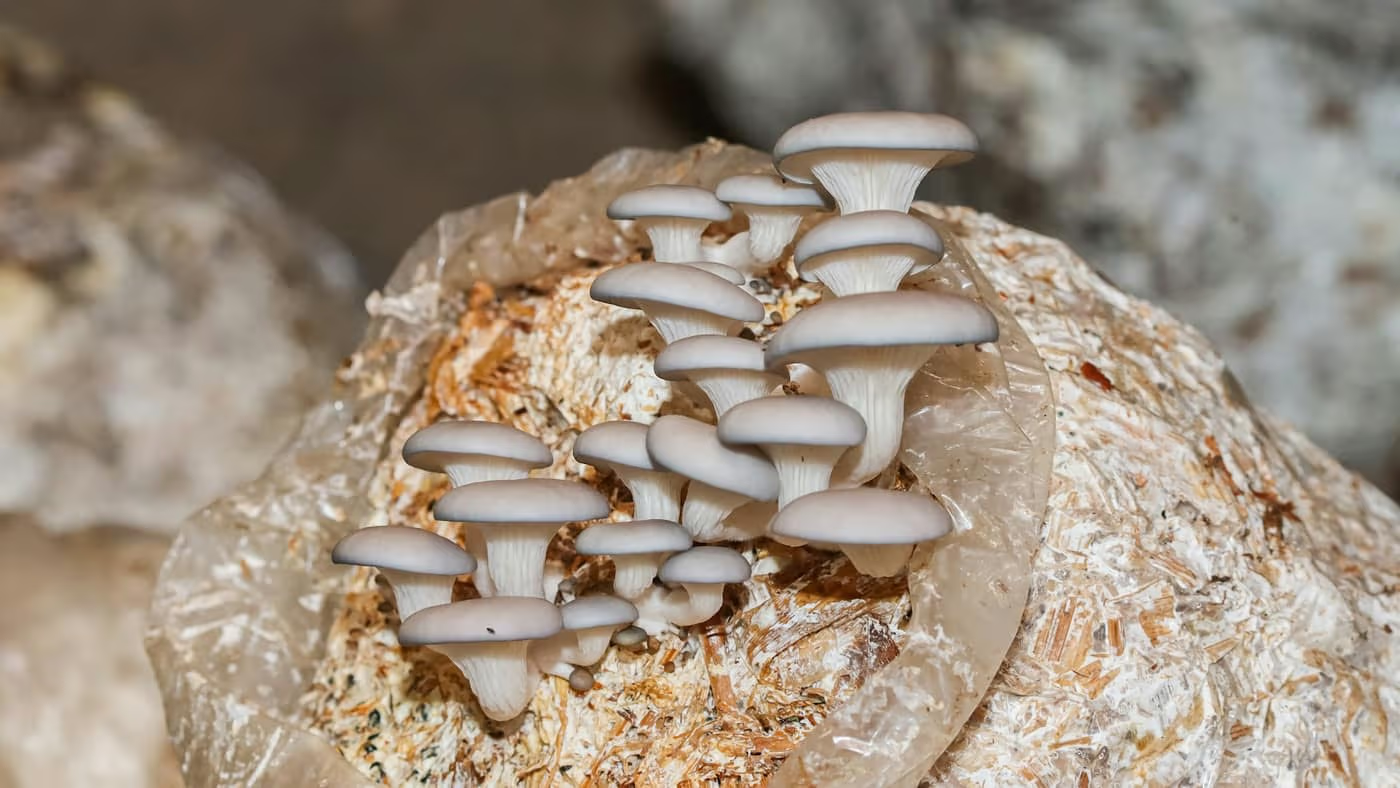
The one crop on this site that needs no field at all — a fungus grown indoors on pasteurised straw, compost or sawdust, ready to pick in three to seven weeks. That is exactly why it has become a favourite starter enterprise for young and land-short growers: a spare room or a rented shed is enough, the whole cycle runs in weeks not months, and oyster mushroom in particular needs no boiler, no AC room and almost no capital to try it on a small scale first.
Quick Summary
The key points from this page in about two minutes — read it or have it read aloud.
Quick Summary
Mushroom farming is not really "farming" in the usual sense — there is no field, no soil, no sowing season. A mushroom is the fruiting body of a fungus, grown indoors in a shed or room on a pasteurised or sterilised organic substrate (wheat straw, paddy straw, sawdust or a compost), under controlled temperature and humidity, and harvested in repeated flushes over a few weeks. That indoor, substrate-based nature is exactly what makes it attractive to a new or land-short grower: a spare room, a rented shed, or even one room of a house is enough space to start, the whole crop cycle runs in weeks rather than months, and it can be run as a side income alongside another job or alongside regular field farming rather than needing a farmer's full-time attention.
Three species dominate Indian cultivation, each suited to a different grower and season. Oyster mushroom (Dhingri) is the easiest entry point — it grows well at ordinary room temperature, tolerates a wide range of conditions, needs the least equipment, and fruits fastest, which is why most new growers start here. Button mushroom is the crop most people mean by "mushroom" in the market, but it needs a proper compost, a cooler growing period, and ideally a temperature-controlled room, making it a bigger and more commercial-scale undertaking. Milky mushroom is the summer specialist — it fruits in the hot months when oyster and button both struggle, filling the gap in an off-season supply.
The whole enterprise turns on cleanliness and timing rather than land or water: the substrate must be properly pasteurised so competing moulds don't out-race the mushroom spawn, humidity and fresh air have to be managed daily during fruiting, and the crop has to be picked and sold fast because fresh mushroom spoils within a day or two at room temperature. Get those basics right in a small trial batch before scaling up the shed.
- Crop type
- Indoor fungus, grown on organic substrate (not soil)
- Season
- Oyster: near year-round indoors; Button: Oct–Mar; Milky: Apr–Jun (summer)
- Suitable states
- Himachal Pradesh, Punjab, Haryana, Uttar Pradesh, Odisha, Tamil Nadu, Bihar, West Bengal
- Time to first harvest
- 3–4 weeks (oyster); 6–7 weeks (button); 3–4 weeks (milky)
- Water requirement
- Daily misting for humidity, not field irrigation; substrate itself holds most moisture
- Temperature
- Spawn run 22–28°C; fruiting 15–25°C for oyster/button, 30–35°C for milky
- Growing medium
- Pasteurised wheat/paddy straw, sawdust, or composted substrate
- Difficulty level
- Easy to start (oyster, small batch); moderate–hard to scale (compost, climate control, fast sale)
- Expected yield
- 600–800 g fresh mushroom per kg dry straw (oyster); 10–15 kg/sq.ft compost (button)
- Key risk
- Substrate contamination (green mould) from poor pasteurisation or hygiene
Overview
Mushroom cultivation grows an edible fungus — not a plant — indoors on an organic substrate, under conditions the grower controls rather than the weather. There is no soil, no field, and no fixed sowing season tied to the monsoon; the crop is started by mixing "spawn" (mushroom mycelium grown on grain or straw, the fungal equivalent of seed) into a pasteurised substrate, and the whole cycle from spawning to the last flush of picking runs three to eight weeks depending on the species.
India's three commercially important species are Pleurotus (oyster/dhingri, the easiest and fastest, grown on straw with no compost step), Agaricus bisporus (white button, grown on a properly prepared compost under cooler, more controlled conditions, and the dominant species in the organised/export trade), and Calocybe indica (milky mushroom, a heat-tolerant species that fruits through the summer months when the other two struggle). Paddy straw mushroom (Volvariella) is a fourth, fast, warm-season option grown directly on fresh paddy straw, mainly in the eastern and southern states.
This is why mushroom farming shows up so often in "low-investment, quick-return" farming content aimed at young and new growers: it needs a room or shed rather than acres of land, a crop cycle measured in weeks, and — for oyster mushroom especially — very little specialised equipment to start a small trial batch. Scaling it into a real business does need real skill (sanitation, humidity and temperature control, and a fast, reliable sales channel since the fresh product barely keeps), which is where most beginners actually struggle, not the growing itself.
Crop timeline, sowing to harvest
A quick visual map of the season — jump to any section below for the detail behind each stage.
- Week 0
Substrate preparation
Straw or compost is pasteurised (hot water or steam) or, for button mushroom, composted over 2–3 weeks and pasteurised in a controlled room — the single most important step, since it kills competing moulds and pests without killing the substrate's usefulness to the mushroom.
- Week 0–1
Spawning
Cooled substrate is mixed or layered with mushroom spawn (grain or straw carrying the mushroom mycelium) at roughly 2–5% of the substrate's weight, then packed into bags, trays or beds and moved to a dark, warm room.
- Week 1–3
Spawn run
The mycelium grows through the substrate in the dark, turning it white and binding it into a solid block over 12–21 days depending on species and temperature; humidity is kept high but no light or fresh-air flushing is needed yet.
- Week 2–4
Pinning (fruiting induction)
Once the substrate is fully colonised, bags are opened or cut, moved to a brighter, cooler, more humid and better-ventilated space, and tiny pin-head mushrooms form within a few days of this environmental shock.
- Week 3–8
Cropping (flushes)
Mushrooms are picked at the right cap size every 1–2 days as they mature, in 3–5 repeated flushes about a week apart, with each later flush giving a smaller yield than the one before.
- Week 8+
Bed clearance & next batch
The spent substrate (a good soil conditioner/compost) is cleared out, the room or shed is cleaned and disinfected, and a fresh batch of substrate and spawn is started — sheds are typically kept running back-to-back rather than left idle.
Suitable states
States where this crop is grown at scale, highlighted below. Your local Krishi Vigyan Kendra is still the final word for your specific block.
- Jammu and Kashmir
- Himachal Pradesh
- Punjab
- Uttarakhand
- Haryana
- Delhi
- Uttar Pradesh
- Rajasthan
- Bihar
- Jharkhand
- West Bengal
- Sikkim
- Assam
- Arunachal Pradesh
- Meghalaya
- Nagaland
- Manipur
- Mizoram
- Tripura
- Gujarat
- Madhya Pradesh
- Chhattisgarh
- Maharashtra
- Odisha
- Goa
- Telangana
- Andhra Pradesh
- Karnataka
- Kerala
- Tamil Nadu
- Puducherry
- Ladakh
- Chandigarh
- Lakshadweep
Grown here
Climate requirements
Because the whole climate is artificial, a mushroom shed can be run through seasons when an open field cannot be cropped at all — which is a real part of why it appeals as a side income alongside a farmer's main kharif/rabi cycle, not just to landless growers.
Ideal temperature
Grown indoors, so temperature is managed by the grower rather than the season — but the target still depends on species. Oyster mushroom is the most forgiving, fruiting well anywhere from about 15–28°C, which is why it is grown almost year-round in the plains. Button mushroom needs a distinctly cooler fruiting phase (15–18°C) after a warmer compost/spawn-run phase, which is why it is largely a winter (October–March) crop in the plains unless the room is air-cooled. Milky mushroom is the opposite — it actually prefers 30–35°C and is the one species that fruits well through the hot summer months.
Rainfall
Outdoor rainfall has no direct bearing on the crop since it is grown under a roof, but it matters indirectly: the monsoon's high ambient humidity makes maintaining the shed easier in some ways and encourages contamination in others, and heavy rain can affect the availability and price of fresh straw, the main substrate raw material.
Humidity
The single most closely managed factor. Spawn run wants 80–90% relative humidity in the dark; the pinning and fruiting stage wants a slightly lower 80–85% with fresh air exchange, since stale, still, overly humid air favours long thin stems and contamination over firm, well-formed caps.
Sunlight
Mushrooms do not photosynthesise and need no direct sunlight — in fact strong direct sun overheats and dries the shed. A diffuse, low light level during pinning and fruiting is enough to trigger normal cap colour and shape; the spawn-run stage is kept fully dark.
Soil requirements
Because there is no field soil to build up or exhaust, mushroom growing does not compete with a farmer's regular cropping land at all — the spent substrate afterwards is itself a genuinely useful soil conditioner/compost for the field crops, closing a small loop rather than needing dedicated farmland.
Suitable soil
There is no soil at all in mushroom cultivation — the crop is grown entirely on an organic "substrate" instead: pasteurised wheat or paddy straw for oyster mushroom, a specially prepared and composted mix of wheat straw, poultry manure and gypsum for button mushroom, or paddy straw/sugarcane trash for paddy straw mushroom. The substrate's quality (clean, fresh straw, correctly composted and pasteurised) matters far more than any land the grower owns.
pH range
Substrate pH is checked and adjusted rather than a field's natural pH: oyster mushroom straw is kept close to neutral (pH 6.5–7.5), while button mushroom compost is deliberately alkaline (pH 7.5–8) at spawning, since a too-acidic substrate favours competing green mould over the mushroom mycelium.
Drainage
The equivalent of drainage here is substrate moisture control — straw or compost packed too wet turns anaerobic and sour and fails, while substrate that dries out stops the mycelium cold. Substrate is wrung to the "damp sponge, no dripping water" point before spawning, and bags or beds are never allowed to sit in standing water.
Organic matter
The substrate is 100% organic matter by definition — straw, sawdust or compost is both the growing medium and the mushroom's entire food source, since a mushroom has no roots and takes every nutrient it needs directly from the material it is growing on.
Land preparation
Same four steps whichever region you are in — only the timing shifts with the sowing window.
- 1
Prepare and disinfect the growing room or shed
A clean, shaded, well-ventilated room or simple shed — even a spare room, a bamboo-and-thatch structure, or an unused shop space — is scrubbed, whitewashed with lime and fumigated or disinfected before every fresh batch, since leftover mould spores from a previous crop are the biggest cause of contamination.
- 2
Fix a humidity and ventilation set-up
Simple means (a hand sprayer, wet gunny bags or jute hung on the walls, a small exhaust or window for fresh air) are put in place to hold 80–90% humidity during spawn run and a fresh-air exchange during fruiting; a serious grower later adds a humidifier and thermometer-hygrometer for consistency.
- 3
Arrange racks or hanging space for the substrate bags
Bags, trays or beds are arranged on simple bamboo/wood racks or hung from an overhead rope-and-hook system to use the room's height, keep the substrate off a damp floor, and give even air movement around every bag.
Seed information
How the main varieties compare, so you can pick by duration, yield, disease pressure or what you are growing for.
| Variety | Duration | Yield | Disease resistance | Best state | Suitable for |
|---|---|---|---|---|---|
One of the most widely cultivated button mushroom strains in India, along with U-3 and imported strains such as Horst H3 — grown commercially in the organised cold-room sector as well as by smaller composting units. | 6–7 weeks to first flush (after 2–3 weeks of composting) | 10–15 kg fresh mushroom/sq.ft of compost bed | No special disease resistance claimed; needs careful compost and room hygiene against wet/dry bubble | Himachal Pradesh | — |
The historical base strain of white button mushroom — almost every commercial white button strain grown worldwide today, including most Indian ones, traces back to U-3, making it the closest thing this crop has to a genuine "foundation" variety. | 6–7 weeks to first flush (after 2–3 weeks of composting) | 10–14 kg fresh mushroom/sq.ft of compost bed | No special disease resistance claimed; standard hygiene practice applies | Himachal Pradesh | — |
A browning-resistant hybrid white button mushroom developed and released by ICAR-Directorate of Mushroom Research (DMR), Solan — bred to hold its white colour longer after harvest, which is a genuine shelf-life and marketability advantage over the older S-11/U-3 strains. | 6–7 weeks to first flush (after 2–3 weeks of composting) | Comparable to or better than S-11/U-3 in ICAR-DMR trials | Bred specifically for improved resistance to post-harvest browning; standard hygiene still needed against green mould and blotch | Himachal Pradesh | — |
Florida (Pleurotus florida — White Oyster) The most common oyster mushroom grown in India — usually just called "dhingri" — and the standard first crop for a new, small-space grower because it needs no compost, tolerates a wide temperature range, and fruits fastest of any commercially grown mushroom. | 3–4 weeks to first flush | 600–800 g fresh mushroom/kg dry straw | Generally hardy; main risk is substrate contamination from poor pasteurisation, not a plant disease | Uttar Pradesh | — |
Sajor-Caju (Pleurotus sajor-caju — Grey Oyster) A grey-capped oyster mushroom species tolerant of somewhat higher temperatures than Florida, making it a useful choice for growers in warmer parts of the country or wanting to extend the oyster-mushroom cropping season further into the hot months. | 3–4 weeks to first flush | 600–800 g fresh mushroom/kg dry straw | Generally hardy; better heat tolerance than Florida in warmer months | Uttar Pradesh | — |
Pink Oyster (Pleurotus djamor) A striking bright-pink oyster mushroom that fruits faster than any other cultivated mushroom species and commands a novelty premium at farmers' markets and with restaurants, but needs genuinely warm conditions and has a shorter shelf life than the grey/white oyster types. | 2–3 weeks to first flush — the fastest cultivated mushroom | Broadly similar to Florida oyster mushroom on a straw basis, though flushes are fewer | Needs genuinely warm conditions (25–32°C); poor fruiting, not disease, is the main risk in cool weather | Tamil Nadu | — |
Golden Oyster (Pleurotus citrinopileatus) A bright yellow, small-clustered oyster mushroom grown by specialty and niche-market oriented growers rather than as a mainstream commercial crop — it fetches a distinctly higher price than white or grey oyster mushroom but yields somewhat less bulk weight per bag. | 3–4 weeks to first flush | Somewhat lower than Florida oyster on a straw basis, offset by a higher per-kg price | Generally hardy; the delicate small caps bruise and dry out faster than other oyster types | Tamil Nadu | — |
Ostreatus (Pleurotus ostreatus — Winter Oyster) The cold-tolerant oyster mushroom species, fruiting well at lower temperatures than Florida or sajor-caju — the natural choice for growers in the hill states and for cropping through the coldest winter weeks in the plains without extra heating. | 3–4 weeks to first flush | 600–800 g fresh mushroom/kg dry straw | Generally hardy; the most cold-tolerant of the commonly grown oyster species, but slows in genuine summer heat | Himachal Pradesh | — |
A widely used milky mushroom strain released by Annamalai University (Tamil Nadu), valued for large, robust, milky-white mushrooms with thick stems and, unusually for a cultivated mushroom, genuinely good fruiting through the hot summer months. | 3–4 weeks to first flush | Broadly comparable to oyster mushroom on a straw basis, with notably larger individual mushrooms | Bred and selected for reliable fruiting in genuine summer heat where other cultivated mushrooms struggle | Tamil Nadu | — |
DMR Milky-985 (Milky Mushroom) A milky mushroom strain identified as high-yielding by ICAR-Directorate of Mushroom Research (DMR), Solan following three years of multi-location cultivation trials — a research-backed alternative to the older, widely used APK-2 strain. | 3–4 weeks to first flush | Identified as a high-yielding strain in ICAR-DMR multi-location trials (2017–2020) | Selected specifically for consistent, high-yielding performance across locations in trial conditions | Himachal Pradesh | — |
Paddy Straw Mushroom (Volvariella volvacea) A fast, warm-season mushroom grown directly on bundled fresh paddy straw rather than pasteurised loose straw — a natural fit for paddy-growing regions where straw is abundant right after harvest, though named strains distinct from the species-level classification are not widely documented for Indian commercial spawn, so it is represented here honestly as a species rather than a specific named cultivar. | 10–15 days to first flush — one of the fastest cultivated mushrooms | Lower biological efficiency than oyster mushroom, but compensated by the very short cycle and fresh paddy straw availability after harvest | Needs genuinely hot, humid conditions (30–35°C) to fruit at all; not usable in the cool season | Odisha | — |
- Seed rate
- Spawn (not true seed) is mixed in at roughly 2–5% of the substrate's wet weight — commonly stated as around 300–500 g of spawn per 10 kg of dry straw for oyster mushroom, or about 400–500 g of spawn per sq.ft of compost bed for button mushroom.
- Certified seed
- Buy fresh spawn only from ICAR-DMR Solan, a state horticulture/agriculture department mushroom unit, a Krishi Vigyan Kendra, or another reliable registered spawn lab — never carry spawn over from a previous, possibly contaminated batch. Good spawn is white, evenly colonised through the grain with no green, black or slimy patches, and smells earthy-mushroomy, not sour or ammonia-like; use it within its stated shelf life (spawn weakens with age even under refrigeration).
- Spacing
- Substrate bags/blocks are typically spaced 15–20 cm apart on multi-tier racks, or hung 20–25 cm apart if suspended, so air moves freely around every bag and one contaminated bag does not touch and infect its neighbours.
- Seed treatment
- The real "seed treatment" in mushroom cultivation is substrate pasteurisation — straw dipped in hot water (about 65–80°C) for 45–90 minutes, or steam-pasteurised, before it is cooled and spawned. This single step, done correctly, is what decides whether the crop belongs to the mushroom or to a competing mould.
Sowing guide
Spawning is done with clean, ideally alcohol-wiped hands and surfaces in as draft-free and clean a space as possible — a stray contamination introduced at this single step can ruin an entire batch weeks later, when it is too late to fix.
- Best time
- Oyster mushroom can be spawned almost any time of year indoors, though it fruits fastest and cleanest in the cooler months (October–March) in the plains. Button mushroom spawning is timed so the cooler fruiting phase (15–18°C) lands in October–February. Milky mushroom is spawned to fruit through April–June, the hot months other species avoid.
- Row spacing
- 15–20 cm between substrate bags on a rack tier
- Plant spacing
- Racks are usually spaced 30–45 cm apart vertically to give a person room to inspect and harvest each tier
- Sowing depth
- Spawn is mixed in layers roughly 3–5 cm apart through the substrate, not buried at a single "sowing depth" the way a seed is
- Method
- Cooled, pasteurised substrate and spawn grain are layered alternately into a polythene bag or tray (substrate–spawn–substrate–spawn), the bag is tied or covered, and a few small holes are punched for air exchange once spawn run begins.
Fertilizer schedule
A split dose beats one large dose applied at sowing — nitrogen especially is lost to the air and to leaching if it all goes in on day one.
- 1
No chemical NPK fertiliser is used
Throughout
A mushroom has no roots and takes no fertiliser from soil — its entire nutrition comes from breaking down the organic substrate itself, so there is no NPK schedule to follow. "Feeding" the crop means getting the substrate composition and pasteurisation right, not applying fertiliser.
- 2
Substrate nutrient supplementation (button mushroom only)
During composting (before spawning)
Button mushroom compost is enriched with wheat bran, poultry/farmyard manure and gypsum during the 2–3 week composting process, which is the closest equivalent to a "nutrient dose" this crop has — oyster and milky mushroom are grown on straw with no such enrichment step.
- 3
Casing layer (button mushroom only)
After spawn run, before pinning
A thin layer of pasteurised soil/peat-and-lime mix ("casing") is added on top of the fully colonised compost — it does not feed the crop but supplies the moisture and the surface the mushroom actually forms its fruiting bodies on.
Irrigation schedule
1. Spawn run
Week 1–3
No spraying directly on the substrate; humidity in the room is kept at 80–90% by damp gunny bags or a humidifier, and the substrate itself was already brought to the right moisture before spawning.
2. Pinning
Week 2–4
Light misting of the room air (not directly soaking the mushrooms) two to three times a day to hold 80–85% humidity, alongside fresh-air exchange to bring in the oxygen pinning needs.
3. Cropping (flushes)
Week 3–8
Continue misting through each flush; ease off misting for a day or two between flushes so the substrate surface dries slightly and the next flush of pins forms cleanly rather than rotting in a waterlogged surface.
Critical stages
- Maintaining humidity through the spawn run
- The pinning environmental shock (light, fresh air, humidity change)
Water-saving tips
- A hand sprayer misting the room air, not the mushrooms directly, uses far less water than any field irrigation and avoids waterlogging the substrate, which invites bacterial blotch.
- Damp gunny bags or jute sheets hung on the walls hold humidity for hours between waterings, cutting how often the room needs active misting.
- The spent substrate after harvest still holds moisture and organic matter, and makes a genuinely useful compost/mulch for a kitchen garden or field crop instead of being wasted.
Weed management
Common weeds
Organic control
- Correct substrate pasteurisation (hot water or steam, to the recommended time and temperature) is overwhelmingly the most effective single control — it kills the mould spores that would otherwise out-compete the mushroom spawn.
- Whitewashing the growing room walls with lime and fumigating or deep-cleaning it between every batch removes the spore load that a previous crop leaves behind.
- Using only fresh, dry, undamaged straw and buying spawn from a reliable lab avoids introducing contamination at the raw-material stage.
- Good ventilation and correct (not excessive) humidity discourage the damp, stagnant conditions competing moulds thrive in.
Chemical control
- There is no herbicide use in mushroom cultivation at all — "weed" control here really means keeping out competing moulds, and is done through sanitation, not spray.
- A contaminated bag is not sprayed and saved — it is removed from the room immediately, sealed and discarded away from the growing area, since its spores spread fast through the air to healthy bags.
Nutrient deficiency identification
What a shortage of each nutrient actually looks like on the plant, so you can tell a deficiency apart from a disease before you spray the wrong thing.
Substrate moisture (functional equivalent of a nutrient shortfall)
Visible symptom
A substrate that dried out during spawn run stops the mycelium cold and gives thin, patchy colonisation — the fix is correct initial moisturising and a well-sealed bag, not a fertiliser.
Substrate nutrient enrichment (button mushroom compost only)
Visible symptom
Under-enriched or poorly turned compost gives weak mycelium growth and a poor first flush; the fix is following the standard wheat-bran/manure/gypsum composting recipe and turning schedule, not a soil fertiliser.
Diseases to watch for
Symptoms, likely cause and what actually treats it — not just a spray name.
Green mould
- Symptoms
- A green, powdery mould spreading fast across the substrate surface, first as white patches that turn green as it sporulates; affected bags show poor or no mushroom pinning where the mould has taken hold.
- Cause
- Trichoderma species, opportunistic moulds that thrive when the substrate is under-pasteurised, contaminated straw was used, or hygiene in the growing room is poor.
- Treatment
- No cure once established — the affected bag is removed from the room immediately, sealed in a bag and discarded (burned or buried) well away from the growing area to stop spores spreading to healthy bags.
- Prevention
- Pasteurise the substrate correctly (full recommended time and temperature), use only fresh, clean straw, disinfect the room between batches, and keep spawning conditions as clean as possible.
Cobweb mould
- Symptoms
- A fast-growing, grey, cotton-wool-like fungal growth that spreads across the bed surface and over the developing mushrooms themselves, smothering pins and small mushrooms within days.
- Cause
- Cladobotryum species, favoured by excess humidity, poor ventilation and a wet bed surface during the cropping phase.
- Treatment
- Remove and destroy affected patches along with a margin of surrounding substrate immediately on sighting; do not disturb it roughly, as disturbed cobweb mould releases a spore cloud that spreads it further.
- Prevention
- Avoid over-watering the bed surface, keep good air movement during fruiting, and maintain humidity in the recommended 80–85% band rather than pushing it higher.
Bacterial blotch
- Symptoms
- Brown to yellowish-brown blotches and pitting on the mushroom cap surface, which can weep a sticky liquid in bad cases; the mushroom is still technically edible but unsellable at full price and stores poorly.
- Cause
- Pseudomonas tolaasii bacteria, which multiply in a film of free water sitting on the cap surface — almost always a result of over-misting or condensation dripping directly onto the mushrooms.
- Treatment
- No treatment for already-blotched mushrooms; harvest and sell/use them promptly at a lower grade rather than letting them sit and worsen.
- Prevention
- Mist the room air, not the mushroom caps directly, improve ventilation to reduce condensation, and avoid letting water pool on the bed or casing surface.
Wet bubble / dry bubble (button mushroom)
- Symptoms
- Wet bubble produces soft, distorted, undifferentiated masses of tissue that ooze a brown liquid; dry bubble causes stunted, discoloured caps with a felty grey mould at the base.
- Cause
- Mycogone perniciosa (wet bubble) and Verticillium fungicola (dry bubble), soil-borne fungi usually introduced through contaminated casing soil.
- Treatment
- No cure once symptoms show — remove affected mushrooms and the casing soil immediately around them to slow spread to the rest of the bed.
- Prevention
- Use only properly pasteurised casing soil from a clean source, and keep casing tools and hands separate from anything that has touched raw field soil.
Pests to watch for
What to look for before the damage is visible, and organic options before you reach for a chemical.
Sciarid flies (fungus gnats)
- Identification
- Small, dark, slender flies hovering around the substrate and casing surface, with thin white maggots visible in the substrate when it is disturbed.
- Damage
- Maggots tunnel through the substrate and into developing mushroom stalks, weakening yield directly, and the adult flies also spread mould spores (including green mould) from bag to bag as they move around the shed.
- Organic control
- Fine mesh screens on all door and window openings keep adult flies from entering the shed in the first place; yellow sticky traps hung near the crop monitor and reduce adult numbers.
- Chemical control
- A recommended insecticide labelled safe for mushroom cultivation, used sparingly and with the pre-harvest interval strictly observed since the crop is eaten fresh and often within days of any application.
Phorid flies
- Identification
- Small, hump-backed flies that run rather than fly readily when disturbed, seen around overripe or damaged mushrooms and moist substrate.
- Damage
- Larvae feed inside the mushroom stipe and cap, and like sciarid flies the adults act as a mould-spore vector between bags — a heavy infestation can make a whole flush unsellable.
- Organic control
- The same mesh-screening and sticky-trap measures as for sciarid flies, plus prompt removal of any overripe, damaged or unharvested mushrooms that attract egg-laying.
- Chemical control
- As for sciarid flies — a labelled-safe insecticide used sparingly, with the pre-harvest interval respected.
Mite infestation
- Identification
- Tiny, barely visible pale or reddish mites in large numbers on the substrate surface or on mushroom stalks, sometimes leaving a fine dust-like residue.
- Damage
- Mites feed on the mycelium and on developing pins, reducing yield and, at high numbers, killing pins before they even form; they spread fast between bags on tools, hands and clothing.
- Organic control
- Strict hygiene (clean tools and hands between bags, no re-use of old, mite-carrying straw or casing) is the main defence, since mites are hard to control once established.
- Chemical control
- A registered miticide safe for mushroom cultivation where infestation is severe, applied with the same pre-harvest caution as the fly treatments.
Common mistakes to avoid
The mistakes that cost growers the most, ranked by how often they show up in the field — not in the order you might expect.
- 1
Under-pasteurising the substrate to save time or fuel.
Why it hurts
Competing mould spores that survive a rushed pasteurisation out-grow the mushroom spawn easily, and the entire bag turns green or black instead of white — the single biggest reason a first attempt fails. Give pasteurisation its full recommended time and temperature, every batch.
- 2
Starting with old, weak or unknown-source spawn.
Why it hurts
Weak spawn colonises slowly, giving competing moulds more time to establish, and spawn of unverified origin can itself carry contamination into an otherwise clean substrate. Buy fresh spawn from ICAR-DMR Solan, a state mushroom unit or a trusted registered lab every batch.
- 3
Over-misting directly onto the mushrooms rather than the room air.
Why it hurts
Water sitting on the cap surface is exactly what bacterial blotch needs to establish, and a waterlogged bed surface invites cobweb mould. Mist the surrounding air and let it settle rather than soaking the mushrooms directly.
- 4
Reusing an old shed or room without disinfecting it between batches.
Why it hurts
Mould spores and pest eggs from a previous crop survive in the room and infect the next batch from day one. Whitewash with lime and fumigate or deep-clean the room before every fresh substrate goes in.
- 5
Treating oyster mushroom's easy start as proof the whole business will scale just as easily.
Why it hurts
A single trial bag on a windowsill is genuinely low-risk, but a commercial shed needs real sanitation discipline, reliable humidity/temperature control, and — critically — a fast, dependable buyer, since fresh mushroom spoils within a day or two. Prove the sales channel with a small batch before investing in a bigger shed.
- 6
Letting mushrooms overripen on the bed before picking.
Why it hurts
Overripe caps open flat, release spores that can trigger allergic reactions in the grower over repeated exposure, and attract phorid and sciarid flies that then spread mould spores through the shed. Pick at the right cap size every one to two days without delay.
Harvesting
Oyster mushroom is picked when the cap edge is still slightly curled downward, just before it flattens out — waiting for a bigger cap loses eating quality and shelf life faster than it gains weight. Button mushroom is picked while the cap is still closed (veil unbroken) for the premium white "button" grade. Milky mushroom is picked once the cap is well formed but before it starts to yellow or crack. All picking is done by gently twisting and pulling the whole cluster or mushroom, not cutting, to avoid leaving a stub that rots and invites contamination into the next flush.
Signs it is ready
- Cap edge still curled or veil still closed (species-dependent)
- Firm, not soft or spongy, flesh when gently pressed
- No yellowing, browning or wet patches on the cap
- A clean, fresh mushroom smell, not sour or ammonia-like
Tools
- Clean hands or a small sharp knife for a close, clean twist-and-pull harvest
- Shallow plastic crates lined with paper, not deep sacks that crush the mushrooms
- A weighing scale for grading and billing by weight
- Clean gloves if selling to a buyer who specifies hygienic handling
Expected yield
Oyster mushroom typically gives 600–800 g of fresh mushroom per kg of dry straw used across all flushes combined (roughly 60–80% biological efficiency). Button mushroom gives about 10–15 kg of fresh mushroom per square foot of compost bed over a full cropping cycle. Milky mushroom yields are broadly comparable to oyster mushroom on a straw basis. These are typical figures for well-managed cultivation — a first attempt with imperfect sanitation or climate control will usually fall well short.
Post-harvest & storage
Storage
Fresh mushroom is highly perishable — it keeps only about 1–2 days at room temperature before darkening, drying out or going slimy, and about 5–7 days at 2–4°C in a refrigerator with some airflow (never sealed completely airtight, which speeds spoilage). It does not ripen or improve after picking, only degrades, so it should move to the buyer as fast as possible.
Packaging
Pack in shallow perforated punnets, baskets or paper-lined crates, never deep in a sealed plastic bag — mushrooms need some airflow and crushing from their own weight in a deep pile causes bruising and faster spoilage.
Transportation
Move in the cool of the day, ideally in an insulated box or with an ice pack for anything beyond a short local trip, since heat and jostling both shorten an already short shelf life fast.
Shelf life
About 1–2 days at room temperature; 5–7 days refrigerated. Drying (for straw, oyster and button mushroom) or canning (mainly button mushroom, at an industrial scale) are the standard ways to extend shelf life well beyond the fresh window when the crop cannot be sold immediately.
Market prices
Today's mandi price near you, pulled live from the government's own Agmarknet data.
Live daily mandi prices from the government Agmarknet dataset.
Synced from data.gov.in (Agmarknet). Rates are ₹ per quintal.
Weather
Current conditions and a 5-day outlook for your selected location, with one line of stage-aware advice.
Pick your state for current conditions and a 5-day outlook.
Live data from Open-Meteo
Profit calculator
Your own cost sheet, expected yield and selling price — not ours.
Where the money goes
Share of the total cost per acre, using the calculator’s own default cost sheet below — adjust the numbers there to match your field and this picture will no longer apply to you exactly, but the ranking rarely changes.
- Fertiliser38% (₹1,350)
- Labour22% (₹800)
- Seed13% (₹450)
- Machinery8% (₹300)
- Land rent8% (₹300)
- Pesticide & weedicide4% (₹150)
- Irrigation4% (₹150)
- Interest2% (₹80)
Official downloads
Government and ICAR documents only — everything below is hosted on an official server.
ICAR-Directorate of Mushroom Research (DMR), Solan
Spawn supply, package of practices and training for button, oyster, milky and other mushrooms
National Horticulture Board — Mushroom
Mushroom production package of practices and subsidy schemes for horticulture ventures
Kisan Call Centre — 1800-180-1551
Free crop and enterprise advice in your language
Frequently asked questions
I have no farmland — can I still grow mushrooms?
Yes, and that is exactly why mushroom cultivation appeals to land-short and urban growers. It is grown entirely indoors on a substrate, not in soil, so a spare room, a small rented shed, a terrace enclosure or even part of a house is enough space for oyster mushroom in particular. Land ownership genuinely doesn't decide whether you can start — hygiene, humidity control and a reliable place to sell the crop fast are what decide whether you can run it well.
Which mushroom should a complete beginner start with?
Oyster mushroom (Dhingri). It tolerates a wide temperature range, needs no compost — just pasteurised straw — fruits fastest (about 3–4 weeks), and needs the least equipment to try on a small scale. Button mushroom is more commercial and more technical (a proper compost and a cooler, more controlled room), and is usually a step you take up once oyster mushroom has taught you the basics of sanitation and humidity control.
How much space and money does it take to start?
A genuine trial batch can be run in a single spare room or a simple shed of a few hundred square feet, with the main costs being straw, spawn, a hand sprayer, and basic racks or hanging space — a small fraction of what setting up a field crop of comparable income potential would need. Scaling up to a real income-generating shed does need more investment in humidity/temperature control and racking, but the entry cost to genuinely try it is low.
Why did my first batch turn green instead of white?
Almost always under-pasteurised substrate or contaminated spawn/straw — the green is a mould (usually Trichoderma) that out-competed the mushroom mycelium. Give the substrate its full recommended pasteurisation time and temperature, buy fresh spawn from a reliable lab like ICAR-DMR Solan, and disinfect the growing room between batches. This is the single most common reason a first attempt fails, not bad luck.
How fast do I need to sell the crop after picking?
Very fast — fresh mushroom keeps only about 1–2 days at room temperature and 5–7 days refrigerated before it degrades, so lining up a buyer (a local vegetable market, a restaurant, a direct customer group, or a processor for drying) before the first flush is ready matters as much as growing the crop well. Many small growers dry the surplus as a fallback when fresh sale is slow.
Is mushroom farming really a good side income alongside a regular job or another crop?
For many small growers, yes — a shed can be run with a few hours of daily attention (misting, checking humidity, harvesting), the crop cycle is weeks rather than months, and it does not compete with a farmer's existing field crop for land since it is grown indoors. The real work is learning sanitation and humidity discipline in a small trial batch first, and having a reliable, fast sales channel, rather than the growing itself being difficult.
Does mushroom have an MSP or trade on the mandi?
There is no MSP for mushroom — it is not a CACP-notified crop. Fresh mushroom does trade on Agmarknet at some markets (Delhi's Azadpur mandi reports regular records), but most small and mid-size growers sell directly to local vegetable markets, restaurants, hotels or door-to-door rather than through the mandi system, since the crop is too perishable to wait for a mandi cycle.
Can milky or oyster mushroom be grown in the hot summer when button mushroom can't?
Yes — that is milky mushroom's whole niche. It actually prefers 30–35°C and fruits well through April–June when button mushroom needs active cooling and oyster mushroom slows down. A grower who wants a near-year-round shed often runs oyster and button through the cooler months and switches to milky mushroom for the hot season instead of leaving the shed idle.
Still have questions?
The FAQs above cover the common ones. For anything specific to your field and soil, your nearest Krishi Vigyan Kendra is the authoritative answer.