
Custard Apple (Sitaphal)
Annona squamosa
A tough, drought-hardy dryland fruit tree that crops on marginal and wasteland soil most orchards cannot use — where the real decisions are a grafted plant of a named variety over a cheap seedling (earlier bearing, known fruit, far fewer seeds), hand-pollinating the flowers to beat this crop's notoriously poor natural fruit set, and picking at exactly the right moment, because the fruit is cut mature-but-firm and ripens off the tree, and a day's misjudgement means either a sour fruit that never sweetens or a soft one that is crushed before it reaches the market.
Quick Summary
The key points from this page in about two minutes — read it or have it read aloud.
Quick Summary
Custard apple (sitaphal, sharifa — Annona squamosa) is one of the hardiest fruit crops grown in India: it thrives on poor, shallow, rocky, dryland and wasteland soils in the hot, semi-arid tracts of Maharashtra (the Beed–Balaghat belt is famous for it), Andhra Pradesh, Madhya Pradesh, Gujarat, Karnataka and Tamil Nadu, largely as a rainfed crop needing little irrigation. For a farmer with marginal land and limited water, it is one of the few genuinely profitable fruit options.
The crop turns first on the planting decision. A cheap seedling tree is easy to raise from seed but takes longer to bear, grows large and unpredictable, and gives small, very seedy fruit; a grafted plant of a named variety — Balanagar, the long-standing commercial standard, or the ICAR-IIHR hybrid Arka Sahan with its large, low-seed fruit — bears sooner, stays a manageable size, and gives fruit of known size, sweetness and seed count. For an orchard planted for income, the grafted plant is almost always the better choice.
Two things then decide the size of the crop. The first is pollination: custard apple flowers are structurally awkward (the female parts mature before the male pollen is shed on the same flower), so natural fruit set is often poor and patchy, and hand-pollination — collecting pollen and dabbing it into receptive flowers in the early morning or evening — can dramatically lift both the number and the size of fruit. The second is harvest timing. The fruit is picked mature but still firm, when the segments ("eyes") begin to separate and flatten and the skin colour lightens, and it then ripens and softens off the tree over a few days; picked too early it never sweetens properly, left too long it softens on the tree and is crushed in handling.
Beyond that, custard apple is low-input and forgiving. It is genuinely drought-hardy, sheds its leaves in the dry season, needs only a modest annual feed, and is troubled mainly by mealybugs (its most important pest, clustering on fruit and shoots), fruit borers and, in humid weather, anthracnose and fruit rot. Its one real weakness is its very short shelf life once ripe — which is why it is sold fast and fresh, and increasingly pulped and frozen for the ice-cream, milkshake and dessert trade.
- Crop type
- Hardy, deciduous perennial fruit tree (dryland)
- Season
- Planting: monsoon (Jun–Aug); fruit Sep–Nov (rainfed)
- Suitable states
- Maharashtra, Andhra Pradesh, Telangana, Madhya Pradesh, Gujarat, Karnataka, Tamil Nadu
- Growing duration
- Grafted: first fruit 2–3 years; seedling: 4–5 years. Productive 20–25+ years
- Water requirement
- Low; genuinely drought-hardy, largely rainfed once established
- Temperature
- Hot, semi-arid; best ~20–35°C, tolerant of heat and drought, frost-sensitive when young
- Soil type
- Tolerates poor, shallow, rocky, gravelly dryland soils; needs good drainage
- Difficulty level
- Easy–moderate; pollination and harvest timing decide the crop
- Expected yield
- 80–150 kg fruit/tree/year at maturity, variety-dependent
- Key risk
- Poor natural fruit set, and mistimed harvest on a fruit with a very short shelf life
Overview
Custard apple (sitaphal or sharifa, Annona squamosa) is a small, hardy, deciduous fruit tree grown for its sweet, creamy, segmented fruit, eaten fresh and increasingly processed into pulp for ice cream, shakes and desserts. It is one of the most drought-tolerant fruit crops in India, thriving on poor, rocky, shallow and dryland soils where most orchards fail.
It is grown across the hot, semi-arid tracts of Maharashtra (notably the Beed and Balaghat-range belt), Andhra Pradesh, Telangana, Madhya Pradesh, Gujarat, Karnataka and Tamil Nadu, largely rainfed, and is often found growing semi-wild on hill slopes and wasteland. This hardiness is its defining commercial advantage — it makes productive use of marginal land that would not support a mango or guava orchard.
The crop turns on three decisions: choosing a grafted plant of a named variety (Balanagar, Arka Sahan and others) over a cheap, slow, seedy seedling; lifting the notoriously poor natural fruit set through hand-pollination; and harvesting at exactly the right firm-but-mature stage, since the fruit ripens off the tree and has a very short shelf life once soft. Beyond that it is low-input and drought-hardy, troubled mainly by mealybugs, fruit borers and, in humid weather, anthracnose.
Crop timeline, sowing to harvest
A quick visual map of the season — jump to any section below for the detail behind each stage.
- Year 1 (monsoon)
Planting & establishment
A grafted plant is set into a manure-filled pit at the onset of the monsoon, staked and watered through its first dry season; seedlings are planted the same way but bear later.
- Years 1–3
Formative growth
The young tree is trained to a low, open framework; light formative pruning in these years shapes a manageable, easily-harvested canopy.
- Years 2–3 (grafted); Years 4–5 (seedling)
First flowering & fruiting
A grafted plant bears its first fruit far sooner than a seedling of unknown type.
- Each year, dry season
Leaf fall & dormancy
The tree sheds its leaves and rests through the dry season, flushing new growth with the first rains — a normal deciduous cycle.
- Each year, June–August
Flowering & pollination
Flowers open on the new flush during the rains; because natural fruit set is poor, hand-pollination in the early morning or evening now sharply lifts the crop.
- Each year, September–November
Fruit maturity & harvest
Fruit matures through the post-monsoon months and is picked firm-but-mature in repeated rounds as each fruit's segments begin to separate.
Suitable states
States where this crop is grown at scale, highlighted below. Your local Krishi Vigyan Kendra is still the final word for your specific block.
- Jammu and Kashmir
- Himachal Pradesh
- Punjab
- Uttarakhand
- Haryana
- Delhi
- Uttar Pradesh
- Rajasthan
- Bihar
- Jharkhand
- West Bengal
- Sikkim
- Assam
- Arunachal Pradesh
- Meghalaya
- Nagaland
- Manipur
- Mizoram
- Tripura
- Gujarat
- Madhya Pradesh
- Chhattisgarh
- Maharashtra
- Odisha
- Goa
- Telangana
- Andhra Pradesh
- Karnataka
- Kerala
- Tamil Nadu
- Puducherry
- Ladakh
- Chandigarh
- Lakshadweep
- Andaman and Nicobar Islands
- Dadra and Nagar Haveli and Daman and Diu
Grown here
Climate requirements
Custard apple's great strength is that it is comfortable exactly where mango, guava and most other orchards struggle — hot, dry, shallow, rocky marginal land. Matching it to such a site, rather than planting a more demanding fruit there, is what makes it pay.
Ideal temperature
A hot, semi-arid crop that does best at about 20–35°C and is genuinely tolerant of high heat and dry conditions. It is frost-sensitive, especially when young, so very cold tracts are unsuitable; otherwise it is one of the most heat- and drought-hardy fruit trees grown in India.
Rainfall
Suited to areas of modest, mainly monsoon rainfall; it is largely grown rainfed and is genuinely drought-hardy once established, shedding its leaves and resting through the dry season. Supplementary water during flowering and fruit development improves fruit size where it can be spared, but the crop does not demand irrigation.
Humidity
Moderate humidity suits it; prolonged wet, humid weather during flowering and fruiting raises the risk of anthracnose and fruit rot, so the main crop is timed into the drier post-monsoon months.
Sunlight
Full sun gives the best flowering and fruiting. The tree is deciduous, resting leafless through the dry season and flushing with the rains — a normal cycle, not a stress sign.
Soil requirements
A well-drained, free-draining site matters more than a fertile one for custard apple — it will tolerate poor, stony soil but not standing water, so a sloping or gravelly plot that drains freely is ideal.
Suitable soil
One of the most soil-tolerant fruit trees grown in India — it crops on poor, shallow, rocky, gravelly and dryland soils, and on hill slopes and wasteland, where most orchards fail. A deeper, well-drained loam gives bigger trees and fruit where available, but the tree's value is precisely that it does not need good land.
pH range
Tolerates a wide pH range, including the mildly alkaline soils common in its dryland belts; it only struggles on waterlogged or strongly saline ground.
Drainage
Good drainage is essential despite its toughness — the one thing it will not tolerate is waterlogging, which rots the roots. It is naturally suited to free-draining slopes and gravelly land.
Organic matter
Responds to farmyard manure worked into the planting pit and as an annual dressing, but needs far less feeding than most fruit trees to crop; a modest annual dose is enough on a hardy tree like this.
Land preparation
Same four steps whichever region you are in — only the timing shifts with the sowing window.
- 1
Mark spacing and dig pits
Space grafted plants about 5 × 5 m (roughly 175 trees/ha), or a little closer on poor soil; dig roughly 0.6–1 m pits ahead of the monsoon and leave them open to weather.
- 2
Fill pits with manure
Refill each pit with topsoil mixed with well-rotted farmyard manure and a little single super phosphate; on very poor dryland soil, extra organic matter at planting pays off.
- 3
Stake and protect young plants
Stake the young plant against wind and, in frost-prone tracts, keep a screen ready for its first one or two winters, since young plants are frost-sensitive.
Seed information
How the main varieties compare, so you can pick by duration, yield, disease pressure or what you are growing for.
| Variety | Duration | Yield | Disease resistance | Best state | Suitable for |
|---|---|---|---|---|---|
The long-standing commercial standard custard apple of India, a seedling selection widely grown across the dryland belts for its reliable, heavy cropping and good-quality fruit. Vigorous and adaptable to poor land, it remains the benchmark variety against which others are compared. | First fruit ~3–4 years; fruit matures Sep–Nov | Heavy; commonly 100–150 kg/tree on a mature tree | No special resistance widely documented | Maharashtra, Andhra Pradesh, Telangana | Mainstream dryland commercial orchards, fresh market and pulp |
An ICAR-IIHR (Bengaluru) hybrid custard apple valued for large fruit with very few seeds and a high pulp recovery, bearing earlier than open-pollinated seedlings. Its low seed count and large size make it a premium choice for both the fresh market and pulp processing. | Grafted: bears early, ~2–3 years; fruit matures Sep–Nov | Large, low-seed fruit; ~80–120 kg/tree at maturity | No special resistance widely documented | Karnataka, Maharashtra, Andhra Pradesh | Premium fresh market and pulp, where low seed and large size matter |
A Mahatma Phule Krishi Vidyapeeth (MPKV, Rahuri) release selected for Maharashtra's custard-apple belt, giving good-sized, good-quality fruit on a productive tree well adapted to the state's dryland conditions. | First fruit ~3 years; fruit matures Sep–Nov | Good; well-sized quality fruit | No special resistance widely documented | Maharashtra | Maharashtra dryland orchards, fresh market |
A striking red/purple-skinned (anthocyanin-pigmented) custard apple type with pinkish flesh, grown as a specialty and novelty fruit for premium and niche markets; otherwise cultivated much like the green types. | First fruit ~3–4 years; fruit matures Sep–Nov | Moderate; premium novelty fruit | No special resistance widely documented | Maharashtra, Andhra Pradesh, Karnataka | Specialty/premium fresh market for coloured fruit |
A large-fruited custard apple type valued for its size, suited to the fresh market where big individual fruit command attention; grown on the same hardy dryland footing as the standard types. | First fruit ~3–4 years; fruit matures Sep–Nov | Fewer but notably large fruit | No special resistance widely documented | Maharashtra, Andhra Pradesh | Fresh market where large fruit size is wanted |
A large, good-quality custard apple selection grown in parts of the southern and western belts, valued for fruit size and eating quality on a vigorous tree. | First fruit ~3–4 years; fruit matures Sep–Nov | Good; large, good-quality fruit | No special resistance widely documented | Andhra Pradesh, Karnataka, Maharashtra | Fresh market, larger good-quality fruit |
A Tamil Nadu Agricultural University selection suited to Tamil Nadu and the southern dryland tracts, giving good-quality fruit on a productive, well-adapted tree for the region. | First fruit ~3–4 years; fruit matures Sep–Nov | Good in its target region | No special resistance widely documented | Tamil Nadu | Southern dryland orchards in Tamil Nadu |
- Seed rate
- Not sown from seed for a serious orchard — grown from grafted plants at roughly 175 plants per hectare for a 5 × 5 m orchard, a little denser on poor soil. Seed is used only to raise rootstock seedlings for grafting, or by growers who accept the slower, seedier seedling crop.
- Certified seed
- For an orchard planted for income, buy a grafted plant of a named variety (Balanagar, Arka Sahan and others) from a recognised state horticulture nursery, ICAR institute (such as ICAR-IIHR, Bengaluru) or reputable private nursery — not a cheap, slow, small-fruited seedling. A grafted plant bears sooner, stays a manageable size and gives known fruit quality and seed count.
- Spacing
- 5 × 5 m for most grafted varieties (about 175 trees/ha); a little closer on poor dryland soil.
- Seed treatment
- Not applicable in the usual sense for a grafted plant — inspect the graft union before purchase to confirm it has healed cleanly, with no oozing or rot.
Sowing guide
Never bury the graft union — doing so lets the rootstock take over with its own shoots and roots, undoing the purpose of planting a grafted variety.
- Best time
- Plant grafted plants at the onset of the monsoon (June–August) so the young root system establishes with the rains before its first dry season; with assured water, planting can extend a little beyond this window.
- Row spacing
- 5 m between rows
- Plant spacing
- 5 m between plants
- Sowing depth
- Plant at the depth the plant stood in its nursery bag, with the graft union kept above soil level
- Method
- Set the plant into the prepared, manure-filled pit without disturbing the root ball, firm the soil, water in, and stake against wind; keep the graft union clear of the soil.
Fertilizer schedule
A split dose beats one large dose applied at sowing — nitrogen especially is lost to the air and to leaching if it all goes in on day one.
- 1
Young tree (years 1–3)
Split into 2 doses per year
A modest, rising dose as the tree grows — roughly 10–20 kg farmyard manure per tree plus a small balanced NPK dose, worked in around the drip line, building up each year.
- 2
Bearing tree (from ~year 3–4)
Split after the first rains and again at fruit set
A mature tree is commonly given around 250–500 g N, 125–250 g P₂O₅ and 125–250 g K₂O per year with 20–25 kg farmyard manure, applied in a ring under the canopy edge — a modest feed for a hardy tree.
- 3
Micronutrients
As needed before flowering
A zinc and boron foliar spray before flowering helps flower and fruit set on poor or alkaline dryland soils, where micronutrient shortages are common.
Irrigation schedule
1. Establishment (year 1)
Regularly through the first dry season
Regular watering is important while the young root system establishes; a newly planted tree can be lost to drought stress in its first dry season if neglected.
2. Young tree (years 2–3)
During dry spells
Watering tapers off as the root system deepens; supplementary water in long dry spells still helps before the tree is fully established.
3. Bearing tree
As available at flowering and fruit development
A mature tree is largely drought-hardy and often grown rainfed, but a little water at flowering and fruit development improves fruit size and set where it can be spared.
Critical stages
- First dry season after planting
- Flowering and early fruit development
Water-saving tips
- A mulch around young trees conserves soil moisture and reduces how often watering is needed on dryland sites.
- Drip irrigation, where available, delivers the small amount of water the crop needs efficiently around the canopy drip line.
- Because the tree is genuinely drought-hardy, water is best concentrated on the vulnerable first two to three years and on flowering/fruit-set, rather than spread over a mature orchard that mostly does not need it.
Weed management
Common weeds
Organic control
- Keep a clean, mulched basin around young trees for their first few years, since weeds compete hard with an establishing dryland root system.
- Slash or mow orchard-floor weeds rather than letting them seed and compete, especially in the early years.
- Once the canopy develops, shade suppresses most weed growth beneath the tree.
Chemical control
- Herbicide use is uncommon in custard-apple orchards; where used between rows, keep well clear of the trunk and root flare.
Nutrient deficiency identification
What a shortage of each nutrient actually looks like on the plant, so you can tell a deficiency apart from a disease before you spray the wrong thing.
Zinc
Visible symptom
Small, narrow, bunched leaves at shoot tips and poor flowering, common on light or high-pH dryland soils — a foliar zinc spray before flowering helps.
Boron
Visible symptom
Poor fruit set and misshapen, lumpy fruit, worse on light, sandy or alkaline soils; adds to the crop's already-poor natural set if unaddressed.
Nitrogen
Visible symptom
Pale, yellowing older leaves and weak shoot growth on a young tree; reduced flowering on a bearing tree.
Diseases to watch for
Symptoms, likely cause and what actually treats it — not just a spray name.
Anthracnose
- Symptoms
- Dark, sunken spots on leaves, shoots and especially fruit, which rot and mummify in humid weather; a major cause of fruit loss in a wet flowering-and-fruiting season.
- Cause
- Colletotrichum fungi, spread by rain-splash and favoured by warm, wet, humid conditions.
- Treatment
- Remove and destroy affected fruit and shoots, and apply a protective fungicide (such as a copper or carbendazim-based product) from first sign through humid spells.
- Prevention
- Prune for an open, airy canopy, time the main crop into the drier post-monsoon months, and remove and destroy mummified fruit that carry the fungus over.
Black fruit rot (Diplodia)
- Symptoms
- Black, hardened, scabby patches on the fruit surface and shoots, and rotting of affected fruit, especially in wet weather.
- Cause
- Fungal infection (including Phomopsis and related fungi) entering in humid conditions, often worse on stressed or wounded tissue.
- Treatment
- Remove and destroy affected fruit and prune out cankered shoots; apply a protective fungicide where the problem is spreading.
- Prevention
- Good canopy airflow, prompt removal of affected fruit, and avoiding fruit injury that opens the way for infection.
Leaf spot
- Symptoms
- Brown spots on the leaves that enlarge and merge in humid weather, causing premature leaf fall when severe.
- Cause
- Various leaf-spotting fungi, favoured by humid, overcast conditions.
- Treatment
- A protective fungicide spray where severe, combined with removal of heavily affected leaves.
- Prevention
- Open, well-ventilated canopy, good orchard sanitation, and avoiding dense, crowded planting.
Pests to watch for
What to look for before the damage is visible, and organic options before you reach for a chemical.
Mealybugs
- Identification
- Clusters of soft, white, waxy insects on the fruit (especially between the segments), shoots and leaf undersides, often attended by ants and leaving sticky honeydew and sooty mould.
- Damage
- The most important pest of custard apple — heavy infestation on the developing fruit disfigures and downgrades it, and the sooty mould on the honeydew blackens the fruit surface.
- Organic control
- Control the attending ants, use a strong water jet and neem oil, release/conserve natural predators (such as the mealybug ladybird), and remove heavily infested fruit.
- Chemical control
- A recommended insecticide where infestation is heavy, targeting the colonies on fruit and shoots; the waxy coating makes thorough coverage important.
Annona seed caterpillar (Anonaepestis)
- Identification
- Caterpillars tunnelling into the fruit, with frass and holes on the surface and feeding inside the segments and seeds; affected fruit rots and is unsaleable.
- Damage
- Directly destroys the marketable fruit, boring into the flesh and seeds; losses can be heavy in an unmanaged orchard.
- Organic control
- Bag developing fruit where practical, remove and destroy bored and fallen fruit promptly, use pheromone traps where available, and encourage natural enemies.
- Chemical control
- A recommended insecticide timed against young larvae before they bore in; once inside the fruit they are hard to reach, so monitoring and sanitation matter most.
Fruit fly
- Identification
- Small flies around ripening fruit; stung fruit shows puncture marks and rots from inside, often with maggots.
- Damage
- Punctured fruit rots and is unsaleable; worse on fruit left to soften on the tree.
- Organic control
- Methyl-eugenol pheromone traps, bagging of fruit, and prompt removal of fallen and rotting fruit to break the breeding cycle.
- Chemical control
- Protein-bait spot sprays; harvesting firm-but-mature rather than leaving fruit to soften on the tree is the best defence.
Common mistakes to avoid
The mistakes that cost growers the most, ranked by how often they show up in the field — not in the order you might expect.
- 1
Planting a cheap seedling instead of a grafted plant of a named variety.
Why it hurts
A seedling bears later, grows large and unpredictable, and gives small, very seedy fruit. For an orchard planted for income, a grafted Balanagar, Arka Sahan or similar bears sooner and gives known, larger, lower-seed fruit — well worth the higher plant cost.
- 2
Relying on natural fruit set and skipping hand-pollination.
Why it hurts
Custard apple flowers set poorly on their own because the female parts mature before the flower sheds its own pollen. Hand-pollinating receptive flowers in the early morning or evening can sharply raise both the number and size of fruit — a major, low-cost yield gain this crop uniquely rewards.
- 3
Harvesting too early or too late.
Why it hurts
The fruit ripens off the tree, so it is cut firm-but-mature, when the segments begin to separate and the colour lightens. Picked too green it never sweetens; left to soften on the tree it is crushed in handling and has almost no shelf life. Learn the firm-mature stage and pick in rounds.
- 4
Planting on waterlogging-prone land because the tree is "hardy".
Why it hurts
Custard apple tolerates poor, stony, dry soil but not standing water, which rots the roots. Plant on free-draining, sloping or gravelly ground, not in a low, water-collecting patch.
- 5
Ignoring mealybugs on the developing fruit.
Why it hurts
Mealybugs are the crop's worst pest; left unchecked they disfigure the fruit and blacken it with sooty mould, downgrading or ruining it. Control the ants that tend them and treat the fruit early rather than at harvest.
Harvesting
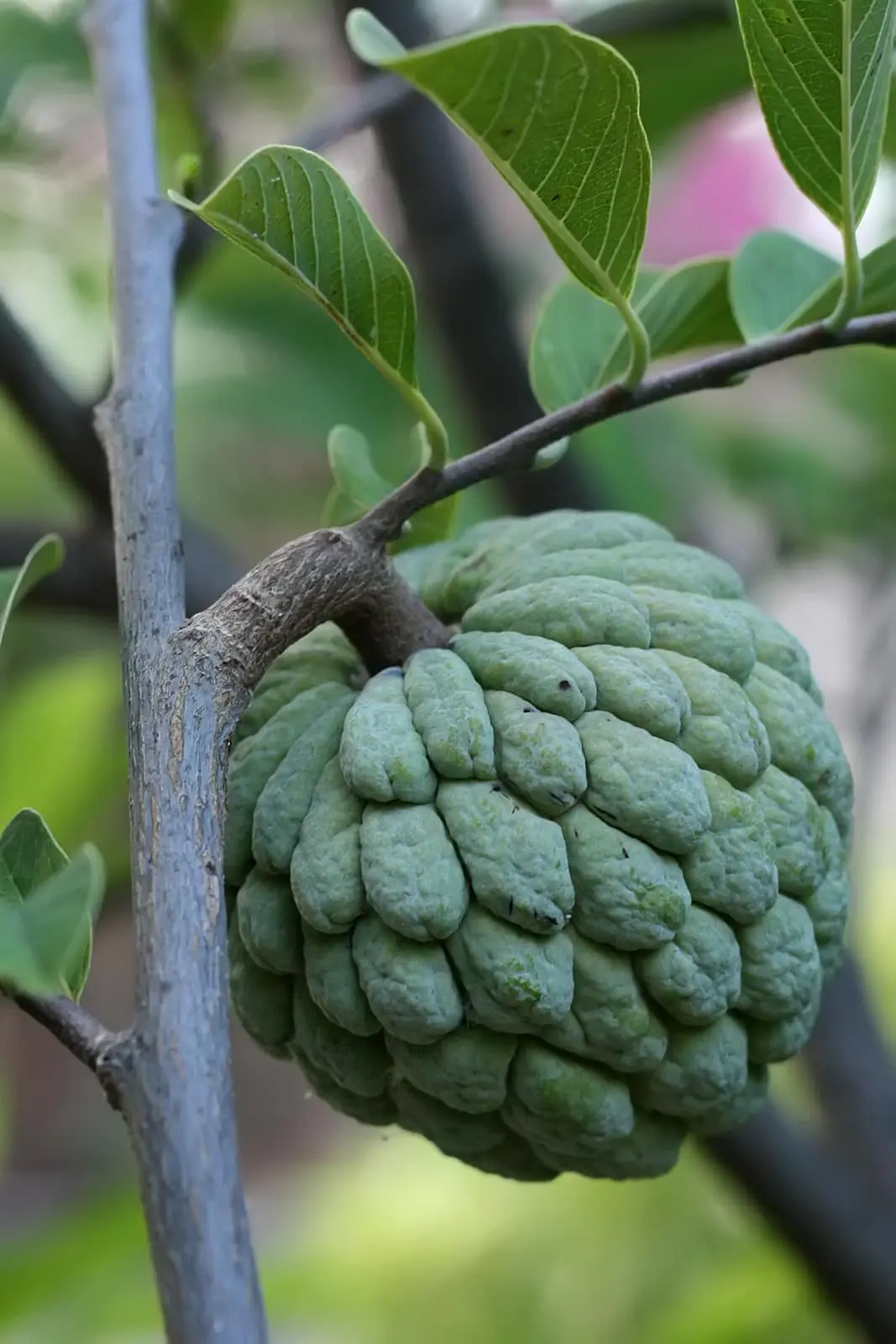
Harvest firm but mature, never soft — the fruit ripens and softens off the tree. The right stage is when the segments ("eyes") begin to separate and flatten, the grooves between them widen and pale, and the skin colour lightens from deep to dull green (or reddens, in red types). Pick in repeated rounds as individual fruit reach this stage, cutting with a short stalk, and ripen them over a few days at room temperature. A fruit left to soften on the tree is crushed in handling and does not travel.
Signs it is ready
- Segments (eyes) starting to separate and flatten, grooves widening and paling
- Skin colour lightening from deep green to a duller, creamy green (or reddening in red types)
- Fruit still firm to the touch — not yet soft
- Picked in rounds as each fruit reaches the firm-mature stage, not all at once
Tools
- Secateurs or a sharp knife to cut the fruit with a short stalk
- Padded baskets or crates, since the fruit bruises easily even when firm
- A shaded, ventilated space to ripen the picked firm fruit over a few days
Expected yield
Variable by variety and tree age — a mature tree commonly gives 80–150 kg of fruit a year, with large-fruited and well-pollinated trees at the higher end and Arka Sahan valued for large, low-seed fruit.
Post-harvest & storage
Storage
Very short-lived once ripe — soft, ripe fruit keeps only a day or two and must be sold or eaten quickly. Firm-but-mature fruit can be held a few days before it softens, and the short shelf life is the crop's main marketing constraint, which is why much of the crop is now pulped and frozen.
Packaging
Pack firm-mature fruit gently in single or shallow layers in padded, ventilated crates — the fruit bruises easily even before it softens, and bruised fruit rots fast.
Transportation
Move firm-mature fruit quickly and gently; ripe soft fruit does not travel at all well. Pulp is extracted and frozen near the growing areas for the ice-cream, milkshake and dessert trade, which greatly extends the crop's reach beyond its short fresh shelf life.
Shelf life
A day or two once ripe and soft; a few days for firm-mature fruit; months once pulped and frozen.
Market prices
Today's mandi price near you, pulled live from the government's own Agmarknet data.
Live daily mandi prices from the government Agmarknet dataset.
Synced from data.gov.in (Agmarknet). Rates are ₹ per quintal.
Weather
Current conditions and a 5-day outlook for your selected location, with one line of stage-aware advice.
Pick your state for current conditions and a 5-day outlook.
Live data from Open-Meteo
Profit calculator
Your own cost sheet, expected yield and selling price — not ours.
Where the money goes
Share of the total cost per acre, using the calculator’s own default cost sheet below — adjust the numbers there to match your field and this picture will no longer apply to you exactly, but the ranking rarely changes.
- Labour33% (₹9,000)
- Land rent26% (₹7,000)
- Pesticide & weedicide11% (₹3,000)
- Fertiliser9% (₹2,500)
- Seed7% (₹2,000)
- Irrigation6% (₹1,500)
- Interest4% (₹1,200)
- Machinery4% (₹1,000)
Official downloads
Government and ICAR documents only — everything below is hosted on an official server.
ICAR-IIHR, Bengaluru
Arka Sahan and custard apple (annona) variety and cultivation guidance
ICAR-CIAH, Bikaner
Custard apple for arid and semi-arid dryland regions
Mahatma Phule Krishi Vidyapeeth (MPKV), Rahuri
Phule Purandar and custard apple package of practices for Maharashtra
Kisan Call Centre — 1800-180-1551
Free crop advice in your language
Frequently asked questions
Should I grow custard apple from seed or buy a grafted plant?
For an orchard planted for income, buy a grafted plant of a named variety such as Balanagar or Arka Sahan. A seedling grown from seed is cheap and easy but bears later, grows large and unpredictable, and gives small, very seedy fruit. A grafted plant bears sooner (2–3 years), stays a manageable size, and gives known fruit size, sweetness and a lower seed count — Arka Sahan in particular is prized for large, low-seed fruit.
Why does my custard apple flower well but set little fruit?
This is the crop's defining quirk. Its flowers are protogynous — the female parts mature and become receptive before the same flower sheds its pollen — so a flower rarely pollinates itself, and natural set is often poor and patchy. Hand-pollination (collecting pollen from freshly-opened flowers and dabbing it into receptive flowers in the early morning or evening) can dramatically raise both the number and size of fruit, and is one of the biggest, cheapest yield gains in this crop.
When exactly do I pick custard apple?
Firm but mature, never soft — the fruit ripens off the tree. Pick when the segments (the "eyes") begin to separate and flatten, the grooves between them widen and pale, and the skin lightens from deep green to a duller, creamy green (or reddens in red types). Then ripen it over a few days at room temperature. Picked too green it never sweetens; left to soften on the tree it is crushed in handling and has almost no shelf life.
Is custard apple really suited to poor, dry land?
Yes — it is one of the hardiest fruit crops in India, cropping on poor, shallow, rocky, gravelly dryland and wasteland soils in hot, semi-arid tracts, largely rainfed. Its one firm requirement is good drainage: it tolerates drought and poor soil but not waterlogging, which rots the roots. For a farmer with marginal land and little water, it is one of the few genuinely profitable fruit options.
Why does custard apple spoil so fast, and what can I do about it?
Ripe, soft custard apple has a very short shelf life — only a day or two — which is its main marketing limitation. The practical answers are to harvest firm-but-mature and sell fast and fresh, and increasingly to pulp and freeze the fruit near the growing area for the ice-cream, milkshake and dessert trade, which extends the crop's reach far beyond its short fresh life.
Does custard apple have an MSP or a mandi price?
There is no MSP for custard apple. It is a seasonal fresh-market fruit sold through local and wholesale markets in and around its growing belts (and increasingly to pulp processors), with prices varying by size, variety and season — large, low-seed fruit like Arka Sahan fetches the most. Check your nearest market for the current rate; mandi records for it are more localised than for major fruits.
Still have questions?
The FAQs above cover the common ones. For anything specific to your field and soil, your nearest Krishi Vigyan Kendra is the authoritative answer.