
Black Pepper (Kali Mirch)
Piper nigrum
The "king of spices" — a perennial woody vine that has to climb a standard, grown on the Western Ghats mostly as an intercrop on coffee, arecanut or shade trees rather than as a sole crop. It bears from the third year for two decades or more, but foot rot can kill a mature vine in a monsoon fortnight, and the price rides the world spice market with no MSP.
Quick Summary
The key points from this page in about two minutes — read it or have it read aloud.
Quick Summary
Black pepper is the dried berry of Piper nigrum, a perennial climbing vine of the Western Ghats. India was historically the world's main producer and exporter; Vietnam now grows far more, but pepper remains one of India's most valuable spice crops. It is grown mostly in Kerala (Idukki, Wayanad, and the traditional homegarden belt), Karnataka (Kodagu and Chikkamagaluru, almost always mixed with coffee and arecanut) and parts of Tamil Nadu and Karnataka's coast, with small areas in the north-east.
The vine cannot stand on its own — it climbs a "standard". Traditionally that is a live tree such as Erythrina (murikku), silver oak or an existing coffee shade tree or arecanut palm; it can also be a dead wooden or concrete post. Because of this, pepper is rarely a monocrop: it is layered into a coffee or arecanut plantation or a homestead, which spreads risk and cost.
Planting is done with the first monsoon showers, setting two or three nursery-rooted cuttings at the base of each standard and tying the growing vine to it. The vine flowers from the third year, reaches full bearing by year seven or eight, and yields for twenty to thirty years. Flowering is triggered by the first monsoon rains after a dry spell, spikes set through the monsoon, and the berries are hand-picked over several rounds from November to February when one or two berries in a spike start to colour.
Two problems decide the crop. Foot rot (quick wilt), a Phytophthora disease, can rot the collar and kill a mature vine within weeks in the monsoon, and slow decline — a nematode-and-fungus complex — kills vines gradually over seasons. Pepper has no MSP; the price is set in the Kochi market and tracks the international pepper trade. The page below carries the standards, planting and training, shade regulation, foot rot and slow decline management, harvesting and curing, and the yields to expect.
- Crop type
- Perennial woody climbing vine, trained on a standard
- Planting material
- Rooted cuttings from runner shoots of a selected mother vine
- Suitable states
- Kerala, Karnataka, Tamil Nadu; small areas in the north-east
- First bearing
- 3rd year; full bearing by year 7–8
- Productive life
- 20–30 years
- Water requirement
- High — 2,000–3,000 mm rain, plus a dry spell before flowering
- Temperature
- 10–40°C tolerated; 23–32°C optimum, humid
- Soil type
- Well-drained forest loam / laterite, humus-rich, acidic pH 4.5–6.0
- Difficulty level
- Moderate
- Expected yield
- 300–500 kg/ha traditional; 2–4 t/ha well-managed
- No MSP
- Kochi market / international spice price; no CACP MSP
Overview
Black pepper comes from Piper nigrum, a perennial woody climbing vine native to the Western Ghats of India. India was for centuries the world's dominant producer and the spice that drew European trade to the Malabar coast; today Vietnam produces several times as much, but pepper is still among India's most valuable spice crops by export value. Kerala grows the largest area — Idukki and Wayanad districts and the traditional homegarden belt — followed by Karnataka, where pepper is almost always trained onto the shade trees and arecanut of a coffee or areca plantation in Kodagu and Chikkamagaluru, and by parts of Tamil Nadu and coastal Karnataka, with newer, smaller areas in the north-east.
The defining feature of the crop is that the vine must climb a support, called a standard. This is traditionally a live tree — Erythrina (murikku), Garuga, silver oak, or an existing coffee shade tree, arecanut palm, mango or jackfruit — chosen because its rough bark grips the vine's clinging roots and its canopy gives the partial shade pepper prefers; a dead wooden post or a concrete/granite pillar is also used. Because every vine needs a standard, pepper is seldom grown as a sole crop: it is layered into an existing plantation or homestead, sharing the land, the labour and the risk with coffee, arecanut or trees.
Pepper is planted with the first monsoon rains from rooted cuttings, trained up the standard for two years, and bears a first light crop in the third year, reaching full bearing by year seven or eight and yielding for twenty to thirty years. Flowering each year is triggered by the first monsoon showers after a distinct pre-monsoon dry spell, spikes set through the monsoon, and the crop is hand-picked in several rounds from November to February. Two diseases govern the outcome: foot rot (quick wilt), a Phytophthora disease that can kill a mature vine within weeks in the monsoon, and slow decline, a nematode-and-fungus complex that kills vines gradually. Pepper has no Minimum Support Price — the price is set in the Kochi terminal market and tracks the international pepper trade, dominated by Vietnam.
Crop timeline, sowing to harvest
A quick visual map of the season — jump to any section below for the detail behind each stage.
- Year 0 (nursery)
Rooting cuttings
Two-to-three-node cuttings taken from runner shoots of a healthy, high-yielding mother vine are rooted in polybags in a shaded nursery for two to three months until well-rooted and hardened.
- Year 1 (May–Jun)
Planting at the standard
With the first monsoon showers, 2–3 rooted cuttings are planted in a pit on the northern side of each established standard (a live tree or a post) and the shoots are tied to the standard.
- Year 1–2
Training up the standard
As the vine grows, each new flush is tied to the standard every few weeks so the clinging roots grip; trailing shoots are lifted and tied back. Shade is kept moderate and the base is mulched.
- Year 3
First flowering
The vine produces its first spikes and a light first crop; flowering is triggered by the first monsoon rains following the pre-monsoon dry spell.
- Year 4–6
Building the frame
The vine climbs higher up the standard and puts out fruiting laterals; yield rises each year as the bearing wood builds.
- Year 7–8 onward
Full bearing
The vine reaches full, stable bearing and — with shade regulation, manuring and disease management — keeps yielding for 20–30 years.
- Jun–Sep (annual)
Flowering & spike set
Spikes emerge and set berries through the south-west monsoon; this is also the peak window for foot rot and pollu beetle.
- Nov–Feb (annual)
Harvesting
Spikes are hand-picked in several rounds as they mature — cut for black pepper when one or two berries per spike turn yellow or red, and left to fully ripen red for white pepper — then this annual cycle repeats.
Suitable states
States where this crop is grown at scale, highlighted below. Your local Krishi Vigyan Kendra is still the final word for your specific block.
- Jammu and Kashmir
- Himachal Pradesh
- Punjab
- Uttarakhand
- Haryana
- Delhi
- Uttar Pradesh
- Rajasthan
- Bihar
- Jharkhand
- West Bengal
- Sikkim
- Assam
- Arunachal Pradesh
- Meghalaya
- Nagaland
- Manipur
- Mizoram
- Tripura
- Gujarat
- Madhya Pradesh
- Chhattisgarh
- Maharashtra
- Odisha
- Goa
- Telangana
- Andhra Pradesh
- Karnataka
- Kerala
- Tamil Nadu
- Puducherry
- Ladakh
- Chandigarh
- Lakshadweep
- Andaman and Nicobar Islands
- Dadra and Nagar Haveli and Daman and Diu
Grown here
Climate requirements
The single most important climate factor is the pre-monsoon dry spell followed by the first monsoon showers — that sequence sets the year's flowering. Shade regulation is the second: the standard's canopy has to be lopped back before the monsoon so the vine gets filtered light, not dense shade, and so the canopy is not a humid trap for disease.
Ideal temperature
23–32°C with high humidity is optimum; the vine tolerates a range of roughly 10–40°C but suffers in frost, in scorching dry heat and in cold above about 1,500 m. It is grown from near sea level up to about 1,500 m on the Western Ghats
Rainfall
2,000–3,000 mm a year suits pepper, but distribution is critical: a distinct dry spell of a few weeks before the monsoon, broken by the first heavy showers, is what triggers uniform flowering. Continuous heavy rain with no dry break gives poor, staggered flowering, and waterlogging invites foot rot
Humidity
Consistently high humidity through the monsoon favours vine growth and spike set, but the same wet, humid conditions drive foot rot, pollu disease and the pollu beetle — the monsoon is both the growing season and the disease season
Sunlight
Pepper is a partial-shade plant — about 25–50% shade suits it, which is why it grows well under a regulated coffee or arecanut canopy. Deep, unregulated shade cuts flowering and yield; full exposure stresses the vine and scorches spikes, though a few varieties (Panniyur-1) are bred for open conditions
Soil requirements
Drainage decides where a pepper vine lives. On the sloping, high-rainfall land it is grown on, the vine goes on the higher ground or on a mound, never in a hollow, and the base is kept mulched but never waterlogged — because the difference between a healthy vine and a dead one in the monsoon is often just whether water sat around the collar.
Suitable soil
Virgin or well-managed forest loams, lateritic and red loamy soils rich in humus, on gentle to moderate slopes that drain freely, are the classic pepper soils of the Western Ghats. The vine also grows in homestead soils and on the shaded floor of a coffee or arecanut plantation
pH range
4.5–6.0 — pepper, like coffee and rubber, positively suits the acidic, leached soils of the Western Ghats
Drainage
Free drainage is essential and non-negotiable: pepper roots are shallow and Phytophthora foot rot takes hold wherever water stands around the collar. Vines are planted on the upper side of a slope, on mounds, or with drainage channels between rows
Organic matter
High — pepper is a heavy feeder on organic matter, and a thick mulch of leaf litter or green leaf over the root zone before the monsoon is standard practice, both to feed the vine and to keep the shallow roots cool and moist
Land preparation
Same four steps whichever region you are in — only the timing shifts with the sowing window.
- 1
Establish the standards first
Plant live standards (Erythrina/murikku, silver oak, Garuga) a year or two ahead, or identify existing trees, arecanut palms or coffee shade trees to train the vine onto. A dead wooden or concrete post is an alternative where a live standard is not available.
- 2
Take pits on the northern side of each standard
Dig a pit about 50 × 50 × 50 cm about 30 cm away from the base of the standard, on its northern side so the young vine is shaded from the harshest afternoon sun, and refill with topsoil mixed with compost or farmyard manure and, in a foot-rot-prone area, a Trichoderma-enriched mix.
- 3
Provide drainage on the slope
Open drainage channels along the contour between rows, and plant each vine on the upper side of its standard or on a slight mound, so monsoon water never collects around the collar.
- 4
Arrange planting material from a clean mother garden
Raise or buy rooted cuttings taken only from vigorous, high-yielding, disease-free mother vines — pepper viruses and nematodes are carried in planting material, so a clean nursery source is the first line of defence.
Seed information
How the main varieties compare, so you can pick by duration, yield, disease pressure or what you are growing for.
| Variety | Duration | Yield | Disease resistance | Best state | Suitable for |
|---|---|---|---|---|---|
The first improved pepper variety in India — a hybrid (Uthirankotta × Cheriyakaniakadan) released in 1971 by the KAU Pepper Research Station, Panniyur. High yielding and bold-berried but performs best in the open or under light shade and is susceptible to heavy shade and to drought; the benchmark variety for open, well-managed cultivation. | Bears for 20–30 years | High in the open (~1,200+ kg/ha dry) | Moderate; sensitive to heavy shade and drought | Kerala | Open or lightly shaded, well-managed sole or arecanut-intercrop cultivation |
An open-pollinated selection from Perumkodi released by KAU Panniyur, notably shade-tolerant — bred for growing as an intercrop under the canopy of coffee, arecanut or other trees, where Panniyur-1 struggles. | Bears for 20–30 years | High under shade | Moderate; good shade tolerance | Kerala, Karnataka | Intercrop under coffee / arecanut shade |
An open-pollinated selection from Balancotta by KAU Panniyur, shade-tolerant and suited to intensive management as a mixed crop; stable yield across sites. | Bears for 20–30 years | Medium–high, stable | Moderate; shade-tolerant | Kerala | Mixed cropping and homegardens |
A later KAU Panniyur release with good yield and quality and moderate tolerance to shade; grown alongside the other Panniyur selections in Kerala. | Bears for 20–30 years | High | Moderate | Kerala | Kerala plains and midlands |
The most widely cultivated traditional cultivar in Kerala — moderately shade-tolerant, wide-adapted, with small-to-medium berries and dependable yield; the default homegarden and plantation pepper across much of the state. | Bears for 20–30 years | Medium, dependable | Moderate; no special resistance | Kerala | Homegardens and mixed plantations, wide adaptation |
A clonal selection from Karimunda released by ICAR-IISR, Kozhikode, with higher yield and good dry-recovery and quality; one of the standard IISR recommendations for new planting. | Bears for 20–30 years | High | Moderate | Kerala, Karnataka | New planting in the traditional belt |
Another Karimunda clonal selection from ICAR-IISR, similar in habit to Sreekara, high-yielding with good berry size; the two are usually recommended together. | Bears for 20–30 years | High | Moderate | Kerala, Karnataka | New planting in the traditional belt |
An ICAR-IISR selection from the Aimpiriyan cultivar, high-yielding and late-maturing with good spike length; suited to the plains and midlands. | Bears for 20–30 years | High | Moderate | Kerala | Plains and midland plantations |
An ICAR-IISR selection noted for tolerance to the root-knot nematode, which is part of the slow-decline complex — a useful choice where slow decline has been a problem. | Bears for 20–30 years | High | Root-knot nematode tolerant; moderate to other problems | Kerala, Karnataka | Slow-decline-prone gardens |
An ICAR-IISR selection from the Thevanmundi cultivar, adapted to the high ranges of Idukki and Wayanad, with good yield and quality at higher elevation. | Bears for 20–30 years | High at high elevation | Moderate | Kerala (high ranges) | High-elevation plantations of Idukki and Wayanad |
- Seed rate
- Not a seed crop. About 2–3 rooted cuttings per standard, with standards spaced roughly 3 × 3 m (about 1,100 standards, and vines, per hectare) when pepper is the main crop; where it is an intercrop, the vine count follows the existing tree or arecanut spacing. Raise 10–20% extra rooted cuttings for gap-filling.
- Certified seed
- Take rooted cuttings only from vigorous, high-yielding, disease-free mother vines, or buy them from an ICAR-IISR / KAU / state horticulture department nursery or an accredited nursery. Pepper stunt/mosaic viruses (Piper yellow mottle virus, cucumber mosaic virus) and nematodes are carried in planting material, so a clean source is the single most important disease-prevention step. Match the variety to the shade level — Panniyur-1 for the open, Panniyur-5 or the IISR selections for intercropping under coffee or arecanut.
- Spacing
- Standards at about 3 × 3 m (roughly 1,100/ha) for a dedicated pepper garden; wider where large live standards are used. As an intercrop, one vine per existing shade tree or per two-to-three arecanut palms.
- Seed treatment
- Not applicable to seed. Instead, dip or drench rooted cuttings and their potting mix with a Trichoderma or recommended fungicide against Phytophthora before field planting, especially in a foot-rot-prone area, and plant only well-rooted, hardened, disease-free cuttings.
Sowing guide
The first two years are all about getting the vine onto the standard. Every new flush must be tied in every few weeks so the clinging roots grip the bark; a vine left to trail on the ground roots down, stays bushy and never climbs to a bearing frame. Planting on the northern, shaded side of the standard protects the young vine from afternoon sun.
- Best time
- Plant with the first steady showers of the south-west monsoon, roughly May–June, so the young vine has the whole wet season to establish and climb before the next dry period. In areas with irrigation, planting can also be done at the start of the north-east monsoon.
- Row spacing
- Standards about 3 m apart between rows for a dedicated garden
- Plant spacing
- Standards about 3 m apart within the row (roughly 1,100 standards/ha); intercrop vines follow the host tree spacing
- Sowing depth
- Set the rooted cutting so the roots are covered and one or two nodes are below the soil to throw new roots, with the growing shoot free and immediately tied to the standard.
- Method
- Plant 2–3 rooted cuttings per pit on the northern side of each standard, firm and mulch the base, shade the young vine for the first few weeks, and tie every new flush to the standard as it grows.
Fertilizer schedule
A split dose beats one large dose applied at sowing — nitrogen especially is lost to the air and to leaching if it all goes in on day one.
- 1
Organic manure (annual)
May, with the first rains
Apply 5–10 kg of farmyard manure or compost per vine each year at the onset of the monsoon, along with a thick mulch of green leaf or leaf litter over the root zone — pepper is a heavy feeder on organic matter and the mulch also keeps the shallow roots cool and moist.
- 2
First fertiliser split
May–Jun
The first split of an NPK dose (built up gradually from planting to a full adult dose of roughly 50:50:150 g N:P2O5:K2O per vine per year in the traditional belt) applied in a shallow band around the vine after the first rains.
- 3
Second fertiliser split
Aug–Sep
The remaining fertiliser split applied toward the end of the monsoon while there is still soil moisture to carry it, supporting spike development and berry fill.
- 4
Lime and micronutrients
April, alternate years
Where the soil is very acidic, a small dose of lime or dolomite in April every second year; magnesium and zinc corrected on leaf or soil test, as they are commonly short on these leached soils.
Irrigation schedule
1. Establishment
First 1–2 dry seasons after planting
Young vines are watered or heavily mulched through their first one or two dry seasons; a newly planted vine that dries out at the base in its first summer usually dies.
2. Summer irrigation (bearing vines)
Dec–May, where water is available
In the traditional belt bearing vines are mostly rainfed, but where irrigation is available, life-saving watering through the dry months — increasingly by drip — markedly improves berry fill and reduces vine stress and dieback.
Critical stages
- Establishment through the first dry seasons
- Spike development and berry filling (Aug–Nov)
- The dry months for bearing vines where irrigation is possible
Water-saving tips
- A thick green-leaf or leaf-litter mulch over the root zone before the monsoon is the main dry-season protection — it keeps the shallow roots cool and moist for months with no irrigation.
- The partial shade of a regulated standard canopy cuts evaporation and moderates temperature at the vine base.
- Drip irrigation to the vine base, where available, uses far less water than basin flooding and keeps water off the collar, which also reduces foot-rot risk.
Weed management
Common weeds
Organic control
- Slash-weeding the vine basin and inter-row two or three times through the rains, and mulching the basin heavily, suppresses most weeds without disturbing the shallow pepper roots.
- A cover of a low legume between rows in a dedicated garden holds the soil on the slope and smothers weeds.
- Hand-pull Mikania and other climbers off the standard and the vine before they take hold, since a herbicide cannot be used once they are entwined with the crop.
Chemical control
- Spot or directed herbicide in the inter-row of a dedicated pepper garden where hand weeding is costly, kept well away from the shallow-rooted vine base; Mikania in particular often needs a directed spray as it climbs the standard and the vine.
Nutrient deficiency identification
What a shortage of each nutrient actually looks like on the plant, so you can tell a deficiency apart from a disease before you spray the wrong thing.
Nitrogen
Visible symptom
Uniform pale-green to yellow older leaves and thin new growth; shows first on a vine carrying a heavy spike load with too little organic manure.
Potassium
Visible symptom
Yellowing and scorch along the margins of older leaves and poorly filled, light berries; potassium demand is high in pepper because the berry crop removes a lot of it, which is why the adult dose is potassium-heavy.
Magnesium
Visible symptom
Interveinal yellowing of older leaves with the veins staying green, very common on the acidic, leached laterite soils and corrected with dolomite or a magnesium spray.
Zinc
Visible symptom
Small, narrow, bunched new leaves with shortened internodes ("little leaf") at the shoot tips, a frequent deficiency on Western Ghat pepper soils, corrected with a foliar zinc spray.
Boron
Visible symptom
Short, poorly filled spikes with many aborted berries and corky, distorted young growth; picked up on leaf analysis and corrected with a careful foliar dose.
Diseases to watch for
Symptoms, likely cause and what actually treats it — not just a spray name.
Foot rot / quick wilt
- Symptoms
- Sudden wilting and yellowing of a whole vine, with a black, water-soaked rot girdling the collar and main stem at or below ground; the vine can collapse within one to three weeks. On leaves and spikes higher up, dark lesions with a fimbriate (frayed) margin and heavy spike shedding.
- Cause
- The soil-borne fungus-like organism Phytophthora capsici (and P. tropicalis), splashed up from the soil and spread by run-off in the monsoon — the single most destructive disease of pepper, capable of killing scattered vines or clearing whole gardens in a wet year.
- Treatment
- There is no cure for a vine once the collar is girdled — remove and destroy it. On the rest of the garden, drench the vine base and spray the foliage with a recommended systemic (metalaxyl-based) or copper fungicide at the first monsoon showers and again mid-monsoon.
- Prevention
- Free drainage and planting on the high side or a mound, a Trichoderma-enriched pit and periodic soil application of Trichoderma, prophylactic fungicide at the onset of the monsoon rather than after wilting, removal of dead vines with their roots, and clean planting material.
Slow decline (slow wilt)
- Symptoms
- A gradual decline over one or more seasons — progressive yellowing, leaf and spike shedding from the lower vine upward, dieback of hanging shoots, and a reduced, knotted or lesioned root system when dug; the vine does not collapse suddenly like foot rot but wastes away.
- Cause
- A complex of the root-knot nematode (Meloidogyne incognita) and the burrowing nematode (Radopholus similis) damaging the roots, with Fusarium and other fungi entering the wounds; also linked to root mealybug.
- Treatment
- Difficult to reverse an advanced case. On mildly affected vines, apply a recommended nematicide or bio-agent (Pochonia/Purpureocillium, Trichoderma) with organic manure to the root zone, improve nutrition and mulch, and remove severely declined vines.
- Prevention
- Plant nematode-free rooted cuttings, choose a tolerant variety (Pournami) in affected gardens, apply neem cake and bio-agents to the pit and annually, and avoid moving soil or planting material from a slow-decline garden to a clean one.
Pollu disease (anthracnose)
- Symptoms
- Dark, sunken, angular spots on leaves; on berries, brown-black shrivelled patches so the berry becomes hollow and light — "pollu" means a hollow, chaffy berry — cutting both yield and the graded value of the lot.
- Cause
- The fungus Colletotrichum gloeosporioides, worst in humid, shaded, poorly ventilated gardens and in low-elevation tracts; often follows or accompanies pollu-beetle damage.
- Treatment
- Spray a recommended fungicide (Bordeaux mixture or a systemic) at flowering and again during berry development on affected vines, timed to wet spells.
- Prevention
- Regulate the standard shade so the canopy is open and airy rather than dense and humid, prune out and destroy affected spikes and shoots, and manage the pollu beetle, which opens the way for the fungus.
Basal wilt / collar rot (Sclerotium)
- Symptoms
- Yellowing and wilting of a vine with a white fan of fungal growth and small mustard-seed-like sclerotia at the collar and on the surrounding soil and mulch, usually in the post-monsoon humid period.
- Cause
- The soil-borne fungus Sclerotium rolfsii, favoured by a warm, humid, mulch-covered soil surface and by dense planting.
- Treatment
- Remove the mulch and infected soil from around the collar, drench with a recommended fungicide, and destroy severely affected vines.
- Prevention
- Avoid piling fresh, undecomposed mulch against the stem, keep the collar zone open and dry, and use Trichoderma-enriched organic manure.
Stunt / mosaic (viral disease)
- Symptoms
- Shortened internodes and small, narrow, puckered, mottled or yellow-flecked leaves; the vine becomes bushy and stunted and yield falls away over years, though it rarely dies outright.
- Cause
- Piper yellow mottle virus and cucumber mosaic virus, spread through infected planting material and, to some extent, by mealybugs and aphids.
- Treatment
- No cure — infected vines are a permanent source of spread and are best removed from a young or high-value garden.
- Prevention
- Use only virus-free planting material from an indexed mother garden, rogue out symptomatic vines early, and control the mealybug and aphid vectors.
Pests to watch for
What to look for before the damage is visible, and organic options before you reach for a chemical.
Pollu beetle
- Identification
- A small blue-black flea beetle (Longitarsus nigripennis); the adults bite small holes in tender leaves and spikes, and the grubs bore into the developing berries, which turn black and hollow ("pollu"). Worst in heavily shaded, low-elevation gardens.
- Damage
- The most serious insect pest of pepper — bored berries are hollow and worthless, and heavy spike and shoot boring checks the vine; losses are highest where shade is dense and unregulated.
- Organic control
- Regulate the standard shade to open, airy conditions the beetle dislikes, prune and destroy bored spikes and shoots, and spray neem formulations at spike emergence and berry set.
- Chemical control
- A recommended insecticide sprayed at spike emergence and again 3–4 weeks later during berry development, directed at the spikes and tender shoots, in gardens with a history of pollu.
Top shoot borer
- Identification
- A small caterpillar (larva of Cydia / Laspeyresia moth) that bores into the tender growing tip of a shoot, which blackens, wilts and dies back; frass is visible at the entry hole. Most active in the monsoon.
- Damage
- Repeated killing of growing tips checks the extension of a young vine and the production of fruiting laterals, slowing the vine's climb up the standard and reducing bearing wood.
- Organic control
- Clip and destroy bored, blackened shoot tips on sight, especially on young vines, and spray neem at the main monsoon flush.
- Chemical control
- A recommended insecticide spray directed at the growing tips during the monsoon flush where young vines are being set back.
Scale insects and mealybugs
- Identification
- Brown or white waxy encrustations along stems, leaf undersides and spikes (foliar scale and mealybug), and white, waxy colonies on the roots and collar below ground (root mealybug), often with attendant ants and sooty mould.
- Damage
- Sap removal weakens the vine and disfigures spikes; root mealybug is associated with the slow-decline complex and is hard to detect until the vine is already declining.
- Organic control
- Conserve natural enemies, control the attendant ants, drench the root zone with a neem or bio-agent formulation for root mealybug, and prune out heavily infested aerial parts.
- Chemical control
- A recommended systemic insecticide as a foliar spray or root-zone drench where infestation is heavy, particularly for root mealybug in a declining garden.
Common mistakes to avoid
The mistakes that cost growers the most, ranked by how often they show up in the field — not in the order you might expect.
- 1
Planting in a spot that does not drain
Why it hurts
Foot rot needs standing water at the collar to take hold. A vine planted in a hollow, on flat compacted ground or without a drainage channel is the one that dies first in the monsoon — plant on the high side of the slope or on a mound, every time.
- 2
Letting the standard canopy grow dense and unregulated
Why it hurts
Deep shade cuts flowering and yield and turns the canopy into a humid trap for pollu disease and the pollu beetle. The standard has to be lopped back before every monsoon so the vine gets filtered light and air movement.
- 3
Using planting material from an unknown or declining vine
Why it hurts
Pepper viruses, nematodes and root mealybug all travel in cuttings. A few rupees saved on cheap planting material can seed slow decline or stunt disease into a garden that then never fully recovers.
- 4
Not tying in the vine as it grows
Why it hurts
A pepper vine left to trail roots down and stays a low bush that never climbs to a bearing frame. Every new flush has to be tied to the standard every few weeks through the first two years.
- 5
Spraying for foot rot only after vines start wilting
Why it hurts
Once the collar is girdled the vine is lost. The prophylactic fungicide drench and spray have to go on at the first monsoon showers, before symptoms, and be repeated mid-monsoon — reacting to wilt is reacting too late.
- 6
Skimping on organic manure and mulch
Why it hurts
Pepper is a heavy feeder and a shallow-rooted one. Without 5–10 kg of compost per vine and a thick pre-monsoon mulch, the vine cannot carry a full spike load and is far more prone to dry-season dieback.
- 7
Choosing Panniyur-1 for a shaded intercrop situation
Why it hurts
Panniyur-1 is bred for open cultivation and does poorly under the heavy shade of a coffee or arecanut canopy. For an intercrop, a shade-tolerant variety such as Panniyur-5 or an IISR selection is the right choice.
- 8
Ignoring slow decline until vines are dying back
Why it hurts
Slow decline creeps — a season of mild yellowing and light crop is easy to blame on weather. By the time dieback is obvious the root system is badly damaged; neem cake, bio-agents and a tolerant variety work far better applied early.
- 9
Harvesting the whole spike too early or too late
Why it hurts
Picked green and immature, the berries shrivel to a poor, low-weight black pepper; left too long, ripe berries drop and are lost to birds. Pick each spike when one or two berries in it start to turn yellow or red, in several rounds.
- 10
Assuming a stable price
Why it hurts
Pepper has no MSP and its price swings widely with the international market, dominated by Vietnam. A boom year draws in new planting that depresses the price years later — plantation decisions have to allow for that cycle, not assume the current price will hold.
Harvesting
Spikes are hand-picked in several rounds from November to February (a little later at high elevation), as they mature. For black pepper, a spike is cut when one or two berries in it turn from dark green to yellow or red — picking the whole garden at that stage over three or four rounds. For white pepper, spikes are left until the berries are fully ripe and red. A spike never ripens all at once, so single-pass harvesting always loses grade or yield.
Signs it is ready
- One or two berries per spike turning yellow or red (for black pepper)
- Berries full-sized and hard, not still soft and flat
- The spike stalk yellowing slightly at the base
- For white pepper, the whole spike coloured red and soft-ripe
Tools
- Hand-picking from a ladder or a light bamboo tripod against the standard
- Collection baskets or sacks; berries stripped from the spike by hand or with a simple thresher
- A drying yard or mat, and for large lots a mechanical or solar drier; for white pepper, a soaking tank and running water
Expected yield
A mature vine in full bearing yields roughly 1–4 kg of dry pepper depending on variety, standard and management; a traditional, lightly managed garden averages only 300–500 kg/ha of dry pepper, while a well-managed garden of an improved variety with good nutrition and disease control can reach 2–4 t/ha. The fresh-to-dry ratio is about 3:1 (roughly a third of the green weight as dry pepper).
Post-harvest & storage
Storage
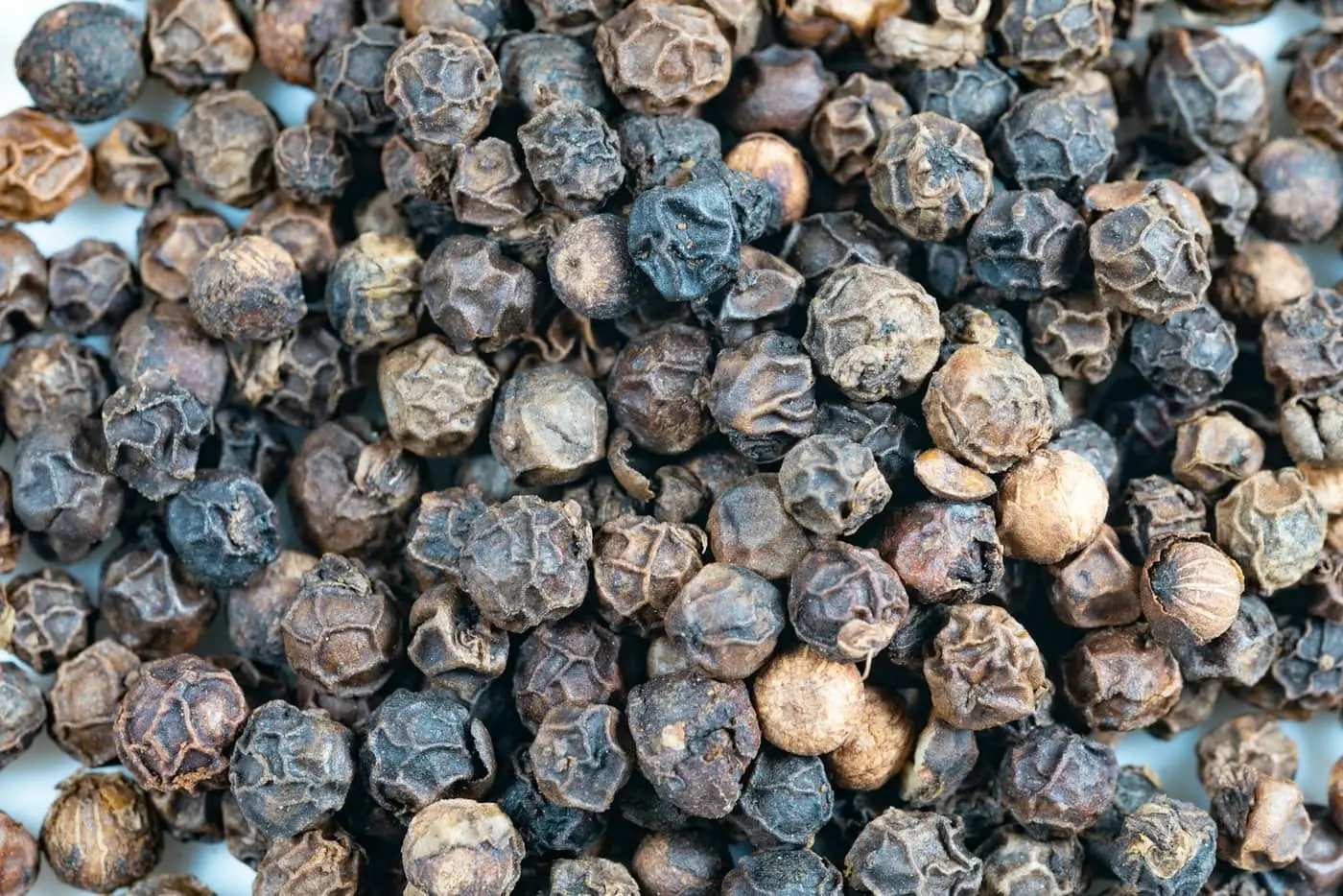
Dry the threshed green berries to about 10–11% moisture — traditionally on a mat or yard in the sun for 4–5 days, better on a raised platform or a solar/mechanical drier to keep the lot clean and to avoid the mould and the dull colour that come from ground drying. Store fully dried black pepper in clean, dry gunny or woven bags off the floor, away from damp and strong odours.
Packaging
Graded by bulk density and by removing pollu (light, hollow) berries and stalk; bagged in new jute or food-grade woven bags. Garbled (cleaned and size-graded) pepper fetches a premium over ungarbled.
Transportation
Dried pepper is stable and transports without special conditions, but it readily picks up moisture and taints, so it is kept dry and away from strong-smelling cargo. Most growers sell to a village trader, a co-operative or directly at the Kochi market; the Spices Board handles export certification.
Shelf life
Properly dried black pepper (10–11% moisture) keeps its weight for a year or more in dry storage, though the volatile aroma and pungency slowly fade, so it trades best within a season. Damp pepper moulds and loses grade quickly, and under-dried lots are the main cause of storage rejection.
Market prices
Today's mandi price near you, pulled live from the government's own Agmarknet data.
Live daily mandi prices from the government Agmarknet dataset.
Synced from data.gov.in (Agmarknet). Rates are ₹ per quintal.
Weather
Current conditions and a 5-day outlook for your selected location, with one line of stage-aware advice.
Pick your state for current conditions and a 5-day outlook.
Live data from Open-Meteo
Profit calculator
Your own cost sheet, expected yield and selling price — not ours.
Where the money goes
Share of the total cost per acre, using the calculator’s own default cost sheet below — adjust the numbers there to match your field and this picture will no longer apply to you exactly, but the ranking rarely changes.
- Labour35% (₹14,000)
- Land rent20% (₹8,000)
- Fertiliser12% (₹5,000)
- Seed10% (₹4,000)
- Pesticide & weedicide10% (₹4,000)
- Irrigation6% (₹2,500)
- Machinery4% (₹1,500)
- Interest4% (₹1,500)
Official downloads
Government and ICAR documents only — everything below is hosted on an official server.
ICAR-Indian Institute of Spices Research (IISR), Kozhikode
The national spices institute — released pepper varieties, package of practices, and advisories on foot rot, slow decline and pollu.
Spices Board India (Ministry of Commerce & Industry)
Statutory body for spices — grower support, quality standards, export certification and price information for pepper.
Kerala Agricultural University — Pepper Research Station, Panniyur
Home of the Panniyur pepper varieties; regional recommendations and planting material.
Soil Health Card portal
Get a free soil-test-based nutrient recommendation for your plot before finalising the manuring schedule above.
Frequently asked questions
Does black pepper have an MSP?
No. Black pepper is not a CACP-notified crop and has no Minimum Support Price. The price is discovered in the Kochi terminal market and tracks the international pepper trade, which is now dominated by Vietnam, with Indonesia, Brazil and Sri Lanka also large exporters. The Spices Board (under the Ministry of Commerce and Industry) supports growers with quality, replanting and export assistance and publishes price data, but it does not set a floor price. India also imports pepper for value addition and re-export, which links the domestic price closely to world prices.
Why does a pepper vine need a "standard"?
Piper nigrum is a climbing vine with short clinging roots along the stem — it cannot stand upright on its own and must climb a support, called a standard. Traditionally this is a live tree such as Erythrina (murikku), silver oak, Garuga, or an existing coffee shade tree, arecanut palm, mango or jackfruit, chosen for rough bark the roots can grip and a canopy that gives partial shade. Dead wooden posts and concrete or granite pillars are also used. Because every vine needs a standard, pepper is usually grown as an intercrop in a coffee or arecanut plantation or a homestead rather than as a sole crop.
What is foot rot and why is it so feared?
Foot rot, also called quick wilt, is caused by Phytophthora capsici, a soil-borne organism that is splashed onto the vine and spread by run-off during the monsoon. It rots the collar and roots and can wilt and kill a fully grown, bearing vine within one to three weeks, and in a wet year it can clear scattered vines or whole gardens. There is no cure once the collar is girdled. Management is preventive: free drainage and mound planting, Trichoderma in the pit and soil, a prophylactic fungicide drench and spray at the first monsoon rains rather than after wilting, and prompt removal of dead vines with their roots.
What is the difference between foot rot and slow decline?
Foot rot (quick wilt) is sudden — a Phytophthora infection that girdles the collar and kills the vine in a couple of weeks in the monsoon. Slow decline (slow wilt) is gradual — a complex of root-knot and burrowing nematodes damaging the roots, with Fusarium entering the wounds, causing progressive yellowing, leaf and spike fall and dieback over one or more seasons until the vine wastes away. Foot rot is managed with drainage and fungicides; slow decline with clean nematode-free planting material, a tolerant variety such as Pournami, and neem cake and bio-agents to the root zone.
How soon does a pepper vine start bearing?
A pepper vine gives its first light crop in the third year after planting, builds up over the next few years, and reaches full, stable bearing by about the seventh or eighth year. From then, with shade regulation, manuring and disease management, it keeps yielding for 20 to 30 years, and sometimes longer.
Can black pepper be grown together with coffee?
Yes — training pepper up the shade trees of a coffee plantation is one of the classic multi-storey cropping systems of Karnataka and Kerala. The shade tree serves as a living standard for the pepper vine, and the land produces coffee, pepper and shade-tree timber or fuel from the same area. For this shaded situation a shade-tolerant pepper variety such as Panniyur-5 or an IISR selection is used, not Panniyur-1, which is bred for open cultivation.
Which pepper variety should I plant?
It depends mainly on shade. For open or lightly shaded, well-managed cultivation, Panniyur-1 has the highest yield potential. For growing as an intercrop under the canopy of coffee or arecanut, choose a shade-tolerant variety — Panniyur-5, Panniyur-2, or an ICAR-IISR clonal selection such as Sreekara or Subhakara. Where slow decline has been a problem, Pournami is tolerant to the root-knot nematode. Karimunda remains the dependable, wide-adapted traditional choice for homegardens. Always take planting material from a clean, disease-free source.
How is black pepper cured after harvest?
The picked spikes are stripped of berries by hand or with a simple thresher, and the green berries are dried in the sun for about four to five days — better on a raised platform, mat or solar drier than on the bare ground — until they shrivel, darken and reach about 10–11% moisture. A brief dip in hot water before drying gives a more uniform black colour and speeds drying. The dried pepper is then winnowed to remove light "pollu" berries and stalk, and graded. White pepper is made differently — from fully ripe red berries soaked in water for about a week until the skin can be rubbed off, then dried.
How much pepper does a vine yield?
A mature vine in full bearing yields roughly 1 to 4 kg of dry pepper a year, depending on the variety, the standard it climbs and how well it is managed. On a garden basis, traditional lightly managed pepper averages only about 300–500 kg of dry pepper per hectare, while a well-managed garden of an improved variety with good nutrition, drainage and disease control can reach 2 to 4 tonnes per hectare. About a third of the fresh green weight is recovered as dry pepper.
Why is the pre-monsoon dry spell important for pepper?
Pepper flowers in response to the first heavy monsoon showers, but only if they follow a distinct dry spell of a few weeks. That dry-then-wet sequence triggers a uniform flush of flowering spikes across the vine. If the pre-monsoon period stays wet with no clear dry break, flowering is poor and staggered, spikes emerge unevenly over a long period, and the harvest is drawn out and reduced. This is why pepper does best in a monsoon climate with a marked dry season, not in a constantly wet one.
Still have questions?
The FAQs above cover the common ones. For anything specific to your field and soil, your nearest Krishi Vigyan Kendra is the authoritative answer.