
Cashew (Kaju)
Anacardium occidentale
A hardy evergreen nut tree confined to India's coastal and near-coastal belt — Kerala, Dakshina Kannada and Udupi in Karnataka, Goa, the Maharashtra Konkan, Andhra Pradesh, Odisha and Tamil Nadu — planted once and harvested for decades. The tea mosquito bug is the single most damaging pest, and its feeding wounds are what open the door to the dieback and anthracnose that follow.
Quick Summary
The key points from this page in about two minutes — read it or have it read aloud.
Quick Summary
Cashew (Anacardium occidentale) is a hardy, evergreen perennial nut tree, planted once and then harvested for several decades — it tolerates poorer, lateritic soils and coastal conditions that would defeat most fruit trees, which is exactly why it anchors the plantation economy of India's west and east coasts. Kerala, coastal Karnataka (Dakshina Kannada and Udupi), Goa and the Maharashtra Konkan form the historic west-coast belt, while Andhra Pradesh, Odisha and Tamil Nadu carry a large share of the crop on the east coast.
ICAR's Directorate of Cashew Research at Puttur, Karnataka, together with state agricultural universities' regional stations at Vengurla (Maharashtra), Vridhachalam (Tamil Nadu) and Madakkathara (Kerala), has released a wide spread of named varieties — Vengurla-4 and Vengurla-7, Bhaskara, Ullal-3, VRI-3, Dhana and Priyanka among them — bred for higher nut yield, bolder kernels and, in some cases, a larger cashew apple worth processing in its own right.
What decides a cashew planting more than almost anything else is the tea mosquito bug: a sap-sucking pest whose feeding wounds cause direct shoot and flower damage and also open the tree to the secondary fungal dieback and anthracnose that follow. Because cashew is a perennial tree crop rather than an annual field crop, this page follows the same shape as avocado, mango and coconut on this site: it covers grafting and the multi-year wait to full bearing rather than a sowing calendar, and it skips the seed-rate, irrigation-scheduling and crop-calendar tools built for row crops.
- Crop type
- Perennial evergreen nut tree
- Season
- Planted at monsoon onset (June–July)
- Suitable states
- Kerala, Karnataka, Goa, Maharashtra, Andhra Pradesh, Odisha, Tamil Nadu
- Time to bearing
- 3 years (grafted); full yield by 8–10 years
- Water requirement
- Moderate; tolerates dry spells once established
- Temperature
- Tropical coastal climate, 20–35°C
- Soil type
- Tolerant of poor, lateritic or sandy coastal soil; pH 5–6.5
- Difficulty level
- Moderate (tea mosquito bug and stem/root borer pressure)
- Expected yield
- 8–10 kg raw nut/mature tree (higher for improved varieties)
- Key risk
- Tea mosquito bug and cashew stem & root borer
Overview
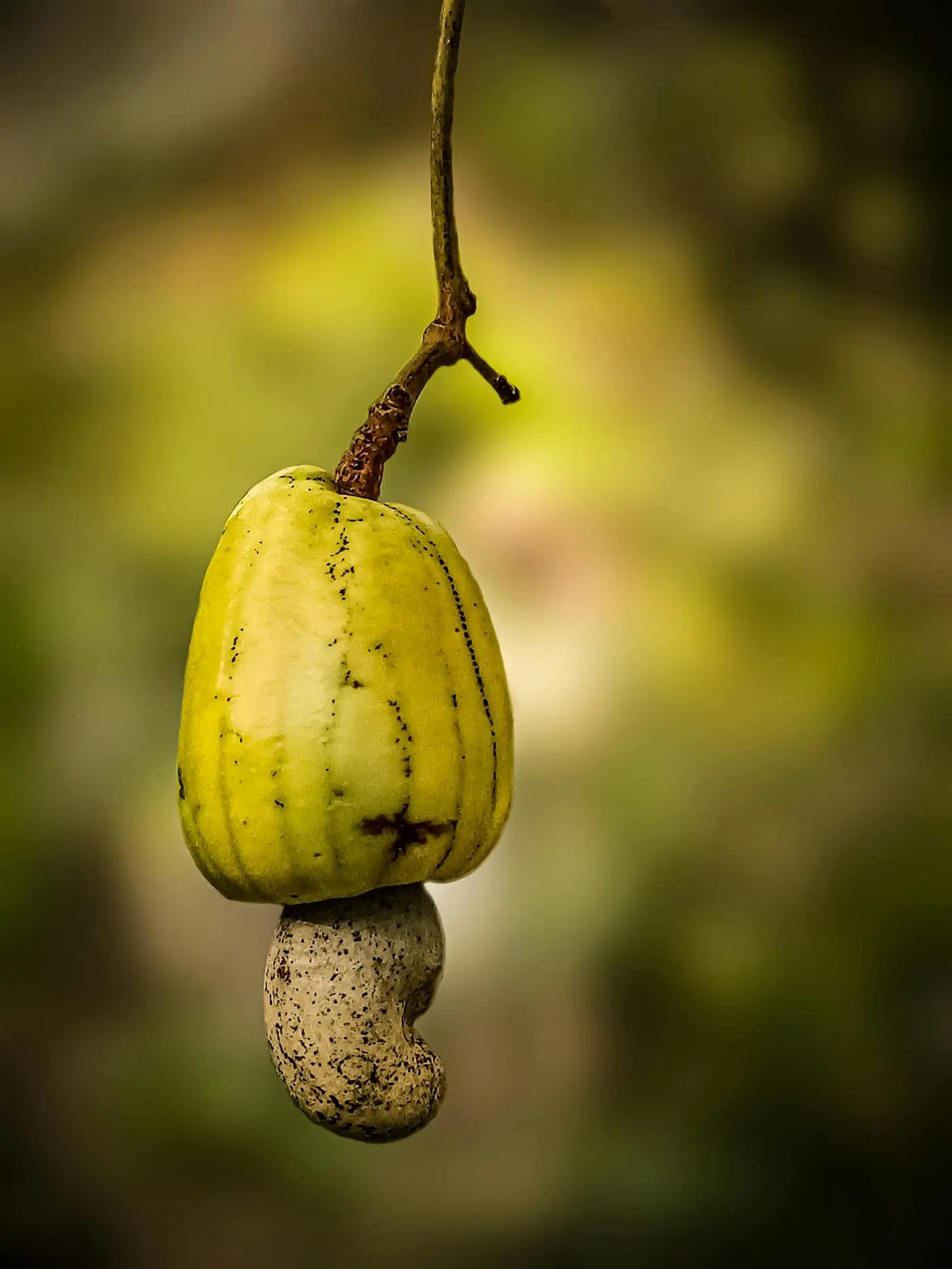
Cashew (Anacardium occidentale) is a hardy, evergreen perennial tree grown for its kidney-shaped nut, which develops on the outside of a swollen, fleshy "cashew apple". India's commercial belt runs down both coasts: Kerala, Dakshina Kannada and Udupi in Karnataka, Goa and the Maharashtra Konkan on the west coast, with Andhra Pradesh, Odisha and Tamil Nadu carrying a substantial share on the east. The tree is unusually tolerant of poor, lateritic, even sandy coastal soils that would defeat most other fruit or nut trees, which is exactly why it became the plantation crop of choice on land many other crops cannot use.
ICAR's Directorate of Cashew Research (DCR) at Puttur, Karnataka, coordinates variety development with regional research stations — Vengurla in Maharashtra (Konkan Krishi Vidyapeeth), Vridhachalam in Tamil Nadu, Ullal/Bhaskara-linked work in Karnataka, and Madakkathara in Kerala — under the All India Coordinated Research Project on Cashew. The result is a genuinely wide spread of named varieties suited to different regions and purposes: high nut-yield selections like Vengurla-7 and VRI-3, and dual-purpose types like Priyanka and Dhana bred with a large, processable cashew apple alongside the nut.
Cashew has no MSP and no CACP notification, but unlike several other plantation crops on this site (tea, coffee, rubber), it does trade genuinely, if thinly, on APMC mandis in its growing states — Andhra Pradesh in particular reports regular arrivals. What decides a planting's health more than almost any other single factor is the tea mosquito bug, a sap-sucking pest whose feeding wounds scorch shoots and flowers directly and also open the tree to the secondary dieback and anthracnose fungi that follow.
Crop timeline, sowing to harvest
A quick visual map of the season — jump to any section below for the detail behind each stage.
- Year 0
Nursery & grafting
Softwood grafts of a named variety are raised in a nursery on seedling rootstock for about a year before they are hardy enough to transplant.
- Year 1 (Jun–Jul)
Transplanting
Hardened grafts are transplanted into prepared pits at the monsoon onset, staked and given a basin irrigation.
- Year 1–3
Establishment
The young tree is trained and protected through its first dry seasons; no meaningful crop is expected while the canopy develops.
- Year 3–4
First bearing
A grafted tree typically gives its first light crop of about a kilogram of raw nut; yield still climbs steeply for several more years.
- Year 8–10 onward
Full bearing
The tree reaches its full canopy and economic yield, and continues bearing every year for several decades with proper care.
- Dec–Mar (annual)
Flowering
Panicles of small flowers open through the cool, dry winter months, pollinated mainly by insects.
- Feb–May (annual)
Nut & apple development, harvest
The nut develops attached to a swollen, fleshy cashew apple; mature nuts (still attached to or fallen with the apple) are picked or collected from the ground through this window.
Suitable states
States where this crop is grown at scale, highlighted below. Your local Krishi Vigyan Kendra is still the final word for your specific block.
- Jammu and Kashmir
- Himachal Pradesh
- Punjab
- Uttarakhand
- Haryana
- Delhi
- Uttar Pradesh
- Rajasthan
- Bihar
- Jharkhand
- West Bengal
- Sikkim
- Assam
- Arunachal Pradesh
- Meghalaya
- Nagaland
- Manipur
- Mizoram
- Tripura
- Gujarat
- Madhya Pradesh
- Chhattisgarh
- Maharashtra
- Odisha
- Goa
- Telangana
- Andhra Pradesh
- Karnataka
- Kerala
- Tamil Nadu
- Puducherry
- Ladakh
- Chandigarh
- Lakshadweep
- Andaman and Nicobar Islands
- Dadra and Nagar Haveli and Daman and Diu
Grown here
Climate requirements
Cashew's real climate requirement is less about narrow temperature bands and more about a workable coastal rainfall pattern and freedom from frost — which is why its Indian range hugs both coastlines rather than reaching deep into the interior.
Ideal temperature
A genuinely tropical coastal tree, comfortable across roughly 20–35°C, with no tolerance for frost or prolonged cold
Rainfall
Wants 1,000–2,000+ mm of mostly monsoon rainfall; established trees tolerate a distinct dry season well, which is part of why the crop suits the coastal calendar
Humidity
Moderate to high coastal humidity suits vegetative growth, but the same humidity through flowering and early nut development favours tea mosquito bug buildup and powdery mildew
Sunlight
Full sun for good flowering and nut development; the tree does not need or want shade the way cardamom, coffee or tea do
Soil requirements
Cashew's defining soil trait is what it can tolerate, not what it demands — deep, fertile loam helps yield, but the crop's real economic value has always been turning coastal laterite and sandy tracts nobody else wanted into a productive plantation.
Suitable soil
Notably tolerant of poor, lateritic, gravelly or even sandy coastal soils that would defeat most other fruit and nut trees — this tolerance is a large part of why cashew became the region's plantation crop of choice
pH range
5.0–6.5 (slightly acidic)
Drainage
Good drainage matters, especially for young trees, though established cashew is markedly more forgiving of a difficult site than avocado or many other fruit trees
Organic matter
Responds well to farmyard manure and mulch at establishment and through the early bearing years, even though it can survive on genuinely low-fertility land
Land preparation
Same four steps whichever region you are in — only the timing shifts with the sowing window.
- 1
Pit digging ahead of the monsoon
Dig pits roughly 60 × 60 × 60 cm at the chosen spacing well before the monsoon, and refill with topsoil mixed with well-rotted farmyard manure.
- 2
Confirm real spacing for the system chosen
Decide between traditional (7 × 7 m) and high-density (5 × 5 m or 4 × 4 m) planting before pit-marking, since retrofitting spacing later is far harder than planning it up front.
- 3
Source grafted plants from an accredited nursery
Take softwood grafts of a named, region-suited variety from an ICAR-DCR or National Horticultural Board-accredited nursery rather than raising or buying unnamed seedlings.
Seed information
How the main varieties compare, so you can pick by duration, yield, disease pressure or what you are growing for.
| Variety | Duration | Yield | Disease resistance | Best state | Suitable for |
|---|---|---|---|---|---|
One of the most widely planted commercial varieties from the Regional Fruit Research Station, Vengurla (Konkan Krishi Vidyapeeth, Maharashtra), valued for its adaptability across Maharashtra, Goa, Karnataka and beyond. | First bearing in 3 years (grafted) | High, well-proven across multiple states | Not specifically documented; standard tea mosquito bug and dieback management applies | Maharashtra, Goa, Karnataka | Broadly adaptable commercial planting |
Released in 1997 from the cross Vengurla-3 × M10/4 (VRI-1) at the same Vengurla station, a high-yielding hybrid with bold nuts and a very high percentage of perfect (bisexual) flowers. | First bearing in 3 years (grafted) | ~18.5 kg/tree average; bold 10 g nuts, W180 kernel grade, ~30.5% shelling | Not specifically documented | Maharashtra, Goa, Karnataka | High-yield commercial cultivation, bold-nut export grade |
A high-yielding release evaluated alongside Ullal-3 at high-density spacing (500 trees/ha), where the two showed the highest cumulative nut yield among tested varieties. | First bearing in 3 years (grafted) | High, among the best performers under high-density planting | Not specifically documented | Karnataka | High-density commercial planting |
A Karnataka-region release from work linked to the Ullal series, performing strongly alongside Bhaskara under high-density (500 trees/ha) spacing trials. | First bearing in 3 years (grafted) | High under high-density planting | Not specifically documented | Karnataka | High-density commercial planting |
From the Cashew Research Station, Vridhachalam (Tamil Nadu Agricultural University), a 35–39% yield improvement over the earlier VRI-1 and VRI-2, with export-standard W210-grade kernels. | First bearing in 3 years (grafted) | ~10 kg/tree; nut weight 7.2 g; ~29.1% shelling, W210 kernel grade | Not specifically documented | Tamil Nadu | Export-grade kernel production |
A dual-purpose variety recommended in both Karnataka and Kerala, valued alongside Priyanka for its large, heavy cashew apple suited to apple-processing (juice, feni, jam) in addition to nut yield. | First bearing in 3 years (grafted) | Good nut yield with a large, processable cashew apple | Not specifically documented | Karnataka, Kerala | Combined nut and cashew-apple processing enterprises |
A Kerala-recommended variety (from work linked to Madakkathara) bred alongside Dhana for a notably large, heavy cashew apple (roughly 68–76.5 g), making it attractive where apple processing adds real value. | First bearing in 3 years (grafted) | Good nut yield with a large, processable cashew apple | Not specifically documented | Kerala | Combined nut and cashew-apple processing enterprises |
- Seed rate
- Not a true seed crop — planted from grafted trees at roughly 200–400 trees/ha depending on spacing (7 × 7 m traditional to 5 × 5 m high-density)
- Certified seed
- Plant only softwood grafts of a named, region-suited variety from an ICAR-DCR or NHB-accredited nursery — an ungrafted seedling tree bears later, gives no guarantee of nut quality, and cannot be relied on for a consistent commercial yield.
- Spacing
- 7 × 7 m for traditional planting (~204 trees/ha); 5 × 5 m (~400 trees/ha) or 4 × 4 m (~625 trees/ha) for high-density systems on dwarf or compact-canopy varieties
- Seed treatment
- Not a seed crop — inspect grafted saplings for a healthy graft union and disease-free root system before planting.
Sowing guide
Cashew is planted once and harvested for decades, so the choice of variety and spacing system at this stage matters more than almost anything done afterward — retrofitting a high-density layout onto an already-planted traditional-spacing block is rarely practical.
- Best time
- Transplant hardened, roughly one-year-old grafts at the onset of the monsoon (June–July) so the young root system establishes on reliable rainfall
- Row spacing
- 7 m for traditional planting; 5 m or 4 m for high-density systems
- Plant spacing
- 7 m for traditional planting; 5 m or 4 m for high-density systems, matching row spacing
- Sowing depth
- Plant at nursery collar depth into the pre-filled, prepared pit, keeping the graft union clear of the soil line
- Method
- Transplant a certified graft into a large, well-drained, farmyard-manure-enriched pit, stake it against wind, and give a basin irrigation immediately after planting
Fertilizer schedule
A split dose beats one large dose applied at sowing — nitrogen especially is lost to the air and to leaching if it all goes in on day one.
- 1
Establishment (Year 1–3)
Split through the growing season
A graduated NPK dose builds the young tree's frame and root system while the canopy is still developing.
- 2
Pre-flowering
Sep–Oct
A dose ahead of the winter flowering season supports panicle development and flower quality.
- 3
Post-harvest recovery
May–Jun, after harvest
A recovery dose with organic manure or compost rebuilds reserves ahead of the next season's flowering.
Irrigation schedule
1. Establishment (Year 1–3)
Regular, light irrigation
Keep the young root zone consistently moist through the first dry seasons; established trees are far more drought-tolerant than young ones.
2. Flowering & nut development
Dec–Apr, dry spells
Supplemental irrigation during dry spells through flowering and nut fill improves flower retention and nut size where water is available.
3. Mature trees, dry season
As needed
A mature, established tree tolerates the dry season well without irrigation, though yield responds positively where water can be given.
Critical stages
- Establishment (Year 1–3)
- Flowering (Dec–Mar)
- Nut development (Feb–Apr)
Water-saving tips
- Mulch the basin of young trees to conserve moisture and suppress weeds through the establishment years.
- Drip or basin irrigation timed to flowering and nut development gives more benefit per litre than blanket watering through the whole dry season.
- Established trees rarely need irrigation to survive — reserve limited water for young trees and for a targeted boost during flowering and nut fill.
Weed management
Common weeds
Organic control
- Hand weeding or shallow hoeing around the basin of young trees until the canopy closes and shades out most weed growth on its own.
- Mulching the basin suppresses weeds and conserves moisture at the same time, especially valuable through the first dry seasons.
Chemical control
- Selective, spot herbicide use between established trees where hand weeding is costly, kept well clear of the trunk and root flare.
- Confirm any herbicide is cleared for use around cashew with your local KVK before applying near young trees.
Nutrient deficiency identification
What a shortage of each nutrient actually looks like on the plant, so you can tell a deficiency apart from a disease before you spray the wrong thing.
Nitrogen
Visible symptom
Pale, sparse foliage and slow canopy development, most noticeable on young, establishing trees.
Potassium
Visible symptom
Poor nut fill and smaller kernel size on an otherwise healthy-looking bearing tree.
Zinc
Visible symptom
Small, narrow, interveinally chlorotic new leaves — a common micronutrient issue on the lighter, sandier coastal soils cashew often occupies.
Diseases to watch for
Symptoms, likely cause and what actually treats it — not just a spray name.
Die-back & branch canker
- Symptoms
- Progressive dying-back of shoots and branches from the tip inward, often starting at wounds left by tea mosquito bug feeding, with visible cankers on affected wood.
- Cause
- Colletotrichum gloeosporioides and Botryodiplodia theobromae, both of which enter far more easily through feeding wounds and other injuries than through healthy bark.
- Treatment
- Prune out and destroy dead and cankered wood well below the visible damage, and spray a recommended copper-based or systemic fungicide on the cut surfaces and surrounding canopy.
- Prevention
- Control the tea mosquito bug promptly, since its feeding wounds are the main entry point for this disease, and avoid unnecessary wounding during pruning and harvest. See the dedicated die-back guide for full detail.
Anthracnose
- Symptoms
- Dark, sunken lesions on leaves, twigs and the developing cashew apple and nut, which can enlarge into gummy twig and stem lesions in humid weather.
- Cause
- Colletotrichum gloeosporioides, favoured by humid weather and, again, worsened by wounds — including those left by tea mosquito bug feeding.
- Treatment
- Spray a recommended copper-based or systemic fungicide during humid flowering and fruit-development weather.
- Prevention
- Manage the tea mosquito bug vector, prune for good air circulation through the canopy, and remove infected plant debris. See the dedicated anthracnose guide for full detail.
Powdery mildew
- Symptoms
- A white, powdery fungal growth on flower panicles, young leaves and developing nuts, which can cause heavy flower and nut drop in a bad outbreak.
- Cause
- The fungus Oidium anacardii, favoured by cool, humid conditions during the flowering season.
- Treatment
- Spray a recommended sulphur-based or systemic fungicide at the first sign of infection on the flower panicles.
- Prevention
- Monitor panicles closely from flowering onward in cool, humid weather, and spray preventively in blocks with a history of the disease. See the dedicated powdery mildew guide for full detail.
Pests to watch for
What to look for before the damage is visible, and organic options before you reach for a chemical.
Tea mosquito bug
- Identification
- A slender, sap-sucking bug (Helopeltis antonii) whose feeding leaves dark brown-black lesions on tender shoots, flower panicles and developing nuts, giving the canopy a scorched, "burnt-up" look in a heavy attack.
- Damage
- The single most damaging pest of Indian cashew, capable of cutting yield by 20–80% — beyond the direct feeding damage, its wounds are the main entry point for dieback and anthracnose fungi.
- Organic control
- Encourage natural predators such as red weaver ants, which have shown real success suppressing tea mosquito bug in cashew plantations; monitor panicles closely from flowering onward.
- Chemical control
- A recommended insecticide timed to flushing and flowering, when new tender growth is most attractive to the bug, applied per local KVK/DCR guidance.
Cashew stem and root borer
- Identification
- The grub of a long-horned beetle (Plocaederus ferrugineus) that tunnels into the trunk and root at the collar region; gum oozing and sawdust-like frass near the base are the key early signs.
- Damage
- Widely considered the single most destructive pest of standing cashew trees — tunnelling cuts off sap flow and can girdle and kill an otherwise healthy-looking tree.
- Organic control
- Monthly inspection of the trunk base during April–May and October–November, mechanical destruction of grubs in fresh bore holes, and prompt removal of dead or beyond-recovery trees.
- Chemical control
- A preventive coal tar-kerosene trunk swab twice a year, and a recommended insecticide applied to the trunk region where infestation is confirmed early. See the dedicated stem and root borer guide for full detail.
Mealybugs
- Identification
- Small, white, cottony-coated insects clustering on tender shoots, panicles and developing nuts, often tended by ants.
- Damage
- Sap loss weakens flushing shoots and flower panicles, and honeydew from heavy infestations invites sooty mould that blackens leaves and reduces photosynthesis.
- Organic control
- Conserve natural predators such as ladybird beetles, manage the attending ant colonies, and hose off light infestations.
- Chemical control
- A recommended systemic insecticide where infestation is heavy, targeted at ant-tended colonies on flushing shoots and panicles.
Common mistakes to avoid
The mistakes that cost growers the most, ranked by how often they show up in the field — not in the order you might expect.
- 1
Planting an ungrafted seedling to save on nursery cost.
Why it hurts
A seedling tree bears later and gives no guarantee of nut size, shelling percentage or quality — a grafted plant of a named variety from an accredited nursery is worth the extra cost for a crop planted once and harvested for decades.
- 2
Ignoring tea mosquito bug until the canopy already looks scorched.
Why it hurts
It is the single most damaging pest of Indian cashew and, beyond direct feeding damage, its wounds are the main entry point for dieback and anthracnose — monitoring and control need to start from flushing and flowering, not after damage is already visible.
- 3
Overlooking gum oozing or frass at the trunk base as "nothing serious".
Why it hurts
These are the earliest signs of cashew stem and root borer, widely considered the most destructive pest of standing cashew trees — by the time canopy yellowing is obvious, tunnelling is often already extensive and the tree may not recover.
- 4
Choosing spacing without deciding on the planting system first.
Why it hurts
Retrofitting a high-density layout onto a block already planted at traditional 7 × 7 m spacing is rarely practical — decide between traditional and high-density planting before pit-marking, not after.
- 5
Wounding the trunk or branches carelessly during pruning or harvest.
Why it hurts
Wounds are the main entry point for both dieback fungi and the stem and root borer beetle — handle pruning cuts and harvest operations carefully, and treat any accidental wound promptly.
- 6
Assuming cashew needs no irrigation at all because it tolerates dry soil.
Why it hurts
Established trees do tolerate the dry season well, but supplemental irrigation through flowering and nut development genuinely improves flower retention and nut size where water is available — tolerance is not the same as no benefit from watering.
Harvesting
Nuts mature attached to a swollen, fleshy cashew apple through February–May; harvesting is either by hand-picking mature nut-and-apple clusters from the tree or, more commonly on a larger scale, by collecting sound, fallen nuts from the ground beneath the tree at regular intervals through the season.
Signs it is ready
- The cashew apple has swollen and coloured (yellow, orange or red depending on variety)
- The attached nut has hardened and turned grey-brown
- Sound nuts have naturally dropped to the ground beneath the tree, ready for collection
Tools
- Clean collection baskets or sacks for fallen nuts
- A picking pole with a catching net for nuts still attached out of reach
- Sun-drying mats or a clean, hard surface for drying collected nuts before storage
Expected yield
8–10 kg raw nut per mature tree on average across major varieties, roughly translating to India's national average productivity of about 635 kg/ha; well-managed improved varieties like Vengurla-7 and VRI-3 can substantially exceed this
Post-harvest & storage
Storage
Sun-dry collected raw nuts to below about 10% moisture before storage — properly dried nuts store well in a cool, dry place, while damp storage invites mould and quality loss.
Packaging
Dried raw nuts are typically bagged in jute or similar breathable sacks for sale or transport to a processing unit; the cashew apple, where processed, is handled separately and far more perishable.
Transportation
Dried raw nuts are a stable, durable commodity that ships without special cold-chain needs; the cashew apple, if being sold or processed for juice, feni or jam, must move quickly since it spoils fast once picked.
Shelf life
Properly dried raw nuts (below ~10% moisture) store for many months in a cool, dry place; the fresh cashew apple has a shelf life of only a day or two and must be processed or sold almost immediately.
Market prices
Today's mandi price near you, pulled live from the government's own Agmarknet data.
Live daily mandi prices from the government Agmarknet dataset.
Synced from data.gov.in (Agmarknet). Rates are ₹ per quintal.
Weather
Current conditions and a 5-day outlook for your selected location, with one line of stage-aware advice.
Pick your state for current conditions and a 5-day outlook.
Live data from Open-Meteo
Profit calculator
Your own cost sheet, expected yield and selling price — not ours.
Where the money goes
Share of the total cost per acre, using the calculator’s own default cost sheet below — adjust the numbers there to match your field and this picture will no longer apply to you exactly, but the ranking rarely changes.
- Labour28% (₹8,000)
- Land rent24% (₹7,000)
- Fertiliser14% (₹4,000)
- Pesticide & weedicide14% (₹4,000)
- Irrigation7% (₹2,000)
- Seed5% (₹1,500)
- Interest4% (₹1,200)
- Machinery3% (₹1,000)
Official downloads
Government and ICAR documents only — everything below is hosted on an official server.
ICAR-Directorate of Cashew Research (DCR), Puttur
Variety development, planting material accreditation and pest/disease advisories for cashew
Cashew Export Promotion Council of India
Export standards, kernel grading and market information for cashew
Kisan Call Centre — 1800-180-1551
Free crop advice in your language
Frequently asked questions
Where in India is cashew genuinely grown as a commercial crop?
Along both coasts: Kerala, Dakshina Kannada and Udupi in Karnataka, Goa and the Maharashtra Konkan form the historic west-coast belt, while Andhra Pradesh, Odisha and Tamil Nadu carry a substantial share on the east coast. The tree's tolerance for poor, lateritic and sandy coastal soil is exactly why it became the plantation crop of choice on land many other crops cannot use.
Should I plant a grafted cashew tree or grow one from seed?
Plant a softwood graft of a named, region-suited variety from an ICAR-DCR or NHB-accredited nursery. A grafted tree bears its first crop in about 3 years with known nut size and quality; an ungrafted seedling tree bears later and gives no guarantee of what the nut will actually be like.
Why is the tea mosquito bug considered such a serious problem for cashew?
Because it does damage in two ways at once. Its direct feeding causes shoot, flower and nut damage that can cut yield by 20–80% in a bad outbreak, and its feeding wounds are also the main entry point for the dieback and anthracnose fungi that follow — so an unmanaged tea mosquito bug problem tends to open the door to further disease losses on top of its own direct damage.
My cashew tree has gum oozing near the base and I see sawdust-like material on the ground. What does this mean?
That is the classic early sign of cashew stem and root borer (Plocaederus ferrugineus), widely considered the single most destructive pest of standing cashew trees in India. Inspect the trunk base closely, and if a fresh bore hole is found, mechanically remove the grub or insert a wire into the hole — waiting until the canopy yellows usually means the tunnelling is already extensive and the tree may not recover.
Does cashew have an MSP or genuine mandi trade in India?
No MSP — cashew is not a CACP-notified crop. Unlike tea, coffee and rubber on this site, cashew does trade genuinely, if thinly, on APMC mandis in growing states, particularly Andhra Pradesh, alongside sale to processors and cooperatives. Use the live mandi prices on this page for guidance, while expecting a meaningful share of the crop to move through direct processor sale as well.
What is the difference between the many cashew varieties, and which should I plant?
Varieties from India's regional research stations split broadly into high nut-yield selections (Vengurla-7, VRI-3, Bhaskara, Ullal-3) bred mainly for kernel output and grade, and dual-purpose types like Dhana and Priyanka bred with a large, processable cashew apple alongside the nut. The right choice depends on your region — source planting material recommended for your specific district from ICAR-DCR or your state agricultural university rather than picking a variety at random.
Still have questions?
The FAQs above cover the common ones. For anything specific to your field and soil, your nearest Krishi Vigyan Kendra is the authoritative answer.