
Ber (Indian Jujube)
Ziziphus mauritiana
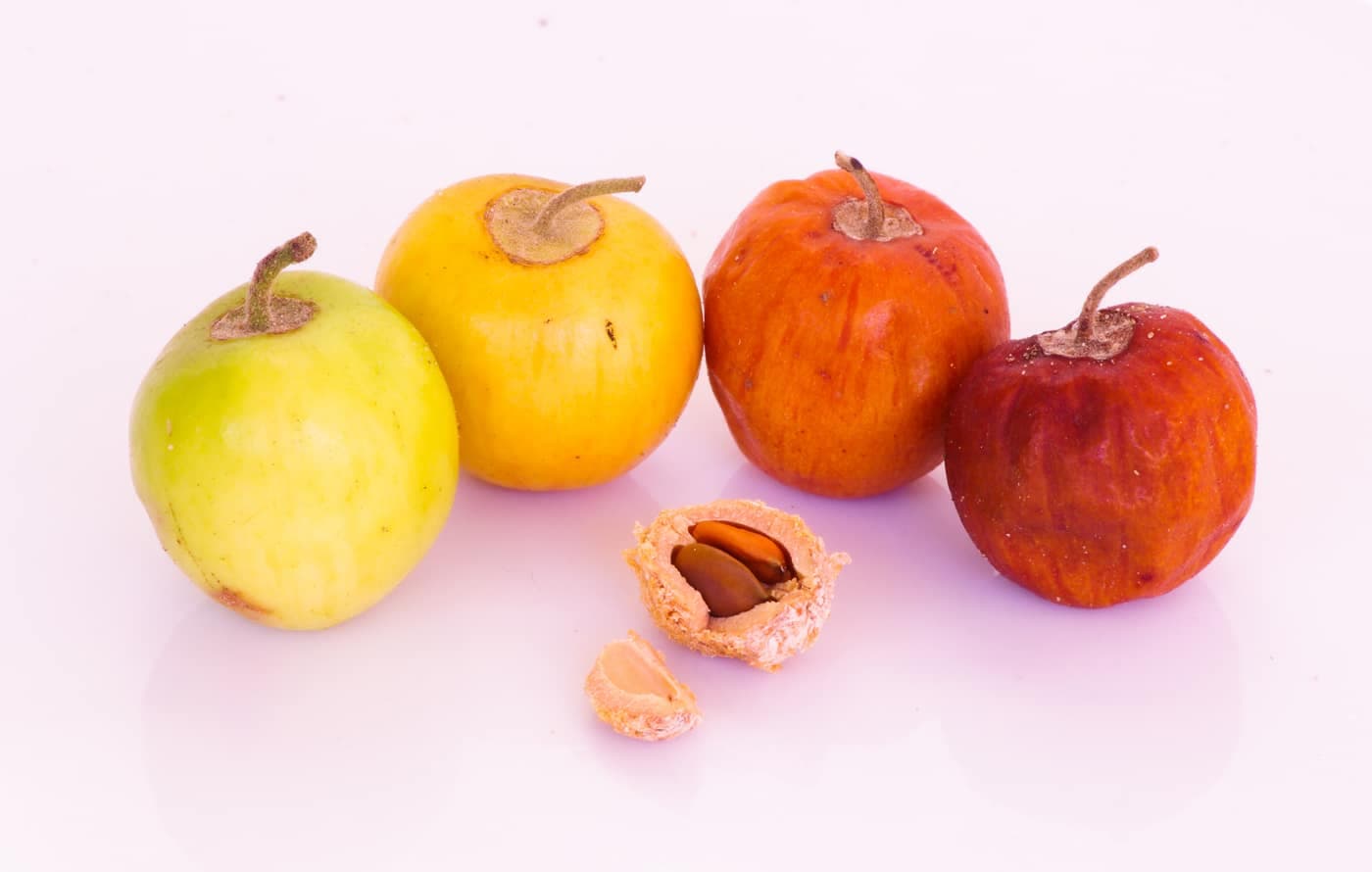
A very drought-hardy fruit tree grown across Rajasthan, Gujarat, Haryana, Punjab, Uttar Pradesh, Madhya Pradesh, Maharashtra, Karnataka, Tamil Nadu and Andhra Pradesh on marginal and wasteland soil other crops cannot use — where top-working a wild seedling ber tree with a scion of a real, named improved variety (Gola, Seb, Umran, Kaithli, or CIAH Bikaner's Thar-series releases) turns a low-value hedge tree into a genuinely productive orchard.
Quick Summary
The key points from this page in about two minutes — read it or have it read aloud.
Quick Summary
Ber, or Indian jujube (Ziziphus mauritiana), is one of the most drought-hardy fruit trees grown in India, widely cultivated across Rajasthan, Gujarat, Haryana, Punjab, Uttar Pradesh, Madhya Pradesh, Maharashtra, Karnataka, Tamil Nadu and Andhra Pradesh, often on marginal and wasteland soil that few other fruit crops can use profitably.
A genuinely common and distinctive practice in ber is top-working: rather than always planting a fresh grafted sapling, growers frequently graft a scion of an improved variety directly onto an established wild or unimproved ber tree already growing in a field or on wasteland, converting it into a productive, named-variety tree far faster than starting from scratch. This makes ber one of the more forgiving fruit crops to upgrade an existing planting on, not just a crop you start new.
Real, named improved varieties — Gola, Seb (Apple Ber), Umran, Kaithli, Banarasi Karaka and ICAR-CAZRI Bikaner's Thar Sevika and Thar Bhubhraj — differ meaningfully in fruit size, sweetness, maturity timing and yield, and choosing among them (rather than sticking with unimproved wild fruit) is the single biggest lever on a ber grower's income. Umran alone is commonly cited giving 150–200 kg of fruit per mature tree, heavily out-yielding wild stock.
Fruit fly and powdery mildew are ber's two defining problems — fruit fly attacks the ripening crop directly, while powdery mildew hits young leaves, flowers and developing fruit in humid weather and can cause serious fruit drop if not managed at the right stage. Both are manageable with timely action, but neither can be ignored on a crop grown mainly for its fresh fruit.
- Crop type
- Perennial deciduous fruit tree
- Season
- Planted/top-worked at monsoon onset; harvest Jan–March
- Suitable states
- Rajasthan, Gujarat, Haryana, Punjab, Uttar Pradesh, Maharashtra
- Time to bearing
- 2–3 years (grafted/top-worked)
- Water requirement
- Very low; among the most drought-hardy fruit trees grown
- Temperature
- Arid–semi-arid; tolerates strong summer heat and mild winter cold
- Soil type
- Very wide tolerance, including marginal/wasteland soil; pH 6.0–8.5
- Difficulty level
- Easy (fruit fly and powdery mildew are the main watch-outs)
- Expected yield
- 80–200 kg fruit per mature tree per year, variety-dependent
- Key technique
- Top-working wild trees onto a named improved variety
Overview
Ber, or Indian jujube (Ziziphus mauritiana), is one of the most drought-hardy fruit trees grown in India, cultivated widely across Rajasthan, Gujarat, Haryana, Punjab, Uttar Pradesh, Madhya Pradesh, Maharashtra, Karnataka, Tamil Nadu and Andhra Pradesh. It is genuinely valued for thriving on marginal, dry and wasteland soil that few other fruit crops can use profitably, making it a real income option on land that would otherwise sit idle.
A distinctive and widely practised technique in ber cultivation is top-working — grafting a scion of a named improved variety directly onto an already-established wild or unimproved ber tree, rather than only ever planting fresh grafted saplings. Because wild and self-sown ber trees are common across much of the crop's dry-zone range, top-working genuinely lets a grower convert existing, low-value trees into a productive named-variety orchard faster and more cheaply than replanting from scratch — a real, commonly documented practice, not a marginal technique.
ICAR-CIAH Bikaner holds the largest ber germplasm collection in the country and, together with regional research stations, has released and evaluated a real set of named varieties: Gola, Seb (Apple Ber), Umran, Kaithli, Banarasi Karaka and the CAZRI-Bikaner Thar series (Thar Sevika, Thar Bhubhraj, Thar Malti). These differ genuinely in fruit size, sweetness, skin thickness, maturity window and yield — Umran, for instance, is commonly cited at 150–200 kg of fruit per mature tree with large, oblong, thick-skinned, high-pulp fruit, a substantial step up from unimproved wild stock.
Fruit fly and powdery mildew are the two problems that most define ber cultivation. Fruit fly attacks the ripening fruit directly and is the main threat to fresh-market quality, while powdery mildew — a fungal disease favoured by humid weather at flowering and early fruit development — can cause serious flower and young-fruit drop if not caught early. Both are real, well-documented, manageable risks rather than occasional nuisances, and timely action against each protects most of a season's crop.
Crop timeline, sowing to harvest
A quick visual map of the season — jump to any section below for the detail behind each stage.
- Year 0
Planting or top-working
Either a grafted sapling of a named variety is planted at the start of the monsoon (June–July), or an established wild/unimproved ber tree already on the land is top-worked by grafting scion wood of the chosen variety onto its cut-back branches.
- Year 1–2
Establishment / re-growth
A new sapling is trained to a strong framework and watered through its first dry seasons; a top-worked tree regrows its canopy from the new grafts, usually faster than a fresh sapling reaches the same size.
- Year 2–3
First bearing
Grafted and top-worked trees begin flowering and setting a first crop; ber is notably quicker to bear than many other fruit trees once grafted.
- September–November
Flowering
Small, fragrant flowers open over an extended period — the key window to watch for powdery mildew in humid weather.
- November–January
Fruit development
Fruit fills and matures over roughly two to three months, changing from green to yellow-green to the variety's mature colour as it ripens.
- January–March
Harvest
Fruit is picked as it ripens, in repeated rounds over several weeks since maturity is not uniform across the tree.
Suitable states
States where this crop is grown at scale, highlighted below. Your local Krishi Vigyan Kendra is still the final word for your specific block.
- Jammu and Kashmir
- Himachal Pradesh
- Punjab
- Uttarakhand
- Haryana
- Delhi
- Uttar Pradesh
- Rajasthan
- Bihar
- Jharkhand
- West Bengal
- Sikkim
- Assam
- Arunachal Pradesh
- Meghalaya
- Nagaland
- Manipur
- Mizoram
- Tripura
- Gujarat
- Madhya Pradesh
- Chhattisgarh
- Maharashtra
- Odisha
- Goa
- Telangana
- Andhra Pradesh
- Karnataka
- Kerala
- Tamil Nadu
- Puducherry
- Ladakh
- Chandigarh
- Lakshadweep
Grown here
Climate requirements
Ber's hardiness is precisely why it is planted on marginal and dry land across its belt — matching it to that kind of ground, rather than competing it against better land for a less drought-tolerant crop, is the whole point of growing it.
Ideal temperature
A genuinely arid-to-semi-arid tree, well suited to strong summer heat and tolerant of mild winter cold once established; young grafted plants and fresh top-worked grafts benefit from some protection in a genuinely severe cold snap.
Rainfall
Very low water need — ber is among the most drought-hardy fruit trees India grows, performing well on 300–800 mm of rain a year with minimal supplementary irrigation once established; it specifically wants a dry spell around flowering and fruit maturity.
Humidity
Prefers a dry atmosphere, especially at flowering and fruit set — this is the exact condition that keeps powdery mildew in check, so a humid flowering season is a real risk period to watch.
Sunlight
Full sun gives the best flowering, fruit set and sugar development; ber is not shade-tolerant for fruiting purposes.
Soil requirements
Ber's real value is turning marginal, dry, wasteland soil that would otherwise earn nothing into a genuine fruit crop — the point is matching it to that kind of land, not displacing a better crop from good soil.
Suitable soil
Extremely wide tolerance — grows well on poor, shallow, sandy, gravelly and even fairly saline or alkaline soils that few other fruit trees can use profitably, alongside better loams where it grows even more vigorously.
pH range
Roughly 6.0–8.5, including mildly saline-alkaline soils common on the marginal land ber is often planted on.
Drainage
Needs reasonable drainage — while very drought- and poor-soil-tolerant, a genuinely waterlogged site still causes root problems.
Organic matter
Low requirement. A manure-filled pit at planting or top-working site establishes good growth; a mature tree on poor land keeps fruiting with only a light yearly manure dose.
Land preparation
Same four steps whichever region you are in — only the timing shifts with the sowing window.
- 1
Decide between fresh planting and top-working
Where wild or unimproved ber trees already grow on the land, top-working them with a named variety is often faster and cheaper than clearing and planting fresh grafted saplings — assess what is already there before committing to a full new orchard.
- 2
Mark spacing and dig pits (fresh planting)
Space grafted trees 6–8 m apart (roughly 150–275 trees/ha); dig 1 m cube pits a few weeks ahead and leave them open to weather.
- 3
Fill pits with manure
Refill each pit with topsoil mixed with 15–20 kg well-rotted farmyard manure and, in termite-prone areas, a recommended soil insecticide.
- 4
Cut back existing trees for top-working
For top-working, cut back the wild tree's main branches to a manageable framework at the right season (typically before the main growth flush), then graft scion wood of the chosen variety onto the cut stubs.
Seed information
How the main varieties compare, so you can pick by duration, yield, disease pressure or what you are growing for.
| Variety | Duration | Yield | Disease resistance | Best state | Suitable for |
|---|---|---|---|---|---|
A widely grown, well-established variety performing reliably in hot arid conditions, commonly cited among the small handful of ber varieties that dominate commercial planting across Rajasthan and neighbouring states. | Bears from year 2–3 (grafted/top-worked) | Good, reliable commercial performance | Not separately documented | Rajasthan, Haryana, Punjab | General commercial planting in hot arid conditions |
A large-fruited variety whose round, apple-like shape and size give it the common name "Apple Ber" — valued for fresh-market appeal and fruit size well above unimproved wild stock. | Bears from year 2–3 (grafted/top-worked) | Good; valued for large fruit size | Not separately documented | Rajasthan, Gujarat, Uttar Pradesh | Fresh-market sale, large-fruit table variety |
A very heavy-yielding variety with large, oblong fruit (roughly 32.5 g), thick skin and about 96% pulp recovery — commonly cited at 150–200 kg of fruit per mature tree, among the highest-yielding named ber varieties. | Bears from year 2–3 (grafted/top-worked) | Very high — commonly 150–200 kg/tree | Not separately documented | Rajasthan, Haryana, Punjab, Uttar Pradesh | Maximum-yield commercial orchards |
A well-established variety performing consistently across the hot arid belt, commonly grown alongside Gola, Seb and Umran as one of the small set of varieties that dominate commercial ber planting. | Bears from year 2–3 (grafted/top-worked) | Good, reliable commercial performance | Not separately documented | Rajasthan, Madhya Pradesh | General commercial planting in hot arid conditions |
An eastern-belt variety associated with the Banaras region of Uttar Pradesh, performing well as part of the small group of ber cultivars that consistently do well under hot arid conditions. | Bears from year 2–3 (grafted/top-worked) | Good, reliable commercial performance | Not separately documented | Uttar Pradesh | Eastern Uttar Pradesh commercial planting |
An ICAR-CAZRI Bikaner release bred from a cross between Seb and Katha, an early-maturing cultivar yielding roughly 30–32 kg per tree, part of the Thar series developed specifically for arid conditions with improved fruit quality. | Bears from year 2–3 (grafted/top-worked); early-maturing | Good — roughly 30–32 kg/tree | Bred for arid-zone tolerance | Rajasthan | Early-market arid-zone orchards |
The companion ICAR-CAZRI Bikaner release in the Thar series, bred alongside Thar Sevika for improved fruit quality and yield under the same hot, arid conditions. | Bears from year 2–3 (grafted/top-worked) | Good; bred for arid-zone quality and yield | Bred for arid-zone tolerance | Rajasthan | Arid-zone commercial orchards |
- Seed rate
- Grown from grafted plants or top-worked existing trees, not a field seed rate: roughly 150–275 grafted trees per hectare at 6–8 m spacing for fresh planting. Seed is used mainly to raise wild rootstock for later grafting or top-working.
- Certified seed
- Source grafted plants of a named variety from ICAR-CIAH Bikaner, a state horticulture department nursery or a registered nursery — or, where wild ber trees already grow on the land, have them top-worked with scion wood of a chosen named variety by a trained grafter. Either route beats leaving trees as unimproved wild stock, which gives small, sour, low-value fruit.
- Spacing
- 6–8 m × 6–8 m for a standard grafted orchard; top-worked trees keep whatever spacing the original wild trees already had.
- Seed treatment
- For wild rootstock raised from seed: seed has a hard shell and benefits from scarification or a period of stratification before sowing to improve germination. At grafting or top-working, keep the graft union clean and protected until it has fully healed.
Sowing guide
Whichever route is used, keeping the graft union clean, protected and free of competing shoots below it in the first season is what determines whether the tree that grows on is genuinely the named variety chosen.
- Best time
- Plant grafted saplings with the first steady monsoon rain, June to July; top-working is typically done in the dry season before the main growth flush so new grafts have the full growing season to establish.
- Row spacing
- 6–8 m for fresh planting
- Plant spacing
- 6–8 m, matching row spacing
- Sowing depth
- Set a fresh sapling so the root collar and graft union sit just above the finished soil level; for top-working, cut back the existing tree's branches to a workable framework before grafting.
- Method
- One grafted plant per pit for fresh planting; for top-working, graft scion wood of the chosen variety onto the cut-back branches of an established wild or unimproved tree using a standard cleft or wedge-graft technique.
Fertilizer schedule
A split dose beats one large dose applied at sowing — nitrogen especially is lost to the air and to leaching if it all goes in on day one.
- 1
Young / newly top-worked trees
Years 1–2
A light NPK dose (roughly 50–75 g N, 25–35 g P and 25–35 g K per tree in year 1, increased in year 2) split across two doses at monsoon onset and post-monsoon, with 10–15 kg farmyard manure per tree per year.
- 2
Bearing trees
Year 3 onward, yearly
About 250–500 g N, 125–250 g P and 250–500 g K per mature bearing tree per year, plus 20–25 kg farmyard manure, applied in a ring under the canopy edge before flowering and again after fruit set.
- 3
On saline/wasteland sites
As needed
A light gypsum application and a foliar zinc spray before flowering can help on the more marginal, saline-alkaline sites ber is often grown on; confirm the dose with your KVK.
Irrigation schedule
1. Establishment
First 1–2 years
Water every 10–15 days through the dry months for the first one or two summers; this is the main stage at which ber genuinely needs irrigation.
2. Bearing trees
Year 2–3 onward
Largely rainfed once established. Where irrigation is available, a watering at flowering and early fruit set improves fruit size, but ber copes without it far better than almost any other fruit tree.
Critical stages
- First 1–2 years after planting or top-working
- Flowering and early fruit set, where irrigation is available
Water-saving tips
- Ber is grown specifically because it does not need routine irrigation once established — a heavy watering schedule around a mature tree defeats the point of choosing this crop for dry, marginal land.
- A basin mulch of leaves or crop residue holds what little rain or watering the tree gets and cuts the number of establishment-stage waterings needed.
- Avoid overwatering at fruit maturity — excess moisture at this stage can affect fruit quality and sweetness.
Weed management
Common weeds
Organic control
- Keep a weed-free circle around each young or top-worked tree by hoeing 2–3 times a year for the first two years; a mature canopy shades out most weeds on its own.
- On wasteland plantings, actively clear Prosopis juliflora seedlings early, since ber's marginal-land sites are exactly where this invasive weed also thrives.
- Slash Parthenium and Calotropis before they seed to reduce their spread across the orchard.
Chemical control
- In the first year or two, a directed post-emergence herbicide can be used between rows on a larger orchard block, kept off young trees; most growers rely on hand and mechanical weeding given the crop's typical scale.
- Confirm any herbicide with your local KVK before spraying near young or recently top-worked trees.
Nutrient deficiency identification
What a shortage of each nutrient actually looks like on the plant, so you can tell a deficiency apart from a disease before you spray the wrong thing.
Nitrogen
Visible symptom
Pale, small older leaves and a poor flush of new growth, worst on the poor, low-organic-matter wasteland soils ber is often planted on.
Zinc
Visible symptom
Small, narrow, bunched leaves at shoot tips and reduced flowering, common on the alkaline soils in the crop's typical growing belt.
Iron
Visible symptom
Yellowing between the veins of young leaves while veins stay green, more likely on strongly alkaline or calcareous marginal sites.
Diseases to watch for
Symptoms, likely cause and what actually treats it — not just a spray name.
Powdery mildew
- Symptoms
- A white, powdery coating on young leaves, flower stalks and developing fruit during humid weather at flowering, causing flower drop and, on affected fruit, corky patches or cracking.
- Cause
- Oidium fungi, favoured by humid weather and soft flush growth right at ber's flowering season.
- Treatment
- A wettable sulphur or recommended fungicide spray at the first sign, repeated if humid weather persists, focused specifically on the flowering and young-fruit stage.
- Prevention
- Avoid pushing excess soft growth with heavy nitrogen near flowering, and keep the canopy open through pruning for better airflow.
Ber fruit rot
- Symptoms
- Soft, discoloured patches on ripening or stored fruit, sometimes with visible fungal growth, spreading fastest in humid conditions.
- Cause
- Fungal pathogens entering through skin damage, insect wounds or over-ripe fruit.
- Treatment
- Harvest promptly as fruit ripens, handle picked fruit gently, and remove any visibly rotting fruit from the tree and ground.
- Prevention
- Avoid harvesting in wet weather where possible and maintain field sanitation to reduce inoculum.
Pests to watch for
What to look for before the damage is visible, and organic options before you reach for a chemical.
Fruit fly
- Identification
- Small maggots inside ripening fruit, with tiny puncture marks on the skin where the female fly laid eggs; affected fruit often drops early or rots from inside.
- Damage
- The single most serious pest of ripening ber — a heavy infestation can ruin a large share of the fresh-market crop.
- Organic control
- Hang fruit-fly pheromone traps as fruit begins to colour, collect and destroy fallen and infested fruit promptly, and maintain field sanitation under the canopy.
- Chemical control
- A recommended bait spray or insecticide timed to fruit fly activity as fruit ripens, observing the pre-harvest interval.
Ber stone weevil
- Identification
- Grubs developing inside the fruit's hard central stone, often not visible from outside until the fruit is cut open or falls prematurely.
- Damage
- A genuine, documented pest of ber specifically, reducing seed viability and, in a heavy infestation, contributing to premature fruit drop.
- Organic control
- Collect and destroy fallen fruit promptly to break the pest's life cycle, and maintain general orchard sanitation.
- Chemical control
- A recommended insecticide timed to early fruit development where stone weevil pressure is known to be high locally.
Bark-eating caterpillar
- Identification
- Silken webbing mixed with frass and bark fragments on the trunk and main branches, hiding caterpillars that feed on the bark beneath.
- Damage
- Weakens the trunk and major limbs over time if left unchecked over several seasons.
- Organic control
- Scrape away the webbing and destroy caterpillars found beneath it, then apply a recommended bio-pesticide paste to the cleaned area.
- Chemical control
- A recommended insecticide injected into visible bore holes beneath the webbing where the infestation is established.
Common mistakes to avoid
The mistakes that cost growers the most, ranked by how often they show up in the field — not in the order you might expect.
- 1
Leaving wild or unimproved ber trees ungrafted instead of top-working them.
Why it hurts
An unimproved wild tree gives small, sour, low-value fruit — top-working with a named variety (Gola, Umran, Seb) converts an existing, often already-established tree into a genuinely productive orchard far faster than clearing and replanting.
- 2
Missing the flowering-stage window for powdery mildew control.
Why it hurts
Powdery mildew hits flowers and young fruit directly during humid weather at flowering — missing this window can mean a season's worth of flower and young-fruit drop that spraying later cannot recover.
- 3
Overwatering a mature, bearing tree.
Why it hurts
Ber is grown specifically for its drought hardiness — routine heavy irrigation on a mature tree not only wastes water but can reduce fruit sweetness and quality at maturity.
- 4
Ignoring fruit fly control because the tree itself seems hardy.
Why it hurts
Ber's toughness is about surviving poor soil and drought, not pest resistance — fruit fly is a genuinely serious threat to the ripening crop regardless of how easy the tree is to grow otherwise.
- 5
Planting or top-working without deciding which named variety fits your market.
Why it hurts
Gola, Seb, Umran, Kaithli, Banarasi Karaka and the Thar-series varieties differ meaningfully in fruit size, sweetness and yield — choosing without a clear market in mind (fresh table fruit versus maximum yield versus early market) leaves value on the table.
Harvesting
Harvest as fruit reaches its variety's mature colour and firmness — usually January to March, varying by variety and region. Maturity is not uniform across the tree, so picking is done in repeated rounds over several weeks rather than a single cutting.
Signs it is ready
- Fruit has reached the mature colour typical of the variety (yellow-green to golden for most types)
- Fruit yields slightly to gentle pressure without being soft or mushy
- Fruit separates easily from the stalk with a light pull
Tools
- Hand-picking is the standard method for most varieties
- Long picking poles with a padded cup for taller, unpruned or wild-origin trees
- Baskets or crates for collecting picked fruit without bruising it
- Tarpaulins spread under the tree where a partial shake-harvest is used for processing-grade fruit
Expected yield
A mature tree typically gives 80–200 kg of fruit a year depending on variety and management; Umran alone is commonly cited at 150–200 kg per tree, among the highest of the named varieties, while Thar Sevika gives roughly 30–32 kg per tree as an early-market type.
Post-harvest & storage
Storage
Fresh ber is moderately perishable and best sold or processed within a week; cool, shaded storage extends this somewhat. Fruit for drying or processing is handled promptly after harvest to avoid quality loss.
Packaging
Fresh fruit is packed in ventilated crates or baskets to avoid crushing; dried ber and processed products (candy, powder) are packed in standard food-grade containers.
Transportation
Fresh fruit tolerates normal transport reasonably well given its firm skin, though it should still be handled to avoid bruising; dried and processed products travel and store far better.
Shelf life
Fresh fruit keeps roughly a week under cool storage; dried ber, properly processed and stored airtight, keeps for many months.
Market prices
Today's mandi price near you, pulled live from the government's own Agmarknet data.
Live daily mandi prices from the government Agmarknet dataset.
Synced from data.gov.in (Agmarknet). Rates are ₹ per quintal.
Weather
Current conditions and a 5-day outlook for your selected location, with one line of stage-aware advice.
Pick your state for current conditions and a 5-day outlook.
Live data from Open-Meteo
Profit calculator
Your own cost sheet, expected yield and selling price — not ours.
Where the money goes
Share of the total cost per acre, using the calculator’s own default cost sheet below — adjust the numbers there to match your field and this picture will no longer apply to you exactly, but the ranking rarely changes.
- Labour32% (₹8,000)
- Land rent28% (₹7,000)
- Fertiliser10% (₹2,500)
- Pesticide & weedicide10% (₹2,500)
- Seed6% (₹1,500)
- Machinery5% (₹1,200)
- Irrigation5% (₹1,200)
- Interest4% (₹1,000)
Official downloads
Government and ICAR documents only — everything below is hosted on an official server.
ICAR-Central Institute for Arid Horticulture, Bikaner
Holds the largest ber germplasm collection in India and is the primary research source for arid-zone ber varieties and package of practices
ICAR-CAZRI, Jodhpur
Source of the Thar-series ber varieties bred for arid conditions
Kisan Call Centre — 1800-180-1551
Free crop advice in your language
Frequently asked questions
What is top-working, and why is it so common in ber?
Top-working means grafting scion wood of a named, improved variety directly onto an already-established wild or unimproved ber tree, rather than always planting a fresh sapling. Because self-sown and wild ber trees are common across the crop's dry-zone range, this genuinely lets a grower convert an existing, otherwise low-value tree into a productive named-variety tree faster and more cheaply than clearing and replanting — a real, widely used technique, not a minor trick.
Which ber variety should I choose?
It depends on your goal. Umran gives the highest cited yield (150–200 kg/tree) with large, thick-skinned fruit. Seb (Apple Ber) is prized for large, appealing fresh-market fruit. Gola and Kaithli are well-established, reliable performers across the hot arid belt. Banarasi Karaka suits the eastern Uttar Pradesh belt. Thar Sevika and Thar Bhubhraj, from ICAR-CAZRI Bikaner, are bred specifically for arid conditions, with Thar Sevika notably early-maturing for an early-market advantage.
Can ber really grow on wasteland with almost no irrigation?
Yes — this is one of the most genuine reasons the crop is grown where it is. Ber is among the most drought-hardy fruit trees India grows, performing on 300–800 mm of rain a year with minimal irrigation once established, and tolerates poor, shallow, sandy and mildly saline-alkaline soils that few other fruit crops can use profitably.
What are the biggest disease and pest problems in ber?
Powdery mildew, a fungal disease that hits flowers and young fruit in humid weather at flowering, and fruit fly, which attacks the ripening crop directly, are ber's two defining problems. Both are manageable with timely spraying and field sanitation, but neither can be ignored — powdery mildew especially needs action right at the flowering window, not after damage is already visible.
Does ber have an MSP or a mandi price?
There is no MSP for ber. It is, however, genuinely and actively traded — Agmarknet lists it under the exact name "Ber(Zizyphus/Borehannu)", with regular records including Telangana's Gaddiannaram APMC, and modal prices commonly ranging roughly ₹2,000–5,000 per quintal depending on grade, season and market.
How quickly does a top-worked ber tree start bearing compared to a fresh sapling?
Often faster, since top-working uses an already-established tree's existing root system and framework rather than starting from a small sapling — the new grafts frequently reach bearing size sooner than a freshly planted grafted tree of the same age, one of the practical advantages that makes top-working so widely used.
Still have questions?
The FAQs above cover the common ones. For anything specific to your field and soil, your nearest Krishi Vigyan Kendra is the authoritative answer.