
Coconut
Cocos nucifera
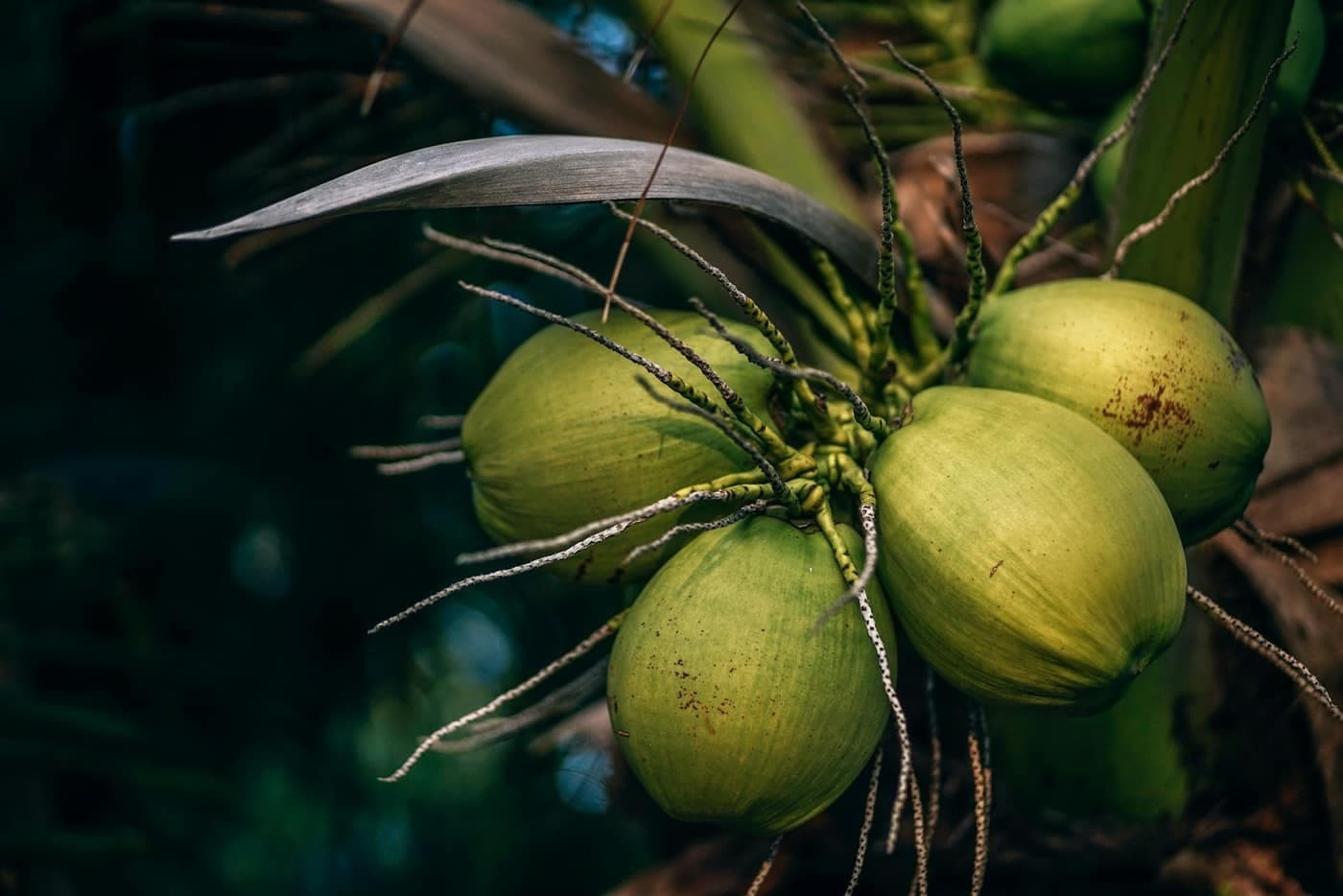
The kalpavriksha — a once-planted, decades-yielding palm that is the backbone of the coastal south. It rewards patience and steady moisture, and the real returns come not from raw nuts but from tender-coconut, copra and coir value addition once the palm is in full bearing.
Quick Summary
The key points from this page in about two minutes — read it or have it read aloud.
Quick Summary
The coconut palm, the kalpavriksha, is planted once and bears for sixty years or more, and it is the backbone of coastal farming across Kerala, Karnataka, Tamil Nadu and Andhra Pradesh. Every part is used — water, kernel, copra oil, coir, shell and timber.
Because a tall takes six to eight years to start bearing and longer still to reach full yield, the decisions made at planting shape the palm’s whole life: a well-selected seedling, the right site, good drainage, and steady moisture and care through the first few years. The site and climate rule is one line — plenty of moisture, never standing water. Coconut needs a lot of water but will not tolerate a high water table or waterlogging, and where rainfall is seasonal, irrigation through the dry months lifts yield sharply while long dry spells cause button shedding and small nuts.
The economics have moved decisively from selling raw nuts to value addition — tender-coconut water, good copra and oil, coir, and neera or coconut sugar in some states all earn far more at the farm gate than plain nuts. Through the bearing years the palm needs full sun and is not crowded or shaded, and two pests are watched: the rhinoceros beetle, and the red palm weevil, which can kill a palm from the inside. Cut tender nuts at about seven months for the sweetest water; for copra and seed, harvest fully mature nuts round the year. The page below carries the seedling-selection guidance, planting layout, the early-years moisture and drainage plan, pest management, value-addition options and nuts-per-palm yields.
- Crop type
- Perennial palm (60+ yrs)
- Planting
- Jun–Jul (monsoon)
- Suitable states
- 10+ major states
- First bearing
- 5–7 years (4–5 dwarf/hybrid)
- Water requirement
- High but well-drained
- Temperature
- 27–32°C, humid coastal
- Soil type
- Well-drained sandy loam/laterite
- Difficulty level
- Moderate
- Expected yield
- 80–120 nuts/palm/year
- Key practice
- Drainage + value addition
Overview
The coconut palm (Cocos nucifera), the “kalpavriksha” or tree of a thousand uses, is the backbone of coastal agriculture in Kerala, Karnataka, Tamil Nadu and Andhra Pradesh, with growing area in the east coast and the islands. Every part is used — water, kernel, copra oil, coir, shell and timber.
It is the ultimate long-term crop: planted once, it bears for 60 years or more, but a tall takes 6–8 years to start and reaches full yield later still. That long horizon makes the planting decisions — the right seedling, the right site, good drainage and steady moisture in the early years — decisive for the palm’s whole life.
The economics of coconut have shifted decisively from selling raw nuts to value addition: tender-coconut water, quality copra and oil, coir, and neera/sugar in some states earn far more than nuts at the farm gate. This guide follows the palm from seedling selection to full bearing, with drainage, moisture, the rhinoceros beetle and red palm weevil, and value addition as the levers that decide the return.
Crop timeline, sowing to harvest
A quick visual map of the season — jump to any section below for the detail behind each stage.
- Year 0
Planting
A 9–12 month, well-selected seedling set at 7.5 × 7.5 m in a large pit with FYM at the monsoon’s start.
- Year 1–3
Establishment
The young palm builds its root system and leaf crown; basins, mulch and steady moisture are critical now.
- Year 4–5
First flowering
Dwarfs and hybrids begin flowering around year 4–5; talls take 6–8 years to bear.
- Year 6–8
Bearing begins
The palm settles into regular bunch production, one inflorescence emerging from each leaf axil.
- Continuous
Bunch cycle
Each bunch takes about a year from flowering to a mature nut; bunches of different ages hang together.
- ~7 months
Tender-nut stage
For tender coconut (water), nuts are cut at about 7 months when the water is at its sweet best.
- ~11–12 months
Mature-nut harvest
For copra and seed, nuts are harvested fully mature every 30–45 days, round the year.
Suitable states
States where this crop is grown at scale, highlighted below. Your local Krishi Vigyan Kendra is still the final word for your specific block.
- Jammu and Kashmir
- Himachal Pradesh
- Punjab
- Uttarakhand
- Haryana
- Delhi
- Uttar Pradesh
- Rajasthan
- Bihar
- Jharkhand
- West Bengal
- Sikkim
- Assam
- Arunachal Pradesh
- Meghalaya
- Nagaland
- Manipur
- Mizoram
- Tripura
- Gujarat
- Madhya Pradesh
- Chhattisgarh
- Maharashtra
- Odisha
- Goa
- Telangana
- Andhra Pradesh
- Karnataka
- Kerala
- Tamil Nadu
- Puducherry
- Ladakh
- Chandigarh
Grown here
Climate requirements
Coconut is a palm of the humid coastal tropics — warm, humid and evenly wet, but always well-drained. It needs abundant water yet cannot stand a high water table, so the climatic and site rule together is “plenty of moisture, never standing water”. Where rainfall is seasonal, irrigation through the dry months lifts yield sharply.
Ideal temperature
27–32°C with high humidity is ideal; coconut is a humid-tropical palm and yields poorly where it is too cold, too dry or too seasonal
Rainfall
Wants 1,500–2,500 mm well distributed; it needs a lot of water but supplied on well-drained land — it will not take a high water table or waterlogging
Humidity
High, coastal humidity suits it best; long dry, low-humidity spells cause button shedding and small nuts unless irrigated
Sunlight
Full sun for a productive crown; the palm is a light-demander and yields poorly if crowded or heavily shaded
Soil requirements
Coconut adapts to a wide range of soils from coastal sands to laterites, but it always wants depth and drainage. The classic mistake is a high or waterlogged water table, which rots the roots and declines the palm. Building organic matter and burying husks in the basin is the standard way to hold moisture in the light soils it favours.
Suitable soil
Deep, well-drained sandy loam, laterite, coastal sandy and alluvial soils; adaptable but always needs depth and drainage
pH range
5.2–8.0 (wide)
Drainage
Good drainage with a water table not too near the surface — the palm needs moisture but rots and declines with a high or fluctuating water table
Organic matter
Responds strongly to organic matter, husk-burial and green manures in the basin, which hold moisture in the sandy soils it often grows on
Land preparation
Same four steps whichever region you are in — only the timing shifts with the sowing window.
- 1
Pits & husk burial
Dig large pits, part-fill with topsoil, FYM and buried husks/coir pith to hold moisture, especially on sandy or laterite soils.
- 2
Drainage & spacing
Ensure the site drains and lay out at 7.5 × 7.5 m (about 175 palms/ha); provide drainage channels where the water table is high.
- 3
Seedling selection
Select vigorous 9–12 month seedlings with early splitting, more leaves and a stout collar from a known mother palm.
Seed information
How the main varieties compare, so you can pick by duration, yield, disease pressure or what you are growing for.
| Variety | Duration | Yield | Disease resistance | Best state | Suitable for |
|---|---|---|---|---|---|
The hardy, long-lived tall of the west coast — late to bear but durable, drought-hardy and the backbone variety. | Bears in 6–8 years | High (long-term) | Fairly hardy | Kerala/Karnataka | Copra & oil, rainfed |
The tall of the east coast, adapted to the Tamil Nadu and Andhra conditions. | Bears in 6–8 years | High (long-term) | Fairly hardy | Tamil Nadu | Copra, east coast |
An early-bearing dwarf prized for sweet tender-coconut water; shorter-lived but quick to yield. | Bears in 4–5 years | High (tender nut) | Disease-prone | Kerala | Tender coconut (water) |
A Dwarf × Tall hybrid combining early bearing with high yield and bigger nuts — a modern commercial choice. | Bears in 4–5 years | Very high | Moderate | Kerala, Andhra Pradesh, Maharashtra | High-yield commercial |
Chandra Sankara (Dwarf × Tall hybrid) From ICAR-CPCRI Kasaragod — bears years earlier than a tall-variety seedling, at the cost of a shorter palm life and fresh seed nuts needed for the next planting rather than saved seed. | Bearing from year 3–4 (seedling) | 100–120 nuts/palm/year at full bearing | Shorter productive palm life than West Coast Tall — plan replanting on a shorter cycle | Kerala, Karnataka, Andhra Pradesh | High-yield commercial |
A dwarf type grown for tender nut and homestead use, quick to bear and easy to harvest. | Bears in 4–5 years | High (tender) | Variable | South India | Tender nut, homestead |
A dwarf type on the same tender-nut, homestead line as Malayan Dwarf, quick to bear and easy to harvest. | Bears in 4–5 years | High (tender) | Variable | South India | Tender nut, homestead |
- Seed rate
- About 175 seedlings/ha at 7.5 × 7.5 m (square); adjust for the system and variety
- Certified seed
- The seedling is the whole crop for 60 years, so choose it well: pick 9–12 month seedlings that germinated early, have more leaves and a stout collar, from a high-yielding, healthy mother palm or a reliable nursery. A poor seedling cannot be fixed later — this is the single most consequential decision in coconut.
- Spacing
- 7.5 × 7.5 m square (about 175 palms/ha) for talls/hybrids; closer for dwarfs
- Seed treatment
- Not a seed crop in the field sense — select the best-germinated, vigorous seedlings and reject weak or late ones before planting.
Sowing guide
Plant at the monsoon’s onset so the young palm establishes on natural moisture, and mulch and protect the basin through the first two or three years, which are the vulnerable ones. On a high water table, plant on a mound. The seedling and site chosen now decide the palm’s output for the next half-century.
- Best time
- Plant seedlings at the onset of the monsoon (June–July), or with assured irrigation in other months in the humid tracts
- Row spacing
- 7.5 m between rows
- Plant spacing
- 7.5 m within the row
- Sowing depth
- Plant so the collar is at ground level; on a high water table, plant on a mound and keep the bud clear
- Method
- Plant the selected seedling in a pit part-filled with topsoil, FYM and buried husks, firm in and mulch the basin
Fertilizer schedule
A split dose beats one large dose applied at sowing — nitrogen especially is lost to the air and to leaching if it all goes in on day one.
- 1
Young palm (yr 1–3)
Split, per year
Graduated FYM plus NPK in the basin, split over the year, building up as the palm grows; coconut also needs magnesium and, on coastal sands, potassium and chlorine.
- 2
Bearing palm
Annually
A full annual dose of FYM and NPK (with Mg) per palm, placed in the basin and worked in, to sustain continuous bunch production.
- 3
Micronutrients & organics
As needed
Husk burial, green manure and correcting deficiencies (Mg, B, S) keep the sandy soils fertile and moisture-holding.
Irrigation schedule
1. Establishment
Yr 1–3
Regular basin irrigation and heavy mulching in the dry months — the young palm is very drought-sensitive.
2. Dry season (bearing)
Summer
Irrigate bearing palms through the dry months (drip is ideal) — dry-spell stress causes button shedding and small nuts.
3. Monsoon
Rains
Rely on rain but keep the basins draining; never let water stand around the palm.
Critical stages
- Establishment (yr 1–3)
- Dry-season bearing
Water-saving tips
- Drip irrigation with a mulched basin sharply cuts water use and lifts dry-season yield.
- Burying coconut husks in the basin acts as a moisture sponge for months — a classic coconut water-saving practice.
- Basin mulch conserves the moisture that decides nut number in the dry season.
Weed management
Common weeds
Organic control
- Grow intercrops and cover crops (banana, pineapple, cocoa, fodder, legumes) in the wide inter-space — they suppress weeds and add income.
- Basin mulch with husks and fronds smothers weeds and holds moisture.
Chemical control
- Keep the palm basin clean; herbicide is rarely needed if intercropping and cover crops occupy the space.
- Spot-control aggressive climbers like Mikania that smother young palms.
Nutrient deficiency identification
What a shortage of each nutrient actually looks like on the plant, so you can tell a deficiency apart from a disease before you spray the wrong thing.
Potassium
Visible symptom
Yellowing and scorch of older fronds and reduced nut number — coconut is a heavy potassium user, especially on sands.
Magnesium
Visible symptom
Yellow-orange bands along the older-frond margins while the base stays green.
Nitrogen
Visible symptom
General paling of the crown and slow growth with fewer, shorter fronds.
Boron
Visible symptom
Crinkled, distorted new leaves and “fused” leaflets, and poor nut set.
Chlorine
Visible symptom
On inland/some soils, low chlorine limits yield — a nutrient coconut needs unusually much of.
Diseases to watch for
Symptoms, likely cause and what actually treats it — not just a spray name.
Bud rot
- Symptoms
- The spindle (youngest) leaf yellows, wilts and can be pulled out easily, with a foul-smelling rot of the growing bud; if the bud dies, the palm dies.
- Cause
- Phytophthora palmivora, favoured by the wet monsoon and worst in young palms.
- Treatment
- Cut out the rotten tissue early, apply Bordeaux paste/fungicide to the crown, and protect neighbouring palms preventively.
- Prevention
- Prophylactic fungicide/Bordeaux to the crown before the monsoon in disease-prone areas, and drainage and sanitation — this is a killer disease of the growing point.
Root (wilt) disease
- Symptoms
- Flaccid, ribbon-like flaccidity and yellowing of fronds, general decline and steadily falling yield; a chronic, debilitating disease of parts of Kerala.
- Cause
- A phytoplasma, insect-vectored, in endemic zones; it debilitates rather than quickly kills.
- Treatment
- No cure — manage with good nutrition, integrated pest and disease control, and replacing badly affected palms with tolerant varieties.
- Prevention
- Plant tolerant varieties in endemic zones, keep palms well-nourished and vector-managed, and remove severely diseased palms.
Ganoderma basal stem rot (Thanjavur wilt)
- Symptoms
- Yellowing and drooping of the whole crown, bleeding lesions and rot at the base of the trunk, with bracket fungi appearing; the palm slowly dies.
- Cause
- Ganoderma fungus in the soil, worst in water-stressed, ill-drained or poor palms.
- Treatment
- Isolate affected palms with a trench, apply recommended fungicide/bio-agent to the soil, and remove and destroy dead palms and stumps.
- Prevention
- Good drainage and nutrition, soil application of Trichoderma, and removing infected stumps that harbour the fungus.
Stem bleeding & leaf rot
- Symptoms
- Reddish-brown liquid oozing and bleeding from cracks on the trunk (stem bleeding), and rotting of the leaflets of the spindle/young leaves (leaf rot), often alongside root wilt.
- Cause
- Thielaviopsis (stem bleeding) and a fungal complex (leaf rot), favoured by stress and humidity.
- Treatment
- Chisel out bleeding lesions and paint with fungicide; cut and treat rotted leaf tissue and improve palm vigour.
- Prevention
- Keep palms well-nourished and unstressed, with good drainage and sanitation.
Pests to watch for
What to look for before the damage is visible, and organic options before you reach for a chemical.
Rhinoceros beetle
- Identification
- A large black beetle that bores into the crown and unopened spear leaf, leaving characteristic V-shaped cuts in the newly-opened fronds.
- Damage
- Crown boring damages the growing point and fronds and opens the door to bud rot and red palm weevil — a major, widespread pest.
- Organic control
- Destroy breeding sites (manure pits, decaying logs), hook out beetles, use pheromone traps and the Oryctes baculovirus/Metarhizium.
- Chemical control
- Place recommended insecticide/naphthalene in the leaf axils prophylactically where beetle pressure is high.
Red palm weevil
- Identification
- A reddish weevil whose grubs tunnel inside the trunk, often unseen until the crown wilts; oozing and gnawing sounds inside the stem are warning signs.
- Damage
- Internal tunnelling can kill the palm from inside and is very hard to detect early — a deadly, hidden pest, often entering through rhinoceros-beetle or pruning wounds.
- Organic control
- Avoid trunk injuries, seal cut ends, use pheromone traps to mass-trap adults, and remove and destroy dead palms that breed it.
- Chemical control
- Trunk injection/crown treatment with a recommended insecticide for infested palms, on expert advice.
Coconut eriophyid mite
- Identification
- Microscopic mites under the perianth of young buttons causing triangular pale patches, then warty, distorted, cracked, undersized nuts.
- Damage
- Severely downgrades nut appearance and size and cuts copra and market value; a widespread problem.
- Organic control
- Good nutrition and irrigation to keep palms vigorous, root-feeding of neem formulations, and crown sanitation.
- Chemical control
- Recommended acaricide/oil sprays or root-feeding directed at the young bunches where damage is heavy.
Black-headed caterpillar & rugose whitefly
- Identification
- Black-headed caterpillars feeding under galleries on the underside of fronds, browning the crown; rugose spiralling whitefly coating the underside of leaves with white wax and sooty mould.
- Damage
- Both reduce the palm’s effective leaf area and photosynthesis; heavy outbreaks noticeably cut yield.
- Organic control
- Release of parasitoids (a proven biocontrol for both pests), conserving natural enemies, and washing off whitefly wax.
- Chemical control
- Rarely needed and discouraged — broad sprays kill the parasitoids that control these pests best.
Common mistakes to avoid
The mistakes that cost growers the most, ranked by how often they show up in the field — not in the order you might expect.
- 1
Planting a poor or randomly-chosen seedling.
Why it hurts
The seedling determines 60 years of output and cannot be fixed later — always select an early-germinated, vigorous seedling with more leaves and a stout collar from a good mother palm.
- 2
Planting where the water table is high or the site waterlogs.
Why it hurts
Coconut needs lots of water but rots and declines with a high or fluctuating water table — ensure drainage, and plant on a mound where the table is near the surface.
- 3
Neglecting the palm in its first three years.
Why it hurts
The young palm is very drought- and weed-sensitive; skimping on mulch, moisture and protection in years 1–3 stunts it for life — this is the make-or-break period.
- 4
Under-feeding potassium and magnesium.
Why it hurts
Coconut on sandy soils is a heavy potassium and magnesium user; short them and fronds scorch, buttons shed and nut number falls — feed the full annual dose with Mg.
- 5
Leaving manure pits and rotting logs around the plantation.
Why it hurts
They are the breeding grounds of the rhinoceros beetle, which then bores the crowns and opens the way for bud rot and red palm weevil — destroy breeding sites as basic sanitation.
- 6
Injuring the trunk and ignoring red palm weevil.
Why it hurts
The weevil enters through wounds and tunnels the palm from inside, killing it before you see it — avoid trunk injuries, seal cuts, and mass-trap with pheromones.
- 7
Skipping pre-monsoon crown protection in bud-rot areas.
Why it hurts
Bud rot kills the growing point in the wet season; in disease-prone areas a prophylactic crown treatment before the monsoon is cheap insurance against losing the palm.
- 8
Leaving the wide inter-space empty.
Why it hurts
A young coconut plantation wastes years of open ground — intercropping (banana, pineapple, cocoa, fodder, spices) and cover crops earn income, suppress weeds and improve the soil while the palms mature.
- 9
Selling only raw nuts.
Why it hurts
Raw nuts at the farm gate earn the least — tender-coconut water, quality copra and oil, coir and neera add far more value, and the whole modern economics of coconut rests on that value addition.
- 10
Not removing dead or Ganoderma-hit palms and stumps.
Why it hurts
Dead palms and stumps breed red palm weevil and harbour Ganoderma that infects the rest — remove and destroy them promptly as sanitation.
Harvesting
Coconut is harvested continuously, round the year. For tender coconut (water), cut the nuts at about 7 months when the water volume and sweetness peak. For mature nuts (copra, oil, seed), harvest fully mature nuts — the husk browning and the water sloshing/reducing — every 30–45 days, taking each bunch as it matures. Harvest by trained climber, a mechanical/pole harvester or trained monkeys in some areas.
Signs it is ready
- Tender: ~7 months, maximum sweet water
- Mature: husk browned, kernel hard, water reduced
- Bunches taken in rotation as each matures
Tools
- Trained climber with a harvesting knife, or a pole/mechanical harvester
- Nets/care to avoid nuts damaging on the fall
- Regular 30–45 day harvest rounds
Expected yield
80–120 nuts per palm per year in a well-managed bearing plantation (good hybrids can exceed this), i.e. roughly 14,000–20,000+ nuts/ha/year
Post-harvest & storage
Storage
Mature nuts store for weeks; the real post-harvest work is processing — drying the kernel into copra (sun or kiln), and pressing copra for oil. Tender coconut is highly perishable and sold fresh fast, or the water is bottled.
Packaging
Nuts are bagged or bulk-handled; copra is graded and bagged dry; tender coconut is often trimmed/branded for the fresh trade. Coir and shell are separate product streams.
Transportation
Mature nuts and copra transport easily; tender coconut must move fast and cool as its water spoils. Value-added products (oil, coir) ship as durable goods.
Shelf life
Mature nuts: several weeks to months; copra and oil: months when properly dried/stored; tender coconut: a few days fresh.
Market prices
Today's mandi price near you, pulled live from the government's own Agmarknet data.
Live daily mandi prices from the government Agmarknet dataset.
Synced from data.gov.in (Agmarknet). Rates are ₹ per quintal.
Weather
Current conditions and a 5-day outlook for your selected location, with one line of stage-aware advice.
Pick your state for current conditions and a 5-day outlook.
Live data from Open-Meteo
Profit calculator
Your own cost sheet, expected yield and selling price — not ours.
Where the money goes
Share of the total cost per acre, using the calculator’s own default cost sheet below — adjust the numbers there to match your field and this picture will no longer apply to you exactly, but the ranking rarely changes.
- Labour26% (₹12,000)
- Land rent22% (₹10,000)
- Fertiliser17% (₹8,000)
- Irrigation13% (₹6,000)
- Seed7% (₹3,000)
- Pesticide & weedicide7% (₹3,000)
- Machinery4% (₹2,000)
- Interest4% (₹2,000)
Official downloads
Government and ICAR documents only — everything below is hosted on an official server.
Frequently asked questions
How soon does a coconut palm start bearing, and how long does it live?
It depends on the variety. Dwarfs and Dwarf×Tall hybrids begin flowering around year 4–5, while the hardy talls take 6–8 years to start and reach full yield later still. But once bearing, a coconut palm keeps producing for 60 years or more. That very long life is why the planting decisions — seedling, site, drainage and early care — matter so much: they shape the palm’s output for half a century.
How do I choose a good coconut seedling?
This is the single most important decision in coconut, because the seedling is the crop for the next 60 years and cannot be improved later. Choose a 9–12 month seedling that germinated early (early splitting is a sign of vigour), has more leaves than its siblings, an early splitting of leaves, and a stout collar, taken from a high-yielding, healthy mother palm or a reliable nursery. Reject weak, late-germinating or thin seedlings however cheap.
Coconut needs a lot of water — so why does drainage matter?
Because coconut needs abundant moisture but cannot tolerate a high or fluctuating water table or waterlogging, which rot the roots and slowly decline the palm. The rule is “plenty of moisture, never standing water”. On good-draining sandy or lateritic soil this is natural; where the water table is high, plant on a mound and provide drainage channels. Burying husks in the basin then holds moisture between rains without waterlogging.
What are the most dangerous pests of coconut?
The two most serious are the rhinoceros beetle and the red palm weevil, and they are linked. The rhinoceros beetle bores into the crown, damaging the growing point and fronds and opening wounds; the red palm weevil then enters those wounds (or pruning cuts) and tunnels the palm from inside, often killing it before you notice. Manage them together: destroy the beetle’s breeding sites (manure pits, rotting logs), avoid and seal trunk injuries, use pheromone traps, and remove dead palms that breed the weevil.
Is it worth growing coconut just for nuts?
Increasingly not — raw nuts at the farm gate earn the least, and the modern economics of coconut rests on value addition. Tender-coconut water, quality copra and oil, coir from the husk, and neera or coconut sugar in states that allow it earn far more than selling whole nuts. Intercropping the wide spacing with banana, pineapple, cocoa, spices or fodder adds further income, especially while the palms are young. Plan for value addition from the start.
Does coconut have an MSP?
Copra (dried coconut kernel) does have a Minimum Support Price announced each year, and agencies like NAFED/state bodies procure it under the price-support scheme — but the fresh coconut itself is a market commodity with no MSP, and its price swings with season and demand. Use the live mandi prices and the profit calculator on this page when planning, and remember that copra, oil and coir value addition are usually where the return is made.
Still have questions?
The FAQs above cover the common ones. For anything specific to your field and soil, your nearest Krishi Vigyan Kendra is the authoritative answer.