
Quinoa (Kinwa)
Chenopodium quinoa
A drought- and salt-tolerant rabi pseudocereal still new to Indian fields, grown on marginal land in Rajasthan, Himachal Pradesh, Uttarakhand and Ladakh where wheat and rice struggle — the two things that decide the crop are downy mildew, which can cut yield by up to a third to all of it in a bad year, and birds, which find the ripening grain heads as attractive as any buyer does.
Quick Summary
The key points from this page in about two minutes — read it or have it read aloud.
Quick Summary
Quinoa (Chenopodium quinoa) is a broadleaf pseudocereal, not a true grass grain, grown in India as a rabi-season crop mainly on the marginal, saline or drought-prone land where wheat and rice give a poor return. Rajasthan's Barmer, Bikaner, Jaisalmer and Nagaur belt carries the largest area, alongside Chittorgarh and Bhilwara; Himachal Pradesh (Lahaul-Spiti, Kinnaur, Kullu), Uttarakhand and the cold desert of Ladakh grow it at higher altitude, and ICAR has more recently introduced it as a trial crop in Arunachal Pradesh. Its appeal is straightforward: it needs far less water than wheat or rice, tolerates saline and alkaline soils that would fail most cereals, and fetches a premium price as a recognised global superfood.
The only named quinoa variety we found in an official release list is Him Shakti, from ICAR-NBPGR's regional station in Shimla, named in the September 2021 list of varieties dedicated to the nation. Beyond it, almost all commercial quinoa grown in India comes from imported or privately sourced seed lines, traded and sold by grain colour — white, red and black quinoa — through private exporters and contract-farming companies rather than as named bred varieties. That is not a gap in reliability so much as an honest reflection of how new this crop still is to Indian agriculture.
Two things decide whether a quinoa crop succeeds. The first is downy mildew (Peronospora variabilis), the pseudocereal's most damaging disease worldwide, capable of cutting yield anywhere from 30% to a complete crop loss in a bad, humid year. The second is birds: quinoa's ripening seed heads are conspicuous and attractive, and while the seed's natural bitter saponin coating discourages some feeding, it does not stop it — netting, scaring and timely harvest matter as much as any spray. The page below carries sowing and spacing, the fertiliser schedule, the shared and quinoa-specific disease and pest list, and realistic state-wise yield.
- Crop type
- Pseudocereal (broadleaf grain crop)
- Season
- Rabi
- Suitable states
- Rajasthan, Himachal Pradesh, Uttarakhand, Ladakh
- Growing duration
- 90–150 days, by variety and sowing date (87–99 days in a Pune trial)
- Water requirement
- Low; drought-tolerant
- Temperature
- Cool-season growth; heat above ~35°C at flowering hurts seed set
- Soil type
- Tolerates saline & alkaline marginal soils; needs drainage
- Difficulty level
- Moderate (downy mildew, bird pressure)
- Expected yield
- Varies widely with sowing date: 1,446 kg/ha from 1 Nov sowing against 346 from 15 Dec at Pune
- Key risk
- Downy mildew and bird damage at grain fill
Overview
Quinoa (Chenopodium quinoa) is a broadleaf pseudocereal — grown and eaten like a grain crop, but botanically a relative of spinach and the common bathua (Chenopodium album) weed rather than a true grass like wheat or rice. It is grown in India as a rabi crop, mainly on marginal, saline or drought-prone land in Rajasthan, Himachal Pradesh, Uttarakhand and Ladakh.
The crop's draw is its tolerance: it needs far less water than wheat or rice, copes with saline and alkaline soils that defeat most cereals, and commands a premium price as a globally recognised superfood grain. Indian trial yields swing widely with sowing date and site: an ICAR-NIASM trial at Pune gave 1,446 kg/ha from a 1 November sowing and 346 kg/ha from 15 December, while a Nagaur (Rajasthan) trial gave under 100 kg/ha.
The one named quinoa variety in an official release list is Him Shakti from NBPGR Shimla (September 2021 list). The rest of the commercial crop is grown from imported or privately traded seed lines, sold by grain colour rather than a named variety, and moves mostly through private exporters and contract-farming arrangements rather than an open seed market — an honest reflection of how new this crop still is here.
Crop timeline, sowing to harvest
A quick visual map of the season — jump to any section below for the detail behind each stage.
- Day 0
Sowing
Seed drilled or broadcast shallow, 2–5 cm deep, into a fine, moist rabi seedbed — sown as early as October in parts of Rajasthan, through the first half of December in trial conditions elsewhere.
- Day 3–5
Emergence
Germination is fast under good soil moisture; seedlings are small and slow-growing at first, vulnerable to weed competition.
- Day 20–25
Thinning
Seedlings are thinned to their final spacing once they reach 20–25 cm, and the first weeding is usually done alongside it.
- Day 30–60
Branching & vegetative growth
The plant builds height and branches; this is also the window for a top-dressing of nitrogen.
- Day 60–90
Panicle formation & flowering
Seed-bearing panicles form and flower; humid, cloudy weather now is the biggest risk window for downy mildew.
- Day 90–130
Grain fill
Grain fills and the panicle turns from green to its mature colour (gold, red or dark, depending on the type); bird pressure builds as grain fills.
- Day 90–150
Harvest
Whole panicles or plants are cut once grain is hard and the plant has dried down, then dried further and threshed.
Suitable states
States where this crop is grown at scale, highlighted below. Your local Krishi Vigyan Kendra is still the final word for your specific block.
- Jammu and Kashmir
- Himachal Pradesh
- Punjab
- Uttarakhand
- Haryana
- Delhi
- Uttar Pradesh
- Rajasthan
- Bihar
- Jharkhand
- West Bengal
- Sikkim
- Assam
- Arunachal Pradesh
- Meghalaya
- Nagaland
- Manipur
- Mizoram
- Tripura
- Gujarat
- Madhya Pradesh
- Chhattisgarh
- Maharashtra
- Odisha
- Goa
- Telangana
- Andhra Pradesh
- Karnataka
- Kerala
- Tamil Nadu
- Puducherry
- Ladakh
- Chandigarh
- Lakshadweep
- Andaman and Nicobar Islands
- Dadra and Nagar Haveli and Daman and Diu
Grown here
Climate requirements
Quinoa's entire case for a place in Indian agriculture rests on tolerance most cereals do not have — drought, salinity and marginal soils — rather than on being an easy, forgiving crop in every other respect. Downy mildew and bird pressure still need active management regardless of how little water and fertiliser the crop otherwise asks for.
Ideal temperature
A cool-season crop through most of its cycle; grows well in a wide range but heat stress above roughly 35°C at flowering hurts pollen viability and seed set
Rainfall
Genuinely low-water — much of Rajasthan's crop is grown on residual soil moisture with limited supplemental irrigation, which is the main reason it is trialled on land wheat and rice cannot profitably use
Humidity
Low humidity is best; warm, humid, cloudy weather around flowering and grain fill is what drives downy mildew, the crop's worst disease
Sunlight
Full sun for the best branching, flowering and grain fill
Soil requirements
Quinoa's real agronomic niche in India is the marginal field a normal cereal would fail on — saline, alkaline or drought-prone land — rather than displacing wheat or rice on good irrigated soil where those crops already out-yield it.
Suitable soil
Tolerates saline and alkaline soils that defeat most cereals, and performs on marginal, low-fertility land; still needs reasonable drainage, since it does not tolerate waterlogging
pH range
Wide tolerance, roughly 6.0–8.5, including moderately saline and alkaline soils
Drainage
Good drainage matters even though the crop is otherwise unusually soil-tolerant — standing water at germination or after sowing damages the crop
Organic matter
Moderate; the crop performs on lower-fertility land than most cereals would tolerate, though it still responds to basal fertiliser
Land preparation
Same four steps whichever region you are in — only the timing shifts with the sowing window.
- 1
Fine, moist seedbed
Two to three ploughings and planking to a fine tilth, since the seed is small and sown shallow.
- 2
Basal fertility on marginal land
A basal dose of farmyard manure and fertiliser still improves establishment even though the crop is bred to tolerate poor soils.
- 3
Choose drained ground
Avoid low-lying, waterlogging-prone plots even on otherwise marginal or saline land, since standing water — not salinity — is what the crop cannot tolerate.
Seed information
How the main varieties compare, so you can pick by duration, yield, disease pressure or what you are growing for.
| Variety | Duration | Yield | Disease resistance | Best state | Suitable for |
|---|---|---|---|---|---|
The only quinoa named in the September 2021 list of varieties dedicated to the nation (protein 15.64%, oil 8.91%), developed at ICAR-NBPGR's regional station in Shimla. | Not published | No release yield published; 96 kg/ha in one 2022-23 Nagaur trial table | No rating published; early, steady flowering in the Nagaur trial | Himachal Pradesh, wider Himalayan and hill trials | Farmers who want a named Indian release and will test seed germination first |
The cream-coloured grain type, a trade class sold from imported or traded seed lines and not a named bred variety. | No colour figure; 87–99 days in one Pune trial | No colour figure; about 100–3,700 kg/ha across Indian trials | Not separately documented; standard field hygiene and downy mildew management apply | Rajasthan, Uttarakhand | Farmers with a buyer who asks for plain quinoa |
A red-to-pink grain type whose colour comes from betanin pigments; a trade class sourced the same way as white quinoa, not a bred variety. | No colour figure; 87–99 days in one Pune trial | No colour figure; about 100–3,700 kg/ha across Indian trials | Not separately documented | Rajasthan, Himachal Pradesh | Farmers with a buyer who asks for red grain |
The darkest grain type, with the most phenolic compounds of three colours in one 2015 study; a trade class, not a bred variety. | No colour figure; 87–99 days in one Pune trial | No colour figure; about 100–3,700 kg/ha across Indian trials | Not separately documented | Rajasthan | Farmers with a buyer who asks for black grain |
- Seed rate
- About 5 kg/ha at 45 × 15 cm in the ICAR-NIASM Pune trial; 8–10 kg/ha is commonly advised for line sowing and 15–20 kg/ha for broadcast sowing
- Certified seed
- With only one ICAR-released variety in the country, most Indian growers sow imported or privately traded seed lines. Confirm the grain-colour type and germination percentage with the seller before sowing, and settle which colour a contract-farming buyer actually wants before committing land to it.
- Spacing
- Indian field trials found 30 cm row spacing gave meaningfully higher grain yield per hectare than wider 45 cm rows, even though individual plants performed better at the wider spacing — plant density, not per-plant size, is what drives yield here
- Seed treatment
- A standard fungicide seed treatment (such as Thiram or Carbendazim) guards against damping-off at the vulnerable seedling stage, the same practice used across other small-seeded crops on this site.
Sowing guide
Because the seed and seedling are both small, a fine, weed-free seedbed and prompt thinning matter more for quinoa than for a large-seeded cereal like wheat.
- Best time
- A rabi crop, sown as early as October in parts of Rajasthan and through November–December in most other growing areas; in a two-winter ICAR-NIASM trial near Pune, a 1 November sowing gave 1,446 kg/ha and a 15 December sowing only 345.61 kg/ha
- Row spacing
- 30 cm (higher-yielding in Indian trials than a wider 45 cm)
- Plant spacing
- Thinned to roughly 20 cm within the row once seedlings reach 20–25 cm tall
- Sowing depth
- 2–5 cm, shallow, since the seed is small
- Method
- Drill or broadcast shallow into a fine, moist seedbed; germination is fast (within 24 hours under good moisture, seedlings emerging in 3–5 days), but seedlings are small and need protection from weed competition and birds early on
Fertilizer schedule
A split dose beats one large dose applied at sowing — nitrogen especially is lost to the air and to leaching if it all goes in on day one.
- 1
Basal (at sowing)
Day 0
Full phosphorus and potash with about half the nitrogen — a total programme of roughly 120 kg N : 50 kg P₂O₅ : 50 kg K₂O per hectare, higher than most niche crops on this site since quinoa is grown as a genuine grain crop, not a low-input spice.
- 2
Top-dressing
Branching stage (~30–40 days)
The remaining nitrogen, applied with an irrigation or on adequate soil moisture during active vegetative growth.
- 3
Marginal-land caveat
Throughout
On genuinely poor, saline or low-fertility land where quinoa is often deliberately placed, actual response to fertiliser can be more modest than these figures suggest — a soil test is worth more than a fixed recipe on this crop.
Irrigation schedule
1. Germination
Day 0–5
Adequate soil moisture at sowing is what drives quinoa's fast, even germination; a light irrigation helps where the seedbed is not already moist.
2. Branching to flowering
30–90 days
Light, infrequent irrigation during dry spells supports branching and flowering, though much of Rajasthan's crop runs mainly on residual soil moisture with minimal supplemental watering.
3. Grain fill
90–130 days
Some moisture through grain fill improves size and yield, but avoid waterlogging — the crop tolerates drought far better than standing water.
Critical stages
- Germination
- Flowering
- Grain filling
Water-saving tips
- Quinoa's core advantage over wheat and rice is exactly this: it needs far less water and can be grown largely on residual moisture on suitable land.
- Because it does not tolerate waterlogging, resist the instinct to irrigate heavily just because the crop is planted on otherwise poor or marginal land.
- Where irrigation is available, use it sparingly at the critical germination, flowering and grain-fill windows rather than on a routine schedule.
Weed management
Common weeds
Organic control
- Hand weeding at thinning time (20–25 days) and again a few weeks later handles most of the early competition, since the crop's small seedlings are otherwise easily crowded out.
- A closer 30 cm row spacing, kept for yield reasons anyway, also helps the canopy close and shade out weeds sooner than a wider spacing would.
Chemical control
- Herbicide choice needs real care: quinoa is itself a Chenopodium species, closely related to the common bathua weed, so several herbicides that control bathua in other crops can also injure quinoa. Confirm any product is specifically cleared for quinoa before spraying, rather than assuming a standard broadleaf herbicide is safe.
- Where a cleared product is not available, mechanical and hand weeding are the more reliable route for this crop.
Nutrient deficiency identification
What a shortage of each nutrient actually looks like on the plant, so you can tell a deficiency apart from a disease before you spray the wrong thing.
Nitrogen
Visible symptom
Pale, small, slow-growing plants with reduced branching and panicle size.
Phosphorus
Visible symptom
Stunted early growth and delayed flowering, most noticeable on the marginal, low-fertility soils this crop is often grown on.
Potassium
Visible symptom
Weak stems more prone to lodging under wind or the weight of a full grain head.
Diseases to watch for
Symptoms, likely cause and what actually treats it — not just a spray name.
Downy mildew
- Symptoms
- Yellow patches on the upper leaf surface with a corresponding greyish-purple downy fungal growth on the underside; badly affected plants show stunted growth and poor panicle fill.
- Cause
- Peronospora variabilis, favoured by humid, cloudy weather, especially around flowering and grain fill; the most damaging quinoa disease worldwide, capable of losses from 30% up to total crop failure in a severe, humid year.
- Treatment
- Spray a recommended fungicide such as Mancozeb at first appearance and repeat through humid spells.
- Prevention
- Avoid dense stands so air moves freely, use treated seed, and scout closely around flowering — this is quinoa's single biggest disease risk and deserves the same attention a farmer would give wilt in cumin or blight in fennel.
Leaf spot
- Symptoms
- Small, roughly circular brown or grey spots on leaves that enlarge and can merge, causing premature leaf loss and reduced photosynthetic area feeding the grain.
- Cause
- Fungal leaf-spot pathogens (Cercospora and related species), favoured by humid, cloudy conditions similar to downy mildew.
- Treatment
- Spray Mancozeb or a recommended fungicide at first appearance.
- Prevention
- Use treated seed, avoid dense sowing and rotate crops on a field with a history of leaf-spot problems.
Damping-off
- Symptoms
- Seedlings collapse and die at or just after emergence, often in patches of the seedbed.
- Cause
- Soil-borne fungi favoured by waterlogged, poorly drained seedbeds — the same risk small-seeded nursery and direct-sown crops face generally.
- Treatment
- No effective in-crop cure for affected seedlings; improve drainage and re-sow gaps if the loss is significant.
- Prevention
- Treat seed with a fungicide before sowing and avoid a waterlogged seedbed, especially important for quinoa's small, vulnerable seedlings.
Pests to watch for
What to look for before the damage is visible, and organic options before you reach for a chemical.
Aphids
- Identification
- Small soft-bodied insects clustering on tender shoots, leaves and developing panicles.
- Damage
- Colonies suck sap, weaken the plant and can foul developing grain heads, cutting both vigour and grain quality.
- Organic control
- Neem oil sprays and conserving natural predators like ladybird beetles by avoiding early broad-spectrum insecticide use.
- Chemical control
- A recommended insecticide once colonies cross a damaging threshold.
Leaf miner
- Identification
- Pale, winding tunnels visible within the leaf tissue where larvae feed between the upper and lower leaf surfaces.
- Damage
- Reduces the leaf area available for photosynthesis, weakening the plant during branching and flowering.
- Organic control
- Remove and destroy heavily mined leaves and conserve natural parasitic wasps that attack the larvae.
- Chemical control
- A recommended systemic insecticide where infestation is heavy enough to threaten yield.
Birds
- Identification
- Sparrows and other grain-feeding birds gathering on ripening panicles as grain fill progresses.
- Damage
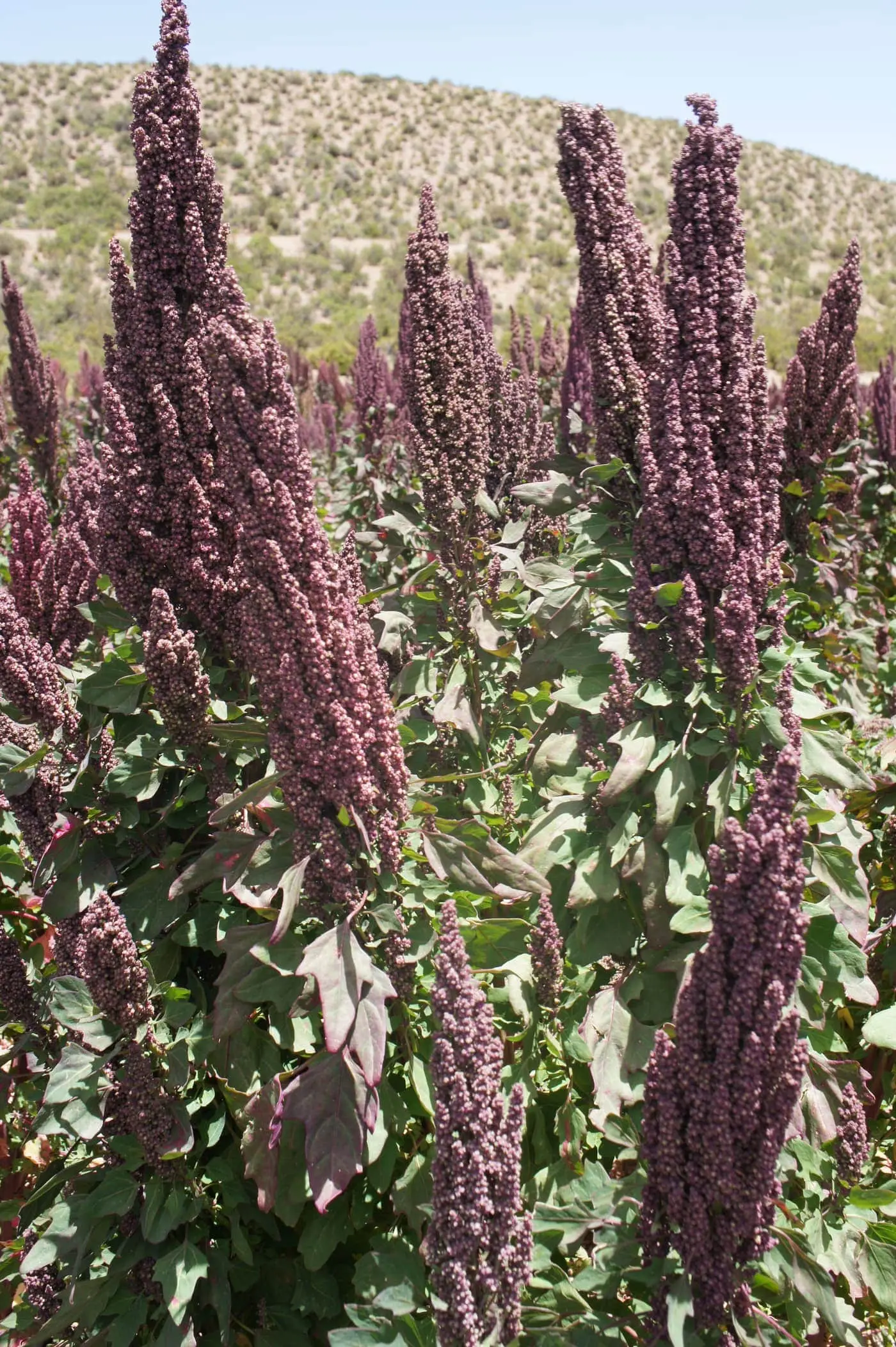
- Quinoa's seed heads are large, exposed and highly visible, and while the seed's natural bitter saponin coating discourages some feeding, it does not stop determined birds — losses can be significant in the final weeks before harvest if the crop is left unprotected.
- Organic control
- Netting over panicles, scaring devices, and coordinated timing of harvest across a growing area so birds cannot simply move between fields at different ripening stages.
- Chemical control
- Not applicable — bird damage is managed physically and culturally, not chemically.
Common mistakes to avoid
The mistakes that cost growers the most, ranked by how often they show up in the field — not in the order you might expect.
- 1
Sowing at a wide 45 cm row spacing to give plants more room.
Why it hurts
Indian trials found individual plants do look better at 45 cm, but grain yield per hectare is meaningfully higher at a closer 30 cm spacing — plant density, not per-plant size, is what pays here.
- 2
Reaching for a standard broadleaf herbicide to control bathua and other weeds.
Why it hurts
Quinoa is itself a Chenopodium species closely related to bathua, so many herbicides that kill bathua can injure quinoa too — confirm a product is specifically cleared for quinoa before spraying.
- 3
Assuming a drought-tolerant, low-input crop needs no active management.
Why it hurts
Downy mildew and bird pressure are both real, yield-limiting risks that need scouting and action regardless of how little water and fertiliser quinoa otherwise asks for.
- 4
Leaving ripening panicles unprotected from birds.
Why it hurts
Quinoa's exposed seed heads attract birds even with their bitter saponin coating, and unmanaged losses can be significant in the weeks before harvest — net, scare or time harvest with this in mind.
- 5
Overwatering because the crop is on otherwise poor or marginal land.
Why it hurts
Quinoa tolerates drought far better than waterlogging — heavy irrigation on top of marginal soil can do more harm than the dry conditions it was meant to fix.
- 6
Committing land to a grain colour before confirming what a contract buyer actually wants.
Why it hurts
White, red and black quinoa move through separate, mostly private trade channels — sowing the wrong colour for your buyer can leave you without a ready market at harvest.
Harvesting
Cut whole panicles or plants once the grain is hard when pressed between the fingers and the panicle has turned from green to its mature colour (gold, red or dark depending on the type), usually 90–150 days after sowing depending on variety and sowing date (87–99 days in the Pune trial). Harvesting on time matters doubly here, since both shattering losses and bird damage increase the longer a mature crop stands in the field.
Signs it is ready
- Grain hard, not milky, when pressed
- Panicle colour changed from green to mature gold/red/dark
- Leaves largely yellowed and dropped from the lower plant
Tools
- Sickle to cut whole panicles or plants
- Tarpaulin for drying and threshing
- Netting or scaring devices used through the final ripening weeks, not just at harvest
Expected yield
Trial yields vary widely with sowing date and site: 1,446 kg/ha from a 1 November sowing at Pune against 346 kg/ha from 15 December (ICAR-NIASM), and under 100 kg/ha in a Nagaur, Rajasthan trial. No state-wise average is published
Post-harvest & storage
Storage
Dry grain to a safe moisture level before storage, then keep clean and dry in a cool, airy store the same as any small grain; well-dried quinoa keeps for many months.
Packaging
Pack clean, well-dried grain in clean bags kept off the floor in a dry store.
Transportation
Move dry grain protected from moisture; most quinoa moves to a contract-farming buyer or processor rather than an open grain market.
Shelf life
Many months for well-dried, properly stored grain. Note that raw quinoa carries a bitter natural saponin coating on the seed coat that is normally washed or mechanically pearled off before the grain is cooked and eaten — this processing step is usually handled by the buyer or processor, not the farmer, but is worth knowing when discussing terms with a contract buyer.
Market prices
Today's mandi price near you, pulled live from the government's own Agmarknet data.
Live daily mandi prices from the government Agmarknet dataset.
Synced from data.gov.in (Agmarknet). Rates are ₹ per quintal.
Weather
Current conditions and a 5-day outlook for your selected location, with one line of stage-aware advice.
Pick your state for current conditions and a 5-day outlook.
Live data from Open-Meteo
Profit calculator
Your own cost sheet, expected yield and selling price — not ours.
Where the money goes
Share of the total cost per acre, using the calculator’s own default cost sheet below — adjust the numbers there to match your field and this picture will no longer apply to you exactly, but the ranking rarely changes.
- Land rent32% (₹7,000)
- Labour28% (₹6,000)
- Fertiliser15% (₹3,200)
- Machinery7% (₹1,500)
- Pesticide & weedicide6% (₹1,200)
- Irrigation6% (₹1,200)
- Seed4% (₹800)
- Interest3% (₹700)
Official downloads
Government and ICAR documents only — everything below is hosted on an official server.
ICAR-NBPGR Regional Station, Shimla
National Bureau of Plant Genetic Resources — home of the Him Shakti quinoa release
ICAR — All India Coordinated Research Network on Potential Crops
National coordination for emerging crops including quinoa
Kisan Call Centre — 1800-180-1551
Free crop advice in your language
Frequently asked questions
Is quinoa a real grain like wheat or rice?
Not botanically — quinoa is a pseudocereal, a broadleaf plant related to spinach and the common bathua weed rather than a true grass like wheat or rice. It is grown and eaten like a grain crop, but agronomically it behaves quite differently, including its unusual tolerance for drought and saline soil and its shared weed-control challenges with bathua.
Is there a government-released quinoa variety in India?
Yes, one that we found: Him Shakti, from ICAR-NBPGR's regional station in Shimla, named in the September 2021 list of varieties dedicated to the nation. Almost all other commercial quinoa grown in India comes from imported or privately traded seed lines sold by grain colour (white, red, black) rather than a named bred variety.
Why is quinoa grown on marginal or saline land instead of good farmland?
Because that is exactly where it earns its place — quinoa tolerates saline and alkaline soils and needs far less water than wheat or rice, so it gives a usable crop on land those cereals would fail on or give a poor return from. On good irrigated soil, wheat or rice typically out-yield it, so quinoa's real niche in India is the difficult field, not the best one.
Why do birds damage quinoa so much?
Quinoa's seed heads are large, exposed and highly visible as they ripen, and while the seed carries a naturally bitter saponin coating that discourages some feeding, it does not stop determined birds. Netting, scaring devices and timing harvest promptly once grain is mature are the main defences, since there is no chemical control for this problem.
Can I use a normal weed spray on quinoa?
Be careful — quinoa is itself a Chenopodium species, closely related to the common bathua weed, so several herbicides that control bathua and similar broadleaf weeds in other crops can also injure quinoa. Confirm any product is specifically cleared for use on quinoa before spraying; hand and mechanical weeding are the safer default.
Does quinoa have an MSP or mandi trade in India?
No MSP — quinoa is not a CACP-notified crop. It does see genuine, if thin, mandi trade at a small number of markets (Mandsaur, Neemuch and Jaora in Madhya Pradesh have reported records), alongside sale through private exporters and contract-farming arrangements, which handle most of the crop. Confirm your buyer and price before committing land, since the open mandi trade alone is not yet reliable for this crop.
Still have questions?
The FAQs above cover the common ones. For anything specific to your field and soil, your nearest Krishi Vigyan Kendra is the authoritative answer.