
Jamun (Indian Blackberry)
Syzygium cumini
A widely grown Indian native fruit tree — Uttar Pradesh, Maharashtra, Gujarat, Haryana, Karnataka, Tamil Nadu and Bihar all carry real production — where a grafted plant of a named variety bears in 4–5 years with known, seedless or near-seedless fruit quality, against 8–10 years and unpredictable fruit from a seedling; the ripe black plum is eaten fresh and processed into juice, vinegar and seed powder, with a genuine, long-standing traditional association with diabetes management that this guide states factually, without medical-cure claims.
Quick Summary
The key points from this page in about two minutes — read it or have it read aloud.
Quick Summary
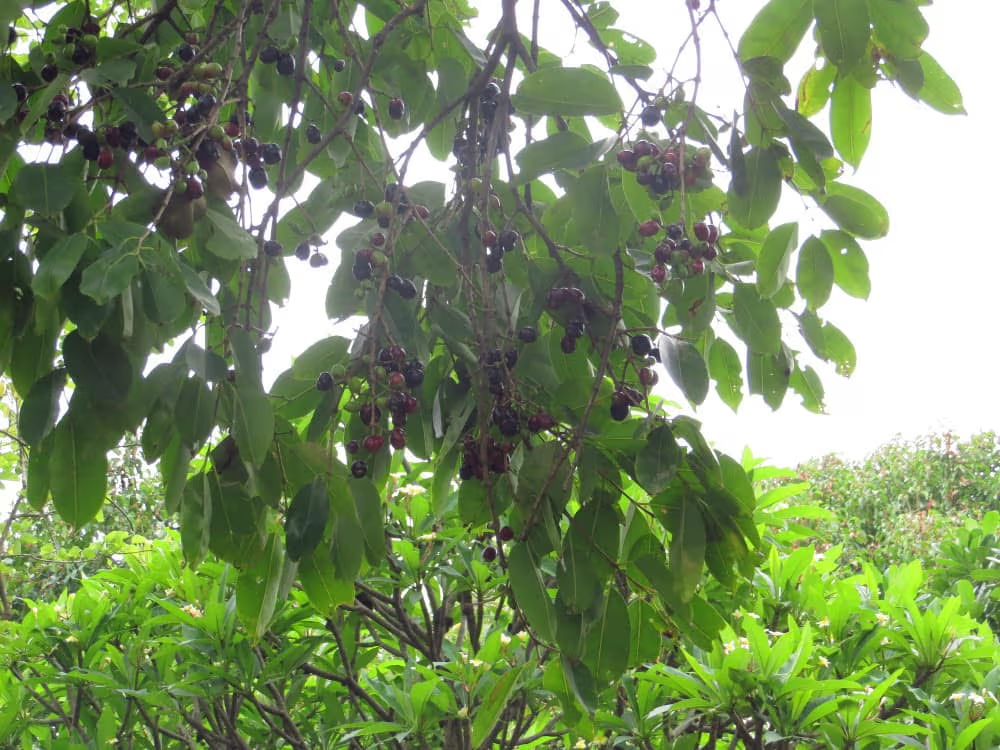
Jamun (Syzygium cumini), also called Indian blackberry or black plum, is a large, hardy, evergreen fruit tree native to India and widely grown across Uttar Pradesh, Maharashtra, Gujarat, Haryana, Karnataka, Tamil Nadu and Bihar, often along roadsides, field bunds and homesteads as well as in dedicated orchards.
As with most Indian fruit trees, the single decision that changes the whole economics is grafted versus seedling planting material. A seedling tree takes 8–10 years to bear, grows very tall, and gives fruit of unpredictable size, seed content and sweetness. A grafted plant of a named variety — Konkan Bahadoli, Goma Priyanka, Rajendra Jamun-1, Narendra Jamun-6, or a CISH Lucknow selection — bears in about 4–5 years on a more manageable tree, and some releases (CISH J-42) are bred specifically to be seedless or near-seedless, a trait that commands a real price premium since seed content is the main quality complaint about ordinary jamun.
The ripe, deep purple-black fruit is eaten fresh, and a real share of the crop is processed into juice, squash, vinegar and jamun seed powder. Jamun carries a genuine, long-standing traditional association with blood-sugar management in Indian home remedies and Ayurvedic use, particularly the seed — a real cultural and commercial fact worth stating plainly, though this guide makes no medical claim that jamun cures or replaces treatment for diabetes; anyone managing the condition should follow their doctor's advice.
The tree tolerates a wide range of conditions and is genuinely more sodicity-tolerant than many fruit trees, making it a workable choice on soils that reject fussier crops, though it still wants decent drainage and a real dry spell to fruit well.
- Crop type
- Perennial evergreen fruit tree
- Season
- Planted at monsoon onset (June–July); harvest May–July
- Suitable states
- Uttar Pradesh, Maharashtra, Gujarat, Haryana, Karnataka, Tamil Nadu, Bihar
- Time to bearing
- 4–5 years (grafted); 8–10 years (seedling)
- Water requirement
- Moderate at establishment; a mature tree tolerates dry spells well
- Temperature
- Tropical–subtropical; tolerates a wide range once established
- Soil type
- Wide tolerance, including sodic/alkaline soils; pH 6.0–8.5
- Difficulty level
- Easy (fruit fly at ripening is the main watch-out)
- Expected yield
- 80–150 kg fruit per mature grafted tree per year
- Key decision
- Grafted seedless/near-seedless variety versus an unpredictable seedling
Overview
Jamun, or Syzygium cumini — known in English as Indian blackberry, black plum or java plum — is a large, hardy, evergreen fruit tree native to India, widely grown across Uttar Pradesh, Maharashtra, Gujarat, Haryana, Karnataka, Tamil Nadu and Bihar. Much of the tree seen across the country grows informally along roadsides, field bunds, canal banks and homesteads rather than in a dedicated orchard, though named-variety orchard plantings are a real and growing part of the crop.
The decision that most changes a jamun grower's outcome is grafted planting material versus a seedling tree. A seedling takes roughly 8–10 years to first bear, grows into a very large, hard-to-manage tree, and gives fruit of unpredictable size, sweetness and — critically — seed content. A grafted plant of a named variety bears in about 4–5 years on a smaller, more manageable tree and reproduces the parent's known fruit quality, including, for a few specific releases, a genuinely seedless or near-seedless fruit that fetches a real premium over ordinary jamun's dominant, often-large seed.
Konkan Bahadoli (Regional Fruit Research Station, Vengurla, Maharashtra), Goma Priyanka (ICAR-CHES Godhra, Gujarat), Rajendra Jamun-1 (Bihar Agricultural University, Sabour) and Narendra Jamun-6 (Narendra Dev University of Agriculture and Technology, Faizabad, Uttar Pradesh) are real, named, institution-released varieties, alongside CISH Lucknow selections such as CISH J-37 and the seedless CISH J-42. Comparative trials have found real differences between these releases — Goma Priyanka recording higher fruit and pulp weight and yield than Konkan Bahadoli in one study, while Konkan Bahadoli showed the best graft success and survival rate and CISH J-37 the strongest sodicity tolerance in others — genuine, research-documented distinctions worth knowing before choosing a variety, not interchangeable marketing names.
The ripe fruit is eaten fresh and also processed into juice, squash, vinegar and jamun seed powder. Jamun has a real, long-standing place in Indian home remedies and Ayurvedic practice as a traditional aid to blood-sugar management, especially via the seed — a genuine cultural and commercial fact that supports real demand for seed powder, stated here factually and without any claim that it cures or substitutes for medical treatment of diabetes; anyone managing the condition should follow their doctor's guidance rather than self-treat with jamun.
Crop timeline, sowing to harvest
A quick visual map of the season — jump to any section below for the detail behind each stage.
- Year 0
Planting
A grafted plant of a named variety is set into a manure-filled pit at the start of the monsoon (June–July), staked and basin-irrigated until the rains take over.
- Year 1–3
Establishment & training
The young tree is trained to a strong framework of well-spaced main branches, protected from grazing, and given occasional watering through its first dry seasons.
- Year 4–5
First bearing
A grafted improved variety begins flowering and setting a first light crop; a seedling tree gives nothing useful until 8–10 years.
- March–April
Flowering
Small, fragrant, greenish-white flowers open in dense clusters — the key window for pollinator activity and any available irrigation.
- April–June
Fruit development
Fruit fills over roughly two to three months, changing from green to pink to the mature deep purple-black colour as it ripens.
- May–July
Harvest
Ripe, fully purple-black fruit is picked, mostly by hand, in repeated rounds over several weeks as successive fruit ripens across the tree.
Suitable states
States where this crop is grown at scale, highlighted below. Your local Krishi Vigyan Kendra is still the final word for your specific block.
- Jammu and Kashmir
- Himachal Pradesh
- Punjab
- Uttarakhand
- Haryana
- Delhi
- Uttar Pradesh
- Rajasthan
- Bihar
- Jharkhand
- West Bengal
- Sikkim
- Assam
- Arunachal Pradesh
- Meghalaya
- Nagaland
- Manipur
- Mizoram
- Tripura
- Gujarat
- Madhya Pradesh
- Chhattisgarh
- Maharashtra
- Odisha
- Goa
- Telangana
- Andhra Pradesh
- Karnataka
- Kerala
- Tamil Nadu
- Puducherry
- Ladakh
- Chandigarh
- Lakshadweep
Grown here
Climate requirements
Jamun's wide climate tolerance is real, but a young grafted plant still needs the same first-two-years care as any other fruit tree — the crop's reputation for hardiness applies mainly once the tree is established.
Ideal temperature
A genuinely tropical-to-subtropical tree that tolerates a wide temperature range once mature, thriving in real summer heat; young grafted plants benefit from some frost protection in their first winter or two in the cooler parts of its northern range.
Rainfall
Moderate rainfall, roughly 600–1,500 mm a year, suits jamun well, and the tree copes with a genuine dry season once established — in fact a distinct dry spell around flowering and fruit set helps rather than hurts, while excess rain right at flowering can cause flower drop.
Humidity
Tolerates a range of humidity; prolonged wet, humid weather at flowering favours minor fungal problems and can affect fruit set.
Sunlight
Full sun gives the best flowering, fruit set and fruit colour; jamun is not a shade-tolerant tree for fruiting purposes, even though it is often planted as a shade tree for its size and canopy.
Soil requirements
Jamun's sodicity tolerance is a genuine reason to consider it for land that struggles with other fruit crops, but "tolerant of poor soil chemistry" is not the same as "tolerant of waterlogging" — drainage still matters.
Suitable soil
Grows on a wide range of soils from deep loam to fairly poor, shallow or clayey ground; genuinely more tolerant of sodic and alkaline soil than most fruit trees, a real and research-documented trait, though it still performs best on decent, well-drained loam.
pH range
Roughly 6.0–8.5, with real sodicity tolerance documented in comparative cultivar studies — some releases (CISH J-37) notably more tolerant than others.
Drainage
Needs reasonable drainage — jamun tolerates poor soil chemistry better than poor soil structure, and a genuinely waterlogged site still causes root problems regardless of how sodicity-tolerant the variety is.
Organic matter
A manure-filled pit at planting establishes the young tree well; a mature tree keeps bearing with a yearly manure dose and a light NPK ring even on middling land.
Land preparation
Same four steps whichever region you are in — only the timing shifts with the sowing window.
- 1
Mark spacing and dig pits
Space grafted trees 8–10 m apart (roughly 100–150 trees/ha); dig 1 m cube pits a few weeks ahead of planting and leave them open to weather.
- 2
Fill pits with manure
Refill each pit with topsoil mixed with 15–20 kg well-rotted farmyard manure and, in termite-prone areas, a recommended soil insecticide.
- 3
Choose grafted planting material deliberately
Decide whether a seedless or near-seedless variety (CISH J-42) matters for your intended market before buying — this is the single highest-value choice in the whole planting decision.
Seed information
How the main varieties compare, so you can pick by duration, yield, disease pressure or what you are growing for.
| Variety | Duration | Yield | Disease resistance | Best state | Suitable for |
|---|---|---|---|---|---|
A Regional Fruit Research Station, Vengurla (Maharashtra) release, widely grown and well documented for grafting success — comparative studies have recorded it with the highest graft success and survival rate, earliest sprouting and strongest early growth among evaluated cultivars. | Bears from year 4–5 (grafted) | Good, well-documented commercial performance | Not separately documented for major diseases; moderate sodicity tolerance in comparative studies | Maharashtra, Karnataka | General commercial planting, reliable grafting success |
An ICAR-Central Horticultural Experiment Station, Godhra (Gujarat) release that recorded higher fruit weight, pulp weight and yield per tree than Konkan Bahadoli in comparative trials, along with relatively better tolerance to sodicity stress. | Bears from year 4–5 (grafted) | High — outperformed Konkan Bahadoli on fruit and pulp weight in trials | Relatively better sodicity-stress tolerance documented versus Konkan Bahadoli | Gujarat, Maharashtra | Growers prioritising fruit size, pulp yield and moderately sodic land |
A Bihar Agricultural University, Sabour release bred and evaluated for Bihar's growing conditions, giving growers a regionally adapted option in the eastern jamun belt. | Bears from year 4–5 (grafted) | Good under Bihar conditions | Not separately documented | Bihar | Eastern India commercial planting |
A Narendra Dev University of Agriculture and Technology, Faizabad (Uttar Pradesh) release bred for the eastern Uttar Pradesh belt, a real regionally developed alternative to the Maharashtra and Gujarat releases. | Bears from year 4–5 (grafted) | Good under eastern Uttar Pradesh conditions | Not separately documented | Uttar Pradesh | Eastern Uttar Pradesh commercial planting |
An ICAR-Central Institute for Subtropical Horticulture, Lucknow selection that recorded the highest sodicity-stress tolerance among cultivars in a published comparative physiological study — a genuinely useful option for sodic-soil sites specifically. | Bears from year 4–5 (grafted) | Good; selected as much for stress tolerance as yield | Documented as the most sodicity-tolerant cultivar in comparative CISH trials | Uttar Pradesh | Sodic and alkaline-soil sites where other varieties struggle |
An ICAR-CISH Lucknow release bred specifically for a seedless or near-seedless fruit — a trait that commands a real market premium since large, dominant seed is the most common quality complaint buyers have about ordinary jamun. | Bears from year 4–5 (grafted) | Good; valued for fruit quality (seedlessness) as much as yield | Not separately documented | Uttar Pradesh | Growers targeting the premium fresh-fruit and processing market for seedless jamun |
- Seed rate
- Grown from grafted plants, not a field seed rate: roughly 100–150 grafted trees per hectare at 8–10 m spacing. Seed is used only to raise rootstock in the nursery.
- Certified seed
- Buy grafted plants of a named, released variety from a state horticulture department nursery, an ICAR institute (CISH Lucknow) or a registered nursery — never plant an unknown seedling if fruit sale is the goal. A seedling is slow to bear, grows very large, and gives unpredictable fruit size, sweetness and seed content.
- Spacing
- 8–10 m × 8–10 m for a standard grafted orchard.
- Seed treatment
- For rootstock: soak seed briefly before sowing in the nursery to even out germination. At field planting, dip the grafted plant's root ball in a Trichoderma or recommended bio-fungicide slurry and keep the graft union above the soil.
Sowing guide
Keeping the graft union clear of soil and rubbing off rootstock suckers in the first two years is what makes sure the tree that grows — and its seedless or near-seedless fruit, if that is the variety chosen — is the one you paid for.
- Best time
- Plant grafted plants with the first steady monsoon rain, June to July, so the tree roots well before its first dry season; assured-irrigation sites can also plant in February–March.
- Row spacing
- 8–10 m
- Plant spacing
- 8–10 m, matching row spacing
- Sowing depth
- Set the plant so the root collar and graft union sit just above the finished soil level; firm the soil and form a broad watering basin.
- Method
- One grafted plant per pit, staked against wind. Remove any shoots from below the graft union as soon as they appear, so growth goes into the named variety, not the rootstock.
Fertilizer schedule
A split dose beats one large dose applied at sowing — nitrogen especially is lost to the air and to leaching if it all goes in on day one.
- 1
Young trees (pre-bearing)
Years 1–4
Roughly 100 g N, 50 g P and 100 g K per tree in year 1, increased each year, split into two doses at monsoon onset and its end, with 10–15 kg farmyard manure per tree per year.
- 2
Bearing trees
Year 5 onward, yearly
About 500–750 g N, 250–375 g P and 500–750 g K per full-grown bearing tree per year, plus 25–40 kg farmyard manure, applied in a ring under the canopy edge just before flowering and again after fruit set.
- 3
On sodic/alkaline land
As needed
A gypsum application and a foliar zinc-and-iron spray before flowering can help correct chlorosis and improve flower retention on the more strongly sodic sites jamun is sometimes planted on; confirm the dose with your KVK.
Irrigation schedule
1. Establishment
First 2–3 years
Water every 10–15 days through the dry months for the first two or three summers; this is the stage at which jamun most genuinely needs irrigation.
2. Bearing trees
Year 4 onward
Largely rainfed once established. Where irrigation is available, watering at flowering and early fruit set improves fruit size, but a real dry spell right around flowering helps fruit set rather than hurting it.
Critical stages
- First 2–3 years after planting
- Fruit development, where irrigation is available
Water-saving tips
- A basin mulch of leaves or crop residue holds the little rain or watering the tree gets and cuts the number of establishment-stage waterings needed.
- Avoid heavy irrigation right at flowering — jamun genuinely benefits from a drier flowering window, unlike many other fruit trees.
- A mature tree's wide root system reaches moisture other crops cannot, which is part of why it copes so well with dry spells once established.
Weed management
Common weeds
Organic control
- Keep a weed-free circle around each young tree by hoeing 2–3 times a year for the first three years; once the canopy closes it shades out most weeds on its own.
- Grow a short intercrop — a pulse, vegetable or fodder — between wide rows in the first 4–6 years to earn from the land while trees are small.
- Slash Lantana and Parthenium before they seed and use the cut material as basin mulch.
Chemical control
- In the first 3–4 years, a directed post-emergence herbicide can be used in the inter-row of a larger orchard, kept off young trees; most growers rely on hand and mechanical weeding.
- Confirm any herbicide with your local KVK before spraying near young trees.
Nutrient deficiency identification
What a shortage of each nutrient actually looks like on the plant, so you can tell a deficiency apart from a disease before you spray the wrong thing.
Nitrogen
Visible symptom
Pale, small older leaves and a poor flush of new growth after the monsoon, worst on sandy, low-organic-matter soils.
Zinc
Visible symptom
Small, narrow, bunched leaves at shoot tips ("little leaf") and reduced flowering, common on the alkaline and sodic soils jamun is sometimes planted on specifically for its tolerance.
Iron
Visible symptom
Yellowing between the veins of young leaves while veins stay green, more common on strongly sodic or calcareous sites.
Diseases to watch for
Symptoms, likely cause and what actually treats it — not just a spray name.
Leaf spot
- Symptoms
- Small brown to reddish angular or round spots on leaves, sometimes merging, with premature leaf yellowing and drop in a wet year.
- Cause
- Cercospora and related leaf-spot fungi, favoured by prolonged leaf wetness.
- Treatment
- Usually not economic to spray a mature tree; a protective copper or mancozeb spray checks a bad outbreak on young trees.
- Prevention
- Rake up and remove heavily infected fallen leaves, and keep the canopy open for airflow.
Jamun fruit rot
- Symptoms
- Soft, discoloured patches on ripening fruit, sometimes with visible fungal growth, spreading fastest in humid weather right at harvest time.
- Cause
- Fungal pathogens entering through skin damage or over-ripe fruit, worse in wet, humid conditions during the harvest window.
- Treatment
- Harvest promptly as fruit ripens rather than leaving it on the tree, and handle picked fruit gently to avoid skin damage that lets rot in.
- Prevention
- Avoid harvesting in wet weather where possible, and remove and destroy any visibly rotting fruit from the tree and ground promptly.
Pests to watch for
What to look for before the damage is visible, and organic options before you reach for a chemical.
Fruit fly
- Identification
- Small maggots inside ripening fruit, with tiny puncture marks on the skin where the female fly laid eggs; affected fruit often drops early or rots from inside.
- Damage
- The single most serious pest of ripening jamun — a heavy infestation can ruin a large share of the fresh-market crop.
- Organic control
- Hang fruit-fly pheromone traps as fruit begins to colour, collect and destroy fallen and infested fruit promptly, and maintain field sanitation under the canopy.
- Chemical control
- A recommended bait spray or insecticide timed to fruit fly activity as fruit ripens, observing the pre-harvest interval.
Bark-eating caterpillar
- Identification
- Silken webbing mixed with frass and bark fragments on the trunk and main branches, hiding caterpillars that feed on the bark beneath.
- Damage
- Weakens the trunk and major limbs over time, potentially opening the tree to further disease and structural weakness if left unchecked over several seasons.
- Organic control
- Scrape away the webbing and destroy caterpillars found beneath it, then apply a recommended bio-pesticide paste to the cleaned area.
- Chemical control
- A recommended insecticide injected into visible bore holes beneath the webbing where the infestation is established.
Scale insects and mealybugs
- Identification
- Brown or waxy encrustations along twigs and leaf midribs, tended by ants, with sticky honeydew and sooty mould following.
- Damage
- Sap loss weakens young trees and the sooty mould on leaves and fruit lowers market appeal.
- Organic control
- Prune out and burn the worst-infested twigs, spray horticultural mineral oil or neem, and conserve ladybird beetles.
- Chemical control
- A systemic insecticide or oil-insecticide mix where the infestation is spreading through a young orchard.
Common mistakes to avoid
The mistakes that cost growers the most, ranked by how often they show up in the field — not in the order you might expect.
- 1
Planting an unknown seedling instead of a grafted named variety.
Why it hurts
A seedling takes 8–10 years to bear, grows into a very large tree, and gives unpredictable fruit size, sweetness and seed content — a grafted Konkan Bahadoli, Goma Priyanka or CISH J-42 bears in 4–5 years with known, reproducible fruit quality.
- 2
Ignoring the seedless-variety option when targeting the fresh-fruit or processing market.
Why it hurts
Large, dominant seed is the single most common quality complaint about ordinary jamun — CISH J-42's seedless or near-seedless fruit commands a real premium that an unremarkable seeded variety cannot match, regardless of how well it is grown.
- 3
Choosing a variety without checking its documented sodicity tolerance on a genuinely sodic or alkaline site.
Why it hurts
Comparative trials show real differences between releases — CISH J-37's documented sodicity tolerance can matter a great deal on a problem site where a less-tolerant variety like Konkan Bahadoli would struggle.
- 4
Heavy irrigation right at flowering.
Why it hurts
Unlike most fruit trees, jamun genuinely benefits from a drier spell around flowering — pushing water at this stage can encourage flower drop rather than helping fruit set.
- 5
Delaying harvest of fully ripe fruit.
Why it hurts
Fruit rot and fruit fly infestation both accelerate once fruit is fully ripe on the tree — prompt, repeated picking as fruit colours protects both quality and the crop's resistance to these problems.
Harvesting
Harvest when fruit has turned fully deep purple-black and yields slightly to gentle pressure — usually May to July, peaking in June. Fruit ripens over an extended period on the same tree, so picking is done in repeated rounds every few days rather than a single cutting.
Signs it is ready
- Skin fully deep purple-black, not pink or green
- Fruit yields slightly to gentle finger pressure
- Fruit separates easily from the stalk with a light pull
- Some fully ripe fruit beginning to drop naturally
Tools
- Hand-picking from a ladder for grafted, low-headed trees
- Long picking poles with a padded cup for taller trees
- Baskets lined with soft material to avoid bruising the delicate fruit
- Tarpaulins spread under the tree to catch naturally dropped ripe fruit
Expected yield
A mature grafted tree gives roughly 80–150 kg of fruit a year, varying by variety and age; Goma Priyanka has recorded higher fruit and pulp weight than Konkan Bahadoli in comparative trials.
Post-harvest & storage
Storage
Fresh jamun is highly perishable and should be kept cool and sold or processed within a few days; refrigeration extends this to about a week. Fruit meant for juice, squash or vinegar is processed promptly after harvest rather than stored fresh for long.
Packaging
Fresh fruit is packed in shallow, ventilated crates or baskets lined with soft material to prevent crushing; processed juice, squash and seed powder are packed in standard food-grade containers.
Transportation
Fresh fruit bruises and spoils easily, so it needs prompt, careful transport, ideally with some cold-chain protection for longer distances; processed products tolerate normal transport far better.
Shelf life
Fresh fruit keeps only a few days at room temperature, about a week refrigerated; dried jamun seed powder, properly dried and stored airtight, keeps for many months.
Market prices
Today's mandi price near you, pulled live from the government's own Agmarknet data.
Live daily mandi prices from the government Agmarknet dataset.
Synced from data.gov.in (Agmarknet). Rates are ₹ per quintal.
Weather
Current conditions and a 5-day outlook for your selected location, with one line of stage-aware advice.
Pick your state for current conditions and a 5-day outlook.
Live data from Open-Meteo
Profit calculator
Your own cost sheet, expected yield and selling price — not ours.
Where the money goes
Share of the total cost per acre, using the calculator’s own default cost sheet below — adjust the numbers there to match your field and this picture will no longer apply to you exactly, but the ranking rarely changes.
- Labour31% (₹9,000)
- Land rent24% (₹7,000)
- Fertiliser12% (₹3,500)
- Pesticide & weedicide10% (₹3,000)
- Seed7% (₹2,000)
- Irrigation7% (₹2,000)
- Machinery4% (₹1,200)
- Interest4% (₹1,200)
Official downloads
Government and ICAR documents only — everything below is hosted on an official server.
ICAR-Central Institute for Subtropical Horticulture, Lucknow
Source of the CISH J-37 and CISH J-42 (seedless) selections and subtropical fruit-tree package of practices
ICAR-Central Horticultural Experiment Station, Godhra
Source of the Goma Priyanka variety
Bihar Agricultural University, Sabour
Source of the Rajendra Jamun-1 variety
Kisan Call Centre — 1800-180-1551
Free crop advice in your language
Frequently asked questions
Why plant a grafted jamun instead of growing one from seed?
A grafted plant of a named variety bears in about 4–5 years on a manageable tree, with known, reproducible fruit quality — including a genuinely seedless or near-seedless option (CISH J-42) for growers targeting the premium fresh-fruit market. A seedling takes 8–10 years to bear, grows very large, and gives unpredictable fruit size, sweetness and seed content.
Which jamun variety should I choose?
It depends on your priority. Konkan Bahadoli is a widely grown, reliable choice with strong documented grafting success. Goma Priyanka gives larger fruit and higher yield in comparative trials. CISH J-37 has the strongest documented sodicity tolerance, useful on problem soils. CISH J-42 is bred specifically for seedless fruit, commanding a real price premium. Rajendra Jamun-1 and Narendra Jamun-6 are regionally adapted choices for Bihar and eastern Uttar Pradesh respectively.
Is it true jamun helps with diabetes?
Jamun, and especially its seed, has a long-standing traditional place in Indian home remedies and Ayurvedic practice as an aid to blood-sugar management — a real cultural and commercial fact that supports genuine demand for jamun seed powder. This guide states that factually but makes no medical claim that jamun cures or replaces treatment for diabetes; anyone managing the condition should follow their doctor's advice rather than self-treat.
What is the biggest pest problem in jamun?
Fruit fly on the ripening crop is the most serious threat — a heavy infestation can ruin a large share of the fresh-market fruit. Prompt, repeated harvesting as fruit ripens, pheromone traps and field sanitation are the main defences.
Does jamun have an MSP or a mandi price?
There is no MSP for jamun. It is, however, genuinely and actively traded — Agmarknet lists it under the exact name "Jamun(Narale Hannu)", with regular records across states including Tamil Nadu, Madhya Pradesh, Maharashtra, Haryana and Delhi, and modal prices commonly ranging roughly ₹5,000–20,000 per quintal depending on grade, season and market.
How does jamun tolerate poor or sodic soil?
Genuinely well compared to most fruit trees — this is a real, research-documented trait, not just a general reputation for hardiness, with some releases like CISH J-37 specifically evaluated and found more sodicity-tolerant than others such as Konkan Bahadoli. It still needs decent drainage, though; tolerating poor soil chemistry is not the same as tolerating waterlogging.
Still have questions?
The FAQs above cover the common ones. For anything specific to your field and soil, your nearest Krishi Vigyan Kendra is the authoritative answer.