
Agroforestry
Growing trees deliberately alongside crops or livestock on the same land — for an additional income stream, not instead of farming.
- 6 recognised agroforestry systems, compared
- How to think about tree selection — with no one-size-fits-all species pick
- Management: spacing, pruning, competition and long-term planning
- The government scheme that actually funds tree-based farming
What is agroforestry?
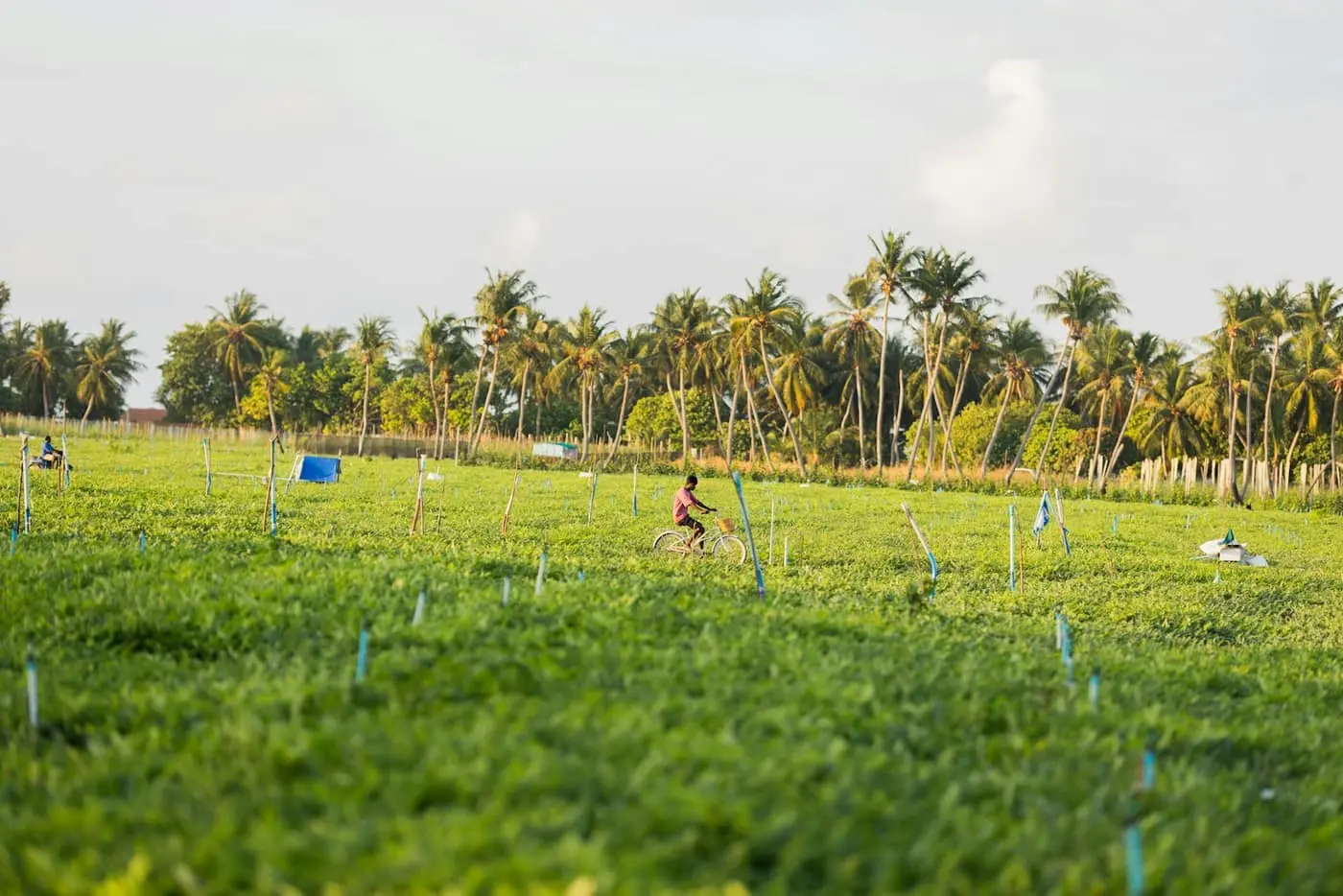
Agroforestry is the deliberate combination of trees with crops, or with livestock and pasture, on the same piece of land — grown together rather than trees in one field and crops in another. It sits between pure agriculture and pure forestry: unlike a forestry plantation grown only for timber, an agroforestry system is designed to keep producing an annual crop or grazing income while the trees mature; unlike ordinary field-crop farming, part of the land's output only arrives after several years.
Farmers take up agroforestry mainly to diversify income — a tree crop on the same land as an annual crop pays out on a completely different cycle, which cushions a bad crop year — and for what it does to the land itself: tree roots and canopy reduce wind and water erosion, leaf fall adds organic matter over time, and trees moderate the microclimate for the crop or animals nearby. The trade-off is real too: trees compete with the crop for light, water and nutrients if spacing and management are wrong, the tree income arrives late, and land under a maturing canopy cannot always be used for anything else in the meantime — see Economics & Planning below before committing land to it.
Benefits
- A second income stream from the same land, on a different cycle to the main crop
- Reduces wind and water erosion, and adds organic matter to the soil over time
- Moderates microclimate — shade and reduced wind speed — for crops or grazing animals
- Diversifies farm income so one bad crop season does not sink the whole year
Limitations
- Trees compete with the crop for light, water and nutrients if spacing and species are wrong
- Tree income typically arrives only after several years, not every season
- Real upfront establishment cost, with no return until trees mature
- Land under a maturing canopy earns less from the crop underneath than the same land in full sun
Major agroforestry systems
Six recognised ways of combining trees with crops, pasture or field boundaries, from a couple of trees scattered through a field to a fully mixed home garden. Most working agroforestry farms in India actually use more than one of these together — a windbreak along one edge and scattered fruit trees through the field, for instance — rather than picking a single system and stopping there.
Major agroforestry systems
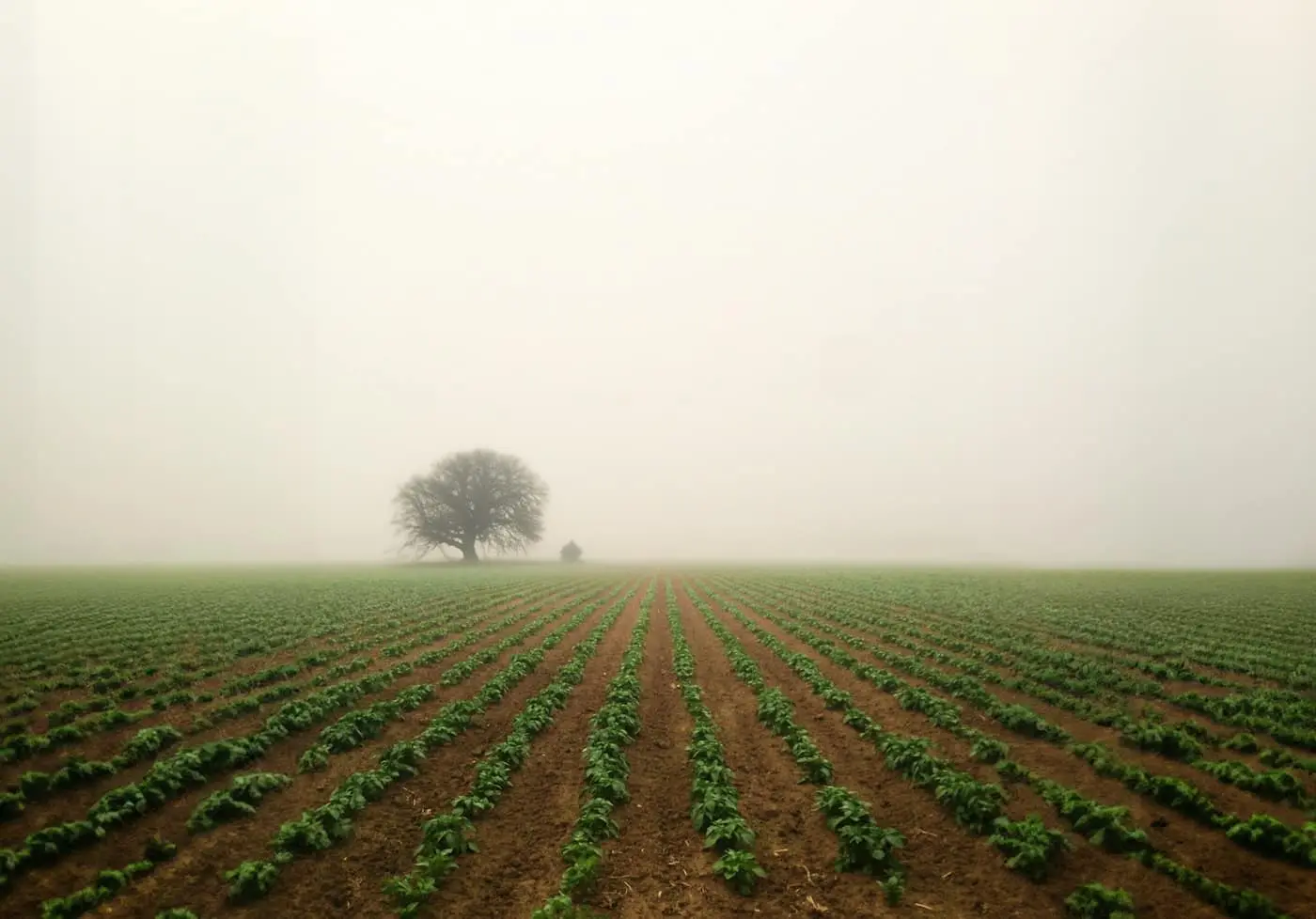
A single tree left standing in an otherwise open crop field is agroforestry in its oldest, simplest form — still a common sight across Indian farmland today.
- 1
Agrisilviculture — Trees + Crops
Trees and crops grow in the same field — from a few trees scattered around, to trees planted in organised rows between crop strips. The most common agroforestry system in India.
- 2
Silvopasture — Trees + Livestock
Trees grow together with grass or fodder and grazing animals. The trees give shade and sometimes fodder leaves; the animals graze the ground underneath.
- 3
Agrosilvopastoral Systems — Trees + Crops + Livestock
Trees, crops and animals all share the same land. It gives the widest mix of income, but takes the most planning to get right.
- 4
Boundary / Field-Border Plantations
Trees are planted only along the edge of the field, not inside it. This barely reduces your cropped area, which makes it the easiest system to start with.
- 5
Windbreaks & Shelterbelts
A row of trees planted to break the force of the wind across a field. This protects the crop and keeps the soil from drying out — especially useful in dry regions.
- 6
Home Gardens / Mixed Tree-Based Systems
A mix of trees, shrubs and crops grown together around the house — fruit, timber, fodder and vegetables all in one plot, tended more like a garden than a farm.
Choosing which trees to plant
There is no single "best" agroforestry tree — a species that pays off in coastal Kerala can fail outright in arid Rajasthan. The right choice depends on weighing all ten factors below together, for your specific land, climate and market, not picking whichever tree a neighbour happens to have planted.
- 1
Climate
Rainfall, temperature and frost decide which trees can even survive on your land. A tree that thrives on the coast can die outright in a dry inland district.
- 2
Soil
Check the soil's depth, drainage and pH before choosing a tree — the same test you'd use to pick a crop works for picking a tree too.
- 3
Water availability
Some trees survive long dry spells once grown; young trees of any species usually need watering to get established. Match this to what your land can actually give.
- 4
Root competition
A tree with deep roots competes less with a shallow-rooted crop for water and food than a tree whose roots sit at the same depth as the crop's.
- 5
Canopy characteristics
A thick, wide crown blocks light from crops growing below it. A tree with a lighter crown, or one that drops its leaves when the crop needs light most, competes far less.
- 6
Growth rate
Fast-growing trees give a return sooner but are usually worth less per tree than slow-growing ones. The real choice is how many years you're willing to wait.
- 7
Timber, fodder or fruit value
Decide before you plant whether you want timber, fodder leaves or fruit from the tree — this changes how far apart to plant, how to prune, and when to harvest.
- 8
Market demand
A valuable tree with no buyer nearby is money stuck in the ground. Check who actually buys timber, fodder or fruit in your area, and at what price, before you plant.
- 9
Compatibility with crops
Some trees release substances into the soil that stunt certain crops nearby, and some attract pests that then spread to the crop. Check a pairing locally — don't just assume it will work.
- 10
Local regulations
Rules on cutting, moving and selling timber differ by state and by tree species. Check with your local forest or agriculture office before you plant for timber — not after.
This hub deliberately does not name one universally "best" species — the right tree depends on the factors above, for your land specifically. A Krishi Vigyan Kendra or state agricultural university can advise on what is proven to work in your district.
Crop and tree combinations
The principles behind a compatible pairing, and examples farmers commonly use — not a universal recommendation.
The principle
- A good crop-tree pairing minimises competition and maximises complementarity: a deep-rooted tree over a shallow-rooted crop, a canopy that is open or leafless during the crop's peak growing season, and leaf litter or root activity that improves the soil rather than depleting it.
- Spacing and orientation matter as much as species choice — trees planted in north-south rows, for instance, cast a shorter shadow across the crop through the day than an east-west row would.
- A pairing that works well in one district can fail in another with different rainfall or soil — treat any specific combination as a starting point to verify locally, not a fixed formula.
Examples in use across India
- Example
Poplar with wheat or sugarcane
Widely used in agrisilviculture across parts of Punjab, Uttar Pradesh and Haryana — poplar's leafless winter period lines up with the wheat crop's growing season.
- Example
Coconut with intercrops like banana, pineapple or turmeric
Coconut's tall, sparse canopy and deep root system leave enough light and surface soil for shorter intercrops beneath it — common across coastal and southern coconut-growing belts.
- Example
Khejri (Prosopis cineraria) with pearl millet or moong
A traditional agroforestry system of arid Rajasthan — khejri is deep-rooted, sheds leaves during the crop's growing season, and adds fodder and fuelwood value on the same land.
- Example
Young fruit trees (mango, guava, citrus) with vegetable intercrops
Common while an orchard is young and its canopy has not yet closed — the vegetable intercrop earns income from the land before the trees start bearing fruit.
Managing an agroforestry system
Once trees and crops are both in the ground, the ongoing work shifts from planting decisions to managing the space and resources between them — light, water and nutrients that both the tree and the crop are drawing on at once. Skipping this stage is the single most common reason a promising agroforestry planting turns into a shaded, underperforming field a few years in.
Managing an agroforestry system
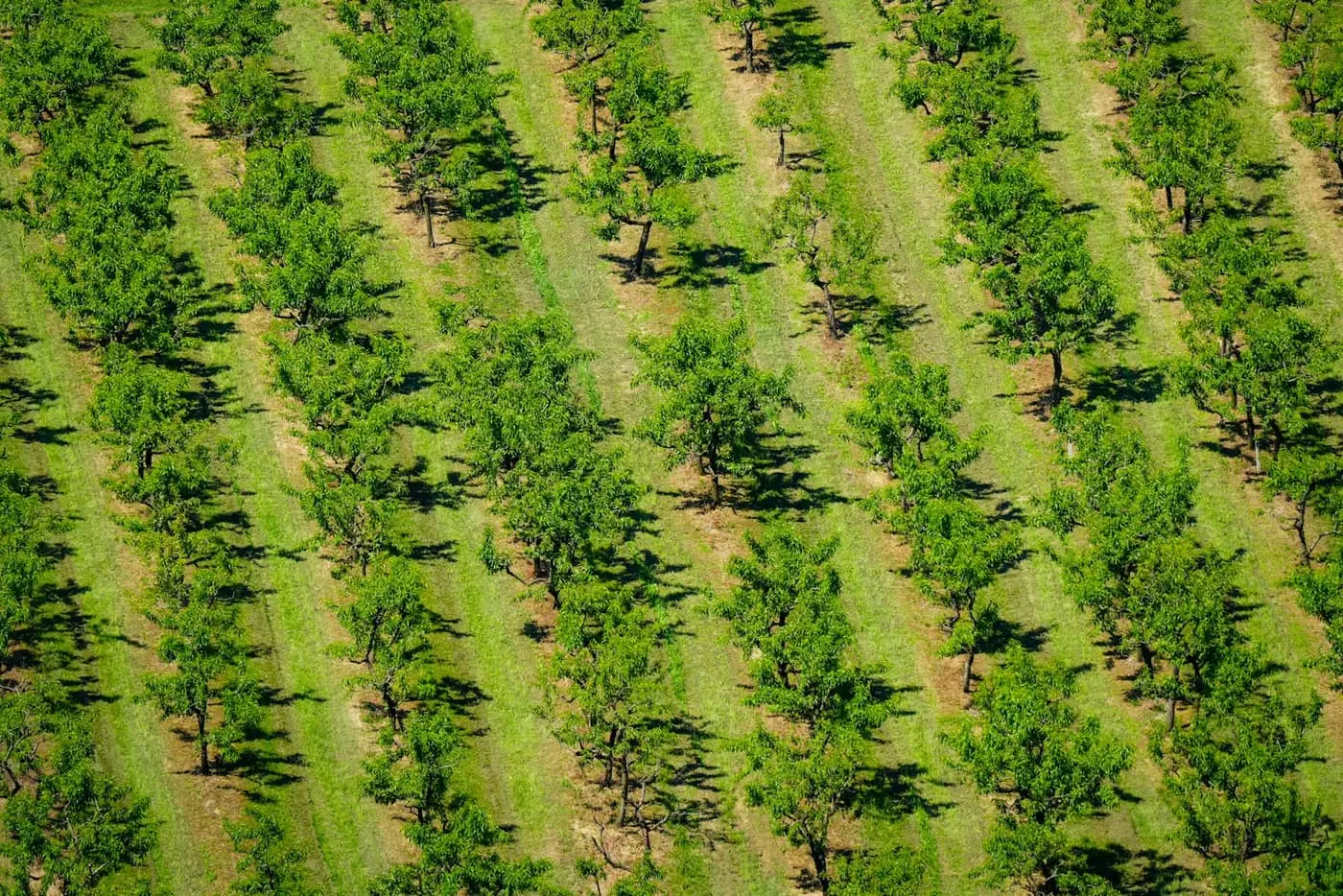
Wide, mown rows between orchard trees, seen from above — spacing this generous is a deliberate management choice, not an accident, made to let light, air and machinery move through.
- 1
Tree spacing
Plant trees wider apart than in a pure timber plantation, to leave room and light for the crop or pasture growing alongside them.
- 2
Pruning
Cut back lower branches and thin the crown as the tree grows. This keeps shade and root competition in check, and the cut branches can be used as fodder or firewood.
- 3
Canopy management
Keep the crown open through pruning, wider spacing, or choosing a naturally light-crowned tree. This is the main way to keep enough light reaching the crop below.
- 4
Nutrient management
Trees and crops draw on the same soil, so a mixed plot needs closer watch on nutrients than a field of crop alone — not less.
- 5
Irrigation
Young trees usually need extra watering to get established, even in a system meant to need little water later on. Plan for this in the first year or two.
- 6
Weed management
Weeds hurt young trees the most, before they're tall and strong. Mulch around the base — it keeps weeds down and holds soil moisture at the same time.
- 7
Tree-crop competition
Watch how the crop yields near the trees compared to further away. If it's dropping, prune the trees, widen the spacing, or change what's planted underneath.
- 8
Harvesting
The crop is picked every season; the tree product — timber, fruit or fodder — comes on its own multi-year schedule. Plan both harvests so neither one damages the other.
- 9
Long-term planning
Decide on tree species, spacing and the crop rotation underneath before the first tree goes into the ground. These choices are hard to undo once trees are established.
Benefits
Real, but worth reading against the limitations above and the economics below — not every benefit applies to every system.
- 1
Additional farm income
A second income from the same land, on a different schedule to your main crop — timber, fruit or fodder you can sell when crop prices are low.
- 2
Diversification
If the crop has a bad season, or tree prices are low, you're not depending on just one source of income that year.
- 3
Soil protection
Tree roots hold the soil together on sloping or open land, cutting down erosion. Fallen leaves add nutrients back to the soil over time.
- 4
Wind protection
A line of trees slows the wind across a field, which protects the crop from physical damage and stops the wind from drying out the soil.
- 5
Microclimate benefits
Shade and calmer air near trees can take the edge off extreme heat for a crop or for grazing animals — useful in areas with harsh summers.
- 6
Biomass & fodder
Fallen leaves, pruned branches and fodder-tree leaves give you usable material — green manure, mulch or animal feed — without growing a separate crop for it.
- 7
Timber & fruit production
Once established, trees keep producing with relatively little daily work, paying out as a lump sum at harvest rather than a regular income.
- 8
Environmental value
Trees on farmland help store carbon and support wildlife, alongside the soil and water benefits above. It's real, but it should not be the main reason a farmer plants trees — the economics should be.
Economics & planning
A tree is a multi-year commitment on land that could otherwise grow a crop every season, so it needs its own budget line, not a rough guess folded into the crop's accounts. These six factors are what to work out on paper before the first sapling goes in — not after several years have already passed.
- 1
Short-term vs long-term returns
Your crop pays every season; your trees may pay only after several years. Count both together when you judge whether the system is worth it — not the tree income alone.
- 2
Initial establishment cost
Saplings, protection from grazing animals, and the labour to plant trees all cost money upfront, with no return until the trees mature. Budget for this separately from your crop costs.
- 3
Opportunity cost of land
Land under a growing tree canopy earns less from the crop below it than the same land in full sun would. That lost crop income is a real cost, even if no cash changes hands for it.
- 4
Market access
A tree product is worth only what a nearby buyer will actually pay. Check timber, fodder or fruit prices in your area before the trees mature, not after.
- 5
Labour requirements
Pruning, canopy care and harvest add work on top of your crop's usual needs — usually less than growing a second crop would, but not nothing.
- 6
Evaluate the whole system
Judge the system by its total return — crop plus tree, over the whole cycle — against what the same land would earn growing only crops.
Agroforestry in the Indian context
India has some of the world's longest-running agroforestry traditions — khejri-based systems in arid Rajasthan, coconut-based multistorey cropping in Kerala, and poplar agroforestry across parts of Punjab, Uttar Pradesh and Haryana are decades-old, well-documented practices, not recent introductions. The National Agroforestry Policy (2014) recognises agroforestry as a distinct land-use category, and support for it is available through schemes such as Rainfed Area Development (RAD) under PM-RKVY, which specifically funds systems combining trees with crops and livestock on rainfed land.
Beyond that, the right system for any given farm depends on local climate, soil, water availability, existing cropping pattern and market access — which is exactly why this hub does not name one species or system as universally best. Rules on felling, transporting and selling timber grown on farmland also vary by state, species and land record, and have changed in recent years in several states. Always confirm the current position with your state forest or agriculture department, and check with a Krishi Vigyan Kendra or state agricultural university for what grows well locally, before committing land to a tree crop.
Frequently asked questions
What is agroforestry?
Agroforestry is farming that deliberately combines trees with crops, or with livestock and pasture, on the same land — rather than growing trees and crops in separate, unconnected fields. It sits between pure crop farming and pure forestry, aiming to produce both a regular crop or grazing income and a longer-term tree product from the same piece of land.
What are the main types of agroforestry systems?
The commonly recognised systems are agrisilviculture (trees with crops), silvopasture (trees with livestock and pasture), agrosilvopastoral systems (trees, crops and livestock together), boundary or field-border plantations, windbreaks and shelterbelts, and home gardens — see the systems section above for what distinguishes each.
Which trees are best for agroforestry?
There is no single best tree — the right choice depends on your local climate, soil, water availability, what you intend to grow underneath or alongside it, and what actually sells in your area. See the Tree Selection section above for the factors to weigh, and consult your state agricultural university or Krishi Vigyan Kendra for species proven to work in your specific district.
Is agroforestry profitable?
It can add meaningfully to farm income, but the tree component typically pays out only after several years, and establishing trees carries a real upfront cost plus an opportunity cost on the land they occupy. Whether it is worthwhile depends on evaluating the whole system — crop plus tree, over the full rotation — against what the land would earn under crops alone; see Economics & Planning above.
Do I need permission to cut and sell trees grown on my own farmland?
Rules on felling, transporting and selling farm-grown timber vary by state, species and land record, and have changed in several states in recent years. This is not something to assume either way — confirm the current rules with your state forest or revenue department before you plant for timber, and again before you harvest it.
What government support exists for agroforestry in India?
Rainfed Area Development (RAD), a component of PM-RKVY, funds integrated farming systems that combine crops with trees (horticulture or agroforestry) and livestock on rainfed land. The National Agroforestry Policy also recognises agroforestry as a distinct land-use category for planning purposes. See the RAD scheme page for eligibility and how to apply.