
Strawberry
Fragaria × ananassa
Botanically a perennial, but grown in India as a fresh annual crop — tissue-culture or runner plantlets go into black-plastic-mulched raised beds every September–October and the whole planting is picked out and replaced the following year. Almost everything comes down to keeping the fruit and crown dry: grey mould (Botrytis) rots the berries in humid, wet weather, and red stele rots the roots in waterlogged soil — the opposite failure mode from most other tuber and root crops on this site.
Quick Summary
The key points from this page in about two minutes — read it or have it read aloud.
Quick Summary
Strawberry (Fragaria × ananassa) is grown in India as a high-value winter annual, not a true multi-year perennial — plants go in fresh each September–October and the bed is cleared after the last picking in March. Mahabaleshwar and Panchgani in Maharashtra form India's largest strawberry belt, with real cultivation also across the Himachal Pradesh and Uttarakhand hills and, increasingly, under polyhouse cultivation in the winter around Punjab, Haryana, Uttar Pradesh and Delhi-NCR.
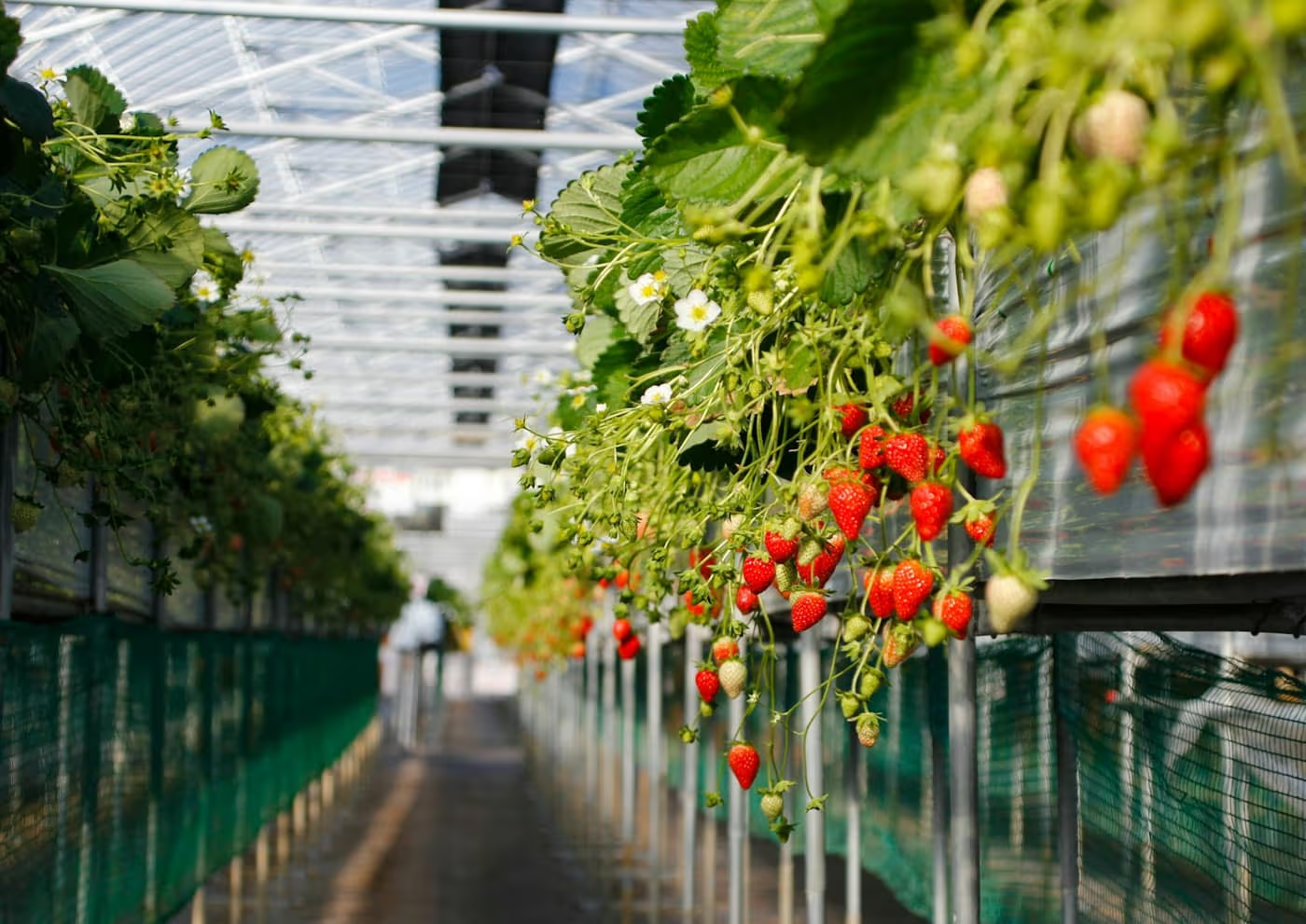
The crop is never grown from true seed. Planting material is either a runner — a small rooted plantlet a mother plant sends out on a stolon — or a tissue-culture plantlet raised in a lab for disease-free, true-to-type stock. Both go onto raised beds covered in black plastic mulch, near-universal in Indian strawberry growing: it keeps ripening berries off wet soil, suppresses weeds, and holds moisture so the crop can be watered by drip alone.
Two failure modes decide most strawberry crops, pulling in opposite directions. Grey mould (Botrytis cinerea) rots flowers and ripening fruit into a soft, fuzzy grey mass whenever humid or wet weather sets in during flowering and picking — the single most damaging disease of strawberry worldwide. Red stele, a soil fungus that turns the root centre a telltale reddish-purple, does the opposite: it takes hold in cold, waterlogged, poorly drained soil, which is exactly why the crop is always grown on a raised bed rather than flat ground. Between the two, drainage and airflow matter more for strawberry than almost any other crop on this site.
One more thing worth knowing: the varieties actually grown here (Camarosa, Chandler, Winter Dawn, Sweet Charlie, Festival, Nabila) were bred abroad for low winter-chilling needs, which is exactly why they fruit through an Indian plains or hill winter. None is an ICAR-bred Indian release — they reach growers through certified nurseries in Mahabaleshwar and Himachal Pradesh, a normal state of affairs for this crop, not a red flag.
- Crop type
- Cool-season fruit crop, grown as an annual from runners/tissue-culture plantlets (not seed)
- Season
- Winter annual: planted Sept–Oct, harvested Dec–Mar
- Suitable states
- Maharashtra (Mahabaleshwar–Panchgani), Himachal Pradesh, Uttarakhand, Punjab, Haryana, Uttar Pradesh, Delhi-NCR
- Growing duration
- ~150–180 days, planting to end of picking
- Water requirement
- Moderate; frequent light drip irrigation, never waterlogging
- Temperature
- Cool, roughly 10–25°C; most Indian varieties are low-chill, short-day types
- Soil type
- Well-drained sandy loam rich in organic matter, pH 5.7–6.5; cannot tolerate waterlogging
- Difficulty level
- Hard (grey mould, red stele, mulch/drip infrastructure, short shelf life)
- Expected yield
- 8–15 t/ha in typical field cultivation; up to 25–35 t/ha under polyhouse and best management
- Key risk
- Grey mould rotting flowers and fruit in humid, wet weather
Overview
Strawberry (Fragaria × ananassa) is a low, spreading plant grown for its soft, red, sweet-tart aggregate fruit. Though the plant itself is a perennial, Indian growers treat it as a single-season winter annual: fresh planting material goes in every September–October and the whole bed is cleared after the last picking, because a second-year planting carries forward too much disease and virus pressure to be worth keeping.
India's biggest belt by far is Mahabaleshwar and neighbouring Panchgani in Maharashtra's Satara district, a cool hill-station tract that alone accounts for the large majority of the country's commercial strawberry. The Himachal Pradesh and Uttarakhand hills grow it too, and a newer, fast-growing front is polyhouse (protected) cultivation in the plains around Punjab, Haryana, Uttar Pradesh and Delhi-NCR, where a controlled winter structure lets growers raise a crop that open fields in the same tract could not support.
Two things decide how a strawberry crop turns out. First, planting material: since it is never grown from seed, a runner or tissue-culture plantlet carrying red stele, verticillium wilt or a virus infects the whole bed from day one — buy only from a certified, reputable nursery. Second, moisture management, which cuts both ways: too little airflow and too much humidity at flowering and picking brings grey mould, while poorly drained, waterlogged soil brings red stele — the raised bed and black plastic mulch that are standard practice across Indian strawberry growing exist specifically to manage both risks at once.
Crop timeline, sowing to harvest
A quick visual map of the season — jump to any section below for the detail behind each stage.
- Day 0
Bed preparation & planting
Raised beds formed, FYM and basal fertiliser worked in, black plastic mulch laid and drip line installed; certified runners or tissue-culture plantlets transplanted with the crown at soil level — not buried, not exposed. Main window: September–October in both the hills and the plains.
- Day 7–20
Establishment
Plants root into the bed through the mulch's planting holes; light, frequent drip irrigation keeps the shallow root zone moist without waterlogging it. Gap-fill any plantlet that fails within two weeks.
- Day 20–60
Vegetative growth
New leaves and crown expand; the first nitrogen top-dressing goes in around three weeks after planting. Scout for two-spotted spider mite on leaf undersides as the canopy fills in.
- Day 60–100
Flowering & fruit set
Flower trusses emerge — the single most important stage for both potash and boron, since boron shortage causes poor pollination and misshapen fruit. This is also grey mould's prime window: any humid, cloudy or rainy spell now calls for active scouting, not routine care.
- Day 100–150
Fruiting & first pickings
Berries colour and ripen unevenly across the bed; picking begins roughly 90–110 days after planting and repeats every 2–3 days for the rest of the season. Typical harvest window: December to March.
- Day 150–180
Peak harvest to bed clearance
Picking continues at 2–3 day intervals through peak season; once fruiting tails off in March the whole planting, mulch and drip line are cleared out rather than carried over, and the bed is reworked for the next September's fresh planting.
Suitable states
States where this crop is grown at scale, highlighted below. Your local Krishi Vigyan Kendra is still the final word for your specific block.
- Jammu and Kashmir
- Himachal Pradesh
- Punjab
- Uttarakhand
- Haryana
- Delhi
- Uttar Pradesh
- Rajasthan
- Bihar
- Jharkhand
- West Bengal
- Sikkim
- Assam
- Arunachal Pradesh
- Meghalaya
- Nagaland
- Manipur
- Mizoram
- Tripura
- Gujarat
- Madhya Pradesh
- Chhattisgarh
- Maharashtra
- Odisha
- Goa
- Telangana
- Andhra Pradesh
- Karnataka
- Kerala
- Tamil Nadu
- Puducherry
- Ladakh
- Chandigarh
- Lakshadweep
Grown here
Climate requirements
Strawberry sits at almost the opposite end of the water-management spectrum from most root and tuber crops on this site: instead of tolerating or needing standing water, it cannot survive waterlogging at all, which is why every practice — raised beds, drip only, never flood or furrow irrigation — is built around keeping the root zone moist but never wet.
Ideal temperature
A genuinely cool-season crop, growing and fruiting best at roughly 10–25°C. Most commercial Indian varieties (Camarosa, Chandler, Sweet Charlie, Festival, Winter Dawn, Nabila) are bred for a low or short-day chilling need rather than the deep winter cold of temperate strawberry country, which is exactly why they can be grown at all in an Indian plains or hill winter. High heat during flowering and fruiting gives small, soft, poorly coloured berries.
Rainfall
Rainfall itself is not wanted during the growing season — this is a winter crop grown almost entirely on drip irrigation, and rain or high humidity at flowering and fruiting is the single biggest trigger for grey mould. Growers in the hills times planting to finish before the monsoon returns and rely on irrigation, not rainfall, for the whole crop.
Humidity
The trait to manage most carefully. Grey mould and other fruit rots explode in humid, cloudy, still-air conditions, so the raised bed, plant spacing and black plastic mulch all exist partly to keep air moving and berries off wet soil, not just for weed control.
Sunlight
Full sun for the best flowering, fruit colour and sugar content. A shaded planting flowers poorly and produces pale, low-sugar fruit even where temperature and moisture are otherwise right.
Soil requirements
Because red stele and other root rots take hold fastest in cold, wet, poorly-drained ground, soil preparation for strawberry is really disease prevention wearing the name of land preparation — a well-formed, well-drained raised bed does more to keep the crop healthy than any spray applied afterward.
Suitable soil
A well-drained sandy loam or loam rich in organic matter suits strawberry best. Heavy clay that holds water is the crop's single biggest soil risk, since it creates exactly the cold, wet conditions red stele needs.
pH range
Best at a slightly acidic pH 5.7–6.5. Strongly alkaline soil causes iron chlorosis (pale, yellow young leaves with green veins) even where the soil is otherwise fine.
Drainage
Free, fast drainage is non-negotiable — strawberry cannot tolerate waterlogging even briefly, unlike most of the tuber and corm crops on this site. This is the entire reason the crop is grown on a raised bed rather than flat ground, anywhere in India.
Organic matter
Responds strongly to organic matter — 20–25 t/ha of well-rotted FYM or compost worked into the bed before planting improves both structure and drainage, which matters as much for disease prevention here as for fertility.
Land preparation
Same four steps whichever region you are in — only the timing shifts with the sowing window.
- 1
Plough deep and form raised beds
Plough two to three times to a fine, weed-free tilth, then form raised beds about 15–20 cm high and roughly 1–1.2 m wide with clear drainage furrows between them — the single most important step against red stele and waterlogging.
- 2
Work in FYM and basal fertiliser, then lay black plastic mulch
Mix 20–25 t/ha of well-rotted FYM plus the basal phosphorus and potash dose into the bed, install the drip line down its centre, then stretch black plastic mulch tightly over the whole bed and cut planting holes at the chosen spacing.
- 3
Source certified, disease-free runners or tissue-culture plantlets
Buy planting material only from a reputable, certified nursery in Mahabaleshwar, Himachal Pradesh or elsewhere with a track record for disease-free stock — never use runners pulled from an old, declining planting, which is how red stele, verticillium wilt and virus carry straight into a new bed.
Seed information
How the main varieties compare, so you can pick by duration, yield, disease pressure or what you are growing for.
| Variety | Duration | Yield | Disease resistance | Best state | Suitable for |
|---|---|---|---|---|---|
Bred by the University of California, Davis (released 1994, cross 'Douglas' × Cal 85.218-605), Camarosa is a vigorous, high-yielding short-day variety with large, firm, dark-red conical fruit and good shelf life for transport. It is one of the most widely planted varieties in Mahabaleshwar and Panchgani and across the northern plains. | ~150–170 days | High (among the highest-yielding varieties grown in India) | No specific resistance claimed; firm fruit tolerates handling well | Maharashtra (Mahabaleshwar–Panchgani) | Fresh market, transport to distant cities |
An earlier University of California, Davis release (1983, cross 'Douglas' × Cal 72.361-105), Chandler is a classic short-day variety with bright red, conical, moderately firm fruit and reliable flowering. Long grown in the Himachal Pradesh and Uttarakhand hills and still common there and on the northern plains. | ~150–170 days | Good, moderate-to-high | No specific resistance claimed | Himachal Pradesh, Uttarakhand | Hill cultivation, fresh market |
Bred by the University of Florida and released in the early 1990s, Sweet Charlie is an early-fruiting, low-chill variety valued in India for genuinely useful field tolerance to anthracnose and Colletotrichum crown rot alongside its sweet flavour — a real advantage where fungal fruit rot is the main risk. Grown in Mahabaleshwar, on the northern plains and in Odisha/Chhattisgarh trials. | ~140–160 days | Moderate; valued more for earliness and disease tolerance than sheer volume | Useful field tolerance to anthracnose and Colletotrichum crown rot | Maharashtra, Punjab, Haryana, Delhi-NCR | Early-season market, anthracnose-prone fields |
Another University of Florida release (2000), Festival is a day-neutral-leaning, warm-adapted variety that fruits reliably through a wider temperature range than most short-day types, which suits it to India's milder winters. Grown in Mahabaleshwar and trialled successfully in eastern states such as Odisha and Chhattisgarh. | ~150–170 days | Good, consistent across a season | No specific resistance claimed | Maharashtra, Odisha, Chhattisgarh | Warmer winter tracts, extended fruiting season |
Bred by the University of Florida (cross FL 93-103 × FL 95-316, patented 2009), Winter Dawn is valued specifically for heavy fruiting from November through February — an early, cold-season production window that suits the main Indian picking season well. Widely planted in Mahabaleshwar, where growers rate its fruit as reliable but somewhat less sweet than Camarosa or Sweet Charlie. | ~150–170 days | High early-season yield; heaviest output in the Nov–Feb window | No specific resistance claimed | Maharashtra (Mahabaleshwar–Panchgani) | Early, high-volume winter picking |
Bred by Consorzio Italiano Vivaisti (CIV), Italy (cross 'Ventana' × selection Q6Q8-26, first propagated 2004), Nabila is a Mediterranean-climate variety with large, conical, glossy, well-flavoured fruit, selected for low-chill regions. Grown in Mahabaleshwar and increasingly in Odisha and Chhattisgarh trials as an alternative to the older American releases. | ~150–170 days | Good; large fruit size is its main commercial draw | No specific resistance claimed | Maharashtra, Odisha, Chhattisgarh | Large-fruit fresh market, export-grade sorting |
- Seed rate
- Never grown from true seed — planting material is certified runners (rooted stolon plantlets) or lab-raised tissue-culture plantlets, bought fresh each year rather than farm-saved. A common 30×30 cm spacing works out to roughly 22,000 plants/acre (about 54,000/ha); a wider layout on 1–1.2 m raised beds with 30–45 cm plant-to-plant spacing needs somewhat fewer.
- Certified seed
- Buy runners or tissue-culture plantlets only from a certified, reputable nursery with a track record for disease-free stock — Mahabaleshwar and Himachal Pradesh both have established multiplication nurseries. Never take runners from an old, declining planting, since red stele, verticillium wilt and virus infections travel on the planting material itself and infect the whole new bed from day one.
- Spacing
- Raised beds 1–1.2 m wide with drainage furrows between them; plants set 30×30 cm to 30×45 cm apart within the bed, through holes cut in the black plastic mulch.
- Seed treatment
- Dip the roots of bare-root runners in a recommended fungicide solution before planting as a precaution against crown and root rots; tissue-culture plantlets, raised in sterile lab conditions, generally need no such dip but should still come with a nursery health certificate.
Sowing guide
Never plant runners pulled from last year's declining bed, however healthy they look on the surface — red stele and verticillium wilt both travel silently on planting material and only show up weeks into the new season.
- Best time
- September–October across both the hills (Himachal Pradesh, Uttarakhand, Mahabaleshwar) and the plains, timed so the plant establishes before the cool winter growing season and flowers into the December–March window. Polyhouse growers in Punjab, Haryana and Delhi-NCR have some flexibility either side of this window since the structure moderates temperature.
- Row spacing
- 1–1.2 m between raised beds (bed-to-bed), which functions as the effective row spacing
- Plant spacing
- 30×30 cm to 30×45 cm within the bed
- Sowing depth
- Crown set exactly at soil level — the single most common planting mistake either way: bury the crown and it rots, leave the roots exposed above the mulch and the plant dries out and fails to establish.
- Method
- Transplant certified runners or tissue-culture plantlets through holes cut in the black plastic mulch, firming the soil around the roots so the crown sits flush with the surface. Irrigate immediately by drip to settle the soil around the roots.
Fertilizer schedule
A split dose beats one large dose applied at sowing — nitrogen especially is lost to the air and to leaching if it all goes in on day one.
- 1
Basal (at bed preparation)
Before planting
Well-rotted FYM (20–25 t/ha) plus the full phosphorus dose and part of the potash, worked into the raised bed before the black plastic mulch is laid.
- 2
First nitrogen top-dressing
~3 weeks after planting
About half the total nitrogen dose (of an overall 75–100 kg N/ha), fed through the drip line to support vegetative establishment without pushing soft, disease-prone growth.
- 3
Flowering top-dressing
At flower emergence (~Day 60–70)
The remaining nitrogen plus the full potash dose (of an overall 40–80 kg K₂O/ha) — potash at flowering is what actually builds fruit size, colour and shelf life, and a boron spray at this stage corrects the poor pollination and misshapen fruit that boron shortage causes.
Irrigation schedule
1. Establishment
Day 0–20
Light, frequent drip irrigation daily or every other day so the shallow root zone stays moist through the mulch's planting holes without ever waterlogging the bed.
2. Vegetative growth to flowering
Day 20–100
Regular drip irrigation, adjusted for weather, keeping the root zone evenly moist — strawberry's roots are shallow and cannot draw on reserves the way a deep-rooted crop can, so long gaps between waterings stress the plant quickly.
3. Fruiting & picking
Day 100–180
Continue steady drip irrigation through the picking season; avoid any overhead or furrow watering at this stage, since wetting the foliage and fruit directly is one of the surest ways to trigger a grey mould outbreak.
Critical stages
- Establishment (first 2–3 weeks)
- Flowering and fruit set
Water-saving tips
- Drip irrigation under black plastic mulch is standard practice in Indian strawberry growing, not an upgrade — it typically cuts water use by around 30% compared with any surface method while also keeping the foliage dry.
- Never irrigate overhead or by furrow flooding at any stage; strawberry's intolerance of wet foliage and waterlogged roots makes this the costliest water mistake a grower can make.
- Fertigation — feeding nitrogen and potash through the same drip line — saves both water and labour compared with separate irrigation and top-dressing rounds.
Weed management
Organic control
- The black plastic mulch itself is the main organic weed control — very few weeds emerge through the planting holes, and any that do are easily hand-pulled.
- Keep the open furrows between beds hoed or lightly mulched with straw, since weeds there compete less with the crop but still host pests and diseases if left unchecked.
Chemical control
- Black plastic mulch, laid before planting, is the primary weed control on almost every Indian strawberry planting and removes most of the need for herbicide within the bed.
- A pre-emergence herbicide cleared for strawberry is occasionally used in the open furrows between beds, where the mulch gives no protection; confirm the current product and dose with your local KVK.
Nutrient deficiency identification
What a shortage of each nutrient actually looks like on the plant, so you can tell a deficiency apart from a disease before you spray the wrong thing.
Potassium
Visible symptom
Scorched, purplish-brown margins on older leaves and small, soft, poorly coloured fruit with a shorter shelf life — potash fed at flowering is what actually builds fruit size, colour and firmness in strawberry.
Boron
Visible symptom
Poor fruit set and small, hard, misshapen ("cat-faced") berries with uneven seed distribution — boron is essential for pollen viability and fruit development, so a shortage shows up directly in the harvested fruit rather than just the leaves.
Nitrogen
Visible symptom
Pale, small, slow-growing plants on genuinely poor soil — but the more common mistake with strawberry is over-applying nitrogen, which produces lush, soft foliage that grey mould infects far more readily.
Diseases to watch for
Symptoms, likely cause and what actually treats it — not just a spray name.
Grey mould (Botrytis)
- Symptoms
- A soft, watery rot on flowers, green fruit and especially ripening berries, quickly coated in a fuzzy grey-brown mould; infected berries collapse within a day or two of the first spot appearing, and the disease spreads fast through a wet, dense canopy at picking time.
- Cause
- The fungus Botrytis cinerea, spread by air-borne spores and favoured by cool, humid, wet or cloudy weather, especially during flowering and fruit ripening. It is considered the single most damaging disease of strawberry worldwide, capable of yield losses well over half the crop in an unmanaged, wet season.
- Treatment
- Remove and destroy infected flowers and fruit as soon as seen — do not leave rotted berries in the bed. Apply a recommended protective fungicide (rotated to avoid resistance) at flowering and again as fruit ripens if humid weather is forecast.
- Prevention
- Keep the canopy open with correct spacing, avoid overhead irrigation entirely, remove old leaves and spent flowers regularly, pick ripe fruit promptly rather than leaving it on the plant, and rely on the black plastic mulch to keep fruit off wet soil.
Red stele root rot
- Symptoms
- Stunted, wilted plants with a dull blue-green or reddish tinge to the foliage and poor fruit set; splitting an affected taproot lengthwise shows a telltale reddish-purple core (the "stele") inside an otherwise normal-looking root, which is the confirming sign.
- Cause
- The soil-borne water-mould Phytophthora fragariae, a genuinely distinct pathogen from the Phytophthora species behind late blight, pepper foot rot or avocado root rot. It thrives specifically in cold, waterlogged, poorly drained soil and spreads in surface water and on infected planting material.
- Treatment
- There is no cure once red stele is established in a plant or a plot — remove and destroy affected plants and avoid replanting strawberry in the same bed for several years.
- Prevention
- Plant only on well-drained raised beds, never in a low-lying or heavy-clay spot that holds water; buy certified, disease-free runners or tissue-culture plantlets only; and avoid moving soil or irrigation water between an affected planting and a healthy one.
Anthracnose
- Symptoms
- Small, sunken, dark brown to black spots on ripening fruit that enlarge and can rot the whole berry; on the crown, a reddish-brown internal rot that wilts and kills the plant outright, especially in warm, humid weather.
- Cause
- Colletotrichum species (including C. acutatum, C. fragariae and C. gloeosporioides), spread by rain-splash and irrigation water from infected runners and debris, favoured by warm, wet, humid conditions — genuinely worse on some black-plastic-mulched plantings where splash from the mulch surface carries spores onto low fruit.
- Treatment
- Remove and destroy infected fruit and crowns promptly; apply a recommended protective fungicide at the first sign, especially through a warm, wet spell during fruiting.
- Prevention
- Source certified, disease-free runners or tissue-culture plantlets, avoid overhead irrigation, keep the canopy open for airflow, and rotate out of strawberry for a few years where the disease has a history.
Powdery mildew
- Symptoms
- A white, powdery coating on the underside of leaves that curl upward at the edges, followed by a similar coating on flowers and fruit that gives berries a dull, poor finish and off-taste.
- Cause
- Podosphaera aphanis (grouped with the wider Erysiphales fungi that cause powdery mildew across many crops), favoured by warm, dry days with high humidity at night — a different weather pattern from grey mould's cool-wet preference, so both diseases can appear in the same season at different stages.
- Treatment
- Apply a recommended sulphur-based or systemic fungicide at the first sign of the white coating, before it reaches the fruit; follow the label and pre-harvest interval closely on a crop picked every 2–3 days.
- Prevention
- Choose a well-ventilated spacing, avoid excess nitrogen that produces dense, susceptible foliage, and scout the underside of leaves regularly rather than waiting for the coating to become obvious from above.
Pests to watch for
What to look for before the damage is visible, and organic options before you reach for a chemical.
Two-spotted spider mite
- Identification
- Tiny, barely visible mites on the underside of leaves, often with fine webbing across the leaf surface in a heavy infestation; affected leaves show a fine yellow-white stippling that spreads and eventually bronzes the whole leaf.
- Damage
- Feeding drains the leaf of chlorophyll and, in a hot, dry spell, can build up fast enough to weaken the whole plant and cut fruit size and yield noticeably. It is one of the most common strawberry pests in India, especially in warm, dry weather.
- Organic control
- Regularly hose down or spray the leaf undersides with water to disrupt colonies, release predatory mites where available, and avoid the dusty, water-stressed conditions that favour a mite build-up.
- Chemical control
- A recommended miticide only where infestation is heavy and spreading fast, rotated between different modes of action since spider mites build resistance quickly; observe the pre-harvest interval strictly given how often the crop is picked.
Aphids
- Identification
- Small, soft-bodied insects clustering on new leaves and flower stalks, often with sticky honeydew and sooty mould developing beneath them.
- Damage
- Direct feeding is usually minor, but aphids can transmit plant viruses between strawberry plantings, so a build-up is a warning sign for the health of next year's planting material as much as a pest problem in its own right.
- Organic control
- Yellow sticky traps, a strong water spray to dislodge colonies, and conserving ladybird beetles and other natural predators.
- Chemical control
- A recommended insecticide where aphid numbers build fast, particularly in mother-plant nursery blocks kept for runner production, observing the short pre-harvest interval needed on a crop picked every few days.
Cutworms and white grubs
- Identification
- Fat, greyish-brown caterpillars (cutworms) that hide in the soil by day and feed at night, or creamy-white C-shaped grubs (white grubs) found in the soil around the roots and crown.
- Damage
- Cutworms sever young transplants at the soil line soon after planting, sometimes wiping out whole patches of newly set runners; white grubs feed on roots and the crown underground, weakening or killing established plants.
- Organic control
- Hand-pick cutworms found at the base of damaged plants at dusk or after dark, deep-plough the bed before planting to expose grubs to birds and predators, and keep the bed free of undecomposed organic matter that attracts egg-laying adults.
- Chemical control
- A recommended soil insecticide worked into the bed at preparation where cutworm or white grub pressure has a history on the plot.
Birds
- Identification
- Peck marks and partly eaten berries on the ripest, most exposed fruit in the bed, usually worst near field edges and in the days just before a planned picking.
- Damage
- Birds are drawn to ripening strawberries as readily as to any other soft fruit and can strip a surprising amount of the ripest, most marketable fruit if a planting is left unprotected, especially in smaller or isolated plots.
- Organic control
- Netting stretched over the bed during the ripening and picking window is the most reliable protection; reflective tape, scarecrows and noise-makers give partial, short-lived relief at best.
- Chemical control
- Not applicable — bird damage is managed by physical exclusion, not chemical control.
Common mistakes to avoid
The mistakes that cost growers the most, ranked by how often they show up in the field — not in the order you might expect.
- 1
Planting runners taken from an old, declining bed instead of certified, disease-free stock.
Why it hurts
Red stele, verticillium wilt and viruses all travel silently on the planting material itself and only show up weeks into the new season, by which point the whole bed is infected. Buy fresh runners or tissue-culture plantlets from a certified nursery every year.
- 2
Growing strawberry on flat ground or in a low-lying, poorly drained spot instead of a raised bed.
Why it hurts
This is the single most common way growers unknowingly invite red stele — the fungus needs exactly the cold, waterlogged conditions flat, poorly drained ground provides. The raised bed is not optional infrastructure; it is the crop's main defence against its worst root disease.
- 3
Watering overhead or by furrow flooding instead of drip.
Why it hurts
Wetting the foliage and fruit directly is one of the surest ways to trigger a grey mould outbreak, and furrow flooding waterlogs the root zone that strawberry cannot tolerate. Drip irrigation under mulch is the only irrigation method that manages both risks at once.
- 4
Planting the crown too deep or leaving the roots exposed above the mulch.
Why it hurts
A buried crown rots before it can establish; an exposed root system dries out and the plant fails within days. The crown must sit exactly at soil level — this single detail decides whether a large share of a new planting survives.
- 5
Skipping fungicide scouting during a humid or rainy spell at flowering and picking.
Why it hurts
Grey mould can rot a large share of the ripening crop within days once it establishes in wet weather. Treat any humid or cloudy forecast during flowering and fruiting as a trigger to scout and, if needed, spray — not something to notice only after berries are visibly rotting.
- 6
Trying to carry a strawberry bed over into a second year to save on planting-material cost.
Why it hurts
Indian growers replant fresh every September–October for a real reason: a second-year bed carries forward a full season's worth of accumulated disease and pest pressure, and the saving on runners is almost always smaller than the resulting drop in fruit quality and yield.
Harvesting
Picking begins roughly 90–110 days after planting, once the first berries reach three-quarters to full red colour, and continues every 2–3 days through the December–March season as fruit ripens unevenly across the bed. Harvest in the cool of the morning wherever possible, since warm midday fruit softens and bruises faster.
Signs it is ready
- Berry at three-quarters to full red colour depending on the market (fully red for local sale, slightly less for longer transport)
- Fruit still firm to a light squeeze, not soft
- Calyx (green cap) still fresh and attached, a sign of recent, careful picking
Tools
- Fingers or small scissors to snip the stem just above the berry rather than pulling, which bruises the fruit
- Shallow, ventilated punnets or crates rather than deep baskets, since strawberry bruises and crushes easily under its own weight
- Shade or a cool shelter at the field edge to hold picked fruit out of direct sun until it moves to cold storage
Expected yield
Roughly 8–15 t/ha for a well-managed open-field crop, and up to 25–35 t/ha under polyhouse (protected) cultivation and the best management. On an acre this is about 32–60 quintals in the open field, more under protection.
Post-harvest & storage
Storage
Strawberry is one of the most perishable fruits grown in India and does not cure or keep at ambient temperature the way a tuber crop does. Pre-cool picked fruit to around 4°C within two hours of picking wherever a cold chain is available, then hold at 0°C and high humidity — this extends usable shelf life to about 7–10 days, against just 1–2 days at room temperature.
Packaging
Pack directly into shallow, ventilated punnets or perforated cardboard trays with paper or foam cushioning at picking time — never re-handle or repack loose fruit later, since every extra touch bruises berries and shortens shelf life.
Transportation
Move to market in refrigerated or at least insulated transport wherever the buyer justifies the cost, and always in the cool of the day; strawberry moving without any cold chain has a matter of hours, not days, before quality drops sharply.
Shelf life
1–2 days at ambient room temperature; about 7–10 days at 0°C and 85–90% relative humidity with proper pre-cooling — the gap between these two numbers is the entire reason cold-chain access, not just growing skill, decides how much of a harvest actually reaches a distant market in sellable condition.
Market prices
Today's mandi price near you, pulled live from the government's own Agmarknet data.
Live daily mandi prices from the government Agmarknet dataset.
Government mandi price not available for this crop
This crop is not traded through APMC mandis covered by the government’s Agmarknet system, so there is no mandi price to show here.
Weather
Current conditions and a 5-day outlook for your selected location, with one line of stage-aware advice.
Pick your state for current conditions and a 5-day outlook.
Live data from Open-Meteo
Profit calculator
Your own cost sheet, expected yield and selling price — not ours.
Where the money goes
Share of the total cost per acre, using the calculator’s own default cost sheet below — adjust the numbers there to match your field and this picture will no longer apply to you exactly, but the ranking rarely changes.
- Seed52% (₹1,50,000)
- Labour23% (₹65,000)
- Pesticide & weedicide7% (₹20,000)
- Machinery5% (₹15,000)
- Land rent4% (₹12,000)
- Fertiliser3% (₹10,000)
- Interest3% (₹8,000)
- Irrigation2% (₹6,000)
Official downloads
Government and ICAR documents only — everything below is hosted on an official server.
National Horticulture Board (NHB) — Strawberry crop note
Climate, soil, spacing, fertiliser dose, irrigation, pests/diseases and post-harvest handling for Indian strawberry cultivation
Dr Y.S. Parmar University of Horticulture and Forestry (UHF), Solan
Variety evaluation and package of practices for Himachal Pradesh hill cultivation
ICAR-Indian Institute of Horticultural Research (IIHR), Bengaluru
Strawberry cultivar evaluation and protected-cultivation research
Kisan Call Centre — 1800-180-1551
Free crop advice in your language
Frequently asked questions
My strawberries are rotting with a fuzzy grey coating right as they ripen. What is it and what do I do?
That is almost certainly grey mould (Botrytis cinerea), the single most damaging strawberry disease worldwide — it thrives in exactly the cool, humid, wet weather that often coincides with the flowering and picking season. Remove and destroy every infected flower and berry immediately, spray a recommended protective fungicide before the next humid spell, and for the season ahead keep the canopy open, irrigate only by drip (never overhead), and pick ripe fruit promptly rather than leaving it on the plant.
Is strawberry a perennial or an annual crop in India?
Botanically the plant is a perennial, but almost every Indian grower treats it as a single-season winter annual — fresh runners or tissue-culture plantlets go into the bed every September–October, and the whole planting is cleared out after the last March picking rather than kept for a second year. A second-year bed carries forward too much accumulated disease pressure (especially red stele and viruses) to be worth the saving on new planting material.
Why does my strawberry field need a raised bed when other crops here grow flat?
Because strawberry cannot tolerate waterlogging at all, unlike many tuber and root crops — its worst root disease, red stele, needs exactly the cold, wet, poorly drained conditions that flat or low-lying ground provides. The raised bed, together with drip irrigation and black plastic mulch, exists specifically to keep the root zone drained and the fruit off wet soil, and skipping it is one of the most common reasons a new strawberry planting fails.
Why do people plant strawberry through black plastic sheeting?
Black plastic mulch does three jobs at once, which is why it is close to universal in Indian strawberry growing: it keeps the ripening berries from resting on wet soil (cutting fruit rot), suppresses weeds without hand-weeding, and holds soil moisture so the crop can be watered efficiently by drip alone rather than needing frequent surface irrigation.
Are Camarosa, Chandler and the other varieties grown in India actually Indian varieties?
No, and that is completely normal for this crop — Camarosa and Chandler were bred at the University of California, Davis, Sweet Charlie and Festival at the University of Florida, Winter Dawn also in Florida, and Nabila in Italy. None is an ICAR-bred Indian release. They reach Indian growers as certified planting material multiplied by nurseries in Mahabaleshwar and Himachal Pradesh, selected because their low-chill, short-day breeding suits an Indian winter rather than the deep cold of their countries of origin.
How long do picked strawberries actually keep, and does it matter how I store them?
Enormously. At room temperature, picked strawberries hold usable quality for only about 1–2 days. Pre-cooled to around 4°C within two hours of picking and then held at 0°C and high humidity, the same fruit keeps for roughly 7–10 days. This gap is exactly why cold-chain access, not just growing skill, decides how much of a harvest reaches a distant market in sellable condition — a grower near Mahabaleshwar's pre-cooling and cold-storage facilities has a real market-access advantage over one without.
Does strawberry have a Minimum Support Price or a live mandi market?
No MSP, and a live check of the Agmarknet mandi price dataset found zero records under "Strawberry." The crop moves mostly through direct sale to fruit traders, cold-storage aggregators near Mahabaleshwar and Panchgani, and retail/hotel supply chains rather than the standard mandi network that reports daily prices for grains and most vegetables.
Still have questions?
The FAQs above cover the common ones. For anything specific to your field and soil, your nearest Krishi Vigyan Kendra is the authoritative answer.