
Water Chestnut (Singhara)
Trapa bispinosa
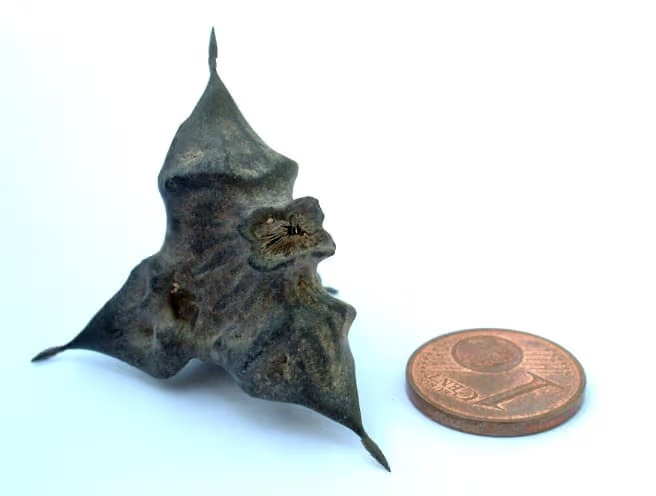
An aquatic annual grown floating in ponds, tanks and diked wetland fields across Bihar, Uttar Pradesh, West Bengal, Madhya Pradesh and, most famously, Kashmir's Dal Lake — unlike makhana, whose ripe seed sinks and is dived for on the pond floor, singhara's spiny nut ripens just under the floating rosette and is hand-picked from a raft in repeated rounds over several weeks, then eaten fresh or dried and ground into singhare ka atta, a staple vrat (fasting) flour.
Quick Summary
The key points from this page in about two minutes — read it or have it read aloud.
Quick Summary
Water chestnut, called singhara or paniphal, is the spiny fruit of an annual floating-leaved aquatic plant grown submerged in ponds, tanks and shallow diked fields across Bihar, Uttar Pradesh, West Bengal, Madhya Pradesh and Kashmir's Dal Lake. It shares its growing world with makhana, but the two plants and their harvests are genuinely different — singhara's spiny fruit develops right beneath the floating rosette and, as it ripens, detaches and rises to float near the surface rather than sinking, so growers hand-pick it from a raft in repeated rounds over several weeks from September into November, instead of diving to gather it off the pond floor the way makhana is harvested.
Unlike makhana, singhara has no nationally released ICAR variety with a household name like Swarna Vaidehi. ICAR's Makhana research centre at Darbhanga trialled two improved selections, Improved Red Spineless and Improved Green Spineless, but most of the crop still grows from farmer-saved local red-spined and green-spined biotypes carried over between seasons rather than bought as certified seed. The fresh nut is eaten boiled or raw, and a large share is dried and ground into singhare ka atta, one of the flours Hindu households treat as suitable for vrat (religious fasting) because it comes from an aquatic fruit rather than a grain — a real reason the flour sees a festival-season demand spike on top of its everyday vegetable-market use.
- Crop type
- Aquatic floating annual, grown submerged in ponds/diked fields
- Season
- Planted Mar–Jun (region-dependent); harvested Sep–Nov
- Suitable states
- Bihar, Uttar Pradesh, West Bengal, Madhya Pradesh, Jammu & Kashmir
- Growing duration
- About 6–7 months from planting to first harvest
- Water requirement
- Constant standing water, about 1–2 m deep, for the whole season
- Temperature
- 20–35°C; a warm subtropical to tropical climate suits it
- Growing medium
- Pond/field with a soft, fertile silt floor that holds water without draining away
- Difficulty level
- Hard — specialised water management and repeated hand harvest
- Expected yield
- 25–35 q/ha fresh nut (up to 50 q/ha under good management)
- No MSP
- Not a CACP-notified crop; genuinely traded, farmgate roughly ₹5,000–7,000/quintal fresh
Overview
Water chestnut, known across north and east India as singhara or paniphal (Trapa bispinosa, also cited as Trapa natans var. bispinosa), is the spiny nut of an annual, floating-leaved aquatic plant grown submerged in ponds, tanks and shallow diked wetland fields. Bihar, Uttar Pradesh and West Bengal carry the largest growing area, with real production also in Madhya Pradesh, Assam, Odisha, Tamil Nadu and Jammu & Kashmir — where Srinagar's Dal and Wular Lakes support a well-known singhara harvest that local boat-owning families have worked for generations.
Singhara is often mentioned in the same breath as makhana because both are pond crops of the same eastern and northern belt, sometimes even grown in the same water body, but the two plants and their harvest are genuinely different. Makhana's ripe seed drops out of its fruit and sinks into the pond mud, so harvest means wading or diving to gather it off the floor. Singhara's spiny fruit instead develops underwater right beneath the floating rosette and, as it ripens, detaches and rises to float near the surface among the leaves rather than sinking — so growers work from a raft or wade the shallows, hand-picking and netting the floating nuts in repeated rounds every few days over several weeks, from roughly September into November, instead of one dive-based collection at season's end.
Unlike makhana, singhara has no single nationally released ICAR variety with the recognition of a Swarna Vaidehi. ICAR's National Research Centre for Makhana at Darbhanga trialled two improved selections drawn from local biotypes, Improved Red Spineless (IRS) and Improved Green Spineless (IGS), across multiple locations through 2021, both outyielding their unimproved parent stock — but this remains research-station-level work, not a widely distributed commercial release. In practice most growers still plant farmer-saved local red-spined, green-spined and, less commonly, spineless biotypes carried over from pond to pond rather than buying certified seed, the same honest picture as makhana's own thin varietal landscape before Swarna Vaidehi came along.
The fresh nut is peeled and eaten boiled, roasted or raw, and a large share of the crop is sun-dried and ground into singhare ka atta (water chestnut flour) — one of the handful of flours Hindu households treat as permitted during vrat (religious fasting) because it comes from an aquatic fruit rather than a cereal grain, a real and specific reason the flour carries a steady festival-season premium on top of its everyday vegetable-market demand.
Crop timeline, sowing to harvest
A quick visual map of the season — jump to any section below for the detail behind each stage.
- Day 0
Pond/field preparation
Clear the pond of old plant debris and silt, or bund and puddle a shallow field, and fill it to a modest starting depth before planting.
- Day 0–15
Planting
Sprouted tubers or young rosette seedlings raised in a nursery corner are set into the mud by hand from March to May (the Dal Lake belt) or with the monsoon in the plains, depending on the local water cycle.
- Day 15–45
Establishment
Roots anchor in the mud and the first floating leaves reach the surface; water depth is kept shallow at this stage so the young rosette is not swamped.
- Day 45–100
Vine and leaf spread
Rosettes multiply from runners and spread to cover the water surface, shading out most competing weeds; water depth is raised as the canopy thickens.
- Day 100–140
Flowering
Small white flowers open above the water at the leaf axils and submerge once pollinated, each going on to swell into a hard, spiny fruit just beneath the rosette.
- Day 140–210
Fruit development
Fruits fill and harden underwater over several weeks; unlike makhana seed, a ripe singhara fruit detaches and rises to float near the surface rather than sinking into the mud.
- Day 150–240
Harvest
From September into November, floating ripe nuts are hand-picked or netted from a raft in repeated rounds every few days as successive fruit ripens, rather than as one end-of-season collection.
Suitable states
States where this crop is grown at scale, highlighted below. Your local Krishi Vigyan Kendra is still the final word for your specific block.
- Jammu and Kashmir
- Himachal Pradesh
- Punjab
- Uttarakhand
- Haryana
- Delhi
- Uttar Pradesh
- Rajasthan
- Bihar
- Jharkhand
- West Bengal
- Sikkim
- Assam
- Arunachal Pradesh
- Meghalaya
- Nagaland
- Manipur
- Mizoram
- Tripura
- Gujarat
- Madhya Pradesh
- Chhattisgarh
- Maharashtra
- Odisha
- Goa
- Telangana
- Andhra Pradesh
- Karnataka
- Kerala
- Tamil Nadu
- Puducherry
- Ladakh
- Chandigarh
- Lakshadweep
Grown here
Climate requirements
As with makhana, the defining climate need is not temperature or rainfall but a water source that can hold a pond or field at a near-constant depth for six to seven months. A grower in the established Bihar–UP–Bengal belt or in the Kashmir valley already has the right climate; the real question is whether a specific pond can be kept full through a dry spell.
Ideal temperature
20–35°C through the growing season suits singhara well; it is a warm-climate plant that does not tolerate frost or cold, stagnant water at any stage
Rainfall
A reliable water source matters more than rainfall itself — the pond or field is filled and topped up from rain, a river, canal or tube well, but must hold a steady depth through the season regardless of how the monsoon behaves
Humidity
High humidity through the monsoon and post-monsoon months is normal and not a particular risk on its own, though very still, humid water favours leaf-spot fungal problems
Sunlight
Full sun on the open water surface once the rosettes spread out is important — a shaded pond gives thin leaf cover and poorly filled fruit
Soil requirements
Choosing where to grow singhara is really a choice of water body, not soil type — an old, well-silted village pond in the established belt already has what the crop needs, while a new plot has to be bunded tightly enough to hold 1–2 m of water for six to seven months.
Suitable soil
Not a soil crop in the usual sense — singhara is grown in the soft, organically rich silt floor of a pond or a shallow, bunded field that holds standing water; a base that leaks or drains quickly cannot support the crop regardless of fertility
pH range
Roughly neutral to mildly alkaline water and mud (about pH 6.7–8.2) suits it best, a slightly wider tolerance than makhana's preference for neutral-to-acidic water
Drainage
The opposite of a normal crop's requirement — singhara needs the growing area to hold water, not shed it. A pond or field that loses water to seepage or a porous bed cannot maintain the depth the plant needs
Organic matter
A silty, nutrient-rich pond floor built up over years of accumulated organic matter is naturally fertile and needs little added fertiliser; a newly dug or converted field-based plot has to build this up with farmyard manure
Land preparation
Same four steps whichever region you are in — only the timing shifts with the sowing window.
- 1
Desilt and clean an established pond
Before planting, clear the pond of old plant debris, excess weed growth and built-up silt so tubers root into open mud and water depth can be properly controlled.
- 2
Bund and puddle a new field-based plot
For a diked wetland field, build well-compacted bunds exactly as for a paddy field and puddle the floor so water sits at an even depth across the whole area.
- 3
Confirm the water source before planting
Make sure the pond or field can be filled and topped up reliably for the full six to seven months — from rain, a river, canal or tube well — since a pond that runs dry partway through the season loses the crop.
- 4
Work farmyard manure into a new plot
A newly dug or converted plot lacks the years of natural fertility an old pond has, so work well-rotted farmyard manure into the floor before flooding it.
Seed information
How the main varieties compare, so you can pick by duration, yield, disease pressure or what you are growing for.
| Variety | Duration | Yield | Disease resistance | Best state | Suitable for |
|---|---|---|---|---|---|
The most widely grown planting material across the Bihar–UP–Bengal belt — a farmer-saved local biotype with a reddish, sharply two-spined nut, carried over from pond to pond as tubers or self-sown seedlings rather than bought fresh each year. Yield and quality vary considerably by pond and by how carefully growers have selected their own planting stock over time. | ~6–7 months | 20–30 q/ha, pond-dependent | Not formally documented; standard field hygiene applies | Bihar, Uttar Pradesh, West Bengal | General pond and diked-field cultivation |
A second common farmer-saved biotype, grown alongside the red-spined type in many of the same ponds, with a greener nut and generally regarded locally as slightly milder in taste; like the red-spined type it is propagated informally rather than through certified seed. | ~6–7 months | 20–30 q/ha, pond-dependent | Not formally documented | Bihar, Uttar Pradesh, West Bengal, Jammu & Kashmir (Dal Lake) | General pond and diked-field cultivation |
An ICAR National Research Centre for Makhana (Darbhanga) research selection bred from spineless red biotypes and evaluated across multiple locations through 2021, showing higher yield and total soluble solids than its unimproved parent stock — a genuine varietal improvement, though it remains research-station material rather than a widely distributed commercial release the way makhana's Swarna Vaidehi is. | ~6–7 months | Higher than unimproved local stock in ICAR-NRC Makhana's own multilocation trials; no separately published all-India figure | Not separately documented | Bihar (trialled at ICAR-NRC Makhana, Darbhanga, and partner locations) | Growers able to source planting material through ICAR-NRC Makhana or its state partners |
Improved Green Spineless (IGS) The companion selection to IRS from the same ICAR-NRC Makhana breeding programme, bred from spineless green biotypes and similarly evaluated through 2021 with improved yield and quality over unimproved local stock — the spineless trait also makes the fruit easier and safer to handle by hand at harvest and during peeling. | ~6–7 months | Higher than unimproved local stock in ICAR-NRC Makhana's own multilocation trials; no separately published all-India figure | Not separately documented | Bihar (trialled at ICAR-NRC Makhana, Darbhanga, and partner locations) | Growers prioritising easier hand-harvesting and peeling, where planting material can be sourced |
- Seed rate
- About 400–600 kg/ha of sprouted tubers, or roughly 6,000–10,000 self-rooted rosette seedlings per hectare where nursery-raised transplants are used instead of direct tuber planting — considerably heavier planting material per hectare than makhana's seed rate, since singhara is typically established from vegetative tubers rather than broadcast true seed.
- Certified seed
- There is no organised private or certified seed trade for singhara — nearly all planting material is farmer-saved tubers or self-sown seedlings carried over between seasons in the same pond, or exchanged locally between growers. The ICAR-NRC Makhana-bred IRS and IGS selections are available only through the institute or its state extension partners in Bihar, not through open market channels; confirm current availability directly before planning a planting around them.
- Spacing
- Not sown in fixed rows — tubers or seedlings are set into the mud at a spacing that lets mature rosettes cover the water surface without excessive crowding, commonly worked out as one plant per roughly 1–1.5 sq m of pond area.
- Seed treatment
- No routine chemical seed treatment is standard practice; growers select only firm, undamaged, well-sprouted tubers or healthy seedlings, discarding soft, rotted or shrivelled planting material.
Sowing guide
As with makhana, timing is the sowing decision that matters most — plant too early into still-cold water and establishment is slow; plant too late and the crop loses growing days before the fruit-development window has to close ahead of falling temperatures.
- Best time
- March to May in the Kashmir valley's Dal Lake belt, once winter cold has passed; with the monsoon onset (June–July) in the Bihar–UP–Bengal plains belt — the exact window is set by when each region's water body reliably holds a steady, warm-enough depth.
- Row spacing
- Not applicable — tubers or seedlings are set individually into the mud rather than drilled in rows
- Plant spacing
- Roughly one plant per 1–1.5 sq m of water surface, thinned by hand once rosettes are visibly crowding each other
- Sowing depth
- Tubers are pressed into the soft mud a few centimetres deep; nursery-raised seedlings are transplanted with their roots set into the floor the same way a paddy seedling is
- Method
- Hand planting of sprouted tubers directly into the mud is the traditional method; raising seedlings in a shallow nursery corner and transplanting them once established is increasingly used to even out the stand and save planting material
Fertilizer schedule
A split dose beats one large dose applied at sowing — nitrogen especially is lost to the air and to leaching if it all goes in on day one.
- 1
Established pond system
Throughout the season
A well-silted, long-used pond usually needs little or no added chemical fertiliser — years of accumulated organic matter on the floor supply much of what the crop needs, keeping the traditional method low-cost.
- 2
New field-based system — basal dose
Before flooding, at field preparation
A newly converted plot benefits from roughly 12–15 tonnes/ha of well-rotted farmyard manure worked into the floor before it is flooded, since it starts without a pond's built-up fertility.
- 3
New field-based system — NPK
Split through the season
Where chemical fertiliser is used, a dose of roughly 80:40:40 kg/ha of N:P2O5:K2O is applied in split doses through the growing season, since nutrients dissolved into standing water are more easily lost than in a dry field.
Irrigation schedule
1. Filling
At planting
Fill the pond or field to a shallow depth for planting and establishment, then raise the water level gradually as rosettes grow and spread across the surface.
2. Full-depth maintenance
Leaf spread through fruit development
Hold the water at a steady 1–2 m depth through leaf spread, flowering and fruit development — the single most important water task in the whole crop, since a falling level exposes and stresses the plant.
3. Drawdown for late harvest
Toward the end of the picking season, field-based system
On a diked field-based plot, water can be partly drawn down late in the harvest window to make netting the last floating nuts easier; a natural pond is simply worked by raft or by wading through the whole picking season instead.
Critical stages
- Establishment — the pond must not run dry in the first weeks after planting
- Leaf spread and flowering — depth must stay steady, not just present
- Fruit development — a sudden drop in water level here stresses the plant and can affect how well fruit fills
Water-saving tips
- A tightly bunded field-based plot loses far less water to seepage than a poorly maintained pond, cutting how much has to be topped up over the season.
- Topping up little and often, rather than letting the level fall a long way and refilling in one go, keeps the plant from the stress of a swinging water depth.
- A pond that also holds fish alongside singhara can share the same water management, spreading upkeep cost across two harvests.
Weed management
Common weeds
Organic control
- Hand-removal of competing floating and submerged weeds from a small boat or by wading, timed before the singhara canopy has closed over the water.
- A well-established rosette canopy shades out most new weed growth once it covers the surface, so early, thorough weeding matters more than repeated later effort.
- Clearing old plant debris from the pond at the end of each season reduces weed and algae carryover into the next.
Chemical control
- Chemical herbicide use in a standing-water pond crop is uncommon and risky, since the pond often has other uses (fish, drinking or irrigation water) that a herbicide would contaminate — manual and cultural control is the standard approach instead.
Nutrient deficiency identification
What a shortage of each nutrient actually looks like on the plant, so you can tell a deficiency apart from a disease before you spray the wrong thing.
Nitrogen
Visible symptom
Older leaves turn pale yellow-green and rosette growth slows on a nutrient-poor pond or a new field-based plot without enough organic matter worked in.
Phosphorus
Visible symptom
Leaves take on a dull, darker green cast and flowering and fruit set are delayed or sparse — more likely on a new plot without an old pond's built-up fertility.
Potassium
Visible symptom
Yellowing and scorching along the margins of older leaves, with weaker leaf stalks that struggle to hold the floating rosette flat on the water.
Diseases to watch for
Symptoms, likely cause and what actually treats it — not just a spray name.
Pests to watch for
What to look for before the damage is visible, and organic options before you reach for a chemical.
Aphid
- Identification
- Small, soft-bodied insects clustering on the underside of young leaves and on flower buds, often in visible colonies.
- Damage
- Sap-sucking weakens young leaves and can reduce flowering and fruit set in a heavy infestation, though it is rarely the crop's most serious problem.
- Organic control
- A 0.3% neem oil spray on affected foliage is the standard organic response, along with encouraging natural predators such as ladybird beetles around the pond.
- Chemical control
- A need-based spray of a recommended insecticide, used sparingly and with care around a water body that may have other uses, only where the infestation is heavy.
Leaf-eating caterpillar
- Identification
- Caterpillars feeding on the leaf surface, leaving irregular chewed patches and holes across the floating rosettes.
- Damage
- Reduces the healthy leaf area available for the plant to fill its developing fruit, and a heavy infestation can noticeably thin the canopy.
- Organic control
- Hand-picking visible caterpillars where the pond is small enough to manage this way, plus a neem-based spray for a wider outbreak.
- Chemical control
- A need-based insecticide spray recommended for use in standing water, applied only when damage crosses a noticeable threshold.
Common mistakes to avoid
The mistakes that cost growers the most, ranked by how often they show up in the field — not in the order you might expect.
- 1
Letting pond water level fall during fruit development
Why it hurts
A falling water level exposes and stresses the plant during its most water-sensitive stage, reducing both leaf growth and the number of fruit that fill properly.
- 2
Treating singhara harvest like makhana's — waiting for a single end-of-season collection
Why it hurts
Singhara's ripe fruit floats rather than sinks and is best picked in repeated rounds every few days as it ripens; leaving it too long lets fully ripe nuts drift, get lost, or spoil before collection.
- 3
Choosing a plot or pond that cannot hold water reliably for the full season
Why it hurts
A pond or field that leaks or dries out partway through the six-to-seven-month cycle can lose the crop entirely, regardless of how well everything else was managed.
- 4
Delaying drying of the fresh nut meant for flour
Why it hurts
Fresh nuts left too long before drying can spoil or discolour, lowering the quality — and price — of the singhare ka atta ground from them.
- 5
Overcrowded planting without later thinning
Why it hurts
A dense stand shades its own fruit-bearing zone and encourages leaf-spot fungal problems in the still, humid air trapped under a thick canopy.
Harvesting
From around September into November, roughly five to six months after planting, once fruit begins ripening and detaching to float near the surface. Harvest is done in repeated rounds every few days over several weeks as successive fruit ripens, not as a single cutting or dive-based collection.
Signs it is ready
- Fruit has hardened and its spines have darkened and firmed
- Ripe fruit detaches from the plant and floats or hovers near the surface rather than staying attached
- The floating leaf canopy begins to thin toward the end of the picking season
Tools
- Small rafts or boats for working the open pond surface
- Hand-nets or baskets for scooping floating ripe nuts from among the leaves
- Wading, in shallower ponds, to hand-pick nuts within reach
- Gloves, useful on spined biotypes to avoid the sharp fruit horns
Expected yield
A typical pond gives roughly 25–35 q/ha of fresh nut across the full picking season, with well-managed plots reaching up to about 50 q/ha; ICAR-NRC Makhana's IRS and IGS selections have shown higher yield than unimproved local stock in station trials.
Post-harvest & storage
Storage
Fresh nuts are highly perishable and are usually sold quickly for the fresh vegetable market. Nuts meant for flour are sun-dried, then the hard shell is removed and the kernel is dried further before grinding; dried, properly stored kernel or flour keeps far longer than the fresh nut.
Packaging
Fresh nuts are packed loosely in sacks or baskets for quick transport to market; dried kernel and singhare ka atta are packed in moisture-proof bags, since the flour readily reabsorbs moisture and spoils if kept damp.
Transportation
Fresh nuts must reach market quickly, within a few days of picking, since they do not keep well; dried kernel and flour tolerate longer transport if kept dry.
Shelf life
Fresh nuts keep only a few days to about a week under normal conditions; well-dried kernel keeps for several months, and singhare ka atta, stored airtight and away from moisture, keeps similarly well.
Market prices
Today's mandi price near you, pulled live from the government's own Agmarknet data.
Live daily mandi prices from the government Agmarknet dataset.
Government mandi price not available for this crop
This crop is not traded through APMC mandis covered by the government’s Agmarknet system, so there is no mandi price to show here.
Reference MSP: Not a CACP-notified crop; genuinely traded, farmgate roughly ₹5,000–7,000/quintal fresh
Weather
Current conditions and a 5-day outlook for your selected location, with one line of stage-aware advice.
Pick your state for current conditions and a 5-day outlook.
Live data from Open-Meteo
Profit calculator
Your own cost sheet, expected yield and selling price — not ours.
Where the money goes
Share of the total cost per acre, using the calculator’s own default cost sheet below — adjust the numbers there to match your field and this picture will no longer apply to you exactly, but the ranking rarely changes.
- Labour54% (₹20,000)
- Land rent22% (₹8,000)
- Seed9% (₹3,500)
- Irrigation5% (₹2,000)
- Fertiliser4% (₹1,500)
- Interest3% (₹1,000)
- Pesticide & weedicide1% (₹500)
- Machinery1% (₹500)
Official downloads
Government and ICAR documents only — everything below is hosted on an official server.
ICAR-National Research Centre for Makhana, Darbhanga
Bred the Improved Red Spineless and Improved Green Spineless singhara selections and researches pond-crop cultivation practices for the same eastern Bihar belt as makhana.
Soil Health Card portal
For a farmer converting a field to the diked field-based system, a soil test helps judge the manure and fertiliser needed to build up fertility an established pond already has.
mKisan — SMS advisory portal
Register for free SMS advisories, including for districts covered by pond-crop extension programmes.
Frequently asked questions
Is singhara the same crop as makhana?
No, though the two are often grown in the same ponds and belt. Both are aquatic plants, but makhana's ripe seed drops out of its fruit and sinks into the pond mud, so harvest means wading or diving to gather it off the floor. Singhara's spiny fruit develops right beneath the floating rosette and, as it ripens, detaches and rises to float near the surface instead — so it is hand-picked or netted from a raft in repeated rounds every few days, not collected in a single dive-based harvest.
Where in India is water chestnut grown?
Bihar, Uttar Pradesh and West Bengal carry the largest growing area, with real production also in Madhya Pradesh, Assam, Odisha, Tamil Nadu and Jammu & Kashmir. Srinagar's Dal and Wular Lakes in Kashmir support a particularly well-known singhara harvest worked by local boat families for generations.
Are there released, named water chestnut varieties like makhana's Swarna Vaidehi?
Not at the same scale. ICAR's National Research Centre for Makhana at Darbhanga trialled two improved selections, Improved Red Spineless and Improved Green Spineless, through 2021, both outyielding unimproved local stock — a genuine step forward, but still research-station material rather than a widely distributed named release. Most growers still plant farmer-saved local red-spined, green-spined and spineless biotypes carried over between seasons.
What is singhare ka atta and why is it eaten during fasting?
Singhare ka atta is flour ground from dried, peeled water chestnut kernel. Hindu households treat it as suitable for vrat (religious fasting) because it comes from an aquatic fruit rather than a cereal grain, unlike wheat or rice flour — a specific, factual reason it sees a steady demand spike around major fasting festivals on top of its everyday use in vegetable dishes.
Does water chestnut have an MSP or a mandi price?
There is no MSP for water chestnut, and a direct check of the Agmarknet mandi dataset found no genuine trade records under "Singhara," "Water Chestnut" or any related name — like makhana, most of the crop moves through local and direct sale to traders and processors rather than organised APMC mandis. Cost-of-cultivation studies do document real farmgate transactions this way, commonly in the range of roughly ₹5,000–7,000 per quintal for fresh nut, varying by season and region.
Why is singhara harvested in repeated rounds instead of all at once?
Because fruit on the same plant ripens over an extended period, not together, and a ripe nut floats free rather than staying put — leaving it too long risks the nut drifting away, being missed, or spoiling. Growers instead work the pond every few days from September into November, picking only what has ripened since the last round.
Still have questions?
The FAQs above cover the common ones. For anything specific to your field and soil, your nearest Krishi Vigyan Kendra is the authoritative answer.