
Cucumber
Cucumis sativus
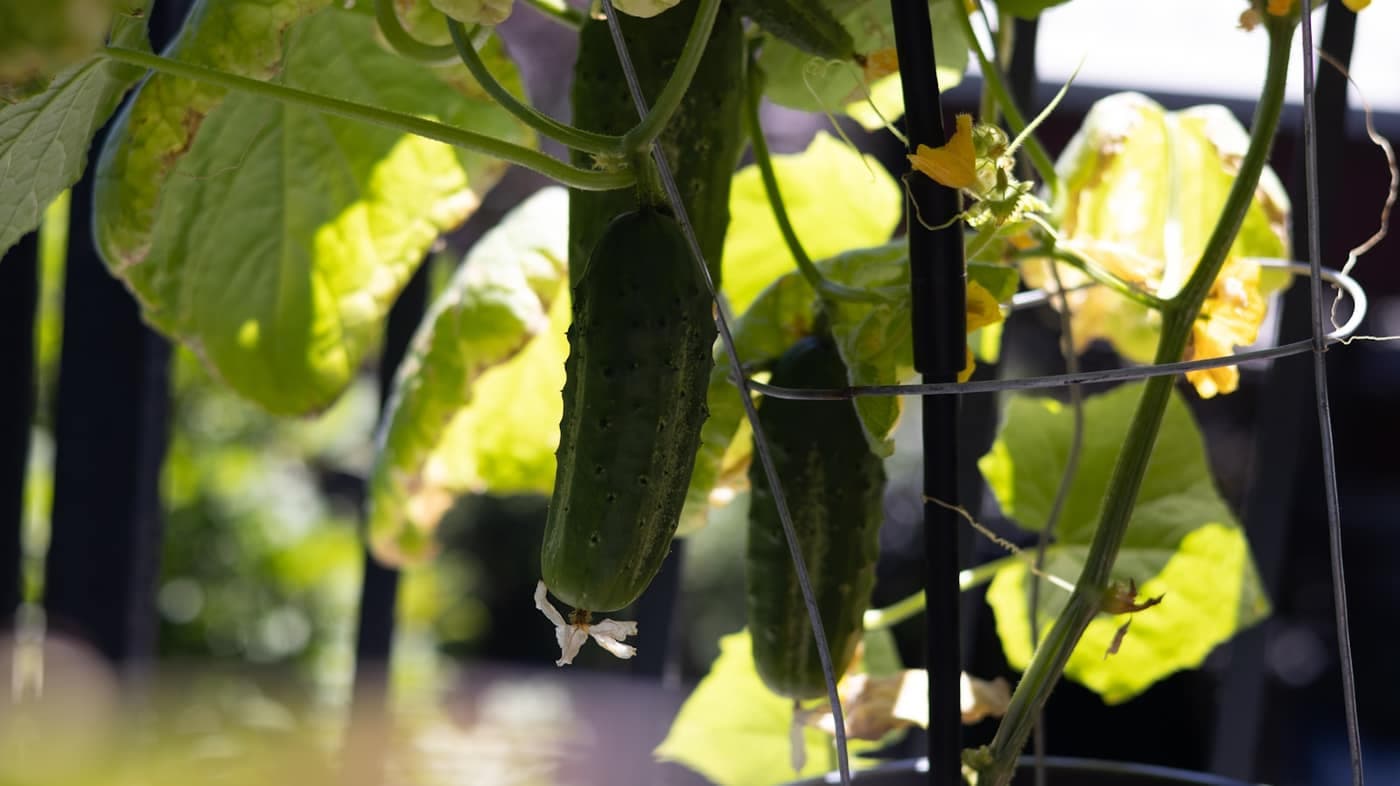
A quick summer and rainy-season cucurbit that reaches the first pick in as little as six to seven weeks. Yield lives and dies by picking frequency — harvest every second or third day and the vine keeps setting; let one fruit go to seed and the whole plant slows right down.
Quick Summary
The key points from this page in about two minutes — read it or have it read aloud.
Quick Summary
Cucumber is a fast, warm-season cucurbit — from sowing to the first pick can be as little as six or seven weeks — grown across India in the summer and the rains, and increasingly under cover for a year-round crop.
One rule decides the whole crop: pick often, every two or three days. The vine keeps flowering and setting new fruit only as long as you keep taking the young ones off; leave a single fruit to mature and go to seed and the plant treats the job as done and slows right down. Pollination is the other half of fruit set — bees do the work, so never spray insecticide during the hours the flowers are open, or set drops sharply.
Two pests and one disease group make or break the rest. The red pumpkin beetle attacks the seedlings, so watch from the day they emerge; fruit fly attacks the fruit and is best handled with traps; and downy and powdery mildew build up in warm, humid weather. Training the vines onto a trellis keeps the fruit clean and cuts disease. Cucumber has no tolerance for frost or cold soil, so sow only after the cold has passed, and keep the moisture steady without letting water stand, which rots the roots. The page below carries the exact spacing, seed rate, nutrient doses, irrigation schedule, the pest-trap plan, days to first pick and expected yields.
- Crop type
- Vegetable (cucurbit)
- Season
- Summer & rainy
- Suitable states
- 15+ major states
- Growing duration
- 45–70 days to first pick
- Water requirement
- Moderate & frequent
- Temperature
- 18–30°C
- Soil type
- Well-drained sandy loam
- Difficulty level
- Easy
- Expected yield
- 100–150 q/ha
- Key practice
- Pick every 2–3 days
Overview
Cucumber (Cucumis sativus) is a fast, warm-season cucurbit grown right across India in the summer and the rains, and increasingly under protected cultivation for a year-round crop.
Its great appeal is speed — from sowing to the first pick can be as little as six or seven weeks. But that speed comes with a rule that decides the whole crop: pick often. A cucumber vine keeps flowering and setting as long as you keep removing young fruit; leave a single fruit to mature and go to seed and the plant reads it as "job done" and slows right down.
The other two things that make or break the crop are pests — the red pumpkin beetle on the seedlings and the fruit fly on the fruit — and the mildews that thrive in warm, humid weather. This guide is built around picking frequency, pollination, and staying ahead of those problems.
Crop timeline, sowing to harvest
A quick visual map of the season — jump to any section below for the detail behind each stage.
- Day 0
Sowing
Seed dibbled 2–3 cm deep on ridges or mounds at 1.5 m × 60 cm into warm, moist soil.
- Day 5–8
Emergence
Seedlings emerge; the red pumpkin beetle attacks the tender cotyledons and must be watched from day one.
- Day 15–25
Vine growth
Runners extend and start to climb; training onto a trellis now keeps fruit clean and disease down.
- Day 25–35
Flowering
Male flowers open first, then females with a tiny fruit behind them — bees now decide the fruit set.
- Day 35–45
First fruit
The earliest fruit swell to a tender, market size — the first of many picks begins.
- Day 45–70
Repeated picking
Frequent picking every 2–3 days keeps the vine flowering and setting new fruit; fruit fly must be trapped.
- Day 70–90
End of crop
Yield tails off as the vine tires and mildew builds; a fresh sowing takes over.
Suitable states
States where this crop is grown at scale, highlighted below. Your local Krishi Vigyan Kendra is still the final word for your specific block.
- Jammu and Kashmir
- Himachal Pradesh
- Punjab
- Uttarakhand
- Haryana
- Delhi
- Uttar Pradesh
- Rajasthan
- Bihar
- Jharkhand
- West Bengal
- Sikkim
- Assam
- Arunachal Pradesh
- Meghalaya
- Nagaland
- Manipur
- Mizoram
- Tripura
- Gujarat
- Madhya Pradesh
- Chhattisgarh
- Maharashtra
- Odisha
- Goa
- Telangana
- Andhra Pradesh
- Karnataka
- Kerala
- Tamil Nadu
- Puducherry
- Ladakh
- Chandigarh
Grown here
Climate requirements
Cucumber is a warm-season crop that will not tolerate frost or cold soil. Sow after the cold has passed. Bees do the pollination, so avoid spraying insecticide during the hours flowers are open, or fruit set drops sharply.
Ideal temperature
18–30°C is ideal; growth stalls below 15°C and germination fails in cold soil
Rainfall
Grown in summer on irrigation and through the rains; steady moisture matters, but standing water rots the roots
Humidity
Warm humid weather speeds growth but also brings on downy and powdery mildew
Sunlight
Full sun for strong vines, plenty of flowers and good fruit set
Soil requirements
Cucumber does well on the residual fertility of a well-manured bed. On heavy or poorly drained soil, grow it on ridges or raised mounds so the crown and roots stay out of standing water, which is a fast route to root rot and wilt.
Suitable soil
Well-drained sandy loam to loam rich in organic matter
pH range
6.0–7.0 is ideal
Drainage
Good drainage is essential; the shallow-rooted vine rots quickly in waterlogged soil
Organic matter
High; work plenty of FYM into the planting pits or ridges
Land preparation
Same four steps whichever region you are in — only the timing shifts with the sowing window.
- 1
Well-manured ridges or pits
Plough to a fine tilth and form ridges 1.5 m apart, or dig pits, working in plenty of well-rotted FYM at each planting spot.
- 2
Trellis or support ready
For a clean, high-yielding crop arrange a trellis, net or bower before the vines start to run.
- 3
Basal fertiliser
Mix basal phosphorus, potash and part of the nitrogen into the pits or ridges before sowing.
Seed information
How the main varieties compare, so you can pick by duration, yield, disease pressure or what you are growing for.
| Variety | Duration | Yield | Disease resistance | Best state | Suitable for |
|---|---|---|---|---|---|
Early, high-yielding variety with medium-green, cylindrical fruit for the fresh market. | 50–55 days to first pick | High | Moderate | Uttar Pradesh | Summer, fresh market |
Rainy-season variety bred to set and yield well in the humid monsoon. | 45–50 days | Medium–high | Tolerant to humid-weather disease | Uttar Pradesh | Rainy season |
Popular dark-green, long-fruited variety with field tolerance to several diseases. | 55–60 days | High | Tolerant to downy mildew & scab | Punjab | Main season, long fruit |
An ICAR variety suited to the eastern plains, early and dependable. | 50–60 days | Medium–high | Moderate | Jharkhand | Eastern plains |
An ICAR variety on the same early, dependable eastern-plains line as Swarna Ageti. | 50–60 days | Medium–high | Moderate | Jharkhand | Eastern plains |
A traditional Maharashtra open-pollinated type, thicker-skinned than Poinsette and grown as much for local salad demand as for distant markets. | 60–65 days | 100–130 q/ha | Moderate downy mildew tolerance | Maharashtra | Local salad market |
F1 gynoecious hybrids All-female-flowering hybrids for protected cultivation with very high, uniform yield. | 40–50 days | Very high | Variable by hybrid | Maharashtra | Polyhouse, year-round |
- Seed rate
- 2.5–3.5 kg/ha for open-field sowing (much less for hybrids under protection)
- Certified seed
- Match the variety to the season — a rainy-season type like Pusa Barkha sets fruit in humidity where a summer variety would fail. For protected cultivation, gynoecious F1 hybrids give the highest, most uniform yields.
- Spacing
- 1.5 m between rows × 60 cm within the row
- Seed treatment
- Treat seed with Thiram or Carbendazim against seed and seedling rots; soaking overnight speeds germination in cooler soil.
Sowing guide
Sow only once the soil is warm — cold soil rots the seed. Sowing on ridges or mounds keeps the crown above water in the rains. Plan a trellis from the start; a trellised crop stays cleaner, yields more and is far easier to pick frequently.
- Best time
- February–March for the summer crop and June–July for the rainy crop; year-round under protection
- Row spacing
- 1.5 m
- Plant spacing
- 60 cm within the row
- Sowing depth
- 2–3 cm
- Method
- Dibble 2–3 seeds per spot on ridges or mounds and thin to the strongest one
Fertilizer schedule
A split dose beats one large dose applied at sowing — nitrogen especially is lost to the air and to leaching if it all goes in on day one.
- 1
Basal (at sowing)
Day 0
Full phosphorus and potash with one-third of the nitrogen on a base of FYM in the pits or ridges.
- 2
First top-dressing
Vine growth (20–25 days)
One-third of the nitrogen as the vines start to run, with irrigation.
- 3
Second top-dressing
Flowering (30–35 days)
The remaining nitrogen as flowering and fruiting begin, to sustain the pick.
- 4
Maintenance
Through picking
On a heavy-cropping vine, light supplementary feeds of nitrogen and potash after picking flushes keep it setting.
Irrigation schedule
1. Germination
Day 0–7
Keep the seed zone moist for even emergence.
2. Vine growth
15–30 days
Irrigate every 4–6 days in summer to keep the vines growing fast.
3. Flowering and fruiting
30 days onward
Keep moisture steady and frequent; the fruit is mostly water and stress here makes it bitter and misshapen.
Critical stages
- Flowering
- Fruit development
Water-saving tips
- Drip irrigation with mulch gives steady moisture, saves water and keeps foliage dry to cut mildew.
- Never let a fruiting cucumber go dry then flood it — the swing causes bitter, cracked and curved fruit.
- Grow on ridges so you can irrigate the furrows without waterlogging the crown.
Weed management
Organic control
- Mulching the ridges with straw or plastic suppresses weeds, holds moisture and keeps fruit clean.
- One or two hand weedings until the vines spread and shade out later weeds.
Chemical control
- Pre-emergence Pendimethalin on moist soil after sowing controls early weeds between the widely-spaced rows.
- Follow with a hand weeding before the vines cover the ground.
Nutrient deficiency identification
What a shortage of each nutrient actually looks like on the plant, so you can tell a deficiency apart from a disease before you spray the wrong thing.
Nitrogen
Visible symptom
Pale, slow vines with small leaves and few fruit.
Potassium
Visible symptom
Scorched older leaf margins and poorly shaped, tapering fruit — heavy fruiting draws a lot of potash.
Magnesium
Visible symptom
Interveinal yellowing of older leaves with green veins, on light soils.
Boron
Visible symptom
Cracked, corky and misshapen fruit and death of growing tips on deficient soils.
Calcium
Visible symptom
Poor fruit tips and weak growing points under fast growth and uneven watering.
Diseases to watch for
Symptoms, likely cause and what actually treats it — not just a spray name.
Downy mildew
- Symptoms
- Angular yellow patches on the upper leaf, bounded by the veins, with a greyish-purple down beneath; leaves brown and die from the crown outward in humid weather.
- Cause
- Pseudoperonospora cubensis, favoured by warm, humid, wet-leaf conditions.
- Treatment
- Spray Mancozeb or Metalaxyl-Mancozeb at first appearance and repeat; improve airflow.
- Prevention
- Grow tolerant varieties, trellis the crop for airflow, avoid overhead irrigation and do not crowd the vines.
Powdery mildew
- Symptoms
- A white powdery growth on leaves and stems, worst in warm dry spells, causing early leaf death and small fruit.
- Cause
- Podosphaera / Erysiphe species, favoured by warm days and dry weather.
- Treatment
- Spray wettable sulphur or a systemic fungicide such as Hexaconazole at first appearance.
- Prevention
- Grow tolerant varieties, ensure airflow and avoid dense canopies.
Anthracnose
- Symptoms
- Sunken, dark, water-soaked spots on leaves and fruit that rot and spoil the fruit in warm wet weather.
- Cause
- Colletotrichum, seed-borne and spread by splashing rain.
- Treatment
- Spray a recommended fungicide and remove affected fruit.
- Prevention
- Use treated seed, trellis to keep fruit off the soil, and rotate crops.
Cucumber mosaic virus
- Symptoms
- Mottled, distorted, cupped leaves and warty, mottled fruit; plants are stunted.
- Cause
- A virus spread by aphids — not seed-borne in cucumber.
- Treatment
- No cure; rogue out infected plants and control the aphid vector.
- Prevention
- Control aphids, remove weed hosts and use tolerant varieties.
Pests to watch for
What to look for before the damage is visible, and organic options before you reach for a chemical.
Red pumpkin beetle
- Identification
- Bright orange-red beetles that swarm the tender seedlings and skeletonise the cotyledons and young leaves; grubs feed on roots below.
- Damage
- The key seedling pest — a swarm can wipe out a young stand in days, and grubs damage roots and fruit resting on soil.
- Organic control
- Cover seedlings with net early, dust ash, hand-collect beetles in the morning, and destroy grubs by shallow interculture.
- Chemical control
- A recommended insecticide on the young crop when beetles swarm, applied before flowers open to spare bees.
Fruit fly
- Identification
- Flies that lay eggs under the skin of young fruit; maggots tunnel inside and the fruit rots and drops.
- Damage
- The key fruit pest — maggot-infested fruit are unsaleable and fallen fruit breed the next generation.
- Organic control
- Cue-lure/methyl-eugenol pheromone traps, bait splashes, bagging fruit, and collecting and burying fallen fruit daily.
- Chemical control
- Spot bait sprays rather than cover sprays; avoid blanket insecticide on a frequently-picked fruit.
Aphids
- Identification
- Soft green or black insects clustering on growing tips and the leaf underside.
- Damage
- Sap loss and honeydew, and transmission of cucumber mosaic virus.
- Organic control
- Neem oil sprays, yellow sticky traps and conserving ladybirds.
- Chemical control
- A recommended insecticide when colonies build, avoiding flowering hours.
Whitefly & red spider mite
- Identification
- Whiteflies rising from the canopy, and fine webbing with speckled, bronzed leaves from mites in hot dry weather.
- Damage
- Sap loss, virus spread (whitefly) and leaf scorching (mite) that weaken the vine.
- Organic control
- Neem sprays, sticky traps and keeping the crop unstressed and well-watered against mites.
- Chemical control
- A recommended insecticide or miticide when populations build.
Common mistakes to avoid
The mistakes that cost growers the most, ranked by how often they show up in the field — not in the order you might expect.
- 1
Picking too rarely and letting a fruit mature on the vine.
Why it hurts
A single fruit left to ripen and seed signals the plant to stop, and the whole vine slows down — frequent picking every 2–3 days is the single biggest yield lever.
- 2
Spraying insecticide while flowers are open.
Why it hurts
Bees do the pollination; killing them during flowering hours drops fruit set sharply — spray only in the evening, after the flowers close.
- 3
Growing the crop flat on the ground with no trellis.
Why it hurts
Fruit lie on damp soil and rot, the canopy stays humid and mildew-prone, and picking is slow — a trellis lifts yield and quality at once.
- 4
Ignoring the red pumpkin beetle on seedlings.
Why it hurts
A beetle swarm can strip a young stand in days; netting and early control save the crop before it establishes.
- 5
Not managing fruit fly with traps and sanitation.
Why it hurts
Maggot-infested fruit are unsaleable, and every fallen fruit left in the field breeds the next wave — traps plus daily removal of fallen fruit break the cycle.
- 6
Letting the vine go dry then flooding it.
Why it hurts
Uneven moisture makes the fruit bitter, curved and cracked; steady, frequent watering keeps fruit straight and mild.
- 7
Sowing into cold soil.
Why it hurts
The seed rots instead of germinating — wait until the soil is warm and the cold has passed.
- 8
Overhead irrigation in humid weather.
Why it hurts
Wet foliage triggers downy mildew, which can strip the vines fast — water at the base and trellis for airflow.
- 9
Crowding the vines closer than recommended.
Why it hurts
A dense, humid canopy invites mildew and makes both spraying and picking harder — give the vines their full spacing.
- 10
Growing cucurbit after cucurbit on the same land.
Why it hurts
Fruit fly, mildew and wilt build up in the soil and surroundings — rotate away from cucurbits to keep pressure down.
Harvesting
Pick fruit young, tender and uniformly green, well before it starts to yellow or the seeds harden — usually 45–70 days after sowing, then every 2–3 days. Frequent, timely picking is what keeps the vine productive.
Signs it is ready
- Fruit firm, tender and full green
- Fruit reached market size but seeds still soft
- Skin not yet yellowing or dulling
Tools
- Sharp knife to cut with a short stalk
- Baskets or crates for gentle handling
- Shade for holding before market
Expected yield
100–150 q/ha in the open field for a well-managed crop; much higher under protection
Post-harvest & storage
Storage
Cucumber is perishable and chilling-sensitive — it keeps about a week at 10–12°C with high humidity but pits and turns watery below 10°C. It loses water and goes limp quickly if left warm and dry.
Packaging
Pack firm, uniform fruit in ventilated crates, avoiding bruising; a light film or shade reduces water loss.
Transportation
Move to market quickly and cool; wilted or yellowing fruit lose grade fast.
Shelf life
A few days at room temperature; about a week cool — best sold fresh.
Market prices
Today's mandi price near you, pulled live from the government's own Agmarknet data.
Live daily mandi prices from the government Agmarknet dataset.
Synced from data.gov.in (Agmarknet). Rates are ₹ per quintal.
Weather
Current conditions and a 5-day outlook for your selected location, with one line of stage-aware advice.
Pick your state for current conditions and a 5-day outlook.
Live data from Open-Meteo
Profit calculator
Your own cost sheet, expected yield and selling price — not ours.
Where the money goes
Share of the total cost per acre, using the calculator’s own default cost sheet below — adjust the numbers there to match your field and this picture will no longer apply to you exactly, but the ranking rarely changes.
- Labour29% (₹10,000)
- Land rent23% (₹8,000)
- Fertiliser11% (₹4,000)
- Irrigation11% (₹4,000)
- Pesticide & weedicide10% (₹3,500)
- Seed6% (₹2,000)
- Machinery6% (₹2,000)
- Interest4% (₹1,500)
Official downloads
Government and ICAR documents only — everything below is hosted on an official server.
Frequently asked questions
How often should I pick cucumbers?
Every two or three days, without fail. A cucumber vine keeps flowering and setting fruit only as long as you keep removing the young fruit. If you leave even one fruit to mature and go to seed, the plant treats its job as done and slows right down. Frequent, timely picking is the single most important thing you can do for yield.
Why are my cucumber fruits bitter and misshapen?
The usual cause is uneven moisture and stress — letting the vine go dry and then flooding it, or a spell of heat and water shortage, makes the fruit bitter, curved and cracked. Keep the moisture steady and frequent. Poor pollination (too few bees, or spraying during flowering) also causes curved, tapering fruit.
How do I control fruit fly in cucumber?
Fruit fly is best managed without cover sprays on a fruit you pick every few days. Hang pheromone (cue-lure) traps, use bait splashes, bag developing fruit where practical, and — most important — collect and bury every fallen and infested fruit daily, because each one breeds the next generation. Spot bait sprays beat blanket insecticide.
Does cucumber need a trellis?
It is not strictly required, but a trellis pays for itself. Trellised vines keep their fruit off the damp soil (less rot), have an open, airy canopy (less mildew), yield more, and are far quicker to pick frequently. On heavy or wet soil, growing on ridges with a trellis is strongly recommended.
When can I sow cucumber?
Sow the summer crop in February–March and the rainy crop in June–July — always once the soil is warm, as cold soil rots the seed. Under a polyhouse with gynoecious hybrids you can grow it almost year-round. Match the variety to the season: a rainy-season type sets fruit in humidity where a summer variety struggles.
Does cucumber have an MSP?
No. Cucumber is a market vegetable with no Minimum Support Price — its price is set by local mandi demand and supply and swings with the season and glut. Use the live mandi prices and the profit calculator on this page to judge when your fruit is worth taking to market.
Still have questions?
The FAQs above cover the common ones. For anything specific to your field and soil, your nearest Krishi Vigyan Kendra is the authoritative answer.