
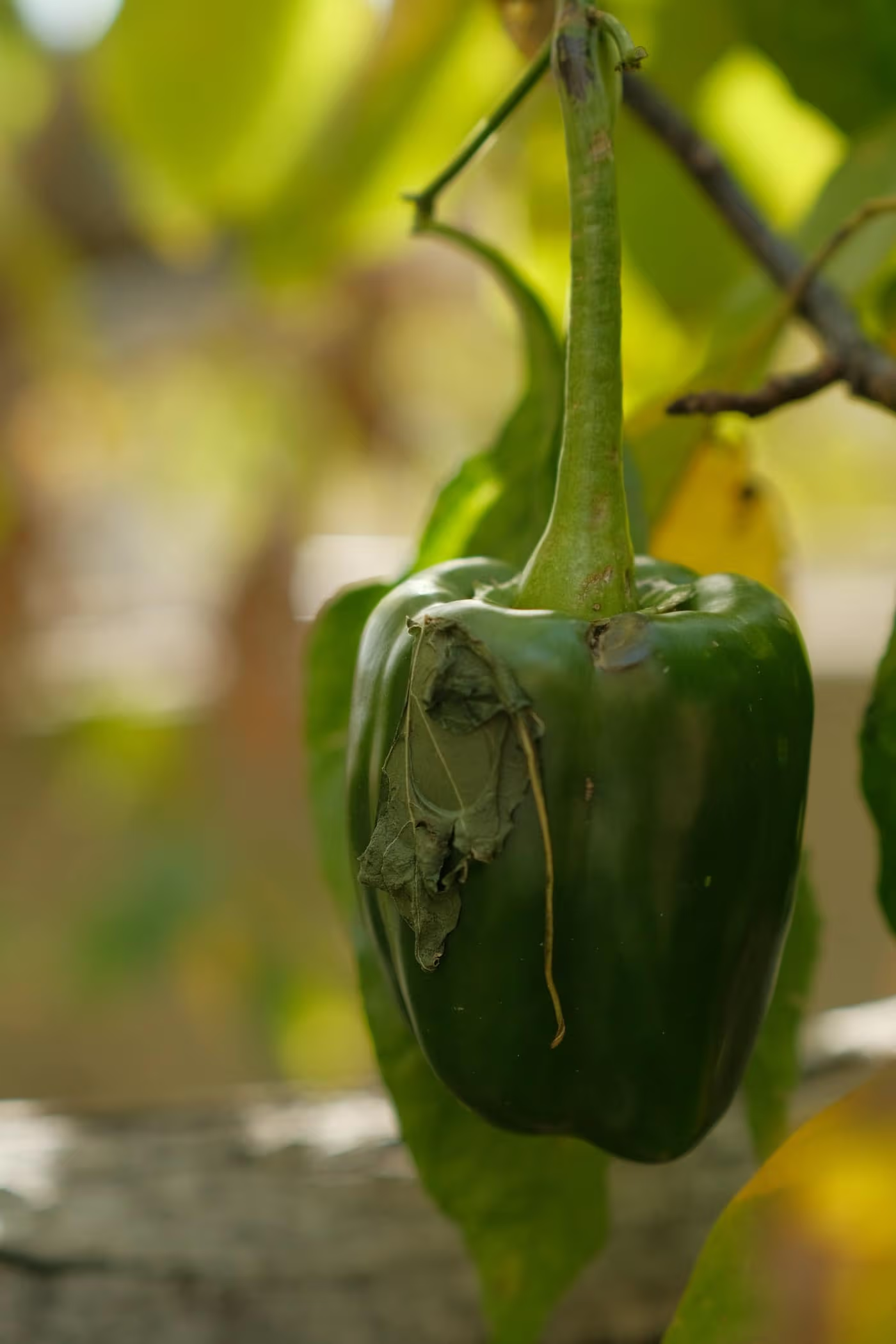
Capsicum (Shimla Mirch)
Capsicum annuum var. grossum
A transplanted, staked fruiting vegetable where the whole crop turns on raising strong, disease-free nursery seedlings and then keeping the sucking pests that carry leaf curl virus off the plant from day one — because once the virus gets in there is no cure, and a crop that keeps its foliage clean and gets even calcium and moisture is the one that fills its blocky fruit without blossom-end rot.
Quick Summary
The key points from this page in about two minutes — read it or have it read aloud.
Quick Summary
Capsicum, or shimla mirch (the sweet bell pepper), is grown across India both in the open field as a rabi/summer crop and increasingly under low-cost poly-tunnels, shade net and full polyhouses for off-season and export-quality coloured fruit. Karnataka, Himachal Pradesh, Maharashtra, Punjab, Haryana and the hill belts of Uttarakhand and the north-east are the main growing areas.
Unlike most vegetables it is always transplanted, not direct-sown — seedlings are raised in a protected nursery for 30–35 days and then set out on ridges or raised beds. Because the crop stands 3–4 months and carries a heavy load of fruit on a fairly soft stem, staking or a wire-and-twine support is standard, especially for the taller, indeterminate varieties and almost always under poly-cover.
The defining risk is virus: aphids, whitefly and thrips move onto the young crop and spread leaf curl and mosaic viruses, for which there is no cure once a plant is infected — infected plants are simply rogued out to stop them becoming a source for more. So vector control from the nursery stage onward, insect-proof nylon-net nursery covers, and reflective mulch are not optional extras but the core of managing the crop.
The other defining problem is blossom-end rot — a dark, sunken, leathery patch on the fruit tip caused not by a disease but by the fruit not getting enough calcium at the right moment, almost always because watering has been uneven. Steady, even moisture and a calcium spray at fruit-set prevent most of it. Fruit borer and thrips-carried viruses round out the main problems, and coloured (red/yellow/orange) capsicum for the premium market needs a longer wait on the plant and, usually, protected cultivation to get a clean, unblemished fruit.
- Crop type
- Warm-season transplanted fruiting vegetable, staked
- Season
- Plains: rabi (Oct–Dec transplant); hills: summer/monsoon; year-round under polyhouse
- Suitable states
- Karnataka, Himachal Pradesh, Maharashtra, Punjab, Haryana, Uttarakhand
- Growing duration
- 30–35 days nursery + 70–90 days to first harvest; picking for 2–3 months
- Water requirement
- Moderate but very steady; drip strongly preferred
- Temperature
- Warm, 20–25°C ideal; poor fruit set below 15°C and above 32°C
- Soil type
- Well-drained sandy loam to loam rich in organic matter, pH 6.0–7.0
- Difficulty level
- Moderate to demanding — nursery raising, staking, virus and calcium management all needed
- Expected yield
- 15–25 t/ha open field (up to 60–100 t/ha under a well-run polyhouse)
- Key risk
- Leaf curl/mosaic virus spread by whitefly, aphids and thrips — no cure once infected
Overview
Capsicum (Capsicum annuum var. grossum), known as shimla mirch or Simla mirch, is the large, blocky, mild "bell pepper" grown for its thick-walled fruit — harvested green for the mass market, or left to ripen to red, yellow or orange for the premium salad and export trade. It is a warm-season crop that dislikes both frost and extreme heat, which is why much of India's best crop comes from hill and plateau belts or from protected cultivation.
It is grown as an open-field rabi crop (transplanted October–December) in the plains, as a summer/monsoon crop in the hills (Himachal Pradesh, Uttarakhand, parts of Karnataka and the north-east), and increasingly under naturally-ventilated polyhouses and shade nets around Bengaluru, Pune, and the hill states, which give higher yield, cleaner fruit, and the coloured types that fetch a premium.
The crop is always raised as nursery seedlings and transplanted, needs staking to carry its fruit load, and is defined by two problems: sucking-pest-borne viruses (leaf curl, mosaic) that have no cure once established, and blossom-end rot from uneven watering and calcium supply. Getting vector control right from the nursery and keeping moisture steady through fruiting matter more than almost anything else.
Crop timeline, sowing to harvest
A quick visual map of the season — jump to any section below for the detail behind each stage.
- Day 0
Nursery sowing
Seed sown in a raised, insect-net-covered nursery bed or in pro-trays, in a light, disease-free potting mix. Seed treatment against damping-off is essential at this stage.
- Day 30–35
Transplanting
Seedlings with 5–6 true leaves are transplanted onto ridges or raised beds in the cool of the evening, at 45–60 × 45–60 cm spacing depending on variety and system, followed by a light irrigation.
- Day 35–55
Establishment & staking
Plants establish and put on vegetative growth; staking or an overhead wire-and-twine support is put up now, before the plant becomes heavy with fruit and before roots are disturbed by driving stakes in later.
- Day 50–70
Flowering & fruit set
The first flowers open and set fruit; this is the critical period for even moisture and calcium — a dry check or a calcium shortage now shows up later as blossom-end rot.
- Day 70–90
First green harvest
The first fruit reach full size and dark green colour and are cut for the green market; sucking-pest and virus watch continues through this stage.
- Day 90–150
Repeat picking / colour development
Green fruit is picked every 7–10 days for 2–3 months; fruit left on the plant for the coloured market takes another 3–4 weeks to turn fully red, yellow or orange.
Suitable states
States where this crop is grown at scale, highlighted below. Your local Krishi Vigyan Kendra is still the final word for your specific block.
- Jammu and Kashmir
- Himachal Pradesh
- Punjab
- Uttarakhand
- Haryana
- Delhi
- Uttar Pradesh
- Rajasthan
- Bihar
- Jharkhand
- West Bengal
- Sikkim
- Assam
- Arunachal Pradesh
- Meghalaya
- Nagaland
- Manipur
- Mizoram
- Tripura
- Gujarat
- Madhya Pradesh
- Chhattisgarh
- Maharashtra
- Odisha
- Goa
- Telangana
- Andhra Pradesh
- Karnataka
- Kerala
- Tamil Nadu
- Puducherry
- Ladakh
- Chandigarh
- Lakshadweep
Grown here
Climate requirements
Because so much of India's premium capsicum now comes from protected cultivation, climate control (venting, shade, fogging) is increasingly part of the crop's management, not just something to work around in the open field.
Ideal temperature
A warm-season crop that dislikes extremes. Growth and fruit set are best at 20–25°C; flowers drop and fruit set fails below about 15°C and above about 32°C, and fruit exposed to strong direct sun in very hot weather gets sunscald. Frost kills the plant outright, which is why the plains crop is timed to avoid winter cold snaps at transplanting and summer heat at flowering.
Rainfall
Grown mostly on irrigation. Heavy, continuous rain waterlogs the shallow roots, spreads bacterial wilt and fruit rot, and knocks down open-field crops — good drainage and, where possible, a rain shelter or polyhouse largely remove this risk.
Humidity
Moderate humidity suits it; long very humid spells favour Cercospora leaf spot, powdery mildew and fruit rots, while very low humidity with heat stresses flowering. Polyhouse growers actively manage humidity through venting.
Sunlight
Full sun for open-field crops; coloured capsicum under net or polyhouse often gets a diffused-light or 30–50% shade covering to prevent sunscald on the fruit while it ripens slowly.
Soil requirements
Calcium availability in the soil is worth checking specifically — even on a soil that tests fine for calcium, uneven watering can stop the plant taking it up fast enough during rapid fruit growth, which is the real mechanism behind blossom-end rot.
Suitable soil
A well-drained sandy loam to loam rich in organic matter suits it best. Capsicum is sensitive to both waterlogging and drought stress, so soil structure and drainage matter as much as fertility — raised beds or ridges are standard even where the water table is not high.
pH range
Best at pH 6.0–7.0. It tolerates a slightly acidic to neutral range poorly outside these limits — strongly acid or alkaline soil restricts nutrient uptake, especially calcium, and worsens blossom-end rot.
Drainage
Free drainage is essential. Standing water around the root for even a short spell brings on root rot and bacterial wilt and can kill plants outright — always plant on ridges or raised beds, never on the flat in heavier soils.
Organic matter
Responds strongly to well-rotted farmyard manure or compost — 20–25 t/ha worked in before transplanting. Good organic matter improves both water-holding (against the dry checks that cause blossom-end rot) and drainage (against waterlogging), which is exactly the balance capsicum needs.
Land preparation
Same four steps whichever region you are in — only the timing shifts with the sowing window.
- 1
Plough deep and form ridges or raised beds
Two or three ploughings to a fine tilth, then ridges 60–75 cm apart or raised beds, always with the crown well above any standing water. Under polyhouse, beds are usually solarised or fumigated between crops against soil-borne disease.
- 2
Mix in organic manure and basal fertiliser
Work 20–25 t/ha of well-rotted FYM or compost into the ridge or bed, along with a basal dose of phosphorus and potash, part of the nitrogen, and calcium (gypsum or lime, soil-test guided) where the soil is short of it.
- 3
Raise a protected, disease-free nursery
Sow into an insect-net-covered raised nursery bed or pro-trays with a sterile, well-drained potting mix, treated seed, and a fungicide/Trichoderma drench — a clean nursery is the first and cheapest line of defence against virus and damping-off.
Seed information
How the main varieties compare, so you can pick by duration, yield, disease pressure or what you are growing for.
| Variety | Duration | Yield | Disease resistance | Best state | Suitable for |
|---|---|---|---|---|---|
The classic introduced open-pollinated variety that most Indian bell-pepper types trace back to — a compact, medium-tall plant with thick-walled, 4-lobed, blocky green fruit that ripens red. Still widely grown and seed-saved for the open-field green market. | First harvest ~70–75 days | 15–20 t/ha (open field) | No special resistance; standard virus and mildew watch | North Indian plains, Karnataka, Maharashtra | Open-field green-fruit market |
A closely related open-pollinated introduction with slightly darker, more elongated blocky fruit and good field vigour. Grown alongside California Wonder as an interchangeable standard for the fresh green market. | First harvest ~70–80 days | 15–20 t/ha (open field) | No special resistance claimed | North and central India | Open-field green-fruit market |
An ICAR-IIHR (Bengaluru) selection from an American cultivar, determinate plant with dark green foliage and thick-fleshed, 3–4 lobed, dark green blocky fruit (average 180–200 g) that ripens red. A reliable, well-tested southern recommendation. | ~160 days full cycle | ~20 t/ha | No special resistance claimed | Karnataka, Andhra Pradesh, Tamil Nadu | Southern open-field and shade-net crop |
An ICAR-IIHR selection, indeterminate with green foliage, thick-fleshed 3–4 lobed green fruit (average 130–150 g) that ripens orange-yellow, and notably tolerant of bacterial wilt — a real advantage on land with a wilt history. | ~150 days full cycle | ~16 t/ha | Bacterial wilt tolerant | Karnataka, Andhra Pradesh, wilt-prone soils | Bacterial-wilt-affected fields |
An ICAR-IIHR release bred for the open-field and shade-net segment, with vigorous plants and good fruit quality suited to southern growing conditions; used alongside Arka Mohini and Arka Gaurav as a public-sector option outside the costlier private hybrids. | ~150–160 days full cycle | 15–18 t/ha | Field-tolerant of common leaf diseases | Karnataka, southern plateau | Open field and shade-net, budget-conscious growers |
A widely grown private F1 hybrid (Syngenta) — a medium-tall, bushy, dense-foliage plant with dark green, thick-walled fruit averaging about 170 g, fruiting from 50–55 days after transplanting, valued for shelf life and export-grade uniformity. | First harvest ~50–55 days after transplant | 25–35 t/ha (open field/net) | Good vigour and field tolerance | Karnataka, Maharashtra, Punjab, Himachal Pradesh | Commercial green-fruit and export-grade crop |
Bomby / Orobelle (F1 hybrid, coloured types) Modern private F1 hybrids bred for protected cultivation — Bomby a strong, tall, staking-required plant giving red fruit, Orobelle turning green to yellow at full ripeness. Both need polyhouse or shade-net protection and cooler conditions to colour up cleanly, and supply the premium coloured-capsicum retail and export trade. | First harvest ~75–90 days; longer to full colour | 60–100 t/ha under a well-run polyhouse | Good vigour under protected, managed conditions | Polyhouse belts — Maharashtra, Karnataka, Himachal Pradesh | Protected cultivation, coloured premium/export fruit |
- Seed rate
- 400–500 g/ha for open-pollinated varieties, 200–300 g/ha for F1 hybrids — always sown in a nursery first, never direct in the field. On an acre that is roughly 160–200 g (OP) or 80–120 g (hybrid) of seed for the nursery.
- Certified seed
- Buy fresh seed of a named variety or hybrid each season from a reputable source. Hybrid seed does not come true from saved fruit and must be bought new every time. Choose a bacterial-wilt-tolerant variety like Arka Gaurav on land with a wilt history, and a protected-cultivation hybrid only where polyhouse/net infrastructure is actually available.
- Spacing
- 60–75 cm between rows, 45–60 cm between plants (closer for determinate open-pollinated types, wider for vigorous indeterminate hybrids); polyhouse crops are often planted in paired rows on raised beds for easier staking and picking access.
- Seed treatment
- Treat seed with a fungicide such as thiram or carbendazim, or with Trichoderma, before nursery sowing to guard against damping-off — the single most damaging nursery-stage loss in capsicum.
Sowing guide
Never transplant seedlings that show any leaf curling, mottling or stunting — a virus-infected seedling planted into a clean field becomes the source that infects the whole plot through its resident whitefly and aphids.
- Best time
- Plains rabi crop: nursery sown September, transplanted October–November. Hills: nursery sown February–March for a summer/monsoon crop. Polyhouse: nursery timed for a near year-round staggered planting programme, avoiding only the coldest weeks for transplanting.
- Row spacing
- 60–75 cm between rows
- Plant spacing
- 45–60 cm between plants
- Sowing depth
- Nursery: seed 0.5–1 cm deep; field: transplant at the same depth the seedling stood in its nursery bed/tray
- Method
- Raise seedlings in a protected nursery for 30–35 days to the 5–6 true leaf stage, harden them off for a few days by reducing water, then transplant onto ridges or raised beds in the cool of the evening, followed by a light irrigation to settle the roots.
Fertilizer schedule
A split dose beats one large dose applied at sowing — nitrogen especially is lost to the air and to leaching if it all goes in on day one.
- 1
Basal (at transplanting)
Day 0
Well-rotted FYM in the bed, plus a basal dose of about 100–120 kg N, 60–80 kg P₂O₅ and 60–80 kg K₂O per hectare (open field); polyhouse crops run higher, fertigated through drip in many small doses rather than one basal dose.
- 2
Vegetative growth
25–35 days after transplanting
A nitrogen and potash top-dressing as the plant establishes and before flowering starts, split into two or three doses rather than one heavy application.
- 3
Flowering to fruit development
45 days onward, repeating
Regular small doses of nitrogen and potash through flowering and fruiting, plus a calcium spray (calcium chloride or calcium nitrate) at fruit set to guard against blossom-end rot, especially where irrigation has been uneven.
Irrigation schedule
1. Transplanting to establishment
Day 0–15
Light, frequent irrigation to settle the roots and establish the transplants, every 3–4 days depending on soil and weather.
2. Vegetative growth
Day 15–45
Water every 5–7 days, keeping the soil moist but never waterlogged — this stage builds the plant that will carry the fruit load.
3. Flowering to harvest
Day 45–150
The critical period — irrigate every 4–6 days (or run drip on a shorter, steadier cycle) so the soil never swings between dry and saturated. Uneven moisture here is the single biggest cause of blossom-end rot and of flower and fruit drop.
Critical stages
- Flowering and fruit set
- Fruit development (against blossom-end rot)
Water-saving tips
- Drip irrigation with fertigation is close to standard for serious capsicum growers — it holds the steady, even moisture the crop needs and delivers nutrients (including calcium) precisely when fruit is filling.
- A plastic or straw mulch on the ridge keeps moisture even, suppresses weeds, and keeps fruit that touches the soil clean and rot-free.
- Under polyhouse, drip is near-universal and is scheduled by soil-moisture sensors or evapotranspiration estimates rather than a fixed calendar.
Weed management
Organic control
- A plastic or organic mulch on the ridge is the standard weed-control method on a staked, drip-irrigated crop and also helps against blossom-end rot by evening out soil moisture.
- One or two hand-weedings before the canopy closes, taking care not to disturb the shallow root system, which recovers poorly from careless hoeing.
Chemical control
- A pre-transplant or early post-transplant herbicide cleared for solanaceous vegetables, where used on larger open-field plantings, followed by hand-weeding; confirm product and pre-harvest interval with the local KVK.
- Herbicide use is rare under polyhouse and mulched systems, where physical weed suppression already does most of the job.
Nutrient deficiency identification
What a shortage of each nutrient actually looks like on the plant, so you can tell a deficiency apart from a disease before you spray the wrong thing.
Calcium
Visible symptom
Blossom-end rot — a dark, sunken, leathery patch at the blossom end (tip) of the fruit, caused by the fruit not getting enough calcium fast enough during rapid growth, almost always driven by uneven watering rather than a true soil shortage. The single most common physiological disorder in capsicum.
Nitrogen
Visible symptom
Pale, small, slow-growing plants with reduced flowering; older leaves yellow first. Both too little and too much nitrogen hurt yield — excess nitrogen pushes leafy growth at the cost of fruit set.
Boron
Visible symptom
Distorted, thickened, brittle young leaves, poor fruit set, and corky, cracked patches on the fruit surface — worse on light, sandy or over-limed soils.
Magnesium
Visible symptom
Yellowing between the veins of the older leaves while the veins stay green, common on light soils and after heavy potash use, and worsened by uneven irrigation.
Diseases to watch for
Symptoms, likely cause and what actually treats it — not just a spray name.
Leaf curl / mosaic virus complex
- Symptoms
- Upward or downward curling, puckering and yellowing of leaves, stunted bushy growth, reduced flowering, and small, distorted or blotchy fruit; different viruses in the complex give slightly different symptoms, but all are transmitted by sucking insects.
- Cause
- A range of begomoviruses and other viruses (transmitted by whitefly), plus aphid- and thrips-borne viruses — not a single pathogen but a group, all spread by insect vectors rather than by seed or soil.
- Treatment
- No cure once a plant is infected. Rogue out and destroy infected plants immediately to remove them as a source for the vector to spread further.
- Prevention
- Raise the nursery under insect-proof nylon net, transplant only clean seedlings, control whitefly/aphids/thrips from the nursery stage onward, use reflective (silver) mulch to repel whitefly, and remove weed hosts around the field.
Bacterial wilt
- Symptoms
- Sudden wilting of the whole plant despite moist soil, often with no yellowing beforehand; a cut stem oozes a milky bacterial stream in water, and plants die in patches that expand each season on infested land.
- Cause
- The soil bacterium Ralstonia solanacearum, which survives for years in soil and water and enters through root wounds, worse in warm, wet, poorly drained conditions.
- Treatment
- No cure for an infected plant; remove and destroy it, and avoid working in the wet soil around it (which spreads the bacterium on tools and boots).
- Prevention
- Choose a tolerant variety (Arka Gaurav) on land with a wilt history, rotate away from solanaceous crops for 2–3 years, improve drainage, and avoid moving irrigation water or soil from an infected patch to a clean one.
Cercospora leaf spot / fruit rot
- Symptoms
- Small circular spots with a grey centre and dark border on leaves, which yellow and drop; on fruit, sunken, discoloured lesions that expand into a soft rot in humid weather.
- Cause
- The fungus Cercospora capsici, spread by wind-blown spores and rain splash, favoured by warm, humid weather and dense canopy.
- Treatment
- A protective fungicide (mancozeb or a copper product) from the first spots, repeated at 10–14 day intervals in wet weather, observing the pre-harvest interval.
- Prevention
- Wider spacing and staking for airflow, avoid overhead irrigation late in the day, rotate away from solanaceous crops, and remove and destroy infected leaves and fruit.
Damping-off (nursery)
- Symptoms
- Seedlings that fail to emerge, or topple over with a pinched, water-soaked stem at soil level soon after emergence; patches of the nursery bed come up empty.
- Cause
- Soil fungi (Pythium, Rhizoctonia), worst in a cold, wet, poorly ventilated, overcrowded nursery bed.
- Treatment
- No cure for a collapsed seedling; drench the remaining bed with a recommended fungicide or Trichoderma and thin overcrowded patches.
- Prevention
- Use a sterile, well-drained potting mix, treat seed before sowing, do not over-water the nursery, and give seedlings good airflow and light.
Pests to watch for
What to look for before the damage is visible, and organic options before you reach for a chemical.
Whitefly
- Identification
- Tiny white insects that fly up in a cloud when the plant is disturbed, clustering on leaf undersides, with sticky honeydew and sooty mould on the leaves below them.
- Damage
- The main vector of leaf curl and mosaic viruses in capsicum — the sap loss itself is minor compared to the virus it spreads, which has no cure. A heavy population can also directly weaken young plants.
- Organic control
- Insect-proof net over the nursery, yellow sticky traps from the seedling stage, reflective silver mulch on the ridge, neem sprays, and removing weed hosts around the field.
- Chemical control
- A recommended systemic insecticide from the nursery stage where whitefly pressure is high, rotating modes of action to slow resistance; timing matters more than any single product since prevention of virus spread is the real goal.
Thrips
- Identification
- Tiny, slender, pale-to-dark insects rasping the undersides of young leaves and inside flowers, leaving silvery streaks, distorted growth at the shoot tip, and scarred fruit skin.
- Damage
- Direct feeding scars leaves and fruit, but thrips also transmit some of the viruses in the leaf curl complex, making early control as much about virus prevention as direct damage.
- Organic control
- Blue sticky traps (thrips are drawn to blue more than yellow), neem sprays targeting the growing point and flowers, and removing and destroying badly infested shoot tips.
- Chemical control
- A recommended insecticide from first detection, since thrips populations build fast in warm dry weather; rotate products to slow resistance.
Fruit borer (Helicoverpa)
- Identification
- A round entry hole in the fruit, often near the stalk end, with frass visible at the hole and a pale-green to brown caterpillar feeding inside, hollowing the fruit.
- Damage
- A bored fruit is a direct, unsalvageable loss — the caterpillar moves from fruit to fruit, so an unmanaged infestation can take a large share of the crop.
- Organic control
- Pheromone traps to monitor and mass-trap moths, handpick and destroy visibly bored fruit, encourage natural parasitoids by avoiding broad-spectrum sprays, and use a Bt (Bacillus thuringiensis) spray at first egg-hatch.
- Chemical control
- A CIB&RC-registered insecticide for fruit borer on capsicum at the first sign of entry holes, observing the pre-harvest interval strictly since the fruit is picked repeatedly.
Aphids
- Identification
- Colonies of small green or black soft-bodied insects on the undersides of young leaves and growing tips, with sticky honeydew, sooty mould and ants.
- Damage
- Sap loss curls and stunts new growth, but the bigger concern, as with whitefly, is virus transmission — aphids carry some of the mosaic viruses that affect capsicum.
- Organic control
- Strong water jets on hotspots, neem sprays, yellow sticky traps, reflective mulch, and conserving ladybird beetles and lacewings.
- Chemical control
- A recommended systemic insecticide only when colonies are heavy and virus pressure is high, with early control prioritised for virus prevention.
Common mistakes to avoid
The mistakes that cost growers the most, ranked by how often they show up in the field — not in the order you might expect.
- 1
Transplanting seedlings without checking the nursery for virus symptoms.
Why it hurts
A single virus-infected seedling planted into a clean field, along with its resident whitefly or aphids, becomes the source that infects the whole plot over the following weeks. Inspect every tray and discard any seedling showing curling, mottling or stunting before transplanting.
- 2
Letting irrigation swing between dry and saturated during fruiting.
Why it hurts
Uneven moisture is the single biggest cause of blossom-end rot — the fruit cannot take up calcium fast enough during a growth spurt that follows a dry check. Keep moisture steady through flowering and fruit development, ideally on drip.
- 3
Skipping staking on a heavy-fruiting or indeterminate variety.
Why it hurts
The soft stem breaks or the whole plant lodges under the weight of a full fruit load, especially in wind or rain, losing the crop on those branches. Put up staking or wire support before the plant becomes heavy, not after.
- 4
Over-applying nitrogen.
Why it hurts
The plant runs to lush leafy growth at the cost of flowering and fruit set, and dense foliage also raises humidity around the plant, worsening fungal leaf and fruit diseases.
- 5
Ignoring early whitefly and thrips buildup because direct feeding damage looks minor.
Why it hurts
By the time virus symptoms show on the crop, the vector population is already large and has likely infected more plants than are yet showing symptoms. Vector control has to start in the nursery, before any visible damage.
- 6
Picking coloured (red/yellow) capsicum in the open field without shade.
Why it hurts
Fruit exposed to strong direct summer sun while it slowly ripens to full colour gets sunscald — a pale, papery, sunken patch — and loses market grade. Coloured capsicum for the premium trade is best grown under net or polyhouse shade.
Harvesting
For the green market, cut fruit once it reaches full size for the variety, firm, glossy and dark green, usually 60–75 days after transplanting for the first harvest, then every 7–10 days for 2–3 months. For the coloured (red/yellow/orange) premium market, leave selected fruit on the plant for a further 3–4 weeks until it has turned fully and evenly to colour, accepting the lower per-plant yield this brings. Always cut with a short stalk attached using a sharp knife or secateurs — pulling breaks branches.
Signs it is ready
- Fruit at full size and blocky shape for the variety
- Skin glossy, firm, no wrinkling
- For green harvest: uniform dark green, no yellow or red starting
- For coloured harvest: colour fully and evenly developed, not patchy
Tools
- A sharp knife or secateurs to cut with a short stalk attached
- Shallow crates or lugs — capsicum bruises and a bruised spot rots fast
- Shade at the field edge for holding picked fruit before it moves to the packhouse
Expected yield
About 15–25 t/ha for a well-managed open-field crop (25–35 t/ha for a good hybrid), and 60–100 t/ha or more under a well-run polyhouse with fertigation and climate control. On an acre that is roughly 60–100 quintals in the open field.
Post-harvest & storage
Storage
Green capsicum keeps reasonably well for a fresh vegetable — up to 2–3 weeks at 7–10°C and 90–95% humidity (colder storage causes chilling injury and pitting). Coloured (ripe) fruit is more perishable and best sold within a week even under refrigeration.
Packaging
Pack in single or double layers in ventilated cartons or crates, sorted by size and colour grade for the export and modern-retail trade; the fruit bruises easily and a bruised patch spreads rot quickly.
Transportation
Move in the cool of the day, in ventilated crates, avoiding crushing under a deep load; export-grade fruit typically moves through a cold chain from the pack house onward.
Shelf life
2–3 weeks at 7–10°C for green fruit; about 1 week for ripe coloured fruit even under refrigeration. Chilling injury (pitting, water-soaking) sets in below about 7°C, so it is not stored as cold as many other vegetables.
Market prices
Today's mandi price near you, pulled live from the government's own Agmarknet data.
Live daily mandi prices from the government Agmarknet dataset.
Synced from data.gov.in (Agmarknet). Rates are ₹ per quintal.
Weather
Current conditions and a 5-day outlook for your selected location, with one line of stage-aware advice.
Pick your state for current conditions and a 5-day outlook.
Live data from Open-Meteo
Profit calculator
Your own cost sheet, expected yield and selling price — not ours.
Where the money goes
Share of the total cost per acre, using the calculator’s own default cost sheet below — adjust the numbers there to match your field and this picture will no longer apply to you exactly, but the ranking rarely changes.
- Labour33% (₹20,000)
- Pesticide & weedicide15% (₹9,000)
- Land rent15% (₹9,000)
- Fertiliser13% (₹8,000)
- Irrigation8% (₹5,000)
- Seed7% (₹4,000)
- Machinery6% (₹3,500)
- Interest5% (₹3,000)
Official downloads
Government and ICAR documents only — everything below is hosted on an official server.
ICAR-IIHR, Bengaluru — Vegetable Crops
Arka Mohini, Arka Gaurav, Arka Basant and capsicum/bell pepper package of practices
ICAR-IIVR, Varanasi
Solanaceous vegetable integrated pest and disease management
National Horticulture Mission (MIDH) — Protected Cultivation
Subsidy support for polyhouse and shade-net capsicum cultivation
Kisan Call Centre — 1800-180-1551
Free crop advice in your language
Frequently asked questions
Why do my capsicum fruit get a dark, sunken patch at the tip?
That is blossom-end rot, a physiological disorder, not a disease — it happens when the fruit does not get enough calcium fast enough during a burst of rapid growth, almost always because watering has been uneven (a dry spell followed by heavy watering). Keep soil moisture steady through flowering and fruiting, ideally on drip, and a calcium spray (calcium chloride or calcium nitrate) at fruit set helps as extra insurance.
My plants have curled, yellowing leaves and stopped flowering — what happened?
That is almost certainly a leaf curl or mosaic virus, spread by whitefly, aphids or thrips feeding on the plant. There is no cure once a plant is infected — remove and destroy it so it does not become a source for the vectors to spread the virus further, and step up control of whitefly/aphids/thrips on the rest of the crop, starting from the nursery next time.
Is capsicum the same as chilli?
They are close relatives in the same genus but different in fruit type and use — chilli (Capsicum annuum, the pungent type) is grown for its hot fruit, while capsicum (Capsicum annuum var. grossum) is the large, mild, thick-walled "bell pepper" grown for its sweet fruit, eaten green or ripened to red, yellow or orange. Their agronomy is broadly similar but capsicum is always transplanted and usually staked, and its defining risks (virus, blossom-end rot) are the same ones described here.
Do I need a polyhouse to grow capsicum profitably?
No — open-field capsicum is grown successfully across Karnataka, the north Indian plains and the hills, and gives good returns on the green-fruit market. A polyhouse or shade net raises yield substantially (60–100 t/ha versus 15–25 t/ha in the open) and is what makes clean, uniformly coloured red/yellow/orange fruit for the premium and export trade practical, but it is a real capital investment that needs to be matched to a market that pays for the extra quality.
Why does staking matter so much for capsicum?
The plant stands for 3–4 months carrying a heavy, continuous load of fruit on a relatively soft stem. Without support, branches break or the whole plant lodges under wind, rain or its own fruit weight, and fruit lying on wet soil rots. Put up stakes or an overhead wire-and-twine support early, before the plant is heavy, so training does not damage roots or branches later.
Does capsicum have an MSP or a mandi price?
There is no MSP for capsicum. It is traded as "Capsicum" on Agmarknet, with daily price and arrival data from APMC markets, and coloured/export-grade fruit also moves through direct contracts with retail chains and exporters at a separate, usually higher, price outside the mandi system. Green-fruit mandi price is seasonal, best in the off-season and lowest at the peak plains rabi flush.
Still have questions?
The FAQs above cover the common ones. For anything specific to your field and soil, your nearest Krishi Vigyan Kendra is the authoritative answer.