
Tapioca (Cassava)
Manihot esculenta
Grown from stem cuttings, not seed, where the single biggest decision is which kind of tapioca to plant — a quick 6-month table variety that rotates with paddy on Kerala's low-lying land, or a slow 10–11-month industrial hybrid grown for the starch and sago mills of Tamil Nadu and Andhra Pradesh — and where every cutting must come from a healthy, mosaic-free mother plant, because cassava mosaic disease travels in the planting material itself.
Quick Summary
The key points from this page in about two minutes — read it or have it read aloud.
Quick Summary
Tapioca, also called cassava (Manihot esculenta), is a hardy root crop grown mainly in Kerala, which accounts for roughly half of India's cassava area, and Tamil Nadu, which accounts for close to a third. It is not grown from seed at all — every plant starts as a stem cutting (called a sett) taken from an older tapioca plant, so choosing healthy, disease-free mother plants to cut from matters as much as choosing the variety.
The variety choice itself splits the crop into two very different jobs. Kerala's short-duration table varieties are bred to fit into a roughly six-month window between paddy crops on low-lying land, giving tubers meant for direct eating rather than industrial processing. Tamil Nadu and Andhra Pradesh instead grow long-duration industrial hybrids that take ten to eleven months and are bred for very high starch content, feeding the starch and sago (sabudana) mills that are the backbone of the crop's economy in those states. Planting the wrong type for your purpose — a slow industrial hybrid where you need a quick paddy-rotation crop, or a low-starch table variety for a starch mill — wastes a season.
The one threat that runs through both kinds of tapioca is cassava mosaic disease, a virus spread by whitefly and, just as importantly, carried inside infected stem cuttings themselves. A single batch of diseased cuttings can seed an entire new planting with the virus before a single whitefly ever visits the field, which is why taking setts only from healthy, vigorously growing mother plants is the single most effective thing a grower can do.
- Crop type
- Hardy perennial-habit root crop, grown as an annual from stem cuttings
- Season
- Planted with the onset of rains (April–June); some irrigated planting year-round
- Suitable states
- Kerala, Tamil Nadu, Andhra Pradesh
- Growing duration
- 6–9 months (table types); 10–11 months (industrial hybrids)
- Water requirement
- Low to moderate; drought-tolerant once established, mostly rainfed
- Temperature
- Warm tropical, 25–32°C; frost-tender, poor growth below about 18°C
- Soil type
- Deep, well-drained sandy loam to laterite, tolerates poor soil, pH 5.5–7.0
- Difficulty level
- Moderate (choosing the right duration/type, protecting mother stock from mosaic disease)
- Expected yield
- 20–35 t/ha depending on variety and duration
- Key risk
- Planting cuttings from mosaic-infected mother plants
Overview
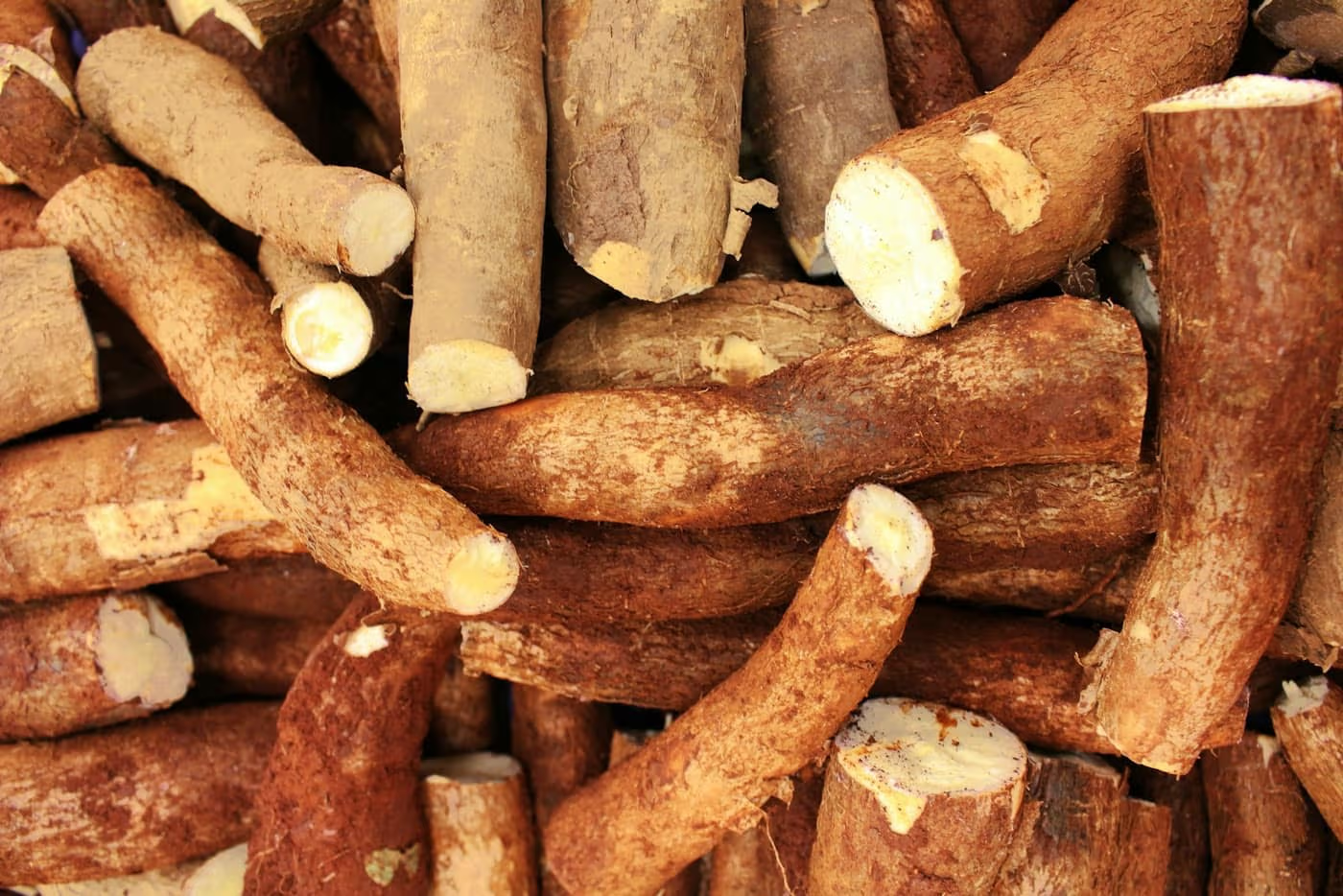
Tapioca, or cassava (Manihot esculenta), is a hardy, drought-tolerant root crop grown for its starchy tuberous roots, eaten boiled, fried or steamed and processed into starch and sago (sabudana). It is propagated entirely from stem cuttings taken from a mature plant — there is no seed sowing in commercial cultivation.
Kerala accounts for close to half of India's cassava area, grown as a rainfed crop that fits into rotation with paddy on low-lying land; Tamil Nadu accounts for roughly a third, grown mainly as a longer-duration industrial crop feeding starch and sago mills; Andhra Pradesh and small pockets of the north-east grow it as well. The crop tolerates poor soil and drought better than most root crops, which is part of why it has long been a reliable food-security crop for smallholders.
The two decisions that shape a tapioca crop are picking the right variety for the purpose — a quick table type for paddy rotation, or a long-duration high-starch hybrid for industrial sale — and always planting from healthy, visibly disease-free stem cuttings, since cassava mosaic disease spreads through infected planting material as readily as through its whitefly vector.
Crop timeline, sowing to harvest
A quick visual map of the season — jump to any section below for the detail behind each stage.
- Day 0
Planting
Healthy stem cuttings (setts) 15–20 cm long with 5–8 nodes, taken from a vigorous, mosaic-free mother plant, are planted slanting or upright on ridges or mounds at the start of the rains.
- Day 10–20
Sprouting
Shoots and roots emerge from the buried nodes; gap-fill any cutting that fails to sprout within about three weeks.
- Day 30–60
Establishment & early growth
The plant builds its stem and leaf canopy; a first weeding and top-dressing of nitrogen and potash are given, and the field is earthed up.
- Day 60–120
Vegetative growth & tuber initiation
The canopy closes over, shading out most weeds, while the storage roots begin to swell below ground.
- Day 150–270 (table types)
Tuber bulking & harvest
Short-duration table varieties bulk their tubers and are ready to lift by about six to nine months, timed to free the land for the next paddy crop.
- Day 270–330 (industrial types)
Extended bulking & harvest
Long-duration industrial hybrids continue bulking starch for ten to eleven months before being lifted for the starch and sago mills.
Suitable states
States where this crop is grown at scale, highlighted below. Your local Krishi Vigyan Kendra is still the final word for your specific block.
- Jammu and Kashmir
- Himachal Pradesh
- Punjab
- Uttarakhand
- Haryana
- Delhi
- Uttar Pradesh
- Rajasthan
- Bihar
- Jharkhand
- West Bengal
- Sikkim
- Assam
- Arunachal Pradesh
- Meghalaya
- Nagaland
- Manipur
- Mizoram
- Tripura
- Gujarat
- Madhya Pradesh
- Chhattisgarh
- Maharashtra
- Odisha
- Goa
- Telangana
- Andhra Pradesh
- Karnataka
- Kerala
- Tamil Nadu
- Puducherry
- Ladakh
- Chandigarh
- Lakshadweep
Grown here
Climate requirements
Cassava's drought tolerance is a real strength on marginal land, but growers should not read this as meaning it needs no water at all — steady moisture in the first two to three months while roots establish still matters for a good final yield.
Ideal temperature
A warm tropical crop that grows best at 25–32°C. It is frost-tender and grows poorly below about 18°C, and it is one of the more heat-tolerant root crops as long as soil moisture is adequate.
Rainfall
Grown mostly as a rainfed crop on 750–1,500 mm of well-distributed rainfall, and is genuinely drought-tolerant once established — it survives dry spells that would ruin most other root crops by shedding leaves and slowing growth rather than dying, then recovering when rain returns.
Humidity
Moderate to high humidity suits vegetative growth, but prolonged wet, humid conditions favour some leaf diseases and can encourage tuber rot in poorly drained soil.
Sunlight
Full sun is needed for good canopy growth and tuber bulking; it tolerates partial shade as a young crop but yields poorly if shaded through the bulking period.
Soil requirements
Because the crop is often grown on land considered too marginal for other options, growers sometimes skip land preparation almost entirely — a basic ridge or mound system with reasonable drainage still meaningfully improves tuber shape and yield over planting flat into hard, unprepared ground.
Suitable soil
A deep, well-drained sandy loam or lateritic soil is ideal, and the crop is unusually tolerant of poor, low-fertility soils that would struggle to support most other food crops — one reason it has long been a smallholder security crop on marginal land.
pH range
Best at pH 5.5–7.0; it tolerates moderately acidic soil better than most crops, which suits Kerala's and the wider south's naturally acidic laterite soils.
Drainage
Free drainage matters for tuber quality even though the crop tolerates drought — waterlogging around the developing roots causes tuber rot and poor bulking.
Organic matter
Responds well to organic matter, though it can produce a crop even on soil too poor for most alternatives; a moderate dose of well-rotted FYM or compost worked in before planting still lifts yield noticeably.
Land preparation
Same four steps whichever region you are in — only the timing shifts with the sowing window.
- 1
Plough and form ridges or mounds
Plough or dig to a reasonable tilth and form ridges or mounds 60–90 cm apart so the developing tubers have loose soil to bulk into and excess water drains away.
- 2
Work in organic matter where available
Mix well-rotted FYM or compost into the ridge line before planting — even a modest dose meaningfully lifts yield on the marginal land the crop is often grown on.
- 3
Select and prepare healthy setts
Cut stem pieces 15–20 cm long with 5–8 nodes from the middle portion of a vigorous, visibly mosaic-free mother plant using a clean, sharp tool, and plant promptly rather than letting cuttings dry out.
Seed information
How the main varieties compare, so you can pick by duration, yield, disease pressure or what you are growing for.
| Variety | Duration | Yield | Disease resistance | Best state | Suitable for |
|---|---|---|---|---|---|
A long-duration industrial hybrid, one of the two hybrids dominant in Tamil Nadu and Andhra Pradesh's starch and sago belt, with relatively short, conical roots and high starch content bred for factory processing. | 10–11 months | 33–38 t/ha | No special resistance claimed; protect with mosaic-free planting material | Tamil Nadu, Andhra Pradesh | Industrial starch and sago processing |
The other long-duration hybrid dominant in the same industrial belt, bred for high yield and starch content to feed the starch and sago mills of Tamil Nadu and Andhra Pradesh. | 10–11 months | 30–35 t/ha | No special resistance claimed; protect with mosaic-free planting material | Tamil Nadu, Andhra Pradesh | Industrial starch and sago processing |
A short-duration ICAR-CTCRI (Thiruvananthapuram) clonal selection with brown skin and purple rind, bred to fit into a roughly six-month rotation with paddy on Kerala's low-lying land. | ~6 months | 26–30 t/ha | No special resistance claimed | Kerala | Quick paddy-rotation crop on low-lying land, table use |
A short-duration ICAR-CTCRI clonal selection released alongside Sree Vijaya, suited to the same low-lying paddy-rotation system in southern and central Kerala. | ~6 months | 26–30 t/ha | No special resistance claimed | Kerala | Quick paddy-rotation crop on low-lying land, table use |
A higher-starch ICAR-CTCRI triploid variety with about 30% starch content, giving a heavier yield than the short-duration table types while still suited to table use. | 8–9 months | ~38 t/ha | No special resistance claimed | Kerala | Higher-yield table variety, some processing use |
An ICAR-CTCRI erect, branching variety with good table quality and 28–30% starch content, suited to both upland and low-lying cultivation and actively promoted in Kerala and the north-east. | 8–10 months | 25–30 t/ha | No special resistance claimed | Kerala, north-eastern states | Good table quality on both upland and lowland fields |
An ICAR-CTCRI erect, branching table variety with 28–30% starch content, suited to both upland and lowland conditions and one of CTCRI's more recently produced quality-planting-material lines. | 8–10 months | 25–30 t/ha | No special resistance claimed | Kerala | Good table quality on both upland and lowland fields |
- Seed rate
- Planting material is counted in stem cuttings, not kilograms of seed — roughly 10,000–12,500 setts per hectare at normal ridge spacing (about 4,000–5,000 setts per acre). One healthy mother plant yields enough stem to cut several setts, so a modest nursery block of mother plants supplies a much larger planting area the following season.
- Certified seed
- Take setts only from healthy, vigorously growing mother plants that show no mosaic mottling, and cut them from the woody middle portion of the stem, not the soft tip or the very old base. Never propagate from a plant showing mosaic symptoms, even if the rest of the field looks fine — infected planting material is the single biggest way the disease spreads.
- Spacing
- Ridges or mounds 60–90 cm apart, with setts planted 60–90 cm apart within the row, giving a fairly wide, sprawling canopy as the crop matures.
- Seed treatment
- Dip the cut ends of setts in a recommended fungicide solution before planting to reduce rotting at the cut surface, and plant promptly — cuttings left lying around for days lose vigour and sprout poorly.
Sowing guide
Never plant a cutting taken from a plant showing mosaic symptoms, even a single one — the disease is carried inside the stem tissue itself, not just spread later by whitefly.
- Best time
- Main planting is with the onset of the south-west monsoon, April–June, though irrigated tapioca in parts of Kerala and Tamil Nadu is planted more flexibly across the year.
- Row spacing
- 60–90 cm
- Plant spacing
- 60–90 cm
- Sowing depth
- Setts planted slanting or upright with about two-thirds of the length buried, so 3–5 nodes are below the soil surface
- Method
- Plant healthy setts slanting into ridges or mounds, firming the soil around the buried portion, and keep the field weed-free until the canopy closes over.
Fertilizer schedule
A split dose beats one large dose applied at sowing — nitrogen especially is lost to the air and to leaching if it all goes in on day one.
- 1
Basal (at planting)
Day 0
Well-rotted FYM or compost worked into the ridge, plus the phosphorus dose and part of the nitrogen and potash.
- 2
First top-dressing
Day 30–45
The remaining nitrogen and part of the potash, applied as the canopy is establishing, combined with earthing-up.
- 3
Second top-dressing (tuber bulking)
Day 90–120
A potash-heavy final split as the roots begin bulking, since potash is the nutrient most closely tied to tuber starch content and size.
Irrigation schedule
1. Establishment
Day 0–60
The crop is most water-sensitive here even though it is drought-tolerant later — steady rainfall or supplementary irrigation while shoots and roots establish carries the whole crop forward.
2. Vegetative growth
Day 60–150
Mostly carried by monsoon rainfall in the rainfed crop; supplementary irrigation every 2–3 weeks in a dry spell keeps growth from stalling.
3. Tuber bulking
Day 150 onward
The crop can tolerate a genuinely dry finish better than most root crops, but a prolonged severe drought right through bulking still cuts final tuber size.
Critical stages
- Establishment of cuttings (first 60 days)
- Tuber bulking under a long dry spell
Water-saving tips
- Most tapioca in India is grown entirely rainfed, and the crop's genuine drought tolerance means it is rarely worth the cost of full irrigation on marginal land.
- A mulch of dry leaves or straw between ridges conserves the moisture the crop does get and suppresses weeds in the slow early stand.
- Where irrigation is available, concentrate it in the first two months rather than spreading it evenly through the whole cycle.
Weed management
Organic control
- Two or three hand-weedings in the first three to four months, before the canopy closes and shades out most weeds on its own.
- Earthing-up at the first top-dressing buries small weeds around the base and firms the ridge around the developing roots.
Chemical control
- A pre-emergence herbicide cleared for cassava applied to clean, moist ridges soon after planting, followed by one or two hand-weedings, is the practice on larger plots.
- Confirm the current product, dose and pre-harvest interval with your local KVK.
Nutrient deficiency identification
What a shortage of each nutrient actually looks like on the plant, so you can tell a deficiency apart from a disease before you spray the wrong thing.
Potassium
Visible symptom
Scorched, yellow-brown older leaf margins and smaller, lower-starch tubers — potash is the nutrient most closely tied to tuber bulking and starch content in cassava.
Nitrogen
Visible symptom
Pale, stunted early growth and a slow-establishing canopy, though excess nitrogen also delays tuber bulking in favour of leafy growth.
Magnesium
Visible symptom
Yellowing between the veins of older leaves while the veins themselves stay green, most often on light, sandy, heavily leached soils.
Diseases to watch for
Symptoms, likely cause and what actually treats it — not just a spray name.
Pests to watch for
What to look for before the damage is visible, and organic options before you reach for a chemical.
Cassava mealybug
- Identification
- Small, soft, white, wax-covered insects clustering on shoot tips, leaf axils and the underside of leaves, often with ants tending them and sooty mould developing on their honeydew.
- Damage
- Heavy infestation stunts shoot growth and can badly check young plants; it is historically one of cassava's most serious pests where it establishes.
- Organic control
- Plant only clean, mealybug-free cuttings, conserve natural predators by avoiding unnecessary broad-spectrum spraying, and control the ants that protect and spread the mealybug colonies.
- Chemical control
- A recommended systemic insecticide directed at shoot tips and leaf axils where colonies are established and spreading.
Whitefly
- Identification
- Small, white-winged insects that fly up in a cloud when the leaves are disturbed, found mainly on the underside of young leaves.
- Damage
- Direct sap-sucking weakens young plants, but the greater damage is as the vector of cassava mosaic disease — controlling whitefly is as much about slowing virus spread as about the insect itself.
- Organic control
- Yellow sticky traps, conserving natural predators, and avoiding planting a new crop immediately next to an old, whitefly-carrying field.
- Chemical control
- A recommended insecticide on young plants where whitefly numbers are building up fast, following the label and local KVK advice.
Termites
- Identification
- Soil-dwelling termites tunnelling into stored setts before planting and, in dry conditions, into the developing tubers themselves, leaving characteristic soil-lined tunnels.
- Damage
- Damaged setts fail to sprout, and termite-tunnelled tubers are downgraded or unsellable at harvest, worst on light, dry soils.
- Organic control
- Store cut setts off bare ground, avoid leaving harvested land fallow and untended for long stretches, and remove old termite mounds near the field where practical.
- Chemical control
- A recommended soil or sett-dip insecticide where termite damage has a history on the land.
Common mistakes to avoid
The mistakes that cost growers the most, ranked by how often they show up in the field — not in the order you might expect.
- 1
Cutting setts from a plant showing mosaic symptoms, even just once.
Why it hurts
Cassava mosaic disease travels inside the stem tissue itself, so a single batch of infected cuttings can seed an entire new planting with the virus before whitefly ever visit the field. Always take cuttings only from healthy, visibly symptom-free mother plants.
- 2
Planting a long-duration industrial hybrid where a quick paddy-rotation crop was needed, or the reverse.
Why it hurts
H-165 and H-226 take 10–11 months and are bred for starch content, not a fast turnaround; Sree Vijaya and Sree Jaya are bred for a roughly six-month cycle but carry less starch. Matching the variety to the actual purpose — rotation timing versus industrial sale — avoids wasting a season on the wrong crop.
- 3
Letting cut setts lie around for days before planting.
Why it hurts
Cuttings lose vigour and moisture the longer they sit, and sprouting becomes slow and patchy. Plant promptly after cutting, and dip the cut ends in a fungicide solution first.
- 4
Skipping drainage on the assumption that a drought-tolerant crop needs no soil preparation at all.
Why it hurts
Cassava tolerates dry spells well but not waterlogging — planting flat into poorly drained ground still causes tuber rot and poor bulking regardless of how little rain falls overall.
- 5
Ignoring termites in stored planting material.
Why it hurts
Termite-damaged setts fail to sprout, leaving gaps in the stand that are hard to fill in later. Store cut setts off bare ground rather than piled directly on it.
Harvesting
Table varieties are usually lifted at six to nine months, timed to free the land for the next paddy crop; industrial hybrids are left ten to eleven months to maximise starch content before lifting. Roots are dug up carefully to avoid cutting or bruising them, since damaged roots deteriorate within a day or two.
Signs it is ready
- Reaching the variety's expected duration since planting
- Some yellowing and dropping of the lower leaves
- A test dig showing well-filled, mature-sized roots
Tools
- A digging fork or mattock to lift roots without cutting them
- Baskets or sacks for immediate transport
- A sharp knife to trim the stem stub cleanly
Expected yield
Roughly 26–30 t/ha for the short-duration Kerala table varieties, 30–38 t/ha for the long-duration industrial hybrids and higher-starch selections like Sree Athulya.
Post-harvest & storage
Storage
Fresh tapioca roots deteriorate very fast once lifted — often within one to two days at room temperature, as the cut surface discolours and the root begins to rot. There is essentially no long fresh storage; roots are either sold and eaten within a day or two, or processed promptly into starch, chips or sago.
Packaging
Handle roots gently to avoid cuts and bruises, which sharply speed deterioration; pack loosely in ventilated sacks or baskets rather than tightly stacked.
Transportation
Move roots to market or to the processing mill as soon as possible after lifting — same-day movement is standard practice given how fast fresh tapioca spoils.
Shelf life
One to two days at ambient temperature for fresh roots; processed forms (dried chips, starch, sago) store for months once properly dried.
Market prices
Today's mandi price near you, pulled live from the government's own Agmarknet data.
Live daily mandi prices from the government Agmarknet dataset.
Synced from data.gov.in (Agmarknet). Rates are ₹ per quintal.
Weather
Current conditions and a 5-day outlook for your selected location, with one line of stage-aware advice.
Pick your state for current conditions and a 5-day outlook.
Live data from Open-Meteo
Profit calculator
Your own cost sheet, expected yield and selling price — not ours.
Where the money goes
Share of the total cost per acre, using the calculator’s own default cost sheet below — adjust the numbers there to match your field and this picture will no longer apply to you exactly, but the ranking rarely changes.
- Labour31% (₹10,000)
- Land rent28% (₹9,000)
- Fertiliser12% (₹4,000)
- Seed9% (₹3,000)
- Pesticide & weedicide6% (₹2,000)
- Machinery6% (₹2,000)
- Irrigation5% (₹1,500)
- Interest4% (₹1,200)
Official downloads
Government and ICAR documents only — everything below is hosted on an official server.
ICAR-Central Tuber Crops Research Institute (CTCRI), Thiruvananthapuram
Sree Vijaya, Sree Jaya, Sree Athulya, Sree Pavithra, Sree Rekha and cassava package of practices
Tamil Nadu Agricultural University (TNAU) Agritech Portal
H-165, H-226 and the industrial cassava belt of Tamil Nadu
Kisan Call Centre — 1800-180-1551
Free crop advice in your language
Frequently asked questions
How is tapioca planted if it has no seed?
It is grown entirely from stem cuttings, called setts, taken from an older tapioca plant — 15–20 cm long pieces with 5–8 nodes, cut from the woody middle portion of a healthy, vigorously growing mother plant. There is no seed sowing at all in commercial cultivation; the mother plant you cut from matters as much as the variety you choose.
Should I grow a quick variety or a long-duration one?
It depends on your purpose. If you need land free again for the next paddy crop, a short-duration Kerala table variety like Sree Vijaya or Sree Jaya (about six months) fits that rotation. If you are growing for a starch or sago mill and want the highest starch content, a long-duration industrial hybrid like H-165 or H-226 (10–11 months) is the better choice, even though it ties up the land far longer.
My tapioca leaves have a yellow-green mottled pattern. What is wrong?
That mottling is almost certainly cassava mosaic disease, a virus spread by whitefly and also carried inside infected cuttings. There is no cure once a plant is infected — remove and destroy it, and never take cuttings from it. The single best prevention is always sourcing setts from healthy, visibly symptom-free mother plants.
How quickly do I need to sell or use freshly dug tapioca?
Very quickly — fresh roots deteriorate within one to two days at room temperature as the cut ends discolour and rot sets in. Unlike sweet potato or many other root crops, tapioca has essentially no fresh storage life, so roots are usually sold or processed into chips, starch or sago the same day or the next.
Does tapioca have an MSP or a mandi price?
There is no MSP for tapioca. It is traded on Agmarknet as "Tapioca", with regular records especially from Tamil Nadu's Uzhavar Sandhai markets. Prices reflect the fresh table market rather than the separate industrial starch-and-sago trade, which mostly moves through direct mill contracts rather than open mandis.
Still have questions?
The FAQs above cover the common ones. For anything specific to your field and soil, your nearest Krishi Vigyan Kendra is the authoritative answer.