
Garlic
Allium sativum
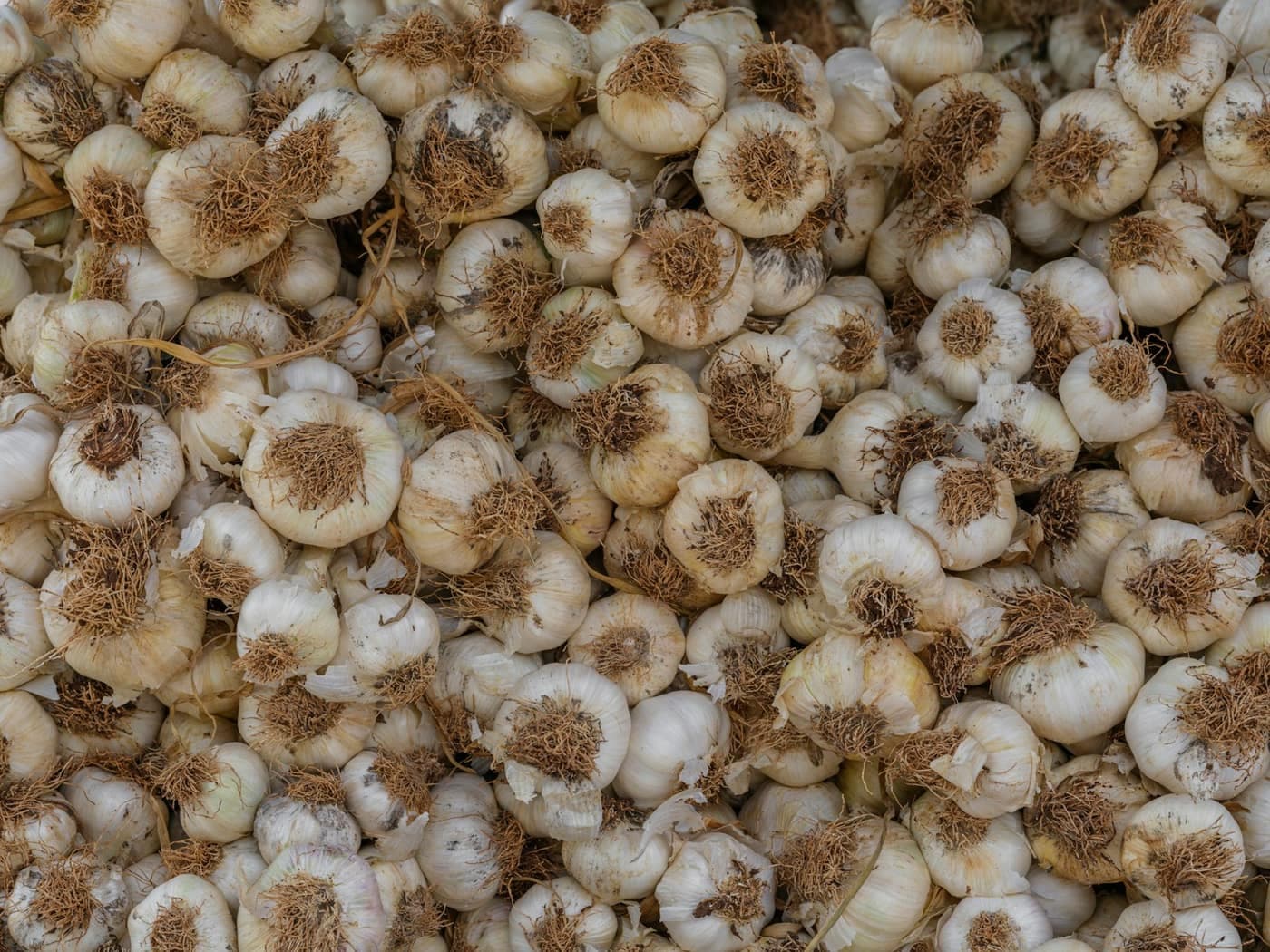
Two details decide a garlic crop: planting graded, healthy cloves rather than whatever the bulb splits into, and stopping irrigation two to three weeks before harvest so the bulbs fill, cure and store. Garlic keeps far longer than onion when cured right — and rots just as fast when it is not.
Quick Summary
The key points from this page in about two minutes — read it or have it read aloud.
Quick Summary
Garlic is planted from cloves, not seed — each clove broken off the bulb becomes one plant — so the size and health of the planting cloves carry straight through to the size of the bulb you harvest. Grading the cloves and planting only sound ones, pointed end up at the right depth, is the first of the two things that decide the crop.
The second is when you stop watering. Cut irrigation completely two to three weeks before harvest so the bulbs fill, firm up and cure; skip that step and they stay soft and rot in store. Cured well, garlic keeps for five to seven months, so like onion it is grown as much to be held for a thinner, better-priced market as to be sold straight off the field.
It is a rabi crop for most of India. Garlic needs a cool spell early on for the single clove to split into a proper multi-clove bulb, then mild warmth and lengthening days to finish — so planting too late shortens the cool window it depends on. It establishes slowly and competes poorly with weeds, so keep the field clean through vegetative growth. Cut off nitrogen around bulb initiation, keep soil moisture steady through clove swelling so bulbs do not stay small or split, and watch for purple blotch and storage rot in humid weather. Unseasonal rain near harvest is the big risk. Lift when the lower leaves yellow and the tops start to bend, then cure the bulbs before storing. The page below carries the exact clove rate, spacing, nutrient doses, irrigation schedule, curing method, crop duration and expected yields.
- Crop type
- Spice (bulb)
- Season
- Rabi (main); some early/kharif types
- Suitable states
- 8 major states
- Growing duration
- 150–180 days
- Water requirement
- Low–moderate (stop 2–3 weeks before harvest)
- Temperature
- 12–24°C (cool for growth)
- Soil type
- Well-drained sandy loam to loam
- Difficulty level
- Moderate
- Expected yield
- 80–120 q/ha
- Storage
- 5–7 months if well cured
Overview
Garlic (Allium sativum) is grown across roughly 0.5 million hectares in India, with Madhya Pradesh alone accounting for well over half the national output, followed by Rajasthan and Gujarat. It is a rabi crop for most of the country, planted after the monsoon into cooling weather and harvested in late winter and spring.
Unlike almost every field crop, garlic is planted from cloves, not seed — each clove separated from the bulb becomes one plant, and clove size and health carry directly into bulb size, which is why grading and selecting planting material matters more here than for a seed crop. Like onion, it is grown as much for storage as for immediate sale: cured properly, garlic keeps for five to seven months and can be held for a thinner, higher-priced market.
The crop turns on two things done right — planting good cloves at the right depth and spacing, and stopping irrigation two to three weeks before harvest so the bulbs fill and cure rather than staying soft and rotting in store. This page follows the crop in the order you will actually meet it — land, planting material, planting, nutrition, water, protection, harvest, sale.
Crop timeline, sowing to harvest
A quick visual map of the season — jump to any section below for the detail behind each stage.
- Day 0
Planting (cloves)
Bulbs broken into individual cloves just before planting and set 5–7 cm deep, pointed end up, at 15 × 10 cm — not sown as seed.
- Day 8–15
Sprouting
Each healthy clove sends up a shoot; a shrivelled or diseased clove either misses or comes up weak, which is why clove grading at planting matters.
- Day 30–90
Vegetative growth
Leaf growth in the cool part of the season is what feeds bulb size later — garlic competes poorly with weeds through this slow-establishing window.
- Day 90–120
Bulb initiation
Lengthening days and the season's cool spell together trigger the single clove to split into a multi-clove bulb; nitrogen is deliberately cut off around here.
- Day 120–150
Bulb development
Consistent moisture through clove swelling sets final bulb size; both drought stress and waterlogging here give small or split bulbs.
- Day 150–165
Irrigation stopped
A deliberate, complete stop 2–3 weeks before harvest — the signature step that lets bulbs fill, firm up and cure, and the one most often skipped.
- Day 150–180
Harvest
When the lower leaves yellow and dry and the tops begin to bend over, for a properly matured rabi crop.
Suitable states
States where this crop is grown at scale, highlighted below. Your local Krishi Vigyan Kendra is still the final word for your specific block.
- Jammu and Kashmir
- Himachal Pradesh
- Punjab
- Uttarakhand
- Haryana
- Delhi
- Uttar Pradesh
- Rajasthan
- Bihar
- Jharkhand
- West Bengal
- Sikkim
- Assam
- Arunachal Pradesh
- Meghalaya
- Nagaland
- Manipur
- Mizoram
- Tripura
- Gujarat
- Madhya Pradesh
- Chhattisgarh
- Maharashtra
- Odisha
- Goa
- Telangana
- Andhra Pradesh
- Karnataka
- Kerala
- Tamil Nadu
- Puducherry
- Ladakh
- Chandigarh
Grown here
Climate requirements
Garlic is both cold- and day-length-responsive: it needs the cool early-season spell to bulb properly, so a rabi crop planted too late runs its bulbing stage into warm weather and forms small, loosely filled bulbs no matter how well it is otherwise managed.
Ideal temperature
12–24°C suits the crop best; garlic needs a cool spell during early growth for the clove to split into a proper multi-clove bulb, then mild warmth and lengthening days to finish bulbing — which is exactly why it is a rabi crop across most of India
Rainfall
Grown almost entirely under irrigation; unseasonal rain late in the season, especially close to harvest, is a major risk since wet bulbs cure poorly and rot in storage
Humidity
Low to moderate is best; high humidity through bulb development and at harvest sharply raises purple blotch and storage-rot risk
Sunlight
Full sun, with the lengthening days of late rabi helping trigger and complete bulbing — planting too late shortens the cool growing window the crop needs before bulbing begins
Soil requirements
A raised bed or ridge is worth the extra effort on any field without excellent natural drainage; garlic's bulb sits at or just below the surface, which makes it more exposed to waterlogging and rot than a deep-rooted crop. A soil test matters most here for sulphur, which garlic — like onion — is unusually responsive to.
Suitable soil
Well-drained sandy loam to loam rich in organic matter; garlic cannot stand heavy, poorly drained clay, which restricts the shallow-sitting bulb and encourages basal and white rot
pH range
6.0–7.0
Drainage
Very good — even short waterlogging rots the developing bulb and the roots beneath it, and wet soil at any stage feeds the soil-borne rots garlic is prone to
Organic matter
Medium to high, from well-rotted compost rather than fresh manure — fresh, undecomposed manure close to planting raises basal-rot risk and pushes leafy growth over bulb development
Land preparation
Same four steps whichever region you are in — only the timing shifts with the sowing window.
- 1
Field cleaning
Remove the previous crop's residue and weeds so the field starts clean, and rotate away from onion or garlic on fields with a history of basal or white rot.
- 2
Ploughing and harrowing
Two to three ploughings followed by harrowing break the soil to a fine, well-pulverised tilth — garlic's shallow roots and surface-sitting bulb both need loose, clod-free soil to develop properly.
- 3
Raised bed or ridge formation
Forming raised beds or ridges rather than a flat seedbed protects the crop from waterlogging and makes the light, frequent irrigation garlic needs easier to manage precisely.
- 4
Compost incorporation
Working 20–25 tonnes/ha of well-rotted compost into the final ploughing — not fresh manure, which raises rot risk this close to planting — builds the organic matter garlic responds well to.
Seed information
How the main varieties compare, so you can pick by duration, yield, disease pressure or what you are growing for.
| Variety | Duration | Yield | Disease resistance | Best state | Suitable for |
|---|---|---|---|---|---|
The most widely grown white garlic across the plains, developed by ICAR-DOGR — dependable, good-keeping, with compact silvery-white bulbs. | 150–160 days | 130–150 q/ha | No specific bred-in resistance — standard exposure to purple blotch and thrips | Madhya Pradesh, Gujarat, Uttar Pradesh | Main-season rabi, storage |
A bold, large-cloved white variety preferred for the export and premium market, where big, uniform cloves fetch a higher price. | 140–150 days | 175–200 q/ha | No specific bred-in resistance | Madhya Pradesh, Maharashtra, Haryana, Gujarat, Punjab, Rajasthan, Uttar Pradesh, Chhattisgarh | Export / bold-clove premium market |
A creamy-white, compact-bulbed variety valued for its keeping quality in storage, another ICAR-DOGR release. | 150–160 days | 120–140 q/ha | No specific bred-in resistance | Madhya Pradesh, Maharashtra | Storage-bred keeping quality |
A bold, very large-bulbed type originally selected for the hills, grown where a longer, cooler season allows the bulb to size up fully. | 230–250 days | 200–225 q/ha | No specific bred-in resistance | Jammu and Kashmir, Himachal Pradesh, Uttarakhand (hills) | Long, cool-season hill cultivation |
An early-maturing variety that fits a shorter window and lets growers reach an earlier, often better market than the main-season crop. | 120–135 days | 100–120 q/ha | No specific bred-in resistance | Delhi, Gujarat, Haryana, Rajasthan | Early harvest / short season |
A purple-skinned, early type suited to earlier planting in western India, where its short duration and colour find a specific market. | 110–120 days | 60–70 q/ha | No specific bred-in resistance | Andhra Pradesh, Bihar, Delhi, Haryana, Karnataka, Maharashtra, Punjab, Uttar Pradesh | Early planting, purple-clove market |
- Seed rate
- 500–600 kg/ha of cloves — the highest planting-material weight of any crop on this site, since each of the roughly 300,000–400,000 plants per hectare is grown from a whole clove rather than a light seed.
- Certified seed
- Use healthy, medium-to-bold cloves from disease-free bulbs, and separate them from the bulb only just before planting — cloves broken too early dry out and sprout unevenly. Big cloves give bigger bulbs, so grading out the small inner cloves for planting material genuinely pays.
- Spacing
- 15 cm row-to-row, 10 cm clove-to-clove, planted 5–7 cm deep with the pointed (growing) end facing up
- Seed treatment
- Treat cloves before planting with a fungicide such as carbendazim (and Trichoderma where basal or white rot is a known problem) to protect against the soil-borne rots that spread through infected planting material.
Sowing guide
Because garlic is planted from cloves and not seed, the quality of the planting material is set before the crop even goes in the ground: healthy, graded, medium-to-bold cloves from disease-free bulbs give a far more even, higher-yielding stand than whatever a bulb happens to split into.
- Best time
- October–November for the main rabi crop across most of the plains; planting on time matters because garlic needs the cool early-season spell to bulb properly — planted too late, bulbing runs into warm weather and bulbs stay small
- Row spacing
- 15 cm
- Plant spacing
- 10 cm
- Sowing depth
- 5–7 cm, with the pointed end up — cloves planted upside down or too deep emerge slowly and unevenly
- Method
- Cloves separated from the bulb and dibbled or dropped into furrows by hand at the correct spacing and depth, then covered — garlic is planted directly from cloves, never raised in a nursery like onion
Fertilizer schedule
A split dose beats one large dose applied at sowing — nitrogen especially is lost to the air and to leaching if it all goes in on day one.
- 1
Basal dose
At planting
Full phosphorus and potash plus about a third of the nitrogen — a common recommendation is 100:50:50 kg/ha N:P₂O₅:K₂O — worked into the bed before planting.
- 2
First top dressing
30 days after planting
About a third of the nitrogen, applied with irrigation during active vegetative growth.
- 3
Second top dressing
45–60 days after planting, before bulb initiation
The remaining nitrogen — the last nitrogen dose of the season. Nitrogen applied after bulb initiation delays maturity and hurts storage life, so it is deliberately cut off here.
- 4
Sulphur application
At basal dose, ~20–25 kg/ha S, on deficient soils
Garlic, like onion, is a sulphur-responsive crop — sulphur measurably improves both bulb pungency (the allicin that gives garlic its value) and size on fields with a known deficiency.
Irrigation schedule
1. Establishment
At planting and first 2–3 weeks
A light irrigation right after planting settles the cloves, followed by light, frequent watering to establish the stand.
2. Vegetative growth
30–90 days after planting
Regular irrigation every 8–12 days supports the leaf growth that feeds bulb size later.
3. Bulb development
90–140 days after planting
Consistent moisture through clove swelling sets final bulb size; both drought stress and waterlogging here give small or split bulbs.
Critical stages
- Bulb development (90–140 days) — sets final bulb size
- The final 2–3 weeks before harvest, when irrigation is deliberately stopped
Water-saving tips
- Stop irrigation 2–3 weeks before harvest without exception — this is the single most important step for bulb filling and storage, since bulbs lifted from wet soil cure poorly and rot fast
- Drip irrigation cuts water use against flood irrigation and reduces the leaf wetness that favours purple blotch
- Mulching between rows conserves moisture and suppresses the weed flush garlic competes poorly against in its slow early weeks
Weed management
Common weeds
Organic control
- Garlic is a poor weed competitor early on, so two to three hand weedings between 30 and 75 days after planting are usually needed regardless of herbicide use
- Mulching between rows both conserves moisture and smothers weeds
- A stale seedbed before planting knocks down the first weed flush cheaply
Chemical control
- Pre-emergence: pendimethalin within 2–3 days of planting controls the early weed flush during the crop's slow-establishing weeks
- Post-emergence: oxyfluorfen where the pre-emergence pass was missed, applied carefully since garlic foliage is sensitive
Nutrient deficiency identification
What a shortage of each nutrient actually looks like on the plant, so you can tell a deficiency apart from a disease before you spray the wrong thing.
Nitrogen
Visible symptom
Pale, thin, yellowing older leaves and weak leaf growth, which caps bulb size later since leaf mass feeds the bulb.
Phosphorus
Visible symptom
Dark bluish-green, stunted leaves and delayed, poor root and bulb development.
Potassium
Visible symptom
Yellowing and browning (scorch) of leaf tips, with softer bulbs that store noticeably worse.
Sulphur
Visible symptom
Pale green foliage and bulbs that lack pungency and size — garlic, like onion, is unusually sulphur-responsive, and sulphur drives the allicin content that gives garlic its value.
Zinc
Visible symptom
Yellow striping between the veins of younger leaves and stunted, bunched growth, most common on light, deficiency-prone or heavily cereal-cropped soils.
Diseases to watch for
Symptoms, likely cause and what actually treats it — not just a spray name.
Purple Blotch
- Symptoms
- Small, water-soaked white spots on leaves that enlarge into purple-brown, zonate lesions, often girdling and collapsing the leaf in a severe attack.
- Cause
- Fungus Alternaria porri, favoured by warm days, high humidity and heavy dew — the most common and damaging foliar disease of garlic and onion in India.
- Treatment
- Spray mancozeb or a suitable combination fungicide at first appearance, repeating on a 7–10 day interval through a favourable spell.
- Prevention
- Avoid overhead irrigation that wets the foliage, keep spacing wide enough for airflow, and rotate out of onion and garlic for a season on badly affected fields.
Stemphylium Blight
- Symptoms
- Small yellow to brown lesions on leaf tips that spread downward, often appearing alongside or just after purple blotch and easily mistaken for it.
- Cause
- Fungus Stemphylium vesicarium, favoured by conditions similar to purple blotch and often found as a mixed infection with it.
- Treatment
- The same fungicide programme used for purple blotch generally controls both together.
- Prevention
- Same as purple blotch — foliage kept dry through the day is the single biggest lever against both diseases.
Basal Rot / White Rot
- Symptoms
- Yellowing and dieback from the leaf tips, with a soft or fluffy white rot at the bulb base when cut open, and roots that pull away easily; white rot leaves tiny black resting bodies on the rotted base.
- Cause
- Soil-borne fungi Fusarium (basal rot) and Sclerotium cepivorum (white rot), which persist in the soil for years and spread through infected cloves and soil.
- Treatment
- No in-season cure; remove and destroy affected plants promptly to limit spread.
- Prevention
- Use healthy, treated cloves from disease-free bulbs, avoid fresh manure close to planting, ensure good drainage, and rotate out of onion and garlic for several seasons on fields with a heavy history.
Downy Mildew
- Symptoms
- Pale, yellowish patches on leaves with a greyish-violet fungal growth in humid, overcast weather, causing leaves to bend over and collapse.
- Cause
- Water mould Peronospora destructor, favoured by cool, humid, overcast conditions.
- Treatment
- Spray metalaxyl + mancozeb at first appearance.
- Prevention
- Good field drainage and avoiding overly dense planting both reduce the humid microclimate the disease needs.
Pests to watch for
What to look for before the damage is visible, and organic options before you reach for a chemical.
Thrips
- Identification
- Tiny, slender, pale yellow to brown insects rasping the leaf surface, leaving silvery-white streaks and patches visible against the light, tucked into the leaf axils.
- Damage
- The single most damaging pest of garlic — a heavy infestation during bulb development cuts bulb size and yield, and thrips thrive in exactly the warm, dry weather that is otherwise good for the crop.
- Organic control
- Blue sticky traps for monitoring, a strong jet of water to dislodge light populations, and conserving natural predators by avoiding unnecessary early broad-spectrum sprays.
- Chemical control
- Spray fipronil or a suitable systemic insecticide as soon as silvering shows on a meaningful share of leaves, rotating chemical groups between sprays since thrips build resistance quickly.
Eriophyid mite (garlic/bloat mite)
- Identification
- Microscopic mites, not visible to the eye, that cause twisted, curled, streaked leaves and, in storage, sunken tan patches and a dry, spongy rot in the cloves.
- Damage
- A serious pest precisely because it is carried in the cloves — infested planting material spreads it to the next crop, and it keeps damaging the bulbs after harvest in storage, on top of the field leaf damage.
- Organic control
- Plant only clean, mite-free cloves; hot-water or recommended treatment of planting material where the mite is known; discard visibly infested bulbs rather than saving them for seed.
- Chemical control
- A recommended acaricide dip or treatment of planting cloves where the mite is established, following local advisory, since field sprays reach the sheltered mites poorly.
Onion/garlic maggot
- Identification
- Small, legless white maggots tunnelling into the bulb base and roots, usually noticed only when plants wilt or bulbs rot despite adequate water.
- Damage
- Direct feeding opens the bulb to secondary bacterial and fungal rot, which is often what actually kills the plant or ruins the bulb in storage.
- Organic control
- Crop rotation away from onion and garlic breaks the maggot's life cycle; removing and destroying culled or damaged bulbs at harvest reduces carryover.
- Chemical control
- A chlorpyrifos soil drench at the base of affected plants if damage is spreading across the field.
Common mistakes to avoid
The mistakes that cost growers the most, ranked by how often they show up in the field — not in the order you might expect.
- 1
Planting small, inner or shrivelled cloves as seed
Why it hurts
Clove size carries directly into bulb size — planting the small, culled cloves gives a weak, uneven stand and undersized bulbs, forfeiting yield before the crop even starts.
- 2
Planting cloves upside down or too deep
Why it hurts
Cloves set with the pointed end down, or buried too deep, emerge slowly and unevenly and lose the early vigour that feeds bulb size.
- 3
Continuing irrigation right up to harvest instead of stopping 2–3 weeks before
Why it hurts
Bulbs lifted from wet soil stay soft, cure poorly and rot fast in storage — undoing a whole season of otherwise good management, and the single most common garlic mistake.
- 4
Planting too late in the season
Why it hurts
Garlic needs the cool early-season spell to bulb properly; a late-planted crop runs its bulbing stage into warm weather and forms small, loosely filled bulbs no matter what else is done.
- 5
Applying nitrogen after bulb initiation
Why it hurts
Late nitrogen delays maturity, keeps the neck thick and green, and shortens storage life — which is why the last dose is deliberately cut off before bulbing begins.
- 6
Using fresh manure instead of well-rotted compost close to planting
Why it hurts
Raises basal- and white-rot risk and pushes excess leafy growth at the expense of bulb development.
- 7
Saving mite- or rot-infested bulbs for planting material
Why it hurts
Both the eriophyid mite and the soil-borne rots travel in the cloves — replanting infested material carries the problem straight into next season's crop and its storage.
- 8
Skipping hand-weeding in the first 75 days
Why it hurts
Garlic is a poor weed competitor in its slow early weeks, and ground lost to weeds here shows up directly as smaller bulbs later.
- 9
Skipping field curing after lifting
Why it hurts
Uncured bulbs go into storage with an unsealed neck and moist skin and rot within weeks instead of keeping for months.
- 10
Storing in sealed sacks or an unventilated room
Why it hurts
Trapped moisture accelerates rot and sprouting regardless of how well the crop was cured — airflow, not just shade, is what keeps cured garlic sound in storage.
Harvesting
When the lower leaves have yellowed and dried and the tops begin to bend over — usually 150–180 days after planting for a main-season rabi crop — rather than waiting for the whole plant to dry down, which risks the bulbs splitting and the skin cracking in the field.
Signs it is ready
- Lower leaves turn yellow and dry from the tips
- Plant tops soften at the neck and begin to bend over
- Bulbs are firm and well-filled with the cloves clearly formed and the outer skin papery
Tools
- Manual lifting by hand or with a light digging tool, since bruised or cut bulbs cure and store far worse than undamaged ones
- Field curing in windrows for a few days after lifting, tops left on to shade the bulbs while the outer skin dries
- Topping and further curing under shade before bagging or storage
Expected yield
80–120 q/ha of cured bulbs under normal irrigated management; a bold-cloved variety with timely planting and good thrips control reaches the upper end of that range and beyond.
Post-harvest & storage
Storage
Cure lifted bulbs in the field or under shade for 2–3 weeks until the neck, outer skin and roots are fully dry, then store in a well-ventilated structure rather than a sealed room — airflow around the bulbs, not just shade, is what actually prevents storage rot and sprouting.
Packaging
Loosely woven jute or mesh bags, or traditional plaited braids, that allow airflow; sealed plastic sacks trap moisture and accelerate rot.
Transportation
Handle gently to avoid bruising, and never transport wet or under-cured bulbs — they heat, sweat and rot in transit and can spoil a sound lot around them.
Shelf life
5–7 months for a properly cured crop in ventilated storage — noticeably longer than onion — provided the bulbs went in dry and mite-free; storage losses climb steeply once moisture or the bloat mite gets into a lot.
Market prices
Today's mandi price near you, pulled live from the government's own Agmarknet data.
Live daily mandi prices from the government Agmarknet dataset.
Synced from data.gov.in (Agmarknet). Rates are ₹ per quintal.
Weather
Current conditions and a 5-day outlook for your selected location, with one line of stage-aware advice.
Pick your state for current conditions and a 5-day outlook.
Live data from Open-Meteo
Profit calculator
Your own cost sheet, expected yield and selling price — not ours.
Where the money goes
Share of the total cost per acre, using the calculator’s own default cost sheet below — adjust the numbers there to match your field and this picture will no longer apply to you exactly, but the ranking rarely changes.
- Seed34% (₹24,000)
- Labour23% (₹16,000)
- Land rent14% (₹10,000)
- Fertiliser10% (₹7,000)
- Irrigation6% (₹4,000)
- Pesticide & weedicide5% (₹3,500)
- Machinery4% (₹3,000)
- Interest4% (₹3,000)
Official downloads
Government and ICAR documents only — everything below is hosted on an official server.
ICAR-DOGR — Directorate of Onion and Garlic Research, Rajgurunagar, Pune
Package of practices, variety recommendations and storage advisories from the ICAR institute mandated for onion and garlic.
Farmer Portal — crop advisories
Government of India's farmer portal, including season-specific advisories and market information.
Soil Health Card portal
Get a free, crop-wise fertilizer recommendation — including a sulphur reading — before finalising the fertilizer schedule above.
mKisan — SMS advisory portal
Register for free SMS advisories timed to your crop stage and district.
Frequently asked questions
When should I plant garlic?
October–November for the main rabi crop across most of the plains. Planting on time matters because garlic needs the cool early-season spell to bulb properly — planted too late, the bulbing stage runs into warm weather and the bulbs stay small no matter how well the crop is otherwise managed.
How much planting material (cloves) do I need per acre?
Roughly 200–240 kg of cloves per acre (500–600 kg/ha) — the highest planting-material weight of any crop here, because each plant is grown from a whole clove rather than a light seed. Use healthy, medium-to-bold cloves from disease-free bulbs.
Why is garlic planted from cloves and not seed?
Garlic rarely sets viable true seed under Indian conditions, so it is propagated vegetatively — each clove separated from the bulb grows into a new plant. This is why clove size and health matter so much: they carry directly into the size and health of the bulb you harvest.
Does clove size really affect yield?
Yes, strongly. Bigger cloves have more stored energy and produce bigger bulbs, so grading out the small inner cloves and planting the medium-to-bold ones genuinely raises yield. Separate cloves from the bulb only just before planting, since cloves broken too early dry out and sprout unevenly.
Why should I stop irrigation before harvesting garlic?
Stopping irrigation 2–3 weeks before harvest lets the bulbs fill, firm up and begin curing in the ground. Bulbs lifted from wet soil stay soft, cure poorly and rot fast in storage — so this single step, often skipped, decides much of how well the crop keeps. It is the signature practice of a good garlic grower.
How much irrigation does garlic need overall?
Light, regular irrigation every 8–12 days through vegetative growth and bulb development, then a complete stop 2–3 weeks before harvest. Garlic needs steady moisture through bulb swelling but resents waterlogging at any stage, which feeds the soil-borne rots it is prone to.
What fertilizer dose should I use, and why does nitrogen stop early?
A common recommendation is 100:50:50 kg/ha of N:P:K, with about a third of the nitrogen at planting and the rest split across two top dressings, plus 20–25 kg/ha of sulphur on deficient soils. The last nitrogen dose is given before bulb initiation — nitrogen applied later delays maturity, keeps the neck thick, and shortens storage life.
Why is sulphur important for garlic?
Garlic, like onion, is unusually sulphur-responsive. Sulphur improves both bulb size and pungency — it drives the allicin content that gives garlic its flavour, aroma and market value — so 20–25 kg/ha of sulphur on a deficient soil pays off in both yield and quality.
Does garlic have an MSP, and why does its price swing so much?
No — garlic has no Minimum Support Price; it is a spice, not a mandated crop. Its price is among the most volatile of any farm produce, swinging hard between glut and shortage year to year, and shifting with carryover stock, storage decisions and export demand. The live mandi price on this page is the most useful real-time signal for deciding when to sell from storage.
Why are my garlic leaves twisted and streaked?
Twisted, curled and streaked leaves often point to the eriophyid (bloat) mite, a microscopic pest carried in the cloves that also causes a dry, spongy rot in stored bulbs. Because it travels in planting material, the main defence is planting only clean, mite-free cloves and discarding visibly infested bulbs rather than saving them for seed — field sprays reach the sheltered mites poorly.
Why do my garlic leaves have purple-brown blotches?
Most likely purple blotch, the most common foliar disease of garlic and onion in India, favoured by warm, humid weather and heavy dew. Spray mancozeb or a suitable combination fungicide at first appearance and keep foliage dry by avoiding overhead irrigation — see the Diseases section for the full programme.
What yield can I realistically expect from garlic?
80–120 quintals per hectare of cured bulbs under normal irrigated management. A bold-cloved variety such as Yamuna Safed-3 (G-282), planted on time with good thrips control, reaches the upper end of that range and beyond.
How do I cure and store garlic so it keeps?
Cure lifted bulbs in the field or under shade for 2–3 weeks until the neck, skin and roots are fully dry, then store in a well-ventilated structure — not a sealed room or plastic sacks, which trap moisture. Cured properly and stored with airflow, garlic keeps for five to seven months, noticeably longer than onion.
How is garlic different from onion to grow?
Both are Alliums grown much the same way — rabi, cured and stored, sulphur-responsive, thrips-prone — but garlic is planted directly from cloves rather than raised as a nursery and transplanted, it takes longer (150–180 days), and it stores longer when cured well. Garlic also carries its own signature pest, the clove-borne bloat mite.
When should I harvest garlic, and what are the signs?
When the lower leaves have yellowed and dried and the tops begin to bend over, usually 150–180 days after planting. Don't wait for the whole plant to dry down — that risks the bulbs splitting and the outer skin cracking in the field, which hurts both appearance and storage.
Can I insure my garlic crop, and does it qualify for PM-KISAN?
Garlic is covered under PMFBY (Pradhan Mantri Fasal Bima Yojana) where it is in your state's notified crop list, and as a commercial/horticultural crop the farmer's premium is capped at 5% of the sum insured. PM-KISAN is not crop-specific — any eligible landholding farmer family qualifies. Check your state's seasonal notification and cut-off dates.
Which garlic variety should I grow?
For the main rabi crop on the plains, Yamuna Safed (G-1) and Agrifound White (G-41) are dependable, good-keeping whites; for a bold-cloved export or premium market, Yamuna Safed-3 (G-282) sizes up largest. Bhima Omkar and Bhima Purple suit earlier planting and a shorter season. Match the variety to your region and market, and hedge any single choice against local advice.
Still have questions?
The FAQs above cover the common ones. For anything specific to your field and soil, your nearest Krishi Vigyan Kendra is the authoritative answer.