
Turmeric
Curcuma longa
A near-year-long rhizome crop where the money is made twice — once in the field over eight to nine months, and again at the boiling-drying-polishing bench that turns a raw rhizome into graded, bright, curcumin-rich turmeric. Get either half wrong and the other half cannot rescue the price.
Quick Summary
The key points from this page in about two minutes — read it or have it read aloud.
Quick Summary
Turmeric is a rhizome crop that spends eight to nine months in the ground — planted with the pre-monsoon showers and dug the following winter — and it is unusual in that the money is made twice. Once in the field, and again at the bench, where freshly dug rhizomes are boiled, dried and polished. That curing step fixes the colour, stops sprouting and produces the bright, graded surface a buyer pays for; get either half wrong and the other cannot rescue the price.
There is no MSP. Turmeric is a pure market and export crop, and its rate swings with curcumin demand and the stock in hand. Curcumin content — the yellow pigment, ranging from around two per cent in ordinary local types to over seven in a variety like IISR Prathibha — drives price more than raw weight, so variety choice is a price decision, not only a yield one.
Plant mother and finger rhizome bits on ridges or raised beds and mulch immediately with green leaf, with a second mulching about six weeks later to hold moisture and smother the first weeds before the canopy closes. The long rhizome-bulking phase needs steady, uninterrupted soil moisture — a dry spell there costs rhizome size directly. The crop is shade-tolerant, so it is often grown under coconut, arecanut or banana rather than alone. Watch for shoot borer during canopy growth and for leaf spot in warm, wet weather, and use only healthy, rot-free seed rhizomes on well-drained soil. Stop watering at maturity so the skin sets, dig once the foliage has dried, and cure at once. The page below carries the exact seed-rhizome rate, spacing, nutrient doses, irrigation schedule, the full curing method and expected fresh-rhizome yields.
- Crop type
- Spice (rhizome)
- Season
- Kharif (May–June planting)
- Suitable states
- 8 major states
- Growing duration
- 240–270 days (8–9 months)
- Water requirement
- Moderate–high (15–25 irrigations; rainfed in high-rainfall tracts)
- Temperature
- 20–30°C
- Soil type
- Well-drained loam, rich in organic matter
- Difficulty level
- Moderate
- Expected yield
- 200–250 q/ha (fresh rhizome)
- Post-harvest
- Boil, dry & polish (curing)
Overview
Turmeric (Curcuma longa) is grown across roughly 3 lakh hectares in India — the world's largest producer, consumer and exporter — mainly in Maharashtra, Telangana, Tamil Nadu, Karnataka, Andhra Pradesh, Odisha and West Bengal. It is a long-duration rhizome (root) crop that spends eight to nine months in the ground, planted with the pre-monsoon showers of May–June and harvested the following January–March.
What sets turmeric apart from a field crop is that the harvest is only half the job. Freshly dug rhizomes are near-worthless until they are cured — boiled, then dried, then polished — a step that fixes the colour, kills sprouting, and develops the bright surface a buyer grades on. Price is driven above all by curcumin content, the yellow pigment that varies from about 2% in ordinary local types to over 7% in a variety like IISR Prathibha, and turmeric has no MSP: it is a pure market and export crop whose rate swings with curcumin demand and stock in hand.
This page follows the crop in the order you will actually meet it — land, seed, planting, nutrition, water, protection, harvest and, unusually, a full curing step — so you can jump straight to whichever stage you are at.
Crop timeline, sowing to harvest
A quick visual map of the season — jump to any section below for the detail behind each stage.
- Day 0
Planting
Mother and finger rhizome seed-bits planted 4–5 cm deep on ridges or raised beds, 45–60 cm apart, 25 cm within the row, then mulched immediately with green leaf material.
- Day 20–30
Sprouting
Shoots break the surface; the second mulching is done around 40 days to hold moisture and smother the early weed flush before the canopy closes.
- Day 60–120
Tillering & canopy growth
The leafy pseudostem clump builds; the first nitrogen top-dressing and earthing-up go on here, and the shoot-borer watch runs right through this window.
- Day 120–150
Rhizome initiation
The underground rhizome begins to form and branch into fingers — the point from which steady, uninterrupted soil moisture matters most for final rhizome number.
- Day 150–210
Rhizome bulking
Mother and finger rhizomes swell and lay down curcumin and starch; this long window, kept evenly moist, sets both yield and cured quality.
- Day 210–240
Maturity & senescence
Leaves yellow and dry down; irrigation is stopped so the rhizomes firm up and the skin sets ahead of digging.
- Day 240–270
Harvest
Rhizomes are dug once the foliage has dried — followed immediately by the boiling, drying and polishing that actually make market-grade turmeric.
Suitable states
States where this crop is grown at scale, highlighted below. Your local Krishi Vigyan Kendra is still the final word for your specific block.
- Jammu and Kashmir
- Himachal Pradesh
- Punjab
- Uttarakhand
- Haryana
- Delhi
- Uttar Pradesh
- Rajasthan
- Bihar
- Jharkhand
- West Bengal
- Sikkim
- Assam
- Arunachal Pradesh
- Meghalaya
- Nagaland
- Manipur
- Mizoram
- Tripura
- Gujarat
- Madhya Pradesh
- Chhattisgarh
- Maharashtra
- Odisha
- Goa
- Telangana
- Andhra Pradesh
- Karnataka
- Kerala
- Tamil Nadu
- Puducherry
- Ladakh
- Chandigarh
Grown here
Climate requirements
The whole calendar is built around landing the long rhizome-bulking phase in the warm, moist months and finishing before the rhizomes would otherwise sit in cold or waterlogged winter soil — which is why planting is tied to the first pre-monsoon showers rather than a fixed date.
Ideal temperature
20–30°C through most of the season; turmeric is a warm, humid-tropics crop that grows through the monsoon and needs warmth for the long vegetative phase, tolerating neither frost nor a cold, dry winter well
Rainfall
1,500 mm or more spread through the year suits a rainfed crop; where rainfall is lower or uneven, the crop is grown under irrigation, since the long bulking phase cannot tolerate a dry spell without losing rhizome size
Humidity
Moderate to high humidity through the vegetative and bulking phases is normal and beneficial; the same warm, wet conditions favour leaf spot and leaf blotch, so foliar disease is managed rather than avoided
Sunlight
Grows in full sun but is notably shade-tolerant, which is why it is so often intercropped under coconut, arecanut, banana or in orchard interspaces rather than as a sole crop
Soil requirements
Because turmeric occupies the land for nearly a year and removes a great deal of potassium and nitrogen, a soil test before planting is worth doing — and the crop should be rotated rather than grown on the same field year after year, which builds up rhizome rot and nematode pressure.
Suitable soil
Well-drained sandy loam to clay loam or red loam rich in organic matter; turmeric is a heavy feeder that rewards a deep, friable, humus-rich soil the rhizomes can expand freely into
pH range
5.0–7.5, with the best rhizome development on slightly acidic to neutral soils
Drainage
Very good — turmeric will not tolerate waterlogging, and standing water at any stage is the direct trigger for rhizome rot, the crop's single most destructive disease
Organic matter
High; the crop is one of the most responsive to well-rotted farmyard manure or compost, both for yield and for the loose structure the rhizomes need, and the standard heavy mulch adds organic matter as it breaks down
Land preparation
Same four steps whichever region you are in — only the timing shifts with the sowing window.
- 1
Field cleaning and deep ploughing
Clear the previous crop's residue and give the field two to three deep ploughings to a fine tilth — the rhizomes need loose, friable soil to branch and bulk into without deforming.
- 2
Heavy FYM incorporation
Work 25–30 tonnes/ha of well-rotted farmyard manure or compost into the last ploughing; turmeric is a heavy feeder and responds to organic matter as much as to chemical fertilizer.
- 3
Ridge-and-furrow or raised beds
Form ridges 45–60 cm apart, or raised beds, so the crop has the drainage it genuinely cannot do without — flat planting on heavy soil invites rhizome rot in the very first wet spell.
- 4
Plan for mulch
Arrange the 12–15 tonnes/ha of green-leaf mulch that goes on immediately after planting — this is a standard, non-optional operation in turmeric, not an extra, and a second mulch follows around 40 days.
Seed information
How the main varieties compare, so you can pick by duration, yield, disease pressure or what you are growing for.
| Variety | Duration | Yield | Disease resistance | Best state | Suitable for |
|---|---|---|---|---|---|
A high-yielding IISR release prized for exceptionally high curcumin and good rhizome-rot tolerance — the benchmark where curcumin value is the goal. | 225–240 days | 300+ q/ha (fresh) | Tolerant to rhizome rot and leaf blotch | Widely adapted | High-curcumin, processing and export |
From IISR — planted as rhizome pieces, not true seed, and bred for a higher curcumin content that buyers pay a premium for. | 210–220 days | 250–300 q/ha (fresh) | Moderate rhizome rot tolerance | Karnataka, Andhra Pradesh, Telangana | High-curcumin premium market |
The famous Tamil Nadu type behind much of India's export trade, with bold, bright, high-curcumin fingers. | 250–270 days | 250–300 q/ha (fresh) | Moderate | Tamil Nadu | Export-grade bright fingers |
A large, bold-rhizomed Maharashtra type valued for appearance and size in the domestic table market. | 250–270 days | 250–300 q/ha (fresh) | Moderate | Maharashtra | Bold-rhizome domestic market |
A Kerala-origin release known for high curcumin and attractive deep-orange interior, favoured for colour value. | 210–225 days | 250–300 q/ha (fresh) | Moderate | Kerala, Karnataka, Maharashtra, West Bengal | High-colour, oleoresin and export |
Also from IISR — a shorter-duration release than Suvarna with the highest curcumin rating among IISR's turmeric releases. | 190 days | 280–320 q/ha (fresh) | Leaf blotch and leaf spot tolerant | Kerala, Andhra Pradesh | Short duration, highest curcumin |
A short-to-medium duration ICAR release with good disease tolerance and dependable curcumin, suited to shorter growing windows. | 200–255 days | 200–250 q/ha (fresh) | Good tolerance to leaf and rhizome disease | Odisha, eastern India | Shorter-season, disease-prone tracts |
A sibling short-to-medium duration ICAR release on the same disease-tolerant, dependable-curcumin line as Roma. | 200–255 days | 200–250 q/ha (fresh) | Good tolerance to leaf and rhizome disease | Odisha, eastern India | Shorter-season, disease-prone tracts |
- Seed rate
- 2,000–2,500 kg/ha of seed rhizomes (roughly 8–10 quintal/acre) — turmeric has an unusually high seed rate because whole mother and finger rhizomes, not small seeds, are planted.
- Certified seed
- Use plump, disease-free seed rhizomes from a healthy crop — both whole mother rhizomes and single-bud finger bits are used. Thin, shrivelled or rot-affected seed is the most common way rhizome rot and scale carry into the new field, so seed selection matters as much here as certified seed does in potato.
- Spacing
- 45–60 cm between ridges and about 25 cm between plants within the row.
- Seed treatment
- Dip seed rhizomes in a fungicide solution (mancozeb, or a Trichoderma bio-formulation) for about 30 minutes and shade-dry before planting, to check the rhizome rot and scale that otherwise travel on the seed.
Sowing guide
Mulching right after planting is not optional in turmeric: the 12–15 t/ha of green leaf holds soil moisture through germination, smothers the early weed flush over a slow-emerging crop, and adds organic matter as it rots down. A second mulch around 40 days, applied with the top-dressing, carries the benefit through the critical early growth.
- Best time
- April–May under irrigation, or with the first pre-monsoon showers of May–June in rainfed tracts, so the long bulking phase runs through the warm, moist months; planting much after June shortens the season and measurably cuts rhizome yield.
- Row spacing
- 45–60 cm
- Plant spacing
- 25 cm
- Sowing depth
- 4–5 cm, covered and then mulched
- Method
- Planting seed rhizomes on ridges or raised beds by hand, one bit per spot, followed immediately by a heavy green-leaf mulch — the defining first operation of a turmeric crop
Fertilizer schedule
A split dose beats one large dose applied at sowing — nitrogen especially is lost to the air and to leaching if it all goes in on day one.
- 1
Basal dose
At planting
The full phosphorus and potash plus about a third of the nitrogen, along with the heavy FYM, worked in before planting — a common recommendation is around 60:50:120 kg/ha N:P₂O₅:K₂O, with turmeric notably potash-hungry for good rhizome development.
- 2
First top-dressing
45–60 days after planting
A part of the remaining nitrogen with potash, applied at the first earthing-up and the second mulching, to drive canopy growth going into the bulking phase.
- 3
Second top-dressing
90–120 days after planting
The balance of the nitrogen at the second earthing-up, timed to feed the rhizome-bulking phase; micronutrients (zinc, iron) are added on a soil-test basis where a deficiency history exists.
Irrigation schedule
1. Establishment
Planting to sprouting
Light irrigation to keep the mulched beds moist for even sprouting, where the pre-monsoon rains have not yet set in.
2. Vegetative & rhizome initiation
60–150 days
Regular irrigation on a 7–10 day cycle (in the absence of rain) through canopy growth and into rhizome initiation, the point from which moisture stress starts costing rhizome number.
3. Rhizome bulking
150–210 days
Steady, even moisture through the long bulking window sets final rhizome size and curcumin; irrigation is then withdrawn as the crop matures and the leaves begin to dry.
Critical stages
- Rhizome initiation (~120–150 days) — sets the number of finger rhizomes
- Rhizome bulking (150–210 days) — sets final rhizome size and curcumin
Water-saving tips
- The heavy mulch is itself the biggest water-saver in turmeric — it cuts surface evaporation sharply over a nine-month crop and is worth maintaining, not just applying once
- Drip irrigation suits the wide-ridge spacing well and saves water against furrow irrigation while keeping the root zone evenly moist through bulking
- Stop irrigation as the crop matures and leaves yellow, both to firm up the rhizomes and to avoid the waterlogging that triggers late-season rhizome rot
Weed management
Common weeds
Organic control
- The heavy green-leaf mulch is the primary weed control in turmeric — it smothers most of the early flush that a slow-germinating rhizome crop is otherwise vulnerable to
- Two to three hand weedings combined with the earthing-up passes at roughly 60 and 120 days cover the crop until the canopy closes
Chemical control
- A pre-emergence herbicide such as atrazine or oxyfluorfen applied after planting, before mulching, controls the first weed flush over the slow-emerging crop
- Post-emergence options are limited; most late-season weed control is manual, aided by the mulch and the closed canopy
Nutrient deficiency identification
What a shortage of each nutrient actually looks like on the plant, so you can tell a deficiency apart from a disease before you spray the wrong thing.
Nitrogen
Visible symptom
Older, lower leaves turn pale yellow first and the whole clump looks small and pale, with thin, short pseudostems and fewer tillers.
Phosphorus
Visible symptom
Dull, dark green foliage with poor tillering and a weak, sparse rhizome set that shows up only at harvest.
Potassium
Visible symptom
Scorching and browning along the margins of older leaves — turmeric is potash-hungry, and a shortfall directly caps rhizome bulking.
Magnesium
Visible symptom
Interveinal yellowing of older leaves while the veins stay green, worsening upward through the canopy in the later months.
Iron
Visible symptom
Interveinal yellowing of the youngest leaves while the veins stay green, most common on high-pH or temporarily waterlogged soil.
Diseases to watch for
Symptoms, likely cause and what actually treats it — not just a spray name.
Rhizome Rot
- Symptoms
- The collar region of the pseudostem turns soft and water-soaked, leaves yellow and droop, and the whole clump collapses; dug rhizomes are soft, discoloured and foul-smelling.
- Cause
- The soil- and water-borne fungi Pythium (and Fusarium) that explode in waterlogged, poorly drained soil and travel on infected seed rhizomes — the single most destructive disease of turmeric.
- Treatment
- There is no reliable cure once a clump has rotted; drench the soil around affected patches with a recommended fungicide (mancozeb/metalaxyl) and remove collapsed clumps to limit spread.
- Prevention
- Plant only healthy, fungicide-treated seed rhizomes on well-drained ridges or raised beds, never on waterlogged ground, and rotate away from turmeric on affected fields.
Leaf Spot
- Symptoms
- Small brown, oval spots with a greyish-white centre and a dark margin on the leaves, which coalesce and dry the foliage in a bad attack, cutting the plant's ability to fill rhizomes.
- Cause
- The fungus Colletotrichum capsici, favoured by warm, humid, rainy weather during the vegetative phase.
- Treatment
- Spray a recommended fungicide such as mancozeb or a copper fungicide at first appearance and repeat as advised during a prolonged wet spell.
- Prevention
- Avoid overly dense clumps, use clean seed and tolerant varieties, and do not carry infected leaf trash over into the next crop.
Leaf Blotch
- Symptoms
- Numerous small, dirty-yellow to brown blotches on both leaf surfaces that give the whole leaf a soiled, reddish-brown, roughened look and reduce rhizome yield in a severe case.
- Cause
- The fungus Taphrina maculans, favoured by cool, humid, cloudy conditions on a dense canopy.
- Treatment
- Spray mancozeb or a copper-based fungicide at first appearance, repeating if humid weather persists.
- Prevention
- Use resistant or tolerant varieties, avoid excessive shade and dense planting that trap humidity, and maintain field sanitation.
Root-knot Nematode
- Symptoms
- Stunted, off-colour clumps in patches, with galls (knots) on the roots and pitted, poor-quality rhizomes that store and cure badly.
- Cause
- Root-knot nematodes (Meloidogyne species) that build up in soil under continuous turmeric or turmeric-after-vegetable cropping.
- Treatment
- No quick in-crop cure; incorporating neem cake and biocontrol agents (Trichoderma, Pochonia) at planting reduces the population.
- Prevention
- Rotate with non-host crops such as cereals, use nematode-free seed rhizomes, and add neem cake and organic matter to build suppressive soil biology.
Pests to watch for
What to look for before the damage is visible, and organic options before you reach for a chemical.
Shoot Borer
- Identification
- The larva bores into the pseudostem, leaving a hole with extruded frass and a withered, dead central shoot ("dead heart"); the moth is active mainly through the monsoon months.
- Damage
- The most important pest of turmeric — repeated boring through July to October kills central shoots, thins the clump and cuts the rhizome yield the clump can support.
- Organic control
- Cut and remove bored, dead-hearted shoots as soon as seen to destroy the larva inside; conserve natural parasitoids by not spraying broad-spectrum insecticide unnecessarily early.
- Chemical control
- A need-based spray of a recommended insecticide (such as malathion) at roughly monthly intervals through the July–October moth-active period when dead hearts start appearing.
Rhizome Scale
- Identification
- Tiny circular, greyish scales encrusting the rhizome, both in the field near harvest and — more seriously — on rhizomes in storage, which shrivel and dry out under a heavy crust.
- Damage
- Caused by the scale insect Aspidiella hartii, which travels on infested seed rhizomes and multiplies in poorly managed storage; a heavy crust shrivels and dries stored rhizomes, cutting both seed viability and market weight.
- Organic control
- Select only clean, scale-free seed, dip seed rhizomes before storage and before planting, and discard heavily encrusted rhizomes rather than storing them alongside clean stock.
- Chemical control
- Dip seed rhizomes in a recommended insecticide solution before storage and again before planting where scale history is bad.
Turmeric Leaf-roller (skipper)
- Identification
- The caterpillar cuts and folds a leaf edge into a roll and feeds inside it, leaving cut, rolled leaves scattered through the canopy.
- Damage
- Usually a minor defoliator that the crop tolerates, but a heavy population late in a poorly managed field can reduce the leaf area available to fill rhizomes.
- Organic control
- Hand-collect and destroy the rolled leaves with the larvae inside; a healthy, well-spaced crop generally outgrows light damage.
- Chemical control
- A recommended insecticide spray only where defoliation is heavy and spreading, not for occasional rolled leaves.
Common mistakes to avoid
The mistakes that cost growers the most, ranked by how often they show up in the field — not in the order you might expect.
- 1
Planting thin, shrivelled or rot-affected seed rhizomes
Why it hurts
Carries rhizome rot and scale straight into the new field and gives a weak, gappy stand — the most common single reason a turmeric crop starts badly.
- 2
Flat planting on poorly drained soil
Why it hurts
Waterlogging rots the developing rhizomes; on heavy soil without ridges or raised beds, rhizome rot can take out patches in the first wet spell.
- 3
Skipping the mulch after planting
Why it hurts
Loses the moisture conservation and weed suppression a slow-emerging nine-month crop depends on, cutting both the stand and the final yield.
- 4
Planting late, after June
Why it hurts
Shortens the long bulking phase before the season turns, measurably reducing rhizome size and yield no matter how well the crop is otherwise fed.
- 5
Harvesting before the crop has fully matured
Why it hurts
Immature rhizomes have lower curcumin and dry matter, cure poorly, and lose out twice — on weight and on the colour and grade buyers pay for.
- 6
Under- or over-boiling during curing
Why it hurts
Under-boiled rhizomes dry unevenly and stay pale and brittle; over-boiled ones lose colour and aroma — either way the cured grade, and the price, drop.
- 7
Drying the boiled rhizomes too little
Why it hurts
Turmeric stored above safe moisture moulds and loses colour in storage, throwing away the value built up over nine months in the field.
- 8
Ignoring shoot borer through July–October
Why it hurts
Repeated boring kills central shoots and thins the clump; by the time dead hearts are widespread the yield the clump can carry has already fallen.
- 9
Growing turmeric on the same field year after year
Why it hurts
Builds up rhizome rot and root-knot nematode in the soil, so yields fall and rhizome quality deteriorates crop after crop.
- 10
Under-fertilizing potash on a heavy-feeding crop
Why it hurts
Turmeric is potash-hungry over a long season; skimping on potash directly caps rhizome bulking even when nitrogen looks adequate.
Harvesting
When the leaves yellow and dry down and the pseudostems begin to fall over, usually 240–270 days (8–9 months) after planting depending on variety — a crop dug too early loses both weight and curcumin.
Signs it is ready
- Foliage yellows and dries and the pseudostems lodge
- A sample dig shows well-formed, firm mother and finger rhizomes
- The cut surface of a rhizome shows the deep, even colour of the variety
Tools
- Manual digging with a spade or pickaxe, or ploughing out the clumps on lighter soil
- Careful lifting to keep mother and finger rhizomes intact and unbruised for curing
- Separating, cleaning and sorting rhizomes before the boiling step
Expected yield
200–250 q/ha of fresh rhizome under good management, giving roughly 40–50 q/ha of cured (dry) turmeric at a dry recovery of about 20–25%.
Post-harvest & storage
Storage
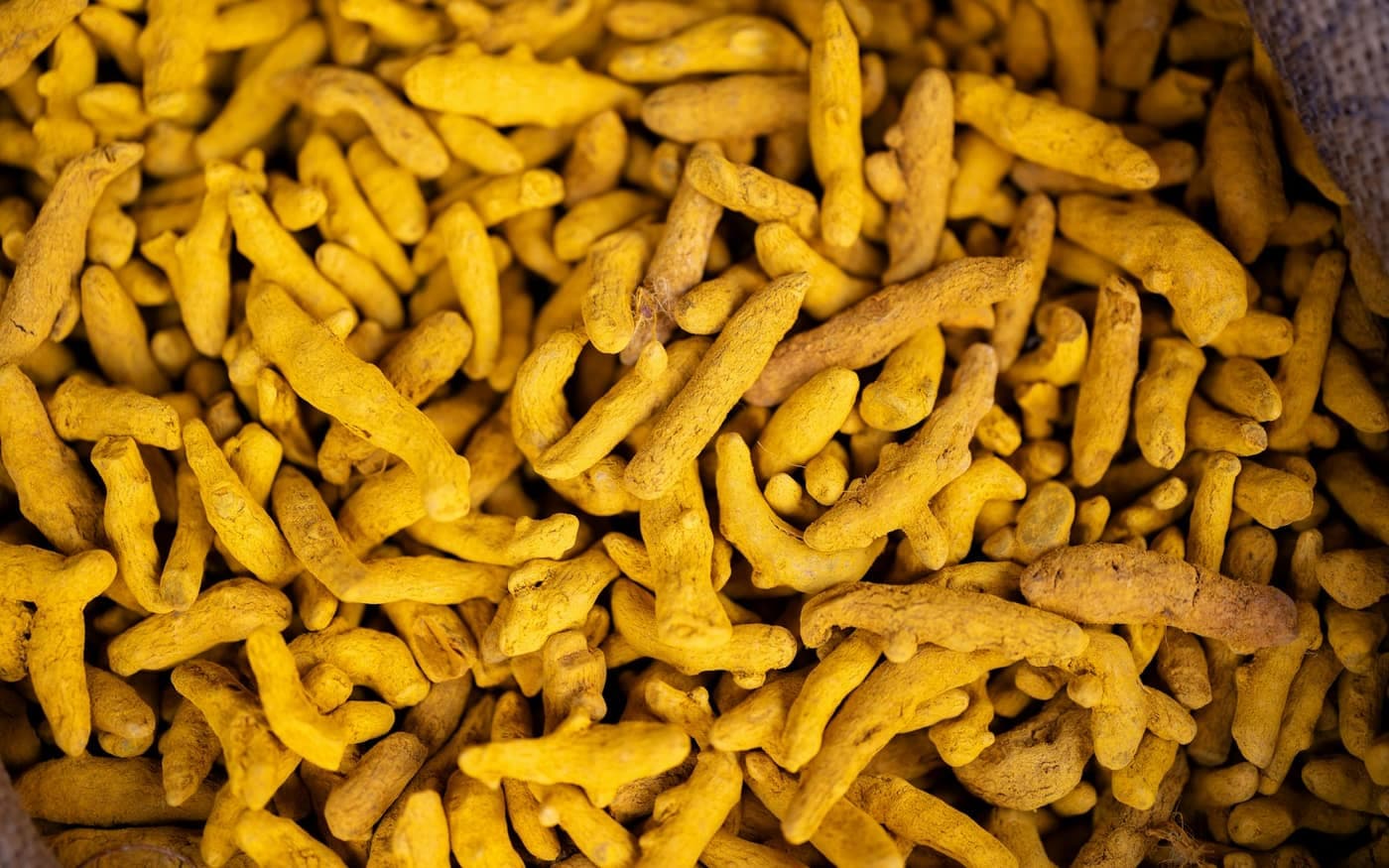
The defining post-harvest step is curing, not just storage: fresh rhizomes are boiled (cooked) in water until soft and an even colour throughout, then sun-dried for 10–15 days to about 10% moisture, then polished to remove the rough outer skin and scales and bring up the surface shine — only then is turmeric market-grade. Cured, dried turmeric is stored in a dry, ventilated space.
Packaging
Polished, graded dry turmeric (whole fingers or bulbs) is bagged for market; grade is set by colour, curcumin and finger size, so uniform curing and sorting directly set the price.
Transportation
Transport the dried, cured produce protected from rain and dampness; re-wetting cured turmeric undoes the drying and invites mould and colour loss.
Shelf life
Well-cured, well-dried and polished turmeric keeps for a year or more with little loss of colour; the limiting factors are moisture pick-up and rhizome scale in poorly dried stock, which is why the curing step decides how much of the field's value actually survives to sale.
Market prices
Today's mandi price near you, pulled live from the government's own Agmarknet data.
Live daily mandi prices from the government Agmarknet dataset.
Synced from data.gov.in (Agmarknet). Rates are ₹ per quintal.
Weather
Current conditions and a 5-day outlook for your selected location, with one line of stage-aware advice.
Pick your state for current conditions and a 5-day outlook.
Live data from Open-Meteo
Profit calculator
Your own cost sheet, expected yield and selling price — not ours.
Where the money goes
Share of the total cost per acre, using the calculator’s own default cost sheet below — adjust the numbers there to match your field and this picture will no longer apply to you exactly, but the ranking rarely changes.
- Seed27% (₹22,000)
- Labour27% (₹22,000)
- Land rent15% (₹12,000)
- Fertiliser10% (₹8,000)
- Irrigation7% (₹6,000)
- Machinery5% (₹4,000)
- Interest4% (₹3,500)
- Pesticide & weedicide4% (₹3,000)
Official downloads
Government and ICAR documents only — everything below is hosted on an official server.
ICAR-IISR — Indian Institute of Spices Research, Kozhikode
Package of practices, improved turmeric varieties and curcumin data from the ICAR institute mandated for spices research.
Spices Board India
The Government of India board for spice development and export — grading, quality standards and export guidance for turmeric.
Agmarknet — mandi prices
Daily mandi arrivals and prices for turmeric across regulated markets — the most useful real-time price signal for a crop with no MSP.
Soil Health Card portal
Get a free, crop-wise fertilizer recommendation — including the potash reading turmeric depends on — before finalising the schedule above.
Frequently asked questions
When is the best time to plant turmeric?
April–May under irrigation, or with the first pre-monsoon showers of May–June in rainfed areas, so the long rhizome-bulking phase runs through the warm, moist months. Planting much after June shortens the season and measurably cuts rhizome yield, since turmeric needs its full eight to nine months in the ground to bulk and develop curcumin.
How much seed rhizome do I need per acre?
Roughly 8–10 quintals per acre (2,000–2,500 kg/ha) of seed rhizomes. Turmeric has an unusually high seed rate because whole mother rhizomes and finger bits — not small seeds — are planted; the seed cost is one of the larger single items in the crop's budget.
What is the difference between mother and finger rhizomes?
The mother rhizome is the central bulb at the base of the plant; the fingers are the slimmer secondary rhizomes that branch off it. Both are used as seed and both are sold, though bold, well-coloured fingers usually grade and price better. Whole mother rhizomes as seed tend to give more vigorous early growth, while single-bud finger bits stretch the seed further.
Does turmeric have an MSP?
No — turmeric has no Minimum Support Price. It is a pure market and export spice crop, and its price swings with curcumin content, overall quality, and the balance of demand (including export and oleoresin buyers) against the stock farmers are holding. The live mandi price on this page is the most useful real-time signal for deciding when to sell.
What is curcumin and why does it decide the price?
Curcumin is the yellow pigment that gives turmeric its colour and much of its medicinal value, and it is the main quality parameter buyers pay a premium for. It ranges from about 2% in ordinary local types to over 7% in a variety like IISR Prathibha, so choosing a high-curcumin variety and curing it well are the two biggest levers a grower has on price beyond raw yield.
Why does turmeric have to be boiled and cured after harvest?
Freshly dug rhizomes are not market-grade until they are cured: boiling (cooking) the rhizomes gelatinises the starch and spreads the colour evenly, stops them sprouting, and cuts the drying time; drying then brings them to safe storage moisture; and polishing removes the rough skin and scales to give the bright surface a buyer grades on. Skipping or rushing any step leaves pale, uneven, low-grade turmeric that fetches far less.
How is turmeric cured, step by step?
Cleaned fresh rhizomes are boiled in water until they are soft and an even colour right through (they turn frothy and give off the characteristic smell), then spread in the sun to dry for 10–15 days down to about 10% moisture, turning them regularly. The dried rhizomes are then polished — by hand-rubbing, in a drum, or mechanically — to remove the rough outer skin and bring up the shine before grading and sale.
How long does a turmeric crop take to harvest?
About 240–270 days, or eight to nine months, from planting to harvest, depending on the variety. It is one of the longest-duration crops a farmer grows in a single season, which is why the field is committed for nearly the whole year and why late planting cannot simply be made up later.
What yield can I realistically expect from turmeric?
200–250 quintals per hectare of fresh rhizome under good management, which cures down to roughly 40–50 quintals per hectare of dry, market-grade turmeric at a dry recovery of about 20–25%. Realised yield depends heavily on variety, healthy seed, even moisture through bulking, and control of rhizome rot and shoot borer.
How much dry turmeric do I get from fresh rhizomes?
Roughly 20–25 kg of cured, dry turmeric from every 100 kg of fresh rhizome — a dry recovery of about a fifth to a quarter. This ratio matters when comparing prices, since fresh and dry turmeric are quoted differently, and the dry recovery itself is higher in a fully mature, well-cured crop than in one dug early.
What is rhizome rot and how do I prevent it?
Rhizome rot is the crop's most destructive disease — a soil- and water-borne fungal rot (Pythium and Fusarium) that softens the collar, yellows and collapses whole clumps, and leaves soft, foul-smelling rhizomes. There is no reliable cure once a clump rots, so it is prevented: plant only healthy, fungicide-treated seed rhizomes on well-drained ridges or raised beds, never on waterlogged ground, and rotate away from turmeric on affected fields.
How do I control shoot borer in turmeric?
The shoot borer is turmeric's most important pest — its larva bores into the pseudostem and kills the central shoot, leaving a hole with frass and a withered "dead heart". Cut and destroy dead-hearted shoots as soon as you see them to kill the larva inside, and where dead hearts keep appearing through the July–October moth season, spray a recommended insecticide such as malathion at roughly monthly intervals through that window.
Can turmeric be grown as an intercrop?
Yes — turmeric is notably shade-tolerant, which is why it is so commonly intercropped under coconut, arecanut and banana or in orchard interspaces rather than only as a sole crop. This uses land that would otherwise be idle and often gives the turmeric useful partial shade, though yield per plant is lower than in a well-managed open sole crop.
Why are my turmeric leaves yellowing?
Late in the season, uniform yellowing and drying of the whole canopy is simply the crop maturing ahead of harvest — expected and not a problem. Earlier in the season, yellowing that starts on older, lower leaves usually points to nitrogen deficiency; check whether the top-dressing was applied on schedule. But yellowing and drooping of a whole clump with a soft, water-soaked base is rhizome rot — dig a plant to check, and if it is rot, improve drainage and remove affected clumps rather than adding fertilizer.
Why is mulching so important in turmeric?
Turmeric germinates slowly and sits in the ground for nine months, so the 12–15 t/ha of green-leaf mulch applied right after planting does three jobs at once: it conserves soil moisture through germination and dry spells, smothers the early weed flush the slow crop would otherwise lose ground to, and adds organic matter as it breaks down. A second mulch around 40 days carries the benefit through early growth — it is a standard, non-optional operation, not an extra.
How should I store cured turmeric?
Store well-boiled, fully sun-dried (about 10% moisture) and polished turmeric in a dry, ventilated space in clean bags. Properly cured turmeric keeps for a year or more with little colour loss; the two things that spoil stored turmeric are moisture pick-up, which causes mould and colour loss, and rhizome scale on under-dried or poorly selected stock — both are avoided by curing thoroughly and keeping the produce dry.
Can I insure my turmeric crop under government schemes?
In districts where turmeric is notified, it is covered under the PMFBY (Pradhan Mantri Fasal Bima Yojana) as a horticultural/commercial crop, for which the farmer's premium is capped at 5% of the sum insured. Whether turmeric is notified, and the enrolment cut-off dates, vary by district and season, so check your local notification before the season's window closes.
Still have questions?
The FAQs above cover the common ones. For anything specific to your field and soil, your nearest Krishi Vigyan Kendra is the authoritative answer.