
Foxtail Millet (Kangni)
Setaria italica
The oldest cultivated millet and one of the toughest, quickest grain crops a farmer can grow — it matures in about 70–90 days on poor, light, rainfed land where almost nothing else pays, needs very little water and few inputs, and has swung back into demand as a nutritious, gluten-free, low-glycaemic grain carried by the national millet push and government procurement.
Quick Summary
The key points from this page in about two minutes — read it or have it read aloud.
Quick Summary
Foxtail millet (kangni / kakum, Setaria italica) is a short-duration, drought-hardy small millet grown mainly in the rainfed tracts of Andhra Pradesh, Telangana, Karnataka, Tamil Nadu, Rajasthan, Madhya Pradesh and the hills of Uttarakhand. It is one of the oldest domesticated crops in the world and remains a classic "famine-insurance" grain: it ripens in roughly 70–90 days, survives on light, shallow, marginal soils and a short rainy spell, and gives a dependable grain-and-fodder harvest where rice, maize or even other millets would fail.
As a crop it is simple and low-cost. It is sown with the first good monsoon rain, needs only a modest, well-drained seedbed and a light fertiliser dose, and asks for little more than one or two weedings in the critical first month while the young plant — which grows slowly at the start — is overtaken easily by weeds. Because the seed is tiny, getting a thin, even stand (rather than a thick, patchy one) is the single most important sowing decision, and most beginners sow far too heavily.
The one disease that genuinely decides the crop is blast (Pyricularia setariae), which spots the leaves and, more damagingly, blackens the neck and grain heads in humid, cloudy weather; a resistant variety and treated seed are the main defence. Rust, downy mildew (green ear) and grain smut also appear, and shoot fly and stem borer are the pests to watch in the early crop. None of these is hard to manage on a crop grown, as foxtail millet usually is, with moderate nitrogen and an open, airy stand.
The real change for foxtail millet is on the demand side. Promoted hard as a "nutri-cereal" under the national millet mission (and through the International Year of Millets), it now has a growing health-food market — it is high in protein and iron, gluten-free and low on the glycaemic index — and genuinely trades on APMC markets in Karnataka and the southern states, with some state procurement. Grown with a good variety and a thin, timely stand, it is one of the lowest-risk crops a dryland farmer can put on marginal land.
- Crop type
- Short-duration small millet (nutri-cereal), rainfed
- Season
- Mainly kharif (Jun–Jul sowing); rabi/summer under irrigation in the south
- Suitable states
- Andhra Pradesh, Telangana, Karnataka, Tamil Nadu, Rajasthan, Madhya Pradesh, Uttarakhand
- Growing duration
- Very short — about 70–90 days
- Water requirement
- Low; drought-hardy, grown largely rainfed on a short spell
- Temperature
- Warm, ~20–35°C; tolerant of heat and dry spells
- Soil type
- Wide range; does well on light, shallow, marginal loams, pH ~5.5–7.5
- Difficulty level
- Easy — a low-input, low-risk dryland crop
- Expected yield
- 15–25 q/ha grain under good management; 8–12 q/ha rainfed on poor land
- Key risk
- Over-seeding (thick patchy stand), weeds in the first month, blast in humid weather
Overview
Foxtail millet (Setaria italica), called kangni or kakum in Hindi and korra, navane, thinai or tenai in the southern languages, is a short-duration small millet and one of the oldest cultivated grains in the world. It is valued as a hardy, quick, low-input crop for dry, marginal, rainfed land, maturing in about 70–90 days on soils and in rainfall where most other cereals cannot be grown reliably.
It is grown mainly in Andhra Pradesh, Telangana, Karnataka, Tamil Nadu, Rajasthan, Madhya Pradesh, Maharashtra and the Uttarakhand hills — largely as a rainfed kharif crop, and as a rabi or summer crop under some irrigation in parts of the south. Because it tolerates drought and poor soil, survives a short growing window and gives both grain and fodder, it has long been a food-security crop for dryland and tribal farming.
The crop turns on three simple things: a thin, even stand from the tiny seed (over-seeding is the commonest mistake), one or two timely weedings in the slow-growing first month, and a blast-resistant variety with treated seed. Beyond the field, foxtail millet is now promoted as a nutritious gluten-free "nutri-cereal" under the national millet mission, has a growing health-food market, and genuinely trades on APMC markets in the southern states with some government procurement.
Crop timeline, sowing to harvest
A quick visual map of the season — jump to any section below for the detail behind each stage.
- Day 0
Sowing
Treated seed is drilled or broadcast thinly into a well-prepared, moist seedbed with the first good monsoon rain; the fine seed is sown shallow (2–3 cm) and comes up in 4–6 days.
- Day 15–20
Thinning & first weeding
The young plant grows slowly and is easily smothered by weeds — the critical first weeding (and thinning to a single plant spacing) is done now, the most important operation in the crop.
- Day 25–35
Tillering
The plant puts out tillers; a nitrogen top-dress and a second weeding support a strong, even stand, and the canopy begins to close over the weeds.
- Day 40–50
Booting & ear emergence
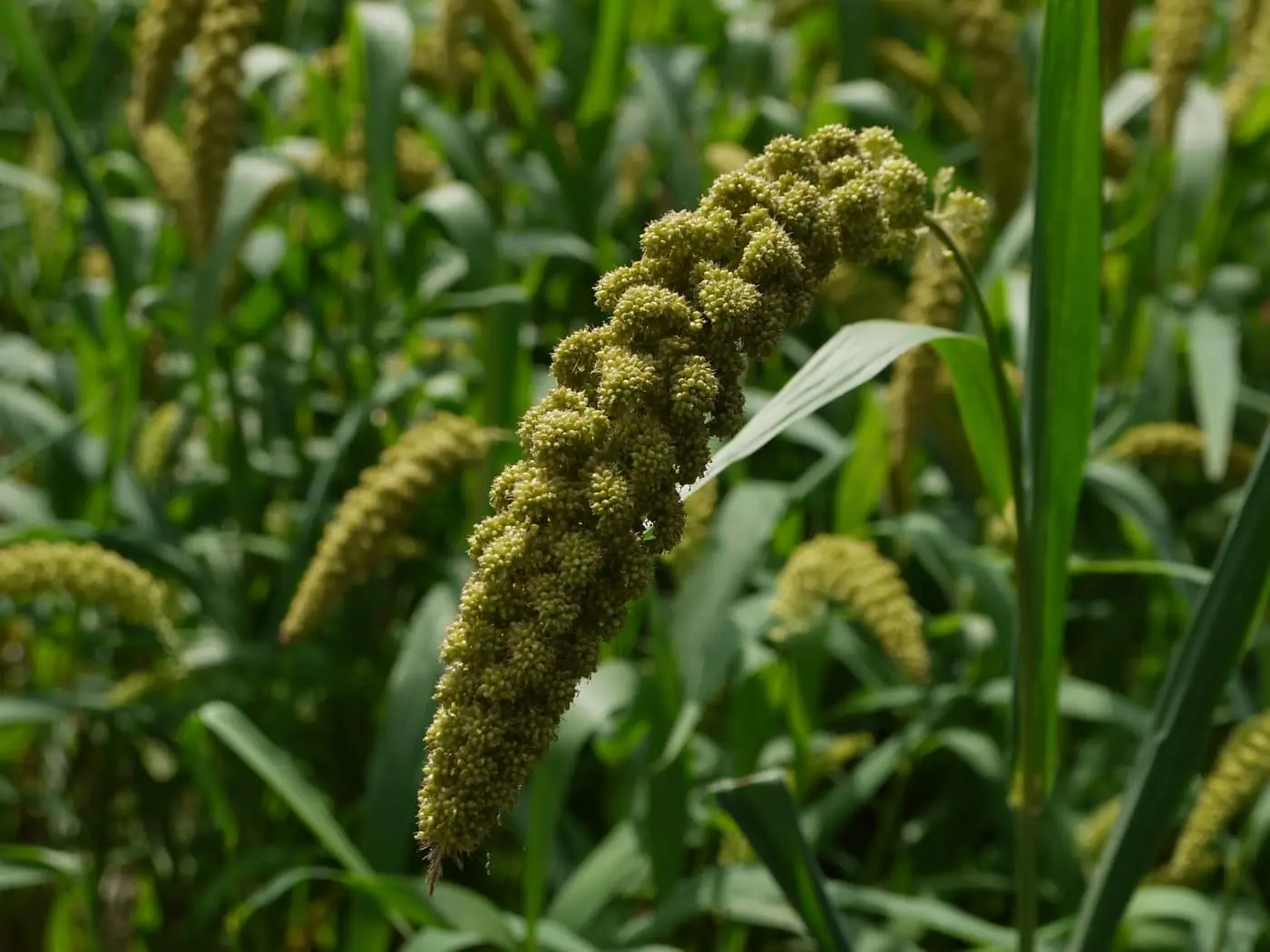
The flag leaf and the cylindrical, bristly ear heads (the "foxtails") emerge — the stage at which neck and head blast strike in humid weather, so this is when a protective fungicide is timed if blast weather sets in.
- Day 50–65
Flowering & grain filling
The ear flowers and fills; steady (if any) moisture and freedom from blast and shoot pests through this window decide the grain yield.
- Day 70–90
Maturity & harvest
The ears turn golden and the grain hardens; the crop is cut, dried, threshed and cleaned. It matures fast — a short, dependable season is its signature.
Suitable states
States where this crop is grown at scale, highlighted below. Your local Krishi Vigyan Kendra is still the final word for your specific block.
- Jammu and Kashmir
- Himachal Pradesh
- Punjab
- Uttarakhand
- Haryana
- Delhi
- Uttar Pradesh
- Rajasthan
- Bihar
- Jharkhand
- West Bengal
- Sikkim
- Assam
- Arunachal Pradesh
- Meghalaya
- Nagaland
- Manipur
- Mizoram
- Tripura
- Gujarat
- Madhya Pradesh
- Chhattisgarh
- Maharashtra
- Odisha
- Goa
- Telangana
- Andhra Pradesh
- Karnataka
- Kerala
- Tamil Nadu
- Puducherry
- Ladakh
- Chandigarh
- Lakshadweep
- Andaman and Nicobar Islands
- Dadra and Nagar Haveli and Daman and Diu
Grown here
Climate requirements
Foxtail millet's whole value is that it crops where water and soil are poor — grow it on light, marginal, rainfed land as an insurance crop, not on a rich, well-watered field where a higher-value crop would pay more.
Ideal temperature
A warm-weather crop that grows best at about 20–35°C and tolerates heat and dry spells well. It is a short-day, quick-maturing plant, which is why it fits a short monsoon window; very cold weather and frost do not suit it, so in the hills it is a summer-season crop.
Rainfall
Grown largely rainfed on a modest, well-distributed rainfall of roughly 400–700 mm, and genuinely drought-hardy — it can set a grain crop on a short spell that would fail rice or maize. It does not tolerate waterlogging, so good drainage matters more than extra water; heavy continuous rain at flowering raises blast and head-mould risk.
Humidity
Prefers a drier atmosphere; long humid, cloudy, drizzly weather at ear emergence and flowering is what drives blast and grain mould, the crop's main weather risk.
Sunlight
A full-sun crop that fills grain best in bright, warm weather after flowering.
Soil requirements
Its best use is on the light, marginal, rainfed soils that will not pay under a more demanding crop — foxtail millet turns that land into a dependable grain-and-fodder harvest.
Suitable soil
Grows on a very wide range of soils, including light, shallow, sandy and marginal land, which is where it is most useful. It does best on a well-drained loam with reasonable fertility, but will crop on poor red and black soils where other cereals struggle. Waterlogging-prone heavy clay is its one weakness.
pH range
Tolerant of a fair range, roughly pH 5.5–7.5; it handles slightly acid and slightly alkaline soils better than most cereals.
Drainage
Good drainage is essential — the crop will not stand waterlogging, and standing water around the roots quickly kills the stand. On heavier land, sow on a well-drained bed or light ridges.
Organic matter
Responds to a modest dressing of farmyard manure or compost; because it is grown as a low-input crop, even a small amount of organic matter worked in before sowing lifts the yield noticeably.
Land preparation
Same four steps whichever region you are in — only the timing shifts with the sowing window.
- 1
Prepare a fine, firm, well-drained seedbed
Because the seed is tiny, plough and harrow to a fine tilth and firm the bed so the shallow-sown seed sits in close contact with moist soil — a cloddy, loose bed gives a poor, patchy stand.
- 2
Work in farmyard manure and the basal fertiliser
Mix 5–10 t/ha of well-rotted farmyard manure or compost and the basal fertiliser dose into the seedbed before sowing; a low-input crop still rewards a modest basal feed.
- 3
Sow with the first good rain into moisture
Time the sowing to the first good monsoon rain so the fine seed germinates into warm, moist soil — sowing into dry soil ahead of uncertain rain risks a failed or uneven stand.
Seed information
How the main varieties compare, so you can pick by duration, yield, disease pressure or what you are growing for.
| Variety | Duration | Yield | Disease resistance | Best state | Suitable for |
|---|---|---|---|---|---|
A widely grown ICAR/ANGRAU (RARS Nandyal) pure-line variety released in 2011, valued for a short 80–85-day duration and a useful 20–30 q/ha yield potential, with documented resistance to blast and downy mildew — one of the standard choices across the foxtail-millet belt. | ~80–85 days | 20–30 q/ha under good management | Resistant to blast and downy mildew | Andhra Pradesh, Telangana, Karnataka and across the country | Rainfed kharif grain crop needing a short, dependable season |
An ANGRAU (RARS Nandyal) pure-line variety released in 2012, maturing in about 85–90 days with a 20–25 q/ha yield potential; it is highly responsive to nitrogen and is recommended across a wide set of states (Andhra Pradesh, Bihar, Gujarat, Karnataka, Madhya Pradesh, Tamil Nadu and Uttarakhand). | ~85–90 days | 20–25 q/ha; responds strongly to nitrogen | Good field tolerance; strong agronomic performance | Andhra Pradesh, Bihar, Gujarat, Karnataka, Madhya Pradesh, Tamil Nadu, Uttarakhand | Growers who can give a modest nitrogen dose for higher yield |
An ANGRAU (Nandyal) release popular in Andhra Pradesh and Telangana, grown as a dependable mid-duration rainfed variety with good grain quality for the kharif crop. | ~80–90 days | Good rainfed yield in its recommended belt | Good field tolerance in its target region | Andhra Pradesh, Telangana | Rainfed kharif cultivation in the south-central belt |
An Andhra Pradesh / Telangana recommended variety grown as a standard rainfed kharif foxtail millet in the region, valued for its adaptation to the local dryland conditions. | ~80–90 days | Good rainfed yield in its recommended belt | Good field tolerance in its target region | Andhra Pradesh, Telangana | Rainfed kharif cultivation on dryland |
A drought-tolerant variety recommended across Andhra Pradesh, Telangana, Karnataka, Uttar Pradesh and Uttarakhand, and used as a parent in further breeding (it is a parent of the TNAU variety Co-5 × SiA 326 line) — a good choice where the growing spell is short and uncertain. | ~80–90 days | Dependable rainfed yield; drought-tolerant | Drought-tolerant; good field tolerance | Andhra Pradesh, Telangana, Karnataka, Uttar Pradesh, Uttarakhand | Short, uncertain rainfed growing windows |
A recommended variety across Andhra Pradesh, Karnataka, Uttar Pradesh and Uttarakhand, grown as a standard rainfed foxtail millet with wide adaptation across the northern and southern belts. | ~80–90 days | Good rainfed yield; widely adapted | Good field tolerance | Andhra Pradesh, Karnataka, Uttar Pradesh, Uttarakhand | Rainfed cultivation across a wide range of states |
A Tamil Nadu Agricultural University (TNAU, Coimbatore) released variety, the standard improved foxtail millet for Tamil Nadu, bred for the state's rainfed and irrigated small-millet systems. | ~80–90 days | Good yield in Tamil Nadu conditions | Good field tolerance in its target region | Tamil Nadu | Tamil Nadu small-millet cultivation |
- Seed rate
- About 8–10 kg/ha (roughly 3–4 kg/acre) for a drilled crop — the seed is tiny, so mix it with fine sand or sieved soil to spread it evenly and avoid over-seeding, which gives a thick, weak, patchy stand. Transplanted crops (in parts of the south) use much less seed raised in a nursery.
- Certified seed
- Buy fresh, certified seed of a named, blast-resistant variety from a state seed corporation, an ICAR institute (such as ICAR-IIMR, Hyderabad, or ANGRAU/TNAU), a KVK or a reputable dealer each season; a true-to-type open-pollinated variety can be seed-saved from a clean crop, but treat the seed against blast before sowing.
- Spacing
- Rows about 22–25 cm apart, with plants thinned to about 8–10 cm within the row — a thin, even stand matters far more than a thick one.
- Seed treatment
- Treat seed with carbendazim or a Trichoderma formulation against seed-borne blast and grain smut before sowing — the cheapest and most effective single step against the crop's main disease.
Sowing guide
Do not sow too heavily or too deep. Over-seeding is the commonest foxtail-millet mistake — it gives a thick, weak, uneven stand that lodges and yields poorly — and deep-buried fine seed simply does not come up.
- Best time
- In the main rainfed belt, sow the kharif crop with the first good monsoon rain, from about mid-June to July. In parts of the south it is also grown as a rabi or summer crop (sown around October–November or January–February) under some irrigation. Time the sowing so flowering and grain fill avoid the heaviest, most humid rain, which drives blast.
- Row spacing
- 22–25 cm
- Plant spacing
- 8–10 cm (after thinning)
- Sowing depth
- Shallow — about 2–3 cm; the fine seed must not be buried deep
- Method
- Drill or broadcast the treated seed thinly into a fine, firm, moist seedbed (mix the tiny seed with sand for an even spread), or transplant nursery seedlings in parts of the south. Thin to a single plant spacing and weed at 15–20 days — the crop grows slowly at first and is easily lost to weeds.
Fertilizer schedule
A split dose beats one large dose applied at sowing — nitrogen especially is lost to the air and to leaching if it all goes in on day one.
- 1
Basal (at sowing)
At field preparation / sowing
Work in 5–10 t/ha farmyard manure and a basal dose of roughly half the nitrogen with the full phosphorus — commonly around 20 kg N and 20 kg P₂O₅/ha as the basal share for a rainfed crop (higher under irrigation).
- 2
Top-dressing
~25–30 days (tillering), with adequate soil moisture
Top-dress the remaining nitrogen (around 20 kg N/ha) at tillering when there is moisture, to build a strong, even stand. Keep nitrogen moderate — excess gives a lush canopy that lodges and invites blast.
Irrigation schedule
1. Establishment
Rely on sowing rain; irrigate once if a dry spell follows sowing
The rainfed crop establishes on monsoon moisture; where irrigation is available, one watering to establish the stand if the rain pauses after sowing is enough.
2. Tillering to booting
One irrigation if a long dry spell hits
A single irrigation through a prolonged dry spell at tillering/booting protects the stand and the developing ears on an irrigated crop.
3. Flowering & grain filling
The most responsive stage if water is available
If any irrigation is to be given, flowering and grain filling is the stage that most repays it; water stress here reduces grain set and filling.
Critical stages
- Flowering
- Grain filling
Water-saving tips
- Foxtail millet is grown chiefly to save water — treat any irrigation as a bonus that protects the crop through a dry spell at flowering, not as a routine schedule.
- Good drainage matters more than extra water; never let water stand around the roots.
- A light mulch and timely weeding conserve the little soil moisture the crop needs through its short season.
Weed management
Common weeds
Organic control
- The key operation is one or two timely hand-weedings or inter-row hoeings in the first 15–35 days, when the young crop grows slowly and loses most to weeds.
- A thin, even, correctly spaced stand lets the canopy close faster and shade out later weeds.
- Thinning at the first weeding both removes excess plants and takes out early weeds in one pass.
Chemical control
- A pre-emergence herbicide cleared for small millets (such as atrazine on recommendation) may be used on larger plantings, followed by one hand-weeding; confirm the product and dose with your KVK, as small-millet herbicide clearances are limited.
Nutrient deficiency identification
What a shortage of each nutrient actually looks like on the plant, so you can tell a deficiency apart from a disease before you spray the wrong thing.
Nitrogen
Visible symptom
Pale, yellow-green older leaves, thin tillering and small ears; the most common deficiency, though the crop needs only moderate nitrogen.
Phosphorus
Visible symptom
Stunted plants with dark, sometimes purplish older leaves and poor root and tiller development, mainly on poor marginal soils.
Iron
Visible symptom
Yellowing between the veins of the youngest leaves while the veins stay green, mainly on alkaline or waterlogged patches.
Diseases to watch for
Symptoms, likely cause and what actually treats it — not just a spray name.
Foxtail millet blast
- Symptoms
- Spindle-shaped grey-centred spots with brown borders on the leaves; more damagingly, a black, shrivelled zone on the neck just below the ear and darkened, poorly filled grain heads in humid, cloudy weather.
- Cause
- The fungus Pyricularia setariae, favoured by long humid, overcast weather at ear emergence and flowering, a dense over-fertilised canopy and heavy nitrogen; seed- and stubble-borne.
- Treatment
- Spray a recommended fungicide (tricyclazole, or a carbendazim/mancozeb combination) at booting to ear emergence when blast weather sets in, and again at flowering if it stays wet; there is no cure for an affected ear.
- Prevention
- Grow a blast-resistant variety (such as SiA 3085), treat seed before sowing, keep nitrogen moderate and split, use an open stand, and clear infected stubble.
Rust
- Symptoms
- Reddish-brown powdery pustules on the leaves, mainly later in the season, which in a heavy attack dry the foliage early and shrink the grain.
- Cause
- The fungus Uromyces setariae-italicae, spread by air-borne spores and favoured by humid weather and a dense canopy.
- Treatment
- A protective mancozeb or a recommended fungicide at first sign on a susceptible crop in a wet year; usually not needed on a short-duration variety that matures before rust builds up.
- Prevention
- Grow tolerant varieties, avoid very late sowing that exposes the crop to late-season rust weather, and keep the canopy open.
Downy mildew (green ear)
- Symptoms
- Pale, yellowed, downy patches on the leaves and, characteristically, a malformed leafy "green ear" in place of a normal grain head, which bears no grain.
- Cause
- The fungus Sclerospora graminicola, favoured by cool, wet, humid conditions and carried on seed and soil.
- Treatment
- Rogue out and destroy green-ear plants early; there is no cure for an affected plant.
- Prevention
- Treat seed with a recommended fungicide (metalaxyl), grow tolerant varieties, rogue out affected plants, and rotate away from millets on a badly affected field.
Grain smut
- Symptoms
- Individual grains in the ear replaced by swollen, dark, dusty smut sori filled with black spore powder, cutting the saleable grain.
- Cause
- The smut fungus (Ustilago crameri), seed-borne, infecting the developing grain.
- Treatment
- Remove and destroy smutted ears; a seed-borne disease has no in-crop cure once the grain is affected.
- Prevention
- Treat seed with a recommended fungicide before sowing and use clean, certified seed — seed treatment largely eliminates grain smut.
Pests to watch for
What to look for before the damage is visible, and organic options before you reach for a chemical.
Shoot fly
- Identification
- The maggot bores into the central shoot of young seedlings, killing the growing point and causing a withered, dried-out central leaf known as a "dead heart" that pulls out easily.
- Damage
- Kills or stunts young plants and thins the stand in the first two to three weeks, worst on a late-sown or slow-establishing crop.
- Organic control
- Sow early into good moisture for quick, uniform establishment (the crop outgrows the risk), keep a slightly higher seed rate to compensate, and remove and destroy dead-heart shoots.
- Chemical control
- A seed treatment or an early recommended insecticide where shoot fly is regular and the crop is sown late; timely establishment is the main defence.
Stem borer
- Identification
- Caterpillars bore into the stem, causing dead hearts in young plants and, later, whiteheads (empty, whitened ears) where the stem is tunnelled below the ear.
- Damage
- Kills tillers and empties ears; a heavy attack at ear stage directly cuts grain yield.
- Organic control
- Destroy stubble after harvest to break the carry-over, grow a vigorous even stand, and encourage natural enemies; remove affected shoots.
- Chemical control
- A recommended insecticide timed against young larvae where stem borer is a regular problem; stubble destruction matters as much as spraying.
Aphids
- Identification
- Colonies of small soft green or black insects on the leaves and ear heads, often with sticky honeydew and sooty mould, worst in dry spells.
- Damage
- Sap-sucking weakens the plant and, on the ears, can reduce grain filling; heavy colonies also foul the crop with honeydew.
- Organic control
- Conserve ladybird beetles and other natural enemies, use a neem spray on building colonies, and keep the crop unstressed; aphids are rarely a serious problem on a healthy short-duration crop.
- Chemical control
- A recommended insecticide only where colonies build up heavily on the ears; usually not required.
Common mistakes to avoid
The mistakes that cost growers the most, ranked by how often they show up in the field — not in the order you might expect.
- 1
Sowing the tiny seed far too heavily.
Why it hurts
Over-seeding is the commonest foxtail-millet mistake — it gives a thick, weak, uneven stand that lodges and yields poorly. Mix the seed with fine sand for an even spread and aim for a thin stand of about 8–10 kg/ha; thin at the first weeding.
- 2
Not weeding in the slow-growing first month.
Why it hurts
The young crop grows slowly and is easily smothered — weeds in the first 15–35 days are the single biggest yield drain. One or two timely weedings (with thinning) are the most important operations in the crop.
- 3
Sowing deep or into dry soil ahead of the rain.
Why it hurts
The fine seed sown deep simply does not emerge, and seed sown into dry soil ahead of uncertain rain gives a failed or patchy stand. Sow shallow (2–3 cm) into moisture with the first good rain.
- 4
Ignoring blast and pushing heavy nitrogen.
Why it hurts
A lush, heavily nitrogen-fed crop in humid weather is a blast crop — black necks and empty heads. Grow a resistant variety, treat the seed, keep nitrogen moderate and split, and plan a protective spray at ear emergence where blast is regular.
- 5
Growing it on rich, well-watered land.
Why it hurts
Foxtail millet's whole value is that it crops on poor, light, rainfed land that will not pay a higher-value crop. On a good field a higher-value crop usually earns more — use the millet to turn marginal land into a dependable harvest.
Harvesting
Harvest when the ears turn golden and the grain hardens, about 70–90 days after sowing depending on the variety. The crop matures fast and fairly evenly; cut the earheads or the whole plant, dry in the sun, then thresh and winnow. Do not leave a ripe crop standing too long, as the grain shatters and birds take it.
Signs it is ready
- Ear heads turned golden-yellow
- Grain hard and no longer milky when pressed
- Lower leaves dried; the short season complete
- Harvested before the ripe grain shatters or birds strip it
Tools
- Sickle for cutting earheads or whole plants
- Tarpaulin and a threshing floor or small thresher
- Winnowing to clean the fine grain
Expected yield
About 15–25 quintals per hectare of grain under good management, and roughly 8–12 q/ha on poor rainfed land, plus a useful fodder yield — a dependable return for a very low-input crop.
Post-harvest & storage
Storage
Dry the grain well (to about 12% moisture) before storage; dry foxtail millet grain stores exceptionally well for long periods in a cool, dry store without insect damage, which is part of its traditional food-security value. Store the unhulled grain and dehull close to use for the best keeping quality.
Packaging
Store in clean, dry gunny or woven bags, or in traditional bins, kept off the floor and away from damp; the hard, small grain resists storage pests well when properly dried.
Transportation
Transport the clean dry grain in bags as for any millet; the hardy grain travels and keeps well without special handling.
Shelf life
Whole dry grain keeps for a year or more in good storage; dehulled millet and flour have a shorter life and are best milled close to use.
Market prices
Today's mandi price near you, pulled live from the government's own Agmarknet data.
Live daily mandi prices from the government Agmarknet dataset.
Synced from data.gov.in (Agmarknet). Rates are ₹ per quintal.
Weather
Current conditions and a 5-day outlook for your selected location, with one line of stage-aware advice.
Pick your state for current conditions and a 5-day outlook.
Live data from Open-Meteo
Profit calculator
Your own cost sheet, expected yield and selling price — not ours.
Where the money goes
Share of the total cost per acre, using the calculator’s own default cost sheet below — adjust the numbers there to match your field and this picture will no longer apply to you exactly, but the ranking rarely changes.
- Labour36% (₹6,000)
- Land rent30% (₹5,000)
- Fertiliser9% (₹1,500)
- Machinery9% (₹1,500)
- Pesticide & weedicide6% (₹1,000)
- Interest5% (₹800)
- Seed4% (₹600)
- Irrigation3% (₹500)
Official downloads
Government and ICAR documents only — everything below is hosted on an official server.
ICAR-Indian Institute of Millets Research (IIMR), Hyderabad
Foxtail millet varieties, package of practices and the national millet mission
ANGRAU / RARS Nandyal
SiA 3085, SiA 3156, SiA 3088 and other released varieties and guidance
Vikaspedia — Foxtail Millet
Cultivation guidance for foxtail millet in plain language
Kisan Call Centre — 1800-180-1551
Free crop advice in your language
Frequently asked questions
How long does foxtail millet take to mature?
About 70–90 days from sowing, depending on the variety — one of the shortest-duration grain crops grown in India. That quick, dependable season is exactly why it fits a short monsoon window and marginal rainfed land where a longer crop would be at risk.
Why is my foxtail millet stand thick but weak?
Almost always because the seed was sown too heavily. The seed is tiny, so it is easy to over-sow, which gives a thick, spindly, uneven stand that lodges and yields poorly. Mix the seed with fine sand or sieved soil for an even spread, aim for about 8–10 kg/ha, and thin to a single plant spacing at the first weeding around 15–20 days.
What is the biggest disease risk in foxtail millet?
Blast (Pyricularia setariae) is the one disease that genuinely decides the crop. It spots the leaves and, more damagingly, blackens the neck below the ear and the grain heads in humid, cloudy weather, choking grain fill. Grow a blast-resistant variety such as SiA 3085, treat the seed before sowing, keep nitrogen moderate, and spray a recommended fungicide at ear emergence if blast weather sets in.
Does foxtail millet need irrigation?
Usually not — it is grown chiefly as a rainfed, drought-hardy crop and can set a grain harvest on a short spell of rain. Where irrigation is available, one watering through a prolonged dry spell at flowering and grain filling is the stage that most repays it, but the crop's whole value is that it crops with very little water. Good drainage matters more than extra water, as it will not tolerate waterlogging.
Is there a market and an MSP for foxtail millet?
Foxtail millet is promoted hard as a nutritious gluten-free "nutri-cereal" under the national millet mission, so there is a real and growing health-food market for it, and it genuinely trades on APMC markets in Karnataka and the southern states (reported on Agmarknet, often under a name like "Foxtail Millet (Navane)"), with some state procurement. There is no separate central MSP specifically for foxtail millet in the way there is for the major cereals, so check your nearest market and your state millet-mission procurement rate before planning the crop.
Why grow foxtail millet instead of a bigger cereal?
Because it crops where bigger cereals cannot. It matures in 70–90 days on poor, light, rainfed land with little water and few inputs, stores for years without damage, and now carries a growing nutri-cereal market and government promotion. On a rich, well-watered field a higher-value crop usually earns more — but on marginal, dry, uncertain land, foxtail millet is one of the lowest-risk, most dependable crops a farmer can grow.
Still have questions?
The FAQs above cover the common ones. For anything specific to your field and soil, your nearest Krishi Vigyan Kendra is the authoritative answer.