
Nutmeg (Jaiphal)
Myristica fragrans Houtt.
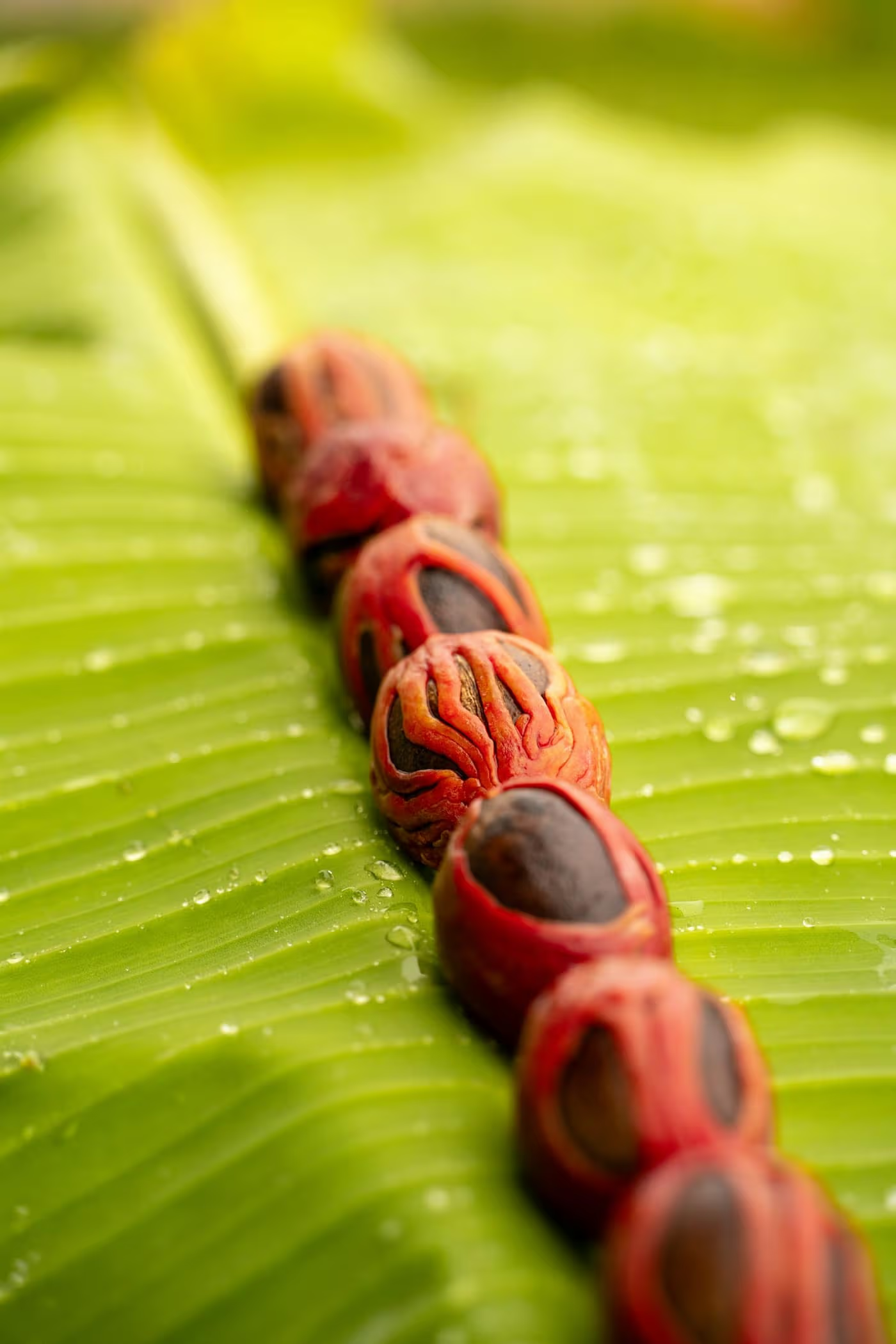
India's "twin spice" tree — every ripe fruit gives both a nutmeg kernel and a scarlet mace aril, two distinct products priced separately. The game-changer is that nutmeg is dioecious: male and female trees look identical until they flower four to six years after planting, so a seedling garden can be half male trees that never bear. Grafting from a known female (or planting the only hermaphrodite variety, Konkan Sugandha) eliminates this gamble entirely.
Quick Summary
The key points from this page in about two minutes — read it or have it read aloud.
Quick Summary
Nutmeg (jaiphal, Myristica fragrans) is a tropical evergreen tree whose ripe fruit splits open to reveal two spices at once — the hard brown kernel (nutmeg) and the bright red net-like covering around it (mace, javitri). India grows nutmeg mainly in Kerala's Idukki, Ernakulam, Thrissur and Kottayam districts, the Nilgiris in Tamil Nadu, coastal Karnataka, Goa and the Andaman and Nicobar Islands.
The single biggest decision is how to plant. Nutmeg is dioecious — male and female trees look the same until they flower, which can take four to six years. A seedling garden may turn out to be half males that will never bear a fruit. Grafting from a known, heavy-bearing female mother tree sidesteps this problem and brings the first crop earlier. Only one released variety — Konkan Sugandha from Dapoli, Maharashtra — is hermaphrodite, meaning every tree bears fruit without needing a separate male.
Once established, a nutmeg tree is long-lived and steady. Mature trees yield about a thousand to two thousand fruits a year. The fruit is processed by separating the fleshy outer husk (used for pickles), peeling off the mace and drying it, and drying the kernel inside the hard shell. Both products command good prices. The main risks are Diplodia fruit rot — which can spoil mace and nut before harvest — and dieback of branches in older trees.
- Crop type
- Perennial tropical evergreen spice tree (dioecious)
- Season
- Planted in the rainy season (June–December); fruits ripen year-round with a main harvest
- Suitable states
- Kerala, Tamil Nadu (Nilgiris), Karnataka, Goa, Andaman & Nicobar
- First harvest
- About 6–7 years from planting (4 years to first flowering in grafts)
- Water requirement
- Steady moisture; irrigation once every 5–7 days in summer
- Temperature
- Warm and humid tropical; about 20–30°C
- Soil type
- Deep, well-drained clay loam, red laterite or forest soil rich in organic matter
- Difficulty level
- Moderate (long wait; grafting and sex identification are key decisions)
- Expected yield
- About 5–7 kg dried nuts + 0.5–0.7 kg dried mace per mature tree
- Key risk
- Dioecious — seedling trees may turn out male; fruit rot can ruin the mace
Overview
Nutmeg (Myristica fragrans Houtt.), called jaiphal in Hindi and jathikka in Malayalam, is a tropical evergreen tree native to the Banda Islands of Indonesia. It is unique among spice crops because every ripe fruit yields two distinct, independently traded products: the hard, oval kernel inside the shell (nutmeg) and the bright red, net-like aril wrapped around the shell (mace, known as javitri in Hindi). India is among the significant producers, with about 23,478 hectares under the crop and a production of roughly 15,076 tonnes, though it still imports nutmeg to meet domestic demand.
In India, nutmeg is a homestead tree of the warm, humid Western Ghats. Kerala leads production — Idukki, Ernakulam, Thrissur and Kottayam are the main districts — followed by the Nilgiris and Kanyakumari in Tamil Nadu, the coastal belt of Karnataka, Goa and the Andaman and Nicobar Islands. It is commonly grown as a component of mixed homestead gardens, often under or alongside arecanut, coconut and fruit trees.
The defining biological fact of nutmeg is that it is dioecious: individual trees are either male or female, and there is no way to tell the sex from the seedling or the young tree. Male trees flower but never set fruit, and in a seedling-raised garden roughly half the trees may turn out to be male — a discovery that comes only after four to six years of waiting. This is why vegetative propagation (approach grafting or patch budding from known, heavy-bearing female mother trees) is the recommended method, and why the only hermaphrodite released variety, Konkan Sugandha from Dr BSKKV Dapoli, Maharashtra, is a breakthrough — every tree of this variety bears fruit.
Crop timeline, sowing to harvest
A quick visual map of the season — jump to any section below for the detail behind each stage.
- Before planting (6–12 months)
Shade and pit preparation
Shade trees or a temporary shade plan (banana, fast-growing species) are established well before the nutmeg saplings go in. Pits of 60 × 60 × 60 cm are dug and filled with a mix of equal parts forest soil and well-rotted cattle manure.
- Nursery / grafting (12–18 months)
Seedling or graft production
Fresh seed is sown immediately after extraction (viability is short). Grafting by approach method or budding by patch method is done October–January on orthotropic shoots from known heavy-bearing female trees. Grafts are ready for field planting at about 12–18 months.
- Year 0 (June–December)
Field planting
Twelve- to eighteen-month-old grafts (or seedlings if grafts are unavailable) are planted in the prepared pits at 8 × 8 m spacing in the rainy season, with banana or other shade already in place.
- Year 1–4
Establishment
Regular watering through the dry months, mulch, shade protection, weeding and gradually increasing fertiliser doses build the young tree. Loranthus (parasitic plant) is removed on sight.
- Year 4–6
First flowering
Grafted trees begin flowering from about the fourth year. In seedling gardens, this is also the stage when the sex of the tree first becomes apparent — male trees will flower but never set fruit.
- Year 6–7
First harvest
The first useful crop of fruit is picked from about the sixth or seventh year. Yields are small at first and build steadily over the next decade.
- Year 10–15+
Full bearing
A well-managed tree reaches full production around year 10–15 and can keep bearing productively for many decades. IISR Keralashree grafts produced about 2,000 fruits per tree by year 10.
- Each season
Harvest and processing
Fruits are picked when they start splitting naturally, usually over several rounds. The mace is peeled off, flattened and dried; the nut is dried in the shell, then shelled and graded.
Suitable states
States where this crop is grown at scale, highlighted below. Your local Krishi Vigyan Kendra is still the final word for your specific block.
- Jammu and Kashmir
- Himachal Pradesh
- Punjab
- Uttarakhand
- Haryana
- Delhi
- Uttar Pradesh
- Rajasthan
- Bihar
- Jharkhand
- West Bengal
- Sikkim
- Assam
- Arunachal Pradesh
- Meghalaya
- Nagaland
- Manipur
- Mizoram
- Tripura
- Gujarat
- Madhya Pradesh
- Chhattisgarh
- Maharashtra
- Odisha
- Goa
- Telangana
- Andhra Pradesh
- Karnataka
- Kerala
- Tamil Nadu
- Puducherry
- Ladakh
- Chandigarh
- Lakshadweep
Grown here
Climate requirements
Suitable altitude runs from near sea level up to about 1,000 m. Outside a warm, humid belt with assured water, nutmeg is a poor bet.
Ideal temperature
Nutmeg needs a warm, humid tropical climate — a mean temperature of about 20–30°C. It does not tolerate frost, cold or prolonged dry heat.
Rainfall
Well-distributed rainfall of about 1,500–2,500 mm per year. The tree needs watering every 5–7 days in the dry summer months but does not tolerate waterlogging.
Humidity
High humidity, above about 70%, suits the tree and helps fruit development. The same humidity favours fruit rot and thread blight.
Sunlight
Young plants need partial shade — banana or a temporary pandal. Mature trees tolerate full sun at higher elevations but do best with some filtered light in hot lowland areas.
Soil requirements
Choose a sheltered, well-drained site with reliable water for the dry months. Nutmeg does not forgive waterlogging or prolonged drought.
Suitable soil
Deep, well-drained clay loam, red laterite or forest soils rich in organic matter are best suited. Kerala's red midland soils, the Nilgiris' humus-rich hill soils and coastal Karnataka's laterite are traditional nutmeg areas.
pH range
Slightly acidic to near-neutral, as found in humus-rich forest and laterite soils.
Drainage
Good drainage is essential. Waterlogging leads to root problems and favours fruit rot.
Organic matter
Heavy organic matter at planting and as an annual top-dress — compost or well-rotted cattle manure — is standard practice.
Land preparation
Same four steps whichever region you are in — only the timing shifts with the sowing window.
- 1
Establish shade
Plant banana, fast-growing trees or other shade 6–12 months before the nutmeg saplings go in, especially in open areas.
- 2
Dig pits
Dig pits of 60 × 60 × 60 cm at 8 × 8 m spacing (about 50–60 trees per acre). Fill with a mix of equal parts forest soil/topsoil and well-rotted cattle manure (TNAU).
- 3
Plan irrigation
Arrange drip or basin irrigation before planting. Young nutmeg trees need regular water through the dry months.
- 4
Plan for dioecious sex ratio
If planting seedlings instead of grafts, plan for about one confirmed male tree for every 10–12 females to ensure pollination, and be prepared to replace excess males once sex is known.
Seed information
How the main varieties compare, so you can pick by duration, yield, disease pressure or what you are growing for.
| Variety | Duration | Yield | Disease resistance | Best state | Suitable for |
|---|---|---|---|---|---|
Released in 2001 by ICAR-IISR, Kozhikode, through clonal selection from an elite tree (accession A-9/4) from Mannoor, Kozhikode district. Bushy, compact growth habit. At 8 years: about 1,000 fruits per tree, 3,122 kg dry nuts/ha and 480 kg dry mace/ha with 360 plants/ha. Dry nut recovery 70%, mace recovery 35%. Oil content: nut 7.14%, mace 7.13%. | First harvest about year 6; full bearing by year 15–25 | About 3,122 kg dry nuts + 480 kg mace/ha at year 8 (360 grafts/ha) | Low incidence of Diplodia fruit rot reported | Kerala | All nutmeg-growing areas of Kerala |
Released in 2013 by ICAR-IISR — the first nutmeg variety developed through farmer-participatory breeding. Seedling selection from an elite mother tree from Burliar, Nilgiris, Tamil Nadu. Bold nut, thick entire dark-red mace. First flowering from about year 4 after grafting. About 7,560 kg nuts/ha and 1,512 kg mace/ha by year 10 with 360 plants/ha. | First flowering from year 4 after grafting; full bearing by year 10–15 | About 7,560 kg nuts + 1,512 kg mace/ha by year 10 (360 grafts/ha) | Low incidence of Diplodia fruit rot | Kerala, Tamil Nadu | All nutmeg-growing regions; wide adaptability |
Released by Dr BSKKV, Dapoli, Maharashtra. The only hermaphrodite nutmeg variety in India — every tree bears fruit without needing a separate male tree nearby, eliminating the biggest risk of nutmeg farming. About 526 fruits (2.63 kg dry seed) per tree at 15 years. | First harvest about year 6–7 | About 2.63 kg dry seeds per tree at age 15 | Not documented in available sources | Maharashtra (Konkan), Kerala | Growers who want every planted tree to bear; mixed gardens where a male pollinator tree is impractical |
Released by Dr BSKKV, Dapoli, from a selection in the Ratnagiri seedling population. About 761 fruits per tree. | First harvest about year 6–7 | About 761 fruits per tree | Not documented in available sources | Maharashtra (Konkan) | Konkan coastal region |
Released by Dr BSKKV, Dapoli. A high-yielding female variety with bold nut (about 14 g) and thick mace (about 2.1 g). About 9 kg nutmeg and 2 kg mace per tree at full bearing. | First harvest about year 6–7 | About 9 kg nutmeg + 2 kg mace per tree | Not documented in available sources | Maharashtra (Konkan) | Growers in the Konkan belt wanting high yield and bold nut |
- Seed rate
- Nutmeg is planted as 12–18-month-old grafts or seedlings, not direct-sown. Plan for about 50–60 trees per acre at 8 × 8 m spacing. If using seedlings, keep extra for replacing males once sex is known.
- Certified seed
- Buy grafted plants from ICAR-IISR (Kozhikode), KAU (Kerala Agricultural University) nurseries, BSKKV Dapoli (for Konkan varieties), state horticulture nurseries or reliable private nurseries. Insist on grafts from known, heavy-bearing female mother trees to avoid the male-tree gamble.
- Spacing
- About 8 × 8 m in both directions (TNAU). Some mixed-garden systems plant after every third row of arecanut.
- Seed treatment
- Seed viability is short — sow fresh seed immediately after extraction from ripe fruit, June–July. Germination takes about 40–90 days. Grafting (approach method) or budding (patch method) is done October–January on orthotropic shoots.
Sowing guide
Grafts are strongly preferred over seedlings because of the dioecious sex problem. If using seedlings, keep one confirmed male tree for every 10–12 female trees for pollination.
- Best time
- Plant out grafts in the rainy season — June to December — once shade is established and the soil is well wet.
- Row spacing
- About 8 m between rows
- Plant spacing
- About 8 m between trees
- Sowing depth
- Set the graft at the same depth it grew in the nursery bag, with soil firmed lightly and no water standing in the pit.
- Method
- One healthy graft per prepared pit, filled with topsoil and cattle manure, then shaded and watered in immediately.
Fertilizer schedule
A split dose beats one large dose applied at sowing — nitrogen especially is lost to the air and to leaching if it all goes in on day one.
- 1
At planting (basal)
Year 0
Pit filled with equal parts forest soil/topsoil and well-rotted cattle manure (TNAU).
- 2
Young trees
Years 1–5
First year: 20:20:60 g N:P₂O₅:K₂O with about 15 kg FYM per tree per year (TNAU). Increase the dose gradually each year. Apply in two splits — June–July and September–October.
- 3
Bearing trees
Year 6 onward
TNAU gives about 300:300:960 g N:P₂O₅:K₂O with about 50 kg FYM per tree for an established bearing tree. Potash is the heaviest need, as with clove. Apply in two splits at the start and end of the monsoon.
- 4
Biofertilisers
One month after manuring
TNAU advises about 50 g each of Azospirillum and Phosphobacterium per tree, applied one month after the manure.
Irrigation schedule
1. Young trees
Dry months
Water once every 5–7 days during summer (TNAU). Drip or basin irrigation keeps the root zone evenly moist without waterlogging.
2. Bearing trees
Dry spells
Continue watering every 5–7 days through dry spells. Both drought stress and waterlogging hurt yield and invite disease.
Critical stages
- First two dry seasons after planting
- Dry months during fruit development
- Long dry spells at any age
Water-saving tips
- Use drip irrigation to conserve water and avoid waterlogging.
- Mulch the basin with leaves or crop residue to hold moisture and keep roots cool.
- Maintain shade trees and windbreaks to reduce evaporation.
Weed management
Organic control
- Keep a clean basin around each tree and use mulch to suppress weeds.
- Slash Lantana and Parthenium before they seed.
- Intercrops such as banana, pineapple or ginger in the early years keep the ground covered.
Chemical control
- Weed by hand or hoe around each young tree; avoid herbicide on or near young plants.
- If a herbicide is needed in the inter-row, confirm a currently registered product and dose with your state horticulture department or KVK.
Nutrient deficiency identification
What a shortage of each nutrient actually looks like on the plant, so you can tell a deficiency apart from a disease before you spray the wrong thing.
Nitrogen
Visible symptom
Pale, yellow-green older leaves and slow shoot growth, especially on leached or poor hill soils.
Phosphorus
Visible symptom
Slow establishment of young trees and dull, purplish tinge on older leaves.
Potassium
Visible symptom
Scorched or yellowed leaf edges and poor fruit set; nutmeg takes a large quantity of potash.
Diseases to watch for
Symptoms, likely cause and what actually treats it — not just a spray name.
Nutmeg fruit rot (Colletotrichum / Diplodia)
- Symptoms
- Water-soaked lesions on developing fruit, discoloured and disintegrating tissue, premature splitting of the pericarp and rotting of the mace and seed inside.
- Cause
- The fungi Colletotrichum gloeosporioides and Botryodiplodia (Diplodia) theobromae, favoured by humid weather and poor air circulation.
- Treatment
- TNAU advises spraying with 1% Bordeaux mixture or copper oxychloride at 0.25% during the monsoon, starting before the main fruiting season; confirm the current product and dose with your KVK.
- Prevention
- Maintain good air circulation by pruning overlapping branches, remove and destroy fallen rotten fruit, and choose varieties with reported low fruit-rot incidence (IISR Viswashree, IISR Keralashree).
Dieback (Lasiodiplodia theobromae)
- Symptoms
- Drying of branches and shoots from the tip downward, starting as discolouration and progressing to complete death of the branch.
- Cause
- Lasiodiplodia theobromae (family Botryosphaeriaceae), entering through wounds or stressed tissue.
- Treatment
- Cut out and burn affected branches well below the dead portion and seal the cut with Bordeaux paste; confirm a systemic fungicide option with your KVK.
- Prevention
- Avoid wounds to the bark, maintain tree vigour through proper nutrition and watering, and remove dead wood promptly.
Thread blight (Marasmius)
- Symptoms
- Fine black silky threads of the fungus forming an irregular network on stems and leaves, causing blight and leaf drop.
- Cause
- The fungi Marasmius pulcherrima and M. equicrinus, spreading through the canopy in wet weather.
- Treatment
- Spray copper oxychloride at 0.25% or 1% Bordeaux mixture during the monsoon; confirm the current recommendation with your KVK.
- Prevention
- Prune overlapping branches to improve air circulation, collect and burn fallen infected leaves, and avoid overcrowding.
Leaf spot and shot hole (Colletotrichum)
- Symptoms
- Small dark spots on leaves that enlarge and may fall out to create shot holes, mainly on young or shaded trees.
- Cause
- Colletotrichum gloeosporioides, favoured by humid, shaded conditions.
- Treatment
- Spray copper oxychloride at 0.25%; confirm the current recommendation with your KVK.
- Prevention
- Maintain air circulation by pruning, avoid excess shade on older trees, and remove fallen infected leaves.
Pests to watch for
What to look for before the damage is visible, and organic options before you reach for a chemical.
Loranthus (parasitic plant)
- Identification
- A leafy, semi-parasitic plant growing on the branches of the nutmeg tree, tapping into the tree's water and nutrient supply and visible as a bushy green growth different from the tree's own leaves.
- Damage
- Weakens the host branch and can reduce yield by drawing away water and nutrients; heavy infestations can kill branches.
- Organic control
- Mechanical removal: cut out Loranthus growths along with a small portion of the host branch, and apply Bordeaux paste to the cut surface (TNAU). Inspect and remove regularly before the parasite seeds and spreads.
- Chemical control
- No systemic chemical control; mechanical removal is the standard practice.
Common mistakes to avoid
The mistakes that cost growers the most, ranked by how often they show up in the field — not in the order you might expect.
- 1
Planting only seedlings without grafted plants.
Why it hurts
In a seedling garden roughly half the trees may turn out to be male — discovered only after four to six years of investment. Grafting from known female trees or planting Konkan Sugandha (hermaphrodite) avoids this.
- 2
Planting without planning for the male-female ratio.
Why it hurts
If all trees are grafted females, there is no pollen source. Keep one confirmed male tree for every 10–12 females, or plant Konkan Sugandha which is self-fertile.
- 3
Letting Loranthus grow unchecked.
Why it hurts
The parasitic plant quietly weakens the tree over years. Regular inspection and cutting out is essential before it seeds and spreads.
- 4
Ignoring fruit rot by not removing fallen fruit.
Why it hurts
Rotten fruit on the ground builds up Colletotrichum and Diplodia inoculum for the next season. Remove and destroy fallen fruit promptly.
- 5
Planting in a dry or waterlogged site.
Why it hurts
Nutmeg needs steady moisture but free drainage. Waterlogging invites root problems and fruit rot; drought stress leads to dieback and poor fruiting.
- 6
Skipping shade for young plants.
Why it hurts
Young nutmeg trees are tender and need partial shade. In open sun they scorch and grow poorly, setting the tree back by years.
Harvesting
Bearing begins from about the sixth or seventh year after planting. Fruits are picked when the fleshy outer husk starts splitting naturally, exposing the bright red mace covering the nut inside. This happens over several rounds as fruits ripen unevenly.
Signs it is ready
- Fleshy outer husk splits open, exposing the red mace
- Mace is bright scarlet-red and pliable
- Fruit separates easily from the stalk
Tools
- Ladders or long-handled pickers for tall trees
- Clean baskets or trays for collecting fruit
- Flat drying mats or racks for mace and nut
Expected yield
About 1,000–2,000 fruits per mature tree. Each fruit yields about 5–7 kg dried nuts (with shell) and about 0.5–0.7 kg dried mace per tree (TNAU). Yields build over years — IISR Keralashree produced 7,560 kg nuts/ha + 1,512 kg mace/ha by year 10 with 360 grafts/ha.
Post-harvest & storage
Storage
Dried nuts (in shell or shelled) and dried mace are stored separately in clean, dry, airtight containers away from moisture. Both keep well when properly dried.
Packaging
Separate the mace from the nut carefully, flatten the mace and dry. Dry the nut in the shell, then crack and grade. Pack dried nut and mace separately for sale.
Transportation
Dried nutmeg and mace are compact and keep well in transport. Sold to traders, regional spice markets, and occasionally through mandis.
Shelf life
Properly dried and stored, nutmeg and mace retain aroma for a long time; moisture and insect damage are the main enemies in storage.
Market prices
Today's mandi price near you, pulled live from the government's own Agmarknet data.
Live daily mandi prices from the government Agmarknet dataset.
Synced from data.gov.in (Agmarknet). Rates are ₹ per quintal.
Weather
Current conditions and a 5-day outlook for your selected location, with one line of stage-aware advice.
Pick your state for current conditions and a 5-day outlook.
Live data from Open-Meteo
Profit calculator
Your own cost sheet, expected yield and selling price — not ours.
Where the money goes
Share of the total cost per acre, using the calculator’s own default cost sheet below — adjust the numbers there to match your field and this picture will no longer apply to you exactly, but the ranking rarely changes.
- Labour50% (₹30,000)
- Fertiliser13% (₹8,000)
- Land rent13% (₹8,000)
- Seed8% (₹5,000)
- Irrigation8% (₹5,000)
- Pesticide & weedicide3% (₹2,000)
- Interest3% (₹2,000)
- Machinery1% (₹500)
Official downloads
Government and ICAR documents only — everything below is hosted on an official server.
Spices Board India — Nutmeg
Official crop facts, uses and regional names
ICAR-Indian Institute of Spices Research (IISR), Kozhikode
Nutmeg varieties, germplasm and spice research
TNAU Agritech Portal — Nutmeg
Cultivation, manuring and plant-protection package
Kisan Call Centre — 1800-180-1551
Free crop advice in your language
Frequently asked questions
Which nutmeg variety should I plant?
If you are in Kerala, IISR Keralashree (2013, bold nut, thick mace, low fruit rot) and IISR Viswashree (2001, bushy compact habit, high yield) are the best documented ICAR releases, available as grafted plants from IISR Kozhikode and Kerala Agricultural University nurseries. If you want every tree to bear fruit without worrying about male-female ratio, Konkan Sugandha from Dr BSKKV Dapoli is the only hermaphrodite variety in India. For the Konkan coast, Konkan Sreemanthi gives high yield with a bold 14 g nut.
How long before a nutmeg tree gives a crop?
Grafted trees begin flowering from about the fourth year and give a first useful crop around the sixth or seventh year. Seedling trees may take longer and carry the risk of turning out male. Yields build over the next decade — IISR Keralashree produced about 2,000 fruits per tree by year 10. A well-managed tree keeps producing for many decades.
Why did half my nutmeg trees never fruit?
Nutmeg is dioecious — male and female trees look identical until they flower, which takes four to six years. If your trees were raised from seed rather than grafted from known female mother trees, roughly half may have turned out male. Male trees will flower (with thin, pale clusters) but will never produce fruit. The fix for a new planting is to use grafts or the hermaphrodite variety Konkan Sugandha. For an existing garden, replace excess males but keep about one male for every 10–12 females for pollination.
Is there an MSP or mandi price for nutmeg?
No. Nutmeg is not covered by an MSP. It is sold to traders, regional spice markets and occasionally through mandis. The Agmarknet dataset lists a "Nutmeg" commodity and Kerala markets have historically reported prices, though reporting can be thin. Prices can be volatile — check current trader rates before you sell.
Can I grow nutmeg with arecanut or coconut?
Yes. Nutmeg is traditionally grown in mixed homestead gardens alongside arecanut, coconut and fruit trees. TNAU suggests planting nutmeg after every third row of arecanut. The partial shade from taller trees actually suits young nutmeg plants, and the mixed system diversifies income.
What is the difference between nutmeg and mace (javitri)?
Both come from the same fruit. Nutmeg is the hard, oval kernel inside the seed shell. Mace (javitri) is the bright red, net-like aril that wraps around the outside of the shell. They taste different, are priced separately (mace is often more expensive per kg), and are traded as two distinct products — this "twin spice" character is what makes nutmeg unique among spice crops.
Still have questions?
The FAQs above cover the common ones. For anything specific to your field and soil, your nearest Krishi Vigyan Kendra is the authoritative answer.