
Bottle Gourd (Lauki)
Lagenaria siceraria
A fast, heavy-cropping warm-season vine where two simple habits make the crop — spraying a low dose of ethrel on the young seedlings to turn on female flowers and bring the first pick forward, and picking the fruit young and tender every two or three days, because a lauki left to harden on the vine turns fibrous and seedy and tells the plant to stop flowering.
Quick Summary
The key points from this page in about two minutes — read it or have it read aloud.
Quick Summary
Bottle gourd (lauki, ghia) is a warm-season climbing vegetable grown in nearly every state — Uttar Pradesh, Bihar, Madhya Pradesh, West Bengal, Punjab, Haryana, Rajasthan, Maharashtra, Odisha and the south — in a summer crop sown January–March and a rainy-season crop sown June–July. It is one of the easiest, highest-yielding vegetables a smallholder can grow, and demand is steady all year.
The one practice that most improves a bottle gourd crop is a light ethrel (ethephon) spray on the seedlings. Bottle gourd, like other cucurbits, opens many male flowers before the first female flowers, which delays and reduces early yield. Spraying about 150–200 ppm ethrel at the 2-leaf and again at the 4-leaf stage shifts the plant towards female flowers, so it sets fruit earlier and more heavily. It is cheap and the extra early fruit — which fetches the best price — usually pays back the cost several times over.
The second thing is picking discipline. Lauki must be cut young, while the skin is soft enough to dent with a thumbnail and the fruit is still light. A fruit left two or three days too long turns hard-skinned, fibrous and seedy, cannot be sold, and — more costly — signals the vine to slow flowering. Pick every 2–3 days and remove every over-mature fruit.
After that it is mostly about drainage in the rains, steady water in summer, and staying ahead of the melon fruit fly and the red pumpkin beetle. Trained onto a bower the crop yields more and gives cleaner, straighter fruit, but bottle gourd also does reasonably well trailing on the flat.
- Crop type
- Warm-season annual climbing vegetable (cucurbit)
- Season
- Summer (Jan–March sowing) and rainy season (June–July)
- Suitable states
- Uttar Pradesh, Bihar, Madhya Pradesh, West Bengal, Punjab, Haryana, Maharashtra
- Growing duration
- First pick 55–70 days; picking runs 2–3 months
- Water requirement
- Moderate; steady in summer, good drainage in the rains
- Temperature
- Warm, 25–35°C; poor below about 18°C
- Soil type
- Well-drained sandy loam to loam rich in organic matter, pH 6.0–7.0
- Difficulty level
- Moderate–easy (melon fruit fly, red pumpkin beetle, picking discipline)
- Expected yield
- 25–35 t/ha (open-pollinated); 40–60 t/ha (hybrid on a bower)
- Key risk
- Fruit left to harden on the vine — unsellable, and it stops flowering
Overview
Bottle gourd, or lauki / ghia (Lagenaria siceraria), is a warm-season climbing cucurbit grown for its tender green fruit, eaten as a vegetable and made into kofta, raita, halwa and juice. It is quick — the first fruit is ready 55–70 days after sowing — and then crops heavily for two to three months.
It is grown all over India in two main windows: a summer crop sown from January to March and a rainy-season crop sown in June–July. Uttar Pradesh, Bihar, Madhya Pradesh, West Bengal, Punjab, Haryana, Rajasthan, Maharashtra, Odisha, Jharkhand and the southern states all grow it in quantity, much of it near cities for the daily vegetable market.
Two habits decide how good the crop is: a low-dose ethrel spray on the seedlings to bring on female flowers and lift early yield, and strict picking of young, tender fruit every 2–3 days so the vine keeps flowering. Drainage in the rainy season, steady water in summer, and early control of the melon fruit fly and red pumpkin beetle do the rest.
Crop timeline, sowing to harvest
A quick visual map of the season — jump to any section below for the detail behind each stage.
- Day 0
Sowing
Soaked seed dibbled 2–3 per pit on ridges or beds; summer crop January–March, rainy-season crop June–July. Seedlings can also be raised in poly bags for an early summer start.
- Day 6–12
Germination & seedling
Seedlings emerge; the red pumpkin beetle window opens, when a few beetles can strip a young stand. First ethrel spray at the 2-leaf stage.
- Day 15–25
Vine growth & training
The vine begins to run and throw tendrils; it is led up a stake and onto the bower or spread on the flat. Second ethrel spray at the 4-leaf stage.
- Day 30–45
Flowering
White flowers open in the evening and are pollinated by moths and bees at dusk and dawn; female flowers carry a small gourd behind the petals.
- Day 50–70
First fruit & first pick
The first fruit reach picking size — soft-skinned and light. Fruit-fly traps and bait should already be running.
- Day 70–150
Peak picking
Fruit is cut every 2–3 days for two to three months; steady moisture and split nitrogen keep new flowers coming.
Suitable states
States where this crop is grown at scale, highlighted below. Your local Krishi Vigyan Kendra is still the final word for your specific block.
- Jammu and Kashmir
- Himachal Pradesh
- Punjab
- Uttarakhand
- Haryana
- Delhi
- Uttar Pradesh
- Rajasthan
- Bihar
- Jharkhand
- West Bengal
- Sikkim
- Assam
- Arunachal Pradesh
- Meghalaya
- Nagaland
- Manipur
- Mizoram
- Tripura
- Gujarat
- Madhya Pradesh
- Chhattisgarh
- Maharashtra
- Odisha
- Goa
- Telangana
- Andhra Pradesh
- Karnataka
- Kerala
- Tamil Nadu
- Puducherry
- Ladakh
- Chandigarh
- Lakshadweep
Grown here
Climate requirements
Bottle gourd flowers open in the evening and are pollinated at dusk and dawn, so evening insecticide sprays are especially harmful to fruit set — spray only in the very early morning if at all.
Ideal temperature
A hot-weather crop, best at 25–35°C for growth and fruit set. It germinates poorly and grows slowly below about 18°C, so the summer crop waits until the cold is over. It has no frost tolerance at all — a single frost kills the vine.
Rainfall
The rainy-season crop runs largely on the monsoon, but bottle gourd cannot stand waterlogging; heavy continuous rain brings flower drop, fruit rot and collar rot. The summer crop is grown entirely on irrigation.
Humidity
Moderate humidity is fine. Long humid, overcast spells favour downy and powdery mildew and anthracnose, and slow the drying of dew on the leaves.
Sunlight
Full sun. In shade the vine makes long leafy runners and few female flowers.
Soil requirements
Bottle gourd is a heavy feeder over a long picking period; land that was well manured for the previous crop and given fresh compost at sowing keeps the vine cropping to the end of the season.
Suitable soil
A deep, well-drained sandy loam to loam rich in organic matter gives the best crops. It tolerates a range of soils but does badly on heavy, waterlogging clay and on shallow or gravelly land. Alluvial river-bank soils are ideal.
pH range
Best at pH 6.0–7.0. It handles slightly acid to neutral soil; strongly acid, alkaline or saline soils cut yield.
Drainage
Free drainage is essential, especially for the rainy-season crop. Plant on ridges or raised beds so water never stands around the collar — a day or two of waterlogging in warm weather causes collar and root rot.
Organic matter
Responds strongly to 20–25 t/ha of well-rotted farmyard manure or compost worked into the pits or ridges before sowing. Organic matter carries the long-cropping vine and buffers soil moisture.
Land preparation
Same four steps whichever region you are in — only the timing shifts with the sowing window.
- 1
Plough and open ridges or pits
Plough two or three times to a fine tilth; open ridges and furrows 2–3 m apart or dig pits 45 × 45 × 45 cm at the planting spacing so the collar sits above standing water.
- 2
Mix in manure and basal fertiliser
Work 20–25 t/ha of well-rotted FYM or compost into the ridge tops or pits, with a basal dose of phosphorus and potash and part of the nitrogen.
- 3
Decide bower or flat, and put the bower up early
If growing on a bower, erect the pandal (poles about 2 m high with an overhead grid of wire or bamboo) before the vines run. On the flat, keep the ground between rows clear for the vines to spread and for picking.
Seed information
How the main varieties compare, so you can pick by duration, yield, disease pressure or what you are growing for.
| Variety | Duration | Yield | Disease resistance | Best state | Suitable for |
|---|---|---|---|---|---|
An IARI open-pollinated variety with straight, cylindrical, uniform green fruit about 30–40 cm long and no crook neck, ready early and cropping in both seasons. The standard commercial long lauki of the northern plains. | First pick ~60–65 days | 35–42 t/ha | No special resistance; standard fruit-fly and mildew watch | Uttar Pradesh, Punjab, Haryana, Delhi, Bihar | Both-season plains crop, long-fruit fresh market |
An IARI open-pollinated variety with round, apple-green fruit about 600–800 g, favoured where the round type sells (kofta, raita). Crops in both seasons with a compact, early-bearing vine. | First pick ~55–60 days | 32–38 t/ha | No special resistance claimed | North Indian plains | Round-fruit market, kitchen gardens |
An IARI open-pollinated variety with long, slightly club-shaped, light green fruit and heavy early yield, suited to both seasons across the plains. | First pick ~55–60 days | 38–42 t/ha | No special resistance claimed | North and central Indian plains | Long-fruit market, high early yield |
An IARI F1 hybrid with long, straight, medium-green fruit, very high and uniform yield, and good vine vigour, grown in both seasons. Fresh hybrid seed must be bought each time. | First pick ~55–60 days | 48–55 t/ha | Vigorous; good field tolerance of leaf diseases | Uttar Pradesh, Punjab, Haryana, Maharashtra | Commercial bower crop, top yield |
An ICAR-IIVR (Varanasi) F1 hybrid (VRBOH-1) with long, straight, light green fruit of about 700–850 g and high productivity around 500–550 q/ha; widely grown in the eastern plains. | First pick ~55–60 days | 50–55 t/ha | Good field tolerance; some tolerance to cucumber mosaic | Uttar Pradesh, Bihar, Jharkhand, West Bengal | Eastern plains, commercial long-fruit crop |
An ICAR-IIHR (Bengaluru) open-pollinated variety with straight, medium-long, light green fruit of about 1 kg, a strong vine and wide adaptability; one of the most planted lauki varieties in the south and centre. | First pick ~60–65 days | 40–45 t/ha | Field-tolerant; open-pollinated so seed can be saved | Karnataka, Maharashtra, Andhra Pradesh, Madhya Pradesh | Southern and central plains, seed-saving growers |
A PAU (Ludhiana) F1 hybrid with long, light green fruit, early and heavy bearing and useful tolerance to cucumber mosaic virus — a good choice where mosaic has been a problem. | First pick ~55–60 days | 42–50 t/ha | Tolerant of cucumber mosaic virus | Punjab, Haryana, Rajasthan | North-west plains, mosaic-prone fields |
- Seed rate
- 3–5 kg/ha for open-pollinated varieties; only about 1.5–2 kg/ha for F1 hybrids. On an acre that is roughly 1.2–2 kg of open-pollinated seed, or under 1 kg of hybrid.
- Certified seed
- Buy fresh seed of a named variety each season from a state seed corporation, an ICAR institute or a reputed company. Hybrid seed must be bought new every time — seed saved from a hybrid fruit does not come true. Match the fruit shape (long or round) to what your market pays for.
- Spacing
- Rows or channels 2–3 m apart; hills 0.6–1.0 m apart in the row, 2–3 seeds per hill thinned to the best 2. Wider on a bower, closer on the flat.
- Seed treatment
- Soak seed for 24 hours or nick the hard seed coat to speed germination. Treat with thiram or carbendazim plus Trichoderma against damping-off and seedling rots.
Sowing guide
Do not sow the summer crop into cold soil — the seed rots and the stand is thin. Wait until night temperatures are reliably above about 15°C.
- Best time
- Northern plains: January to March for the summer crop (after frost) and June–July for the rainy-season crop. South and coast: a longer window, roughly November through July. Poly-bag seedlings can advance the summer crop by two to three weeks.
- Row spacing
- 2–3 m between rows/channels
- Plant spacing
- 0.6–1.0 m between hills
- Sowing depth
- 2–3 cm
- Method
- Dibble 2–3 soaked seeds per pit, thin to the best two, and train the vine onto the bower or spread it on the flat. Spray about 150–200 ppm ethrel at the 2-leaf and 4-leaf stages to bring on female flowers and lift early yield.
Fertilizer schedule
A split dose beats one large dose applied at sowing — nitrogen especially is lost to the air and to leaching if it all goes in on day one.
- 1
Basal (at sowing/planting)
Day 0
Well-rotted FYM in the pits or ridges, plus a basal dose of about 20–25 kg N, 50–60 kg P₂O₅ and 50–60 kg K₂O per hectare.
- 2
First top-dressing
25–30 days (vine growth / early flowering)
About one-third of the remaining nitrogen (roughly 20–25 kg N/ha) beside the plants, lightly earthed in as the vine climbs and flowers.
- 3
Second top-dressing
45–55 days (start of picking)
The rest of the nitrogen at the start of picking. On a long bower crop, small split doses of nitrogen and potash every 3–4 weeks through the picking period keep flowering and fruit size up.
Irrigation schedule
1. Sowing to establishment
Day 0–20
Light irrigation after sowing, then every 4–6 days in summer to keep the ridge moist through germination and early growth.
2. Vine growth to flowering
Day 20–45
Water every 6–8 days; keep the soil moist but not wet, and never let the young vine wilt.
3. Flowering and picking
Day 45–150
The critical period — irrigate every 4–7 days in summer so the soil stays evenly moist. Water stress now causes flower drop and short, curved, bitter fruit; a sudden heavy irrigation after a dry spell can crack the fruit.
Critical stages
- Flowering
- Continuous fruit development and picking
Water-saving tips
- Drip on the ridge gives steady moisture through the long picking period on a fraction of the water furrows use, and keeps the foliage dry against mildew.
- A straw or plastic mulch on the ridge holds soil moisture, suppresses weeds and — on a trailing crop — keeps fruit off wet soil.
- In the rainy season the priority flips to drainage: keep furrows open and drain excess water within hours, because bottle gourd dies quickly from waterlogged roots.
Weed management
Common weeds
Organic control
- One or two hand-weedings with light earthing-up in the first month, before the vine covers the ground or the bower.
- A straw or black-plastic mulch on the ridge suppresses weeds, saves water and keeps the fruit clean.
- On a bower, the ground under the crop can be hoed or mulched through the whole season, which a trailing crop makes difficult.
Chemical control
- A pre-emergence herbicide cleared for cucurbits (such as pendimethalin) right after sowing, followed by one hand-weeding and earthing-up at 25–30 days, is standard on larger areas.
- Confirm the product, dose and pre-harvest interval with your local KVK, since bottle gourd is picked frequently and eaten directly.
Nutrient deficiency identification
What a shortage of each nutrient actually looks like on the plant, so you can tell a deficiency apart from a disease before you spray the wrong thing.
Nitrogen
Visible symptom
Pale, small, yellowing older leaves and weak vine growth, showing up as a mid-season fall in flowering as the long picking period drains the soil.
Potassium
Visible symptom
Scorched, browning margins on older leaves and small, soft, poorly filled fruit that does not keep after picking; worst on light sandy soils.
Magnesium
Visible symptom
Yellowing between the veins of older leaves with the veins staying green, moving up the vine — common on sandy soils and after heavy potash.
Boron
Visible symptom
Corky patches or cracks on the fruit, a hollow or browned growing point and poor fruit set on light or over-limed soils.
Diseases to watch for
Symptoms, likely cause and what actually treats it — not just a spray name.
Downy mildew
- Symptoms
- Angular yellow patches on the upper leaf surface bounded by the veins, with a fine grey-purple mould underneath in humid weather; leaves brown and die from the base of the vine upward.
- Cause
- The oomycete Pseudoperonospora cubensis, favoured by cool nights, dew and long leaf wetness in the rainy season.
- Treatment
- A protective mancozeb spray, or a systemic downy-mildew fungicide (metalaxyl, dimethomorph) once it appears, repeated at 8–10 day intervals in wet weather.
- Prevention
- Grow on a bower for airflow, avoid dense planting, use drip not overhead water, and destroy crop residue after harvest.
Powdery mildew
- Symptoms
- White powdery patches on the upper leaf surface and stems, spreading to whole leaves that then yellow and dry; worst in warm dry weather with cool nights.
- Cause
- The fungi Podosphaera / Erysiphe, spread by wind-borne spores and not needing free water.
- Treatment
- Wettable sulphur or a recommended fungicide at first sign, repeated as needed; sulphur is cheap and works well applied early.
- Prevention
- Full sun and open spacing, balanced nitrogen, and removing the first affected leaves.
Anthracnose
- Symptoms
- Round, water-soaked to brown spots with dark margins on leaves, sunken dark lesions on stems, and sunken, pinkish-oozing circular spots on the fruit that rot in transit.
- Cause
- The fungus Colletotrichum, seed- and residue-borne, spread by rain-splash in warm, wet weather.
- Treatment
- A protective mancozeb or chlorothalonil spray, or a recommended systemic, from the first spots and repeated in wet weather; remove and destroy affected fruit.
- Prevention
- Clean, treated seed; 2–3 year rotation away from cucurbits; wider spacing and a bower for airflow; and not working the crop while the foliage is wet.
Cucurbit mosaic
- Symptoms
- Mottled light-and-dark green, puckered, distorted young leaves, short internodes and a bushy look, with small, blotchy, misshapen fruit that cannot be sold.
- Cause
- Aphid-borne viruses (cucumber mosaic virus, watermelon mosaic virus and others), spread within minutes of an aphid probing.
- Treatment
- No cure. Rogue out infected plants early before aphids spread the virus from them.
- Prevention
- Clean seed, early aphid control, removal of weed hosts, a reflective/plastic mulch to deter aphids, and a mosaic-tolerant variety such as Punjab Komal where the disease is common.
Pests to watch for
What to look for before the damage is visible, and organic options before you reach for a chemical.
Melon fruit fly
- Identification
- Brownish flies larger than a housefly around the vines; young fruit with tiny sting marks and oozing spots that go soft and drop, with white maggots and a foul rot inside when cut.
- Damage
- The most damaging pest of bottle gourd in the rainy season — an unprotected crop can lose a large share of its fruit. Stung fruit cannot be saved.
- Organic control
- Cue-lure or pheromone traps (8–10 per acre) from first flowering; a protein-bait splash on the leaves; picking and deep-burying or burning every stung and fallen fruit daily; bagging fruit on small plots; and deep-ploughing after the crop to kill soil pupae.
- Chemical control
- Prefer bait sprays to cover sprays. If a cover spray is needed, use a CIB&RC-registered insecticide for cucurbit fruit fly and observe the pre-harvest interval strictly.
Red pumpkin beetle
- Identification
- Small bright orange-red beetles on the seedlings that fly off when disturbed; round holes bitten in the cotyledons and young leaves; whitish grubs in the soil on roots and ground-lying fruit.
- Damage
- The main pest of the seedling stage — a swarm can destroy the stand at the two-leaf stage and force a resowing. Grubs damage roots and fruit on the ground.
- Organic control
- Sow a little extra seed as insurance, cover seedlings with a net or basket, handpick beetles at dawn, dust wood ash or spray neem, and remove residue and fallen fruit that shelter grubs.
- Chemical control
- A recommended insecticide for cucurbits at the seedling stage only; the established vine tolerates the beetle and needs little further treatment.
Epilachna (hadda) beetle
- Identification
- Rounded dull-orange beetles with black spots and spiny yellow grubs, both on the leaf undersides; leaves are scraped into a lace of veins with a papery brown look.
- Damage
- Adults and grubs scrape the leaf surface; heavy attack skeletonises the foliage, cuts photosynthesis and reduces fruiting, worst on the rainy-season crop.
- Organic control
- Handpick beetles, grubs and yellow egg clusters from the leaf undersides, spray neem, and conserve natural enemies by avoiding routine broad-spectrum sprays.
- Chemical control
- A recommended insecticide directed at the leaf undersides only when defoliation is spreading, observing the pre-harvest interval.
Aphids and whitefly
- Identification
- Colonies of small soft-bodied insects (green/black aphids, white winged whitefly) on shoot tips and leaf undersides, with sticky honeydew, sooty mould and attendant ants.
- Damage
- Sap loss curls and stunts shoots, but the bigger threat is virus spread — aphids carry mosaic viruses and whitefly carries yellow-vein/leaf-curl type viruses, and a few insects can seed a field.
- Organic control
- Neem sprays, strong water jets, yellow sticky traps, a reflective/plastic mulch, and conserving ladybird beetles and lacewings.
- Chemical control
- A recommended systemic insecticide only when populations are heavy and virus pressure is high; early control matters most for virus prevention.
Common mistakes to avoid
The mistakes that cost growers the most, ranked by how often they show up in the field — not in the order you might expect.
- 1
Leaving fruit on the vine until the skin hardens.
Why it hurts
A hard-skinned lauki is fibrous, seedy and unsellable — and, worse, it signals the vine to slow flowering. Pick every 2–3 days while the skin still dents with a thumbnail, and cull every over-mature fruit.
- 2
Skipping the ethrel spray on the seedlings.
Why it hurts
The plant opens far more male than female flowers early on, so the first pick is late and light — the ethrel spray at the 2-leaf and 4-leaf stages is a cheap way to bring female flowers and early fruit forward.
- 3
Sowing the summer crop into cold soil.
Why it hurts
Bottle gourd seed rots in cold, wet ground; the stand is thin, slow and uneven. Wait until night temperatures are reliably above about 15°C, or raise poly-bag seedlings.
- 4
Ignoring drainage in the rainy-season crop.
Why it hurts
A day or two of water standing around the collar in warm weather causes collar and root rot and kills plants in patches. Plant on ridges and keep the furrows open to drain within hours.
- 5
Spraying insecticide in the evening.
Why it hurts
Bottle gourd flowers open in the evening and are pollinated at dusk; an evening spray kills the pollinating moths and bees and cuts fruit set badly. Spray only in the very early morning if at all.
- 6
Over-feeding nitrogen.
Why it hurts
The vine runs to leaf with plenty of male flowers and little fruit. Balance nitrogen with phosphorus and potash and split it through the picking period.
Harvesting
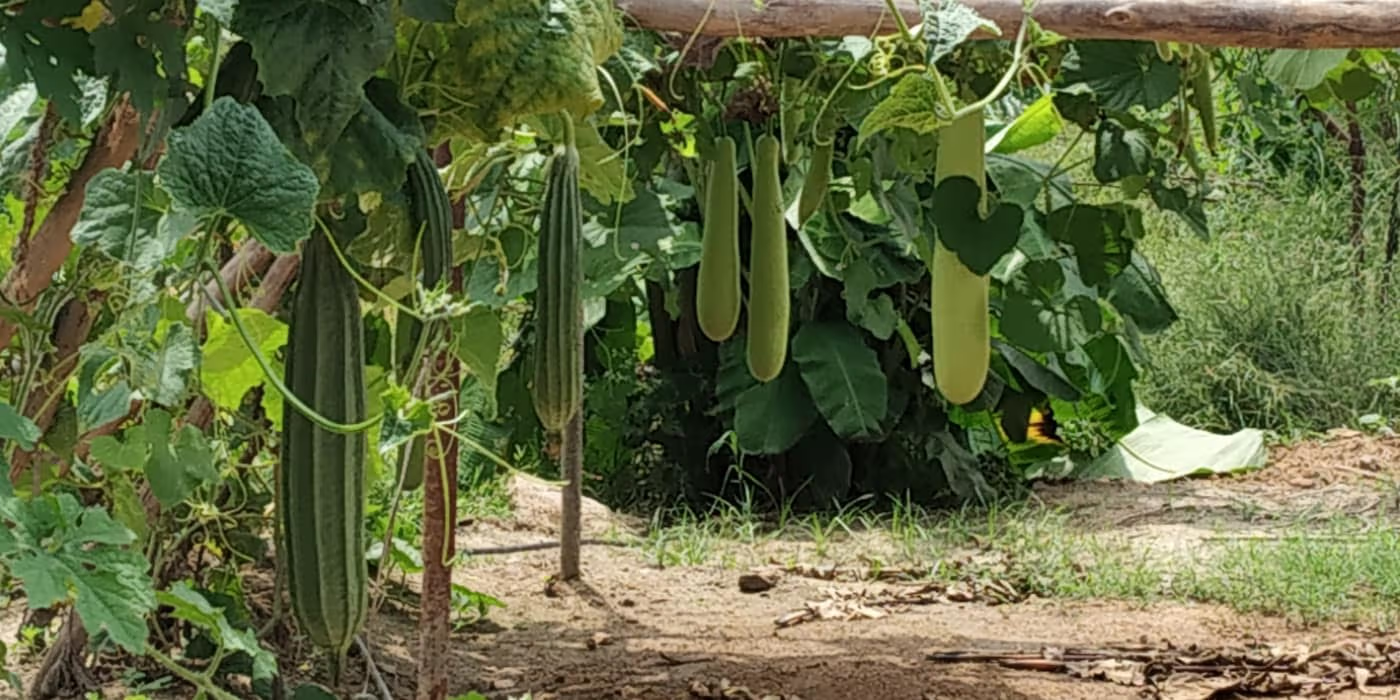
Start picking 55–70 days after sowing. Cut the fruit young, while the skin still dents with a thumbnail, the fruit is still light for its size, and the seeds inside are soft and white. Pick every 2–3 days with a sharp knife, leaving a short stalk. A fruit that has gone hard-skinned or heavy is past use.
Signs it is ready
- Skin still soft enough to dent with a thumbnail
- Fruit light for its size, surface glossy with fine hairs
- Seeds inside soft and white, not hard
- New flowers still opening along the vine
Tools
- A sharp knife or secateurs for clean cuts
- Shallow crates or baskets — the fruit bruises
- Shade at the field edge for holding picked fruit
- Paper or net bags if covering fruit against the fruit fly
Expected yield
About 25–35 t/ha for an open-pollinated crop and 40–60 t/ha for a hybrid on a bower with good pest control. On an acre that is roughly 100–240 quintals over the whole picking period.
Post-harvest & storage
Storage
Bottle gourd is perishable but keeps a little better than bitter gourd — 3–5 days at room temperature in the shade, up to about 2 weeks at 10–12°C and high humidity. Do not stack in the sun; the fruit softens and shrivels fast.
Packaging
Pack in ventilated crates or baskets in one or two layers, not tight sacks. Long fruit should lie flat, not be crammed upright.
Transportation
Move in the cool of the morning or evening, covered against sun and drying wind. Avoid deep loads that crush the bottom layer.
Shelf life
3–5 days at room temperature; up to 2 weeks at 10–12°C and 85–90% humidity. Best sold within a day or two of picking.
Market prices
Today's mandi price near you, pulled live from the government's own Agmarknet data.
Live daily mandi prices from the government Agmarknet dataset.
Synced from data.gov.in (Agmarknet). Rates are ₹ per quintal.
Weather
Current conditions and a 5-day outlook for your selected location, with one line of stage-aware advice.
Pick your state for current conditions and a 5-day outlook.
Live data from Open-Meteo
Profit calculator
Your own cost sheet, expected yield and selling price — not ours.
Where the money goes
Share of the total cost per acre, using the calculator’s own default cost sheet below — adjust the numbers there to match your field and this picture will no longer apply to you exactly, but the ranking rarely changes.
- Labour33% (₹14,000)
- Land rent22% (₹9,000)
- Fertiliser10% (₹4,000)
- Pesticide & weedicide10% (₹4,000)
- Irrigation10% (₹4,000)
- Seed6% (₹2,500)
- Machinery6% (₹2,500)
- Interest4% (₹1,800)
Official downloads
Government and ICAR documents only — everything below is hosted on an official server.
ICAR-IARI, New Delhi — Division of Vegetable Science
Pusa Naveen, Pusa Sandesh, Pusa Samridhi, Pusa Hybrid-3 and the bottle gourd package of practices
ICAR-IIVR, Varanasi
Kashi Bahar and other Kashi bottle gourd varieties, and cucurbit pest and disease management
ICAR-IIHR, Bengaluru
Arka Bahar and southern cucurbit advisories
Kisan Call Centre — 1800-180-1551
Free crop advice in your language
Frequently asked questions
What is the ethrel spray for bottle gourd and how do I use it?
Ethrel (ethephon) is a plant growth regulator that shifts a cucurbit vine towards female flowers. Spray about 150–200 ppm (roughly 1.5–2 ml of 39% ethephon per litre of water — confirm with your KVK) once at the 2-leaf stage and again at the 4-leaf stage. The plant then sets fruit earlier and more heavily, and the extra early fruit fetches the best price, so the small cost pays back several times.
Why does my lauki turn hard and full of seeds?
It has been left on the vine too long. Bottle gourd must be picked young, while the skin still dents with a thumbnail and the fruit is still light. A fruit left even two or three days too long turns hard-skinned, fibrous and seedy — and it also tells the vine to slow down flowering. Pick every 2–3 days and remove every over-mature fruit.
When should bottle gourd be sown?
In the northern plains, January to March for the summer crop (only after frost risk is over) and June–July for the rainy-season crop. In the south the window is longer, roughly November to July. Raising poly-bag seedlings lets you start the summer crop two to three weeks earlier without risking cold-soil seed rot.
Do I need a bower, or can bottle gourd trail on the ground?
It can trail on the flat and still give a fair crop, which is why many smallholders grow it that way. But a bower raises yield, gives cleaner, straighter fruit, keeps the fruit off wet soil away from rot and the fruit fly, and makes picking much faster. If you are growing for market, a bower usually pays for itself.
My vine has many flowers but little fruit. Why?
Early on, a young vine opens mostly male flowers — female flowers, which carry a tiny gourd behind the petals, start a week or two later. Too much nitrogen delays them further. Bottle gourd is also pollinated in the evening by moths and bees, so evening spraying badly hurts fruit set. Use the ethrel spray, ease off nitrogen, and never spray in the evening.
Does bottle gourd have an MSP or a mandi price?
There is no MSP for bottle gourd. It is one of the most heavily traded fresh vegetables on Agmarknet as "Bottle gourd", with daily price and arrival data from APMC markets across India. Price is best for the early summer crop and lowest at the main flush.
Still have questions?
The FAQs above cover the common ones. For anything specific to your field and soil, your nearest Krishi Vigyan Kendra is the authoritative answer.