
Banana
Musa spp.
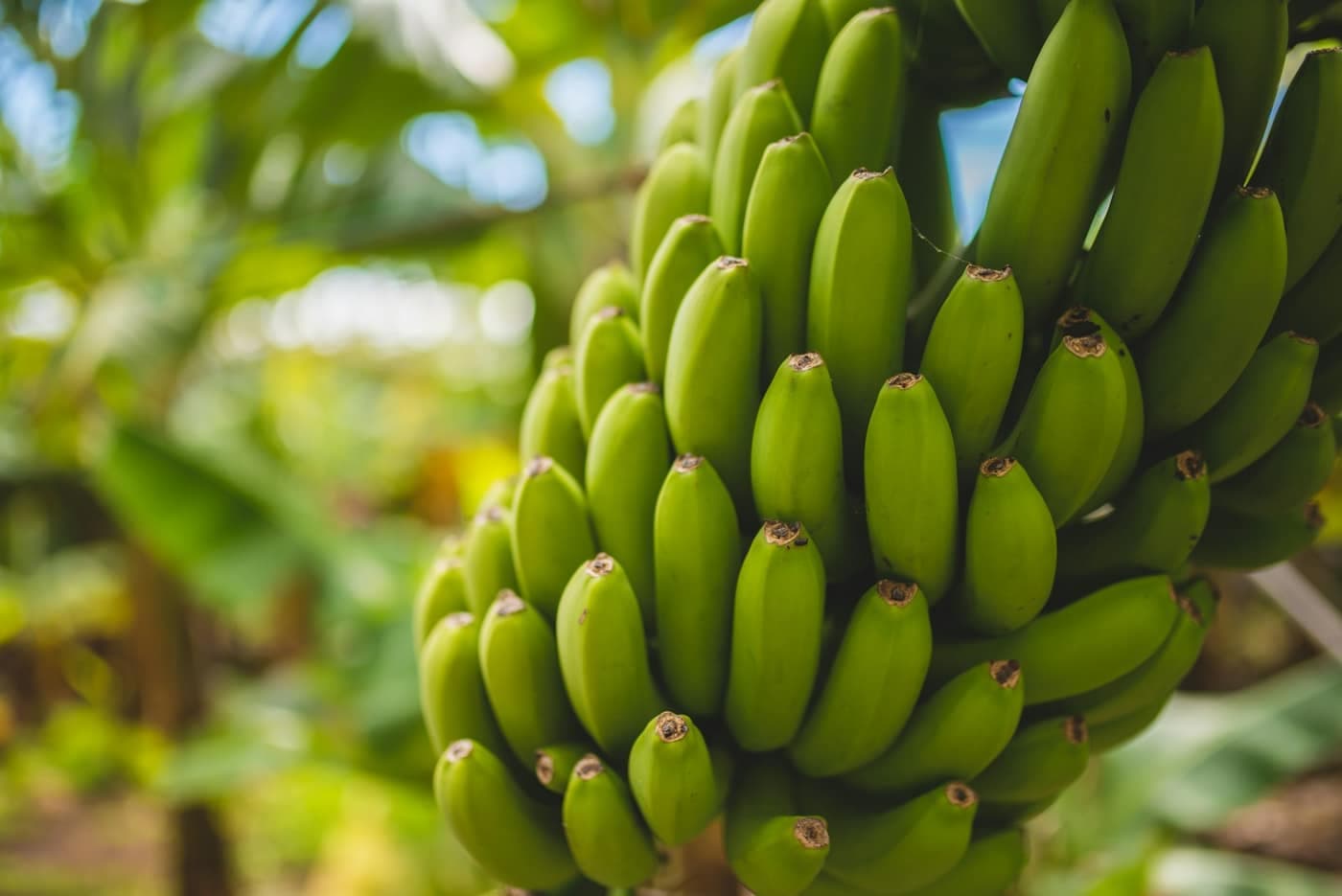
India’s highest-tonnage fruit, grown almost year-round under heavy fertigation on a raised, well-drained bed. Plant disease-free tissue-culture suckers, prop the bunch, and keep the soil moist but never waterlogged — Panama wilt and standing water are the crop’s two silent killers.
Quick Summary
The key points from this page in about two minutes — read it or have it read aloud.
Quick Summary
Banana is India’s highest-tonnage fruit, grown almost year-round as an irrigated crop and carried on through one or two ratoons before a block is replanted. The modern crop is built on tissue-culture planting material — uniform, disease-free plantlets that shoot and harvest together, so a whole block is sellable in one window — and that uniformity, with drip fertigation, is why yields have climbed so far above the old sucker-planted crop.
Two things quietly decide the crop: drainage and sanitation. Banana is a heavy feeder and a thirsty plant, taking a lot of nitrogen and potash, but its corm rots in standing water, so it goes on a raised, well-drained bed. Panama wilt, a soil and sucker-borne Fusarium, is the other silent killer — which is the real reason clean tissue-culture material matters as much as the feeding schedule.
It is a frost-free, warm-humid crop: cold, frost and hot, dry winds all damage it, so windbreaks are worth having. Through the cycle, desucker to keep just one follower for the ratoon, earth up for wind support, and once the bunch emerges, remove the male bud after the last hand sets and prop the bunch as the fingers fill. Cut the bunch about three-quarters mature — when the fingers round off and lose their angular edges — for distant markets. The page below carries the planting layout, the fertigation schedule, the desuckering and bunch-care steps, months to first harvest and expected yields.
- Crop type
- Perennial fruit (ratooned)
- Season
- Planted year-round
- Suitable states
- 10+ major states
- To first harvest
- 11–14 months
- Water requirement
- High; drip preferred
- Temperature
- 25–35°C, frost-free
- Soil type
- Deep, well-drained loam
- Difficulty level
- Moderate
- Expected yield
- 400–600 q/ha
- Key practice
- Tissue-culture + drainage
Overview
Banana (Musa spp.) is India’s leading fruit by production, grown across Maharashtra, Tamil Nadu, Gujarat and Andhra Pradesh both as an irrigated field crop and in small holdings. It crops almost year-round and, once planted, carries on through one or two ratoons before replanting.
The modern crop is built on tissue-culture planting material — uniform, disease-free plantlets that shoot and harvest together, which is what makes a whole block sellable in one window. That uniformity, plus drip fertigation, is why banana yields have climbed so far above the old sucker-planted crop.
Two things quietly decide the crop: drainage and sanitation. Banana is a heavy feeder and a thirsty plant, but it rots at the corm in standing water, and Panama wilt (Fusarium) rides in on infected suckers and contaminated soil. This guide follows the crop with drainage, clean planting material and bunch care as the levers.
Crop timeline, sowing to harvest
A quick visual map of the season — jump to any section below for the detail behind each stage.
- Month 0
Planting
Disease-free tissue-culture plantlets set on a raised bed at 1.8 × 1.8 m into a well-drained pit filled with FYM and soil.
- Month 1–3
Establishment
Roots and the first new leaves establish; light, frequent fertigation and desuckering (keep one follower) begin.
- Month 4–6
Vegetative growth
The pseudostem thickens fast on heavy nitrogen and potash; earthing-up supports the plant against wind.
- Month 7–8
Shooting (flowering)
The bunch emerges from the top of the pseudostem; the male bud is removed after the last hand sets.
- Month 9–10
Bunch development
Fingers fill and grade up; the bunch is propped, and often sleeved, and irrigation kept steady.
- Month 11–12
Maturity
Fingers round off and lose their angular edges — the sign the bunch is ready for a green harvest.
- Month 11–14
Harvest
The bunch is cut three-quarters mature for distant markets; the followers carry the ratoon crop on.
Suitable states
States where this crop is grown at scale, highlighted below. Your local Krishi Vigyan Kendra is still the final word for your specific block.
- Jammu and Kashmir
- Himachal Pradesh
- Punjab
- Uttarakhand
- Haryana
- Delhi
- Uttar Pradesh
- Rajasthan
- Bihar
- Jharkhand
- West Bengal
- Sikkim
- Assam
- Arunachal Pradesh
- Meghalaya
- Nagaland
- Manipur
- Mizoram
- Tripura
- Gujarat
- Madhya Pradesh
- Chhattisgarh
- Maharashtra
- Odisha
- Goa
- Telangana
- Andhra Pradesh
- Karnataka
- Kerala
- Tamil Nadu
- Puducherry
- Ladakh
- Chandigarh
Grown here
Climate requirements
Banana is a frost-free, warm-humid crop that grows non-stop where temperature and moisture stay in range. Its enemies are cold, frost, hot desiccating wind and — above all — waterlogging, which rots the corm. Windbreaks and drainage are as important as feeding.
Ideal temperature
25–35°C is ideal; growth stalls below 15°C and the plant is killed by frost, so it is a crop of the frost-free tropics and subtropics
Rainfall
Wants abundant, evenly-spread moisture (1,000–2,000 mm equivalent) but supplied through irrigation on well-drained land, not standing rain
Humidity
Moderate to high humidity suits it; hot dry winds scorch the leaves and desiccate the bunch
Sunlight
Full sun for a strong pseudostem and well-filled bunch; shade thins the plant and delays shooting
Soil requirements
A deep, well-drained loam with high organic matter is ideal. The single soil rule that matters is drainage: banana will not tolerate waterlogging, so plant on raised beds or ridges and never in a low pocket that ponds after rain.
Suitable soil
Deep, fertile, well-drained loam to clay-loam rich in organic matter; avoid heavy, poorly-drained or saline soils
pH range
6.0–7.5
Drainage
Excellent drainage is essential — the corm rots in standing water, and poor drainage also spreads Panama wilt
Organic matter
High; the crop responds strongly to heavy FYM/compost and green manuring before planting
Land preparation
Same four steps whichever region you are in — only the timing shifts with the sowing window.
- 1
Deep ploughing & FYM
Plough deep, incorporate heavy FYM or compost, and level; a green-manure crop turned in before planting pays back well.
- 2
Raised beds / ridges
Form raised beds or ridges so water drains away from the corm — the key structural defence against rot and wilt.
- 3
Pit filling
Dig and refill planting pits with topsoil, FYM and a little phosphorus ahead of planting so roots meet fertile, loose soil.
Seed information
How the main varieties compare, so you can pick by duration, yield, disease pressure or what you are growing for.
| Variety | Duration | Yield | Disease resistance | Best state | Suitable for |
|---|---|---|---|---|---|
The dominant tissue-culture Cavendish — uniform, high-yielding, export-friendly, the default commercial choice. | 11–12 months | Very high | Susceptible to Sigatoka | Maharashtra | Commercial, export |
A short, wind-tolerant Cavendish long grown in western India before G-9. | 12–14 months | High | Highly susceptible to Sigatoka leaf spot | Maharashtra | Windy tracts |
A tall, heavy-bunching Cavendish popular in the south for the fresh market. | 12–13 months | High | Susceptible to Sigatoka | Tamil Nadu | Fresh market, south |
A regional table type (Silk group) grown for premium local markets. | 12–15 months | Medium | Variable | Tamil Nadu, Kerala | Premium local market |
A traditional AAB-genome dessert banana — a smaller bunch than Grand Naine, with a loyal fresh-fruit market, but not a safe Foc-wilt fallback: field surveys found real infection, so it should not be planted as a wilt-tolerant replacement for a failed Cavendish block. | 12–13 months to first bunch | 200–250 q/ha | Susceptible to Fusarium wilt — 45–50% field incidence reported in West Bengal | Tamil Nadu, Kerala | Fresh dessert market |
A plantain (AAB genome) with a lower bunch weight than a Cavendish but the variety Kerala's chip and curry trade is built around — it does not substitute for Grand Naine in that market. | 12–13 months to first bunch | 250–300 q/ha | Moderate Sigatoka leaf-spot tolerance | Kerala, Tamil Nadu | Culinary plantain, chips/curry trade |
A high-value niche variety with red-skinned fruit, fetching a premium where it grows well. | 16–18 months | Medium | Moderate | Tamil Nadu | Niche premium market |
- Seed rate
- About 3,000 tissue-culture plants/ha at 1.8 × 1.8 m; higher densities under paired-row planting
- Certified seed
- Use certified, virus-indexed tissue-culture plantlets from a reputable lab, hardened in a nursery before field planting. This is the single most important input decision — sucker planting from an unknown field is how Panama wilt and bunchy top enter a new plot.
- Spacing
- 1.8 × 1.8 m for Cavendish (about 3,000 plants/ha); adjust by variety vigour
- Seed treatment
- Field-plant only hardened, healthy tissue-culture plantlets; where suckers are used, pare and treat the corm and dip against nematodes and Fusarium before planting.
Sowing guide
Plan the planting date so bunch harvest misses the coldest and the hottest months, which both spoil filling. Plant on the raised bed, never in the furrow, and irrigate at once — the first month of establishment sets the uniformity the whole block depends on.
- Best time
- February–March and June–July are the main planting windows; tissue-culture plants can be set almost year-round where water and temperature allow
- Row spacing
- 1.8 m between rows
- Plant spacing
- 1.8 m within the row
- Sowing depth
- Set the plantlet so the collar is just above the finished soil level on the raised bed
- Method
- Plant hardened plantlets into FYM-filled pits on raised beds, firm in, and irrigate immediately
Fertilizer schedule
A split dose beats one large dose applied at sowing — nitrogen especially is lost to the air and to leaching if it all goes in on day one.
- 1
Basal (at planting)
Month 0
Heavy FYM with full phosphorus and part of the potash worked into the pit; banana is a very heavy feeder.
- 2
Vegetative fertigation
Month 1–6
Split nitrogen and potash through drip fertigation every 1–2 weeks during rapid growth — roughly 200 N : 60 P : 300 K g/plant/year, split many ways.
- 3
Bunch stage
Month 7–10
Keep potash high through shooting and bunch fill for finger size and grade; avoid heavy late nitrogen, which softens the plant.
Irrigation schedule
1. Establishment
Month 0–1
Frequent light irrigation to settle the plantlet; never let the bed dry out or pond.
2. Vegetative & shooting
Month 2–8
Steady drip irrigation to meet the high demand; water stress now delays shooting and shrinks the bunch.
3. Bunch development
Month 9–12
Keep moisture even through bunch fill; wide dry-wet swings crack and under-fill the fingers.
Critical stages
- Shooting (flowering)
- Bunch development
Water-saving tips
- Drip irrigation with fertigation is the standard — it cuts water use sharply and places nutrients at the root.
- Mulch the basin with banana trash or plastic to hold moisture and suppress weeds.
- Maintain drainage channels so heavy rain runs off — saved water is worthless if the corm rots.
Weed management
Organic control
- Heavy basin mulching with banana trash smothers weeds and recycles potash.
- Intercropping short vegetables in the first three months uses the open space and shades out weeds.
Chemical control
- A pre-emergence herbicide in the inter-space early on, kept off the pseudostem base.
- Spot herbicide or slashing of alleyways in the ratoon, where hand weeding is costly.
Nutrient deficiency identification
What a shortage of each nutrient actually looks like on the plant, so you can tell a deficiency apart from a disease before you spray the wrong thing.
Potassium
Visible symptom
Orange-yellow scorch along older-leaf margins and small, poorly-filled bunches — banana’s hungriest nutrient.
Nitrogen
Visible symptom
Uniform pale-green plants with thin pseudostems and slow growth.
Magnesium
Visible symptom
Yellowing between the veins of older leaves while the midrib stays green.
Zinc
Visible symptom
Narrow, bunched “little-leaf” new growth with pale striping, on light soils.
Iron
Visible symptom
Yellowing of the youngest leaves with green veins, on calcareous or waterlogged soil.
Diseases to watch for
Symptoms, likely cause and what actually treats it — not just a spray name.
Panama wilt (Fusarium)
- Symptoms
- Older leaves yellow, collapse and skirt the pseudostem; splitting the stem shows reddish-brown vascular streaks. The plant dies without fruiting.
- Cause
- Soil-borne Fusarium oxysporum f.sp. cubense, spread in infected suckers, soil and water; it persists in soil for years.
- Treatment
- No cure once a plant is infected — rogue and destroy it and do not replant banana in that spot.
- Prevention
- Use virus- and wilt-free tissue-culture plants, resistant varieties where TR4 is a threat, good drainage, and avoid moving soil/water from infected blocks — this is the crop’s defining disease.
Sigatoka leaf spot
- Symptoms
- Streaks and then dark eye-spots on the leaves that merge and kill the foliage, cutting bunch fill and grade in humid weather.
- Cause
- Mycosphaerella fungi, favoured by high humidity, close spacing and poor air movement.
- Treatment
- Remove and destroy affected leaves and spray a recommended fungicide (protectant plus systemic) on a schedule in the wet season.
- Prevention
- Wider spacing, good drainage, deleafing of old leaves and balanced potash to harden the foliage.
Bunchy top (BBTV)
- Symptoms
- Bunched, narrow, upright “rosette” of stiff leaves with dark green dot-dash streaks on the midrib; affected plants never bunch properly.
- Cause
- Banana bunchy top virus, spread by the banana aphid and by infected suckers.
- Treatment
- No cure — rogue and destroy infected plants at once and control the aphid vector.
- Prevention
- Plant virus-indexed tissue-culture material, rogue early and control aphids; never take suckers from a symptomatic field.
Corm/rhizome rot & nematodes
- Symptoms
- Toppling plants, rotten corm and root lesions; burrowing and root-knot nematodes wreck the root system and open the door to wilt.
- Cause
- Waterlogging, bacterial/fungal rots and nematodes, worst on wet, continuously-cropped land.
- Treatment
- Improve drainage, remove rotten plants, and apply a recommended bio-nematicide/treatment in nematode-prone soils.
- Prevention
- Clean planting material, raised beds, drainage, crop rotation and organic amendments that build antagonistic soil life.
Pests to watch for
What to look for before the damage is visible, and organic options before you reach for a chemical.
Banana pseudostem weevil
- Identification
- Large dark weevils whose grubs bore the pseudostem, leaving oozing tunnels and a weakened plant that snaps.
- Damage
- Tunnelling weakens the pseudostem, cuts bunch weight and can topple the plant.
- Organic control
- Field sanitation, split-pseudostem traps to catch adults, and destroying crop residue between crops.
- Chemical control
- A recommended insecticide applied to the crown/leaf axils where infestation is established.
Banana rhizome (corm) weevil
- Identification
- Weevil grubs boring the corm, seen as tunnels when a toppled plant is dug up.
- Damage
- Corm tunnelling reduces vigour and yield and can kill young plants.
- Organic control
- Plant clean pared corms/tissue-culture plants, use disc-on-stump traps, and keep the field free of old corms.
- Chemical control
- A recommended soil/corm insecticide treatment at planting in problem fields.
Banana aphid
- Identification
- Small dark aphids clustered in the leaf axils and around the emerging heart.
- Damage
- Direct sap-sucking is minor; the real damage is that it transmits bunchy top virus.
- Organic control
- Rogue virus-struck plants, conserve natural enemies, and spray neem on colonies.
- Chemical control
- A recommended systemic insecticide on hotspots as part of bunchy-top management.
Thrips & fruit-scarring beetle
- Identification
- Thrips rusting the peel and beetles scarring young fingers in the developing bunch.
- Damage
- Cosmetic peel scarring and rust that downgrade dessert and export fruit.
- Organic control
- Sleeve the bunch with a perforated cover after the last hand sets to protect the fingers.
- Chemical control
- A recommended insecticide directed at the bunch at shooting where scarring is a problem.
Common mistakes to avoid
The mistakes that cost growers the most, ranked by how often they show up in the field — not in the order you might expect.
- 1
Planting suckers of unknown origin instead of tissue-culture plants.
Why it hurts
Field suckers carry Panama wilt and bunchy top into a clean plot and germinate unevenly — virus-indexed tissue-culture material is the cheapest insurance you can buy.
- 2
Planting in a low, poorly-drained spot or in the furrow.
Why it hurts
Standing water rots the corm and spreads Fusarium wilt; banana must go on a raised bed with drainage, whatever else you do.
- 3
Under-feeding potash.
Why it hurts
Potassium is banana’s hungriest nutrient — short it and you get margin scorch and small, poorly-graded bunches however much nitrogen you apply.
- 4
Leaving too many followers (suckers) on the plant.
Why it hurts
A crowd of suckers steals water and nutrients from the mother bunch — desucker to keep just one well-placed follower for the ratoon.
- 5
Not propping the bunch.
Why it hurts
A heavy bunch on a soft pseudostem topples the whole plant in wind, and the crop is lost — prop or guy every bunching plant.
- 6
Skipping male-bud removal (denavelling).
Why it hurts
Leaving the male bud on wastes assimilate and invites bunch pests — snap it off a few cm below the last hand once the hands have set.
- 7
Letting Sigatoka run in the wet season.
Why it hurts
Unchecked leaf spot kills the foliage that fills the bunch — deleaf and spray on a schedule before the canopy is stripped.
- 8
Ignoring bunch protection.
Why it hurts
Sun, thrips and beetles scar and rust the fingers; a simple sleeve after the last hand keeps dessert and export fruit clean.
- 9
Harvesting fully ripe for a distant market.
Why it hurts
Fruit ripened on the plant will not travel — cut three-quarters mature (green) for transport and ripen it near the market.
- 10
Replanting banana on wilt-sick land.
Why it hurts
Fusarium persists in the soil for years, so a fresh crop on infected ground fails again — rotate out of banana and use clean land for the next block.
Harvesting
Cut the bunch when the fingers have rounded off and lost their sharp angular edges but are still green — about three-quarters mature — for a distant market; a little more mature for a local one. That is usually 11–14 months from planting and 90–120 days from shooting. Harvest gently to avoid bruising the fingers.
Signs it is ready
- Fingers rounded, angular edges gone
- Fingers still green (for transport)
- About 3–4 months after shooting
Tools
- Sharp knife or sickle to cut the bunch
- A shoulder pad/cradle so the bunch is not dropped
- Ropes/props kept until the day of cutting
Expected yield
400–600 q/ha (bunches of 15–30 kg), higher under intensive tissue-culture cultivation and good management
Post-harvest & storage
Storage
Green banana is short-lived; it is de-handed, washed, graded and moved fast, and ripened near the market in a controlled ethylene ripening chamber rather than being held long.
Packaging
De-hand into clusters, wash and grade, and pack in ventilated corrugated cartons with cushioning for transport; loose whole-bunch handling bruises the fruit.
Transportation
Move green fruit quickly in ventilated, cushioned loads; reefer transport greatly extends the window for distant and export markets.
Shelf life
A few days green at ambient; 1–3 weeks under cold/reefer conditions, then a controlled ripening cycle at the destination.
Market prices
Today's mandi price near you, pulled live from the government's own Agmarknet data.
Live daily mandi prices from the government Agmarknet dataset.
Synced from data.gov.in (Agmarknet). Rates are ₹ per quintal.
Weather
Current conditions and a 5-day outlook for your selected location, with one line of stage-aware advice.
Pick your state for current conditions and a 5-day outlook.
Live data from Open-Meteo
Profit calculator
Your own cost sheet, expected yield and selling price — not ours.
Where the money goes
Share of the total cost per acre, using the calculator’s own default cost sheet below — adjust the numbers there to match your field and this picture will no longer apply to you exactly, but the ranking rarely changes.
- Labour24% (₹25,000)
- Seed21% (₹22,000)
- Fertiliser17% (₹18,000)
- Land rent14% (₹14,000)
- Irrigation10% (₹10,000)
- Pesticide & weedicide6% (₹6,000)
- Machinery4% (₹4,000)
- Interest4% (₹4,000)
Official downloads
Government and ICAR documents only — everything below is hosted on an official server.
Frequently asked questions
Why plant tissue-culture banana instead of suckers?
Tissue-culture plantlets are uniform, disease-free and virus-indexed, so a whole block shoots and harvests together and is sellable in one window — and, crucially, they do not carry Panama wilt or bunchy top into your field the way suckers of unknown origin do. It is the single most important input decision in modern banana growing.
What is Panama wilt and can I cure it?
Panama wilt is a soil-borne Fusarium disease that yellows and collapses the leaves and streaks the inside of the pseudostem, killing the plant before it fruits. There is no cure once a plant is infected — you rogue and destroy it and stop replanting banana there, because the fungus survives in soil for years. Prevention is everything: clean planting material, resistant varieties where the aggressive TR4 strain is a threat, good drainage, and not moving soil or water from sick blocks.
How much water does banana need and how should I give it?
Banana is a thirsty crop that wants abundant, even moisture — but it rots at the corm in standing water. The answer is drip irrigation on a raised, well-drained bed, which meets the high demand without waterlogging and lets you fertigate potash and nitrogen straight to the root. Never plant in a low pocket that ponds after rain.
Why is potash so important for banana?
Potassium is banana’s hungriest nutrient — a mature plant removes several hundred grams of K a year. Short it and you get orange-yellow scorch along the older leaf margins and small, poorly-filled, low-grade bunches, no matter how much nitrogen you apply. Keep potash high right through shooting and bunch fill.
When should I harvest the bunch?
For a distant market, cut the bunch green at about three-quarters maturity — when the fingers have rounded off and lost their sharp angular edges but are still green — and ripen it near the market in a ripening chamber. For a local market you can let it mature a little more. Fruit ripened on the plant will not travel.
Does banana have an MSP?
No. Banana is a market fruit with no Minimum Support Price — the rate is set by mandi and export demand and swings with season and glut. Use the live mandi prices and the profit calculator on this page when planning the crop and deciding when to sell; value addition (ripening, chips, distant-market supply) is where much of the margin lies.
Still have questions?
The FAQs above cover the common ones. For anything specific to your field and soil, your nearest Krishi Vigyan Kendra is the authoritative answer.