
Cinnamon (Dalchini)
Cinnamomum verum
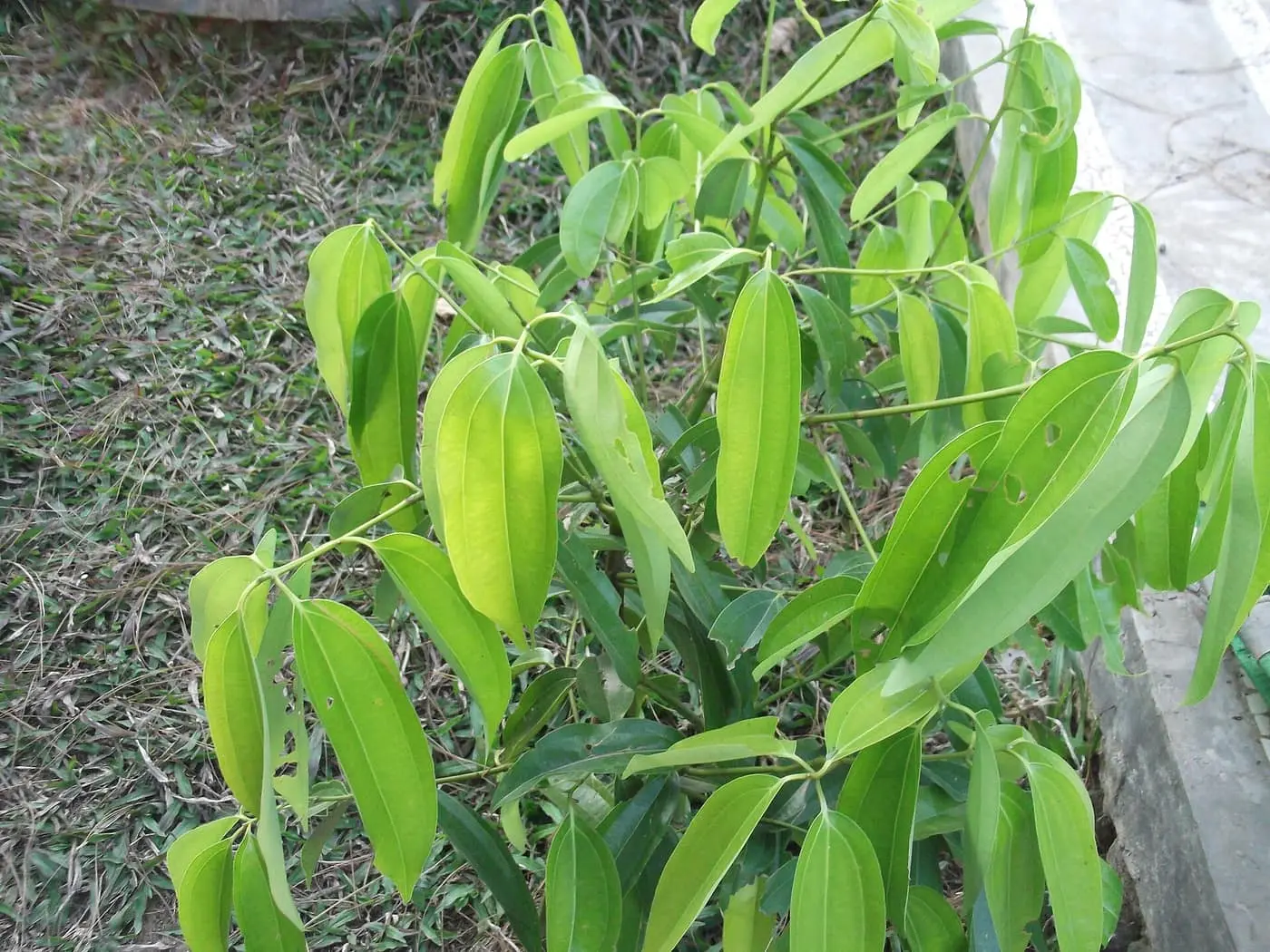
A hardy evergreen spice tree grown for its inner bark, kept as a low bush by cutting it back to the ground, and harvested as rolled quills from 18 to 24 month old shoots twice a year — it gives a first small crop in about three years, needs almost no irrigation once established, and earns most of its money from skilled peeling rather than from heavy tonnage.
Quick Summary
The key points from this page in about two minutes — read it or have it read aloud.
Quick Summary
Cinnamon (dalchini, Cinnamomum verum) is the dried inner bark of an evergreen tree of the laurel family. In India it is grown in the lower Western Ghats — the Kannur, Kozhikode and Kottayam belt of Kerala, the lower Nilgiris, Yercaud and Kanyakumari hills of Tamil Nadu, coastal south Karnataka, the Konkan and the Naga hills of Assam.
It is an easy tree to keep alive and a hard crop to do well. The tree tolerates poor lateritic and sandy soils, grows from sea level up to about a thousand metres, and is mostly rainfed once it is past its first two or three summers. What decides the money is the bark: shoots are cut, the bark is peeled by hand with a special knife, rolled, scraped and dried into quills, and the thinner and cleaner the quill, the better the grade.
Planting material is usually a seedling. Cinnamon seed loses its life quickly, so it is sown fresh in the rainy season, kept in shade in the nursery for the better part of a year, and planted out in pits in the monsoon. Once the young plants are about two years old they are cut back close to the ground — coppiced — so the stump throws up a bush of straight side shoots, and those shoots are the crop from then on.
Four improved selections are available in India: IISR Navashree and IISR Nithyashree from ICAR-IISR Kozhikode, YCD 1 from the TNAU station at Yercaud, and PPI (Ci) 1 from Pechiparai. Harvest comes twice a year, around May and November. There is no MSP, and the only mandi that reports cinnamon regularly is Mumbai APMC, so most growers sell to traders, spice companies or oil distilleries.
- Crop type
- Perennial tropical evergreen spice tree, kept as a coppiced bush
- Season
- Planted June–July with the monsoon; bark harvested in May and November
- Suitable states
- Kerala, Tamil Nadu, Karnataka, Maharashtra (Konkan), Assam
- First harvest
- About year 3 (Karnataka Spices Board) or year 4–5 (TNAU); economic life 20 years or more
- Water requirement
- Low — mostly rainfed; twice-weekly summer watering only in the first 2–3 years
- Temperature
- Hot and moist, average about 27°C; sea level to about 1,000 m
- Soil type
- Sandy or lateritic soils with plenty of humus; tolerates poor coastal soils
- Difficulty level
- Moderate (easy to grow, skilled work to peel and grade)
- Expected yield
- About 225–300 kg quills/ha a year in full bearing; 65–125 kg in the first crop
- Key risk
- Prolonged dry spells, and bad peeling that drops the whole lot to a low grade
Overview
Cinnamon (Cinnamomum verum, earlier called C. zeylanicum), known as dalchini in Hindi and karuva or karuvapatta in Malayalam, is a bushy evergreen tree of the Lauraceae family. Left alone it reaches 6 to 15 m, but in cultivation it is cut back and kept as a low bush, because the crop is the inner bark of young shoots, not timber or fruit. Both the bark and the leaves are strongly aromatic, and both are distilled for oil — bark oil carries the cinnamaldehyde that gives the sweet, hot smell, and leaf oil is mostly eugenol, closer to clove.
It helps to know what you are actually planting. True cinnamon is Cinnamomum verum, a native of Sri Lanka and the Malabar coast. Most of what is sold in Indian kitchens as dalchini is the thicker, harder bark of cassia — C. cassia, C. burmannii or C. loureirii — imported from China, Indonesia and Vietnam, and the Indian bay leaf (tejpatta) is a third species, C. tamala. They are different trees with different prices and different buyers, so confirm the species on the planting material before you buy it.
In India the cultivated crop sits in the lower elevations of the Western Ghats — Kannur, Kozhikode and Kottayam districts of Kerala and the lower Nilgiris of Tamil Nadu are the traditional belt, with coastal south Karnataka, the Yercaud and Kanyakumari hills, the Konkan coast of Maharashtra and the Naga hills of Assam also growing it. The area is small: the Spices Board's own spice-wise area and production table (2022-23 third advance estimate) lists clove, nutmeg and tamarind but carries no separate cinnamon row, which tells you how thin the national crop is. For a farmer that cuts both ways — little competition and no price support either.
Unlike most spice trees, cinnamon does not reward waiting for a big tree. From about the third year after planting, the plant is coppiced and the shoots that spring from the stump are cut every 18 to 24 months for bark. A well-kept garden stays productive for 20 years (TNAU's figure for YCD 1) and the Pechiparai selection PPI (Ci) 1 is described as holding for up to 50 years, so the planting is a long-term asset that starts paying early and keeps paying.
Crop timeline, sowing to harvest
A quick visual map of the season — jump to any section below for the detail behind each stage.
- December – January
Flowering on seed trees
Mother trees flower in December and January; the fruit ripens from May to June, which is when seed for the next nursery is collected.
- May – June
Seed collection
Fruits are picked when the outer pulp turns black, heaped in shade until the pulp rots, then washed clean and air-dried in shade. Seed loses its life quickly and cannot be stored.
- July – August
Sowing in the nursery
Fresh seed is sown in raised beds in rows 12 cm apart, or in polythene bags filled with sand, cattle manure and soil (3:3:1). Germination takes 15 to 20 days. Shade is kept over the bed.
- Nursery (10–12 months)
Raising the seedling
Bed seedlings move into polybags about four months after germination, or when they reach about 15 cm. Artificial shade stays until the plants are about six months old. Plants are ready for the field at 10 to 12 months.
- June – July (year 0)
Planting out
Pits of about 50–60 cm cube at 2 × 2 m or 3 × 3 m are filled with topsoil and about 10 kg of farmyard manure, and seedlings or rooted cuttings go in with the monsoon, under partial shade.
- Year 1–2
Establishment
Watering twice a week through the first two or three summers, two weedings a year, mulch with spent leaves, and a small feed that rises every year.
- About year 2
Coppicing
Once the plant is about 2 m tall it is cut back to about 15 cm from the ground. The stump throws up a bunch of straight side shoots, and stooling soil around the stump pushes out even more.
- Year 3–5
First bark harvest
The Karnataka State Spices Development Board puts the first harvest at three years after planting; TNAU says the fourth or fifth year. The first crop is small — roughly 65 to 125 kg of quills per hectare.
- Every 18–24 months, May and November
Harvest rounds
Shoots 18 to 24 months old, about 1 to 2 m long and 1 to 2.5 cm thick, are cut in May and again in November, peeled, rolled, scraped and dried. New shoots from the stump take their place.
- Year 10–11 onward
Full bearing
A mature garden gives about 225 to 300 kg of quills per hectare per year, plus roughly 70 kg of quillings and featherings, and goes on for 20 years or more.
Suitable states
States where this crop is grown at scale, highlighted below. Your local Krishi Vigyan Kendra is still the final word for your specific block.
- Jammu and Kashmir
- Himachal Pradesh
- Punjab
- Uttarakhand
- Haryana
- Delhi
- Uttar Pradesh
- Rajasthan
- Bihar
- Jharkhand
- West Bengal
- Sikkim
- Assam
- Arunachal Pradesh
- Meghalaya
- Nagaland
- Manipur
- Mizoram
- Tripura
- Gujarat
- Madhya Pradesh
- Chhattisgarh
- Maharashtra
- Odisha
- Goa
- Telangana
- Andhra Pradesh
- Karnataka
- Kerala
- Tamil Nadu
- Puducherry
- Ladakh
- Chandigarh
- Lakshadweep
- Andaman and Nicobar Islands
- Dadra and Nagar Haveli and Daman and Diu
Grown here
Climate requirements
It grows from sea level up to about 1,000 m above mean sea level. YCD 1 is recommended for 500 to 1,000 m with 100 to 200 cm rainfall, and PPI (Ci) 1 for lower elevations of 100 to 500 m with high rainfall, so pick the selection that matches your altitude.
Ideal temperature
A hot, moist climate with an average temperature of about 27°C suits cinnamon. The best gardens in Sri Lanka sit at low altitude with an average near 30°C. Long spells of dry weather hold the crop back, which is why the Western Ghats foothills and the coast suit it better than the interior plains.
Rainfall
The crop is mostly rainfed, and an annual rainfall of about 150 to 250 cm (1,500–2,500 mm), well spread through the year, is considered ideal. Sri Lankan gardens get 200 to 250 cm.
Humidity
Humid, coastal air suits the tree — nearness to the sea and even slightly salty water are reported as good for it. The same humidity makes the nursery the place where leaf spot and die-back start, so beds need air and space.
Sunlight
Partial shade in the first years gives faster, healthier growth; mature bushes take open sun. Wild cinnamon grows inside tropical evergreen forest up to 1,800 m, so a shaded, sheltered site is natural for it.
Soil requirements
Cinnamon will survive on poor ground, but bark yield and thickness follow the humus. Build the soil with mulch and manure around the stump rather than chasing fertiliser alone.
Suitable soil
Sandy or lateritic soils with a good share of humus suit it best (TNAU). On the west coast cinnamon is grown on laterite and sandy patches of poor nutrient status that would not carry a vegetable crop, which is part of its appeal.
pH range
The slightly acidic reaction of laterite and humus-rich forest soils suits the tree. It is a hardy plant that tolerates a wide range of soils, so a soil test matters less here than drainage and organic matter.
Drainage
Free drainage is essential for young plants. On a slope, cut a drainage channel away from each pit — standing water around a young seedling kills it.
Organic matter
Organic matter does most of the feeding: about 10 kg of farmyard manure in the planting pit, 20 kg a year for a young plant, rising to 50 kg a year for a plant of ten years and above, plus mulch from weeds, grass and spent distillation leaves.
Land preparation
Same four steps whichever region you are in — only the timing shifts with the sowing window.
- 1
Clear and mark the grid
Clear the site and mark pits at 2 × 2 m (TNAU) or 3 × 3 m (Karnataka State Spices Development Board). Closer spacing packs in more stumps for bark; wider spacing is easier to work and intercrop.
- 2
Dig pits ahead of the monsoon
Dig pits of about 50 cm cube (Karnataka Spices Board) to 60 cm cube (TNAU) before the rains so the soil settles and weathers.
- 3
Fill with topsoil and manure
Fill each pit with topsoil mixed with about 10 kg of farmyard manure or compost. Several growers plant more than one seedling per pit — the Karnataka package allows up to five — so the stump clump is dense from the start.
- 4
Plan shade and drainage
Arrange partial shade for the first years, and on sloping land cut a drainage channel from each pit along the slope so water never stands around the young plant.
Seed information
How the main varieties compare, so you can pick by duration, yield, disease pressure or what you are growing for.
| Variety | Duration | Yield | Disease resistance | Best state | Suitable for |
|---|---|---|---|---|---|
A seedling selection released by ICAR-IISR Kozhikode. Its own variety page gives the release year as 1996 while the institute's variety table says 1995, and the pedigree is given as a seedling selection from the Indian collection on the variety page and from the Sri Lankan collection in the table. Known for high shoot regeneration (25.45 shoots per four plants) and the highest bark recovery of the Indian selections at 40.6%, with bark oil 2.7%, leaf oil 2.8% and bark oleoresin 8.0%. | First harvest about 3 years; flowering from year 4 | 200 kg dry quills/ha, potential 250 kg/ha; 201.1 g dry bark per plant | No major pest or disease attack noticed (IISR) | All cinnamon-growing areas of India | Growers who want the best bark recovery per shoot cut |
The second ICAR-IISR release, with the same release-year disagreement between the variety page (1996) and the institute table (1995), and described as a seedling selection on the page and a clonal selection in the table. It carries the highest bark oleoresin of the Indian selections at 10.0%, with bark oil 2.7%, leaf oil 3.0% and a very high eugenol content of 78% in the leaf oil, which matters if you plan to distil leaf oil. | First harvest about 3 years; flowering from year 4 | 200 kg dry quills/ha, potential 250 kg/ha; 194.6 g dry bark per plant | No major pest or disease attack noticed (IISR) | All cinnamon-growing areas of India | Quality quills and leaf-oil distillation |
A selection from open-pollinated seedlings at the TNAU station at Yercaud, released in 1995. TNAU puts its dry bark yield at 359.75 kg of quills and 3,800 kg of dried leaves per hectare with 35.3% bark recovery, 2.8% volatile oil in the quills and 3% in the leaves, and 19.2 harvestable shoots in a harvest. The quills are sweet and lightly pungent. | Harvest from the third year; economic life about 20 years | About 360 kg quills/ha plus 3,800 kg dried leaves/ha | Not documented in available sources | Tamil Nadu and Karnataka | Gardens at 500–1,000 m with 100–200 cm rainfall, and for leaf-oil distillation |
A selection from open-pollinated seedlings held at the TNAU Horticultural Research Station, Pechiparai, released in 2003. TNAU describes it as drought-tolerant, resistant to pests and diseases, good for coppicing every 18 to 24 months, and able to be retained for up to 50 years. Its yield of about 980 kg of bark per hectare — 248.42 kg of quills plus 731.58 kg of chips and dust — is 25% above the Pechiparai local. | Coppiced every 18–24 months; tree retained up to 50 years | About 980 kg bark/ha (248 kg quills + 732 kg chips and dust) | Described by TNAU as resistant to pests and diseases and tolerant of drought | Tamil Nadu (Kanyakumari belt) | Lower elevations of 100–500 m with high rainfall, and growers selling chips and dust as well as quills |
Konkan Tej and other regional selections Konkan Tej, from Dr. Balasaheb Sawant Konkan Krishi Vidyapeeth, Dapoli, is released for the Konkan region of Maharashtra, and Sugandhini and RRL (B) C-6 appear in official variety lists. We could not reach published release-year or yield data for any of these from the releasing institution, so the figures quoted for them on trade websites are not repeated here. Ask the releasing university or your state horticulture department before buying. | Not documented in available sources | Not documented in available sources | Not documented in available sources | Maharashtra (Konkan) for Konkan Tej | Growers in the Konkan who want locally released planting material |
- Seed rate
- Cinnamon is planted as 10 to 12 month old nursery seedlings or rooted cuttings, not sown in the field. At 2 × 2 m that is about 2,500 pits per hectare (roughly 1,000 per acre) and at 3 × 3 m about 1,100 pits per hectare (roughly 450 per acre). Growers who plant several seedlings per pit need to multiply accordingly, and should keep 10% extra for gap-filling.
- Certified seed
- There is no certified-seed class for cinnamon as there is for wheat or paddy. Buy planting material of a named selection — IISR Navashree or IISR Nithyashree from ICAR-IISR Kozhikode and its Krishidhan nursery, YCD 1 from the TNAU station at Yercaud, PPI (Ci) 1 from HRS Pechiparai — or seedlings raised from a known heavy-bearing mother tree. Confirm the species is Cinnamomum verum and not cassia or tejpatta.
- Spacing
- 2 × 2 m (TNAU) or 3 × 3 m (Karnataka State Spices Development Board), in pits of 50 to 60 cm cube filled with topsoil and farmyard manure.
- Seed treatment
- Cinnamon seed has no dormancy and no keeping quality — it must be sown as soon as the pulp is removed. Pick the fruit when the outer pulp turns black, heap it in shade until the pulp rots, trample and wash the mass to free the seed, then dry it in air, never in the sun, because sun cracks the seed coat. Sow the clean seed at once in July–August.
Sowing guide
Air layering by the ring method, ground layering and division of old rootstocks all work if you want to multiply a tree you already trust; indole acetic acid or indole butyric acid at 50 ppm improves rooting in air layers. Semi-hardwood cuttings are the other standard route besides seed.
- Best time
- Plant out in June–July with the monsoon, so the seedling establishes on rain. TNAU gives June to December as the workable window.
- Row spacing
- 2 m (TNAU) to 3 m (Karnataka Spices Board) between rows
- Plant spacing
- 2 m to 3 m between plants in the row
- Sowing depth
- Set the seedling at the depth it grew in the polybag, firm the soil lightly, and leave no hollow where water can stand.
- Method
- One healthy 10 to 12 month old seedling or rooted cutting per pit — the Karnataka package allows up to five seedlings in one pit for a denser clump. Some growers dibble seed straight into the filled pit instead. Give partial shade for the first years.
Fertilizer schedule
A split dose beats one large dose applied at sowing — nitrogen especially is lost to the air and to leaching if it all goes in on day one.
- 1
At planting (basal)
Year 0
About 10 kg of farmyard manure or compost mixed with topsoil in each pit before planting.
- 2
First year
Year 1
About 20 g N, 18 g P₂O₅ and 25 g K₂O per plant, with 20 kg of farmyard manure (TNAU). The Karnataka State Spices Development Board gives the same NPK with 20 kg FYM.
- 3
Annual increase
Years 2–9
Add about 20 g N, 18 g P₂O₅ and 25 g K₂O per plant every year, plus about 2 kg more farmyard manure a year, so the dose climbs with the bush.
- 4
Tenth year onward
Year 10+
About 200 g N, 180 g P₂O₅ and 250 g K₂O per plant with 20 kg FYM (TNAU); the Karnataka board gives 200:180:200 g per plant with 50 kg of farmyard manure or compost. At 3 × 3 m spacing that works out to roughly 200:180:200 kg per hectare.
- 5
Splitting the dose
May–June and September–November
Apply the fertiliser in two splits, with the start of the monsoon and after it, so the nutrients are not washed out of light lateritic soils.
Irrigation schedule
1. Young plants
Summer, first 2–3 years
Water twice a week through the summer months. How much depends on soil moisture and how the plant is growing; the point is to stop the young root ball drying out.
2. Established bushes
Summer dry spells
Protective watering in summer is beneficial but not routine — cinnamon is grown as a rainfed crop once established. Long dry spells still cut growth and the next shoot flush.
Critical stages
- First two to three summers after planting
- The flush after each coppicing or harvest cut
- Long dry spells before the May and November harvests
Water-saving tips
- Mulch around the stump with weeds, grass or the spent leaves left after oil distillation, then cover them with soil — the Karnataka package calls this the most effective way to hold root-zone moisture.
- Keep partial shade over young plants rather than opening the canopy fully.
- Dig the soil around the bushes once in August–September so rain soaks in instead of running off.
Weed management
Organic control
- Mulch heavily around each stump with the weeds and grass you have slashed and with spent distillation leaves — it suppresses weeds and holds moisture at the same time.
- Cut Lantana and Parthenium before they seed and use the slashings as mulch.
- Keep a clean basin around young plants and let the bush canopy close over the ground as it grows.
Chemical control
- Weeding in cinnamon is done by hand or hoe — two rounds a year, in June–July and October–November, plus one digging around the bushes in August–September.
- Herbicide is not part of the recommended package for cinnamon; if you need one on a large block, confirm a currently registered product and dose with your state horticulture department or KVK before using it near the thin bark of young shoots.
Nutrient deficiency identification
What a shortage of each nutrient actually looks like on the plant, so you can tell a deficiency apart from a disease before you spray the wrong thing.
Nitrogen
Visible symptom
Pale, yellow-green older leaves and thin, slow shoots after coppicing — common on the light, leached lateritic soils cinnamon is usually planted on.
Phosphorus
Visible symptom
Slow establishment of young plants and a dull, purplish tinge on older leaves.
Potassium
Visible symptom
Scorched or yellowed leaf margins and weak, thin shoots that give poor bark; potash is the largest part of the recommended dose for a mature bush.
Diseases to watch for
Symptoms, likely cause and what actually treats it — not just a spray name.
Pink disease
- Symptoms
- A pale pinkish-white crust spreads over the stem in the rainy season, the corky layer under it is destroyed and the shoot or twig above dies.
- Cause
- The fungus Corticium javanicum, favoured by continuous wet weather.
- Treatment
- Spraying 1% Bordeaux mixture controls it readily (Karnataka State Spices Development Board).
- Prevention
- Keep the bush open so the inside dries after rain, cut out and burn affected shoots early, and spray before the heaviest monsoon weeks rather than after.
Anthracnose leaf spot and die-back
- Symptoms
- Small brown specks on young nursery leaves enlarge until the leaf dries; the infection then moves into the stem and kills it from the tip downwards. On older seedlings and mature trees, light and dark brown concentric rings appear on the stem, and shot holes in the leaves. A separate nursery blight, with light brown patches on the stem and dead seedlings, is caused by a Diplodia species.
- Cause
- Colletotrichum gloeosporioides, spreading in warm, wet nursery conditions.
- Treatment
- Spray 1% Bordeaux mixture through the rainy season (Karnataka Spices Board); the same spray, or 0.3% copper oxychloride, is what the board advises for the Diplodia seedling blight. TNAU lists 1% Bordeaux mixture or 0.25% copper oxychloride for leaf spot.
- Prevention
- Do not crowd nursery beds, keep them drained, water early in the day, remove and burn affected seedlings, and plant out only clean material.
Algal leaf spot
- Symptoms
- Raised, velvety orange-grey spots on the leaves, common in humid gardens and often alongside the brittle, sunken dark brown spots caused by Gleosporium.
- Cause
- The parasitic alga Cephaleuros species, favoured by shade and constant leaf wetness.
- Treatment
- Foliar spray of 1% Bordeaux mixture or 0.3% copper oxychloride (Karnataka Spices Board).
- Prevention
- Thin dense shade, space the bushes so leaves dry, and keep the garden free of old, heavily spotted foliage.
Sooty mould and grey blight
- Symptoms
- Grey blight makes greyish dead patches on older leaves; sooty mould shows as a black soot-like coating that wipes off and usually follows sap-sucking insects.
- Cause
- Pestalotiopsis palmarum for grey blight and Phragmocapnias betle for sooty mould.
- Treatment
- A foliar spray of 1% Bordeaux mixture or 0.3% copper oxychloride controls these leaf diseases (Karnataka Spices Board).
- Prevention
- Control the sap-sucking insects that sooty mould lives on, and keep the canopy airy.
Pests to watch for
What to look for before the damage is visible, and organic options before you reach for a chemical.
Cinnamon butterfly
- Identification
- Pale yellow caterpillars with dark stripes along the sides of the body, feeding on the young leaves of the flush.
- Damage
- The caterpillars eat voraciously and can defoliate a plant; a bush stripped of its new flush gives a poor bark crop from those shoots.
- Organic control
- Hand-pick the caterpillars from young plants while the flush is small and keep the nursery under watch, since seedlings suffer most.
- Chemical control
- Spray 0.05% quinalphos (Karnataka State Spices Development Board). Confirm the current registered product and dose with your KVK before spraying.
Leaf miner
- Identification
- Winding, pale tunnels inside tender leaves, sometimes severe on nursery seedlings.
- Damage
- Mined leaves dry and drop, slowing the growth of young plants in the nursery and in the first year after planting.
- Organic control
- Pick off and destroy mined leaves in the nursery and avoid pushing soft, lush growth with heavy nitrogen.
- Chemical control
- The Karnataka package lists 0.05% monocrotophos for the nursery leaf miner and dimethoate 0.03% for leaf miner, shoot and leaf webber and leaf psyllid — monocrotophos is heavily restricted, so confirm a currently registered alternative with your KVK.
Cinnamon shoot borer
- Identification
- A bore hole in a shoot with fresh frass pushed out, and the shoot wilting or dying above it.
- Damage
- Tunnelling grubs kill the shoot that was going to be a quill, so the loss is direct crop loss.
- Organic control
- Cut out and burn bored shoots at the next round of weeding, and keep the garden clean of dead wood.
- Chemical control
- TNAU advises smearing the stem and branches with carbaryl 50 WP at 2 g per litre of water once a month. For coffee red borer TNAU advises trunk injection, with a 20-day gap between treatment and bark harvest.
Termites and red ants
- Identification
- Earthen runways up the stem of young plants, and ants nesting in the leaf flush.
- Damage
- Termites feed on the roots and stem of young plants in dry periods and can kill them before they are established.
- Organic control
- Destroy nests near the plot, keep the basin free of undecomposed material and water young plants through dry spells.
- Chemical control
- TNAU lists dusting for leaf-eating caterpillars, red ants and termites; the product it names (methyl parathion dust) is no longer freely available, so ask your KVK for the current recommendation.
Common mistakes to avoid
The mistakes that cost growers the most, ranked by how often they show up in the field — not in the order you might expect.
- 1
Buying "dalchini" planting material without checking the species.
Why it hurts
Cassia (C. cassia, C. burmannii) and tejpatta (C. tamala) are different trees with different bark, different buyers and different prices. Confirm you are getting Cinnamomum verum before you pay.
- 2
Storing cinnamon seed, or drying it in the sun.
Why it hurts
The seed has no keeping quality and must be sown as soon as the pulp is washed off. Sun-drying cracks the seed coat and ruins germination, so dry it in shade and sow at once.
- 3
Not coppicing, and letting the plant grow into a tree.
Why it hurts
The crop is the bark of 18 to 24 month old shoots. A plant left to grow tall gives thick, coarse, low-grade bark and makes harvesting dangerous and slow. Cut it back to about 15 cm at around two years.
- 4
Cutting shoots at the wrong time or the wrong age.
Why it hurts
Bark peels cleanly only when sap is flowing, which is why harvest is timed to just after the rains stop in May and November. Off-season cutting or shoots older than about two years give bark that will not lift.
- 5
Careless peeling and scraping.
Why it hurts
Grade — and most of the price — is decided by how thin and clean the quill is. Bark thicker than about 0.5 cm, poorly scraped or badly rolled drops straight into chips and quillings, which sell far below quills.
- 6
Treating it as an irrigated, fertiliser-driven crop.
Why it hurts
Cinnamon is a hardy rainfed tree on poor lateritic soil. Beyond the first two or three summers, water twice-weekly only in summer, and spend your effort on manure, mulch and clean peeling instead.
Harvesting
The first harvest comes about three years after planting (Karnataka State Spices Development Board) or in the fourth to fifth year (TNAU). After that, shoots are cut in May and again in November, as soon as the rains stop and the bush has stopped flushing — that is when sap flows freely between bark and wood, which is what makes the bark lift. Shoots are ready 18 to 24 months after the previous cut, when they are about 1 to 2 m long and 1 to 2.5 cm thick. The peeler tests a shoot with an oblique cut: if the bark does not lift easily, the shoot is rejected.
Signs it is ready
- Rains have stopped and new flushing has paused, with mature leaves on the bush
- The shoot is 18 to 24 months old, about one to two metres long and 1–2.5 cm thick
- A test cut shows the bark lifting easily with free-flowing sap
- Straight shoots from the stump, not old thick stems
Tools
- A sharp billhook or knife for cutting shoots at the stump
- A small peeling knife with a rounded end
- A curved scraping knife for the piping yard
- Mats or dry leaves to cover rolled slips overnight
- A clean drying yard
Expected yield
The first crop gives roughly 65 to 125 kg of quills per hectare. A garden of ten or eleven years normally gives 225 to 300 kg of quills per hectare, plus about 70 kg of quillings and featherings. TNAU puts it per bush at about 100 g of dried bark, and at about 35 kg of leaf oil per hectare a year; roughly 4 kg of bark oil can be distilled from a hectare. Among the released selections, YCD 1 is rated at about 360 kg of quills per hectare and PPI (Ci) 1 at about 980 kg of total bark per hectare, of which 248 kg is quills.
Post-harvest & storage
Storage
Dry the quills thoroughly after piping and keep them in clean, dry, airtight packing away from damp and strong smells. Good cinnamon should be no thicker than a thick sheet of paper, light brown with wavy lines, and should snap with a clean sound.
Packaging
After peeling, the slips are stacked, pressed and cut to about 20 cm, piled in small stick enclosures and covered with dry leaves or mats overnight so they keep moisture and ferment slightly for the next day's work. They are then scraped in the piping yard, sorted by thickness and rolled into pipes — the finest, smoothest, bark-free grade is "00000" and the coarsest "0", with the rest sold as chips, pieces, quillings and featherings.
Transportation
Dry quills are light and bulky and break easily, so they travel packed tight and upright. Chips, quillings and featherings go to grinding units and oil distilleries rather than to the spice counter.
Shelf life
Kept properly dry, quills hold their aroma for a long time; moisture and a damp store are what spoil both the smell and the grade.
Market prices
Today's mandi price near you, pulled live from the government's own Agmarknet data.
Live daily mandi prices from the government Agmarknet dataset.
Synced from data.gov.in (Agmarknet). Rates are ₹ per quintal.
Weather
Current conditions and a 5-day outlook for your selected location, with one line of stage-aware advice.
Pick your state for current conditions and a 5-day outlook.
Live data from Open-Meteo
Profit calculator
Your own cost sheet, expected yield and selling price — not ours.
Where the money goes
Share of the total cost per acre, using the calculator’s own default cost sheet below — adjust the numbers there to match your field and this picture will no longer apply to you exactly, but the ranking rarely changes.
- Labour60% (₹35,000)
- Land rent14% (₹8,000)
- Fertiliser12% (₹7,000)
- Seed4% (₹2,500)
- Irrigation3% (₹2,000)
- Pesticide & weedicide3% (₹1,500)
- Interest3% (₹1,500)
- Machinery1% (₹500)
Official downloads
Government and ICAR documents only — everything below is hosted on an official server.
ICAR-IISR, Kozhikode — Cinnamon
Mandate-crop profile and the IISR Navashree and Nithyashree variety pages
TNAU Agritech Portal — Cinnamon
Soil, season, nursery, planting, manuring table, plant protection and harvest
TNAU — Varieties of spice crops
Official descriptions of YCD 1 (1995) and PPI (Ci) 1 (2003)
Karnataka State Spices Development Board — Cinnamon package of practices
Propagation, planting, manuring, pests and diseases, harvesting, peeling and grading
Kisan Call Centre — 1800-180-1551
Free crop advice in your language
Frequently asked questions
Which cinnamon variety should I plant?
Four Indian selections are documented. IISR Navashree and IISR Nithyashree from ICAR-IISR Kozhikode both give about 200 kg of dry quills per hectare with a potential of 250 kg; Navashree has the better bark recovery (40.6%) and Nithyashree the higher bark oleoresin (10%) and leaf-oil eugenol (78%). YCD 1 from TNAU Yercaud suits 500 to 1,000 m with 100 to 200 cm rainfall and gives about 360 kg of quills plus 3,800 kg of dried leaves per hectare. PPI (Ci) 1 from Pechiparai suits lower elevations of 100 to 500 m, is described as drought-tolerant, and yields about 980 kg of total bark per hectare. Konkan Tej is released for the Konkan region of Maharashtra.
How long until the first harvest, and how much will I get?
The Karnataka State Spices Development Board puts the first bark harvest at three years after planting and TNAU at the fourth or fifth year. That first crop is small — about 65 to 125 kg of quills per hectare. By year ten or eleven a garden normally gives 225 to 300 kg of quills per hectare a year, plus around 70 kg of quillings and featherings, and it keeps producing for 20 years or more.
Where can cinnamon be grown in India?
In warm, humid belts from sea level to about 1,000 m — the Kannur, Kozhikode and Kottayam districts of Kerala, the lower Nilgiris, Yercaud and Kanyakumari hills of Tamil Nadu, coastal south Karnataka, the Konkan coast of Maharashtra and the Naga hills of Assam. It wants about 150 to 250 cm of rain a year and an average temperature near 27°C, and it does not suit the dry plains.
What is the difference between cinnamon, cassia and tejpatta?
True cinnamon is Cinnamomum verum — thin, soft, light brown bark that rolls into layered quills. Cassia (C. cassia, C. burmannii, C. loureirii) is a different species with thick, hard, dark bark, and most of the dalchini sold in Indian shops is cassia imported from China, Indonesia and Vietnam. Tejpatta, the Indian bay leaf, is C. tamala, a third species grown for its leaf. They sell to different buyers at different prices, so check the species on your planting material.
Is there an MSP or mandi price for cinnamon?
There is no MSP. Mandi trade is thin: on the government Agmarknet data, cinnamon is filed as "Cinamon(Dalchini)" and only Mumbai APMC reports it regularly — 223 records in the year to October 2026, with the modal price running between about ₹19,500 and ₹27,000 a quintal in October 2026 (range ₹19,000–34,000). Most growers sell to traders, spice companies or oil distilleries, so check the current trader rate before cutting.
Why do I have to cut the plant down to the ground?
Because the crop is the bark of young shoots, not of old wood. At about two years, when the plant is roughly 2 m tall, it is cut back to about 15 cm from the ground — coppiced — and the stump throws up a bunch of straight side shoots. Heaping soil around the stump (stooling) pushes out even more. Those shoots are cut for bark every 18 to 24 months, and the stump keeps replacing them for decades.
Can I earn from the leaves as well as the bark?
Yes. Cinnamon leaves are steam-distilled for leaf oil, which is rich in eugenol — 78% in IISR Nithyashree and 62% in IISR Navashree. TNAU puts leaf-oil output at about 35 kg per hectare a year, and YCD 1 alone yields about 3,800 kg of dried leaves per hectare. Bark oil is the costlier product but comes in much smaller quantity, about 4 kg per hectare. After distillation the spent leaves make excellent mulch.
Still have questions?
The FAQs above cover the common ones. For anything specific to your field and soil, your nearest Krishi Vigyan Kendra is the authoritative answer.