
Safflower (Kusum / Kardi)
Carthamus tinctorius
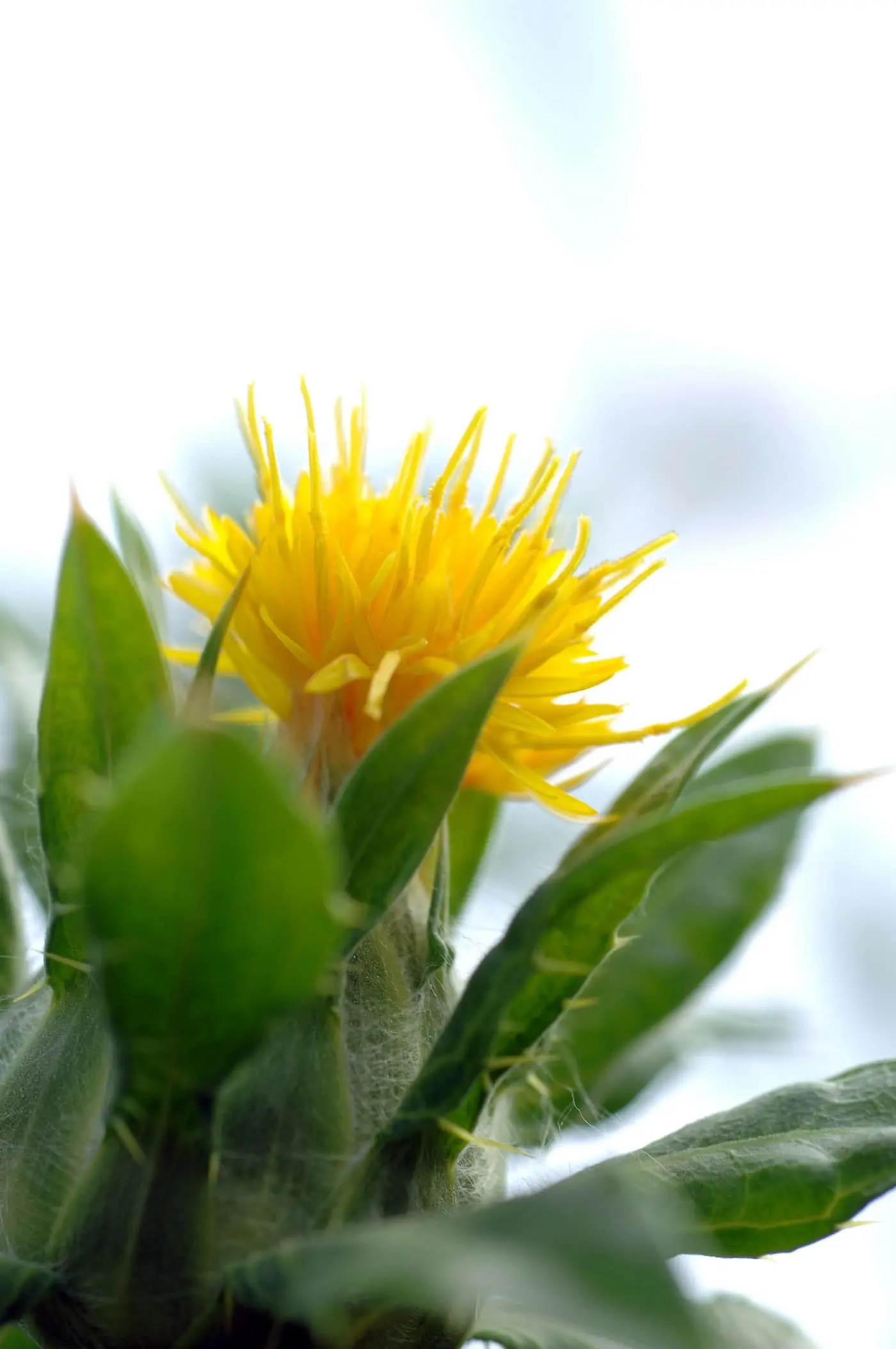
India's hardiest rabi oilseed — a deep-rooted, thistle-like crop of the black cotton soils of Maharashtra, Karnataka and Telangana that lives almost entirely on the soil moisture the monsoon leaves behind. It needs very little bought input, doubles as a border guard on gram and wheat, and yields a seed oil unusually high in polyunsaturated fat. The spines make weeding and harvest awkward, and aphid at the bud stage is the one pest that decides the crop — non-spiny varieties now make it far easier to grow.
Quick Summary
The key points from this page in about two minutes — read it or have it read aloud.
Quick Summary
Safflower (Carthamus tinctorius) — kusum, kusumbha or kardi — is a spiny, branching rabi oilseed grown mainly on the deep black (Vertisol) soils of Maharashtra, Karnataka and Telangana, with smaller areas in Madhya Pradesh, Andhra Pradesh and Chhattisgarh. Its defining feature is a strong taproot that goes down a metre or more, which lets the crop draw on stored subsoil moisture and finish a grain where a shallow-rooted crop would fail. That makes it the classic low-risk, low-input choice for a black-soil field with no assured irrigation.
It is sown on the receding monsoon, from late September into October, drilled deep into moisture behind the plough in rows about 45 cm apart. A rainfed crop on stored moisture takes almost no fertiliser; where one or two protective irrigations are possible, a modest nitrogen dose and the water together lift the yield sharply. The crop grows first as a flat rosette of spiny leaves for a few weeks — the slow, weed-vulnerable phase — then bolts, branches and carries orange-yellow flower heads that each set 15–40 white seeds.
Two things shape the crop. The first is the spines: most traditional varieties are sharply spiny, which protects the heads from birds and grazing but makes hand weeding and harvest painful and slow, so non-spiny varieties (bred by NARI Phaltan and others) are increasingly grown where labour is short. The second is the safflower aphid, which builds up on the buds and flower heads in the cool weather of December–January and can halve an unsprayed crop in a fortnight. Alternaria leaf blight and Fusarium wilt are the main diseases.
Safflower has a notified MSP as a rabi oilseed, though government procurement is thin and most seed is sold to oil mills and in the open mandi. In some tracts the orange florets are also picked as a natural dye, a kesar (saffron) substitute and a herbal tea, giving a second small income. The page below carries the sowing depth and window, the rainfed and irrigated fertiliser and water, spiny-vs-non-spiny variety choice, aphid and wilt control, safe harvesting of a spiny crop, and the yields to expect.
- Crop type
- Oilseed (28–32% oil, linoleic-acid rich); minor dye / floret crop
- Season
- Rabi (sown on the receding monsoon)
- Suitable states
- Maharashtra, Karnataka, Telangana, Madhya Pradesh, Andhra Pradesh, Chhattisgarh
- Growing duration
- 120–140 days
- Water requirement
- Very low — deep-rooted, grown on stored moisture; 1–2 irrigations optional
- Temperature
- 15–25°C for growth; tolerates heat and cold, but frost harms flowering
- Soil type
- Deep, well-drained black (Vertisol) and medium-black soils; pH 6.0–8.0
- Difficulty level
- Easy
- Expected yield
- 8–12 q/ha rainfed, 15–20 q/ha with 1–2 irrigations
- MSP (Safflower, RMS 2025–26)
- ₹5,940 / quintal
Overview
Safflower (Carthamus tinctorius), known as kusum, kusumbha, kardi or kusum phool, is the most drought-hardy oilseed grown in the Indian rabi season. It is a spiny, deeply taprooted annual, and that root is the whole point of the crop: it reaches stored moisture a metre or more down, so safflower can be sown on a black cotton soil at the end of the monsoon and carried to harvest on residual moisture alone. Maharashtra grows by far the largest area — the Marathwada and western Maharashtra black-soil belt — followed by Karnataka (the northern districts) and Telangana, with smaller areas in Madhya Pradesh, Andhra Pradesh, Chhattisgarh and Bihar.
It is grown three ways: as a rainfed sole crop on conserved black-soil moisture, which is the dominant system and takes almost no purchased input; as a border or "guard" row around gram, wheat, linseed or rabi sorghum, where the spiny plants deter cattle and blackbuck and add a bonus harvest; and as a light-irrigated crop that repays one or two waterings and a small nitrogen dose with a much higher yield. The seed carries 28–32% oil in the common hulled types (and more in thin-hull selections), and that oil is one of the richest common sources of linoleic acid, a polyunsaturated fat; high-oleic types exist for a more stable cooking and frying oil.
Two features dominate management. The spines — a defence that protects the heads from birds and grazing but makes hand weeding and hand harvest slow and painful — which is why non-spiny varieties bred by the Nimbkar Agricultural Research Institute (NARI) and the state universities are spreading fast where farm labour is scarce or costly. And the safflower aphid, a species that colonises the buds and flowering heads in the cool, dry weather of December and January and, left unsprayed, routinely halves the crop. Alternaria leaf blight (seed-borne) and Fusarium wilt are the diseases that matter. Safflower has an MSP notified for the rabi marketing season, but procurement is limited and the crop mostly moves to oil mills and the open mandi. This page follows it from sowing depth to a safe harvest.
Crop timeline, sowing to harvest
A quick visual map of the season — jump to any section below for the detail behind each stage.
- Day 0
Sowing
Drilled behind the plough into moist black soil on the receding monsoon (late September–October), rows about 45 cm apart, seed placed 4–6 cm deep so it sits in moisture. Sole crop 10–12 kg/ha; a border or intercrop on gram/wheat uses about half that.
- Day 7–15
Germination & seedling
The seed emerges in a week to ten days if it was placed in moisture. A shallow-sown crop, or one drilled after the moisture line has dropped, gives a thin, gappy stand that cannot be fixed later.
- Day 15–40
Rosette
The plant sits as a low, flat rosette of spiny leaves for three to five weeks, growing its taproot down. It competes very poorly with weeds now, so the one or two inter-cultivations and thinning to 20 cm all go on in this window.
- Day 40–60
Stem elongation & branching
The crop bolts upward and throws primary and secondary branches, each ending in a flower bud. On irrigated land the single most valuable irrigation, with the balance of the nitrogen, goes on at this rosette-to-branching stage.
- Day 60–85
Flowering
Orange-yellow flower heads open over two to three weeks, a few each day. This is the safflower aphid's window — dense colonies on the buds and heads now — and the stage to watch for the capsule fly and Helicoverpa.
- Day 85–110
Seed filling
Each head fills with 15–40 white, angular seeds carrying 28–32% oil. A second irrigation here, where water is available and the season has turned dry, protects seed weight and oil content. Alternaria and head rot strike if the canopy stays wet.
- Day 120–140
Maturity & harvest
Leaves and most heads dry to brown and the seed hardens and turns white. Cut in the cool early morning when the spines are least brittle, wearing thick gloves and long sleeves; stack the heads to dry, then thresh and clean.
Suitable states
States where this crop is grown at scale, highlighted below. Your local Krishi Vigyan Kendra is still the final word for your specific block.
- Jammu and Kashmir
- Himachal Pradesh
- Punjab
- Uttarakhand
- Haryana
- Delhi
- Uttar Pradesh
- Rajasthan
- Bihar
- Jharkhand
- West Bengal
- Sikkim
- Assam
- Arunachal Pradesh
- Meghalaya
- Nagaland
- Manipur
- Mizoram
- Tripura
- Gujarat
- Madhya Pradesh
- Chhattisgarh
- Maharashtra
- Odisha
- Goa
- Telangana
- Andhra Pradesh
- Karnataka
- Kerala
- Tamil Nadu
- Puducherry
- Ladakh
- Chandigarh
- Lakshadweep
- Andaman and Nicobar Islands
- Dadra and Nagar Haveli and Daman and Diu
Grown here
Climate requirements
Safflower is chosen precisely because the rabi weather that limits other crops — no rain, falling soil moisture, big day-night temperature swings — is what it does best in. The one weather risk is unseasonal rain or a long humid, cloudy spell at flowering, which brings Alternaria, head rot and heavy aphid all at once. Sowing on time so flowering is over before any late-winter cloud helps avoid it.
Ideal temperature
15–25°C suits vegetative growth and flowering; safflower tolerates both heat and cold better than most oilseeds, but frost during flowering kills the open heads and a hot, dry wind at seed-fill shrivels the seed and cuts oil. Cool, clear weather at flowering and seed-fill gives the best yield and oil
Rainfall
A dry, largely rainless rabi season is exactly what the crop is built for — it lives on stored soil moisture. Cloudy, humid or unseasonal wet weather at flowering and seed-fill is harmful: it triggers Alternaria leaf blight and head rot, worsens aphid, and can rot the filling heads
Humidity
Low humidity suits the crop and keeps it healthy. A prolonged humid or foggy spell at flowering is the classic trigger for an Alternaria and botrytis head-rot flare, and also favours the aphid
Sunlight
Full sun and clear, dry days through flowering and seed-fill give the best branching, seed set and oil percentage; overcast weather at flowering is the worst combination for disease and aphid together
Soil requirements
Land selection is really about the moisture reserve. A deep black soil that was kept fallow or under a short kharih crop and has a full profile of stored moisture at sowing will carry a rainfed safflower crop to a good yield; a shallow soil, or a deep soil already dried out by a long-duration kharif crop, will not, however well the safflower itself is managed.
Suitable soil
Deep, well-drained black cotton soils (Vertisols) and medium-black soils with a good moisture-holding capacity are the classic safflower lands — the crop is grown specifically to exploit the moisture these soils store. It also does well on deep alluvial and red loams under irrigation, but not on shallow, light or gravelly soils that cannot hold a moisture reserve for the taproot
pH range
6.0–8.0 — safflower tolerates the mildly alkaline and calcareous black soils of the Deccan well, and has fair tolerance to soil salinity, better than most rabi crops
Drainage
Good internal drainage is essential despite the crop's drought tolerance. Safflower will not stand waterlogging even for a day or two — a wet patch yellows the crop, invites root rot and wilt, and kills the taproot that the whole crop depends on
Organic matter
The crop performs on low to medium organic matter and does not need heavy manuring; incorporating the residue of the previous kharif crop or a modest dose of farmyard manure once in the rotation is enough. Rich soil or fresh nitrogen-heavy manure makes it lush, aphid-prone and late
Land preparation
Same four steps whichever region you are in — only the timing shifts with the sowing window.
- 1
Conserve the monsoon moisture
The single most important operation. After the kharif crop or the fallow, harrow and plank early to close the soil and stop the stored moisture evaporating, and keep the field weed-free through the pre-sowing period so weeds do not drain the profile.
- 2
One or two harrowings to a medium tilth
Safflower does not need the fine seedbed a small-seeded crop needs — a medium, cloddy-free tilth after one or two harrowings is enough, and over-tillage on a black soil just loses more moisture.
- 3
Open the field for drainage on heavy land
On the heaviest black soils and in any low-lying patch, open shallow drainage furrows before sowing so an unseasonal shower cannot pond — waterlogging is the one thing this crop cannot take.
- 4
Plan the borders if used as a guard crop
If safflower is to ring a gram or wheat field as a spiny guard against cattle and blackbuck, mark two or three border rows all round and sow them at the same time as the main crop.
Seed information
How the main varieties compare, so you can pick by duration, yield, disease pressure or what you are growing for.
| Variety | Duration | Yield | Disease resistance | Best state | Suitable for |
|---|---|---|---|---|---|
A long-standing spiny variety from UAS Dharwad and for decades the most widely grown safflower in Karnataka and parts of Maharashtra — well adapted to rainfed black soils, dependable, with about 30% oil. Still the benchmark a new variety is compared against. | 120–130 days | Medium–High (rainfed) | Moderate; susceptible to wilt and Alternaria in a wet year | Karnataka | Rainfed black-soil sole crop |
A spiny variety released for the Maharashtra rainfed tracts, medium duration, with good rainfed yield and wide adaptation across Marathwada and western Maharashtra. | 125–135 days | Medium–High (rainfed) | Moderate | Maharashtra | Rainfed sole crop, Maharashtra black soils |
A non-spiny variety from the Nimbkar Agricultural Research Institute (NARI), Phaltan — the spineless trait makes inter-cultivation, spraying and hand harvest far easier and safer. Suited to rainfed and lightly irrigated conditions with reasonable wilt tolerance. | 125–130 days | Medium–High | Moderate; some wilt tolerance | Maharashtra | Growers wanting a spineless crop; labour-short farms |
A non-spiny NARI variety with improved seed yield and oil over NARI-6, bred for the western and central Indian rabi tracts; a common choice where a spineless crop is preferred. | 125–135 days | High | Moderate | Maharashtra & Karnataka | Spineless rainfed / irrigated crop |
A spiny variety from MPKV Rahuri widely grown in Maharashtra, valued for a combination of aphid tolerance and Fusarium-wilt tolerance with a stable rainfed yield — a good pick where both problems recur. | 125–135 days | High | Tolerant to Fusarium wilt; moderate aphid tolerance | Maharashtra | Wilt- and aphid-prone rainfed tracts |
A non-spiny wilt-tolerant variety from the Parbhani (VNMKV) programme, bred for the Marathwada black soils, combining the spineless trait with good wilt resistance and rainfed yield. | 125–135 days | High | Good Fusarium-wilt tolerance | Maharashtra (Marathwada) | Spineless, wilt-prone black-soil tracts |
A spiny variety long grown in the Telangana and northern Andhra Pradesh safflower belt, adapted to the local rainfed black soils with dependable yield and about 30% oil. | 120–130 days | Medium–High | Moderate | Telangana | Rainfed sole crop, Telangana / AP |
A safflower hybrid from ICAR-IIOR Hyderabad, giving a clear yield advantage over the open-pollinated varieties under good rainfed to irrigated management, with moderate wilt tolerance; the seed must be bought fresh each year. | 125–135 days | Very high (hybrid vigour) | Moderate; some wilt tolerance | Karnataka & Maharashtra | Managed / irrigated crop, growers buying fresh seed yearly |
A spiny variety (JSI-7) from the Jabalpur programme for the Madhya Pradesh and central-Indian rabi safflower tracts, with a dependable rainfed yield. | About 125–135 days | Around 9–13 q/ha rainfed in the central-Indian rabi tracts | Moderate | Madhya Pradesh | — |
A non-spiny safflower hybrid from NARI Phaltan combining hybrid yield with the spineless trait; fresh seed must be bought each year. | About 125–135 days | Around 15–20 q/ha under good management — hybrid vigour with the spineless trait | Moderate | Maharashtra | — |
- Seed rate
- Sole crop: 10–12 kg/ha drilled in rows 45 cm apart (use the higher rate on a rough seedbed or for a late sowing). Border / guard rows and intercropping: about 5–6 kg/ha. Aim for roughly 1.5–2 lakh plants per hectare after thinning.
- Certified seed
- Use certified seed of a variety recommended for your state and system — A-1, Bhima, Phule Kusuma, Manjira among the spiny types; NARI-6, NARI-57, Phule Chandrabhaga among the non-spiny; DSH-129 where a hybrid is wanted. Safflower seed reaches farmers mainly through state seed corporations, ICAR-IIOR, the state agricultural universities and KVKs; branded private safflower seed is limited, though a few companies market the hybrids. Always treat seed before sowing, as Alternaria blight is seed-borne.
- Spacing
- 45 cm between rows for a rainfed crop; 45–60 cm under irrigation. Thin to a single plant every 20 cm within the row at two to three weeks, before the spines harden.
- Seed treatment
- Treat seed with a fungicide (carbendazim or a carboxin + thiram dressing) against seed-borne Alternaria leaf blight and against Fusarium wilt and root rot, and follow with a Trichoderma seed treatment where wilt is a recurring problem. A Rhizobium/PSB treatment is not needed — safflower is not a legume — but a PSB inoculant can help on a phosphorus-fixing black soil.
Sowing guide
Depth and date are the two decisions that make or break a rainfed crop. The seed must go into moisture, which on a partly dried black soil means drilling 5–6 cm deep or more, not the shallow placement used for wheat or gram; and it must go in early enough that flowering and seed-fill finish before the profile runs dry. A shallow or late sowing cannot be corrected by anything done afterwards.
- Best time
- The last week of September to the end of October, sown onto the receding monsoon so the crop germinates in the last useful moisture and then grows down on the stored profile. A crop sown after mid-November meets terminal drought at seed-fill, heavier aphid, and a sharp drop in yield and oil.
- Row spacing
- 45 cm (rainfed); 45–60 cm under irrigation
- Plant spacing
- About 20 cm within the row after thinning
- Sowing depth
- 4–6 cm — deeper than most rabi crops, so the seed is placed into moisture and not left in the drying surface layer; on a soil that has already dried on top, drill deeper to reach the moisture line
- Method
- Drill behind the plough or with a seed drill into rows, then cover and lightly compact. Broadcasting is still done but gives a poor, uneven stand that cannot be inter-cultivated and yields much less.
Fertilizer schedule
A split dose beats one large dose applied at sowing — nitrogen especially is lost to the air and to leaching if it all goes in on day one.
- 1
Basal (at sowing) — rainfed crop
Day 0
On a rainfed crop living on stored moisture, apply the whole low dose — about 25:25:0 kg N:P2O5:K2O per hectare — drilled below the seed at sowing, because there is no moisture later to carry a top-dressing. Potash only if a soil test shows a shortage.
- 2
Basal (at sowing) — irrigated crop
Day 0
On an irrigated crop, apply about half the nitrogen with the full phosphorus at sowing; total nitrogen for an irrigated crop is around 40–60 kg N/ha.
- 3
Nitrogen top-dressing (irrigated crop only)
Day 30–40 (rosette to branching)
Apply the second half of the nitrogen at the rosette-to-branching stage, with the first irrigation. Do not top-dress a purely rainfed crop — the nitrogen will simply sit unused in dry soil.
- 4
Sulphur & micronutrients
Basal, as needed
Safflower oil synthesis responds to sulphur; 20–25 kg S/ha through gypsum or single super-phosphate is worthwhile on a sulphur-poor soil. Correct boron and zinc on a soil-test basis.
Irrigation schedule
1. Rosette to branching
Day 30–45
The single most valuable irrigation if water is available — it carries the crop through the switch from rosette to rapid branching and sets the number of flowering heads. Apply the top-dressed nitrogen with it.
2. Flowering to early seed-fill
Day 65–85
A second irrigation where the season has turned dry protects seed set and oil content. Water down the furrow, not over the canopy, and not late in the day, so the heads do not stay wet overnight.
3. Rainfed crop
None
A rainfed crop takes no irrigation at all and is managed entirely by conserving the stored moisture — timely early tillage, weed control and an on-time sowing.
Critical stages
- Rosette to branching (the one irrigation to give if only one is possible)
- Flowering
- Early seed filling
Water-saving tips
- Most of the water-saving is done before sowing — early post-monsoon tillage to seal the soil, a weed-free pre-sowing period, and drilling deep into moisture so no irrigation is needed to germinate the crop.
- If only one irrigation is possible, give it at the rosette-to-branching stage — it returns far more than an irrigation at any other time.
- Irrigate down the furrow and stop before the field is fully wetted; safflower is damaged by waterlogging faster than it is helped by a heavy irrigation.
Weed management
Common weeds
Organic control
- One or two inter-cultivations with a bullock or wheel hoe plus a hand weeding in the first 40 days, while the crop is a slow rosette, cover its critical weed-free period; after branching the canopy and the spines suppress most late weeds.
- A non-spiny variety makes this hand and hoe work far quicker and safer — one of the main practical reasons to grow one.
- A weed-free pre-sowing period and a stale seedbed on an irrigated crop greatly reduce the early flush and conserve moisture for the crop.
Chemical control
- A pre-emergence herbicide such as pendimethalin applied within two to three days of sowing holds the early flush on a rainfed crop that will get only one or two inter-cultivations.
- A post-emergence grass herbicide (for example quizalofop) can be used against Phalaris and wild oat in the rosette stage where those grasses are the problem; there is no fully safe broadleaf post-emergence option, so broadleaf weeds are managed by inter-cultivation.
- Always confirm the current safflower-registered product and dose with your KVK — the crop is sensitive to several herbicides used on cereals.
Nutrient deficiency identification
What a shortage of each nutrient actually looks like on the plant, so you can tell a deficiency apart from a disease before you spray the wrong thing.
Nitrogen
Visible symptom
Pale yellow-green older leaves, few branches and small heads; common where a rainfed crop follows an exhausting kharif crop on a poor black soil. The fix is a modest basal dose, not a heavy one, which would only invite aphid and lodging.
Phosphorus
Visible symptom
Dull dark-green, slightly purplish older leaves, a weak taproot and delayed flowering; common on the calcareous, phosphorus-fixing black soils safflower is grown on, which is why the small P dose is given drilled below the seed.
Sulphur
Visible symptom
Uniform pale-yellow younger leaves (unlike nitrogen, which hits the older leaves first), thin stems and — importantly for an oilseed — a drop in seed oil percentage. Shows on light, low-organic-matter and heavily cropped black soils.
Zinc
Visible symptom
Small, narrow, pale new leaves with a bronzed cast, shortened internodes and a bunched rosette that is slow to bolt; common on the high-pH calcareous black soils, worst in a cold early spell.
Boron
Visible symptom
Hollow or cracked stem, death of the growing point, and heads that flower but set few seeds ("head sterility"); shows on light black and red soils after a dry then wet spell.
Diseases to watch for
Symptoms, likely cause and what actually treats it — not just a spray name.
Alternaria leaf blight
- Symptoms
- Small brown spots with concentric rings and a yellow halo on the leaves, enlarging and merging so leaves dry from the tip and margin inward; dark lesions on the stem and bracts; and, in a wet flowering, a brown rot of the developing heads that shrivels the seed. The most damaging disease of safflower in a year with any unseasonal rain or dew.
- Cause
- The fungus Alternaria carthami, which is seed-borne and also carries over on crop debris, and flares in humid, cloudy, dewy weather at flowering and seed-fill, especially on a dense or late crop.
- Treatment
- Spray a recommended fungicide (mancozeb, or a mancozeb + carbendazim combination) from the first spots, and repeat at 10–15 day intervals if humid weather continues through flowering.
- Prevention
- Treat seed with a fungicide (the disease travels on the seed), sow on time so flowering is over before late-winter cloud, use recommended spacing, grow a tolerant variety where available, and plough in debris after harvest.
Fusarium wilt
- Symptoms
- Plants wilting and dying singly or in patches from the rosette stage onward, one side of the plant often affected first; leaves yellow, droop and dry but hang on the plant; and cutting the stem or taproot across shows a brown-to-black discolouration of the vascular ring.
- Cause
- The soil-borne fungus Fusarium oxysporum f.sp. carthami, which builds up under continuous safflower or a short safflower rotation and survives for years in the soil; worse on a stressed crop and in a warm spell.
- Treatment
- No cure for an affected plant — rogue it out. Manage the field for the rest of the crop and plan a wilt-tolerant variety and a longer rotation for next season.
- Prevention
- Grow a wilt-tolerant or resistant variety (Phule Kusuma, Phule Chandrabhaga and others), rotate 3–4 years away from safflower, treat seed with a fungicide and Trichoderma, and avoid moisture stress and injury that let the fungus in.
Root rot & seedling blight
- Symptoms
- Patchy poor emergence; young plants damping off and collapsing; older plants in a wet or compacted patch yellowing, wilting and pulling up with a rotted, dark, shredded root. Worst in a waterlogged low spot or after an unseasonal shower on a heavy soil.
- Cause
- Soil-borne fungi — mainly Rhizoctonia bataticola (Macrophomina, the dry-root / charcoal rot fungus) and Rhizoctonia solani — favoured by waterlogging, soil compaction and a stressed stand, and carried on seed and debris.
- Treatment
- No in-season cure — remove affected plants and improve drainage on the patch. Do not irrigate a rainfed crop to "help" a wilting patch; it usually makes root rot worse.
- Prevention
- Sharp field drainage and no waterlogging, treated seed, a firm even stand, rotation away from other host crops (pulses, cotton), and Trichoderma applied through farmyard manure.
Powdery mildew & rust
- Symptoms
- Powdery mildew: a white powdery coating on the upper leaf surface and stems, mainly late in the crop, causing early leaf drop. Rust: small reddish-brown powdery pustules on the underside of the leaves and on bracts, which can be severe on a late crop in a cool, humid spell.
- Cause
- Powdery mildew is Erysiphe cichoracearum; rust is Puccinia carthami. Both are favoured by a late crop running into humid late-winter weather, and rust also by dew and a dense canopy.
- Treatment
- Powdery mildew: dust with sulphur or spray a recommended fungicide at the first white patches. Rust: a mancozeb or propiconazole spray on an early, spreading infection.
- Prevention
- Sow on time so the crop matures before the humid late-winter window, use recommended spacing, and remove volunteer safflower and thistle hosts around the field.
Pests to watch for
What to look for before the damage is visible, and organic options before you reach for a chemical.
Safflower aphid
- Identification
- Dense black-to-dark-brown colonies of small soft-bodied aphids packed onto the terminal buds, the flower heads and the top of the stem, with sticky honeydew and black sooty mould below them. Builds up fast in the cool, dry weather of December and January, exactly at the bud-to-flowering stage.
- Damage
- The crop-defining pest. Heavy colonies on the buds and heads suck the plant, distort and dry the buds, prevent flowering and seed set, and an unsprayed crop in a bad aphid year is routinely cut by 40–50% or more. It also fouls the heads with mould, lowering seed and oil quality.
- Organic control
- Scout the buds from the start of stem elongation, and spray at the first colonies — do not wait. Conserve ladybird beetles, lacewings and syrphid flies, which build up on the colonies; a neem-based or insecticidal-soap spray works on light early infestations. Grow an aphid-tolerant variety where the pest is regular.
- Chemical control
- Spray a recommended systemic aphicide (for example dimethoate or a neonicotinoid per the state package) the moment aphids appear on the buds, and repeat after 10–15 days if colonies rebuild. Early action on a light infestation is far more effective than a heavy spray on a colonised crop.
Safflower capsule fly & Helicoverpa
- Identification
- Capsule fly (Acanthiophilus helianthi): small maggots inside the developing flower head, feeding on the ovules and young seed, with a bored, frass-filled head and a small exit hole. Helicoverpa armigera: green-to-brown caterpillars boring into the buds and heads and eating the developing seed, one caterpillar moving head to head.
- Damage
- Both feed directly on the seed inside the head, so the loss does not show until threshing — a head that looks normal outside can be half empty. Capsule fly is often the bigger of the two in the main safflower belt.
- Organic control
- Set pheromone traps for Helicoverpa to time action, encourage birds with perches, hand-pick caterpillars where the crop is small, and spray Bt or an NPV formulation against young Helicoverpa larvae.
- Chemical control
- A need-based spray of a recommended insecticide targeted at the heads at the bud-to-early-flowering stage, timed with the aphid spray where both are present, when trap catches or head damage cross the local threshold.
Bihar hairy caterpillar & leaf-eating caterpillars
- Identification
- Bihar hairy caterpillar (Spilarctia obliqua): hairy brown-black caterpillars feeding in groups on the leaves in the rosette and early branching stage, skeletonising and stripping foliage in patches, often spreading in from the field edge. Other cutworms and semilooper caterpillars feed at night on young plants.
- Damage
- Group feeding on the rosette can strip patches of a young crop and thin the stand; usually a localised, early-season problem rather than a whole-field one, but a heavy migration from a neighbouring field can be serious.
- Organic control
- Scout the field edges early, collect and destroy the leaves carrying the gregarious young caterpillars, dig a trap trench to stop a marching front, and encourage predatory birds.
- Chemical control
- A need-based spot spray of a recommended insecticide on the infested patch and a border strip where the caterpillars cross the threshold, rather than a whole-field spray.
Common mistakes to avoid
The mistakes that cost growers the most, ranked by how often they show up in the field — not in the order you might expect.
- 1
Sowing shallow, or after the moisture line has dropped
Why it hurts
Safflower seed must go into moisture, which on a partly dried black soil means drilling 5–6 cm deep or more. A shallow sowing, or a late one into dry topsoil, gives a thin, gappy stand that no later operation can fix — the commonest cause of a failed rainfed crop.
- 2
Sowing late (after mid-November)
Why it hurts
A late crop runs into terminal drought at seed-fill, meets the December–January aphid peak head-on at the vulnerable bud stage, and is far more exposed to Alternaria and rust in late-winter cloud. Yield and oil both fall sharply.
- 3
Waiting to spray for aphid until the heads are colonised
Why it hurts
The safflower aphid builds up explosively on the buds in cool weather. A spray at the first colonies protects the crop cheaply; a spray once the heads are black with aphid recovers only part of a yield that is already half lost.
- 4
Growing a spiny variety where labour is short
Why it hurts
The spines make inter-cultivation, spraying and hand harvest slow, painful and unpopular with labour, and injuries at harvest are common. Where a non-spiny variety suited to the tract is available, it removes most of that cost and risk for a small yield trade-off.
- 5
Over-doing nitrogen or manure
Why it hurts
A lush, heavily fed safflower crop is late, lodges, carries far more aphid, and holds humidity that feeds Alternaria — for little or no extra seed on a rainfed crop. The dose is deliberately small.
- 6
Irrigating a wilting rainfed crop
Why it hurts
A rainfed crop wilting in a dry spell is usually stressed, not short of a light irrigation the field cannot properly drain — and safflower is damaged by waterlogging faster than it is helped by water. An unplanned irrigation on a heavy soil often triggers root rot and wilt.
- 7
Sowing untreated seed
Why it hurts
Alternaria leaf blight is seed-borne — sowing untreated seed carries the disease straight into the new crop, and it then flares at the worst possible time, flowering. A simple fungicide seed dressing is one of the cheapest protections the crop has.
- 8
Continuous safflower on the same field
Why it hurts
Safflower after safflower builds Fusarium wilt and root rot in the soil until the crop is no longer worth growing. A 3–4 year rotation with a cereal or another non-host is essential on any field where wilt has appeared.
Harvesting
Harvest when the leaves and most of the flower heads have dried to brown, the plant is stiff and straw-coloured, and the seed is hard and white and shells out cleanly — usually 120–140 days after sowing. Do not delay a fully mature spiny crop through the field, as some heads shatter and shed seed, but a few days' wait for the last heads to dry is fine.
Signs it is ready
- Leaves and most heads dried brown; the plant stiff and straw-yellow
- Seed hard, white and angular, separating cleanly from the head
- Bracts dry and brittle (and painfully sharp on a spiny crop)
- Seed moisture down to about 8–10% for safe storage after threshing
Tools
- Sickle for cutting; thick leather or rubber gloves, long sleeves and covered legs are essential on a spiny crop
- Early-morning cutting when dew has softened the spines and they are least brittle and least likely to fly
- A threshing floor or tarpaulin; heads are dried a few days then threshed by beating, a pedal thresher or a multi-crop thresher
- Winnowing and a sieve to clean the seed; a combine harvester with a safflower setting where the area justifies it
Expected yield
A rainfed crop on a full black-soil moisture profile with basic management gives 8–12 q/ha of seed; one or two protective irrigations plus a nitrogen dose lift that to 15–20 q/ha, and a hybrid under good management can go higher. A poorly established or late rainfed crop may yield only 4–6 q/ha. Seed oil content runs 28–32% in the common hulled types. Where the florets are picked, a crop also yields roughly 25–40 kg/ha of dried petals.
Post-harvest & storage
Storage
Dry the threshed seed to about 8–10% moisture and store it clean in bags or bins in a dry, ventilated store. Well-dried safflower seed keeps well for a year or more; the hard, dry seed resists storage pests better than most oilseeds, but seed held for sowing should be kept cool and dry and its germination checked before the next season, as safflower seed loses viability faster than a cereal.
Packaging
Bagged in clean jute or woven bags; keep the lot free of stones, thistle heads and green trash, which oil mills discount. Keep seed intended for sowing separate and labelled by variety.
Transportation
A stable, dry, free-flowing seed that transports without special care once dried; keep it dry and covered so it does not pick up moisture and heat in transit.
Shelf life
Seed for crushing: about a year in good dry storage before the oil quality starts to fall. Seed for sowing: use within one season — safflower seed viability drops noticeably in the second year, so always run a germination test before sowing carried-over seed. Extracted safflower oil, being high in polyunsaturated fat, goes rancid faster than a saturated oil and should be kept cool and dark.
Market prices
Today's mandi price near you, pulled live from the government's own Agmarknet data.
Live daily mandi prices from the government Agmarknet dataset.
Synced from data.gov.in (Agmarknet). Rates are ₹ per quintal.
Weather
Current conditions and a 5-day outlook for your selected location, with one line of stage-aware advice.
Pick your state for current conditions and a 5-day outlook.
Live data from Open-Meteo
Profit calculator
Your own cost sheet, expected yield and selling price — not ours.
Where the money goes
Share of the total cost per acre, using the calculator’s own default cost sheet below — adjust the numbers there to match your field and this picture will no longer apply to you exactly, but the ranking rarely changes.
- Land rent39% (₹7,000)
- Labour25% (₹4,500)
- Machinery11% (₹2,000)
- Fertiliser8% (₹1,400)
- Pesticide & weedicide7% (₹1,200)
- Irrigation4% (₹800)
- Seed4% (₹700)
- Interest2% (₹400)
Official downloads
Government and ICAR documents only — everything below is hosted on an official server.
ICAR-Indian Institute of Oilseeds Research (IIOR), Hyderabad
The national institute for safflower and other oilseeds — released varieties and hybrids, package of practices, and aphid and wilt advisories.
National Mission on Edible Oils – Oilseeds (NMEO-OS)
The central scheme supporting oilseed area, seed minikits, cluster demonstrations and production incentives, including for safflower.
Nimbkar Agricultural Research Institute (NARI), Phaltan
Developer of the non-spiny safflower varieties and of safflower petal and forage uses.
Soil Health Card portal
Get a free, field-specific fertiliser and micronutrient recommendation before finalising the schedule above.
Frequently asked questions
What is safflower, and is kusum the same as kardi?
Safflower (Carthamus tinctorius) is a spiny, branching rabi oilseed grown for a seed oil rich in polyunsaturated (linoleic) fat. It goes by many Indian names — kusum, kusumbha or kusum phool in the north and Hindi belt, kardi or kardai in Maharashtra and the Deccan, and kusube in Kannada. They are all the same crop. It is unrelated to true saffron (kesar), though its dried orange petals are sometimes sold as a cheap saffron substitute and colouring.
Why is safflower called a dryland crop?
Because it has a strong taproot that goes down a metre or more and draws on moisture stored deep in a black cotton soil. That lets it be sown at the end of the monsoon and carried right through to harvest on residual soil moisture, with no irrigation, on land and in a season when wheat or gram would fail. It is the standard low-risk oilseed for an un-irrigated black-soil rabi field.
Spiny or non-spiny variety — which should I grow?
Spiny varieties (A-1, Bhima, Phule Kusuma, Manjira) are the traditional types; the spines protect the heads from birds and grazing but make hand weeding, spraying and harvest slow, painful and hard to hire labour for. Non-spiny varieties (NARI-6, NARI-57, Phule Chandrabhaga) remove almost all of that cost and injury risk for a small yield trade-off, and are the better choice where farm labour is scarce or expensive, or where the crop is not at high bird pressure. Both are grown on the same rainfed system.
Does safflower have an MSP?
Yes. Safflower is one of the rabi oilseeds for which the Government of India notifies a Minimum Support Price each Rabi Marketing Season. However, government procurement of safflower is limited and patchy, so in practice most of the crop is sold to oil mills and in the open mandi at whatever the market pays. Check the current RMS notification for the exact MSP figure, as it is revised every year.
When should I sow safflower and how deep?
Sow from the last week of September to the end of October, onto the receding monsoon, so the crop germinates in the last useful surface moisture and then grows down onto the stored profile. Drill the seed 4–6 cm deep — deeper than wheat or gram — so it sits in moisture; on a soil that has already dried on top, go deeper still to reach the moisture line. A shallow or late sowing is the commonest reason a rainfed safflower crop fails.
How much safflower seed do I need per acre?
About 4–5 kg per acre (10–12 kg/ha) for a sole crop drilled in 45 cm rows, using the higher end on a rough seedbed or a late sowing. For border or guard rows around a gram or wheat field, or for intercropping, about 2–2.5 kg per acre (5–6 kg/ha) is enough.
What is the safflower aphid and how do I control it?
It is a small dark aphid that colonises the buds and flower heads in the cool, dry weather of December and January — exactly when the crop is most vulnerable — and can cut an unsprayed crop by 40–50% or more. The key is to scout the buds from the start of branching and spray a recommended systemic aphicide at the very first colonies, then again after 10–15 days if they rebuild. Waiting until the heads are black with aphid recovers only part of a crop that is already half lost. An aphid-tolerant variety helps where the pest is regular.
Can safflower be grown as a border or intercrop?
Yes, and this is a common traditional use. Two or three spiny safflower rows sown around a gram, wheat, linseed or rabi sorghum field act as a living fence that cattle and blackbuck will not push through, and the border yields a bonus harvest of seed. Safflower is also intercropped in rows with gram or rabi sorghum. Use about half the sole-crop seed rate for borders and intercropping.
What is safflower oil good for, and can I use the flowers?
Safflower seed oil is one of the richest common sources of linoleic acid, a polyunsaturated fat, and is used as a cooking and salad oil; high-oleic safflower types give a more heat-stable frying oil. The pressed cake is a cattle feed. Separately, the dried orange florets are picked in some tracts and sold as a natural fabric and food dye, a cheap saffron (kesar) substitute, and a herbal tea said to aid circulation — a small second income from the same crop.
What yield can I expect from safflower?
A rainfed crop sown on time and deep into a full black-soil moisture profile, with a small basal fertiliser dose and timely aphid control, typically gives 8–12 quintals of seed per hectare. One or two protective irrigations plus a nitrogen top-dressing lift that to 15–20 q/ha, and a hybrid under good management can go higher. A late or poorly established rainfed crop may give only 4–6 q/ha. Seed oil content is around 28–32% in the common types.
Still have questions?
The FAQs above cover the common ones. For anything specific to your field and soil, your nearest Krishi Vigyan Kendra is the authoritative answer.