
Kiwi
Actinidia deliciosa
A fast-rising hill cash crop that India still mostly imports — a deciduous vine grown on an overhead trellis in the cold mid-hills, where the make-or-break facts are that it is dioecious (you must plant one male vine for every five to eight fruiting females, or the whole block flowers and sets almost nothing), that it needs genuine winter chilling to crop, and that the fruit is picked firm at the right maturity and then — unlike most Indian fruit — stores for months in cold storage, which is exactly what lets a hill farmer hold the crop for a better price.
Quick Summary
The key points from this page in about two minutes — read it or have it read aloud.
Quick Summary
Kiwi (Actinidia deliciosa) is one of the fastest-rising hill fruit crops in India and a genuine import-substitution opportunity: the country still imports the large majority of the kiwi it consumes, so domestic demand comfortably exceeds supply. It is grown in the cold mid-hills — Arunachal Pradesh leads production by a wide margin and has launched a dedicated Kiwi Mission, followed by Himachal Pradesh (Solan, Sirmaur, Kullu, Shimla, Mandi), Uttarakhand, Sikkim, Nagaland, Meghalaya and parts of Jammu & Kashmir and the Nilgiris.
The single fact that catches new growers out is that kiwi is dioecious — male and female flowers are on separate vines, and only the female vines fruit. A block planted entirely with a fruiting variety will flower heavily and set almost nothing, because there is no pollen. The rule is to interplant one male vine (a pollinator such as Tomuri or Allison's male partner) for every five to eight female fruiting vines, arranged so the males are spread through the block, and in many orchards to supplement bee activity with hand- or mechanical pollination, since good pollination directly decides both fruit number and fruit size.
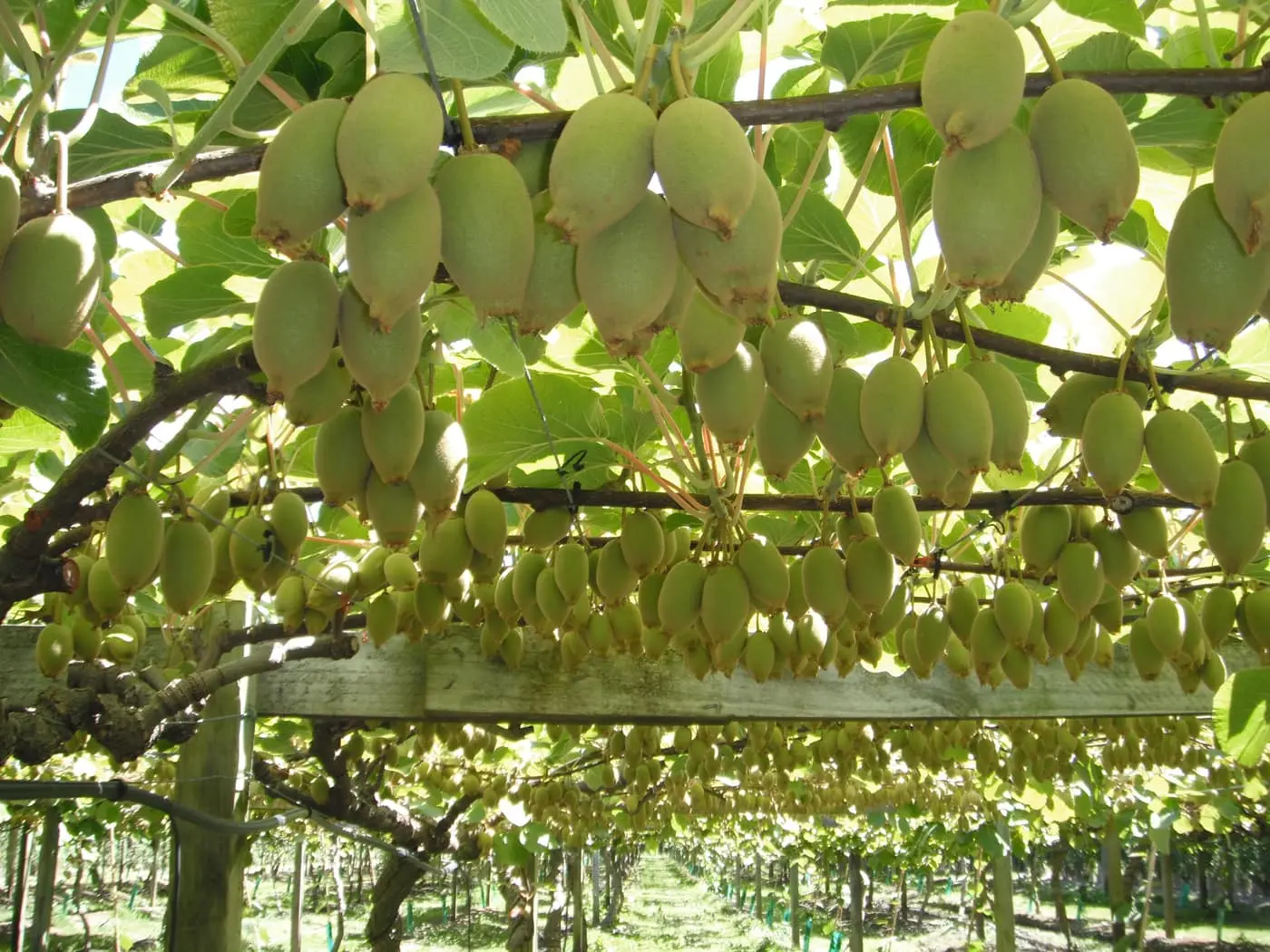
Kiwi is a vigorous deciduous vine that must be grown on a strong overhead pergola or T-bar trellis, needs genuine winter chilling (which is why it is a cold-hill, not a plains crop), a deep well-drained soil rich in organic matter, shelter from wind, and protection of its tender spring growth and flowers from late frost. It is planted as budded or grafted plants in the dormant winter, trained carefully for the first few years, and begins bearing in about its fourth or fifth year, building toward a mature 25–45 kg per vine and cropping for decades.
Its two defining problems are bacterial canker (Pseudomonas syringae pv. actinidiae, "PSA" — the most serious kiwi disease worldwide, spread by rain, wind and infected planting material) and Phytophthora crown and root rot in wet, poorly-drained soil. Against these, clean planting material, good drainage and orchard hygiene matter more than any spray. The crop's great commercial advantage over most Indian fruit is storage: picked firm at the right dry-matter maturity, kiwi stores for months in cold storage and ships well, which is what lets a hill grower sell into a long marketing window at a good price rather than dumping a perishable crop at harvest.
- Crop type
- Perennial deciduous fruiting vine (dioecious), trellis-grown
- Season
- Planting: dormant winter (Dec–Feb); flowering spring; harvest autumn
- Suitable states
- Arunachal Pradesh, Himachal Pradesh, Uttarakhand, Sikkim, Nagaland, Meghalaya, J&K
- Growing duration
- First commercial crop ~4–5 years; productive for decades
- Water requirement
- Moderate–high; needs steady moisture but good drainage, not waterlogging
- Temperature
- Cold mid-hills (~800–1,500 m); needs winter chilling, frost-sensitive in spring
- Soil type
- Deep, well-drained loam rich in organic matter, slightly acidic
- Difficulty level
- Moderate–hard; pollination, site, trellis and frost all decide it
- Expected yield
- 25–45 kg/vine at maturity (~8–15 t/ha)
- Key risk
- A block of only female vines that flowers but sets no fruit; late-frost and PSA canker
Overview
Kiwi (Actinidia deliciosa) is a deciduous, cold-climate fruiting vine grown for its fuzzy-skinned, bright-green (or gold, in some types) fruit, eaten fresh and valued for its vitamin C and long storage life. In India it is a mid-hills cash crop and a strong import-substitution opportunity, since the country still imports most of the kiwi it eats.
Production is led by Arunachal Pradesh (over half the national crop, now backed by a ten-year state Kiwi Mission), with Himachal Pradesh, Uttarakhand, Sikkim, Nagaland, Meghalaya and parts of Jammu & Kashmir and the Nilgiris making up much of the rest. It is a genuine cold-hill crop — it needs winter chilling and does not suit the plains.
The crop turns on three things. First, pollination: kiwi is dioecious, so one male pollinator vine must be planted for every five to eight female fruiting vines or the block sets almost no fruit. Second, the site and structure: a strong overhead trellis, deep well-drained soil, winter chill, shelter from wind and protection from late frost. Third, its standout commercial trait — the fruit is picked firm and stores for months in cold storage, letting a grower sell over a long window rather than all at harvest.
Crop timeline, sowing to harvest
A quick visual map of the season — jump to any section below for the detail behind each stage.
- Year 1 (Dec–Feb)
Planting & trellis
Budded/grafted vines are planted in the dormant winter onto a strong pergola or T-bar trellis, with one male pollinator set among every five to eight female vines.
- Years 1–3
Training
The vine is trained to a single trunk and a framework of permanent arms (cordons) along the trellis wires, with careful winter and summer pruning to build the cropping structure.
- Each year, winter
Dormancy & chilling
The vine drops its leaves and rests through winter; genuine winter chilling is essential for it to break bud and flower properly the next spring.
- Each year, spring
Bud break & flowering
New growth and flowers appear in spring; late frost at this stage is a serious risk, and good pollination (bees plus supplementary pollination) now decides the crop.
- Year 4–5
First commercial crop
The vine begins bearing a commercial crop around its fourth or fifth year, building year on year.
- Each year, autumn
Fruit maturity & harvest
Fruit is picked firm at the right dry-matter/sugar maturity in autumn, then ripened or cold-stored; a mature vine gives 25–45 kg.
Suitable states
States where this crop is grown at scale, highlighted below. Your local Krishi Vigyan Kendra is still the final word for your specific block.
- Jammu and Kashmir
- Himachal Pradesh
- Punjab
- Uttarakhand
- Haryana
- Delhi
- Uttar Pradesh
- Rajasthan
- Bihar
- Jharkhand
- West Bengal
- Sikkim
- Assam
- Arunachal Pradesh
- Meghalaya
- Nagaland
- Manipur
- Mizoram
- Tripura
- Gujarat
- Madhya Pradesh
- Chhattisgarh
- Maharashtra
- Odisha
- Goa
- Telangana
- Andhra Pradesh
- Karnataka
- Kerala
- Tamil Nadu
- Puducherry
- Ladakh
- Chandigarh
- Lakshadweep
- Andaman and Nicobar Islands
- Dadra and Nagar Haveli and Daman and Diu
Grown here
Climate requirements
Two climate facts decide whether kiwi can be grown on a site at all: enough winter chilling for the vine to flower, and freedom from damaging late spring frost at bud break and flowering. A mid-hill site with reliable winter cold but a frost-free spring window is the target; a frost-prone pocket or a too-warm site will disappoint.
Ideal temperature
A genuine cold-hill crop. It needs real winter chilling (a sustained spell of cold during dormancy) to break bud and flower properly the next spring, which is why it is grown in the mid-hills at roughly 800–1,500 m and does not suit the warm plains. It is frost-sensitive in spring — late frost on the tender new growth and flowers is one of the biggest risks — and the fruit is grown and harvested before the hard winter returns.
Rainfall
Suited to areas of good, well-distributed rainfall but needs free drainage; it wants steady moisture through the growing season (supplemented by irrigation in dry spells) but rots at the roots in waterlogged ground. Hot, dry winds in the growing season stress the vine and are best buffered with shelter and irrigation.
Humidity
Moderate humidity suits it, but warm, wet, humid conditions sharply raise the risk of bacterial canker (PSA) and crown rot, so airflow, shelter and drainage all matter.
Sunlight
Needs good sunlight for fruiting but benefits from shelter — the vine and fruit can be sunburned on very exposed sites, and strong wind damages the large leaves and young shoots, so sheltered, well-lit slopes are ideal.
Soil requirements
Deep, free-draining, organic-matter-rich, slightly acidic soil is the ideal — and good drainage is non-negotiable, because the vine's worst soil-borne enemy (Phytophthora crown rot) is driven almost entirely by wet feet.
Suitable soil
Wants a deep, fertile, well-drained loam rich in organic matter; it is a vigorous vine with a large root system and heavy feeding needs, and performs poorly on shallow, heavy or badly-drained soils. The deep hill loams of its growing belts suit it where drainage is good.
pH range
Prefers a slightly acidic soil, roughly pH 5.5–6.5; it is sensitive to alkaline and saline conditions, which bring on iron chlorosis and poor growth.
Drainage
Free drainage is essential — kiwi is very sensitive to waterlogging, which triggers Phytophthora crown and root rot and can kill a vine. Plant on well-drained slopes or raised ground, never in a wet hollow.
Organic matter
A heavy feeder that responds strongly to generous farmyard manure and compost worked in at planting and top-dressed each year; good organic matter also helps the soil hold moisture while draining freely.
Land preparation
Same four steps whichever region you are in — only the timing shifts with the sowing window.
- 1
Build a strong overhead trellis
Erect a sturdy pergola (bower) or T-bar trellis of posts and wires before or at planting — the vine is heavy and long-lived, and the structure carries it for decades, so it must be built strong from the start.
- 2
Dig and enrich large pits on well-drained ground
On a well-drained slope, dig large pits, refill with topsoil mixed with generous well-rotted FYM/compost, and raise the planting spot slightly so water never pools around the crown.
- 3
Plan male pollinators into the layout
Set the planting plan so one male pollinator vine falls among every five to eight female fruiting vines, spread evenly through the block — this is designed in at planting, not added later.
Seed information
How the main varieties compare, so you can pick by duration, yield, disease pressure or what you are growing for.
| Variety | Duration | Yield | Disease resistance | Best state | Suitable for |
|---|---|---|---|---|---|
The world's leading commercial kiwi and the benchmark female variety in India — large, oval, well-flavoured fruit with excellent keeping quality and the firmest flesh at harvest, which is why it stores and ships best. It is later-maturing and suits the higher, colder sites, and needs a compatible male pollinator (such as Tomuri) nearby. | Female; later-maturing; first commercial crop ~4–5 years | High; large fruit with the best storage life of the common varieties | No special resistance; manage PSA canker and crown rot | Himachal Pradesh, Arunachal Pradesh, Uttarakhand (higher, colder sites) | The main commercial fruiting variety, especially where storage and shipping matter |
An early-to-mid-season female variety valued for heavy, reliable cropping and good fruit size, often the top yielder in Indian hill trials. It suits slightly lower, warmer kiwi sites than Hayward and is a mainstay of Himachal and north-east plantings. | Female; early-to-mid season; first commercial crop ~4–5 years | Very high and reliable; among the top yielders in Indian trials | No special resistance widely documented | Himachal Pradesh, Uttarakhand, Arunachal Pradesh | High-yield commercial plantings on mid-elevation sites |
An early female variety with long, cylindrical, densely hairy fruit and heavy cropping, widely grown in the Indian hills. Its distinctive long fruit shape and reliable yield make it a popular commercial choice. | Female; early season; first commercial crop ~4–5 years | High; long cylindrical fruit | No special resistance widely documented | Himachal Pradesh, Uttarakhand, north-east hills | Commercial fruiting plantings, distinctive long fruit |
An early female variety with medium, fragrant fruit, among the earliest to flower and fruit, which can make it more exposed to late spring frost. A good early-season option where the frost risk is managed. | Female; very early season; first commercial crop ~4–5 years | Good; medium, fragrant fruit | No special resistance widely documented | Himachal Pradesh, Uttarakhand | Early-season fruit where late-frost risk is low or managed |
A late-season female variety with medium fruit and heavy cropping, extending the harvest window at the late end of the season. Useful in a mixed planting to spread the harvest and marketing over a longer period. | Female; late season; first commercial crop ~4–5 years | High; medium fruit, late harvest | No special resistance widely documented | Himachal Pradesh, Uttarakhand, Arunachal Pradesh | Extending the harvest window at the late end of the season |
A male pollinator variety that does not itself fruit but supplies pollen, timed to flower with the late female varieties such as Hayward. One male like Tomuri is planted for every five to eight female vines — without a compatible male flowering alongside them, the female vines set almost no fruit. | Male; flowers to match late female varieties; no fruit itself | Not a fruiting variety — its job is pollen for the female vines | No special resistance widely documented | Planted throughout kiwi orchards as the pollen source | Essential pollinator for Hayward and other late female varieties |
- Seed rate
- Not grown from seed commercially — planted as budded or grafted vines, roughly 400–500 female fruiting vines per hectare at wide trellis spacing, plus one male pollinator vine for every five to eight females. Seed is used only for raising rootstocks and in breeding.
- Certified seed
- Buy healthy, true-to-type budded/grafted vines of named varieties from a recognised state horticulture department nursery or ICAR institute (such as ICAR-IARI Regional Station, Shimla, or the state hill horticulture programmes) — and buy the male pollinator vines at the same time. Clean, disease-free planting material is also the first line of defence against bacterial canker (PSA), which is spread on infected plants.
- Spacing
- About 4 m × 5 m to 5 m × 6 m on a pergola/T-bar trellis, with one male pollinator for every 5–8 female vines spread through the block.
- Seed treatment
- Not applicable in the usual sense — the key checks are a clean, healthy, disease-free (especially PSA-free) grafted vine and a sound graft union, inspected before purchase.
Sowing guide
Never plant only female vines — without a male pollinator flowering alongside them, the block will flower heavily but set almost no fruit. Plan and plant the males at the same time, spread through the block.
- Best time
- Plant budded/grafted vines in the dormant winter (December–February), when the vine is leafless and establishes best before spring growth; the exact window shifts with elevation and local winter.
- Row spacing
- 5–6 m between rows (pergola/T-bar)
- Plant spacing
- 4–5 m between vines; one male per 5–8 females
- Sowing depth
- Plant at the depth the vine stood in the nursery, with the graft union kept above soil level
- Method
- Set the dormant vine into a large, manure-filled pit on well-drained ground, firm the soil, water in, and train the leading shoot up to the trellis; lay in the male pollinators among the females as planned.
Fertilizer schedule
A split dose beats one large dose applied at sowing — nitrogen especially is lost to the air and to leaching if it all goes in on day one.
- 1
Young vine (years 1–3)
Split through the growing season
A rising dose as the vine grows — generous FYM/compost plus a balanced NPK, little and often, to build the trunk and cordon framework.
- 2
Bearing vine (from year 4)
Split, mainly spring to early summer
A mature, heavy-feeding vine needs a generous balanced feed with good nitrogen and potassium, plus 30–50 kg FYM per vine, applied through spring and early summer; kiwi responds strongly to adequate potassium for fruit size and quality.
- 3
Micronutrients
As needed
Watch for iron chlorosis on less-acidic soils and correct with an iron chelate; the vine is sensitive to high soil pH.
Irrigation schedule
1. Establishment (years 1–2)
Regular through dry spells
Young vines need steady moisture to establish their large root system, but never waterlogging, which triggers crown rot.
2. Growing season
Steady, especially in dry/windy spells
A bearing vine needs steady moisture through spring and summer; the large leaves transpire heavily, and dry, windy spells stress the vine and reduce fruit size.
3. Fruit development
Even moisture to harvest
Even moisture through fruit sizing improves fruit size and quality; avoid alternating dry spells and heavy watering.
Critical stages
- Establishment of the young vine
- Flowering and fruit development
Water-saving tips
- Drip irrigation suits kiwi well, delivering steady moisture to the root zone while keeping the crown dry (reducing crown-rot risk) and saving water.
- A thick organic mulch under the vines conserves moisture, keeps the root zone cool and feeds the soil.
- Shelter from hot, dry wind reduces the vine's water demand as much as any irrigation saving — windbreaks are worthwhile in exposed sites.
Weed management
Common weeds
Organic control
- A thick organic mulch under the vines suppresses weeds, conserves moisture and feeds the soil.
- Shallow hand-weeding or mowing of the inter-rows, avoiding damage to the vine's shallow surface roots.
- A managed grass sward in the inter-rows (mown, not left to compete) is common practice in hill kiwi orchards and protects the slope from erosion.
Chemical control
- Herbicide may be used along the rows on larger orchards, kept well clear of the trunk; a mulched strip under the vines is often preferred.
Nutrient deficiency identification
What a shortage of each nutrient actually looks like on the plant, so you can tell a deficiency apart from a disease before you spray the wrong thing.
Nitrogen
Visible symptom
Pale, small leaves and weak shoot growth on a vigorous vine that normally grows strongly; reduced fruit size.
Potassium
Visible symptom
Scorched leaf margins on older leaves and smaller, poorer-quality fruit — potassium strongly affects fruit size and storage quality in kiwi.
Iron
Visible symptom
Yellowing between the veins of young leaves while the veins stay green, on less-acidic or alkaline soils to which the vine is sensitive.
Diseases to watch for
Symptoms, likely cause and what actually treats it — not just a spray name.
Bacterial canker (PSA)
- Symptoms
- Dark, angular leaf spots often with a yellow halo, reddish oozing cankers on canes and trunk, wilting shoots and, in bad cases, death of whole vines; the most serious kiwi disease worldwide.
- Cause
- The bacterium Pseudomonas syringae pv. actinidiae (PSA), spread by rain, wind, pruning tools and especially infected planting material, and worst in cool, wet conditions.
- Treatment
- No cure once a vine is badly infected — cut out and destroy affected canes well below the canker, disinfect pruning tools, and apply copper sprays protectively; severely infected vines are removed.
- Prevention
- Plant only certified PSA-free material, disinfect tools between vines, prune in dry weather, avoid overhead wetting and nitrogen excess (soft growth), and remove infected material promptly — hygiene matters more than any spray.
Phytophthora crown & root rot
- Symptoms
- Wilting, yellowing and decline of the vine, with a dark, rotting lesion at the crown and base of the trunk and rotted roots; the vine collapses, often after wet spells.
- Cause
- Soil-borne Phytophthora species, driven almost entirely by waterlogging and poor drainage around the crown.
- Treatment
- Improve drainage immediately, expose and cut away rotted crown tissue, and treat with a recommended systemic fungicide; a badly rotted vine is usually lost.
- Prevention
- Plant on free-draining ground with the crown raised slightly, never waterlog, and keep the crown dry (drip, not crown-wetting irrigation) — this is overwhelmingly a drainage problem.
Bleeding canker / blossom blight
- Symptoms
- Reddish or rusty ooze from cankers on the canes and trunk, and in some seasons rotting of flower buds and blossoms, checking the crop.
- Cause
- Bacterial and fungal canker/blight organisms (overlapping with the PSA complex), favoured by cool, wet spring weather.
- Treatment
- Prune out and destroy cankered wood below the lesion, disinfect tools, and apply protective copper sprays around bud break and flowering.
- Prevention
- Clean material, tool hygiene, dormant and copper sprays where the disease is present, and avoiding injury and overhead wetting of the canes.
Pests to watch for
What to look for before the damage is visible, and organic options before you reach for a chemical.
Scale insects
- Identification
- Small, fixed, shell-like insects on the canes, trunk and sometimes fruit, often with sooty mould on their honeydew; a build-up encrusts the woody parts.
- Damage
- Sap-sucking weakens the vine and, where scale settles on the fruit, blemishes and downgrades it.
- Organic control
- A dormant-season oil spray to smother overwintering scale, conserving natural predators and parasitoids, and pruning out heavily encrusted wood.
- Chemical control
- A recommended insecticide or horticultural oil timed against the mobile young (crawler) stage, when the scale is most vulnerable.
Leaf-rolling larvae
- Identification
- Leaves rolled and webbed with larvae feeding inside, and chewing damage on leaves and the surface of young fruit.
- Damage
- Feeding on leaves and the skin of developing fruit reduces vigour and scars the fruit, downgrading it.
- Organic control
- Bacillus thuringiensis (Bt) sprays against young caterpillars, hand-removal of rolled leaves where practical, and conserving natural enemies.
- Chemical control
- A recommended insecticide where infestation is heavy, timed against young larvae; protect the fruit surface in particular.
Root-knot nematode
- Identification
- Poor, stunted, declining vines with galls (knots) on the roots when lifted, worse on lighter soils and in replant situations.
- Damage
- Root galling impairs water and nutrient uptake, weakening the vine and reducing growth and yield over time.
- Organic control
- Plant clean nematode-free material, incorporate plenty of organic matter, and avoid replanting kiwi straight into heavily infested ground; good soil health suppresses nematode build-up.
- Chemical control
- Soil nematicide treatment only where infestation is confirmed and serious; prevention through clean material and soil health is far more practical.
Common mistakes to avoid
The mistakes that cost growers the most, ranked by how often they show up in the field — not in the order you might expect.
- 1
Planting only female (fruiting) vines and no male pollinators.
Why it hurts
Kiwi is dioecious — with no male vine flowering alongside them, the female vines flower heavily but set almost no fruit. Plant one compatible male pollinator (such as Tomuri) for every five to eight female vines, spread through the block, and plan it in at planting.
- 2
Planting on a frost-prone or too-warm site.
Why it hurts
Kiwi needs genuine winter chilling to flower and a frost-free spring window at bud break and flowering. A frost-prone pocket loses the tender new growth and flowers to late frost; a too-warm plains site never gets the chilling it needs. Choose a mid-hill site with reliable winter cold but a safe spring.
- 3
Building a weak trellis.
Why it hurts
A mature kiwi vine is heavy and long-lived; a sagging or collapsing pergola wrecks the canopy and the crop and is very hard to fix later. Build a strong overhead structure from the start — it carries the vine for decades.
- 4
Planting in wet, poorly-drained ground.
Why it hurts
Kiwi is very sensitive to waterlogging, which triggers Phytophthora crown and root rot and can kill the vine. Plant on free-draining slopes with the crown raised, and never in a wet hollow.
- 5
Ignoring bacterial canker (PSA) hygiene.
Why it hurts
PSA is the most serious kiwi disease worldwide, spread on infected plants and pruning tools; once a vine is badly infected there is no cure. Plant only certified PSA-free material, disinfect tools between vines, and prune in dry weather — hygiene matters more than any spray.
Harvesting
Kiwi is picked firm (not ripe) at the right internal maturity, then ripened or cold-stored — it does not need to soften on the vine. Maturity is judged by the fruit's sugar/dry-matter content (commonly a target total soluble solids of around 6.5% at picking) rather than by softness, since picking too early gives fruit that never develops full flavour and too late shortens storage life. The firm fruit is clipped or snapped from the vine in autumn and handled carefully to avoid bruising.
Signs it is ready
- Internal maturity reached (target sugar/dry-matter content), judged by testing, not softness
- Seeds turned fully black inside the fruit — a practical maturity check
- Fruit still firm — picked firm, never soft, then ripened or cold-stored
- Harvested in autumn before the hard winter
Tools
- Clips or careful hand-picking to detach fruit without tearing the skin
- Padded crates and gentle handling to avoid bruising the firm fruit
- A refractometer or dry-matter check to judge picking maturity on a commercial scale
Expected yield
A mature vine gives about 25–45 kg of fruit a year, which at commercial vine densities works out to roughly 8–15 tonnes per hectare on a well-managed, well-pollinated orchard.
Post-harvest & storage
Storage
Kiwi's great commercial advantage — picked firm, it stores for several months in cold storage (around 0°C at high humidity), far longer than most Indian fruit. This lets a hill grower hold the crop and sell into a long marketing window rather than all at harvest. It is highly sensitive to ethylene, so it must be stored away from ripening fruit like apples and bananas.
Packaging
Pack firm fruit in single or shallow layers in padded trays/crates; the fruit bruises if dropped or over-packed, and bruised fruit rots in store.
Transportation
Firm kiwi travels and stores well, which is central to its commercial value; keep it cool and away from ethylene-producing fruit in transit and storage.
Shelf life
Several months in proper cold storage for firm fruit; a week or more at room temperature once ripened soft.
Market prices
Today's mandi price near you, pulled live from the government's own Agmarknet data.
Live daily mandi prices from the government Agmarknet dataset.
Synced from data.gov.in (Agmarknet). Rates are ₹ per quintal.
Weather
Current conditions and a 5-day outlook for your selected location, with one line of stage-aware advice.
Pick your state for current conditions and a 5-day outlook.
Live data from Open-Meteo
Profit calculator
Your own cost sheet, expected yield and selling price — not ours.
Where the money goes
Share of the total cost per acre, using the calculator’s own default cost sheet below — adjust the numbers there to match your field and this picture will no longer apply to you exactly, but the ranking rarely changes.
- Labour30% (₹12,000)
- Land rent25% (₹10,000)
- Seed12% (₹5,000)
- Fertiliser10% (₹4,000)
- Irrigation7% (₹3,000)
- Pesticide & weedicide6% (₹2,500)
- Interest6% (₹2,500)
- Machinery4% (₹1,500)
Official downloads
Government and ICAR documents only — everything below is hosted on an official server.
ICAR-IARI Regional Station, Shimla
Kiwi variety evaluation and cultivation for the north-western hills
Arunachal Pradesh Horticulture / Kiwi Mission
State kiwi programme, planting material and support
ICAR-CITH, Srinagar
Central Institute of Temperate Horticulture — temperate fruit including kiwi
Kisan Call Centre — 1800-180-1551
Free crop advice in your language
Frequently asked questions
Why is my kiwi vine flowering but not setting fruit?
Almost certainly because there is no male pollinator. Kiwi is dioecious — male and female flowers are on separate vines, and only the female vines fruit, but they need pollen from a male vine flowering at the same time. Plant one compatible male pollinator (such as Tomuri, matched to flower with your female variety) for every five to eight female vines, spread through the block, and supplement bee activity with hand/mechanical pollination if set is still poor.
Where in India can kiwi actually be grown?
Only in the cold mid-hills, because the vine needs genuine winter chilling to flower. Arunachal Pradesh leads production by a wide margin (with a dedicated state Kiwi Mission), followed by Himachal Pradesh (Solan, Sirmaur, Kullu, Shimla, Mandi), Uttarakhand, Sikkim, Nagaland, Meghalaya and parts of Jammu & Kashmir and the Nilgiris. It does not suit the warm plains, which never provide the winter cold it needs.
How soon does a kiwi vine start bearing, and how long does it live?
A kiwi vine begins bearing a commercial crop in about its fourth or fifth year and builds toward a mature 25–45 kg per vine, then crops for decades from that one planting. It is a long-term investment: a strong trellis and careful training in the early years set up a productive vine for its whole life.
Which kiwi variety should I plant?
Hayward is the world benchmark and the best for storage and shipping, though it is later and suits higher, colder sites; Allison and Bruno are heavy, reliable croppers popular in Indian hill orchards; Abbott is very early (and so more exposed to late frost); Monty extends the late end of the season. Whichever female varieties you choose, you must also plant a compatible male pollinator (such as Tomuri) timed to flower with them.
What are the two biggest problems to watch for in kiwi?
Bacterial canker (Pseudomonas syringae pv. actinidiae, "PSA") and Phytophthora crown/root rot. PSA is the most serious kiwi disease worldwide, spread on infected plants and tools and incurable once a vine is badly hit — so plant only certified PSA-free material, disinfect tools, and prune in dry weather. Crown rot is driven by waterlogging, so free drainage with the crown raised is the answer. Both are prevented by clean material, hygiene and drainage far more than by spraying.
Does kiwi have an MSP or a mandi price?
There is no MSP for kiwi. It is a high-value fresh-market fruit sold largely through wholesale fruit markets and direct/contract channels rather than a wide APMC network, and its long cold-storage life lets growers sell over several months at a good price. Agmarknet records for kiwi are thin and localised; check your nearest wholesale market and local buyers for the current rate.
Still have questions?
The FAQs above cover the common ones. For anything specific to your field and soil, your nearest Krishi Vigyan Kendra is the authoritative answer.