
Teak (Sagwan)
Tectona grandis
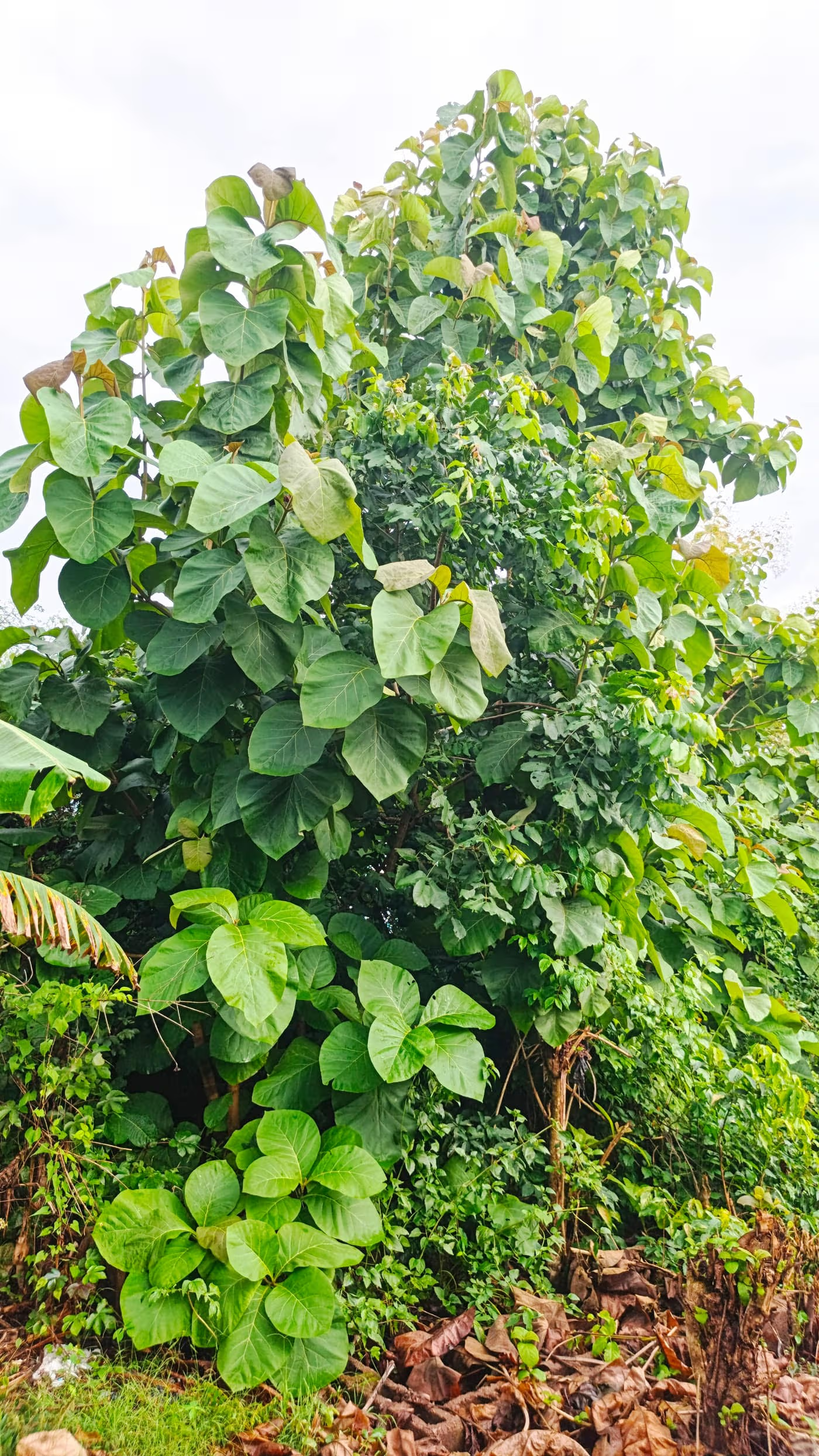
India's premier hardwood timber tree, planted as a pruned one-year "stump" or a tissue-culture clone at monsoon onset and grown on for two decades or more while it is thinned every few years for poles and fuelwood — the real decision that separates a profitable teak block from a locked-up one is not the growing but the paperwork, since felling and moving teak logs off private land still needs state forest department permission under the National Timber Management System even where poplar and eucalyptus have been freed of it.
Quick Summary
The key points from this page in about two minutes — read it or have it read aloud.
Quick Summary
Teak (Tectona grandis), called sagwan or sagaun across most of India, is the country's best-known hardwood timber tree — grown for its strong, naturally termite- and weather-resistant wood used in furniture, doors, window frames, boat-building and shipbuilding. It is a long-term investment, not a short-rotation crop: a farm teak block is usually planted once and thinned every few years for two decades or more before the main crop is felled for full-value timber, with wood quality and price both rising as the tree ages.
The tree is planted from a one-year-old nursery seedling cut down to a bare "stump" — a short piece of root and shoot, easy to transport and to plant by hand at the start of the monsoon — or, increasingly, from a tissue-culture clonal plant bred for a straighter bole and faster early growth. Teak wants deep, well-drained soil (it does badly in waterlogged or heavy clay ground) and a distinct dry season each year, which is exactly why Madhya Pradesh, Maharashtra, Karnataka, Kerala, Gujarat, Tamil Nadu and Andhra Pradesh carry both India's natural teak forests and most of its farm and plantation teak.
What makes teak different from poplar or eucalyptus is not the tree biology but the law. Teak is a high-value species that several states still regulate closely even on private farmland — felling and transporting logs generally needs a permit from the state forest department, now applied for online through the central National Timber Management System (NTMS) portal, unlike poplar and eucalyptus which many states have substantially de-regulated. There is also no MSP and effectively no Agmarknet mandi trade in teak; timber is sold standing or as logs through forest-department auctions, registered timber depots and sawmills, valued by girth, age and grain quality rather than by weight.
Because teak takes decades to pay off in full, it has also attracted fraudulent "plantation investment" schemes that promised fixed, guaranteed multi-fold returns in just a few years — the notorious Anubhav Plantations collapse of the late 1990s, which took in over ₹120 crore from small investors before its promoters vanished, is the best-known example, and SEBI's Collective Investment Scheme regulations exist largely because of cases like it. A genuine teak block grown on your own land is a sound long-term asset; a fixed short-term guaranteed-return "teak scheme" almost never is.
- Crop type
- Deciduous long-rotation hardwood timber tree
- Season
- Planted at monsoon onset (June–July)
- Suitable states
- Madhya Pradesh, Maharashtra, Karnataka, Kerala, Gujarat, Tamil Nadu, Andhra Pradesh
- Rotation length
- 20+ years to full-value timber, thinned in stages from year 5–8
- Water requirement
- Moderate; needs a distinct dry season, never waterlogged soil
- Temperature
- Tropical; 20–38°C growing range, frost-sensitive when young
- Soil type
- Deep, well-drained loam over calcium-rich parent rock; pH 6.5–7.5
- Difficulty level
- Moderate (permit paperwork and long horizon, more than field management)
- Expected yield
- Timber volume builds for decades; value depends on girth-class and grain, not weight
- Key risk
- Felling/transit without a valid state permit, or trusting a guaranteed-return plantation scheme
Overview
Teak (Tectona grandis), known as sagwan across most of north and central India and sagaun/sag in other regions, is a large deciduous tree valued for timber that is strong, dimensionally stable, naturally resistant to termites and fungal decay, and easy to work — the reason it has been the wood of choice for Indian furniture, doors, window frames and traditional boat- and ship-building for centuries. India carries some of the world's finest natural teak forests (Madhya Pradesh, Maharashtra, Karnataka, Kerala) alongside a large and growing area of farm and plantation teak across the same belt plus Gujarat, Tamil Nadu and Andhra Pradesh.
Teak is planted almost entirely by one of two routes: the traditional "stump" — a one-year-old nursery seedling lifted and cut back to a short length of root and shoot, which is cheap, light to transport and plants easily by hand at the start of the monsoon — or, on an increasing number of farm plantations, a tissue-culture clonal plant bred for a straighter bole, more uniform girth and faster early growth, such as the IFGTB TG-series clones now being promoted through state farm-forestry programmes. Either way, the young plantation is thinned in stages every several years — removing the crooked, suppressed or diseased stems for poles and fuelwood — so that the trees left standing concentrate their growth into fewer, larger, better-formed stems by the time of final felling.
What genuinely separates teak from poplar or eucalyptus on a farmer's balance sheet is regulation, not growing difficulty. Because teak logs are valuable enough to be a smuggling target, most states keep tighter control over its felling and transit than they do for poplar, eucalyptus, bamboo and similar de-regulated farm trees — even on private, non-forest land. The Centre's 2024–25 Model Rules for Felling of Trees on Agricultural Land route applications through the National Timber Management System (NTMS) portal, with an automatic no-objection certificate for very small numbers of trees, but teak, along with a handful of other high-value native species, is explicitly carved out of the blanket exemptions given to plantation species like poplar and eucalyptus. Any farmer planning a teak block should register the planting on the NTMS portal (or the applicable state system) at planting time and confirm the current felling and transit procedure with the local forest range office well before the trees mature — not after.
Crop timeline, sowing to harvest
A quick visual map of the season — jump to any section below for the detail behind each stage.
- Year 0 (June–July)
Stump / clonal planting
One-year-old nursery stumps, or tissue-culture clonal plants, are planted in pits at the start of the monsoon, at a close initial spacing to encourage straight early growth.
- Year 1–3
Establishment & first intercrop
Young trees put out a strong first flush; a short intercrop (soybean, pulses, turmeric, vegetables) is often grown between the wide-open rows for the first two or three years before the canopy starts to close.
- Year 3–8
Canopy closure & first thinning
The block canopy closes and crowding begins to suppress weaker stems; the first thinning removes crooked, diseased or overtopped trees for poles and fuelwood, concentrating growth on the remaining crop trees.
- Year 8–20
Progressive thinning
Further thinnings roughly every 5 years remove the next weakest tier of stems, each round giving a marketable intermediate yield of poles and small timber while girth and heartwood build in the trees left standing.
- Year 20+
Final felling
The remaining, best-formed trees are felled for full-value sawtimber once girth, heartwood colour and grain have matured — wood value keeps rising well beyond year 20, which is why most owners fell in stages rather than clear-felling the whole block at once.
Suitable states
States where this crop is grown at scale, highlighted below. Your local Krishi Vigyan Kendra is still the final word for your specific block.
- Jammu and Kashmir
- Himachal Pradesh
- Punjab
- Uttarakhand
- Haryana
- Delhi
- Uttar Pradesh
- Rajasthan
- Bihar
- Jharkhand
- West Bengal
- Sikkim
- Assam
- Arunachal Pradesh
- Meghalaya
- Nagaland
- Manipur
- Mizoram
- Tripura
- Gujarat
- Madhya Pradesh
- Chhattisgarh
- Maharashtra
- Odisha
- Goa
- Telangana
- Andhra Pradesh
- Karnataka
- Kerala
- Tamil Nadu
- Puducherry
- Ladakh
- Chandigarh
- Lakshadweep
Grown here
Climate requirements
Teak's natural range and its best farm-plantation belt (Madhya Pradesh, Maharashtra, Karnataka, Kerala, parts of Gujarat and Tamil Nadu) line up almost exactly with tropical India's monsoon-and-dry-season climate — teak grown well outside this pattern, in continuously wet or in genuinely cold regions, rarely performs.
Ideal temperature
Teak is a tropical species that grows well between about 20°C and 38°C, needs frost protection while young, and is dormant and leafless through the dry season — a genuine cold snap in the first winter or two can kill young stumps outright.
Rainfall
Teak grows across a wide 750–2500 mm annual rainfall range, but the single most important climate fact is that it needs a real dry season of at least three to five months — this is what drives the annual growth rings that give teak timber its strength and is why continuously wet, ever-humid sites rarely produce top-grade wood.
Humidity
Moderate humidity through the growing season suits teak best; prolonged high humidity with poor airflow, especially in dense unthinned blocks, is exactly the condition that favours pink disease and other bark and canker infections.
Sunlight
Full sun once established — teak is a light-demanding species and does not tolerate shade, which is one reason regular thinning matters: an unthinned, overcrowded block slows in growth and produces thin, poorly-formed stems.
Soil requirements
Check both drainage and the underlying rock/soil type before planting a serious teak block — a site over limestone, trap or basalt with good drainage is worth more to a teak grower than any amount of fertiliser on the wrong soil.
Suitable soil
Deep, well-drained, fertile loam is ideal, and teak has a well-documented affinity for soils derived from limestone, trap and basalt rock that carry good available calcium — this is part of why the black-cotton-soil tracts of Madhya Pradesh and Maharashtra grow some of India's best teak. It performs poorly on shallow, waterlogged, heavy clay or strongly acidic lateritic soils.
pH range
Best at a near-neutral pH 6.5–7.5; strongly acidic lateritic soils and saline or alkaline patches both give poor growth and form.
Drainage
Free drainage is essential — teak roots do not tolerate standing water even briefly, and a block planted in a low, water-collecting corner will underperform for its entire life.
Organic matter
Responds well to organic matter worked into the planting pit and to the tree's own leaf litter left as mulch each dry season, which slowly builds soil structure and calcium content under an established block.
Land preparation
Same four steps whichever region you are in — only the timing shifts with the sowing window.
- 1
Mark the grid and dig planting pits
A close initial spacing of 2 × 2 m to 3 × 3 m (roughly 1,000–1,600 plants/acre) is standard for a plantation that will be progressively thinned; dig pits about 30–45 cm across and deep a few weeks ahead of the monsoon so the soil weathers.
- 2
Refill with topsoil and organic matter
Refill each pit with topsoil mixed with well-rotted farmyard manure or compost; in termite-prone belts mix in a recommended soil insecticide or a Metarhizium bio-formulation, since termites are a real risk to freshly planted stumps.
- 3
Order stumps or clonal plants from a state forest department or ICFRE-linked nursery
Book one-year-old teak stumps from the state forest department nursery, or tissue-culture clonal plants from an IFGTB Coimbatore-linked or reputed private tissue-culture nursery, well ahead of the monsoon planting window — good stock sells out early in the planting season.
Seed information
How the main varieties compare, so you can pick by duration, yield, disease pressure or what you are growing for.
| Variety | Duration | Yield | Disease resistance | Best state | Suitable for |
|---|---|---|---|---|---|
A Geographical Indication (GI)-tagged natural seed source from Nilambur taluk, Malappuram district, Kerala — the world's first forest-wood product to receive a GI tag, prized internationally for straight grain, golden-brown colour and exceptional durability; historically the source of teak used in Beypore-built sailing ships. | 20+ years to full-value timber | Very high wood value; premium grade recognised in the international timber trade | Not separately documented; standard teak disease/pest watch applies | Kerala | Premium furniture, boat-building, high-value sawtimber |
A distinct natural seed source from the Konni hill forests of Kerala, giving slower-grown, closer-grained, darker and reportedly stronger timber than Nilambur teak — long recognised alongside Nilambur as one of Kerala's two classic named teak seed sources. | 20+ years, slower early growth than Nilambur | High; valued for strength and density over speed of growth | Not separately documented | Kerala | High-strength construction and furniture timber |
Five tissue-culture clones developed and released by ICFRE-IFGTB, Coimbatore, selected for faster growth, better girth development and a straighter, more cylindrical bole than seedling-origin planting stock; being promoted to farmers through state programmes such as Tamil Nadu's Green Tamil Nadu Mission, and individually available through IFGTB-linked and private tissue-culture nurseries. | Faster early growth than seedling stock; full rotation still 20+ years | High; more uniform bole shape improves sawn-timber recovery | Not separately documented; monitor for the same defoliator/pink disease risk as any teak planting | Tamil Nadu and other states running IFGTB-linked tissue-culture programmes | Farm forestry blocks aiming for uniform, straight-boled timber |
South Gujarat (Dangs–Valsad) Teak Teak grown on the Dangs and Valsad forest tracts of south Gujarat, a regionally recognised commercial-quality seed source and one of the western-India teak belts that supplies both government plantations and private farm forestry in the state. | 20+ years to full-value timber | Good; recognised regional-quality timber | Not separately documented | Gujarat | General construction and furniture timber |
Central India (TFRI Jabalpur seed-orchard) Teak Seed collected from the Tropical Forest Research Institute (TFRI), Jabalpur's clonal seed orchard — which holds roughly 80 superior clones gathered from teak-growing states across India — supplied through Madhya Pradesh Forest Department and TFRI-linked nurseries as improved planting stock for the central-Indian teak belt. | 20+ years to full-value timber | Improved over unselected local seed; orchard-collected seed gives more uniform stands | Not separately documented | Madhya Pradesh, adjoining Maharashtra | General plantation and farm-forestry timber |
Private Tissue-Culture Clonal Teak Clonal teak plantlets raised by private tissue-culture laboratories (such as Sachdev Nursery, Damoh, Madhya Pradesh, and similar labs) for direct sale to farmers — the modern commercial route most new farm-teak plantings actually use today, offering faster, more uniform early growth than ordinary seedling stumps at a higher per-plant cost. | Faster early growth than seedling stock; full rotation still 20+ years | High; uniform planting stock improves final stand quality | Not separately documented | Madhya Pradesh and other central/western Indian states with active tissue-culture nurseries | Farm forestry blocks where planting-stock cost is secondary to uniform growth |
- Seed rate
- Teak is planted from vegetative nursery stock, not broadcast seed — either one-year-old bare-root "stumps" (a nursery seedling cut back to about 2–2.5 cm root-collar diameter, with the root pruned to about 20–25 cm and the shoot cut to about 2 cm) or a tissue-culture clonal plant. Plan for roughly 1,000–1,600 plants per acre at the standard 2 × 2 m to 3 × 3 m initial spacing, allowing for later thinning.
- Certified seed
- Source stumps from a state forest department nursery or a reputed private nursery working from a known seed-production area or clonal seed orchard (Nilambur, Konni, South Gujarat, TFRI Jabalpur CSO); source clonal plants from an IFGTB Coimbatore-linked or reputed private tissue-culture laboratory. Reject stumps with a shrivelled root collar, mould on the cut surfaces, or no visible buds.
- Spacing
- 2 × 2 m (about 1,000 plants/acre) to 3 × 3 m (about 450 plants/acre) at initial planting, thinned progressively every 5 years or so down to a final crop of a few dozen large, well-formed trees per acre by year 20+.
- Seed treatment
- Stumps are planted the same day they are lifted and trimmed wherever possible; if they must be held, keep the root ends moist and shaded and plant within a day or two. Dipping the cut root end in a slurry of cow-dung, clay and a recommended fungicide before planting is common practice against collar and root infections.
Sowing guide
A stump planted upside-down or too shallow simply fails to shoot — check that the natural root-to-shoot orientation is preserved and that enough of the shoot end is below the collar mark before covering the pit.
- Best time
- Plant at the start of the monsoon (June–July), once the soil has been wetted by the first good rains — this is the only planting window that gives the young stump or clonal plant enough soil moisture to establish before the following dry season.
- Row spacing
- 2–3 m between rows at initial planting, reduced further only for very high-density biomass-style blocks
- Plant spacing
- 2–3 m within the row, matching the row spacing for a square or near-square grid
- Sowing depth
- Set a stump so the root collar sits at or just below ground level and the cut shoot tip is level with or barely above the soil surface; a clonal plant is set at the same depth it was growing in its nursery container.
- Method
- One stump or clonal plant per pit, firmed in with the heel and watered immediately if the ground is not already saturated from recent rain; irrigate again after a week if the monsoon breaks.
Fertilizer schedule
A split dose beats one large dose applied at sowing — nitrogen especially is lost to the air and to leaching if it all goes in on day one.
- 1
At planting (basal)
Year 0
Well-rotted farmyard manure or compost mixed into the pit; teak establishes well on organic matter alone on a reasonable soil and rarely needs heavy chemical fertiliser at planting.
- 2
Young trees
Years 1–3
A modest dose of urea, SSP and MOP (roughly 50–100 g urea, 25–50 g SSP, 25–50 g MOP per tree per year, split across the growing season) helps establishment on poorer soils; skip this entirely on good black-cotton or calcareous loam where growth is already strong.
- 3
Established block
Year 4 onward
Most established teak blocks on suitable soil are not fertilised at all beyond their own leaf-litter return; a thin annual layer of compost around the base on lighter or degraded soils is the usual practice where extra input is judged worthwhile.
Irrigation schedule
1. Establishment
First 1–2 dry seasons
A young stump or clonal plant benefits from occasional watering through its first one or two dry seasons if rainfall has been poor, especially on light soils — this is the period most likely to lose plants to drought stress.
2. Established block
Year 3 onward
Teak on a suitable site is normally rainfed once established and does not need routine irrigation — its natural dry-season leaf drop is part of how it grows, not a sign of water stress.
Critical stages
- First dry season after planting
- Any unusually long dry spell in years 1–2
Water-saving tips
- Plant at the true start of the monsoon, not before it, so the young root system has the maximum run of wet-season moisture before its first dry season test.
- A basin or shallow ring around each young plant in year 1 concentrates any supplemental watering over the root zone.
- Leave the tree's own dry-season leaf fall as mulch around the base — it holds soil moisture and slowly returns organic matter and nutrients.
Weed management
Common weeds
Organic control
- Two or three hand or hoe weedings a year in a roughly 1 m circle around each young tree for the first two years is usually enough — after that the closing canopy shades most weeds out on its own.
- Growing a short intercrop (soybean, pulses, turmeric, vegetables) between the rows for the first 2–3 years both earns money and keeps the ground worked and largely weed-free.
- Slash Lantana and other woody weeds before they seed, and leave the slashings as mulch to smother the next flush.
Chemical control
- Weed control in the first two years is normally by manual hoeing in a basin around each young tree rather than routine herbicide use.
- A directed pre- or post-emergence herbicide cleared for plantation use can be used along the tree row in a large block, kept well off young bark; confirm the current product and dose with your state forest department or KVK.
Nutrient deficiency identification
What a shortage of each nutrient actually looks like on the plant, so you can tell a deficiency apart from a disease before you spray the wrong thing.
Nitrogen
Visible symptom
Pale, yellow-green older leaves and a thin annual height flush in an otherwise healthy-looking block — usually only seen on poor, sandy or degraded soils.
Phosphorus
Visible symptom
Slow early establishment of the stump or clonal plant, poor root spread and a dull, purple-tinged cast on the older leaves of a young tree.
Calcium
Visible symptom
Stunted, poorly-formed growth and thin, weak stems on strongly acidic lateritic soils that lack teak's preferred calcium-rich parent material — the reason site selection matters more for teak than fertiliser correction.
Diseases to watch for
Symptoms, likely cause and what actually treats it — not just a spray name.
Pests to watch for
What to look for before the damage is visible, and organic options before you reach for a chemical.
Teak defoliator
- Identification
- Caterpillars of the moth Hyblaea puera feeding on young, tender leaves early in the growing season, often in sudden large outbreaks that can strip a plantation bare within days; adults are small brown-and-orange moths active at night.
- Damage
- The most serious teak pest in India — repeated early-season defoliation slows height and girth growth, reduces flowering and seed production, and can set a young block back significantly if it recurs year after year.
- Organic control
- Conserve natural egg parasitoids (Trichogramma species are used in mass-release biological control programmes against this pest) and predatory birds; hand-collect caterpillars from young trees where the outbreak is small and localised.
- Chemical control
- A CIB&RC-registered contact insecticide spot-sprayed at the first sign of an outbreak, before caterpillars scatter and mature, on high-value young plantations; confirm the current product with your state forest department or nearest KVK — most large outbreaks in natural and plantation forest are left to run their course and are followed by natural parasitoid control.
Teak skeletonizer
- Identification
- Caterpillars of the moth Eutectona machaeralis feeding on the green leaf tissue while leaving the network of veins intact, giving affected leaves a lacy, skeletonised look; damage is usually seen later in the season than the defoliator, on older leaves close to natural leaf fall.
- Damage
- Less serious than the teak defoliator because it feeds later in the season on leaves that would soon drop naturally, but repeated heavy skeletonizing in the same years as defoliator attack compounds the loss of growth and seed production.
- Organic control
- The same parasitoid conservation and outbreak monitoring used against the teak defoliator also helps control the skeletonizer; the two pests are usually managed together, not separately.
- Chemical control
- Rarely justifies separate chemical treatment given its late-season, lower-impact feeding; treat only where it compounds a genuine defoliator outbreak on high-value young plantings, using the same registered contact insecticide.
Termites
- Identification
- Mud sheeting on the stem of freshly planted stumps and young trees, with the soft bark and root collar eaten away underneath; worst on sandy soils, in dry belts, and where undecomposed organic matter has been mixed into the planting pit.
- Damage
- Can kill a freshly planted stump before it roots properly, girdle a young tree at the collar, and attack the roots of stressed older trees; also a risk to felled logs and sawn timber left in storage.
- Organic control
- Use only well-decomposed manure in the planting pit (fresh manure attracts termites), drench the pit with a Metarhizium bio-insecticide in known termite-prone belts, and keep felled logs stacked off the ground and clear of termite mounds.
- Chemical control
- Mix a recommended soil insecticide into the pit at planting in termite-prone areas, and drench around the collar of any affected young tree; confirm the current product with your state forest department or KVK.
Common mistakes to avoid
The mistakes that cost growers the most, ranked by how often they show up in the field — not in the order you might expect.
- 1
Felling or transporting teak logs without confirming the current permit requirement.
Why it hurts
Unlike poplar or eucalyptus, teak felling and transit is still tightly regulated in most states even on private land — moving logs without the correct forest-department clearance (now applied for through the National Timber Management System portal) risks seizure of the timber and legal action, regardless of who planted the tree.
- 2
Trusting a "plantation investment" scheme that promises a fixed, guaranteed high return from teak in just a few years.
Why it hurts
Real teak takes two decades or more to reach full timber value; the notorious Anubhav Plantations collapse of the late 1990s (over ₹120 crore lost) is the best-known example of a fraudulent scheme built on exactly this promise — treat any fixed short-term guaranteed-return teak scheme as a serious red flag.
- 3
Planting on heavy clay, waterlogged or strongly acidic lateritic soil.
Why it hurts
Teak performs poorly outside deep, well-drained, near-neutral to calcium-rich soil — a block on the wrong soil type stays stunted and poorly formed for its entire life, however well it is otherwise managed.
- 4
Skipping scheduled thinning as the block grows.
Why it hurts
An overcrowded, unthinned block slows in overall growth, produces thin and poorly-formed stems on the trees that would otherwise become the final crop, and creates the dense, humid conditions that favour pink disease.
- 5
Planting unlabelled seedling stock with no known seed source when a recognised source (Nilambur, Konni, TFRI Jabalpur CSO, an IFGTB clone) is available.
Why it hurts
Timber from an unimproved, unknown seed source is harder to grade and market with confidence at felling, and may show more crooked or poorly-formed stems than plantings from a documented seed source or clone.
- 6
Ignoring a defoliator outbreak in a young, high-value block on the assumption "it always happens in the forest anyway".
Why it hurts
Repeated early-season defoliation in the first several years measurably slows a young block's height and girth gain — a loss that natural forest can absorb over its much larger area but a small farm plantation feels directly in its final timber volume.
Harvesting
Teak is not harvested once like an annual crop — it is thinned in stages from around year 5–8 onward (removing the weakest, most crowded or diseased stems for poles and fuelwood) and the final, best-formed trees are felled for full-value sawtimber from year 20 onward, once girth, heartwood colour and grain have matured; many owners stagger the final felling over several years rather than clear-felling the whole block at once.
Signs it is ready
- Heartwood has developed the characteristic golden-brown colour and has visibly hardened when cut
- Girth has reached the class the local sawmill or timber trader is paying a premium for
- A valid felling permit for the specific trees has been obtained from the state forest department / NTMS portal before any cutting begins
Tools
- Chainsaw or two-person crosscut saw for felling and cross-cutting
- Tractor-trolley or truck for transporting logs, only after transit documentation is in order
- A registered timber depot or sawmill for grading and sale
Expected yield
Timber volume and value both keep building with age rather than reaching a fixed per-acre figure at a set year — a mature, well-formed teak stand is valued log by log on girth-class, heartwood proportion and grain quality, not sold by simple weight or tonnage the way poplar or eucalyptus pulpwood is.
Post-harvest & storage
Storage
Felled teak logs are far more decay- and termite-resistant than poplar or eucalyptus and can be stored longer if needed, but should still be stacked off the ground on cross-battens under cover to prevent staining, cracking from sun exposure, and pest entry through the cut ends.
Packaging
Logs are graded and sold by measured girth-class, length and visible grain/heartwood quality, usually at a registered timber depot, sawmill or forest-department auction rather than by simple weight.
Transportation
This is the step that differs most sharply from poplar and eucalyptus. Felling and transporting teak grown on private land generally still requires a permit from the state forest department, now applied for through the Centre's National Timber Management System (NTMS) portal under the 2024–25 Model Rules for Felling of Trees on Agricultural Land — very small numbers of trees may get an automatic no-objection certificate, but teak is specifically excluded from the blanket exemptions given to poplar, eucalyptus and similar farm-forestry species in several states. Register the plantation on the NTMS portal (or the applicable state system) at planting time, and confirm the exact current procedure with your local forest range office well before the trees are ready to fell.
Shelf life
Sawn teak timber, once seasoned, is exceptionally long-lasting and does not need special short-term storage — its natural oil content and durability are the whole basis of its value in furniture and boat-building.
Market prices
Today's mandi price near you, pulled live from the government's own Agmarknet data.
Live daily mandi prices from the government Agmarknet dataset.
Government mandi price not available for this crop
This crop is not traded through APMC mandis covered by the government’s Agmarknet system, so there is no mandi price to show here.
Weather
Current conditions and a 5-day outlook for your selected location, with one line of stage-aware advice.
Pick your state for current conditions and a 5-day outlook.
Live data from Open-Meteo
Profit calculator
Your own cost sheet, expected yield and selling price — not ours.
Where the money goes
Share of the total cost per acre, using the calculator’s own default cost sheet below — adjust the numbers there to match your field and this picture will no longer apply to you exactly, but the ranking rarely changes.
- Land rent40% (₹9,000)
- Labour22% (₹5,000)
- Seed13% (₹3,000)
- Fertiliser7% (₹1,500)
- Pesticide & weedicide4% (₹1,000)
- Machinery4% (₹1,000)
- Irrigation4% (₹1,000)
- Interest4% (₹1,000)
Official downloads
Government and ICAR documents only — everything below is hosted on an official server.
ICAR — Central Agroforestry Research Institute (CAFRI, Jhansi)
National institute for agroforestry, including timber-tree systems
Institute of Forest Genetics and Tree Breeding (IFGTB), Coimbatore
Teak clone research, tissue culture and improved planting stock
National Timber Management System (NTMS)
Central portal for registering farm-tree plantations and applying for felling/transit permits
Kisan Call Centre — 1800-180-1551
Free crop advice in your language
Frequently asked questions
Do I really need a permit to fell teak grown on my own farm?
In most states, yes — unlike poplar and eucalyptus, which several states have substantially de-regulated for private-land felling, teak remains a tightly controlled high-value species. The Centre's 2024–25 Model Rules for Felling of Trees on Agricultural Land route applications through the National Timber Management System (NTMS) portal, with an automatic no-objection certificate only for very small numbers of trees, and teak is specifically excluded from the wider blanket exemptions given to plantation species. Register your planting on the NTMS portal at planting time and confirm the current procedure with your local forest range office before you fell or move any logs.
Should I plant ordinary seedling stumps or a tissue-culture clone?
A stump (a one-year-old nursery seedling cut back to a short root-and-shoot piece) is cheap, easy to transport and the traditional, still-dominant planting method — it works well from a good seed source like Nilambur, Konni, South Gujarat or a TFRI Jabalpur seed-orchard collection. A tissue-culture clonal plant (an IFGTB TG-series clone or similar from a private tissue-culture nursery) costs more per plant but gives a straighter, more uniform bole and faster early growth. Either is a legitimate choice; the clonal route suits a farmer prioritising uniform timber quality over lower upfront cost.
Is there an MSP or mandi price for teak?
No. Teak is not a CACP-notified commodity and has no MSP, and a live check of the Agmarknet/data.gov.in mandi-price system found no genuine trading records for teak or sagwan at any APMC. Teak is sold as standing timber or logs through state forest-department auctions, registered timber depots and sawmills, priced by girth-class, age and grain/heartwood quality rather than through the mandi system that handles farm produce.
How long before a teak block actually pays off?
Teak is a decades-long investment, not a short-rotation crop. The block gives some intermediate income from thinnings of poles and fuelwood starting around year 5–8, with further thinnings roughly every five years after that, but the main crop of full-value sawtimber is usually not felled before year 20, and wood value keeps rising well beyond that as girth and heartwood develop. Be very wary of anyone promising a fixed, guaranteed high return in just a few years — see the note on plantation investment scams below.
Are teak plantation "investment schemes" safe?
Be cautious. A genuine teak block grown on your own registered land is a sound, if slow, long-term asset. But teak's long payoff horizon has historically attracted fraudulent collective-investment schemes promising fixed, guaranteed multi-fold returns in just a few years — the Anubhav Plantations collapse of the late 1990s, which took in over ₹120 crore from small investors before its promoters disappeared, is the best-documented Indian example, and it is part of why SEBI's Collective Investment Scheme regulations exist today. Treat any scheme promising a fixed short-term guaranteed return from teak as a serious red flag, and verify any such company's registration with SEBI before investing.
What can I grow between the rows while the teak is young?
A short intercrop is common practice for the first two to three years while the wide initial spacing still lets in full sun — soybean, other pulses, turmeric and vegetables all work well and help pay for establishment costs while the trees are still small. From around year 3–4 the closing canopy shades most intercrops out and the block is left to the trees.
Still have questions?
The FAQs above cover the common ones. For anything specific to your field and soil, your nearest Krishi Vigyan Kendra is the authoritative answer.