
Dragon Fruit (Kamalam)
Hylocereus / Selenicereus spp.
A climbing cactus grown on concrete poles, where three things decide whether a plot pays: choosing a cultivar that actually sets fruit in your block (some red-fleshed types are poorly self-fertile and need a pollen partner or night hand-pollination), building a sturdy pole-and-ring trellis once at the start because the plant crops off it for twenty years, and timing the harvest — the fruit is cut ripe and does not sweeten further after picking, so a day early means a flat, sour fruit and a day late on the plant means bird and fruit-fly damage.
Quick Summary
The key points from this page in about two minutes — read it or have it read aloud.
Quick Summary
Dragon fruit, officially renamed Kamalam in India, is a fast-spreading, high-value climbing cactus (Hylocereus / Selenicereus species) that has gone from a curiosity to a serious commercial crop in barely a decade — Gujarat (Kutch), Maharashtra, Karnataka, Andhra Pradesh, Telangana and now many other states have taken it up, and India still imports most of what it consumes, so the home market is nowhere near saturated.
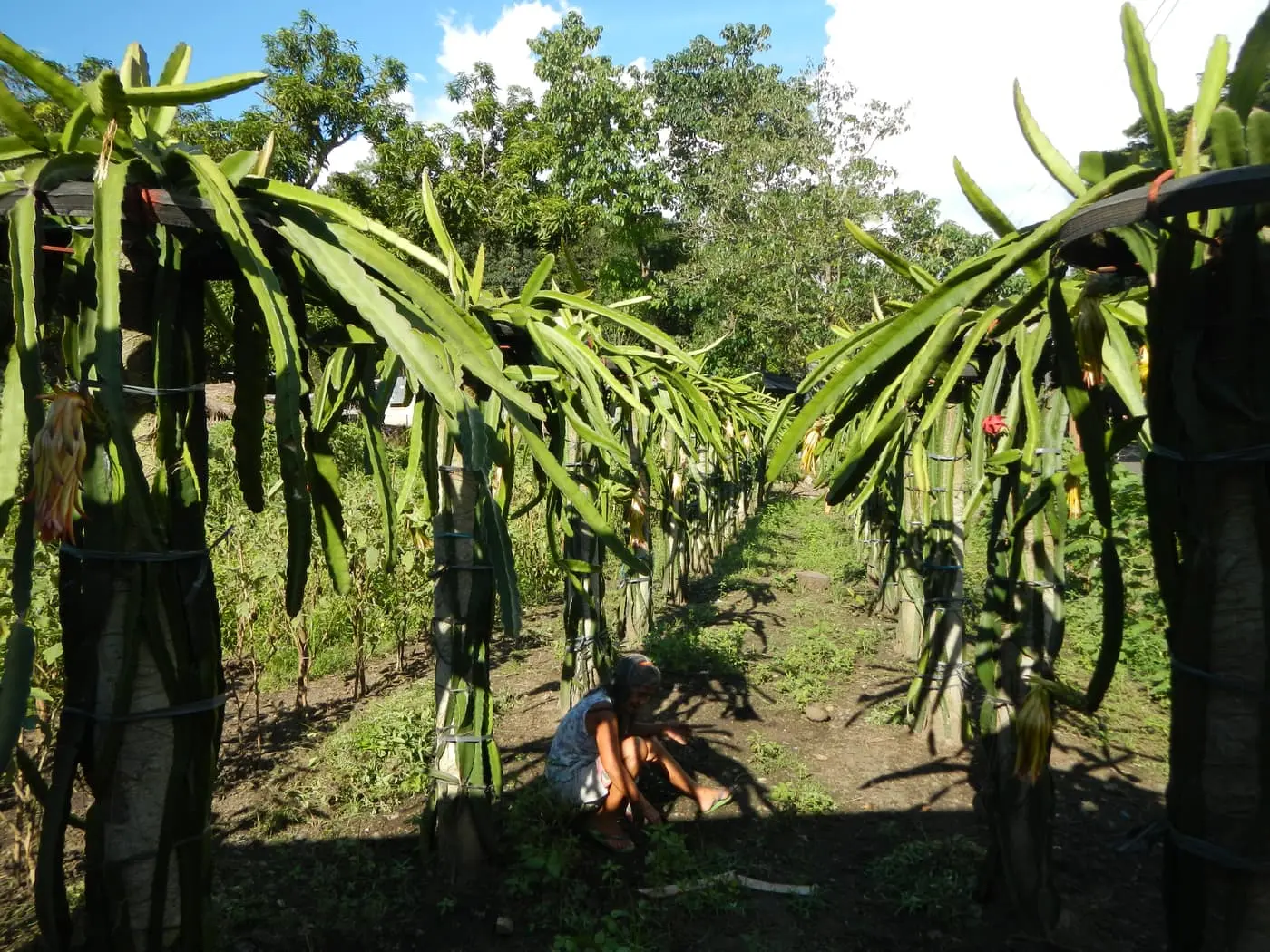
It is grown not from seed but from rooted stem cuttings, trained up a concrete or cement pole topped with a tyre or metal ring so the fleshy stems can cascade over and crop. That pole-and-ring trellis is a one-time cost that carries the planting for twenty years or more, so it is worth building properly — a weak support that collapses under the weight of a mature plant is one of the most expensive early mistakes. Spacing is usually about 2 m × 2 m to 3 m × 3 m, with three to four cuttings set around each pole.
The single agronomic fact that catches new growers out is pollination. Many red-fleshed cultivars — the ones the market pays most for — are partly or fully self-incompatible, meaning a solid block of one red clone can flower heavily and set almost no fruit. The flowers open for a single night and are naturally moth- and bat-pollinated, so a plot either needs a second compatible cultivar interplanted, or the grower hand-pollinates the open flowers at night with a brush. White-fleshed types are generally self-fertile and more forgiving, which is part of why a beginner is often steered toward them first.
Beyond that, dragon fruit is genuinely low-input and drought-hardy. It wants free-draining soil above all — it rots in waterlogging faster than almost any fruit crop — a little drip water and mulch, a light balanced feed, and protection against the handful of problems that matter: stem canker and anthracnose on the fleshy stems in humid weather, mealybugs and ants, and fruit flies and birds on the ripening fruit. It starts bearing in its first or second year and builds toward 20–25 kg per plant by the fourth year, cropping in repeated flushes from roughly June to November.
- Crop type
- Perennial climbing cactus (fruit), grown on poles
- Season
- Planting: monsoon (June–Aug); fruiting June–November in flushes
- Suitable states
- Gujarat, Maharashtra, Karnataka, Andhra Pradesh, Telangana, Tamil Nadu, Odisha
- Growing duration
- First fruit in 1–2 years; full yield by year 4–5; productive 20+ years
- Water requirement
- Low; drought-hardy, but needs good drainage — rots in waterlogging
- Temperature
- Best ~20–35°C; damaged below 0°C and above 40–45°C
- Soil type
- Free-draining sandy loam to loam; pH ~5.5–7; tolerates poor, rocky land
- Difficulty level
- Moderate — pollination and trellis decide the outcome
- Expected yield
- 20–25 kg/plant at maturity (~10 t/acre on a mature planting)
- Key risk
- A solid block of a self-incompatible red clone that flowers but sets no fruit
Overview
Dragon fruit — officially promoted in India as Kamalam, the name Gujarat adopted in 2020 — is the fruit of a climbing cactus (mainly Hylocereus undatus with white flesh, H. costaricensis / polyrhizus with red flesh, and the yellow-skinned Selenicereus megalanthus), grown for its striking pink-or-yellow-skinned fruit with sweet, lightly crunchy, seed-flecked flesh. It is one of the highest-value fruit crops a farmer can plant on marginal, well-drained land.
Commercial cultivation has expanded very fast since around 2015: Gujarat (especially the Kutch region), Maharashtra, Karnataka, Andhra Pradesh, Telangana, Tamil Nadu and Odisha are among the leading states, and the crop has been actively promoted as an import-substitution and drought-hardy diversification option. India still imports the bulk of its dragon fruit, so domestic demand comfortably exceeds supply.
Grown from stem cuttings on a permanent pole-and-ring trellis, it is a perennial that bears for twenty years or more from one planting. The crop turns on three decisions: matching the cultivar to the market and to pollination needs (many red-fleshed types are poorly self-fertile), building a trellis strong enough to carry a mature plant, and harvesting at the right ripeness since the fruit does not sweeten after picking. Free-draining soil is non-negotiable — the plant tolerates drought far better than it tolerates wet feet.
Crop timeline, sowing to harvest
A quick visual map of the season — jump to any section below for the detail behind each stage.
- Year 1 (June–Aug)
Planting & trellis
Concrete poles are set and topped with a ring; three to four rooted cuttings are planted around each pole at the onset of the monsoon and tied up as they grow.
- Months 1–12
Vine establishment
The fleshy stems are trained up the pole to the ring, side-shoots below the top are removed, and the plant builds the framework it will crop from for decades.
- Year 1–2
First flowering & fruit
The plant begins to flower and set a first, modest crop once the stems reach and cascade over the ring.
- Each year, May–July
Flowering flushes begin
Large white night-opening flowers appear in successive flushes; each flower opens for a single night and must be pollinated that night for fruit to set.
- Each year, ~30–50 days after each flush
Fruit development
Fruit develops quickly after pollination, changing colour as it ripens; the crop comes in several waves rather than one harvest.
- Each year, June–November
Harvest flushes
Ripe fruit is cut in repeated pickings through the season; yield builds year on year toward a mature 20–25 kg per plant by about year four.
Suitable states
States where this crop is grown at scale, highlighted below. Your local Krishi Vigyan Kendra is still the final word for your specific block.
- Jammu and Kashmir
- Himachal Pradesh
- Punjab
- Uttarakhand
- Haryana
- Delhi
- Uttar Pradesh
- Rajasthan
- Bihar
- Jharkhand
- West Bengal
- Sikkim
- Assam
- Arunachal Pradesh
- Meghalaya
- Nagaland
- Manipur
- Mizoram
- Tripura
- Gujarat
- Madhya Pradesh
- Chhattisgarh
- Maharashtra
- Odisha
- Goa
- Telangana
- Andhra Pradesh
- Karnataka
- Kerala
- Tamil Nadu
- Puducherry
- Ladakh
- Chandigarh
- Lakshadweep
- Andaman and Nicobar Islands
- Dadra and Nagar Haveli and Daman and Diu
Grown here
Climate requirements
The biggest climate misjudgement is treating dragon fruit as a wetland crop because it is thirsty-looking and fast-growing. It is the opposite — a cactus that dies in wet feet. Choose the best-drained part of the farm, never a low, water-collecting patch.
Ideal temperature
A tropical/subtropical cactus, happiest around 20–35°C. It is remarkably heat- and drought-tolerant but has real limits: stems are scorched and sunburned above about 40–45°C (a problem in exposed summer plots, where shade netting or interplanting helps) and are damaged by frost and temperatures below 0°C, which rules out genuinely cold regions.
Rainfall
Suited to low-to-moderate rainfall areas; it stores water in its fleshy stems and withstands long dry spells better than almost any fruit crop. Heavy or poorly-drained rainfall is the real danger — standing water quickly rots the stems and roots, so the crop is grown on well-drained land, often on a slight mound at each pole.
Humidity
Moderate humidity is fine, but prolonged warm, humid, overcast weather sharply raises the risk of stem canker and anthracnose on the fleshy stems — airflow between poles and avoiding overhead wetting both help.
Sunlight
Full sun gives the best flowering and fruiting, but in very hot, exposed plots the stems can sunburn — a light shade net or a taller interplanted shade line is sometimes used in the hottest tracts.
Soil requirements
A planting pit generously filled with topsoil, well-rotted manure and some sand or gravel for drainage gives the young cutting its best start, especially on heavier ground where drainage must be engineered rather than assumed.
Suitable soil
Dragon fruit grows on a wide range of soils provided they drain freely — sandy loam to loam is ideal, and it famously performs on poor, gravelly, rocky and marginal land where little else fruits (Kutch's rocky tracts are a signature example). Heavy clay that holds water is the one soil to avoid unless it is heavily amended and raised.
pH range
Prefers a slightly acidic to neutral soil, roughly pH 5.5–7; it tolerates a fair range but does best away from strongly alkaline or saline extremes.
Drainage
Free drainage is the single most important soil requirement — the fleshy stems and roots rot rapidly in standing water. Planting on a slight mound around each pole and ensuring surface water drains away are standard practice.
Organic matter
Responds well to farmyard manure or compost worked into the planting pit and top-dressed each year; being a cactus, it needs far less feeding than most fruit crops to crop well.
Land preparation
Same four steps whichever region you are in — only the timing shifts with the sowing window.
- 1
Set the poles and rings
Erect sturdy concrete/cement poles (about 1.8–2 m above ground) at 2 m × 2 m to 3 m × 3 m spacing, each topped with an old tyre or a metal/concrete ring for the stems to cascade over — this trellis carries the crop for 20+ years, so it must not sag or fall.
- 2
Dig and enrich the planting pits
Dig a pit beside each pole, refill with topsoil mixed with well-rotted FYM and some sand/gravel for drainage, and raise the planting spot slightly so water never pools around the base.
- 3
Plan for pollination from the start
Decide the cultivar layout before planting — if red-fleshed self-incompatible clones are used, interplant a compatible pollen-donor cultivar through the block rather than planting a single clone solid.
Seed information
How the main varieties compare, so you can pick by duration, yield, disease pressure or what you are growing for.
| Variety | Duration | Yield | Disease resistance | Best state | Suitable for |
|---|---|---|---|---|---|
A large, red-skinned, deep red-fleshed cultivar (Hylocereus costaricensis type) and one of the most widely planted commercial clones in India, prized for size and the high-value red flesh the market pays most for. Like most red-fleshed types it sets best with cross-pollination or night hand-pollination. | Bears from year 1–2; fruiting flushes June–November | High; large fruit, building to 20–25 kg/plant at maturity | No special resistance; manage stem canker and anthracnose in humid weather | Gujarat, Maharashtra, Karnataka, Andhra Pradesh | Premium red-flesh fresh market, with a pollen partner interplanted |
A popular red-fleshed selection of Vietnamese origin, widely multiplied and sold by Indian nurseries, valued for reliable cropping and good red flesh colour. Best cropped with a compatible pollinator nearby. | Bears from year 1–2; flushes June–November | High and reliable once established | No special resistance widely documented | Maharashtra, Telangana, Andhra Pradesh, Karnataka | Commercial red-flesh plantings, fresh market |
A red-skinned, red-fleshed cultivar sold widely in India, named for its origin, known for sweet, intensely coloured flesh. Shares the self-incompatibility of most red types, so it needs cross-pollination or hand-pollination for good fruit set. | Bears from year 1–2; flushes June–November | High with good pollination | No special resistance widely documented | Gujarat, Maharashtra, Karnataka | Premium red-flesh market, interplanted with a pollen donor |
A red/pink-fleshed cultivar of American origin popular with Indian growers for its attractive bright-magenta flesh and good eating quality, sold as rooted cuttings by specialist nurseries. | Bears from year 1–2; flushes June–November | Good, with reliable fruit quality | No special resistance widely documented | Maharashtra, Karnataka, Gujarat | Niche premium fresh market, mixed-cultivar blocks |
The classic white-fleshed, pink-skinned type (Hylocereus undatus), generally self-fertile and the most forgiving choice for a first planting since it sets fruit without a pollen partner. Milder and less intensely sweet than the red types, and usually a lower market price. | Bears from year 1–2; flushes June–November | High and dependable; self-fertile | No special resistance widely documented | Grown across all dragon-fruit states | Beginners, self-pollinating blocks, everyday fresh market |
A yellow-skinned, white-fleshed type (Selenicereus megalanthus, the Ecuadorian "Palora"), the sweetest of the common types and a slow, premium niche crop in India — later-maturing, smaller-fruited and more demanding than the pink-skinned types, grown for a high-price specialty market. | Slower to establish and bear than pink types; niche | Lower and slower, but highest price per fruit | No special resistance widely documented | Small specialty plantings in Maharashtra, Karnataka | High-value niche market, experienced growers |
- Seed rate
- Not grown from seed commercially — planted as rooted stem cuttings, about 3–4 cuttings per pole, at roughly 1,600–2,700 poles per hectare depending on spacing (2 m × 2 m to 3 m × 3 m). Seed is used only in breeding, not for commercial planting.
- Certified seed
- Buy true-to-type rooted cuttings of a named cultivar from a reputable nursery, ICAR institute (such as ICAR-IIHR, Bengaluru) or state horticulture department — a mislabelled cutting is not obvious until the plant flowers and fruits two years later. Where red-fleshed self-incompatible clones are planted, buy a second compatible cultivar as a pollen donor at the same time.
- Spacing
- 2 m × 2 m to 3 m × 3 m between poles (about 1,600–2,700 poles/ha), with 3–4 cuttings set around each pole.
- Seed treatment
- Cuttings are usually cured (the cut end allowed to dry for a few days) and may be dipped in a fungicide/Trichoderma solution before planting to prevent basal rot — a wet, uncured cutting planted straight into damp soil rots easily.
Sowing guide
Never plant an uncured, freshly-cut stem into wet soil — let the cut end dry and callus for a few days first, or it is very likely to rot at the base before it roots.
- Best time
- Plant rooted cuttings at the onset of the monsoon (June–August in most of India) so they establish with reliable warmth and moisture; with assured drip irrigation, planting can extend a little either side of this window in frost-free areas.
- Row spacing
- 2–3 m between pole rows
- Plant spacing
- 2–3 m between poles; 3–4 cuttings per pole
- Sowing depth
- Set the cured cutting 3–5 cm deep beside the pole, firm the soil, and tie it to the pole as it grows
- Method
- Plant 3–4 cured cuttings around each pole, raised slightly on a mound, and train the growing stems up the pole to the ring where they cascade over to crop; remove side-shoots below the ring so the plant's energy goes into the cropping canopy on top.
Fertilizer schedule
A split dose beats one large dose applied at sowing — nitrogen especially is lost to the air and to leaching if it all goes in on day one.
- 1
Young plant (year 1)
Split through the growing season
A modest dose for a first-year plant — roughly 10–15 kg well-rotted FYM per pole plus a light balanced NPK dose, little and often, to build stem framework.
- 2
Young plant (years 2–3)
Split 3–4 times a year
Doses increase gradually as the plant builds its cropping canopy; a balanced NPK with adequate potassium supports the first real crops.
- 3
Bearing plant (from year 3–4)
Split through flowering and fruiting flushes
A mature plant is commonly given around 20–30 kg FYM per pole per year plus a balanced NPK leaning on potassium for fruit quality, split across the flushes. Over-feeding nitrogen gives lush stems and poor flowering.
Irrigation schedule
1. Establishment (first months)
Light, regular drip
Newly planted cuttings need light, regular moisture to root and establish — but never waterlogging, which rots the base before it roots.
2. Vegetative growth
As needed in dry spells
An established plant needs only occasional water; it stores moisture in its stems and tolerates long dry spells well.
3. Flowering and fruiting
Steady drip through the flushes
Water is most worthwhile during flowering and fruit development, when steady (not heavy) moisture improves fruit size and set — cut back once fruit is near ripe.
Critical stages
- Establishment of young cuttings
- Flowering and fruit development
Water-saving tips
- Drip irrigation with a mulch around each pole delivers the small amount of water the crop needs efficiently and keeps the base from both drying out and waterlogging.
- Because the plant is genuinely drought-hardy, water is best concentrated on establishment and on the flowering/fruiting flushes rather than applied routinely year-round.
- Never flood-irrigate — standing water around the base is the fastest way to lose a plant to stem and root rot.
Weed management
Common weeds
Organic control
- A mulch of straw or dry leaves around each pole suppresses weeds, conserves moisture and keeps the root zone cool.
- Shallow hand-weeding or slashing around the poles in the establishment years, after which the cascading canopy shades out most weed growth.
- Keep the immediate base clear and dry — dense weed growth against the stems traps humidity and encourages stem rot.
Chemical control
- Herbicide use is uncommon in dragon-fruit plots; where used between rows, keep well clear of the fleshy stem bases, which are easily damaged.
Nutrient deficiency identification
What a shortage of each nutrient actually looks like on the plant, so you can tell a deficiency apart from a disease before you spray the wrong thing.
Nitrogen
Visible symptom
Pale, yellowish stems and slow, weak growth on a young plant; some pale new growth on a bearing plant — though excess nitrogen is the more common error, giving lush stems and poor flowering.
Potassium
Visible symptom
Poor fruit size, quality and sweetness, and weaker flowering — potassium matters most once the plant is cropping.
Magnesium
Visible symptom
Yellowing between the green ribs of older stem segments while the ribs stay green, on light or acidic soils.
Diseases to watch for
Symptoms, likely cause and what actually treats it — not just a spray name.
Stem canker
- Symptoms
- Small orange-to-brown sunken spots on the fleshy stems that enlarge into cankers, sometimes with cracked, scabby lesions; badly affected stems rot and die back, and the same fungus can blemish the fruit skin.
- Cause
- The fungus Neoscytalidium dimidiatum, favoured by warm, humid, overcast weather and splashing water; the most important disease of dragon fruit worldwide.
- Treatment
- Cut out and destroy affected stem sections well below the lesion, and apply a protective copper- or mancozeb-based spray; repeat in humid weather.
- Prevention
- Use clean, disease-free cuttings, keep airflow between poles, avoid overhead wetting of the stems, and remove and destroy infected material promptly rather than leaving it in the plot.
Anthracnose
- Symptoms
- Dark, sunken, spreading spots on stems and fruit, sometimes with pinkish spore masses in the centre in wet weather; fruit lesions make the produce unsaleable.
- Cause
- Colletotrichum fungi, spread by rain-splash and favoured by warm, wet, humid conditions.
- Treatment
- Remove affected stems and fruit, and apply a protective fungicide (such as a copper or carbendazim-based product) at first sign and through humid spells.
- Prevention
- Good airflow, clean cuttings, avoiding stem injury, and prompt removal of infected tissue; do not carry anthracnose over on cuttings taken from an affected plant.
Soft rot / basal stem rot
- Symptoms
- Watery, soft, foul-smelling rotting of the stem — often starting at the base of a cutting or a wounded stem segment, spreading rapidly in wet, poorly-drained conditions.
- Cause
- Bacteria and fungi (including Erwinia/Dickeya and Fusarium) entering wounds, driven overwhelmingly by waterlogging and uncured cuttings.
- Treatment
- Cut away all rotted tissue back to healthy stem, improve drainage immediately, and treat cut surfaces; a badly rotted plant is often best removed.
- Prevention
- Plant only cured cuttings on a raised, free-draining spot, never flood-irrigate, and avoid injuring the stems — this disease is almost entirely a drainage and handling problem.
Pests to watch for
What to look for before the damage is visible, and organic options before you reach for a chemical.
Mealybugs
- Identification
- Clusters of soft, white, waxy insects in the grooves of the stems and on flower buds and young fruit, often attended by ants and leaving a sticky honeydew and sooty mould.
- Damage
- Sap-sucking weakens the plant and disfigures fruit; heavy infestations on buds and young fruit reduce quality and marketability.
- Organic control
- A strong water jet, neem oil spray, controlling the ants that tend them, and conserving natural predators such as ladybird beetles.
- Chemical control
- A recommended insecticide where infestation is heavy, targeting the colonies in the stem grooves; rotate products and observe the pre-harvest interval.
Fruit fly
- Identification
- Small flies around the ripening fruit; stung fruit shows tiny puncture marks and rots from the inside, often with maggots in the flesh.
- Damage
- Punctured fruit rots and is unsaleable; a major cause of loss on ripe fruit left too long on the plant.
- Organic control
- Methyl-eugenol pheromone traps to monitor and mass-trap, bagging of developing fruit where practical, and prompt removal and destruction of fallen or rotting fruit.
- Chemical control
- Protein-bait sprays applied in spots rather than blanket cover; harvest promptly at ripeness rather than leaving fruit on the plant for the fly to find.
Birds
- Identification
- Pecked, torn ripe fruit, especially the brightly coloured red types, which birds target as they ripen.
- Damage
- Direct loss of the most valuable, fully-ripe fruit; can be severe near tree lines and in small plots.
- Organic control
- Netting over the plot or bagging individual fruit where the crop is small and high-value; harvesting ripe fruit promptly rather than leaving it on the plant.
- Chemical control
- Not a chemical-control target — physical exclusion (netting/bagging) and timely harvest are the only real answers.
Common mistakes to avoid
The mistakes that cost growers the most, ranked by how often they show up in the field — not in the order you might expect.
- 1
Planting a solid block of a single red-fleshed, self-incompatible cultivar.
Why it hurts
The plant flowers heavily but sets almost no fruit, because most red-fleshed clones cannot pollinate themselves. Interplant a compatible pollen-donor cultivar, or hand-pollinate the night-opening flowers — or choose a self-fertile white type for a first planting.
- 2
Treating dragon fruit as a water-loving crop and planting in low, wet ground.
Why it hurts
It is a cactus — it rots in waterlogging faster than almost any fruit crop. Plant on the best-drained part of the farm, raise the base slightly, and never flood-irrigate.
- 3
Building a weak trellis to save money at planting.
Why it hurts
A mature plant is heavy; a sagging or collapsing pole-and-ring support wrecks the canopy and the crop and is very hard to fix later. Build it strong once — it carries the planting for twenty years.
- 4
Planting an uncured, freshly-cut stem into damp soil.
Why it hurts
The cutting rots at the base before it roots. Let the cut end dry and callus for a few days, and plant into free-draining soil.
- 5
Harvesting too early expecting the fruit to sweeten off the plant.
Why it hurts
Dragon fruit does not ripen further after picking — a fruit cut early stays flat and sour. Cut it only when fully coloured and ripe, but before birds and fruit flies take it.
Harvesting
Harvest when the skin has fully changed to its ripe colour (bright pink-red for most types, yellow for Palora) and the small leafy scales (bracts) on the fruit begin to wither and the fruit yields very slightly to gentle pressure. The fruit does not sweeten after picking, so do not cut it green; it is usually ready about 30–50 days after flowering. Cut, do not pull, the fruit with a short stalk.
Signs it is ready
- Skin fully and evenly coloured for the type
- The leafy bracts (fins) on the fruit starting to wither and dry
- Fruit giving very slightly to gentle pressure, not rock-hard
- Roughly 30–50 days elapsed since that flush flowered
Tools
- Secateurs or a sharp knife to cut the fruit with a short stalk
- Padded crates to avoid bruising the soft skin
- Gloves, since the stems and some fruit carry small spines
Expected yield
Builds year on year — a mature plant gives about 20–25 kg of fruit a year, which at typical pole densities works out to roughly 8–12 tonnes per acre on a well-managed mature planting.
Post-harvest & storage
Storage
Fresh fruit keeps for about a week at room temperature and two to three weeks under cool storage (around 7–10°C); it is sensitive to chilling injury below that, so it is not stored as cold as many fruits.
Packaging
Handle gently — the skin bruises and the fins snap easily; pack in padded, ventilated crates in single or shallow layers.
Transportation
Moves reasonably well given its firm skin, but careful padded handling matters because bruising and broken fins both downgrade a premium fruit quickly.
Shelf life
About a week at room temperature, two to three weeks in appropriate cool storage; sell premium red types promptly, as colour and fin freshness fade with time.
Market prices
Today's mandi price near you, pulled live from the government's own Agmarknet data.
Live daily mandi prices from the government Agmarknet dataset.
Synced from data.gov.in (Agmarknet). Rates are ₹ per quintal.
Weather
Current conditions and a 5-day outlook for your selected location, with one line of stage-aware advice.
Pick your state for current conditions and a 5-day outlook.
Live data from Open-Meteo
Profit calculator
Your own cost sheet, expected yield and selling price — not ours.
Where the money goes
Share of the total cost per acre, using the calculator’s own default cost sheet below — adjust the numbers there to match your field and this picture will no longer apply to you exactly, but the ranking rarely changes.
- Labour34% (₹15,000)
- Seed18% (₹8,000)
- Land rent18% (₹8,000)
- Fertiliser9% (₹4,000)
- Irrigation7% (₹3,000)
- Pesticide & weedicide6% (₹2,500)
- Interest6% (₹2,500)
- Machinery3% (₹1,500)
Official downloads
Government and ICAR documents only — everything below is hosted on an official server.
ICAR-IIHR, Bengaluru
Dragon fruit (Kamalam) cultivation research and variety work
National Horticulture Board (NHB)
Area-expansion support and planting-material guidance for dragon fruit
ICAR-CIAH, Bikaner
Dragon fruit for arid and semi-arid regions
Kisan Call Centre — 1800-180-1551
Free crop advice in your language
Frequently asked questions
Why is my dragon fruit flowering heavily but setting almost no fruit?
Almost always a pollination problem. Many red-fleshed cultivars — Jumbo Red, Moroccan Red, Vietnam Red and similar — are partly or fully self-incompatible, so a block of a single red clone cannot pollinate itself. Either interplant a second, compatible cultivar as a pollen donor, or hand-pollinate the flowers at night with a brush when they open. White-fleshed types like Thai White are generally self-fertile and set fruit on their own.
How soon does a dragon fruit plant start bearing, and how long does it live?
It is fast for a fruit crop — plants often set a first small crop in their first or second year once the stems cascade over the pole ring, and build toward a mature 20–25 kg per plant by about year four. A well-managed planting then crops for twenty years or more from that one planting.
What kind of soil and water does dragon fruit need?
Free-draining soil above all else. It is a cactus — it stores water in its stems and is genuinely drought-hardy, but it rots quickly in waterlogging. Grow it on the best-drained land you have, raise the base of each pole slightly, use drip irrigation and mulch, and never flood-irrigate. It even performs on poor, rocky, marginal land that most fruit crops cannot use.
Should a beginner grow a red or a white variety first?
White-fleshed types (such as Thai White) are usually the easier first crop because they are self-fertile and set fruit without a pollen partner. Red-fleshed types pay more in the market but need cross-pollination or night hand-pollination, so they reward a grower who has the second cultivar and the labour to manage pollination.
When do I pick dragon fruit, and does it ripen after picking?
It does not sweeten after picking, so it must be cut ripe — when the skin is fully coloured and the leafy fins on the fruit begin to wither, roughly 30–50 days after that flush flowered. Pick it before birds and fruit flies get to the fully-ripe fruit, but never pick it green expecting it to ripen in storage.
Does dragon fruit have an MSP or a mandi price?
There is no MSP for dragon fruit. It is a high-value fresh-market crop sold largely through wholesale fruit markets (such as Mumbai, Pune and Surat), direct and online sales rather than a wide APMC network, and prices are high but vary a lot by size, flesh colour and season — red-fleshed fruit fetches the most. Check your nearest wholesale market and local buyers for the current rate.
Still have questions?
The FAQs above cover the common ones. For anything specific to your field and soil, your nearest Krishi Vigyan Kendra is the authoritative answer.