
 Crops
CropsTomato Leaf Curl: Stop Spraying, Prevent
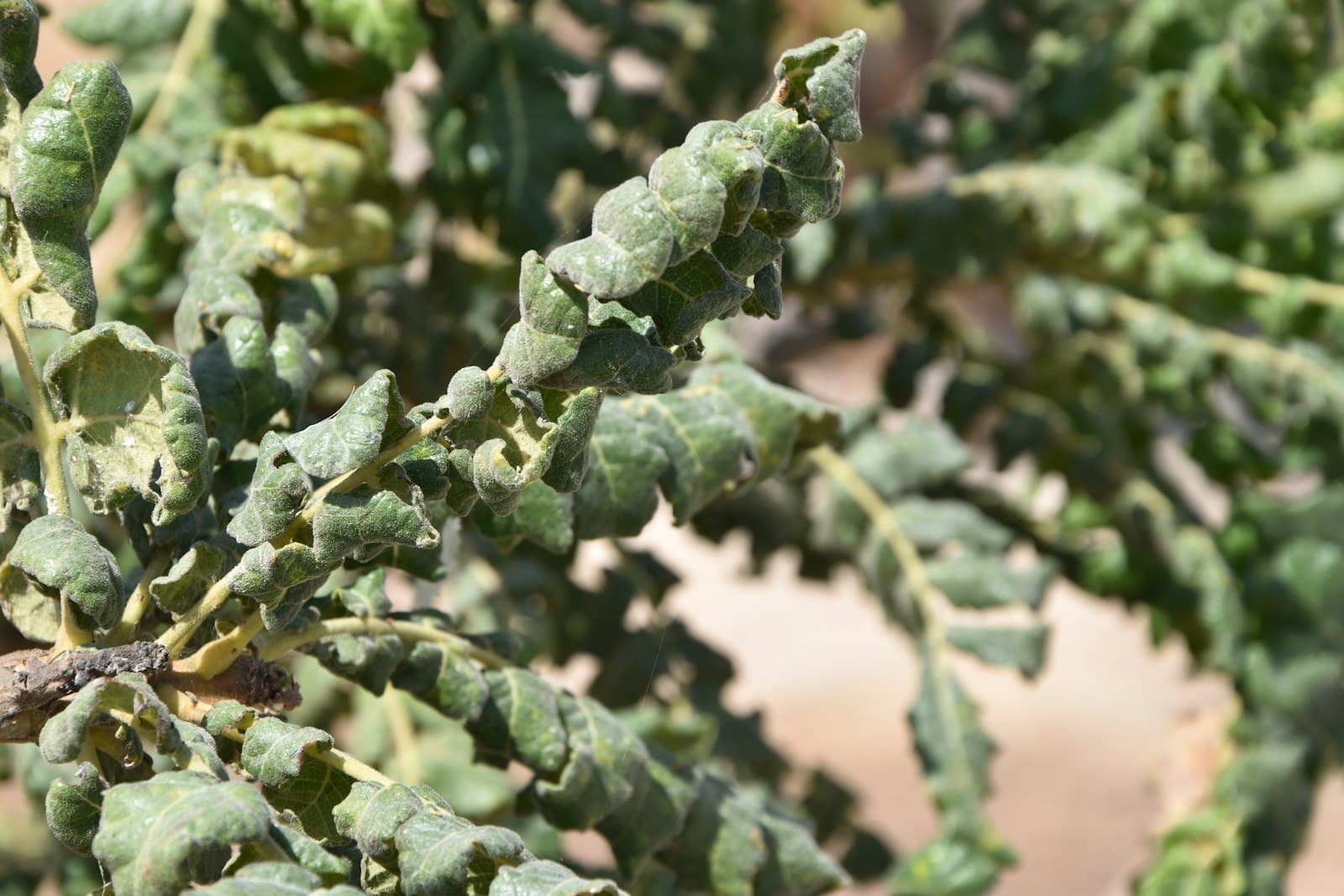
There is no cure once a plant has leaf curl. Everything that works is prevention - whitefly control, barrier crops, and early roguing.
Vaibhav Dhama4 min readSolanum lycopersicum
The most price-volatile crop in the country — a glut can crash the mandi rate to a fraction of the cost of cultivation within days. Staking and drip together lift marketable yield by 30–40%, which is what actually separates a break-even year from a loss.
The key points from this page in about two minutes — read it or have it read aloud.
Tomato is the most price-volatile crop in the country: a local glut can drop the mandi rate to a fraction of the cost of growing it within a few days. The reason is built into the plant — fruit only sets well in a narrow temperature band, so it is grown as three separate, staggered crops through the year rather than one long one, and supply lurches accordingly.
It is a nursery-raised, transplanted crop. What separates a break-even year from a loss is usually two decisions many growers still skip: staking the plants up off the ground, and watering by drip instead of flood. Both cost more at the start and both pay back through far less fruit rot and a longer, heavier picking season. Flowering and fruit set is the most sensitive stage of all — both drought stress and waterlogging at that point strip flowers and young fruit — and the crop is so intolerant of standing water that even a brief spell brings on root rot.
Feed it heavily over the long picking season, leaning on well-rotted manure or compost for steady release rather than the fertiliser bags alone, and start calcium sprays with steady soil moisture to head off blossom-end rot. The biggest disease risk is leaf curl virus, carried by whitefly, alongside early and late blight in warm, humid weather — so keep whitefly down and start with a tolerant hybrid. The page below carries the exact nursery details, spacing, nutrient doses, irrigation and spray schedules, crop duration and expected yields.
Tomato (Solanum lycopersicum) is grown across roughly 0.86 million hectares in India in three overlapping seasons — kharif, rabi and summer — which is exactly why supply, and price, swing so hard through the year.
It is a nursery-raised, transplanted crop, unlike the cereals sown directly on this site, and its economics turn on two decisions many growers still skip: staking the plants off the ground, and irrigating by drip rather than flood. Both cost more upfront and both pay back through less fruit rot and a longer, heavier picking season.
This page follows the crop in the order you will actually meet it — land, seed, transplanting, nutrition, water, protection, harvest, sale — so you can jump straight to whichever stage you are at.
A quick visual map of the season — jump to any section below for the detail behind each stage.
Seed raised in a protected nursery bed or protrays rather than sown direct into the field.
Hardened seedlings with 4–5 true leaves moved into the main field in the cool of late afternoon.
The single most sensitive stage — both drought stress and waterlogging here directly drop flowers and young fruit.
Calcium sprays begin here to prevent blossom-end rot; consistent soil moisture matters more than total volume.
Fruit is picked from the “breaker” stage for distant markets, or fully coloured for local sale.
Rounds every 4–7 days for 8–10 weeks or more on a well-managed staked, drip-irrigated crop.
States where this crop is grown at scale, highlighted below. Your local Krishi Vigyan Kendra is still the final word for your specific block.
Grown here
Because good fruit set has a fairly narrow temperature band, tomato is grown as three separate, staggered crops across most of India rather than one continuous season — this is also the biggest structural reason its mandi price swings harder than almost any other vegetable.
Ideal temperature
20–27°C is optimal for fruit set; fruit set drops sharply above 35°C and below 10°C, which is why the crop is grown across three staggered seasons rather than one long one
Rainfall
Grown mostly under irrigation; the kharif crop gets a share of its water from monsoon rainfall but still needs supplemental irrigation through dry spells
Humidity
Moderate is ideal; high humidity combined with warm nights is the single biggest driver of both early and late blight, and also favours whitefly, the vector for leaf curl virus
Sunlight
Full sun for 6+ hours a day; a shaded or overcast spell during flowering reduces fruit set
A raised bed, even a modest one, is worth building on any soil with less than excellent drainage — tomato’s root system is shallower and more waterlogging-sensitive than most people expect from a plant this vigorous above ground.
Suitable soil
Well-drained sandy loam to loam with good organic matter; heavier clay soils need extra care with drainage, since tomato is highly sensitive to waterlogging
pH range
6.0–7.0
Drainage
Very good — even brief waterlogging triggers root rot and a rapid drop in fruit set
Organic matter
High; tomato is a heavy feeder over a long picking season and depends on sustained nutrient release from well-rotted FYM or compost, not the fertilizer schedule alone
Same four steps whichever region you are in — only the timing shifts with the sowing window.
Remove the previous crop’s residue and weeds so the field starts clean.
Two to three ploughings followed by forming raised beds or ridges, rather than a flat seedbed, protects the crop’s shallow, waterlogging-sensitive roots through the season, including the heavy showers a kharif crop will meet.
Working 20–25 tonnes/ha of well-rotted farmyard manure or compost into the final ploughing supports the crop through its long, heavy-feeding picking season.
Setting stakes, strings or a trellis in place before or right after transplanting — rather than after plants have sprawled on the ground — is what actually delivers the 30–40% marketable-yield gain staking is known for; retrofitting it onto a sprawling crop recovers only part of the benefit.
How the main varieties compare, so you can pick by duration, yield, disease pressure or what you are growing for.
| Variety | Duration | Yield | Disease resistance | Best state | Suitable for |
|---|---|---|---|---|---|
A popular open-pollinated variety for home and small-plot cultivation, whose seed can be saved for the next season, unlike a hybrid. | 100–110 days | 150–200 q/ha | No specific disease resistance bred in — more exposed than a modern hybrid | Home gardens, small plots nationwide | Seed-saving, small-plot |
A widely grown hybrid bred by IIHR with useful multiple-disease resistance, including to bacterial wilt and leaf curl virus, worth the extra seed cost where those diseases have a local history. | 135–145 days | 350–450 q/ha on-farm (IIHR trials report considerably higher under intensive station management) | Triple resistance — leaf curl virus, bacterial wilt and early blight | Karnataka, Andhra Pradesh, Maharashtra | Disease-prone fields |
An open-pollinated pure-line selection from IIHR Bengaluru, bred from the American variety Tip-Top for the fresh market — a heavier crop than Pusa Ruby without paying hybrid seed prices, but with no built-in disease resistance. | 55–60 days from transplanting | 350–400 q/ha | No built-in resistance — susceptible to bacterial wilt | Karnataka, Andhra Pradesh, Tamil Nadu | Seed-saving, higher-yield open-pollinated |
Staked-system private hybrids Numerous private-seed-company hybrids bred specifically for staked, drip-irrigated systems, chosen mainly for fruit firmness and shelf life to survive the trip to a distant mandi. | 110–120 days | 300–400 q/ha | Varies by hybrid — check the seed company’s disease package against local leaf curl and wilt pressure | Maharashtra, Karnataka, Andhra Pradesh (commercial) | Staked, drip-irrigated commercial |
Cherry tomato hybrids (niche) A smaller-fruited, higher-value niche grown increasingly for urban and export markets, with agronomy broadly similar to standard hybrids. | — | 150–250 q/ha (smaller fruit, higher per-kg price) | Varies by hybrid | Peri-urban Maharashtra, Karnataka, NCR | Premium / export niche market |
Harden seedlings for 4–5 days before transplanting by gradually reducing nursery irrigation and exposing them to more direct sun — a hardened seedling establishes far faster in the field and survives the first week’s stress much better than one moved straight from a shaded, well-watered nursery bed.
A split dose beats one large dose applied at sowing — nitrogen especially is lost to the air and to leaching if it all goes in on day one.
At transplanting
Full phosphorus and potash plus about a quarter of the nitrogen — a common recommendation for a staked hybrid crop is 150:100:100 kg/ha N:P₂O₅:K₂O — worked into the bed before transplanting.
20–25 days after transplanting, at first flowering
About a third of the nitrogen — starting nitrogen too early pushes excess leafy growth at the expense of flowering and fruit set.
Through the picking season, every 15–20 days
The remaining nitrogen and potash, split into smaller doses through the long picking season. A staked, drip-fertigated crop can be picked for 8–10 weeks or more, and nutrient supply needs to keep pace with that, not stop after one or two doses.
From first fruit set, repeated every 10–15 days
A calcium chloride or calcium nitrate foliar spray prevents blossom-end rot, a dark, sunken patch at the fruit’s base caused by uneven calcium uptake rather than a disease — common on fields with inconsistent irrigation.
First 2 weeks after transplanting
Light, frequent irrigation establishes the transplant without shocking its root system.
25–45 days after transplanting
The single most sensitive stage — both drought stress and waterlogging here directly cause flower and fruit drop.
45 days onward
Consistent, even soil moisture through the picking season is what prevents fruit cracking and blossom-end rot — irregular watering, wetting and drying the root zone, is worse than steady moderate watering.
What a shortage of each nutrient actually looks like on the plant, so you can tell a deficiency apart from a disease before you spray the wrong thing.
Visible symptom
Pale, uniform yellowing of older leaves, spindly stems, and noticeably fewer flowers than expected.
Visible symptom
Dark, dull purple-green leaves and stunted growth, especially in young transplants in cool weather.
Visible symptom
Yellowing and browning along the margins of older leaves, plus uneven fruit ripening with green shoulders that never colour.
Visible symptom
A dark, leathery, sunken patch at the blossom end of the fruit (“blossom-end rot”) — not a disease, but a sign of uneven water and calcium uptake.
Visible symptom
Cracked, hollow stems and poor fruit set, most common where irrigation is inconsistent rather than genuinely short.
Symptoms, likely cause and what actually treats it — not just a spray name.
What to look for before the damage is visible, and organic options before you reach for a chemical.
The mistakes that cost growers the most, ranked by how often they show up in the field — not in the order you might expect.
Why it hurts
Fruit rots against wet soil and fungal disease pressure rises from poor airflow — most of the 30–40% marketable-yield gain staking gives is lost.
Why it hurts
Transplant shock stunts establishment, and the crop takes noticeably longer to recover than a properly hardened seedling would.
Why it hurts
Uneven soil moisture is the single biggest cause of both fruit cracking and blossom-end rot on this crop.
Why it hurts
Pushes excess leafy growth at the expense of flowering and fruit set, trading fruit yield for a bushier plant.
Why it hurts
By the time curling is visible, the virus has often already spread through much of the field, and there is no in-season cure once a plant is infected.
Why it hurts
Seedlings can pick up leaf curl virus before they are even transplanted, undermining even a resistant hybrid’s field performance.
Why it hurts
Late blight is the same pathogen on both crops, and it spreads readily between an infected potato field and a neighbouring tomato one.
Why it hurts
Loses fruit to blossom-end rot that a foliar spray from first fruit set would have prevented at low cost.
Why it hurts
Fruit at the bottom crushes under the weight above it and gets downgraded or rejected outright at the mandi.
Why it hurts
Builds up bacterial wilt and root-knot nematode pressure in the soil that a two-season rotation would have avoided.
Picking begins around 60–70 days after transplanting and continues in rounds every 4–7 days for 8–10 weeks or more on a well-managed staked crop; fruit is picked from the “breaker” (colour-turning) to fully ripe stage depending on how far it needs to travel to market.
250–400 q/ha for a staked, drip-irrigated hybrid crop under good management; well below that for an unstaked, flood-irrigated crop of the same variety
Storage
Fresh tomato has a short shelf life and is rarely stored beyond a few days on-farm; keep picked fruit in the shade, out of direct sun, and move it to market as quickly as possible rather than holding it.
Packaging
Shallow plastic crates (not deep sacks) prevent crushing; some growers now use padded crates for the top grade of fruit headed to a premium or export buyer.
Transportation
Transport in the cool of early morning or evening where possible, and avoid overloading crates — fruit crushed in transit is downgraded or rejected outright at the mandi.
Shelf life
1–2 weeks at room temperature depending on ripeness at picking; considerably longer, around 3–4 weeks, in cold storage at 10–13°C — warmer than a typical vegetable cold store, since tomato itself is chill-sensitive below about 10°C.
Today's mandi price near you, pulled live from the government's own Agmarknet data.
Live daily mandi prices from the government Agmarknet dataset.
Synced from data.gov.in (Agmarknet). Rates are ₹ per quintal.
Current conditions and a 5-day outlook for your selected location, with one line of stage-aware advice.
Pick your state for current conditions and a 5-day outlook.
Live data from Open-Meteo
Your own cost sheet, expected yield and selling price — not ours.
Share of the total cost per acre, using the calculator’s own default cost sheet below — adjust the numbers there to match your field and this picture will no longer apply to you exactly, but the ranking rarely changes.
Government and ICAR documents only — everything below is hosted on an official server.
Variety releases including Arka Rakshak, and package of practices for tomato and other vegetables from the ICAR institute that develops them.
Government of India’s farmer portal, including season-specific advisories and market information.
Get a free, crop-wise fertilizer recommendation before finalising the fertilizer schedule above.
Register for free SMS advisories timed to your crop stage and district.
Nursery sowing in June–July for the kharif crop, September–October for rabi, and January–February for a short summer crop — with transplanting 25–30 days later, once seedlings have 4–5 true leaves. Three overlapping seasons are why tomato supply, and price, swing so hard through the year.
Roughly 300–400 g of hybrid seed per hectare, raised in a nursery, gives enough seedlings for about 25,000–30,000 plants per hectare at typical staked spacing (60 × 45 cm).
Staking and drip irrigation together lift marketable yield by 30–40% by keeping fruit off wet soil, where it rots, and improving airflow around the canopy, which cuts fungal disease pressure. Setting stakes or a trellis before or right at transplanting captures the full benefit — retrofitting it onto a sprawling crop only recovers part of the gain.
Drip irrigation is close to standard practice on commercial staked tomato, since it cuts water use by 40–50% against flood irrigation while giving even, crack-free fruit. The stage to protect above all others is flowering and fruit set (25–45 days after transplanting) — both drought and waterlogging there directly drop flowers and young fruit.
A common recommendation for a staked hybrid crop is 150:100:100 kg/ha of N:P:K, with roughly a quarter of the nitrogen at transplanting and the rest split through the picking season. Blossom-end rot — a dark, sunken patch at the fruit’s base — is caused by uneven calcium uptake from inconsistent watering, not a disease; a calcium chloride or calcium nitrate foliar spray from first fruit set prevents it.
Most likely tomato leaf curl virus, spread exclusively by whitefly. There is no in-season cure — control comes entirely from managing whitefly (yellow sticky traps, insect-proof nursery netting, and a systemic insecticide started soon after transplanting) and, where available, choosing a virus-tolerant hybrid.
No — tomato has no Minimum Support Price. Its price swings harder than almost any other vegetable because good fruit set has a fairly narrow temperature band, which forces the crop into three staggered seasons rather than a spread-out year-round supply — a glut in any one season can crash the mandi rate within days. The live mandi price on this page is the most useful real-time signal for deciding when to sell.
Look for a clean, round entry hole in developing fruit, usually near the stem end, with visible frass (droppings) at the entrance. Sprays cannot reach the caterpillar once it is inside the fruit, so pheromone traps for early monitoring and a Bt spray on young larvae before they bore in are the more effective window for control.
250–400 quintals per hectare for a staked, drip-irrigated hybrid crop under good management — well below that for an unstaked, flood-irrigated crop of the same variety, which is the single biggest reason two growers with the same seed can see very different returns.
Only if you grew an open-pollinated variety such as Pusa Ruby, and kept it isolated from other tomato varieties during flowering. Seed saved from a hybrid does not breed true and yields poorly the following season — buy fresh hybrid seed each time instead.
"Breaker" is the point where fruit colour just begins to turn from green — that is when to pick fruit headed to a distant market, since it ripens further in transit. For local or same-day sale, pick fully coloured, firm fruit instead. Picking runs in rounds every 4–7 days for 8–10 weeks or more on a well-managed staked crop, starting around 60–70 days after transplanting.
Tomato has a short shelf life — 1–2 weeks at room temperature — so keep picked fruit shaded and move it to market quickly rather than holding it. Cold storage at 10–13°C extends this to around 3–4 weeks; note this is warmer than most vegetable cold stores, since tomato itself is chill-sensitive below about 10°C.
PM-KISAN is not crop-specific — any landholding farmer family meeting the scheme’s land-record and eligibility criteria qualifies, tomato or otherwise. See the Related schemes section below.
Yes, under PMFBY (Pradhan Mantri Fasal Bima Yojana), where tomato is included in your state’s notified crop list. Tomato is classified as an annual horticultural crop, so the farmer’s premium is capped at 5% of the sum insured. Enrolment is seasonal — check your state’s cut-off date and notified crop list before transplanting is complete.
Arka Rakshak tops out highest on-farm among widely grown hybrids, at 350–450 q/ha, with the added benefit of triple disease resistance — staked private hybrids follow close behind at 300–400 q/ha. An open-pollinated variety like Pusa Ruby yields meaningfully less but lets you save seed, which suits a small plot better than a push for maximum yield.
At the typical staked spacing of 60 × 45 cm, that works out to roughly 10,000–12,000 plants per acre (25,000–30,000 per hectare) — the 300–400 g of hybrid seed per hectare raised in the nursery is calculated to produce this many healthy seedlings.
Fruit cracking almost always comes from irregular watering — a dry spell followed by a heavy watering or rain — rather than from a disease. Consistent, even soil moisture through fruit development, which drip irrigation delivers far more reliably than flood irrigation, is the main prevention.
Yes, but expect meaningfully lower marketable yield — an unstaked, sprawling crop loses more fruit to soil-contact rot and fungal disease from poor airflow. Staking and drip together are what lift marketable yield by 30–40%, and skipping staking gives up most of that gain even if every other input stays the same.
Mancozeb or chlorothalonil for early blight, sprayed at first appearance and repeated every 7–10 days through a favourable spell. For late blight, mancozeb works preventively before lesions appear, switching to a curative combination like cymoxanil + mancozeb once they do — the same pathogen and similar chemistry as potato late blight.
A dark, dull purple-green tinge on the leaves, especially in young transplants during cool weather, usually points to phosphorus deficiency. It is most visible early in the season before roots are fully established, and correcting the basal phosphorus dose at transplanting is the main prevention.
Rotate out of tomato and other solanaceous crops (potato, brinjal, chilli) for at least two seasons on any field with a bacterial wilt or root-knot nematode history — maize or another cereal makes a good non-host break crop. Intercropping with a legume in the early weeks before the tomato canopy closes is also common and adds a small early return from the same land.
Deeper reading on specific parts of the season.
The FAQs above cover the common ones. For anything specific to your field and soil, your nearest Krishi Vigyan Kendra is the authoritative answer.