
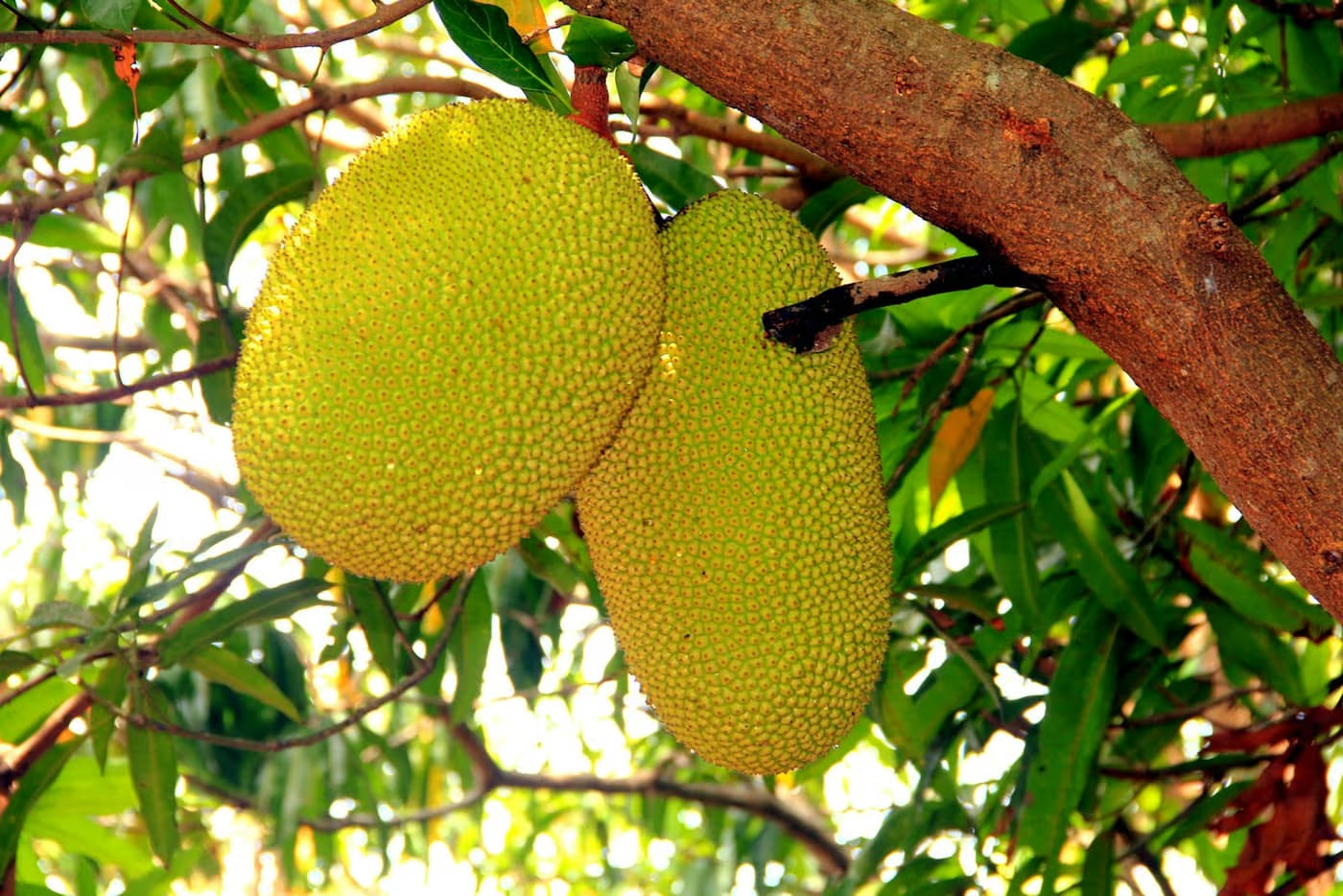
Jackfruit (Kathal)
Artocarpus heterophyllus
A hardy perennial tree where the single biggest decision is made once, at planting: a grafted plant of a named variety bears a known type of fruit in three to five years and stays a manageable size, while a seedling tree is a decade-long gamble on fruit quality and grows too large to pick or spray easily — after that, the crop is made by spacing and pruning to let light and air into the canopy and by getting the fruit off the tree and to market fast once it ripens, because a ripe jackfruit does not wait.
Quick Summary
The key points from this page in about two minutes — read it or have it read aloud.
Quick Summary
Jackfruit, or kathal, is India's largest tree-borne fruit and a genuinely hardy, low-input perennial — once established it survives on rainfall in most of its range and needs little of the spraying and feeding that annual vegetables demand. It grows across the eastern, southern and coastal states — Kerala, Karnataka, Tamil Nadu, Assam, West Bengal, Odisha, Bihar, Jharkhand and Tripura between them account for most of India's crop, both from old dooryard seedling trees and increasingly from planted, grafted orchards.
The whole crop turns on the planting decision. Traditionally jackfruit was grown from seed, and a seedling tree is unpredictable — it may take 8–15 years to fruit, grow into a very large tree that is hard to manage, and give fruit of unknown quality, sometimes with a strong, unwanted latex flow. A grafted plant of a known variety, by contrast, bears true-to-type fruit in three to five years, stays a smaller, more manageable size, and lets a grower actually choose whether they are growing a sweet dessert type or a firmer type suited to the growing "tender jackfruit" vegetable market.
Once established, the tree needs surprisingly little day-to-day management: some formative pruning to build an open, airy framework, thinning of a heavy young fruit-set so the remaining fruit size up well, and protection of the ripening fruit from fruit flies, birds and rain-triggered rot. The defining disease risk is fruit rot in wet, humid weather (both a soft Rhizopus rot and a woody heart-rot on damaged trunks), and the main pest is the stem and fruit borer, which tunnels into the trunk and developing fruit.
Because jackfruit does not ripen further once picked green, timing the harvest by the tree's own signals — a dull thud when tapped, the spines flattening and spreading apart, a change in rind colour, and a strong sweet smell at the stalk end — matters more than a calendar date, and a ripe fruit needs to reach market within a few days.
- Crop type
- Hardy perennial fruit tree, evergreen
- Season
- Planting: monsoon onset; fruit maturing mainly March–August depending on variety and region
- Suitable states
- Kerala, Karnataka, Tamil Nadu, Assam, West Bengal, Odisha, Bihar, Jharkhand
- Growing duration
- Grafted: first fruit in 3–5 years; seedling: 8–15 years. Productive 40–60+ years
- Water requirement
- Low once established; mostly rainfed, supplementary watering helps young trees and dry-spell fruit fill
- Temperature
- Warm tropical to sub-tropical, 20–35°C; sensitive to frost, especially when young
- Soil type
- Deep, well-drained loam or laterite; tolerates a wide range but not waterlogging
- Difficulty level
- Easy once established — the hard decisions are all made at planting
- Expected yield
- 50–150 fruit/tree/year at maturity (varies hugely by variety and tree age)
- Key risk
- Planting an unselected seedling instead of a grafted, known-variety plant
Overview
Jackfruit (Artocarpus heterophyllus) is a large, evergreen tropical tree of the mulberry family and the world's largest tree-borne fruit, native to South and Southeast Asia and long naturalised across much of India. The fruit is eaten two ways: unripe (raw/green), when the firm flesh is cooked as a savoury vegetable — "kathal ki sabzi" — increasingly marketed as a meat-substitute ingredient; and ripe, when the sweet, aromatic bulbs (arils) around the seeds are eaten fresh or used in desserts and processing.
It grows across the humid tropical and sub-tropical belt of India — Kerala, Karnataka (especially the coastal and Malnad tracts), Tamil Nadu, Assam and the north-east, West Bengal, Odisha, Bihar, Jharkhand and Tripura between them growing most of the country's crop, largely from long-established dooryard and homestead trees, with grafted commercial orchards a newer and growing addition.
The tree is remarkably hardy and low-input once established, tolerating a wide range of soils and largely rainfed conditions. What decides the outcome for a new planting is entirely the choice of planting material: a grafted plant of a proven variety bears known-quality fruit in three to five years and stays manageable, while a seedling tree is a decade-long gamble on both fruit type and tree size. Beyond that, formative pruning for an open canopy, fruit thinning, and protecting the ripening crop from fruit flies and rot carry the rest of the management.
Crop timeline, sowing to harvest
A quick visual map of the season — jump to any section below for the detail behind each stage.
- Year 1
Planting & establishment
A grafted plant is set into a large pre-dug, manure-filled pit in the monsoon onset, staked against wind, mulched, and watered through its first dry season until the root system is established.
- Years 1–3
Formative pruning
The young tree is trained to a single clean trunk with well-spaced main branches, removing crossing, crowded or very low branches to build an open framework that will later let light into the fruiting zone.
- Years 3–5
First flowering & fruiting
A grafted plant flowers and sets its first fruit, usually on the main trunk and older branches (jackfruit is cauliflorous — fruit forms on the trunk and thick limbs, not on young shoots).
- Ongoing, each season
Fruit thinning
A young or heavily-flowering tree often sets far more fruitlets than it can size up well; the weakest and most crowded are removed early so the remaining fruit grow to full size and quality.
- Ongoing, each season
Fruit development
Fruit takes roughly 3–8 months from set to ripeness depending on variety and season, swelling from a small green knob to its full size while still firm and green.
- Ongoing, each season
Harvest
Mature fruit is cut by its own ripening signals — a dull hollow sound when tapped, spines flattening and spreading, rind colour lightening, and a strong sweet smell — and moved to market within days, since it does not keep.
Suitable states
States where this crop is grown at scale, highlighted below. Your local Krishi Vigyan Kendra is still the final word for your specific block.
- Jammu and Kashmir
- Himachal Pradesh
- Punjab
- Uttarakhand
- Haryana
- Delhi
- Uttar Pradesh
- Rajasthan
- Bihar
- Jharkhand
- West Bengal
- Sikkim
- Assam
- Arunachal Pradesh
- Meghalaya
- Nagaland
- Manipur
- Mizoram
- Tripura
- Gujarat
- Madhya Pradesh
- Chhattisgarh
- Maharashtra
- Odisha
- Goa
- Telangana
- Andhra Pradesh
- Karnataka
- Kerala
- Tamil Nadu
- Puducherry
- Ladakh
- Chandigarh
- Lakshadweep
Grown here
Climate requirements
Because so much of the crop matures in the humid pre-monsoon and monsoon months, keeping ripening fruit off wet ground and harvesting promptly at the first ripening signs does more to save the crop from rot than any spray programme.
Ideal temperature
A warm tropical to sub-tropical tree, growing best at 20–35°C. It has some tolerance of the sub-tropical plains and can be grown well outside the true tropics, but young trees are frost-sensitive and can be killed or badly set back by a hard frost, while established trees tolerate an occasional light one.
Rainfall
Naturally suited to a humid climate with 1,500–2,500 mm annual rainfall, but the tree is drought-hardy once its root system is established and is grown successfully with supplementary irrigation in drier tracts. Waterlogging, not drought, is the bigger risk to root health.
Humidity
Moderate to high humidity suits general tree growth, but high humidity together with rain during the ripening period is exactly when fruit rot (Rhizopus soft rot) takes hold, which is why timely harvest matters so much in the monsoon-adjacent fruiting window.
Sunlight
Full sun for the best flowering and fruiting; a tree crowded by neighbours or overgrown with its own dense inner branches fruits mainly on the outer canopy and loses production in the shaded interior — a reason formative pruning for an open framework pays off for years.
Soil requirements
A generously large planting pit (at least 1 × 1 × 1 m) filled with topsoil and well-rotted manure gives the young grafted plant the best possible start and is worth the labour, since the tree will occupy that spot for many decades.
Suitable soil
A deep, well-drained loam or laterite soil is ideal, but jackfruit tolerates a genuinely wide range — including poor, gravelly and lateritic soils where few other fruit trees thrive — which is one reason it has long been a reliable homestead tree across eastern and southern India.
pH range
Best at pH 5.5–7.5; it tolerates a fairly wide pH range but does poorly on strongly alkaline or saline soils.
Drainage
Free drainage is important, especially in the young tree's first few years — a waterlogged pit or a site with a high water table encourages root and collar rot and can kill an otherwise healthy young plant. Established trees are more forgiving but still do best without standing water at the base.
Organic matter
Responds well to organic manure worked into the planting pit and applied as an annual top-dressing around the root zone as the tree grows — this matters more in the first several years while the tree is still building its root system and canopy.
Land preparation
Same four steps whichever region you are in — only the timing shifts with the sowing window.
- 1
Choose the site and spacing
Select well-drained ground away from waterlogging risk, and space trees 8–10 m apart (closer for compact varieties, wider for large old-type trees) — the tree becomes very large and the canopy needs room to develop without crowding its neighbours.
- 2
Dig and fill a large planting pit
Dig pits at least 1 × 1 × 1 m about a month before planting so the soil weathers, then refill with a mix of topsoil, well-rotted farmyard manure or compost, and a basal dose of phosphorus.
- 3
Plant at the onset of the monsoon
Set the grafted plant so the graft union stays above soil level, firm the soil, stake it against wind while it establishes, and mulch around the base to conserve moisture through its first dry season.
Seed information
How the main varieties compare, so you can pick by duration, yield, disease pressure or what you are growing for.
| Variety | Duration | Yield | Disease resistance | Best state | Suitable for |
|---|---|---|---|---|---|
A selection promoted by ICAR-CISH, Lucknow for the North Indian plains, valued for early, precocious bearing on a grafted plant and soft, sweet-tasting bulbs — a good choice for growers outside jackfruit's traditional southern heartland who want a shorter wait to first fruit. | First fruit ~3–4 years (grafted) | Moderate to good once established | No special resistance widely documented | Uttar Pradesh, Bihar, and North Indian plains | North Indian plains, home and small commercial orchards |
A widely planted early-bearing, relatively compact grafted type valued for coming into production sooner than most local seedling trees, with medium-sized fruit and firm, crisp bulbs. One of the most commonly available grafted plants at nurseries across India. | First fruit ~3–4 years (grafted) | Good, regular bearer | No special resistance widely documented | Widely planted across India | Commercial and homestead orchards wanting an early, reliable bearer |
Released by Tamil Nadu Agricultural University from a Panruti (South Arcot) selection. A large-fruited type with firm, bright yellow, low-latex bulbs well suited to the fresh and export trade, on a tree that is a heavy bearer once mature. | Fruit ripens roughly 3.5–4 months from set; grafted trees fruit from ~4–5 years | High — around 80 fruit/tree/season on a mature tree, averaging ~12 kg each | No special resistance widely documented | Tamil Nadu | Fresh-market and export-quality firm-bulb fruit |
Developed by Dr Balasaheb Sawant Konkan Krishi Vidyapeeth, Dapoli (Maharashtra) for the Konkan coast. A very heavy bearer with large fruit and a January–February bearing season, suited to the west-coast growing belt. | Bears January–February; grafted trees fruit from ~4–5 years | Very high — reported around 70+ fruit/tree/season, individual fruit up to ~25 kg | No special resistance widely documented | Maharashtra (Konkan coast), Goa | West-coast heavy-bearing commercial orchards |
A well-known regional clone, particularly in Karnataka, with small-to-medium fruit, a distinctive spiny rind, small seeds, and sweet, aromatic bulbs. Popular for its eating quality even though the fruit itself is smaller than the big commercial types. | Grafted trees fruit from ~4–5 years | Moderate; valued for quality over sheer size | No special resistance widely documented | Karnataka | Quality-focused home orchards and local fresh market |
A selection (associated with ICAR-IIHR, Bengaluru) bred and chosen specifically for a very low latex ("gum") flow, which is normally one of the more troublesome aspects of harvesting and cutting jackfruit. Medium fruit with crisp flesh, valued mainly for making the fruit easier to handle. | Grafted trees fruit from ~4–5 years | Moderate | No special resistance widely documented | Karnataka and southern homestead orchards | Growers prioritising easier harvest and processing |
A relatively recently authenticated Karnataka farmer-selection, promoted by ICAR-IIHR after its distinctive coppery-red, thick, sweet bulbs drew attention; now propagated and sold as grafted plants through nurseries. A good example of how strong local selections continue to enter commercial cultivation. | Grafted trees fruit from ~4–5 years | Good; grown mainly for its distinctive premium bulb quality | No special resistance widely documented | Karnataka | Premium fresh-market fruit, distinctive coppery-red bulb colour |
- Seed rate
- Not sown from seed for commercial planting — grown from grafted plants at roughly 100–150 plants per hectare (8–10 m spacing). Seed is used only to raise rootstock seedlings for grafting, not to grow the fruiting tree itself.
- Certified seed
- Always buy a grafted plant of a named, known variety from a recognised state horticulture department nursery, ICAR institute, or reputable private nursery — never plant an unselected seedling for a serious orchard. A seedling tree takes 8–15 years to reveal whether its fruit is even worth eating, by which time it has also grown too large to easily replace.
- Spacing
- 8–10 m between trees in both directions for most grafted varieties; slightly wider for the largest-canopy old-type trees. This gives roughly 100–150 trees per hectare.
- Seed treatment
- Not applicable in the usual sense — the relevant "treatment" is at the graft union, which should be inspected before purchase to confirm it has healed cleanly and is not oozing sap or showing any sign of rot.
Sowing guide
Never bury the graft union below soil level — doing so lets the rootstock's own roots and shoots take over, defeating the purpose of planting a grafted variety in the first place.
- Best time
- Plant grafted saplings at the onset of the monsoon (June–July in most of India) so the young root system establishes with reliable rainfall before facing its first dry season; in areas with assured irrigation, planting can extend into early autumn.
- Row spacing
- 8–10 m between rows
- Plant spacing
- 8–10 m between plants
- Sowing depth
- Plant at the same depth the sapling stood in its nursery bag, with the graft union kept above the final soil level
- Method
- Remove the sapling from its nursery bag without disturbing the root ball, set it centrally in the prepared, refilled pit, firm the soil around it, water immediately, and stake it against wind until established.
Fertilizer schedule
A split dose beats one large dose applied at sowing — nitrogen especially is lost to the air and to leaching if it all goes in on day one.
- 1
Young tree (years 1–3)
Split into 2 doses per year (pre-monsoon and post-monsoon)
A modest annual dose building up as the tree grows — roughly 50–100 g N, 25–50 g P₂O₅ and 50–100 g K₂O per tree in year one, doubling by year three — worked into the soil around the drip line, along with well-rotted manure or compost.
- 2
Bearing tree (from ~year 5)
Split into 2 doses per year
Roughly 500–600 g N, 250–300 g P₂O₅ and 500–600 g K₂O per tree per year on a mature bearing tree, applied around the drip line before flowering and again after fruit set, alongside 25–50 kg of farmyard manure or compost.
- 3
Ongoing
Annually
Adjust doses upward gradually as the canopy and fruit load increase with tree age, and reduce if the tree is putting on excessive vegetative growth at the cost of flowering.
Irrigation schedule
1. Establishment (year 1)
Weekly to fortnightly through the first dry season
Regular watering is important while the young root system establishes — a newly planted grafted sapling can be lost to drought stress in its first dry season if not watered.
2. Young tree (years 2–4)
Every 2–3 weeks in dry weather
Watering tapers off as the root system deepens, but the tree still benefits from supplementary water during long dry spells before it is fully established.
3. Bearing tree
As needed during dry-spell fruit development
A mature tree is largely rainfed, but supplementary watering during a prolonged dry spell while fruit is filling improves fruit size and reduces fruit drop, especially in drier growing tracts.
Critical stages
- First dry season after planting
- Fruit development during a dry spell
Water-saving tips
- A thick organic mulch around the base of young trees conserves soil moisture and reduces how often supplementary watering is needed.
- Basin irrigation or a simple drip line around the drip zone of the canopy delivers water efficiently to a tree this large without wasteful flooding.
- Because jackfruit is genuinely drought-hardy once established, water is best concentrated on the vulnerable first two to three years rather than spread thin over a mature orchard that mostly does not need it.
Weed management
Common weeds
Organic control
- Keep a clean, mulched basin around young trees for the first several years — weeds compete hard with an establishing root system and a mulched basin also conserves moisture.
- Once the canopy closes over, shade from the tree itself suppresses most weed growth beneath a mature orchard.
- Slash or mow orchard-floor weeds rather than letting them seed and compete, especially in the tree's early years.
Chemical control
- Herbicide use is uncommon around jackfruit trees; where used on an orchard floor between rows, keep application well clear of the tree trunk and root-flare to avoid injury.
Nutrient deficiency identification
What a shortage of each nutrient actually looks like on the plant, so you can tell a deficiency apart from a disease before you spray the wrong thing.
Nitrogen
Visible symptom
Pale green to yellowing older leaves and reduced shoot growth on a young tree, or reduced flowering and small fruit on a bearing tree.
Potassium
Visible symptom
Scorched, browning leaf margins on older leaves, and smaller, less well-filled fruit with reduced sweetness — jackfruit is a heavy potassium user once bearing.
Zinc
Visible symptom
Small, narrow, bunched leaves at shoot tips (rosetting) and reduced flowering, more common on light or high-pH soils.
Boron
Visible symptom
Poor fruit set, corky patches or internal breakdown in developing fruit, and dieback of shoot tips — worse on light, sandy or over-limed soils.
Diseases to watch for
Symptoms, likely cause and what actually treats it — not just a spray name.
Fruit rot (Rhizopus soft rot)
- Symptoms
- A soft, watery, rapidly spreading rot starting from a wound, insect entry point or the stalk end of a ripening or ripe fruit, often with a visible whitish-grey fungal growth; a badly affected fruit collapses within days.
- Cause
- The fungus Rhizopus stolonifer and related species, entering through wounds (from fruit borer damage, bird pecking or handling injuries) and spreading fast in warm, humid, wet weather.
- Treatment
- No cure once rot has set in; remove and destroy affected fruit promptly so spores do not spread to sound fruit nearby.
- Prevention
- Harvest promptly at the first ripening signs rather than leaving fruit to over-ripen on the tree, avoid wounding fruit during handling, control fruit borer and fruit flies (which create entry wounds), and keep ripening fruit clear of wet ground and dense wet foliage.
Pink disease / stem and branch rot
- Symptoms
- A pinkish, powdery fungal growth on the bark of branches and the upper trunk, often followed by dieback of the branch beyond the infected point; worse in humid, high-rainfall conditions with dense, poorly-ventilated canopies.
- Cause
- The fungus Erythricium salmonicolor (Corticium salmonicolor), favoured by high humidity and canopies that stay wet for long periods after rain.
- Treatment
- Prune out and destroy affected branches well below the visible infection, and paint the cut surface and surrounding bark with a copper fungicide paste.
- Prevention
- Prune for an open, airy canopy that dries out quickly after rain, and avoid over-crowding trees at planting.
Wound wood rot on damaged trunks and branches
- Symptoms
- Softening, dark decay spreading inward from a wound, pruning cut or old fruit scar on the trunk or a major limb, weakening the wood over years.
- Cause
- Various wood-rotting fungi entering through unprotected wounds, favoured by persistent moisture at the wound site.
- Treatment
- Clean out decayed wood where practical and seal the wound; badly hollowed limbs may need removal to prevent structural failure.
- Prevention
- Make clean pruning cuts and seal large cuts with a wound-sealant paste, avoid unnecessary trunk injury during harvest, and remove fruit stalks cleanly rather than tearing them off.
Pests to watch for
What to look for before the damage is visible, and organic options before you reach for a chemical.
Trunk- and fruit-boring insects
- Identification
- Small entry holes in the trunk, branches or developing fruit with frass (bore-dust) visible at the opening, and a caterpillar or grub tunnelling inside, sometimes with gum or sap oozing from the wound.
- Damage
- Trunk and branch boring weakens the tree's structure over time and can girdle and kill a branch; fruit boring directly spoils fruit and creates entry wounds for rot fungi, compounding the loss.
- Organic control
- Inspect trees regularly for fresh entry holes and frass, probe and destroy the borer inside with a wire where the tunnel is shallow enough, and seal the cleaned hole with mud or a wound-sealant paste.
- Chemical control
- Where infestation is heavy, a recommended systemic insecticide injected into or painted around active bore holes can be effective; consult local horticulture extension for products currently approved for jackfruit.
Fruit fly
- Identification
- Small sting marks on the rind of ripening fruit, with soft, discoloured patches developing around the sting and maggots found inside when the fruit is cut open.
- Damage
- Stung fruit softens, rots from within, and drops early or is unsellable — a significant loss on fruit close to ripening, when the sugar content most attracts the fly.
- Organic control
- Hang cue-lure or pheromone traps in the canopy from early fruit development, collect and destroy fallen and infested fruit promptly rather than leaving it under the tree, and bag individual valuable fruit with cloth or net where practical.
- Chemical control
- A protein-bait spray targeted at the fly (rather than a cover spray over the whole tree) is the standard, more selective control where fruit fly pressure is high.
Mealybugs
- Identification
- Clusters of small, white, waxy-coated soft-bodied insects on shoots, the underside of leaves, and around developing fruit, with sticky honeydew and sooty mould nearby.
- Damage
- Sap loss weakens shoots and reduces vigour, and honeydew and sooty mould disfigure the fruit surface, which matters for the fresh-market sale of ripe fruit in particular.
- Organic control
- Prune out and destroy heavily infested shoots, encourage natural predators (ladybird beetles), and use a strong water jet or neem spray on manageable infestations, along with an ant-control band on the trunk since ants protect mealybugs from predators.
- Chemical control
- A recommended systemic insecticide only where infestation is heavy and spreading, since mealybugs on a large tree are otherwise hard to reach with a contact spray.
Common mistakes to avoid
The mistakes that cost growers the most, ranked by how often they show up in the field — not in the order you might expect.
- 1
Planting an unselected seedling instead of a grafted plant of a known variety.
Why it hurts
A seedling tree takes 8–15 years to reveal whether its fruit is even worth eating, grows far larger and harder to manage than a grafted type, and by the time its fruit quality is known the tree is already too large to easily replace. Always buy a grafted sapling of a named variety.
- 2
Burying the graft union below soil level at planting.
Why it hurts
This lets the rootstock take over and grow its own shoots and roots from above the union, defeating the purpose of the graft — the tree that results is effectively an unselected seedling again.
- 3
Skipping formative pruning in the tree's first few years.
Why it hurts
An unpruned tree develops a crowded, poorly ventilated canopy that fruits mainly on the outer surface, is harder and more dangerous to harvest from, and holds humidity that favours pink disease and fruit rot.
- 4
Leaving too many young fruitlets to develop on a heavily-set tree.
Why it hurts
An overloaded tree produces many small, poor-quality fruit instead of fewer large, well-filled ones, and the excess weight can also break weaker branches. Thin the weakest and most crowded fruitlets early.
- 5
Waiting too long to harvest a ripening fruit.
Why it hurts
An over-ripe fruit left on the tree softens, becomes more attractive to fruit flies and birds, is more prone to splitting and rot, and can also fall and injure itself or workers below. Learn and use the ripening signals rather than guessing by a fixed number of days.
- 6
Handling and transporting ripe fruit roughly.
Why it hurts
A ripe jackfruit bruises and is punctured easily, and any wound becomes an entry point for Rhizopus rot within a day or two in warm weather. Handle gently, pad crates, and move ripe fruit to market as soon as possible after harvest.
Harvesting
For ripe fruit: harvest when the rind colour lightens from dark green toward a duller yellow-green or brown-green, the spines flatten and spread apart with visible gaps between them, tapping the fruit gives a dull hollow thud rather than a solid sound, and a strong sweet aroma develops at the stalk end. For the tender-jackfruit vegetable market, fruit is cut much earlier while still small, firm, fully green and the latex still flows freely. Cut with a sharp knife leaving a short length of stalk, and always support the weight of the fruit as it is cut — large fruit are heavy and can injure a picker or damage themselves if dropped.
Signs it is ready
- Rind colour lightening from dark to a duller green/yellow/brown
- Spines flattened and spread apart with gaps visible between them
- A dull, hollow sound when the fruit is tapped
- A strong, sweet smell developing at the stalk end
Tools
- A sharp knife or pruning saw for a clean cut through the thick stalk
- A rope or sling to lower heavy fruit safely from height rather than dropping them
- Oil or ash on hands and tools to manage the sticky latex during cutting
- Padded crates or baskets for moving ripe fruit without bruising
Expected yield
Widely variable by variety, tree age and management — a mature grafted tree can give anywhere from 50 to 150+ fruit per year, with individual fruit weighing anywhere from a few kilograms to over 20 kg depending on variety.
Post-harvest & storage
Storage
A whole ripe jackfruit keeps only a few days at room temperature before over-ripening and starting to ferment or rot; a green (unripe) fruit for the vegetable market keeps somewhat longer, up to a week or so, if kept cool and dry. Cut bulbs (arils) removed from the fruit keep only 1–2 days at room temperature or about a week refrigerated.
Packaging
Handle whole fruit gently and pack in padded crates or baskets, never stacked deep, since the weight of fruit above bruises and can split fruit below. Processed bulbs for sale are best packed in ventilated containers and kept cool.
Transportation
Move ripe fruit quickly and gently, ideally to the nearest market rather than a distant one, given how fast a ripe fruit deteriorates; green fruit for the vegetable trade travels somewhat better and further.
Shelf life
A few days at room temperature for whole ripe fruit; about a week for green (unripe) fruit; 1–2 days for cut bulbs at room temperature, about a week refrigerated. Speed to market is the main lever for reducing loss on this crop.
Market prices
Today's mandi price near you, pulled live from the government's own Agmarknet data.
Live daily mandi prices from the government Agmarknet dataset.
Synced from data.gov.in (Agmarknet). Rates are ₹ per quintal.
Weather
Current conditions and a 5-day outlook for your selected location, with one line of stage-aware advice.
Pick your state for current conditions and a 5-day outlook.
Live data from Open-Meteo
Profit calculator
Your own cost sheet, expected yield and selling price — not ours.
Where the money goes
Share of the total cost per acre, using the calculator’s own default cost sheet below — adjust the numbers there to match your field and this picture will no longer apply to you exactly, but the ranking rarely changes.
- Labour26% (₹9,000)
- Land rent26% (₹9,000)
- Fertiliser13% (₹4,500)
- Seed9% (₹3,000)
- Pesticide & weedicide9% (₹3,000)
- Irrigation6% (₹2,000)
- Interest6% (₹2,000)
- Machinery4% (₹1,500)
Official downloads
Government and ICAR documents only — everything below is hosted on an official server.
ICAR-CISH, Lucknow
Swarna Manohar and North Indian plains jackfruit cultivation advisories
ICAR-IIHR, Bengaluru — Fruit Crops
Southern jackfruit variety development and package of practices
Tamil Nadu Agricultural University (TNAU) Agritech Portal
Palur-1 and Tamil Nadu jackfruit cultivation guide
Kisan Call Centre — 1800-180-1551
Free crop advice in your language
Frequently asked questions
Should I grow jackfruit from seed or buy a grafted plant?
Always a grafted plant of a named variety for anything beyond a casual dooryard tree. A seedling grown from seed is unpredictable — it typically takes 8 to 15 years to fruit, gives fruit of unknown and often disappointing quality, and grows into a very large tree that is hard to manage or replace by the time you find out. A grafted plant bears true-to-type, known-quality fruit in just three to five years and stays a more manageable size.
How long before a jackfruit tree starts bearing fruit?
A grafted plant of a good variety typically bears its first fruit in three to five years. A seedling tree grown from seed can take anywhere from eight to fifteen years, and there is no guarantee the fruit will even be good eating once it finally arrives — this gap is the main reason grafted planting material is now strongly preferred.
Why does my jackfruit tree set a lot of small fruit that never size up well?
A young or vigorously flowering tree often sets more fruitlets than it can properly nourish, and an overloaded tree spreads its resources too thin, giving many small, poor-quality fruit instead of fewer good ones. Thin out the weakest and most crowded young fruit early in the season so the tree can put its energy into the ones that remain.
How do I know when to pick a jackfruit — it does not ripen after picking, does it?
Correct, jackfruit ripens very little further once cut, so timing matters. Watch for the spines flattening and spreading apart with visible gaps, the rind lightening from dark green to a duller shade, a dull hollow sound when you tap the fruit, and a strong sweet smell developing at the stalk end. For the "raw" or vegetable-market fruit, it is instead cut much earlier while still small, firm and fully green.
What is the biggest disease risk with jackfruit, and how do I prevent it?
Fruit rot (mainly a fast-spreading Rhizopus soft rot) in warm, humid, wet weather is the biggest risk, usually starting from a wound made by a fruit borer, a fruit fly sting, or rough handling. Harvest fruit promptly once it shows ripening signs rather than letting it over-ripen on the tree, control fruit borer and fruit fly, and handle the fruit gently to avoid creating wounds that the rot fungus can enter through.
Does jackfruit have an MSP or a mandi price?
There is no MSP for jackfruit. It is traded as "Jack Fruit" on Agmarknet, with price and arrival data from APMC markets in the main producing states, though a substantial share of the crop is sold locally, through homestead sale, or increasingly through direct contracts for the growing tender-jackfruit vegetable and processed-food trade, which can pay differently from the fresh ripe-fruit mandi price.
Still have questions?
The FAQs above cover the common ones. For anything specific to your field and soil, your nearest Krishi Vigyan Kendra is the authoritative answer.