
Makhana (Fox Nut)
Euryale ferox
Bihar's signature aquatic superfood — the popped seed of a spiny water lily grown submerged in ponds and diked fields across the Mithila and Kosi belt. Seed goes into standing water in December–January, the crop lives underwater for seven to eight months, and the ripe seed is collected by hand from the pond floor before it is roasted and popped into the snack sold in shops. Two released varieties, Swarna Vaidehi and Sabour Makhana-1, roughly double the yield of old pond-grown seed.
Quick Summary
The key points from this page in about two minutes — read it or have it read aloud.
Quick Summary
Makhana, also called fox nut or gorgon nut, is the popped seed of a spiny water lily grown submerged in ponds and shallow diked fields, almost entirely in the Mithila and Kosi districts of north Bihar. Unlike an ordinary field crop, the plant lives its whole life floating and rooted in mud under standing water, so the first decision a grower makes is not which seed drill to use but which pond or field can hold water at a steady depth for the better part of a year without drying out.
There are two ways it is grown. The old way uses a permanent pond that already holds water most of the year, where seed is scattered by hand and the plant is largely left to itself. The newer way copies a paddy field — a shallow, diked plot that is flooded and drained on purpose — which lets a farmer control the water depth, clear weeds, and harvest more easily, and it is spreading fast in newer growing districts. Either way, the crop needs very little bought input once it is established; its biggest cost is labour, especially at harvest, when the ripe seed sinks to the pond floor and has to be gathered by hand from the mud.
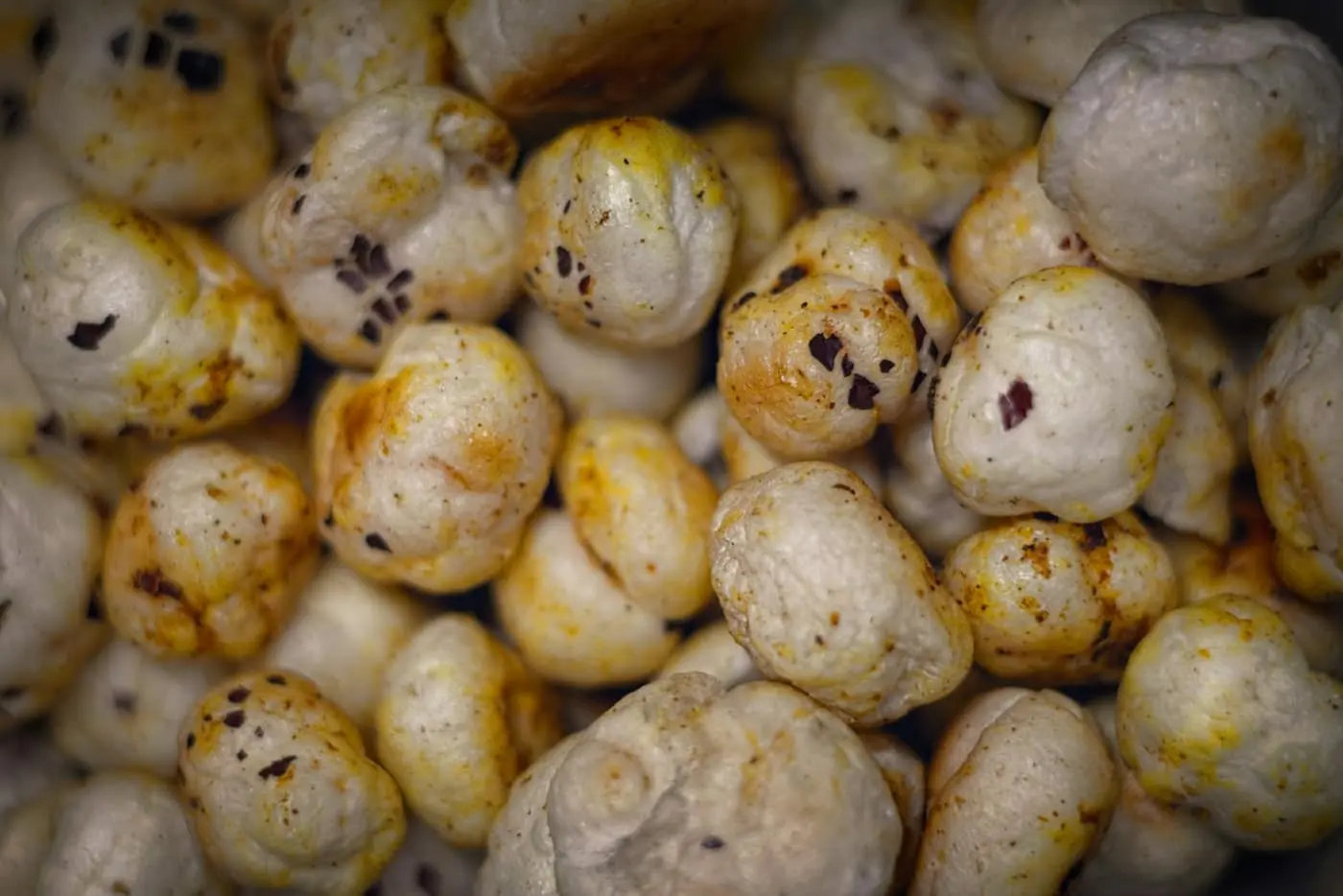
What happens after harvest decides almost the whole value of the crop. The raw seed is not the snack anyone buys — it has to be dried, sorted by size, roasted in a hot pan, and then struck while hot so the shell cracks and the white kernel pops out. A grower who sells only raw seed earns a small fraction of what the popped product fetches, which is why the roasting and popping stage, not the pond itself, is where most of the money in makhana is actually made. The crop has no government-fixed price yet, but it does carry a Geographical Indication tag as "Mithila Makhana," and a new Makhana Board is meant to help with processing and marketing.
- Crop type
- Aquatic water lily, grown submerged in ponds/flooded fields
- Season
- Sown December–January; harvested July–September
- Suitable states
- Bihar (dominant), Assam, West Bengal, Odisha, Manipur, Tripura
- Growing duration
- 7–8 months (about 210–240 days) underwater
- Water requirement
- Constant standing water, about 1–1.5 m deep, for the whole season
- Temperature
- 20–35°C; a warm, humid, subtropical climate suits it
- Growing medium
- Pond/field with a soft clay-silt floor that holds water without draining away
- Difficulty level
- Hard — specialised water and post-harvest management
- Expected yield
- 17–19 q/ha traditional seed; 28–35 q/ha with Swarna Vaidehi or Sabour Makhana-1
- No MSP
- Not a CACP-notified crop; carries a GI tag as "Mithila Makhana"
Overview
Makhana (Euryale ferox), called fox nut or gorgon nut in English, is the popped seed of a spiny, floating-leaved water lily. It is almost entirely a Bihar crop — the Mithila districts of Darbhanga and Madhubani and the Kosi-basin districts of Supaul, Saharsa and Madhepura together grow the great majority of India's makhana, with smaller areas in Purnia, Katihar, Assam, West Bengal, Odisha, Manipur, Tripura and Chhattisgarh. The crop is unusual among the guides on this site because it is never grown on dry land at all — it lives its entire life submerged in a pond or a shallow, flooded field.
Two systems are used side by side. The traditional pond (locally a tal or chaur) already holds water most of the year and is sown once with little further management, which is low-effort but gives a lower and less certain yield. The newer field-based system treats the plot like a paddy field — bunded, deliberately flooded to a controlled depth, and drained for harvest — which costs more to set up but gives a farmer real control over water, weeds and picking. Two released varieties, Swarna Vaidehi and Sabour Makhana-1, work in either system and roughly double the seed yield of old, unimproved pond stock.
Almost the entire value of the crop is added after the pond, not in it. Raw seed sinks to the bottom as it ripens and is gathered by hand — historically by wading or diving, still the case on many older ponds — then dried, graded by size and roasted in a hot iron pan. While still hot, each seed is struck so its hard shell cracks and the light, white kernel pops out, the same way popcorn does. This roasting-and-popping stage is skilled, labour-heavy work, and a grower who sells unpopped raw seed to a trader earns only a small share of what the popped product is worth — which is why processing, storage and marketing, not the pond, are where Bihar's new Makhana Board and farmer cooperatives are focused.
Crop timeline, sowing to harvest
A quick visual map of the season — jump to any section below for the detail behind each stage.
- Day 0
Pond/field preparation
Clear the pond of old plant debris and excess silt, or prepare and dike the field, before the water is let in. This is the one dry-land task in the whole crop cycle.
- Day 0–7
Seed sowing
Scatter healthy, plump seed by hand into standing water from mid-December to mid-January, or raise seedlings in a small nursery pond for later transplanting — the newer method that uses much less seed.
- Day 35–40
Germination
Seed sprouts on the pond floor and pushes up small, arrow-shaped leaves that float to the surface — the first sign the crop has taken.
- Day 40–90
Leaf spread
Large, round, spiny-veined leaves spread out to cover the water surface, shading out competing weeds. Water depth is topped up and held steady through this stage.
- Day 90–150
Flowering
Small purple flowers open just above the water and close again the same day; each one that is pollinated swells into a spiny fruit under the leaf canopy that holds the developing seeds.
- Day 150–210
Seed (guri) development
Seeds mature inside the submerged fruit and, as they ripen, drop and sink into the pond mud rather than staying on the plant — the reason harvest means collecting from the floor, not cutting the plant.
- Day 210–240
Harvest & processing
From around July to September, workers gather the sunk seed from the pond bed by hand, then dry, grade, roast and pop it over the following weeks into the finished makhana.
Suitable states
States where this crop is grown at scale, highlighted below. Your local Krishi Vigyan Kendra is still the final word for your specific block.
- Jammu and Kashmir
- Himachal Pradesh
- Punjab
- Uttarakhand
- Haryana
- Delhi
- Uttar Pradesh
- Rajasthan
- Bihar
- Jharkhand
- West Bengal
- Sikkim
- Assam
- Arunachal Pradesh
- Meghalaya
- Nagaland
- Manipur
- Mizoram
- Tripura
- Gujarat
- Madhya Pradesh
- Chhattisgarh
- Maharashtra
- Odisha
- Goa
- Telangana
- Andhra Pradesh
- Karnataka
- Kerala
- Tamil Nadu
- Puducherry
- Ladakh
- Chandigarh
- Lakshadweep
- Andaman and Nicobar Islands
- Dadra and Nagar Haveli and Daman and Diu
Grown here
Climate requirements
The defining climate need is not rainfall or temperature but a water source that can hold a pond or field at a near-constant depth for seven to eight months. A grower in Bihar's Mithila and Kosi belt already has the climate this crop wants; the real planning question is whether a particular pond or field can be kept full through a dry patch.
Ideal temperature
20–35°C through the growing season suits makhana well; it is a warm-climate plant and does not tolerate frost or cold water at any stage
Rainfall
Rainfall itself matters less than a reliable water source — the pond or field is fed and topped up from rain, a river, a canal or a tube well, but must be kept at a steady depth regardless of how the monsoon behaves
Humidity
High humidity through the monsoon and post-monsoon months is normal for the crop and is not a particular risk on its own, unlike for most dryland crops
Sunlight
Full sun on the open water surface is important once the floating leaves spread out — a shaded pond gives thin, poorly filled seed
Soil requirements
Choosing where to grow makhana is really a choice of water body, not soil type. An old, naturally silted pond in the Mithila belt already has what the crop needs; a new field-based plot must be bunded tightly enough to hold a steady 1–1.5 m of water for the whole season, which is the main civil-works cost of starting into the crop.
Suitable soil
Not a soil crop in the usual sense — makhana is grown in the soft, organic-rich clay-silt floor of a pond or a shallow, bunded field that can hold standing water. A base that leaks or drains quickly cannot support the crop regardless of its fertility
pH range
Roughly neutral to mildly acidic water and mud (about pH 6.0–7.5) suits it best; strongly acidic or alkaline water is unusual in the traditional growing belt
Drainage
The opposite of a normal crop's requirement — makhana needs the growing area to hold water, not drain it. A pond or field that loses water through seepage or a porous bed cannot maintain the depth the plant needs
Organic matter
A silty, organically rich pond floor is naturally fertile from years of accumulated plant and aquatic matter, which is part of why the old pond system needs little added fertiliser; a new field-based plot has to build this up with farmyard manure
Land preparation
Same four steps whichever region you are in — only the timing shifts with the sowing window.
- 1
Desilt and clean an old pond
Before the new season, clear a traditional pond of old plant debris, excess weed growth and built-up silt so fresh seed has open mud to root into and water depth can be properly controlled.
- 2
Bund and level a new field-based plot
For the newer field system, build strong, well-compacted bunds around the plot exactly as for a paddy field, and level the floor so water sits at an even depth across the whole area rather than pooling unevenly.
- 3
Check the water source before sowing
Confirm the pond or field can be filled and topped up reliably — from rain, a river, a canal or a tube well — for the full seven to eight months, since a pond that runs dry partway through the season loses the crop.
- 4
Work in farmyard manure on a new plot
A newly dug or converted field-based plot lacks the years of natural fertility an old pond has, so work well-rotted farmyard manure into the floor before flooding it to give the crop a fertile bed to root in.
Seed information
How the main varieties compare, so you can pick by duration, yield, disease pressure or what you are growing for.
| Variety | Duration | Yield | Disease resistance | Best state | Suitable for |
|---|---|---|---|---|---|
The first formally released makhana variety in India, developed by ICAR's Research Complex for Eastern Region through pure-line selection and released in 2013 for Bihar, Assam, Chhattisgarh and Odisha. It roughly doubles the seed yield of old, unimproved pond stock and grows well in both the pond and the field-based system. | 7–8 months | 28–30 q/ha (seed/guri) | Not separately documented; standard field hygiene applies | Bihar | Both pond and field-based systems |
Released by Bihar Agricultural University, Sabour, from germplasm collected in Purnia district. It out-yields Swarna Vaidehi and gives a notably better popped-seed recovery, thanks to a thinner seed coat that pops more completely — the reason it is increasingly preferred where popping quality decides the price. | 7–8 months | 32–35 q/ha (seed/guri); 55–60% pop recovery | Not separately documented; standard field hygiene applies | Bihar | Both pond and field-based systems |
- Seed rate
- About 30–90 kg/ha of healthy, plump seed for direct broadcasting into standing water; raising seedlings in a small nursery pond and transplanting them uses considerably less seed and is becoming the preferred method on managed field-based plots.
- Certified seed
- Improved seed of Swarna Vaidehi and Sabour Makhana-1 is distributed mainly through Bihar's state seed-distribution scheme and agricultural universities, not through private seed companies — there is no branded private makhana seed trade. Farmers in the notified districts can get subsidised seed of both varieties through the state scheme; source seed only from a government or university channel to avoid a poorly-yielding local lot.
- Spacing
- Not sown in fixed rows like a field crop — seed is broadcast to spread evenly over the water surface, or seedlings are transplanted at a spacing that lets the mature, umbrella-sized leaves cover the water without excessive crowding.
- Seed treatment
- No routine chemical seed treatment is standard practice; growers select only healthy, undamaged, plump seed for sowing and discard shrivelled or discoloured seed, which is the main quality control at this stage.
Sowing guide
The sowing decision that matters most is not depth or spacing but timing — sow before the water has fully warmed after winter and germination is delayed; sow too late and the crop loses growing days before the monsoon's heavy rain and heat set in.
- Best time
- Mid-December to mid-January, once winter cold has passed its peak and the water can be relied on to stay ice-free. This single sowing window is what fixes the rest of the year's timeline.
- Row spacing
- Not applicable — seed is broadcast over open water rather than drilled in rows
- Plant spacing
- Leaves naturally space themselves as they spread to cover the water surface; overly thick sowing is thinned by hand once seedlings are visible
- Sowing depth
- Seed sinks and roots into the pond or field floor on its own once scattered onto the water; there is no controlled sowing depth the way there is for a dryland crop
- Method
- Hand broadcasting of seed directly into standing water is the traditional method; nursery raising followed by transplanting seedlings into the main pond or field is the newer, seed-saving method spreading in managed field systems
Fertilizer schedule
A split dose beats one large dose applied at sowing — nitrogen especially is lost to the air and to leaching if it all goes in on day one.
- 1
Traditional pond system
Throughout the season
An old, well-silted pond usually needs no added chemical fertiliser at all — years of accumulated organic matter on the pond floor supply most of what the crop needs, which is one reason the traditional method is so low-cost.
- 2
Field-based system — basal dose
Before flooding, at field preparation
A newer field-based plot benefits from about 15 tonnes/ha of well-rotted farmyard manure worked into the floor before it is flooded, since it starts without the pond's years of built-up fertility.
- 3
Field-based system — NPK
Split through the season
Where chemical fertiliser is used on a field-based plot, a dose of roughly 100:60:40 kg/ha of N:P2O5:K2O is applied in split doses through the growing season rather than all at once, since nutrients dissolved into standing water are more easily lost than in a dry field.
Irrigation schedule
1. Filling
At sowing
Fill the pond or field to a shallow depth for sowing and germination, then raise the water level gradually as the seedlings grow taller and stronger.
2. Full-depth maintenance
Leaf spread through seed development
Hold the water at a steady 1–1.5 m depth through the leaf-spread, flowering and seed-development stages — the single most important water task in the whole crop, since a falling water level exposes and stresses the plant.
3. Drawdown for harvest
Before harvest, field-based system only
On a field-based plot, the water is partly drained before harvest to make it easier to reach and collect the sunk seed; a traditional pond stays full and harvest is done by wading or diving instead.
Critical stages
- Germination — the pond must not run dry in the first weeks
- Leaf spread and flowering — depth must stay steady, not just present
- Seed development — a sudden drop in water level here stresses the plant and can affect the seed set
Water-saving tips
- A tightly bunded field-based plot loses far less water to seepage than a poorly maintained pond, cutting the amount that has to be topped up over the season.
- Topping up little and often, rather than letting the level fall a long way and then refilling in one go, keeps the plant from the stress of a swinging water depth.
- A pond that also holds fish alongside makhana can share the same water management, spreading the cost of maintaining it across two harvests.
Weed management
Common weeds
Organic control
- Hand-removal of competing floating and submerged weeds is the standard method, done from a small boat or by wading, timed before the makhana canopy has closed over the water.
- A well-established makhana canopy shades out most new weed growth once the large leaves cover the surface, so early, thorough weeding matters more than repeated later effort.
- Keeping the pond free of old plant debris at the end of each season reduces the weed seed and algae bloom the following year.
Chemical control
- Chemical herbicide use in a standing-water pond crop is uncommon and risky, since a pond often has other uses (fish, drinking or irrigation water) that a herbicide would contaminate — manual and cultural control is the standard approach instead.
Nutrient deficiency identification
What a shortage of each nutrient actually looks like on the plant, so you can tell a deficiency apart from a disease before you spray the wrong thing.
Nitrogen
Visible symptom
Older, lower leaves turn pale yellow-green and growth slows on a nutrient-poor pond or a new field-based plot without enough organic matter worked in.
Phosphorus
Visible symptom
Leaves take on a dull, darker green to slightly purplish cast and flowering is delayed or sparse — more likely on a new plot that has not built up the organic fertility of an old pond.
Potassium
Visible symptom
Yellowing and scorching along the margins of older leaves, with weaker leaf stalks that struggle to hold the large floating leaf flat on the water.
Diseases to watch for
Symptoms, likely cause and what actually treats it — not just a spray name.
Pests to watch for
What to look for before the damage is visible, and organic options before you reach for a chemical.
Aphid
- Identification
- Small, soft-bodied insects clustering on the underside of young leaves and on flower buds, often in visible colonies.
- Damage
- Sap-sucking weakens young leaves and can reduce flowering and seed set in a heavy infestation, though it is rarely the crop's most serious problem.
- Organic control
- A 0.3% neem oil spray on affected foliage is the standard organic response, along with encouraging natural predators such as ladybird beetles around the pond.
- Chemical control
- A need-based spray of a recommended insecticide, used sparingly and with care around a water body that may have other uses, only where the infestation is heavy.
Case worm (leaf-eating caterpillar)
- Identification
- Small caterpillars that build a protective case from leaf fragments and feed on the leaf surface, leaving irregular chewed patches and holes across the floating leaves.
- Damage
- Reduces the healthy leaf area available for the plant to feed its developing seed, and a heavy infestation can noticeably thin the canopy.
- Organic control
- Hand-picking visible cases and caterpillars where the pond is small enough to manage this way, plus a neem-based spray for a wider outbreak.
- Chemical control
- A need-based insecticide spray recommended for use in standing water, applied only when damage crosses a noticeable threshold.
Common mistakes to avoid
The mistakes that cost growers the most, ranked by how often they show up in the field — not in the order you might expect.
- 1
Letting pond or field water level fall during leaf spread or seed development
Why it hurts
These are the crop's most water-sensitive stages — a falling water level stresses the plant and can reduce both leaf growth and seed set, undoing months of otherwise good management.
- 2
Sowing with unimproved, old pond-saved seed instead of Swarna Vaidehi or Sabour Makhana-1
Why it hurts
Traditional seed yields roughly half of what the improved varieties give on the same pond or field, for the same amount of labour and water management.
- 3
Delaying harvest of sunk seed
Why it hurts
Seed left too long on the pond floor can be damaged or lost in the mud, and a delayed harvest pushes drying and roasting into less favourable weather.
- 4
Rushing or overheating the roasting stage
Why it hurts
Roasting too hot or too fast scorches the kernel or gives a poor, incomplete pop, which sharply cuts the price the finished makhana fetches compared to a properly popped batch.
- 5
Selling only raw, unpopped seed to a trader
Why it hurts
Raw seed fetches a small fraction of the price of popped makhana — the roasting and popping stage is where most of the crop's value is actually created, and skipping it leaves that value with whoever processes it next.
- 6
Choosing a plot or pond that cannot hold water reliably for the full season
Why it hurts
A pond or field that leaks or dries out partway through the seven-to-eight-month cycle can lose the crop entirely, regardless of how well everything else was managed.
Harvesting
From around July to September, roughly seven to eight months after sowing, once the fruit has matured underwater and seeds have begun dropping and sinking to the pond floor. Harvest is usually done in repeated rounds over several weeks as more seed ripens and sinks, rather than as a single cutting.
Signs it is ready
- Fruits have matured and begun releasing seed into the water
- Sunk seed feels hard, not soft, when gathered from the pond floor
- The floating leaf canopy begins to thin and yellow toward the end of the season
Tools
- Bare hands and feet, or a small boat, for wading or diving to gather sunk seed from the pond floor — the traditional and still most common harvesting method
- A partial drawdown of water on a field-based plot to make the floor easier to reach without diving
- Sieves and baskets for lifting collected seed out of the mud and water
Expected yield
A traditional pond with old, unimproved seed gives roughly 17–19 q/ha of raw seed. Swarna Vaidehi typically gives 28–30 q/ha, and Sabour Makhana-1 gives 32–35 q/ha with a notably better popped-seed recovery. The popped, sellable makhana is only a fraction of the raw seed weight, since a large share is shell that is discarded in processing.
Post-harvest & storage
Storage
Raw seed is sun-dried before storage to prevent rot; once popped, makhana must be kept fully dry and in an airtight container, since it readily reabsorbs moisture from humid air, goes soft, and loses the crisp texture buyers pay for.
Packaging
Popped makhana is graded by size — larger, more uniform pieces fetch a higher price — and packed in moisture-proof bags or containers for sale, since a damp pack quickly loses quality.
Transportation
Popped makhana is light and fragile, so it must be transported in a way that protects it from crushing and, just as importantly, from moisture — a damp truck or godown along the route can ruin an otherwise well-processed batch.
Shelf life
Properly dried and popped makhana, stored airtight and away from moisture, keeps for several months to about a year; raw, unpopped dried seed keeps somewhat longer if stored dry.
Market prices
Today's mandi price near you, pulled live from the government's own Agmarknet data.
Live daily mandi prices from the government Agmarknet dataset.
Synced from data.gov.in (Agmarknet). Rates are ₹ per quintal.
Weather
Current conditions and a 5-day outlook for your selected location, with one line of stage-aware advice.
Pick your state for current conditions and a 5-day outlook.
Live data from Open-Meteo
Profit calculator
Your own cost sheet, expected yield and selling price — not ours.
Where the money goes
Share of the total cost per acre, using the calculator’s own default cost sheet below — adjust the numbers there to match your field and this picture will no longer apply to you exactly, but the ranking rarely changes.
- Labour58% (₹22,000)
- Land rent21% (₹8,000)
- Seed7% (₹2,500)
- Irrigation5% (₹2,000)
- Fertiliser4% (₹1,500)
- Interest3% (₹1,000)
- Pesticide & weedicide1% (₹500)
- Machinery1% (₹500)
Official downloads
Government and ICAR documents only — everything below is hosted on an official server.
ICAR-Research Complex for Eastern Region, Patna
Developed Swarna Vaidehi and runs the dedicated Makhana Research Centre at Darbhanga — the primary research source for pond and field cultivation practices.
Bihar Agricultural University, Sabour
Released Sabour Makhana-1 and publishes package-of-practices guidance for makhana growers in Bihar.
Soil Health Card portal
For a farmer converting a field to the newer field-based system, a soil test helps judge the manure and fertiliser needed to build up fertility a pond already has.
mKisan — SMS advisory portal
Register for free SMS advisories, including for districts covered by makhana extension programmes.
Frequently asked questions
Is makhana grown like a normal crop, in soil?
No. Makhana is an aquatic water lily that lives its whole life submerged in a pond or a shallow, deliberately flooded field, under roughly one to one-and-a-half metres of standing water for seven to eight months. There is no dry-land sowing, weeding or irrigation in the usual sense — the entire management job is about maintaining the right water depth.
Where in India is makhana grown?
Overwhelmingly in Bihar — the Mithila districts of Darbhanga and Madhubani and the Kosi-basin districts of Supaul, Saharsa and Madhepura grow the great majority of India's makhana, with a growing area in Purnia and Katihar. Smaller areas exist in Assam, West Bengal, Odisha, Manipur, Tripura and Chhattisgarh. "Mithila Makhana" carries a Geographical Indication tag recognising the Bihar region's crop specifically.
What are Swarna Vaidehi and Sabour Makhana-1?
They are the two officially released improved makhana varieties in India. Swarna Vaidehi, released in 2013 by ICAR's Research Complex for Eastern Region, was the first ever formally released makhana variety and roughly doubles the yield of old pond-grown seed. Sabour Makhana-1, released later by Bihar Agricultural University, Sabour, yields even more and gives a notably better popped-seed recovery thanks to its thinner seed coat.
Does makhana have a Minimum Support Price?
No. Makhana is not among the crops for which the Government of India notifies an MSP. It does carry a Geographical Indication tag as "Mithila Makhana," recognising its Bihar origin, and a Makhana Board announced in the Union Budget is meant to help with processing, branding and marketing rather than price support.
Why do makhana farmers dive into ponds to harvest it?
As the seed ripens inside its underwater fruit, it drops off and sinks into the soft mud on the pond floor rather than staying on the plant, unlike a grain that can be cut and threshed. The traditional way to collect it is by wading or diving to feel for and gather the sunk seed by hand — genuinely hard, skilled physical work that is a major reason makhana labour costs are high.
How is raw makhana seed turned into the snack sold in shops?
The raw seed is first sun-dried and sorted by size, then roasted in a hot iron pan under careful heat control. While still hot, each seed is struck so its hard outer shell cracks and the light white kernel inside pops open — the same principle as popcorn. This roasting-and-popping stage takes real skill, and how well it is done decides most of the price the finished makhana earns.
Is the traditional pond system or the newer field-based system better?
Neither is simply "better" — they suit different situations. A traditional pond that already holds water most of the year is low-cost to run since it needs little management or added fertiliser, but gives a lower, less predictable yield. A field-based system, built and bunded like a paddy field, costs more to set up but lets a farmer control water depth, manage weeds and harvest more easily, which is why it is spreading fastest in newer growing areas like Purnia and Katihar.
What yield can a makhana grower expect?
A traditional pond with old, unimproved seed typically gives about 17–19 quintals of raw seed per hectare. Swarna Vaidehi gives roughly 28–30 q/ha, and Sabour Makhana-1 gives about 32–35 q/ha with better popped-seed recovery. The finished, popped makhana that is actually sold weighs considerably less than the raw seed, since a large share of the seed is shell that is discarded during roasting.
Still have questions?
The FAQs above cover the common ones. For anything specific to your field and soil, your nearest Krishi Vigyan Kendra is the authoritative answer.