
Sapota (Chikoo)
Manilkara zapota
A slow, tough evergreen tree that only becomes a real orchard crop once it is grafted onto khirni rootstock — a seedling tree can take a decade to fruit and gives fruit of unreliable quality, while a graft bears in three to four years true to its parent — and where judging a fruit ripe enough to pick is its own skill, since sapota barely changes colour as it ripens.
Quick Summary
The key points from this page in about two minutes — read it or have it read aloud.
Quick Summary
Sapota, also called chikoo (Manilkara zapota), is a hardy evergreen fruit tree grown mainly in Maharashtra (the Gholvad–Dahanu belt is India's leading sapota area), Gujarat, Karnataka, Tamil Nadu and Andhra Pradesh. Nearly every commercial tree is a graft, not a seedling: sapota grown from seed is slow to bear, often ten to fifteen years to first fruit, and the fruit quality varies unpredictably from tree to tree. Softwood grafting onto khirni (Manilkara hexandra, a closely related wild rootstock) fixes both problems — a grafted tree bears true to its named variety in about three to four years.
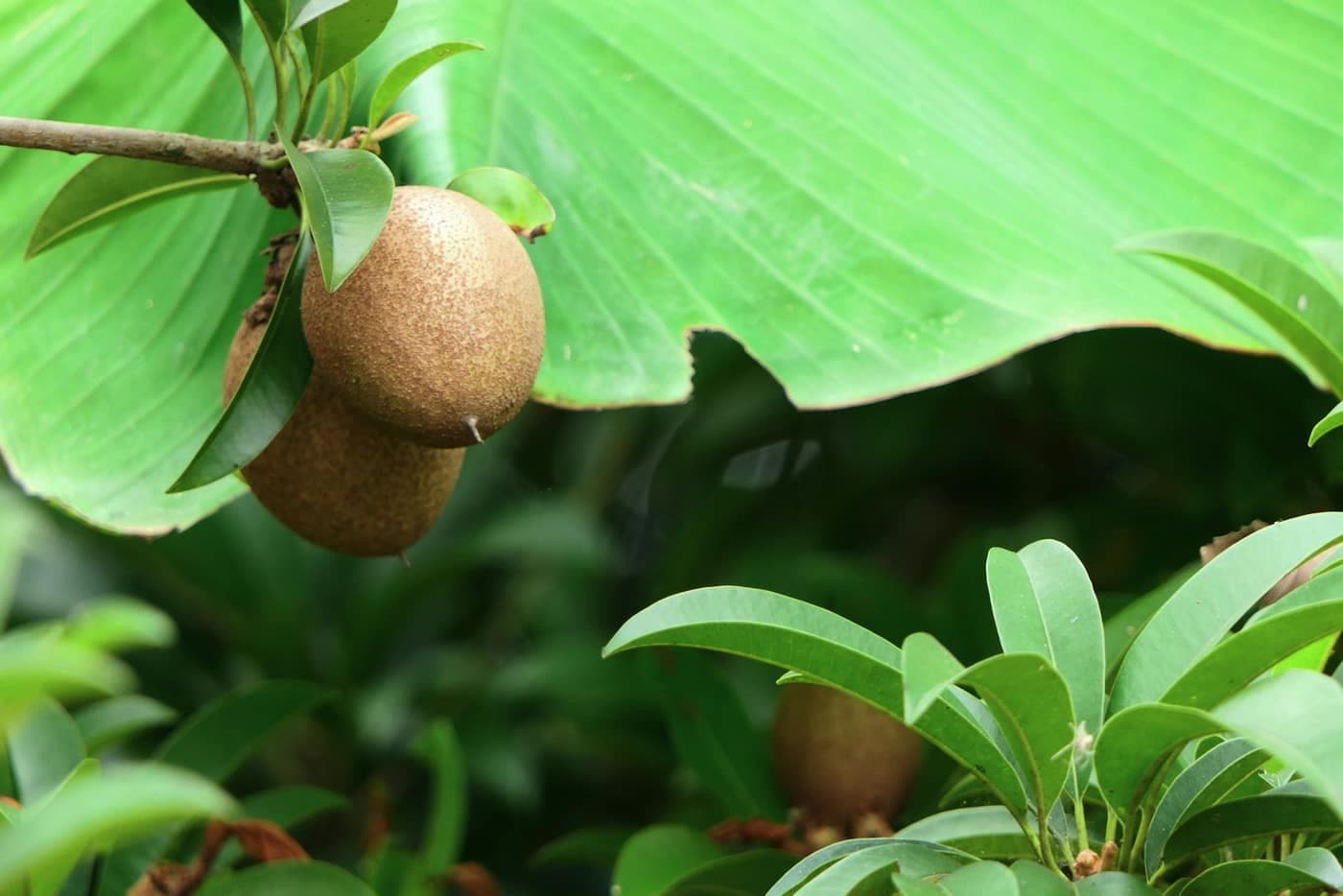
The other skill sapota demands is judging when to pick. Unlike most fruit, its brown, rough-skinned exterior barely changes colour between unripe and ripe, so growers judge maturity by rubbing the surface (a mature fruit's scruffy coat rubs off to a smooth shine) and by checking that the milky white latex the fruit exudes when scratched has mostly dried up. Picked too early, sapota never ripens properly and stays hard and full of latex; picked too late, it turns mealy and starts fermenting on the tree.
Once these two things are right — a good graft and correct picking maturity — sapota is a genuinely low-maintenance orchard tree: tolerant of poor soil, coastal salinity and drought once established, with leaf webber, sooty mould and fruit borer as its main but manageable problems.
- Crop type
- Slow-growing, long-lived evergreen fruit tree (grafted)
- Season
- Planted at monsoon onset; flowers and fruits almost year-round in warm climates
- Suitable states
- Maharashtra, Gujarat, Karnataka, Tamil Nadu, Andhra Pradesh
- Time to first bearing
- 3–4 years (grafted); 10–15 years and unreliable (seedling)
- Water requirement
- Moderate; drought-tolerant once established
- Temperature
- Warm tropical/subtropical, 20–35°C; frost-tender
- Soil type
- Tolerant of a wide range, including poor and coastal saline soils, pH 6.0–8.0
- Difficulty level
- Moderate (correct grafting, judging harvest maturity without a colour change)
- Expected yield
- 100–150 kg/tree/year at full bearing (8+ years)
- Key risk
- Picking fruit before it is ready — it never ripens properly once removed too early
Overview
Sapota, or chikoo (Manilkara zapota), is a slow-growing, long-lived evergreen fruit tree originally from Central America, grown in India for its sweet, grainy-textured, brown-fleshed fruit eaten fresh. It is tolerant of poor, saline and coastal soils and, once established, of real drought — traits that suit its main growing belts.
Maharashtra's Gholvad–Dahanu belt (Palghar district) is India's leading sapota area and gives its name to the well-known Kalipatti variety; Gujarat, Karnataka, Tamil Nadu and Andhra Pradesh grow it as well, each with their own locally preferred varieties. Almost all commercial trees are propagated by softwood grafting onto khirni rootstock rather than grown from seed, since seedling trees are slow and unreliable.
Two decisions define the crop: using a properly grafted plant of a known variety rather than a cheap seedling, and learning to judge ripeness by feel and by the drying of the fruit's latex rather than by colour, since sapota gives almost no visual cue of when it is ready to pick.
Crop timeline, sowing to harvest
A quick visual map of the season — jump to any section below for the detail behind each stage.
- Year 0
Planting
A softwood-grafted sapling of a named variety on khirni rootstock is planted in a well-prepared pit at the start of the monsoon.
- Year 1–3
Establishment
The young tree is trained to a strong framework, watered and manured to build a healthy canopy; flowering that occurs this early is usually removed to let the tree establish first.
- Year 3–4
First bearing
The grafted tree comes into its first light bearing, true to the parent variety's fruit quality.
- Ongoing (2–3 flowering flushes/year)
Flowering & fruit set
Sapota can flower and set fruit almost year-round in warm climates, giving overlapping crops of different maturity on the same tree at once.
- ~150–200 days from flowering
Fruit development
Fruit takes roughly five to seven months from flower to harvest maturity, developing its characteristic rough brown skin.
- Year 8 onward
Full bearing
The tree reaches heavier, more consistent yield from about the eighth year, and continues bearing productively for several decades.
Suitable states
States where this crop is grown at scale, highlighted below. Your local Krishi Vigyan Kendra is still the final word for your specific block.
- Jammu and Kashmir
- Himachal Pradesh
- Punjab
- Uttarakhand
- Haryana
- Delhi
- Uttar Pradesh
- Rajasthan
- Bihar
- Jharkhand
- West Bengal
- Sikkim
- Assam
- Arunachal Pradesh
- Meghalaya
- Nagaland
- Manipur
- Mizoram
- Tripura
- Gujarat
- Madhya Pradesh
- Chhattisgarh
- Maharashtra
- Odisha
- Goa
- Telangana
- Andhra Pradesh
- Karnataka
- Kerala
- Tamil Nadu
- Puducherry
- Ladakh
- Chandigarh
- Lakshadweep
Grown here
Climate requirements
Sapota's tolerance of coastal salinity and poor soil is one of its defining strengths, letting it be grown productively on land that would struggle to support many other fruit trees.
Ideal temperature
A warm tropical to subtropical tree growing best at 20–35°C. It has no frost tolerance and young trees can be killed by even a light frost, while established trees tolerate brief cool spells better.
Rainfall
Grows well on 1,000–2,500 mm of rainfall and, once established, tolerates real drought — a valuable trait for the coastal belts it is often grown in. Young trees need regular watering until their deep root system develops.
Humidity
Tolerates a range of humidity; the coastal, humid conditions of its main growing belts favour some fungal leaf and fruit problems, managed with routine sanitation rather than being a fundamental limit.
Sunlight
Full sun gives the best flowering, fruiting and fruit quality; a shaded tree flowers and fruits poorly.
Soil requirements
Sapota's soil tolerance should not be mistaken for zero soil preparation being needed — a well-prepared pit with organic matter still meaningfully speeds establishment and early bearing.
Suitable soil
Tolerant of a wide range of soils, from sandy coastal land to heavier loams, and notably tolerant of poor fertility and some salinity — one reason it thrives in Maharashtra's Dahanu–Gholvad coastal belt. A deep soil without a hard pan suits its root system best.
pH range
Best at pH 6.0–8.0; it tolerates mildly alkaline coastal soils better than many fruit trees.
Drainage
Reasonable drainage is still important even on tolerant soils — prolonged waterlogging around the root zone stresses the tree and predisposes it to root problems.
Organic matter
Responds well to organic matter worked into the planting pit and applied as ongoing mulch, though the tree can survive on lower-fertility land than most fruit trees if organic inputs are limited.
Land preparation
Same four steps whichever region you are in — only the timing shifts with the sowing window.
- 1
Dig and fill planting pits
Dig pits about 1 m³, fill with topsoil mixed with well-rotted FYM, and let them settle before planting at the start of the monsoon.
- 2
Space for a large, long-lived canopy
Space trees 8–10 m apart in both directions, since a mature sapota tree develops a large, dense, long-lived canopy.
- 3
Stake and shelter young grafts
Stake newly planted grafted saplings against wind and provide light shade if the planting season is unusually hot, since the young graft union is more vulnerable than an established tree.
Seed information
How the main varieties compare, so you can pick by duration, yield, disease pressure or what you are growing for.
| Variety | Duration | Yield | Disease resistance | Best state | Suitable for |
|---|---|---|---|---|---|
The leading commercial variety of Maharashtra, Gujarat and northern Karnataka, with an elongated fruit, thin skin, brown-sandy flesh at about 16–18°Brix sweetness, and a long shelf life of 7–10 days after harvest — a genuine trading advantage over most other varieties. | First bearing ~3–4 years (grafted) | 100–150 kg/tree/year at full bearing | No special resistance claimed | Maharashtra (Gholvad–Dahanu), Gujarat, north Karnataka | Main commercial variety for both local and distant markets |
A large, round-fruited traditional variety with thicker skin and gritty, granular, moderately sweet pulp, performing well in both arid and humid climates and tolerating rough handling in transport better than thinner-skinned types. | First bearing ~3–4 years (grafted) | 100–140 kg/tree/year at full bearing | No special resistance claimed | Widely grown across sapota belts | Long-distance transport, traders wanting tougher handling |
A Tamil Nadu Agricultural University hybrid between Cricket Ball and Vavivalasa, giving an oblong-ovate, pleasantly flavoured, very sweet fruit with a total soluble solids of about 24.2°Brix — among the sweetest named varieties available. | First bearing ~3–4 years (grafted) | 100–130 kg/tree/year at full bearing | No special resistance claimed | Tamil Nadu, Andhra Pradesh | Table use where very high sweetness is valued |
A Dharwad (Karnataka) selection valued for early bearing and high yield, specifically adapted to north Karnataka's drier growing conditions. | First bearing ~3 years (grafted, earlier than most) | 110–150 kg/tree/year at full bearing | No special resistance claimed | North Karnataka | Drier growing tracts wanting earlier bearing |
A very popular traditional variety in Andhra Pradesh and Tamil Nadu bearing small-to-medium, oval or egg-shaped fruit borne in clusters, valued for consistent local demand. | First bearing ~3–4 years (grafted) | 90–130 kg/tree/year at full bearing | No special resistance claimed | Andhra Pradesh, Tamil Nadu | Local table market with steady, reliable demand |
A traditional variety popular in West Bengal, Bihar and Uttar Pradesh with medium-sized, round fruit; the name ("all-season") reflects a tendency to flower and fruit more continuously through the year than some other varieties. | First bearing ~3–4 years (grafted) | 90–130 kg/tree/year at full bearing | No special resistance claimed | West Bengal, Bihar, Uttar Pradesh | Eastern and northern plains growers, more continuous cropping |
A native South Indian variety with a compact growth habit that suits smaller orchard spacing and home gardens better than the more spreading commercial varieties. | First bearing ~3–4 years (grafted) | 70–110 kg/tree/year at full bearing | No special resistance claimed | Andhra Pradesh, Tamil Nadu, Karnataka | Smaller plots and home gardens wanting a compact tree |
- Seed rate
- Not sown from seed commercially — one grafted sapling per planting position, at roughly 100–150 trees per hectare (8–10 m spacing).
- Certified seed
- Buy softwood-grafted saplings of a named variety from a government nursery, agricultural university or reputed private nursery. Confirm the graft union is healed and well-callused before planting — a seedling sold as a "sapota plant" without a visible graft union will be slow and unreliable to bear.
- Spacing
- 8–10 m between trees in both directions, reflecting the large canopy a mature tree develops over its long life.
- Seed treatment
- Not applicable to grafted planting material; the mother tree used for scion wood should be a healthy, true-to-type, disease-free tree of the desired variety.
Sowing guide
Never bury the graft union below soil level — it should stay visible above ground so it does not rot and so any scion roots that form do not bypass the rootstock's benefits.
- Best time
- Plant grafted saplings at the start of the monsoon (June–July) so they establish before the following dry season, though container-grown grafts can be planted with irrigation at other times too.
- Row spacing
- 8–10 m
- Plant spacing
- 8–10 m
- Sowing depth
- Planted at the same depth the sapling stood in its nursery bag, with the graft union kept above the final soil level
- Method
- Set the grafted sapling in a well-prepared, manured pit, firm the soil, stake against wind, and water in well immediately.
Fertilizer schedule
A split dose beats one large dose applied at sowing — nitrogen especially is lost to the air and to leaching if it all goes in on day one.
- 1
Young tree (years 1–3)
Split doses through the year
Modest, increasing doses of nitrogen, phosphorus and potash as the tree establishes its framework, applied in the root zone and watered in.
- 2
Bearing tree, basal
At the start of the main growth flush
The larger share of the annual NPK dose for a bearing tree, along with well-rotted FYM or compost worked into the basin.
- 3
Bearing tree, post-harvest
After the main harvest flush
A follow-up split to help the tree recover and build the next flowering flush, with potash supporting fruit quality on the next crop.
Irrigation schedule
1. Young tree establishment
Years 1–3
Regular watering, especially through the first two dry seasons, until the deep root system is established.
2. Flowering and fruit set
Ongoing, as flushes occur
Even soil moisture through flowering and early fruit set improves fruit retention; a sudden dry-to-wet swing can also affect fruit quality.
3. Established bearing tree
Dry spells
A mature tree tolerates real drought, but occasional deep watering in a prolonged dry spell still helps maintain yield and fruit size.
Critical stages
- First two years of establishment
- Flowering and early fruit set
Water-saving tips
- Established sapota is one of the more drought-tolerant fruit trees on this site, so mature orchards often need only occasional supplementary watering.
- A basin or drip system around the root zone concentrates water where it is used rather than losing it to the wider inter-row area.
- A mulch of dry leaves or crop residue in the tree basin conserves moisture especially valuable during the establishment years.
Weed management
Common weeds
Organic control
- Regular basin weeding by hand, especially around young trees where weeds compete hardest for water and nutrients.
- A mulch of dry leaves or crop residue in the basin suppresses weeds and conserves moisture at the same time.
Chemical control
- A directed spot spray of a cleared herbicide in the inter-row of a mature orchard, keeping it well away from the trunk and root flare.
- Confirm the current product and dose with your local KVK before spraying near a fruiting orchard.
Nutrient deficiency identification
What a shortage of each nutrient actually looks like on the plant, so you can tell a deficiency apart from a disease before you spray the wrong thing.
Zinc
Visible symptom
Small, narrow, mottled young leaves and shortened internodes on the new growth ("little leaf" pattern), corrected with a foliar zinc sulphate spray.
Nitrogen
Visible symptom
Pale, sparse foliage and a weak flowering flush on an otherwise mature bearing tree.
Potassium
Visible symptom
Scorched older leaf margins and smaller, less sweet fruit — potassium matters for fruit sizing and sugar content.
Diseases to watch for
Symptoms, likely cause and what actually treats it — not just a spray name.
Anthracnose
- Symptoms
- Dark, sunken spots on leaves, twigs and developing fruit, sometimes with a pinkish spore mass in humid weather; badly affected fruit rots and drops.
- Cause
- Colletotrichum species, favoured by warm, humid weather with prolonged leaf and fruit wetness.
- Treatment
- A protective copper or recommended fungicide spray at the first spots, repeated at 10–14 day intervals in humid weather.
- Prevention
- Prune to open the canopy for better airflow, remove and destroy fallen infected leaves and fruit, and avoid overhead irrigation late in the day.
Sooty mould
- Symptoms
- A black, sooty coating on leaves and twigs that wipes off with effort, growing on the honeydew left behind by sap-sucking pests rather than attacking the plant tissue directly.
- Cause
- Various fungi growing on honeydew excreted by mealybugs, scale insects and similar sap-sucking pests.
- Treatment
- Control the underlying honeydew-producing pest and the mould itself fades; a wash-down spray can speed removal on badly coated foliage.
- Prevention
- Manage mealybugs and scale insects proactively, since sooty mould is a symptom of their presence rather than an independent disease.
Pests to watch for
What to look for before the damage is visible, and organic options before you reach for a chemical.
Bud borer / leaf webber
- Identification
- Caterpillars that web together young shoot tips, buds and tender leaves with silk, feeding and sheltering inside the webbed mass; affected shoots show a tangled, browned cluster of dead or dying tissue.
- Damage
- Repeated attack on young flushes stunts shoot growth and destroys developing flower buds, cutting the crop that flush would have given.
- Organic control
- Prune out and destroy webbed shoot tips promptly before the caterpillars inside mature and spread, and conserve natural predators by limiting unnecessary broad-spectrum spraying.
- Chemical control
- A recommended insecticide timed to new flush emergence where webbing is a recurring problem, following the label and local KVK advice.
Mealybugs
- Identification
- Small, soft, white, wax-covered insects clustering on new shoots, flower clusters and developing fruit, often tended by ants and followed by sooty mould on their honeydew.
- Damage
- Direct feeding weakens shoots and can cause flower and young fruit drop; heavy infestation also invites sooty mould that further shades the leaf surface.
- Organic control
- Control the ants that protect and spread mealybug colonies, conserve natural predators, and prune out badly infested shoot tips.
- Chemical control
- A recommended systemic insecticide directed at colonies on new growth and flower clusters where infestation is heavy.
Common mistakes to avoid
The mistakes that cost growers the most, ranked by how often they show up in the field — not in the order you might expect.
- 1
Planting an ungrafted seedling tree instead of a proper graft.
Why it hurts
A seedling sapota can take ten to fifteen years to bear its first fruit, and the fruit quality is unpredictable and often disappointing compared with its parent. A softwood graft on khirni rootstock bears true to the named variety in about three to four years.
- 2
Picking fruit by colour rather than by feel and latex.
Why it hurts
Sapota barely changes colour as it ripens, so judging by colour alone leads to picking either too early (fruit stays hard and latex-filled, never ripening properly) or too late (fruit turns mealy and starts fermenting). Judge by the surface rubbing smooth and the milky latex mostly drying up.
- 3
Burying the graft union below soil level at planting.
Why it hurts
A buried union is prone to rot and can let scion roots form that bypass the rootstock's soil tolerance — plant with the union kept visibly above the final soil surface.
- 4
Ignoring sooty mould as a cosmetic issue rather than a pest symptom.
Why it hurts
Sooty mould itself does not attack the plant, but it always signals an underlying mealybug or scale infestation producing the honeydew it grows on — treating the mould without controlling the pest leaves the real problem untouched.
- 5
Letting weeds and poor basin hygiene compete with a young tree in its first two years.
Why it hurts
A young grafted tree establishes far more slowly when weeds take the water and nutrients meant for it, delaying the tree's path to its first bearing.
Harvesting
Judge maturity by rubbing the fruit's surface — a mature fruit's rough, scruffy coat rubs off to reveal a smooth shine, while an immature fruit stays rough. A mature fruit also shows little to no milky latex when the stalk is snapped, whereas an unripe fruit oozes copious white latex. Harvest by hand-picking or with a pole-cutter for high branches, since sapota does not detach easily on its own.
Signs it is ready
- Surface rubs smooth rather than staying rough and scruffy
- Little to no milky latex when the stalk is broken
- A dull rather than shiny-green look to the skin
- Fruit gives slightly to gentle finger pressure
Tools
- A pole-cutter with a collection bag for high branches
- Padded baskets or crates — sapota bruises and the latex stains hands and cloth
- Gloves to keep the sticky latex off bare skin
Expected yield
Roughly 100–150 kg per tree per year at full bearing (from about the eighth year onward), varying by variety and management.
Post-harvest & storage
Storage
Harvested mature-but-firm sapota ripens off the tree over about 4–8 days at room temperature, softening and developing full sweetness; it does not need to be picked fully soft. It can be held a little longer at cooler temperatures (around 10–15°C) to stagger ripening for market.
Packaging
Handle fruit gently — sapota bruises easily and a bruised area ripens unevenly and rots faster. Pack in single or shallow layers in ventilated crates, not tightly stacked sacks.
Transportation
Move fruit picked at the right maturity stage so it arrives at market still firm and ripens correctly along the way; fruit picked too soft for transport bruises badly before it arrives.
Shelf life
About 4–8 days from harvest to full ripeness at room temperature; Kalipatti's longer 7–10 day shelf life after ripening is a genuine trading advantage that helps explain its dominance in distant markets.
Market prices
Today's mandi price near you, pulled live from the government's own Agmarknet data.
Live daily mandi prices from the government Agmarknet dataset.
Synced from data.gov.in (Agmarknet). Rates are ₹ per quintal.
Weather
Current conditions and a 5-day outlook for your selected location, with one line of stage-aware advice.
Pick your state for current conditions and a 5-day outlook.
Live data from Open-Meteo
Profit calculator
Your own cost sheet, expected yield and selling price — not ours.
Where the money goes
Share of the total cost per acre, using the calculator’s own default cost sheet below — adjust the numbers there to match your field and this picture will no longer apply to you exactly, but the ranking rarely changes.
- Labour28% (₹15,000)
- Seed22% (₹12,000)
- Land rent18% (₹10,000)
- Fertiliser11% (₹6,000)
- Pesticide & weedicide7% (₹4,000)
- Irrigation6% (₹3,000)
- Interest5% (₹2,500)
- Machinery4% (₹2,000)
Official downloads
Government and ICAR documents only — everything below is hosted on an official server.
ICAR-Central Coastal Agricultural Research Institute (CCARI), Goa
Sapota crop advisory and package of practices
National Horticulture Board (NHB) — Sapota
Kalipatti and regional sapota variety notes
Tamil Nadu Agricultural University (TNAU) Agritech Portal
CO-3 and southern sapota production technology
Kisan Call Centre — 1800-180-1551
Free crop advice in your language
Frequently asked questions
Why did my sapota tree take so many years to fruit, and why is the fruit disappointing?
Almost certainly because it was grown from seed rather than grafted. A seedling sapota tree can take ten to fifteen years to bear its first fruit, and the fruit quality is unpredictable — it may be far sweeter or blander than expected. Plant a softwood-grafted sapling of a named variety on khirni rootstock instead, which bears true to that variety in about three to four years.
How do I know when a sapota is ripe enough to pick? It never seems to change colour.
That is normal — sapota barely changes colour between unripe and ripe, so colour is not a reliable sign. Instead rub the surface: a mature fruit's rough, scruffy coat rubs off to a smooth shine, while an immature one stays rough. Also snap the stalk — a mature fruit shows little to no milky latex, while an unripe one oozes it copiously.
What is the black sooty coating on my sapota leaves?
That is sooty mould, a fungus growing on the sugary honeydew left behind by mealybugs, scale insects or similar sap-sucking pests — it does not attack the plant tissue directly. Wiping or spraying off the mould alone will not solve the problem; control the underlying pest producing the honeydew, and the mould will fade on its own.
How much space does a sapota tree actually need?
A mature sapota develops a large, dense canopy over its long life, so plant trees 8–10 m apart in both directions. Crowding trees closer shades neighbouring canopies and reduces flowering and fruit quality once the trees mature.
Does sapota have an MSP or a mandi price?
There is no MSP for sapota. It is traded on Agmarknet under the commodity name "Chikoos(Sapota)", with regular records from markets including Tamil Nadu's Uzhavar Sandhai system. Prices vary by variety, with Kalipatti and CO-3's higher sweetness generally commanding better rates than plainer traditional types.
Still have questions?
The FAQs above cover the common ones. For anything specific to your field and soil, your nearest Krishi Vigyan Kendra is the authoritative answer.