
Cardamom (Elaichi)
Elettaria cardamomum
A shade-loving, cross-pollinated perennial spice herb confined to the mid-altitude hill tracts of Idukki and Wayanad in Kerala and Kodagu, Chikmagalur and Hassan in Karnataka — never a field crop planted from seed each season. Two problems decide it: Katte (Cardamom mosaic virus), an incurable virus that stunts a clump for life, and Azhukal (Phytophthora capsule rot), which can rot an entire panicle within days of the monsoon.
Quick Summary
The key points from this page in about two minutes — read it or have it read aloud.
Quick Summary
Small cardamom (Elettaria cardamomum) is a cross-pollinated perennial rhizomatous herb, not a field crop resown each year — a clump, once established under forest shade, keeps producing for a decade or more. India's entire commercial crop sits in a narrow band of mid-altitude, high-rainfall hill tracts: Idukki and Wayanad in Kerala grow the large majority of the national crop, with Kodagu, Chikmagalur, Shivamogga and Hassan in Karnataka and pockets of Tamil Nadu's Western Ghats making up the rest. The plant needs a genuine two- or three-tier forest canopy overhead, not full sun, and fails outside this specific climate niche.
ICAR-IISR's Cardamom Research Centre at Appangala, Karnataka, alongside the Indian Cardamom Research Institute at Myladumpara, Kerala, has released a small number of named varieties — Mudigere-1, Mudigere-2, IISR Avinash and IISR Vijetha foremost among them — bred mainly for disease resistance and compact, high-density-friendly growth rather than dramatic yield jumps, since cardamom's realistic yield ceiling is set as much by disease pressure as by genetics. Farmer-developed selections such as Njallani (Green Gold) sit alongside these official releases in many holdings.
Because cardamom is a shade-dependent perennial herb rather than an annual field crop, this page follows the same different shape as avocado, tea and coffee on this site: it covers clump establishment and the two-to-three-year wait for first bearing rather than a sowing calendar, and it skips the seed-rate, irrigation-scheduling and crop-calendar tools built for row crops. What it does carry, in full, is the honest picture of what actually decides a cardamom crop: Katte disease, capsule rot, and the shade-and-drainage regime that keeps both in check.
- Crop type
- Perennial, cross-pollinated rhizomatous spice herb
- Season
- Planted at monsoon onset (May–June)
- Suitable states
- Kerala, Karnataka, Tamil Nadu
- Time to bearing
- 2–3 years from planting
- Water requirement
- High, well-distributed rainfall; never waterlogged
- Temperature
- Mild, humid hill climate under shade, 10–35°C
- Soil type
- Deep forest loam, rich in organic matter; pH 5.5–6.5
- Difficulty level
- Hard (Katte and capsule rot pressure, narrow climate fit)
- Expected yield
- 150–300 kg dry capsule/ha (up to ~475 kg/ha for high-yielding releases)
- Key risk
- Katte (mosaic virus) and Azhukal (capsule rot)
Overview
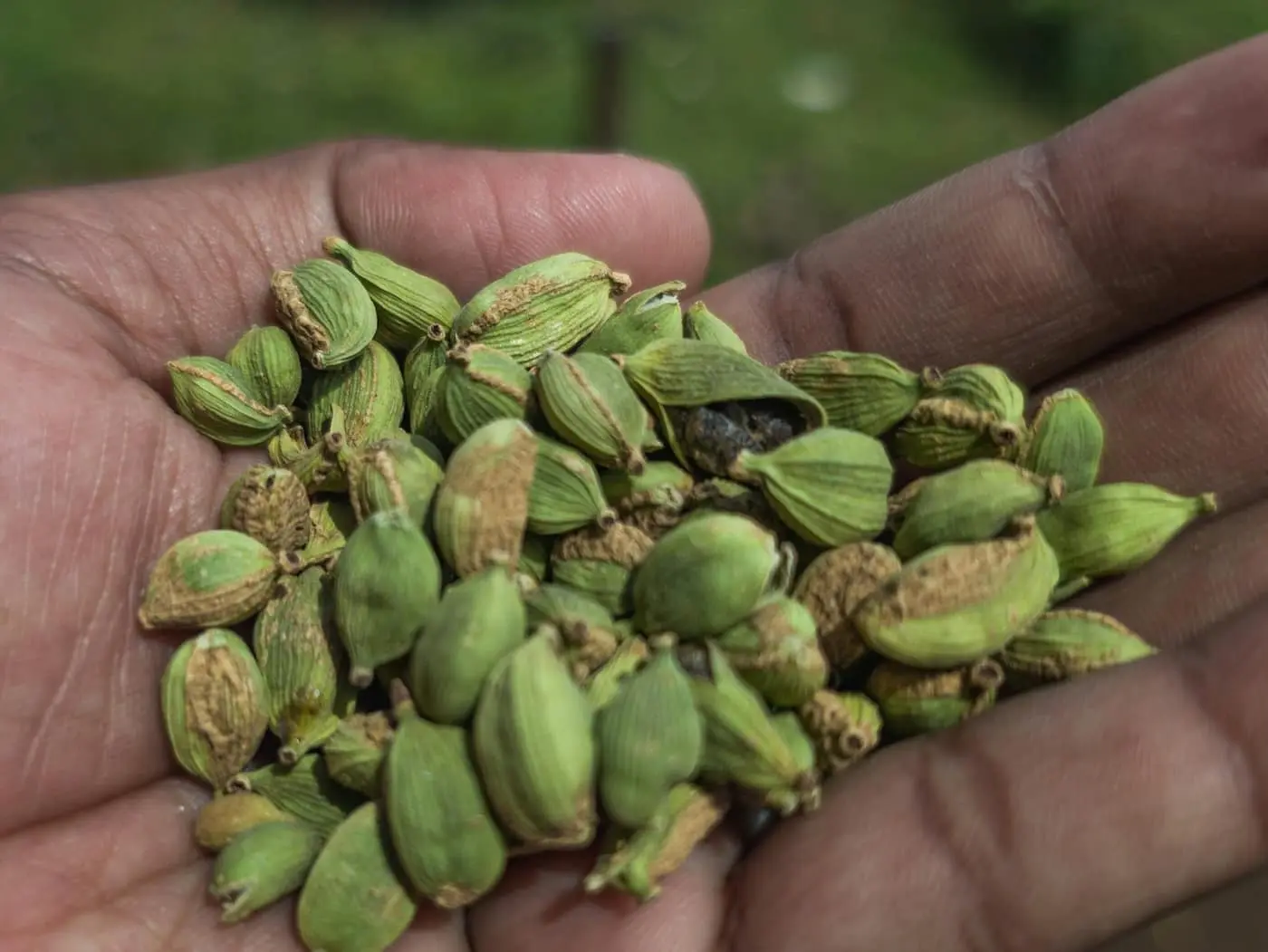
Small cardamom (Elettaria cardamomum) is a cross-pollinated perennial herb of the ginger family (Zingiberaceae), grown for its dried capsules under the forest shade of specific mid-altitude hill tracts. In Kerala, Idukki district alone accounts for roughly three-quarters of the state's cardamom area, with Wayanad and Palakkad making up most of the rest; in Karnataka the crop concentrates in Kodagu, Chikkamagaluru, Shivamogga hills and parts of Hassan district. Small pockets of Tamil Nadu's Western Ghats, including the Bodinayakanur–Theni belt where the Spices Board runs a major e-auction centre, round out India's cardamom map.
The plant is a genuine shade crop: it is grown under a managed two- or three-tier canopy of forest or planted shade trees at 800–1,300 m elevation, in a climate with abundant, well-distributed rainfall and no tolerance for either waterlogging or harsh direct sun. This narrow climate-and-canopy requirement, more than soil type, is what confines cardamom to its specific hill belt rather than any wider Indian range.
ICAR-IISR's Cardamom Research Centre at Appangala and the Indian Cardamom Research Institute at Myladumpara have released a handful of named varieties — Mudigere-1, Mudigere-2, IISR Avinash and IISR Vijetha among them — selected mainly for disease tolerance (rhizome rot and Katte respectively) and a compact habit suited to high-density planting, alongside farmer-origin selections like Njallani that remain widely grown for their high yield potential. Two problems dominate every real conversation about cardamom agronomy: Katte (Cardamom mosaic virus), an incurable, yield-sapping virus spread mainly through infected planting material, and Azhukal (Phytophthora capsule rot), the most fatal field disease, which can destroy a panicle's capsules within days in wet, humid weather.
Crop timeline, sowing to harvest
A quick visual map of the season — jump to any section below for the detail behind each stage.
- Year 0
Planting
Healthy rhizomes or tissue-culture/certified suckers are planted in pits under an established forest or artificial shade canopy at the onset of the monsoon (May–June).
- Year 1–2
Establishment
The clump develops tillers and a root system under shade; irrigation and mulching through the first dry season matter more than any input at this stage.
- Year 2–3
First flowering & bearing
Panicles emerge from the base of the clump and set the first, usually modest, crop of capsules.
- May–Aug (annual)
Flowering
Once established, panicles flower each year through the pre-monsoon and monsoon months; the crop is cross-pollinated, mainly by bees.
- Aug–Feb (annual)
Capsule development & harvest
Capsules mature progressively over several months rather than all at once, so picking runs in repeated rounds through the season.
- Every 20–25 days
Selective picking
Mature capsules are hand-picked as they turn from green to a slightly paler green-yellow, well before they split — a clump is picked over many times across the harvest season.
Suitable states
States where this crop is grown at scale, highlighted below. Your local Krishi Vigyan Kendra is still the final word for your specific block.
- Jammu and Kashmir
- Himachal Pradesh
- Punjab
- Uttarakhand
- Haryana
- Delhi
- Uttar Pradesh
- Rajasthan
- Bihar
- Jharkhand
- West Bengal
- Sikkim
- Assam
- Arunachal Pradesh
- Meghalaya
- Nagaland
- Manipur
- Mizoram
- Tripura
- Gujarat
- Madhya Pradesh
- Chhattisgarh
- Maharashtra
- Odisha
- Goa
- Telangana
- Andhra Pradesh
- Karnataka
- Kerala
- Tamil Nadu
- Puducherry
- Ladakh
- Chandigarh
- Lakshadweep
- Andaman and Nicobar Islands
- Dadra and Nagar Haveli and Daman and Diu
Grown here
Climate requirements
Cardamom's entire Indian range is drawn by elevation and shade at once: it needs the 800–1,300 m hill belt for its mild, humid climate, and it needs a real forest-type canopy overhead, not open field sun — which is why it stays confined to specific pockets of the Western Ghats rather than spreading to any hill tract with the right rainfall alone.
Ideal temperature
A mild, humid hill climate, roughly 10–35°C, under shade — the plant cannot take harsh direct sun or the extremes of either the plains or high alpine cold
Rainfall
Wants abundant, well-distributed rainfall through most of the year (the crop's hill tracts typically see 1,500–4,000+ mm), but never standing water at the root
Humidity
High humidity suits vegetative growth and flowering but also drives both Azhukal (capsule rot) and several leaf diseases, making humid, wet spells the highest-risk window of the year
Sunlight
A genuine shade crop — grown under a managed two- or three-tier forest or planted-tree canopy; too little shade scorches the plant and too dense a canopy favours capsule rot
Soil requirements
Good cardamom land is built as much as found: the shade canopy above and the leaf-litter and mulch that build up below are what keep a hill slope productive for the plant's long life, alongside drainage that stops the abundant monsoon rain from ever standing at the root.
Suitable soil
Deep, friable forest loam rich in organic matter, built up over years under shade-tree leaf litter — the same kind of soil that underlies coffee and pepper estates in the same hill tracts
pH range
5.5–6.5 (slightly acidic)
Drainage
Good drainage on a gentle slope is essential; the shallow rhizome and root system rot quickly in waterlogged ground, especially during the wet capsule-development months
Organic matter
High organic matter is central to cardamom soil health — shade-leaf litter, mulch and farmyard manure sustain the humus the shallow-rooted clump depends on
Land preparation
Same four steps whichever region you are in — only the timing shifts with the sowing window.
- 1
Establish or regulate the shade canopy first
A working two- or three-tier canopy of forest or planted shade trees (silver oak, jackfruit, forest species) must already be in place, or be established a year or two ahead, before cardamom is planted beneath it.
- 2
Prepare pits on a well-drained slope
Dig pits roughly 30 × 30 × 30 cm at the chosen spacing on ground that never holds standing water, refilled with topsoil mixed with well-rotted farmyard manure.
- 3
Source certified, disease-free planting material
Take rhizomes or suckers only from a certified nursery or a known, Katte-free mother clump — this single decision does more to keep a new planting clean than any later spray or fertiliser.
Seed information
How the main varieties compare, so you can pick by duration, yield, disease pressure or what you are growing for.
| Variety | Duration | Yield | Disease resistance | Best state | Suitable for |
|---|---|---|---|---|---|
A compact-habit Malabar-type selection from ICAR-IISR's Cardamom Research Centre, Appangala, suited to high-density planting, with tolerance to hairy caterpillar and white grub reported alongside its compact growth. | First bearing in 2–3 years | High under good management | Reported tolerance to hairy caterpillar and white grub | Karnataka (Kodagu, Chikkamagaluru) | High-density planting on compact clumps |
A later Malabar-type release from the same Appangala programme, recommended for Kodagu, north Wayanad, Hassan and Chikkamagaluru, with an average yield reported around 475 kg/ha in trials. | First bearing in 2–3 years | ~475 kg/ha (trial average) | Not specifically documented beyond general Malabar-type vigour | Karnataka (Kodagu, Chikkamagaluru, Hassan), Kerala (north Wayanad) | General cultivation across the Karnataka–Wayanad hill belt |
Released by ICAR-IISR's Cardamom Research Centre, Appangala, through clonal selection, specifically for tolerance to rhizome rot — the underground-rhizome disease that is separate from, but sometimes confused with, Azhukal capsule rot. | First bearing in 2–3 years | High under good management | Rhizome-rot tolerant (bred trait) | Karnataka | Fields with a history of rhizome rot |
A Malabar-type selection released in 2001, chosen in the field for resistance to Katte (Cardamom mosaic virus) and recommended specifically for moderate-rainfall areas under moderate-to-high mosaic pressure. | First bearing in 2–3 years | High under good management | Field resistance to Katte (Cardamom mosaic virus) | Karnataka (Kodagu, north Wayanad, Hassan, Chikkamagaluru) | Areas with a history of Katte disease pressure |
An early-maturing selection with a compact growth habit suited to high-density planting, bearing a long panicle with oblong, bold, parrot-green capsules. | Early-maturing; first bearing in 2–3 years | High-yielding under high-density planting | Not specifically documented | Kerala, Karnataka | High-density planting systems |
A farmer-developed Vazhukka-type selection, originally identified by a grower in the cardamom hills of Kerala, prized for very high nutrient uptake, hybrid vigour and heavy capsule bearing (commonly cited at 120–160 capsules per panicle); widely grown under high-density spacing (2 × 2 m) though it is not an official ICAR/ICRI release. | First bearing in 2–3 years | Very high, among the highest reported for any cardamom selection | Not formally documented; grower reports describe generally good vigour | Kerala (Idukki), Karnataka | High-density commercial planting (2 × 2 m spacing) |
- Seed rate
- Not a true seed crop — planted from rhizomes/suckers at roughly 1,580–2,470 clumps/ha depending on spacing (2.5 × 2.5 m traditional to 2 × 2 m high-density for compact selections like Njallani)
- Certified seed
- Plant only certified rhizomes or tissue-culture/sucker planting material from a known, Katte-free mother clump or an ICAR-IISR/ICRI-linked nursery — planting material dug from an unchecked neighbouring farm is the single most common way Katte disease enters a new field.
- Spacing
- 2.5 × 2.5 m for traditional varieties (~1,580 clumps/ha); 2 × 2 m for compact, high-density-suited selections like Njallani (~2,470 clumps/ha)
- Seed treatment
- Not a seed crop — inspect rhizomes/suckers for healthy, disease-free tillers before planting, and avoid any planting material showing pale, striped or mottled leaves, the early sign of Katte.
Sowing guide
The single decision that matters most at planting is not spacing but the health of the planting material and the site's drainage — certified, Katte-free rhizomes on a well-drained slope under working shade prevent more loss over the clump's productive life than any input applied afterward.
- Best time
- Plant rhizomes or suckers at the onset of the monsoon (May–June) so the clump establishes on reliable rainfall through its first dry-season test
- Row spacing
- 2 to 2.5 m depending on variety and planting density
- Plant spacing
- 2 to 2.5 m within the row, matching row spacing on a square or rectangular layout
- Sowing depth
- Set the rhizome/sucker at the same depth it stood at in the nursery, into a well-drained pit refilled with topsoil and farmyard manure
- Method
- Plant certified, disease-free rhizomes or suckers into prepared pits under an already-established shade canopy, mulch immediately, and irrigate to settle the soil around the root zone
Fertilizer schedule
A split dose beats one large dose applied at sowing — nitrogen especially is lost to the air and to leaching if it all goes in on day one.
- 1
Young clumps (Year 1–2)
Split through the growing season
A balanced NPK dose supports tiller and root development while the clump is establishing under shade.
- 2
Mature, bearing clumps
Split before and after the monsoon
A higher overall dose, typically split into a pre-monsoon and a post-monsoon application, supports flowering, capsule set and fill.
- 3
Micronutrients
As needed, based on soil test
Zinc and boron deficiencies are common on the leached hill soils cardamom is grown on; correct on the basis of a soil or leaf test rather than routinely.
Irrigation schedule
1. Establishment (Year 1–2)
Regular, light irrigation through the first dry season
Keep the shallow root zone consistently moist while the clump establishes; this is also when drainage mistakes show up fastest.
2. Dry season (Jan–April)
Supplemental irrigation where available
Sprinkler or drip irrigation through the driest months sustains vegetative growth and prepares the clump for the coming flowering season.
3. Flowering & capsule development
May–Nov
Relies mainly on the monsoon's own rainfall; the priority here shifts from adding water to making sure excess water drains away.
Critical stages
- Establishment (Year 1–2)
- Dry-season vegetative growth (Jan–April)
- Flowering and capsule set
Water-saving tips
- Mulch heavily around each clump to conserve soil moisture through the dry months and suppress weeds at the same time.
- Sprinkler or drip irrigation through the dry season is a worthwhile investment where water is available, rather than relying only on the monsoon.
- Never irrigate a site that already shows poor drainage — fixing the drainage problem matters more than any irrigation schedule for a crop this vulnerable to Azhukal.
Weed management
Common weeds
Organic control
- Hand weeding or shallow scraping around each clump is the standard practice, since deep cultivation damages the shallow root system.
- A well-mulched clump under a properly regulated shade canopy suppresses most weed growth on its own.
Chemical control
- Herbicide use is kept very conservative around cardamom, since the plant's shallow rhizome and root system are easily damaged by chemical drift or contact.
- Confirm any herbicide is genuinely cleared for use in a cardamom plantation with your local KVK or the Indian Cardamom Research Institute before applying.
Nutrient deficiency identification
What a shortage of each nutrient actually looks like on the plant, so you can tell a deficiency apart from a disease before you spray the wrong thing.
Nitrogen
Visible symptom
Pale, sparse foliage and reduced tillering, most visible on young, establishing clumps.
Potassium
Visible symptom
Poor capsule filling and marginal leaf scorch on an otherwise established, bearing clump.
Zinc
Visible symptom
Small, narrow, interveinally chlorotic new leaves — a common micronutrient issue on the leached hill soils cardamom is typically grown on.
Diseases to watch for
Symptoms, likely cause and what actually treats it — not just a spray name.
Katte disease (Cardamom mosaic virus)
- Symptoms
- Spindle-shaped pale flecks on the youngest leaf that lengthen into mosaic stripes running parallel to the veins, with the clump becoming progressively stunted, bushy and less productive.
- Cause
- Cardamom mosaic virus, spread mainly by the banana aphid but carried farm to farm chiefly through infected rhizomes and suckers dug from a diseased clump.
- Treatment
- No cure once a plant is infected — the only management is roguing out and destroying affected clumps and controlling the aphid vector to slow further spread.
- Prevention
- Plant only certified, virus-indexed rhizomes and suckers, inspect regularly for the early mosaic-fleck symptom, and grow a field-tolerant release like IISR Vijetha in high-pressure areas. See the dedicated Katte disease guide for full detail.
Azhukal (capsule rot)
- Symptoms
- Small, water-soaked spots on developing green capsules that enlarge fast into a dark, foul-smelling rot within days of warm, humid weather; in severe cases the rot can travel down into the rhizome and kill the whole clump.
- Cause
- Phytophthora meadii, with P. nicotianae also implicated — both thrive in the warm, humid, waterlogged conditions of the south-west monsoon.
- Treatment
- A scheduled protectant fungicide programme (commonly copper-based or metalaxyl-mancozeb) timed to and through the monsoon, alongside prompt removal of rotted capsules and panicles.
- Prevention
- Improve drainage before the monsoon, regulate shade for better air movement, and remove fallen capsule and panicle debris each season. See the dedicated capsule rot guide for full detail.
Rhizome rot
- Symptoms
- Yellowing and collapse of pseudostems above ground with a soft, foul-smelling rot of the underground rhizome itself — a distinct disease from Azhukal, though both can appear in the same wet season.
- Cause
- Mainly Pythium species, often with Fusarium, favoured by warm, waterlogged soil — the same disease that affects ginger and turmeric, both close relatives of cardamom in the ginger family.
- Treatment
- Improve drainage immediately, drench the affected area with a recommended fungicide, and rogue out badly affected clumps.
- Prevention
- Plant a rhizome-rot-tolerant release such as IISR Avinash in fields with a history of the disease, and never plant into ground that has shown waterlogging.
Pests to watch for
What to look for before the damage is visible, and organic options before you reach for a chemical.
Thrips
- Identification
- Tiny, slender insects visible mainly by the silvery scarring and distortion they leave on young leaves and developing capsules.
- Damage
- Feeding scars reduce capsule quality and market grade, and heavy infestation can affect capsule development directly.
- Organic control
- Yellow/blue sticky traps, conserving natural predators, and neem-based sprays where infestation is light.
- Chemical control
- A recommended systemic insecticide where thrips cross the damage threshold, applied per local KVK guidance.
Cardamom shoot & capsule borer
- Identification
- A caterpillar (the same species that attacks ginger and turmeric shoots) that bores into the pseudostem and developing panicles, leaving visible entry holes and frass.
- Damage
- Bored shoots wilt and die, and infested panicles lose developing capsules directly to the tunnelling larva.
- Organic control
- Remove and destroy infested shoots and panicles promptly, and use pheromone or light traps to monitor adult moth activity.
- Chemical control
- A recommended insecticide timed to egg-laying and early larval stages, applied per local KVK/ICRI guidance.
White grub / root grub
- Identification
- C-shaped, cream-coloured grubs found in the soil around the clump's base, feeding on roots and rhizomes.
- Damage
- Root and rhizome feeding weakens or kills the clump outright, and damaged tissue is also more open to rhizome rot infection.
- Organic control
- Light traps to catch adult beetles before egg-laying, and soil application of an entomopathogenic fungus like Metarhizium where available.
- Chemical control
- A recommended soil-applied insecticide around affected clumps where grub damage is confirmed.
Common mistakes to avoid
The mistakes that cost growers the most, ranked by how often they show up in the field — not in the order you might expect.
- 1
Removing too much shade to "let more light in".
Why it hurts
Cardamom is a genuine shade crop — stripping the canopy scorches the plant and stresses it, while a completely closed, unregulated canopy instead favours capsule rot; shade needs active, ongoing regulation, not removal or total neglect.
- 2
Planting suckers or rhizomes from an unchecked neighbouring farm to save on nursery cost.
Why it hurts
This is the single most common way Katte disease enters a new field — a virus with no cure that stunts the clump for the rest of its productive life. Always source certified, disease-free planting material.
- 3
Planting on ground that shows any standing water after rain.
Why it hurts
Azhukal (capsule rot) and rhizome rot both thrive in waterlogged soil — confirm real drainage before planting, since fixing it afterward is far harder than choosing the site well from the start.
- 4
Waiting until capsule rot symptoms are obvious before spraying.
Why it hurts
Capsule rot can turn a water-soaked spot into a fully rotted, foul-smelling capsule within days in wet weather; a scheduled protectant spray programme through the monsoon is far more effective than a reactive spray after damage is visible.
- 5
Ignoring the early mosaic-fleck symptom of Katte disease.
Why it hurts
The pale, spindle-shaped flecks on the youngest leaf are the earliest sign of an incurable virus — roguing the clump immediately, rather than waiting to see how it develops, is what actually protects the rest of the planting.
- 6
Deep cultivation or hoeing around the clump to control weeds.
Why it hurts
Cardamom's shallow rhizome and root system is easily damaged by deep tillage; hand weeding or shallow scraping, backed by mulch, is the safer standard practice.
Harvesting
Capsules mature progressively rather than all at once, so harvesting runs in repeated rounds roughly every 20–25 days through the main August–February season. Capsules are hand-picked as they turn from deep green to a slightly paler green-yellow, well before they fully ripen or split — picking too late loses both weight (through natural shedding) and the prized green colour that curing depends on.
Signs it is ready
- Capsule colour lightening from deep green to pale green-yellow
- Capsule still firm and unsplit
- A picking round due roughly every 20–25 days as more capsules on the panicle reach this stage
Tools
- Skilled hand-picking, since capsules on the same panicle mature at different times
- Collection baskets that avoid crushing the delicate capsules
- Fast transport to the curing unit, ideally within 24 hours of picking
Expected yield
150–300 kg dry capsule/ha under typical smallholder management; up to roughly 475 kg/ha reported for high-yielding releases like Mudigere-2 under good management and disease control
Post-harvest & storage
Storage
Freshly picked capsules must be cured (dried) within about 24 hours, either in traditional wood-fired curing chambers or modern electric/LPG curing units, to fix the green colour and preserve the volatile oils that give cardamom its aroma and value.
Packaging
Cured capsules are graded by size and colour (bold green fetching the best price) and packed in moisture-proof, airtight containers, since cardamom readily absorbs moisture and loses aroma in humid storage.
Transportation
Move freshly picked capsules to the curing unit quickly and gently; once cured and graded, dried capsules are a stable, durable product that ships without special cold-chain needs.
Shelf life
Properly cured and stored in an airtight, moisture-proof container, dried cardamom capsules retain good aroma and quality for a year or more; quality declines faster in humid or open storage.
Market prices
Today's mandi price near you, pulled live from the government's own Agmarknet data.
Live daily mandi prices from the government Agmarknet dataset.
Synced from data.gov.in (Agmarknet). Rates are ₹ per quintal.
Weather
Current conditions and a 5-day outlook for your selected location, with one line of stage-aware advice.
Pick your state for current conditions and a 5-day outlook.
Live data from Open-Meteo
Profit calculator
Your own cost sheet, expected yield and selling price — not ours.
Where the money goes
Share of the total cost per acre, using the calculator’s own default cost sheet below — adjust the numbers there to match your field and this picture will no longer apply to you exactly, but the ranking rarely changes.
- Labour42% (₹18,000)
- Land rent19% (₹8,000)
- Pesticide & weedicide14% (₹6,000)
- Fertiliser9% (₹4,000)
- Irrigation7% (₹3,000)
- Seed5% (₹2,000)
- Interest3% (₹1,500)
- Machinery1% (₹500)
Official downloads
Government and ICAR documents only — everything below is hosted on an official server.
Indian Cardamom Research Institute (ICRI), Myladumpara
Spices Board research institute — variety releases, agronomy and disease-management advisories for small cardamom
Spices Board of India
Marketing, e-auction system and daily price information for cardamom and other spices
Kisan Call Centre — 1800-180-1551
Free crop advice in your language
Frequently asked questions
Where in India can cardamom actually be grown?
Only in specific mid-altitude hill tracts with the right combination of elevation, rainfall and forest-type shade: Idukki and Wayanad in Kerala, which together grow the large majority of India's crop; Kodagu, Chikkamagaluru, Shivamogga hills and parts of Hassan in Karnataka; and small pockets of Tamil Nadu's Western Ghats around the Bodinayakanur–Theni belt. The plant needs a genuine shade canopy and 800–1,300 m elevation, which rules out most other Indian hill regions regardless of rainfall alone.
Is Katte disease the same thing as a nutrient deficiency that also causes pale, streaked leaves?
No — Katte is caused by Cardamom mosaic virus and has no cure once a plant is infected, while a nutrient deficiency corrects with fertiliser. The tell is the pattern: Katte gives spindle-shaped pale flecks on the youngest leaf that lengthen into discontinuous stripes parallel to the veins, along with progressive stunting of the whole clump — a pattern that does not improve however the plant is fed. If in doubt, rogue the suspect clump rather than waiting to see if fertiliser helps.
What is the real difference between capsule rot (Azhukal) and rhizome rot?
They are related but distinct diseases. Azhukal is a Phytophthora disease of the developing capsules and panicles, usually starting above ground during the monsoon and capable of rotting a whole panicle within days. Rhizome rot is a separate, primarily Pythium-driven disease of the underground rhizome itself — the reason releases like IISR Avinash were specifically bred for rhizome-rot resistance rather than Azhukal resistance. A badly managed capsule rot infection can eventually reach the rhizome too, but they start as different problems.
Does cardamom have an MSP or genuine mandi trade in India?
No MSP — cardamom is not a CACP-notified crop. Most of the commercial crop is sold through the Spices Board's e-auction system at Bodinayakanur (Tamil Nadu) and Puttady (Kerala), which functions as the real price-discovery mechanism for growers. A genuine, if thin, APMC mandi record for cardamom also exists (via a wholesale trading market), and this page's live mandi price reflects that — but expect the great majority of the crop to move through the Spices Board auction system rather than a typical local mandi.
Why does cardamom take 2–3 years to bear its first crop?
Unlike an annual field crop, cardamom is a perennial herb that must first build a developed clump — multiple tillers and an established root and rhizome system — under shade before it can support flowering and capsule set. Rushing this establishment period, or planting into poor shade or drainage, gives a weak clump that bears less for its entire productive life, so the two-to-three-year wait is time well spent rather than a delay to work around.
Still have questions?
The FAQs above cover the common ones. For anything specific to your field and soil, your nearest Krishi Vigyan Kendra is the authoritative answer.