
Complete Tractor Guide for Indian Farmers
How to size a tractor to your land, read horsepower honestly, compare the major brands on trade-offs rather than hype, budget the diesel, match implements, and keep it running — without buying more machine than your acreage can ever pay back.
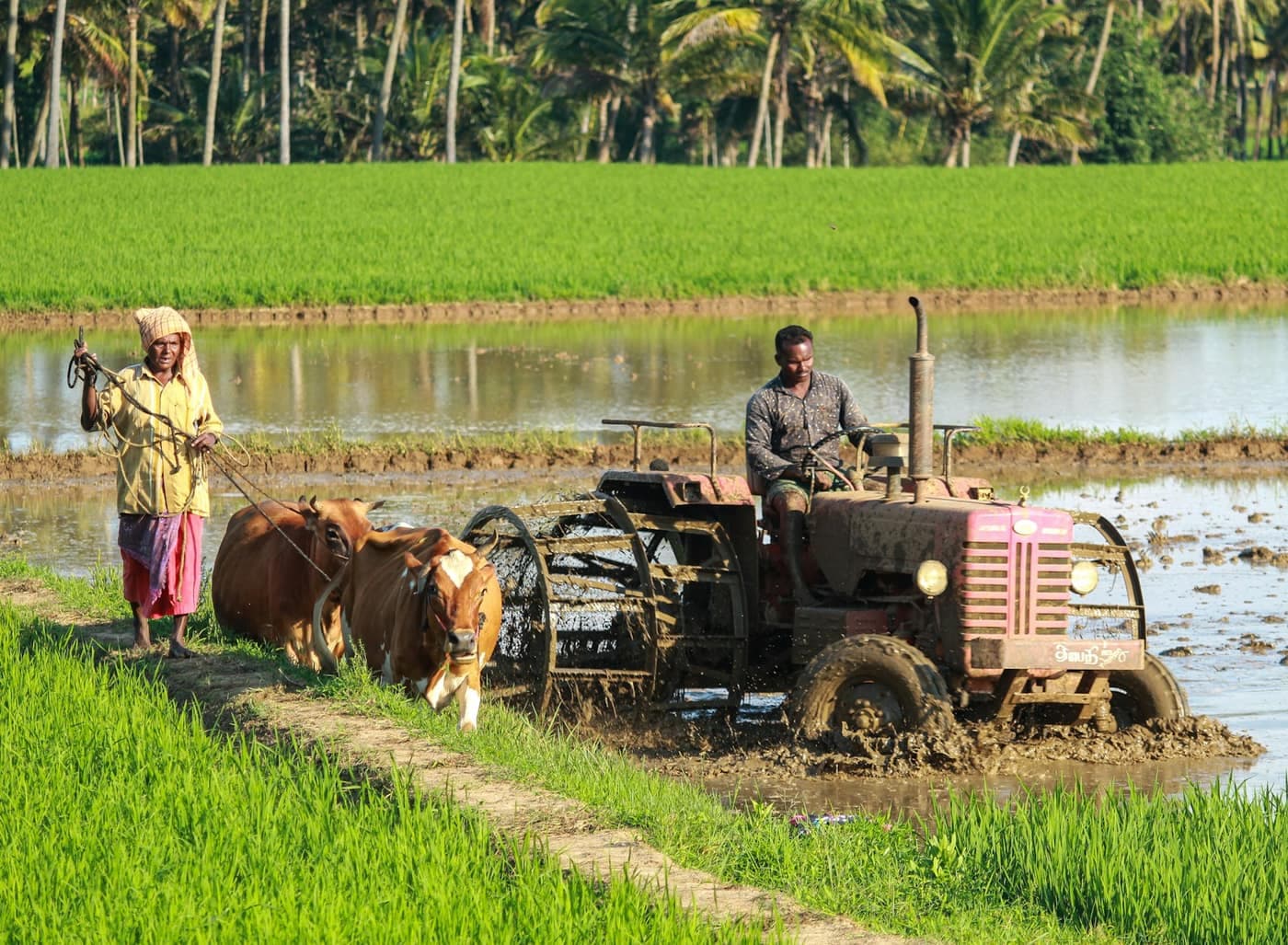
- Sizing rule
- ~1 HP per acre cropped/year
- Most common range
- 35–50 HP
- Break-even use
- ~600 hours/year to own
- Working life
- 10–15 yrs / ~10,000 hrs
- Price band (new)
- ₹3.5–9 lakh (35–55 HP)
- Subsidy
- 25–50% under SMAM (state-wise)
Overview
A tractor is the single largest capital purchase most Indian farmers ever make, and the one most often bought a size too big. The useful rule of thumb is roughly one horsepower for every acre you crop in a year — a farmer double-cropping 20 acres is genuinely served by a 40–45 HP machine, not the 60 HP one the showroom will steer them toward.
The economics turn on hours, not sticker price. A tractor needs to work somewhere around 600 hours a year for ownership to beat hiring; below that, custom hiring or a village-shared machine almost always wins. This is why so many privately owned tractors sit idle 300 days a year — they were sized and financed for prestige, not for the work the land actually generates.
This guide follows the decision in the order you will actually face it — what type and how much power, which brand trade-offs matter, what it will burn in diesel, which implements it can pull, and how to keep it alive — so you can jump straight to whichever question you are stuck on.
Why it earns its place
- Turns a week of bullock or manual tillage into a few hours, freeing the sowing window that decides yield.
- One power source runs dozens of implements — plough, rotavator, seed drill, sprayer, thresher, trolley — through the PTO and hydraulics.
- Cuts the per-hectare cost of land preparation sharply once it is worked enough hours to spread its fixed cost.
- Doubles as rural haulage: a loaded trolley earns off-season income that no other farm asset offers.
- Holds resale value better than almost any farm machine — a well-kept tractor still fetches 40–50% after ten years.
Common uses
- Primary and secondary tillage — ploughing, harrowing, rotavation, planking
- Sowing and planting with seed drills, planters and zero-till drills
- Spraying, inter-culture and fertiliser application
- Powering stationary machines through the PTO — threshers, chaff cutters, pumps
- Haulage of produce, inputs, sand and bricks with a trolley
Types of tractor
Match the type to your land and crop before you even look at a brand — the wrong category wastes money no discount can recover.
Mini Tractor
Compact, narrow and easy to turn — built for orchards, vineyards, polyhouses and small vegetable plots where a full-size machine cannot manoeuvre or would compact the soil.
- Power range
- 15–25 HP
- Suits
- Below 3 acres
- Best for
- Horticulture, intercultural work, tight rows
Compact Tractor
A step up in power and hydraulics while staying light on the soil. Handles a rotavator or a small trolley comfortably and is the honest choice for most 3–8 acre holdings.
- Power range
- 25–35 HP
- Suits
- 3–8 acres
- Best for
- Small mixed farms, light tillage, haulage
Utility Tractor
The workhorse of Indian farming — enough power for a 7-foot rotavator, a cultivator and a loaded trolley, in the price band most co-operative and bank finance is written for.
- Power range
- 35–50 HP
- Suits
- 8–25 acres
- Best for
- General field work on the majority of holdings
Row Crop Tractor
Higher ground clearance and adjustable wheel track so it can straddle standing rows for spraying and inter-culture without crushing the crop. Common in cotton, sugarcane and maize belts.
- Power range
- 40–60 HP
- Suits
- 15–40 acres
- Best for
- Tall row crops needing late-season passes
4WD Tractor
Power delivered to all four wheels for traction in wet paddy fields, heavy black cotton soil and on slopes. Costs more and burns more, but does not dig in where a 2WD stalls.
- Power range
- 45 HP and above
- Suits
- 20+ acres or difficult soil
- Best for
- Puddling, heavy soils, hilly and wet terrain
Garden / Power Tiller
Walk-behind two-wheel power for terraces, hill farms and plots too small to justify a four-wheel tractor at all. Cheap to buy and run, limited to light tillage and small implements.
- Power range
- 5–15 HP
- Suits
- Under 2 acres / terraces
- Best for
- Hill and terrace plots, very small holdings
Horsepower & farm-size guide
A starting point, not a rule — adjust up for heavy or wet soil and PTO-heavy work, down for light soil and mostly haulage.
| Farm size | Recommended HP | Typical uses | Suitable crops | Suggested implements |
|---|---|---|---|---|
| Below 2 acres | 15–25 HP | Light tillage, intercultural work | Vegetables, orchards | Mini rotavator, cultivator, sprayer |
| 2–8 acres | 25–35 HP | Seedbed prep, sowing, small haulage | Wheat, vegetables, pulses | Rotavator (5 ft), seed drill, trolley |
| 8–20 acres | 35–45 HP | Full tillage, PTO work, haulage | Wheat, paddy, cotton, maize | Rotavator (6–7 ft), MB plough, thresher |
| 20–40 acres | 45–55 HP | Heavy tillage, deep ploughing | Sugarcane, cotton, paddy | Disc harrow, reversible plough, laser leveller |
| 40+ acres / custom hiring | 55 HP and above | Continuous heavy work, contracting | All field crops | Large rotavator, combine support, heavy trolley |
Popular brands compared
Trade-offs, not a ranking. No brand here is called the best, and nothing on this page is a paid placement.
Mahindra
Mid to premiumIndia’s largest tractor maker by volume, with the widest dealer and spare-parts reach right down to block towns.
- Known for
- Service network, resale value
- HP range
- 15–75 HP
Pros
- Parts available almost anywhere
- Strong resale demand
- Broad model range across HP bands
Cons
- Premium models priced above rivals
- Fuel economy average on some engines
Swaraj
MidA Mahindra-group brand with a devoted following in Punjab, Haryana and the wheat belt for rugged, simple mechanicals.
- Known for
- Durability, lift capacity
- HP range
- 15–65 HP
Pros
- Tough, easy-to-repair build
- Good hydraulic lift on mid models
- Loyal resale market in the north
Cons
- Cabin comfort basic on older lines
- Fewer premium features than imports
John Deere
PremiumUS brand built in India, known for refined engines, comfortable operation and a strong showing in higher-HP work.
- Known for
- Engine refinement, comfort
- HP range
- 28–120 HP
Pros
- Fuel-efficient, smooth engines
- Comfortable for long hours
- Strong in 45 HP and above
Cons
- Higher purchase price
- Spares can cost more than Indian brands
Sonalika
Budget to midA fast-growing maker and large exporter, competitive on price with a broad range from mini to heavy tractors.
- Known for
- Value for money, exports
- HP range
- 20–90 HP
Pros
- Aggressive pricing
- Feature-rich for the price
- Wide HP spread
Cons
- Service network thinner in some states
- Resale not yet as deep as the leaders
New Holland
PremiumPart of the CNH group, strong in higher-HP and specialist work, widely used on sugarcane and in custom-hiring fleets.
- Known for
- High-HP performance
- HP range
- 35–90 HP
Pros
- Powerful, capable on heavy soils
- Good for contracting and haulage
- Refined transmission
Cons
- Priced at the top of the market
- Overkill for small holdings
Farmtrac (Escorts)
Mid to premiumAn Escorts Kubota brand offering high-lift, higher-HP tractors that appeal to farmers pulling heavy implements.
- Known for
- Lift capacity, power
- HP range
- 22–80 HP
Pros
- Strong hydraulic lift
- Capable engines for heavy work
- Good backward-region reach
Cons
- Fuel use higher on heavier models
- Fewer mini-tractor options
Escorts Kubota (Powertrac)
Budget to midThe Escorts–Kubota tie-up pairs the economical Powertrac range with Kubota’s precision engineering and paddy expertise.
- Known for
- Fuel economy, paddy work
- HP range
- 25–60 HP
Pros
- Economical on diesel
- Reliable for the price
- Kubota engineering on newer models
Cons
- Network still expanding in the south and east
- Fewer very-high-HP options
Compatible implements
One tractor, many jobs — these are the attachments that do the actual field work through the PTO and hydraulics.
Rotavator
Prepares a fine seedbed in a single pass where a cultivator needs three — saves diesel and turnaround time.
Cultivator
Secondary tillage and weed control between crops; the cheapest tine implement most farms own.
Disc Harrow
Breaks clods and chops crop residue after harvest, especially on hard or trashy fields.
Seed Drill
Places seed and fertiliser at a set depth and row spacing — better germination than broadcasting.
Sprayer
Boom or air-assisted sprayers cover far more area per hour than a knapsack, at even dosing.
Laser Leveller
Grades a field dead level, cutting irrigation water 20–30% and improving stand uniformity.
Trolley
Turns the tractor into rural haulage — off-season trolley work often pays a chunk of the EMI.
MB Plough
Mould-board plough for deep primary tillage that inverts soil and buries weeds and residue.
Estimated fuel consumption
Rough diesel use by power band, for budgeting only.
Power
20 HP
Estimated diesel
1.5–2.5 L/hour
Power
30 HP
Estimated diesel
2.5–3.5 L/hour
Power
40 HP
Estimated diesel
3.5–4.5 L/hour
Power
50 HP
Estimated diesel
4.5–6 L/hour
Power
60 HP
Estimated diesel
6–7.5 L/hour
These are working estimates for medium-draft field operations. Actual diesel use swings widely with the implement, soil condition, engine load, ballast, tyre pressure and driving habit — light haulage burns far less than deep ploughing in dry black soil on the same tractor.
Maintenance timeline
Most breakdowns are missed routine checks — this is the schedule that keeps a tractor out of the workshop.
Daily / before each start
- Check engine oil level on the dipstick
- Check coolant / radiator water level
- Check tyre pressure — uneven pressure wears tyres and wastes fuel
- Clean or tap out the air filter in dusty conditions
- Look under the tractor for fresh oil or coolant leaks
Weekly
- Check and top up battery water (distilled), clean the terminals
- Grease all nipples — steering, linkage, king pins
- Inspect the hydraulic lift and linkage for play or leaks
- Check fan-belt tension and the condition of all belts
Monthly / by service hours
- Change engine oil and the oil filter at the maker’s hour interval
- Clean or replace the fuel filter and drain the sediment bowl
- Check clutch and brake free play, adjust if needed
- Full inspection of wiring, lights and the self-starter
Common problems & fixes
Symptoms, likely causes and what you can safely do before calling a mechanic.
Engine overheating
- Symptoms
- Temperature gauge in the red, steam or coolant loss, power drop under load.
- Likely causes
- Low coolant, a clogged radiator core, a slack or broken fan belt, or a stuck thermostat.
- What to do
- Stop and let it cool before opening the cap. Top up coolant, blow out the radiator fins, tension or replace the fan belt, and have the thermostat checked if it recurs.
Black smoke from the exhaust
- Symptoms
- Thick black exhaust, sluggish response, higher fuel use.
- Likely causes
- Overloading, a choked air filter, or badly set / worn injectors giving incomplete combustion.
- What to do
- Clean or replace the air filter first, ease the load, and if it persists get the injectors and fuel pump calibrated at a diesel workshop.
Battery not charging
- Symptoms
- Weak or no self-start, dim lights, the charge warning lamp staying on.
- Likely causes
- Loose or corroded terminals, low battery water, a slipping belt, or a failing alternator.
- What to do
- Clean and tighten terminals, top up distilled water, tension the belt; if the alternator output is low, have it tested and rewound or replaced.
Hydraulic lift not working
- Symptoms
- Implement will not lift, lifts slowly, or drops on its own.
- Likely causes
- Low hydraulic oil, a clogged filter, air in the system, or worn seals and pump.
- What to do
- Check and top up hydraulic oil to grade, clean the filter and bleed air. Persistent slow lift or drift means worn seals or a tired pump — a workshop job.
PTO not engaging
- Symptoms
- PTO shaft will not turn or slips under load with the implement stalling.
- Likely causes
- Clutch or PTO-lever linkage out of adjustment, a worn PTO clutch, or low oil in an oil-immersed PTO.
- What to do
- Adjust the PTO clutch free play and linkage; if the clutch is glazed or worn it needs replacing. Never engage the PTO at high revs from cold.
Hard starting
- Symptoms
- Cranks but will not fire, especially on cold mornings.
- Likely causes
- Air in the fuel line, a choked fuel filter, weak battery, or dirty injectors.
- What to do
- Bleed the fuel system, replace the fuel filter, charge or replace the battery, and clean the injectors. In winter, use the correct grade of diesel.
Buying guide
The honest trade-off comes down to how many hours the tractor will actually work each year.
Buying new
Advantages
- Full manufacturer warranty and free first services
- Latest engine, emission and safety features
- Eligible for SMAM and state subsidy on the invoice
- Clean papers and predictable finance
Disadvantages
- Highest upfront cost and the steepest first-year depreciation
- Only worth it above roughly 600 working hours a year
Buying used
Advantages
- Far lower purchase price — more machine per rupee
- Depreciation already absorbed by the first owner
- Sensible when annual hours are low or for a second tractor
Disadvantages
- No warranty; hidden engine or transmission wear is a real risk
- Usually not eligible for subsidy
- Verify registration, hour meter and service history yourself
Inspection checklist
- Engine — start cold, listen for knocking, check for blue or black smoke
- Hydraulic lift — must raise a loaded implement smoothly and hold it without drifting down
- Tyres — even tread and no sidewall cracks; rear tyres are expensive to replace
- PTO and clutch — engage under load and feel for slip
- Registration papers (RC), insurance and, for used, a clear ownership trail
- Service history and the genuine reading on the hour meter
Government subsidy & finance
The routes that bring the cost down — central, state and credit.
SMAM (Sub-Mission on Agricultural Mechanization)
The central scheme for farm-machinery subsidy. Individual farmers can typically get 25–50% of the cost, with a higher share for SC/ST, women and small/marginal farmers. Applied through your state’s agriculture department, usually on the OFMAS / agrimachinery portal.
State tractor & implement schemes
Many states run their own mechanisation subsidies and Custom Hiring Centre (CHC) support over and above SMAM. Rates, caps and the open-application window differ every year — check your state agriculture department or Krishi Vigyan Kendra.
Kisan Credit Card & tractor finance
Where an outright subsidy is not available, a KCC or a dedicated tractor loan (typically 7 years, 15–25% margin money) spreads the cost. Compare the EMI against what custom hiring would cost you before you borrow.
Subsidy availability, percentage and eligibility vary by state and change every financial year — and PM-KISAN income support is separate and cannot be used as a machinery subsidy. Always confirm the current rate and the open-application window with your state agriculture department or KVK before you buy. Nothing on this page is a paid placement.
Work out the EMI before you commit
A tractor loan is typically 7 years with 15–25% margin money. See the monthly instalment and total interest, and weigh it against what custom hiring would cost you.
Safety essentials
A tractor is the most dangerous machine on most farms — overturns and PTO entanglement kill every season. These are non-negotiable.
Wear the seatbelt whenever a ROPS (roll-over bar) is fitted — most tractor deaths are roll-overs.
Never overload the trolley or take turns at speed with a loaded trolley behind you.
Keep to servicing intervals — worn brakes and steering cause the majority of road accidents.
Guard the PTO shaft and never step over a rotating PTO; loose clothing is lethal here.
Children should never ride on the tractor, the mudguard or the trolley.
Use proper head and tail lights and a reflector for any night or road running.
Official downloads
Government portals only — everything below is hosted on an official server.
Frequently asked questions
Which tractor is best for 5 acres?
For a 5-acre holding, a 25–35 HP compact or utility tractor is the honest fit — enough to pull a 5-foot rotavator, a seed drill and a light trolley without wasting diesel on power you will rarely use. Go higher only if you plan to do custom-hiring work for neighbours or crop very heavy soil.
How much HP tractor do I need?
A good starting rule is about one horsepower for every acre you crop in a year. Then adjust up for heavy black or wet soil, deep ploughing and PTO-heavy work like threshing, and down for light soils and mostly haulage. Most Indian farms are genuinely well served by 35–45 HP.
Which tractor gives the best mileage?
Fuel use depends far more on how you load and drive the tractor than on the badge. That said, brands like Escorts Kubota/Powertrac and John Deere are widely regarded for economical engines. Keeping the air filter clean, tyres correctly inflated and injectors well set matters more than the brand you choose.
How often should tractor engine oil be changed?
Follow the hour interval in your operator’s manual — commonly the first change at around 50 hours (running-in) and then every 250–300 hours, or at least once a season. Change the oil filter with the oil. In very dusty conditions, clean the air filter daily and shorten the interval.
Which tractor brand has the best resale value?
Mahindra and Swaraj generally hold resale value strongly, especially in the northern wheat belt, thanks to deep dealer and spare-parts networks. But condition, service records and honest engine hours move the price far more than the brand alone — a well-kept tractor of any make sells better than a neglected premium one.
Can one tractor run a rotavator and a seed drill?
Yes — matching implements to power is the whole point of a tractor. A 35–45 HP tractor comfortably runs a 6–7 foot rotavator through the PTO and pulls a multi-row seed drill. Just make sure any PTO implement is rated for your tractor’s HP and PTO speed (540 rpm is standard).
Still deciding?
The FAQs above cover the common questions. For a choice tuned to your exact soil, crop and acreage, your nearest Krishi Vigyan Kendra or a Custom Hiring Centre is the authoritative next step.