
Arecanut (Supari)
Areca catechu
A slow, tall palm raised from seed nuts, not a graft — so choosing the right mother palm to collect seed nuts from is the one establishment decision a grower cannot undo — and one that, once planted, faces two defining threats with no chemical cure: yellow leaf disease, a slow phytoplasma decline endemic to parts of Kerala and Karnataka, and koleroga, a monsoon fungal rot that drops immature nuts by the thousand in the wettest years.
Quick Summary
The key points from this page in about two minutes — read it or have it read aloud.
Quick Summary
Arecanut, also called supari (Areca catechu), is a tall, slow-growing palm grown mainly in Karnataka, which produces the majority of India's crop, along with Kerala, Assam, Meghalaya, Tamil Nadu and West Bengal. Like coconut, it is not grafted — every palm is raised as a seedling from a seed nut, so the whole crop's future quality rests on picking healthy, high-yielding, disease-free mother palms to collect seed nuts from in the first place.
Once established, arecanut faces two defining problems that no spray reliably cures. Yellow leaf disease, caused by a phytoplasma and spread by an insect vector, causes a slow yellowing and decline over years with no chemical treatment — management is entirely about slowing spread and replacing badly affected palms, endemic mainly in parts of Kerala and coastal/Malnad Karnataka. Koleroga (also called mahali or fruit rot), a Phytophthora fungus that thrives in the heavy, continuous monsoon rain of the western coastal belt, rots immature nuts and drops them by the thousand in a bad wet year — timely prophylactic Bordeaux-mixture spraying before and during the monsoon is the standard defence.
The rest of the crop is a long, patient wait: a seedling takes four to five years before its first bearing and reaches full production only after eight to ten years, but a well-managed palm then goes on bearing productively for several decades, making the early choices — mother palm, seedling health, and disease-prevention discipline in the first wet seasons — decisions with a very long payoff.
- Crop type
- Tall, slow-growing, long-lived perennial palm (seedling-raised)
- Season
- Planted at monsoon onset; bears year-round once mature
- Suitable states
- Karnataka, Kerala, Assam, Meghalaya, Tamil Nadu, West Bengal
- Time to first bearing
- 4–5 years; full bearing from about year 8–10
- Water requirement
- High; well-distributed rainfall or irrigation, sensitive to prolonged dry spells
- Temperature
- Warm humid tropical, 14–36°C; frost-tender
- Soil type
- Deep, well-drained loamy to lateritic soil, pH 5.5–7.0
- Difficulty level
- Moderate (long establishment, no cure for its two major diseases)
- Expected yield
- 1.5–3.5 kg dried chali (processed nut) per palm per year at full bearing
- Key risk
- Yellow leaf disease and koleroga, neither of which has a reliable cure once established
Overview
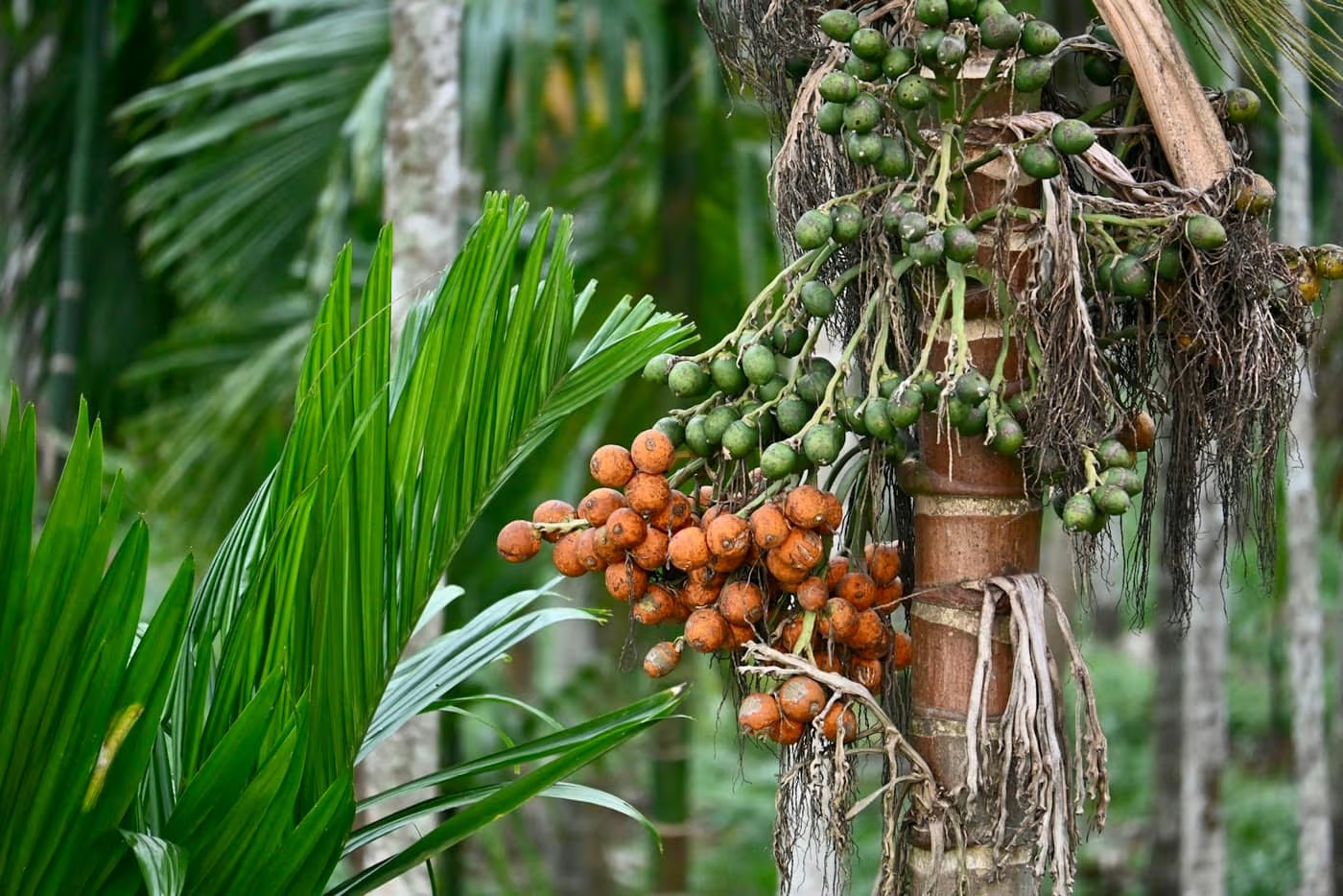
Arecanut, or supari (Areca catechu), is a tall, slender, single-stemmed palm grown for its seed (the "nut"), chewed with betel leaf and used in a wide range of traditional and commercial preparations. It is a slow-growing, long-lived perennial crop, typically productive for 40–60 years once established.
Karnataka is India's leading producer, especially the coastal and Malnad tracts of Dakshina Kannada, Udupi, Shivamogga and Chikmagalur, followed by Kerala, Assam, Meghalaya, Tamil Nadu and West Bengal. Like coconut, arecanut is propagated entirely from seed nuts raised into seedlings, not by grafting, so the selection of the mother palm the seed nut comes from is a decision that shapes the whole planting for decades.
Two problems define arecanut cultivation more than any others: yellow leaf disease, a slow, incurable phytoplasma decline that must be managed by containment rather than treatment, and koleroga, a monsoon-season Phytophthora fruit rot controlled by timely prophylactic spraying rather than cured after the fact. Both demand prevention and vigilance far more than reaction.
Crop timeline, sowing to harvest
A quick visual map of the season — jump to any section below for the detail behind each stage.
- Year 0
Nursery & planting
Seed nuts from selected, high-yielding, disease-free mother palms are germinated and raised in a nursery for about a year before the healthiest seedlings are transplanted to the main field at the start of the monsoon.
- Year 1–4
Establishment
The young palm builds its root system and trunk height, needing regular watering (especially in the dry season) and shade in its first year or two.
- Year 4–5
First bearing
The palm produces its first inflorescence and light nut set, though yield is still far below mature levels.
- Year 8–10 onward
Full bearing
The palm reaches full, stable production and continues bearing for several decades with good management.
- Monsoon (June–September)
Koleroga risk window
The period of highest risk for koleroga (fruit rot); prophylactic Bordeaux-mixture sprays are timed to start just before the rains and continue through wet spells.
- Ongoing
Yellow leaf disease monitoring
Palms in endemic tracts are checked regularly for early yellowing symptoms, since there is no cure and slowing spread depends on catching and managing affected palms early.
Suitable states
States where this crop is grown at scale, highlighted below. Your local Krishi Vigyan Kendra is still the final word for your specific block.
- Jammu and Kashmir
- Himachal Pradesh
- Punjab
- Uttarakhand
- Haryana
- Delhi
- Uttar Pradesh
- Rajasthan
- Bihar
- Jharkhand
- West Bengal
- Sikkim
- Assam
- Arunachal Pradesh
- Meghalaya
- Nagaland
- Manipur
- Mizoram
- Tripura
- Gujarat
- Madhya Pradesh
- Chhattisgarh
- Maharashtra
- Odisha
- Goa
- Telangana
- Andhra Pradesh
- Karnataka
- Kerala
- Tamil Nadu
- Puducherry
- Ladakh
- Chandigarh
- Lakshadweep
Grown here
Climate requirements
The heavy, continuous monsoon rain that arecanut needs to thrive is the same weather that drives koleroga outbreaks — growers in the wettest tracts must plan a prophylactic spray programme as a routine part of the crop, not an emergency response.
Ideal temperature
A warm, humid tropical palm growing best at 14–36°C. It has no frost tolerance, and young palms are especially vulnerable to cold snaps and hot, dry winds alike.
Rainfall
Needs high, well-distributed rainfall of 1,500–4,500 mm or reliable irrigation where rainfall is lower; it does not tolerate prolonged drought well, and a dry spell during nut development sharply cuts yield.
Humidity
High humidity suits vegetative growth, but the same continuously wet, humid monsoon conditions that suit the palm are exactly what favour koleroga fruit rot — the crop's best climate and its worst disease risk come from the same weather.
Sunlight
Grows in full sun and also tolerates partial shade, which is why it is commonly intercropped with coconut, black pepper (grown up the arecanut trunk) and cocoa in the same garden.
Soil requirements
Because arecanut gardens are so often established in high-rainfall tracts, growers sometimes underestimate how much drainage still matters — a waterlogged basin in the monsoon undoes much of the benefit of an otherwise well-managed garden.
Suitable soil
A deep, well-drained loamy to lateritic soil suits arecanut best; it does not tolerate a shallow soil, a hard pan, or standing water around the root zone.
pH range
Best at pH 5.5–7.0, tolerating the naturally acidic laterite soils common in its main growing tracts.
Drainage
Free drainage is essential — arecanut's root system is genuinely intolerant of waterlogging, and poor drainage in the heavy monsoon rain of its main growing belt is a common, avoidable cause of weak, unproductive gardens.
Organic matter
Responds strongly to organic matter worked into the planting pit and applied as ongoing basin mulch and compost, supporting both nutrition and moisture-holding in dry spells.
Land preparation
Same four steps whichever region you are in — only the timing shifts with the sowing window.
- 1
Dig and fill planting pits
Dig pits about 1 m³, fill with topsoil mixed with well-rotted FYM, and let them settle before transplanting a healthy nursery seedling at the start of the monsoon.
- 2
Space for the palm's tall, narrow habit
Space palms about 2.7 m apart in both directions (roughly 1,600–1,800 palms/ha), since the single-stemmed palm has a narrower footprint than a spreading fruit tree despite its height.
- 3
Plan drainage channels before the first monsoon
Lay out drainage channels through the garden before planting, especially on flatter land, so the first monsoon after planting does not waterlog young, vulnerable seedlings.
Seed information
How the main varieties compare, so you can pick by duration, yield, disease pressure or what you are growing for.
| Variety | Duration | Yield | Disease resistance | Best state | Suitable for |
|---|---|---|---|---|---|
An early-bearing CPCRI selection with more female flowers per inflorescence and higher initial nut set, reaching stable production faster than most other selections. A widely grown standard in Karnataka and Kerala. | First bearing ~4–5 years; early stabilisation of yield | ~2.9 kg chali/palm/year | No special resistance claimed | Karnataka, Kerala | Growers wanting faster early yield stabilisation |
A tall CPCRI selection with a partially drooping crown, recommended specifically for chali (dried, processed nut) production rather than fresh/tender nut use. | First bearing ~5 years | ~3.3 kg chali/palm/year | No special resistance claimed | Karnataka, Kerala | Chali (dried nut) production |
A tall CPCRI selection with longer internodes and a notably sturdy stem, giving good standing strength in exposed or windy gardens. | First bearing ~5 years | ~3.2 kg chali/palm/year | No special resistance claimed | Karnataka, Kerala | Exposed or windy garden sites needing a sturdier stem |
A tall CPCRI selection with a medium-thick stem and uniform bearing, giving the highest average yield among CPCRI's standard tall selections. | First bearing ~5 years | ~3.9 kg chali/palm/year | No special resistance claimed | Karnataka, Kerala, Assam | Growers prioritising the highest standard-selection yield |
A regional selection from West Bengal's Terai region, well adapted to the cooler, wetter growing conditions of the eastern arecanut belt. | First bearing ~5 years | Regionally variable; comparable to other tall selections | No special resistance claimed | West Bengal, Assam | Eastern India's cooler, wetter growing tracts |
An Assam Agricultural University selection specifically adapted to Assam's growing conditions, a standard local recommendation for the state. | First bearing ~5 years | Comparable to other regional tall selections | No special resistance claimed | Assam | Assam's specific growing conditions |
A CPCRI dwarf hybrid (Hirehalli Dwarf × Sumangala), bred for earlier bearing and a shorter, more manageable stem than the standard tall selections, easing harvest and garden management. | First bearing earlier than tall selections, typically ~4 years | Comparable to or exceeding standard tall selections | No special resistance claimed | Karnataka, Kerala | Growers wanting earlier bearing and easier harvest access on a shorter palm |
- Seed rate
- Not sown from seed commercially in the field sense — one nursery-raised seedling per planting position, at roughly 1,600–1,800 palms per hectare (about 2.7 m spacing).
- Certified seed
- Collect seed nuts only from healthy, high-yielding, disease-free mother palms of at least 15 years of age, or buy certified seedlings directly from CPCRI, a state horticulture department or a reputed nursery. Never collect seed nuts from a garden with a history of yellow leaf disease, even from a palm that looks unaffected.
- Spacing
- About 2.7 m between palms in both directions (roughly 1,600–1,800 palms/ha) for a pure stand, spaced wider where intercropped with coconut, black pepper or cocoa.
- Seed treatment
- Not applicable to seedlings; seed nuts should be fully ripe, heavy for their size, and free of any visible spotting or damage before being set in the nursery bed.
Sowing guide
Never source seed nuts from a garden where yellow leaf disease is present, however healthy the individual mother palm appears — the phytoplasma's presence in a garden is a reason to avoid all planting material from it, not just visibly symptomatic palms.
- Best time
- Transplant nursery seedlings (raised for about a year from seed nuts) at the start of the monsoon, June–July, so young roots establish in reliably moist soil.
- Row spacing
- ~2.7 m
- Plant spacing
- ~2.7 m
- Sowing depth
- Planted at the same depth the seedling stood in its nursery bag, with the root collar at soil level
- Method
- Set the nursery seedling in a well-prepared, manured pit, firm the soil, and shade young palms in their first year or two if the site is unusually exposed.
Fertilizer schedule
A split dose beats one large dose applied at sowing — nitrogen especially is lost to the air and to leaching if it all goes in on day one.
- 1
Young palm (years 1–4)
Split doses through the year
Modest, increasing doses of nitrogen, phosphorus and potash as the palm establishes its root system and trunk, applied in the basin and watered in.
- 2
Bearing palm, monsoon application
At the start of the rains
The larger share of the annual NPK dose for a bearing palm, along with well-rotted FYM or compost worked into the basin.
- 3
Bearing palm, post-monsoon application
After the rains ease
A follow-up split to support nut development and the next flowering flush, adjusted for local soil-test recommendations.
Irrigation schedule
1. Young palm establishment
Years 1–4
Regular watering, especially through the first two dry seasons, since young palms are genuinely sensitive to moisture stress.
2. Dry-season irrigation (bearing palm)
December–May in most growing tracts
Where rainfall alone is insufficient, irrigate every 5–7 days through the dry months to keep nut development from being checked.
3. Monsoon
June–September
Rainfall usually covers the crop's needs; the priority shifts to drainage rather than irrigation, since waterlogging in this period stresses the root system.
Critical stages
- Establishment (years 1–4)
- Nut development during any dry-season stretch
Water-saving tips
- Basin or drip irrigation concentrates water at the root zone far more efficiently than flood methods on a tall, narrow-footprint palm like this.
- A mulch of husk, dry leaves or crop residue in the basin conserves moisture through the dry season and moderates soil temperature.
- Intercropping with coconut or cocoa under partial shade can reduce evaporative water loss from the arecanut basin itself.
Weed management
Common weeds
Organic control
- Regular basin weeding by hand, especially around young palms where weeds compete hardest for water and nutrients.
- A husk or dry-leaf mulch in the basin suppresses weeds and conserves moisture at the same time.
Chemical control
- A directed spot spray of a cleared herbicide in the inter-row of a mature garden, keeping it well away from the trunk base.
- Confirm the current product and dose with your local KVK before spraying near a bearing garden.
Nutrient deficiency identification
What a shortage of each nutrient actually looks like on the plant, so you can tell a deficiency apart from a disease before you spray the wrong thing.
Potassium
Visible symptom
Scorched, yellow-brown older frond margins and reduced nut size, since potash is closely tied to nut development and quality in arecanut.
Nitrogen
Visible symptom
Pale, sparse fronds and slower trunk and root growth, most noticeable on a young, establishing palm.
Magnesium
Visible symptom
Yellowing between the veins of older fronds while the veins themselves stay green, most often on light, sandy, heavily leached soils.
Diseases to watch for
Symptoms, likely cause and what actually treats it — not just a spray name.
Yellow leaf disease
- Symptoms
- A gradual yellowing of the fronds starting with the older leaves, thinning of the crown, reduced nut size and yield over several years, and eventually stunted growth; the decline is progressive and does not reverse.
- Cause
- A phytoplasma (a bacteria-like organism without a cell wall) spread by an insect vector, endemic mainly in parts of Kerala and coastal/Malnad Karnataka.
- Treatment
- There is no known cure once a palm is infected; management is limited to removing and destroying badly affected palms to reduce the source of spread.
- Prevention
- Never source seed nuts or seedlings from a garden where the disease is present, monitor endemic-tract gardens regularly for early symptoms, and manage the insect vector where practical, though vector control alone does not fully stop spread.
Koleroga (fruit rot / mahali)
- Symptoms
- Immature nuts develop a water-soaked patch that spreads into a soft rot, often with a white fungal growth in very wet weather, and rotted nuts drop from the bunch by the dozen or hundred in a bad year.
- Cause
- The fungus Phytophthora (P. meadii / P. arecae), thriving in the continuous heavy rain and high humidity of the monsoon in the wetter western coastal tracts.
- Treatment
- Once nuts are rotting there is no cure for the affected bunch; the priority is protecting the remaining, still-healthy bunches on the same and neighbouring palms.
- Prevention
- A prophylactic Bordeaux-mixture (1%) spray on the bunches, timed to start just before the monsoon and repeated through wet spells, is the standard and most effective defence; good garden drainage and canopy airflow help too.
Pests to watch for
What to look for before the damage is visible, and organic options before you reach for a chemical.
Red palm weevil
- Identification
- A large reddish-brown beetle whose grubs tunnel inside the crown and trunk; the first visible signs are often oozing, fermented-smelling sap and chewed fibre at the base of fronds, with a wilting or collapsing crown in an advanced attack.
- Damage
- The grub feeding inside the trunk can kill the palm outright once the growing point is destroyed, and by the time damage is visible externally the infestation is often already advanced.
- Organic control
- Avoid wounding the trunk during garden operations (a common entry point), remove and destroy severely infested palms promptly to cut the source of adult weevils, and use pheromone traps to monitor and reduce the adult population.
- Chemical control
- A recommended insecticide injected or applied into the crown region at the first sign of infestation, following the label and local KVK advice, since the grub inside the trunk is otherwise hard to reach.
Rhinoceros beetle
- Identification
- A large black beetle whose adults bore into the crown to feed on the soft growing tissue, leaving characteristic V-shaped cuts on unfolding fronds; grubs develop in decaying organic matter such as manure pits and dead trunk material nearby.
- Damage
- Repeated crown damage can severely check growth and, in young palms, kill the growing point outright.
- Organic control
- Keep manure pits, compost heaps and dead palm material away from the garden or manage them so they do not breed grubs, and hook out adult beetles from the crown where an attack is caught early.
- Chemical control
- A recommended insecticide placed in the crown region (leaf axils) as a preventive measure in gardens with a known history of the pest.
Common mistakes to avoid
The mistakes that cost growers the most, ranked by how often they show up in the field — not in the order you might expect.
- 1
Collecting seed nuts from a garden with a history of yellow leaf disease, even from an apparently healthy palm.
Why it hurts
The phytoplasma's presence in a garden is a reason to avoid all planting material sourced from it — an apparently unaffected mother palm in an infected garden is not a safe source, and seedlings raised from it can carry the disease into a new planting.
- 2
Waiting until nuts are visibly rotting to start koleroga control.
Why it hurts
Once nuts are rotting there is no cure for that bunch. Koleroga must be prevented with a prophylactic Bordeaux-mixture spray programme timed to start just before the monsoon, not treated reactively after rot appears.
- 3
Planting on flat, poorly drained land without laying out drainage first.
Why it hurts
Arecanut needs heavy monsoon rainfall to thrive but is genuinely intolerant of waterlogging around its roots — a garden without proper drainage channels loses much of the benefit of the same rain that makes the crop possible.
- 4
Ignoring early signs of yellowing as ordinary nutrient deficiency.
Why it hurts
In a tract where yellow leaf disease is endemic, gradual yellowing starting on the older fronds should be checked against the disease's known symptoms, not assumed to be a correctable nutrient issue — mistaking the two delays the containment measures that actually slow spread.
- 5
Wounding the trunk carelessly during routine garden operations.
Why it hurts
Trunk wounds are a common entry point for red palm weevil grubs; careful handling around the trunk during pruning, harvesting and other garden work reduces this risk.
Harvesting
Harvest timing depends on the intended product: tender (green) nuts for chewing fresh are picked earlier, while nuts destined for chali (the dried, processed form) are left to mature fully on the bunch before harvest, when the husk has started to yellow or brown. Bunches are cut down with a sickle on a long pole or by a climber, since arecanut palms are tall and unbranched.
Signs it is ready
- Husk colour changing from green toward yellow or brown for mature (chali) nuts
- A firm, well-filled nut when a sample is cut open
- The bunch stalk beginning to dry for a fully mature harvest
Tools
- A sickle on a long pole, or a trained climber, to cut bunches from the tall palm
- Baskets or sacks for collecting cut bunches
- A dehusking tool or machine for processing into chali
Expected yield
Roughly 1.5–3.5 kg of dried chali per palm per year at full bearing, varying by selection, age and management — Swarnamangala and similar high-yielding selections toward the upper end.
Post-harvest & storage
Storage
Mature nuts destined for chali are dehusked, then boiled or dried (depending on the local processing tradition) and thoroughly sun-dried until hard, at which point they store for many months in a dry, ventilated space. Tender (green) nuts for fresh chewing are highly perishable and must be sold within a few days.
Packaging
Dried chali is packed in sacks or bags in a dry state; any residual moisture during storage invites mould and spoilage.
Transportation
Dried chali withstands normal transport well once fully dried; tender green nuts need quick, careful handling to reach the fresh market before quality drops.
Shelf life
Properly dried chali keeps for many months to over a year in dry storage; fresh tender nuts keep only a few days.
Market prices
Today's mandi price near you, pulled live from the government's own Agmarknet data.
Live daily mandi prices from the government Agmarknet dataset.
Synced from data.gov.in (Agmarknet). Rates are ₹ per quintal.
Weather
Current conditions and a 5-day outlook for your selected location, with one line of stage-aware advice.
Pick your state for current conditions and a 5-day outlook.
Live data from Open-Meteo
Profit calculator
Your own cost sheet, expected yield and selling price — not ours.
Where the money goes
Share of the total cost per acre, using the calculator’s own default cost sheet below — adjust the numbers there to match your field and this picture will no longer apply to you exactly, but the ranking rarely changes.
- Labour31% (₹20,000)
- Land rent19% (₹12,000)
- Fertiliser16% (₹10,000)
- Seed13% (₹8,000)
- Pesticide & weedicide8% (₹5,000)
- Irrigation6% (₹4,000)
- Interest5% (₹3,000)
- Machinery3% (₹2,000)
Official downloads
Government and ICAR documents only — everything below is hosted on an official server.
ICAR-Central Plantation Crops Research Institute (CPCRI), Kasaragod
Mangala, Sumangala, Sreemangala, Swarnamangala, VTLAH hybrids and arecanut package of practices
Directorate of Arecanut and Spices Development
Regional arecanut production and disease-management advisories
Kisan Call Centre — 1800-180-1551
Free crop advice in your language
Frequently asked questions
Can I just collect seed nuts from any healthy-looking palm in my area?
Only if the garden that palm grows in has no history of yellow leaf disease. The phytoplasma that causes the disease can be present in a garden even when an individual mother palm looks unaffected, and seed nuts from such a palm can carry the disease into a new planting. Collect seed nuts only from healthy, high-yielding mother palms in a garden with no disease history, or buy certified seedlings from CPCRI or a reputed nursery.
My arecanut fronds are gradually yellowing from the older leaves. What is it, and can it be cured?
In a tract where yellow leaf disease is endemic — parts of Kerala and coastal/Malnad Karnataka — this pattern should be checked against that disease first rather than assumed to be a simple nutrient deficiency. There is no cure once a palm is infected; management is limited to removing badly affected palms to slow further spread and never using them as a source of seed nuts.
How do I prevent koleroga (fruit rot) in my arecanut garden?
Prevention, not cure, is the answer — there is no treatment once nuts are already rotting. Start a prophylactic 1% Bordeaux-mixture spray on the bunches just before the monsoon begins, and repeat it through wet spells during the rains. Good garden drainage and canopy airflow also help reduce the humid conditions the fungus favours.
How long before a newly planted arecanut palm actually bears well?
A seedling typically gives its first light bearing at four to five years, but full, stable production only comes from about the eighth to tenth year onward. This long establishment period is exactly why choosing a healthy, disease-free mother palm and seedling at the very start matters so much — a mistake made at planting is not something you notice or can fix for years.
Does arecanut have an MSP or a mandi price?
There is no MSP for arecanut. It is traded on Agmarknet under the commodity name "Arecanut(Betelnut/Supari)"; trade can be thin or intermittent on the open mandi system in some seasons compared with the volume that moves through cooperative marketing federations (such as Campco) and direct trade channels in the main producing belts.
Still have questions?
The FAQs above cover the common ones. For anything specific to your field and soil, your nearest Krishi Vigyan Kendra is the authoritative answer.