
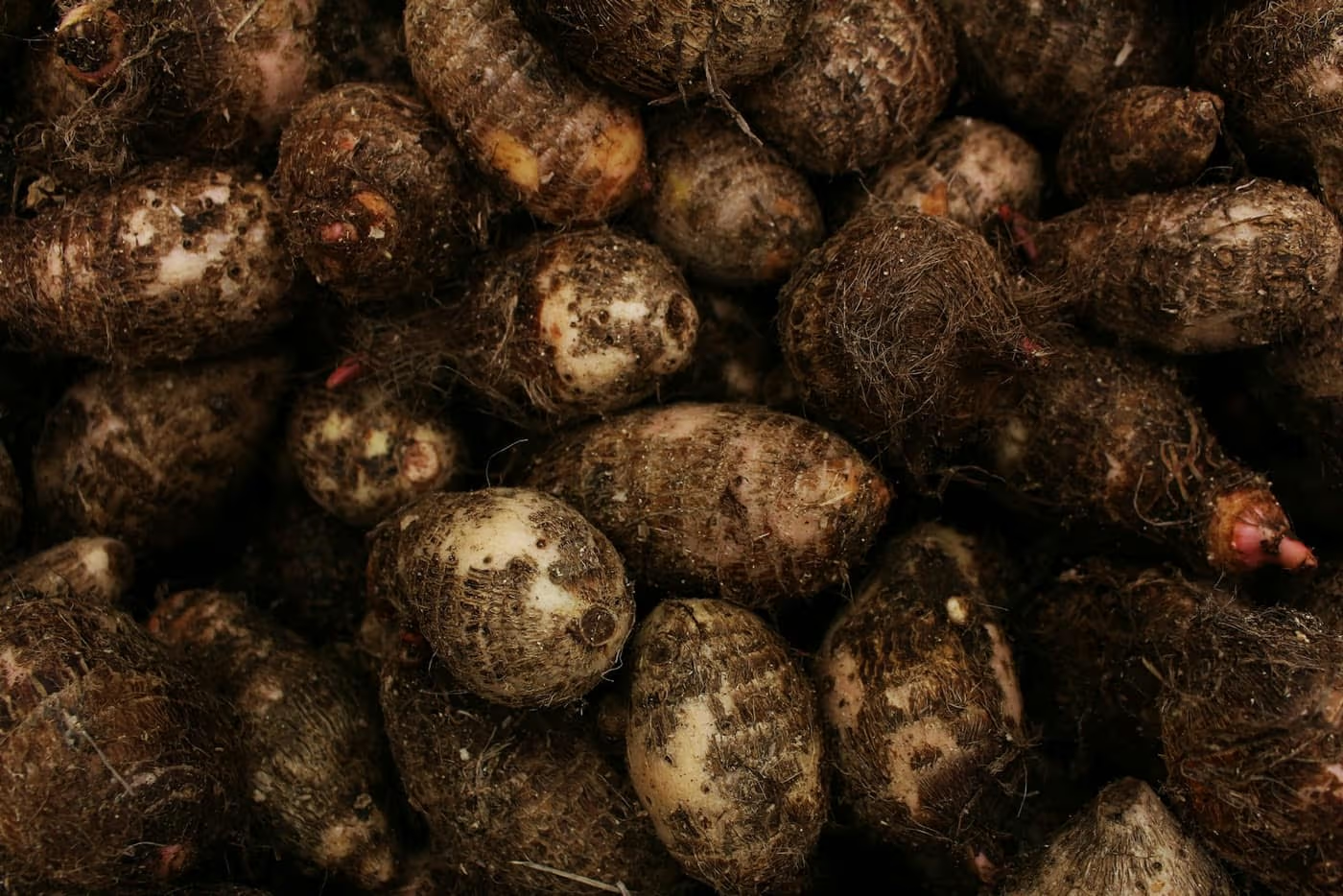
Arbi (Taro)
Colocasia esculenta
Grown from small cormels, not seed, and unusual among tuber crops for actually tolerating the waterlogging that would rot potato or sweet potato — but two things still decide the crop: taro leaf blight, a fungus that can strip a field of leaves in a single humid spell, and acridity, the itchy, biting taste from calcium-oxalate crystals that a low-acridity variety and thorough cooking both keep under control.
Quick Summary
The key points from this page in about two minutes — read it or have it read aloud.
Quick Summary
Arbi, also called taro or colocasia (Colocasia esculenta), is a corm crop grown across the eastern and southern belt — West Bengal, Odisha, Bihar, Uttar Pradesh, Chhattisgarh and Assam, with the south (Kerala, Tamil Nadu, Karnataka) and Gujarat also growing it. Farmers grow it for the corm, sold as a vegetable, and in several regions for the leaves too, cooked as a saag or made into dishes like patra. It is not grown from seed at all — every plant starts from a small side-cormel cut from a healthy mother corm.
What sets arbi apart from other tuber crops is how it handles water. Potato and sweet potato rot within a day or two of standing water; arbi genuinely tolerates it, and in some low-lying tracts is grown almost like a wetland crop with the field kept moist through much of the season. That does not mean it wants to sit in a swamp all the time — steady, even moisture through the growing season is what actually builds a good corm, and a spell of real drought still cuts yield.
The disease that decides an arbi crop is taro leaf blight, caused by a fungus that thrives in exactly the warm, humid weather most of India's taro belt gets during the monsoon. It starts as small water-soaked spots and can spread through a field's leaf canopy within days, cutting badly into yield if it is not watched for and sprayed early. The other defining trait of the crop is acridity — an itchy, burning sensation in the mouth and on bare skin caused by needle-shaped calcium-oxalate crystals in the corm and leaf. Some traditional types are sharply acrid; newer varieties like Sree Hira are bred specifically to be low in it, and thorough cooking destroys most of the effect regardless of variety.
- Crop type
- Warm-season corm crop (grown from cormels, not seed)
- Season
- Mainly kharif (Apr–Jun planting); some irrigated Feb–Mar planting
- Suitable states
- West Bengal, Odisha, Bihar, Uttar Pradesh, Chhattisgarh, Assam, Kerala, Tamil Nadu
- Growing duration
- 175–240 days depending on variety
- Water requirement
- Moderate; tolerates waterlogging but needs even moisture, not drought
- Temperature
- Warm, 25–32°C; day-neutral but frost-tender
- Soil type
- Sandy loam to clay; tolerates poor drainage better than most tuber crops, pH 5.5–7.0
- Difficulty level
- Moderate (taro leaf blight, choosing a low-acridity variety)
- Expected yield
- 15–20 t/ha (up to 28 t/ha with an improved variety)
- Key risk
- Taro leaf blight defoliating the crop in a humid spell
Overview
Arbi, or taro/colocasia (Colocasia esculenta), is a warm-season corm crop grown for its starchy underground corm and, in many regions, its edible leaves. It is propagated entirely from small side-cormels cut from a mother corm — there is no seed sowing in commercial cultivation.
It is grown widely across the eastern belt (West Bengal, Odisha, Bihar, Uttar Pradesh, Chhattisgarh) and Assam, with real cultivation also in Kerala, Tamil Nadu, Karnataka, Punjab and Gujarat. Unlike most tuber crops, it genuinely tolerates waterlogged and even semi-aquatic conditions, which is why it fits into low-lying land that would drown potato or sweet potato.
Two things decide how an arbi crop turns out: catching taro leaf blight early, since the fungus explodes in warm, humid weather and can defoliate a field within days, and choosing a low-acridity variety together with careful cooking, since the calcium-oxalate crystals in the corm and leaf cause a sharp, itchy taste and skin irritation if handled or eaten carelessly.
Crop timeline, sowing to harvest
A quick visual map of the season — jump to any section below for the detail behind each stage.
- Day 0
Planting
Healthy side-cormels (20–35 g each), free of leaf blight and soft rot, planted 5–10 cm deep on ridges or beds, 45–60 cm between rows and 30–45 cm within the row; rainfed crop planted April–June, irrigated crop Feb–March in some regions.
- Day 15–25
Sprouting
Shoots emerge from the buried cormels; gap-fill any cormel that fails to sprout. First irrigation is given right after planting and again about a week later to help even sprouting.
- Day 25–45
Establishment & first top-dressing
The first fertiliser split (full phosphorus, half nitrogen and potash) is applied close to the plant base, combined with the first weeding and earthing-up at around 30–45 days.
- Day 45–90
Vegetative growth & corm initiation
Leaf canopy builds fast; the corm begins forming below ground. This is also when taro leaf blight risk rises sharply in humid, wet weather — start scouting the leaves now. Second earthing-up and the remaining fertiliser dose go in around 60–75 days.
- Day 90–150
Corm bulking
The corm and its side cormels swell steadily; even soil moisture through this stage (not standing water, not drought) is what actually builds size and quality. Continue watching for leaf blight through any humid spell.
- Day 150–240
Maturity & harvest
Leaves yellow, dry and collapse as the crop matures — duration varies sharply by variety, from about 175 days in an early type to 240 days in a longer-duration one. Stop irrigation 3–4 weeks before digging.
Suitable states
States where this crop is grown at scale, highlighted below. Your local Krishi Vigyan Kendra is still the final word for your specific block.
- Jammu and Kashmir
- Himachal Pradesh
- Punjab
- Uttarakhand
- Haryana
- Delhi
- Uttar Pradesh
- Rajasthan
- Bihar
- Jharkhand
- West Bengal
- Sikkim
- Assam
- Arunachal Pradesh
- Meghalaya
- Nagaland
- Manipur
- Mizoram
- Tripura
- Gujarat
- Madhya Pradesh
- Chhattisgarh
- Maharashtra
- Odisha
- Goa
- Telangana
- Andhra Pradesh
- Karnataka
- Kerala
- Tamil Nadu
- Puducherry
- Ladakh
- Chandigarh
- Lakshadweep
Grown here
Climate requirements
Arbi's tolerance of waterlogging is a real strength on low-lying land that would drown other tuber crops, but it is not a licence to ignore water management altogether — a genuine dry spell during corm bulking still cuts yield, just as standing water for too long anywhere still favours corm rot.
Ideal temperature
A warm, day-neutral crop that grows best at 25–32°C and tolerates higher temperatures reasonably well, but it is frost-tender and growth slows sharply in cold weather.
Rainfall
Needs about 700–1,000 mm of well-distributed rainfall or its irrigated equivalent. It is genuinely tolerant of both drought spells and waterlogging/short submergence — an unusual combination among tuber crops — but even, steady moisture through the season still gives the best corm size, not either extreme.
Humidity
This is the trait to watch most closely: warm, humid weather with prolonged leaf wetness is exactly what taro leaf blight needs to explode through a field, so humid monsoon spells call for active scouting, not just routine care.
Sunlight
Full sun gives the best corm yield, but arbi tolerates partial shade better than most field crops, which is why it is commonly intercropped under young coconut, arecanut or banana in the south and east.
Soil requirements
Because arbi is genuinely more water-tolerant than most tuber crops, growers sometimes treat drainage as unnecessary altogether. A basic ridge or raised-bed system with reasonable drainage still gives better corm shape and cuts corm-rot risk compared with planting flat into a permanently waterlogged low spot.
Suitable soil
Sandy loam to clay loam, rich in organic matter, suits arbi well, and it tolerates heavier, less well-drained soils better than most tuber crops — one reason it is grown on low-lying land unsuitable for potato or sweet potato.
pH range
Best at pH 5.5–7.0. It tolerates moderately acidic soils, which suits much of the eastern and southern belt where it is grown.
Drainage
Unusually forgiving of poor drainage and even short spells of standing water compared with other tuber crops, though this tolerance has limits — prolonged waterlogging in badly drained pockets still favours corm rot, especially with wounded or poor-quality planting material.
Organic matter
Responds well to organic matter — about 10–12 t/ha of well-rotted FYM or compost worked into the ridges or beds before planting lifts both yield and corm quality.
Land preparation
Same four steps whichever region you are in — only the timing shifts with the sowing window.
- 1
Plough and form ridges or raised beds
Plough two to three times to a fine tilth and form ridges or raised beds 45–60 cm apart. In genuinely low-lying, semi-aquatic tracts, arbi is instead grown on a puddled, paddy-like field — match the system to the actual water regime of the plot, not just to habit.
- 2
Work in FYM and basal phosphorus
Mix 10–12 t/ha of well-rotted FYM or compost into the ridge line, along with the full phosphorus dose, before planting.
- 3
Select healthy, disease-free cormels
Cut side-cormels of 20–35 g each from a healthy mother crop that showed no sign of leaf blight or corm rot, and treat the cut ends with a fungicide before planting.
Seed information
How the main varieties compare, so you can pick by duration, yield, disease pressure or what you are growing for.
| Variety | Duration | Yield | Disease resistance | Best state | Suitable for |
|---|---|---|---|---|---|
The first hybrid taro variety released in India, bred by ICAR-CTCRI, Thiruvananthapuram, from the cross C-303 × C-383. A semi-erect, medium-tall (70–80 cm) plant with oval corms, light brown skin and white flesh, notable for cormels that keep for about 60 days after harvest — unusually long storage life for a taro variety. | 190–210 days | 17.5–28.5 t/ha | No specific resistance claimed | Kerala | General cultivation, longer post-harvest keeping |
A CTCRI release with a tall (1–1.5 m), low-tillering plant that produces many small cormels (20–25 per plant), field-tolerant to both taro leaf blight and mosaic disease — a useful combination where both pressures are present. | 195–210 days | 15–18 t/ha | Field tolerant to leaf blight and mosaic | Kerala | Fields with a history of both leaf blight and mosaic |
A CTCRI release with a tall (100–150 cm) plant that performs well under relatively low input levels, valued for its non-acrid corm with good cooking quality and taste — a useful choice where acridity has been a market complaint. | 210–240 days | 15–20 t/ha | No specific resistance claimed | Kerala | Low-acridity table use, modest-input farms |
Released by the ICAR-CTCRI Regional Station, Bhubaneswar, specifically for Odisha conditions — suited to both rainfed upland and irrigated medium/low land. Tolerant to the leaf blight that is very prevalent in Odisha's traditional varieties, it produces 12–16 long cormels (14–18 cm) per plant with very low acridity (calcium oxalate about 9.2 mg/100 g) and good cooking quality and aroma. | ~180 days | ~18 t/ha | Tolerant to leaf blight | Odisha | Leaf-blight-prone tracts, low-acridity table use, both upland and lowland fields |
Released by Punjab Agricultural University, Ludhiana, with tall, obliquely erect green leaves and long, fairly thick corms with creamy, brown-tinged flesh — the main institutional release for the north-western plains. | ~175 days | ~22 t/ha | No specific resistance claimed | Punjab | North-western plains cultivation |
A widely grown traditional cultivar found across several states rather than a single institutional release, valued for its consistently high corm yield among locally grown types. Because it is a farmer-grown traditional type, seed quality and disease status vary by source — buy planting material from a reliable, disease-free multiplication plot rather than an unknown field. | 175–200 days | ~20 t/ha | Not formally documented | Grown across several states as a local cultivar | General cultivation where a proven local type is preferred |
- Seed rate
- About 1 tonne of cormels per hectare (roughly 400 kg/acre), using healthy side-cormels of 20–35 g each. At 60×45 cm spacing this works out to around 37,000 plants/ha; at a closer 45×30 cm spacing it rises to about 74,000 plants/ha.
- Certified seed
- Cut side-cormels only from a healthy mother crop that showed no leaf blight, mosaic mottling or corm rot at any point in the season. Never save planting material from a field where blight was seen, even in a different part of the plot — the fungus carries over on and in cormels. Treat the cut ends with a recommended fungicide before planting.
- Spacing
- Ridges or rows 45–60 cm apart, with cormels planted 30–45 cm apart within the row.
- Seed treatment
- Dip the cormels, or at least their cut surfaces, in a recommended fungicide solution (such as a mancozeb-based dip) before planting — this protects against corm rot in the first weeks and cuts down leaf-blight inoculum carried on the planting material itself.
Sowing guide
Never plant a cormel taken from a mother plant that showed leaf blight symptoms, even if the rest of that field looked healthy — the fungus travels on infected planting material as readily as through the air.
- Best time
- Mainly a kharif crop planted April to June with the monsoon in most of the rainfed belt; under irrigation, planting in February–March is also practised in parts of the country. Match the planting window to your variety's stated duration so harvest lands in dry weather.
- Row spacing
- 45–60 cm
- Plant spacing
- 30–45 cm
- Sowing depth
- 5–10 cm, cormel eye-bud facing up
- Method
- Plant healthy cormels into moist ridges or beds (or a puddled field in genuinely low-lying tracts), firming the soil around each one. Irrigate lightly right after planting to help even sprouting.
Fertilizer schedule
A split dose beats one large dose applied at sowing — nitrogen especially is lost to the air and to leaching if it all goes in on day one.
- 1
Basal (at planting)
Day 0
Well-rotted FYM (10–12 t/ha) worked into the ridge or bed ahead of planting, so it is available as the cormel sprouts.
- 2
First top-dressing (at sprouting)
Day 20–25
The full phosphorus dose plus half the nitrogen and half the potash (of an overall 80:25:100 kg/ha N:P₂O₅:K₂O), placed close to the plant base soon after sprouting.
- 3
Second top-dressing
Day 45–60 (with earthing-up)
The remaining half of the nitrogen and potash, applied alongside weeding and earthing-up so the fertiliser is covered rather than left exposed on the surface.
Irrigation schedule
1. Sprouting
Day 0–15
One irrigation right at planting and a second about a week later gives even, uniform sprouting across the field.
2. Vegetative growth & corm bulking
Day 15–150
Irrigate every 12–15 days depending on how well the soil holds moisture — a total of about 9–12 irrigations over the season on a non-lowland field. Even, steady moisture here is what actually builds corm size; neither a dry spell nor standing water for long periods helps it.
3. Pre-harvest dry-down
Last 3–4 weeks before harvest
Stop irrigation so the soil dries somewhat before digging — this makes lifting cleaner and reduces corm-rot risk in storage.
Critical stages
- Sprouting (first 2–3 weeks)
- Corm initiation and bulking
Water-saving tips
- Arbi is unusual among tuber crops in tolerating short spells of standing water without rotting, but that is a safety margin for a heavy-rain year, not a reason to irrigate more heavily than the 12–15 day interval that actually suits it.
- On soils that hold moisture well (loam and clay), intervals can safely stretch toward 15 days; sandy soils need the shorter end of that range.
- Stopping irrigation 3–4 weeks before harvest costs nothing in yield and measurably improves how well the corms keep afterwards.
Weed management
Common weeds
Organic control
- Two to three hand-weedings in the first two to three months, timed with the earthing-up operations at 30–45 and 60–75 days so weeding and re-ridging happen together.
- Earthing-up itself buries small weeds around the base while it protects the developing corm.
- A shallow inter-row hoeing before the canopy closes clears the row middles; after that the dense leaf cover does most of the work.
Chemical control
- A pre-emergence herbicide cleared for arbi/colocasia, applied to clean, moist ridges soon after planting, can hold weeds through early establishment; confirm the current product and dose with your local KVK.
- The closing leaf canopy shades out most weeds from about 8–10 weeks onward, so herbicide use matters most in the first two months.
Nutrient deficiency identification
What a shortage of each nutrient actually looks like on the plant, so you can tell a deficiency apart from a disease before you spray the wrong thing.
Potassium
Visible symptom
Scorched, yellow-brown margins on older leaves and smaller, poorer-quality corms with lower starch content — potash is closely tied to corm bulking and quality in arbi, similar to other corm and tuber crops.
Nitrogen
Visible symptom
Pale, small leaves and a slow-building canopy on genuinely poor soil; the more common mistake, though, is skipping the second top-dressing rather than under-applying overall.
Zinc
Visible symptom
Interveinal yellowing and stunted, narrow new leaves, seen more often on low-lying or waterlogged fields where zinc becomes less available to the plant — a corrective spray or soil application addresses it.
Diseases to watch for
Symptoms, likely cause and what actually treats it — not just a spray name.
Taro leaf blight
- Symptoms
- Small water-soaked spots on the leaves that quickly enlarge into big, brown-to-purple lesions, often with faint concentric rings and drops of yellowish fluid on the underside in humid conditions; badly affected leaves collapse and the whole canopy can be stripped within days, and in severe cases the petioles and corm itself rot.
- Cause
- The fungus-like organism Phytophthora colocasiae, spread by rain-splashed spores and favoured by warm (20–28°C), humid weather with prolonged leaf wetness — the exact conditions of most of India's taro belt during the monsoon. It is the single most damaging disease of taro worldwide, capable of 25–50% yield loss where it is not managed.
- Treatment
- Remove and destroy heavily infected leaves as soon as seen; apply a recommended copper-based or systemic fungicide at the first spots and repeat through humid spells, following the label and pre-harvest interval.
- Prevention
- Grow a tolerant variety (Sree Hira, Sree Pallavi and others show useful field tolerance), space plants for airflow, avoid overhead irrigation late in the day, propagate only from mother plants that never showed blight, and rotate away from arbi where the disease has a history.
Corm rot
- Symptoms
- A soft, mushy rot of the planted cormel or the developing corm, weak plants with only two or three stunted leaves, and sometimes a downy whitish growth on the corm surface in wet soil; affected plants fail to establish or collapse later in the season.
- Cause
- Soil-borne fungi, mainly Pythium myriotylum and sometimes Sclerotium rolfsii, favoured by waterlogged, poorly drained soil and entering through wounds on the planting material.
- Treatment
- There is no effective fungicide once corm rot has set in on a plant — remove and discard affected plants; fungicide treatment before planting is the real point of control.
- Prevention
- Treat cormels with a fungicide dip before planting, avoid planting in permanently waterlogged low spots for the upland crop, use only sound, unwounded cormels, and ensure the field drains after heavy rain even where the crop tolerates some standing water.
Mosaic (Dasheen mosaic virus)
- Symptoms
- A feathery, light-green to yellow mottling along and between the leaf veins, sometimes with mild leaf distortion, and a general stunting of the plant; India-wide surveys report 10–30% incidence in taro.
- Cause
- Dasheen mosaic virus (DsMV), a potyvirus spread by aphids as they feed and, critically, carried inside infected cormels from one season to the next.
- Treatment
- No cure once a plant is infected; rogue out and destroy affected plants so they are never used as a source of planting material.
- Prevention
- Propagate only from healthy, visibly symptom-free mother plants, manage aphids in the crop, and avoid planting cormels of unknown or mixed origin.
Pests to watch for
What to look for before the damage is visible, and organic options before you reach for a chemical.
Taro hawkmoth
- Identification
- A large caterpillar, initially brown and turning green, brown, red or dark grey, with a prominent eyespot pattern and a distinctive tail-horn near the rear end; its large size makes it easy to spot on the leaves.
- Damage
- Feeds on the leaves and can strip a good part of the canopy fast when numbers build up, though its size makes it one of the easier pests to control by hand.
- Organic control
- Hand-pick and destroy caterpillars — their large size makes this genuinely practical — and conserve natural predators and parasitoids; a Bt (Bacillus thuringiensis) spray works well on young caterpillars.
- Chemical control
- A recommended insecticide only where numbers are high and hand-picking cannot keep pace, following the label and local KVK advice.
Aphids
- Identification
- Small, soft-bodied insects clustering on young leaves and shoot tips, often with sticky honeydew and sooty mould developing beneath them.
- Damage
- Direct feeding is usually minor, but aphids are the vector for Dasheen mosaic virus, so an aphid build-up is a warning sign for virus spread as much as a pest problem in its own right.
- Organic control
- Yellow sticky traps, neem-based sprays, and conserving ladybird beetles and other natural predators; keeping mother-plant stock aphid-free matters most since it protects the next season's planting material.
- Chemical control
- A recommended insecticide where aphid numbers are building fast, particularly around mother-plant blocks kept for propagation.
Mealybugs
- Identification
- Small, soft insects covered in a white, waxy, cottony coating, clustering at leaf axils and around the base of the plant, often tended by ants.
- Damage
- A generally minor, occasional pest of arbi that can still check growth on a heavily infested plant and coats leaves in honeydew and sooty mould.
- Organic control
- Conserve natural predators, control the ants that protect and spread mealybug colonies, and avoid excess nitrogen, which favours soft growth that mealybugs prefer.
- Chemical control
- A recommended systemic insecticide directed at colonies only where infestation is heavy and spreading.
Common mistakes to avoid
The mistakes that cost growers the most, ranked by how often they show up in the field — not in the order you might expect.
- 1
Saving or buying cormels from a field where taro leaf blight was seen, even in a different part of the plot.
Why it hurts
The fungus carries over on and inside infected cormels, so a single batch of bad planting material can seed a whole new field with blight before the season's first humid spell even arrives. Propagate only from mother plants that stayed clean all season.
- 2
Growing a sharply acrid variety, or undercooking the corm or leaves, for direct sale or home use.
Why it hurts
Calcium-oxalate crystals in acrid arbi cause a genuinely unpleasant itching and burning in the mouth and throat if the corm is undercooked — this is the single biggest reason a batch goes unsold or a household stops buying a particular source. Choose a documented low-acridity variety like Sree Hira or Sree Rashmi where acridity has been a complaint, and always cook thoroughly.
- 3
Assuming arbi's waterlogging tolerance means drainage never matters.
Why it hurts
The crop tolerates short spells of standing water far better than potato or sweet potato, but prolonged waterlogging in a poorly drained pocket still causes corm rot, especially with wounded planting material. Match the growing system — upland ridges or a lowland, semi-aquatic field — to the plot's actual water regime.
- 4
Skipping earthing-up at 30–45 and 60–75 days.
Why it hurts
Without earthing-up, developing corms and cormels push up toward the surface, turn green, take on an off-flavour and are more exposed to sun scorch and pests. The two earthing-up operations also carry the split fertiliser dose into the root zone instead of leaving it on the surface.
- 5
Waiting to spray until taro leaf blight is already visible across the field.
Why it hurts
The disease can strip a canopy within days once it establishes in warm, humid weather. Start scouting as soon as the monsoon's first humid spell arrives and act on the first water-soaked spots, not after the lesions have already spread.
- 6
Handling corms and leaves bare-handed without care during harvest, peeling or cooking prep.
Why it hurts
The needle-shaped calcium-oxalate crystals in arbi cause genuine, if temporary, itching and irritation on bare skin, worse with acrid varieties. Wear gloves or oil the hands when handling large quantities, especially of leaves meant for saag or patra.
Harvesting
Dig at 175–240 days depending on the variety planted, once the leaves have yellowed, dried and largely collapsed — a sign the corm has stopped bulking and matured. Stop irrigation 3–4 weeks beforehand so the soil is on the drier side for digging.
Signs it is ready
- Leaves yellowing, drying and collapsing
- Corm skin set and no longer soft to a light scratch
- Reaching the planted variety's stated duration
Tools
- A spade, digging fork or khurpi to lift corms without cutting them
- Baskets or sacks for collecting the harvested corms
- A sharp knife to trim the leaf stubs cleanly
Expected yield
Roughly 15–20 t/ha for a well-managed crop of a standard variety, and up to about 28 t/ha with a high-yielding variety like Sree Kiran under good management. On an acre this is about 60–80 quintals, more with an improved variety.
Post-harvest & storage
Storage
Corms do not need the multi-day curing that sweet potato does — brush off excess soil and let them air-dry in a shaded, ventilated spot for a day or two, then store in a cool, dry, well-ventilated place. Handle gently, since cut or bruised corms rot fast; sound corms typically hold for 2–4 weeks at ambient conditions, and considerably longer (reportedly several months) in proper cold storage at around 11–13°C and 85–90% humidity, though that facility is rarely available to smallholders.
Packaging
Pack in ventilated baskets, crates or gunny bags in shallow layers rather than deep, tightly packed sacks that trap heat and moisture and encourage rot.
Transportation
Move to market reasonably promptly and handle carefully — every cut or bruise is an entry point for corm rot in transit and shortens how long the corm keeps afterward.
Shelf life
2–4 weeks unrefrigerated in typical village and market conditions; considerably longer under proper cold storage where it is available.
Market prices
Today's mandi price near you, pulled live from the government's own Agmarknet data.
Live daily mandi prices from the government Agmarknet dataset.
Synced from data.gov.in (Agmarknet). Rates are ₹ per quintal.
Weather
Current conditions and a 5-day outlook for your selected location, with one line of stage-aware advice.
Pick your state for current conditions and a 5-day outlook.
Live data from Open-Meteo
Profit calculator
Your own cost sheet, expected yield and selling price — not ours.
Where the money goes
Share of the total cost per acre, using the calculator’s own default cost sheet below — adjust the numbers there to match your field and this picture will no longer apply to you exactly, but the ranking rarely changes.
- Labour31% (₹11,000)
- Land rent22% (₹8,000)
- Seed10% (₹3,500)
- Fertiliser10% (₹3,500)
- Pesticide & weedicide8% (₹3,000)
- Irrigation8% (₹3,000)
- Machinery7% (₹2,500)
- Interest4% (₹1,500)
Official downloads
Government and ICAR documents only — everything below is hosted on an official server.
ICAR-Central Tuber Crops Research Institute (CTCRI), Thiruvananthapuram
Sree Kiran, Sree Pallavi, Sree Rashmi and the taro/colocasia package of practices
ICAR-CTCRI Regional Station, Bhubaneswar — Sree Hira technical leaflet
Sree Hira variety details, agronomy and leaf-blight tolerance for Odisha conditions
Kerala Agricultural University (KAU) Agri-Infotech Portal
Colocasia/taro package of practices — spacing, fertiliser dose and irrigation schedule
Kisan Call Centre — 1800-180-1551
Free crop advice in your language
Frequently asked questions
My arbi leaves have brown-purple patches that are spreading fast. What is it and what do I do?
That is almost certainly taro leaf blight (Phytophthora colocasiae), the most damaging disease of taro worldwide — it thrives in exactly the warm, humid weather most of India's monsoon brings and can strip a field of leaves within days. Remove and destroy the worst-affected leaves now, spray a recommended copper-based or systemic fungicide, and for the next crop plant a tolerant variety like Sree Hira or Sree Pallavi and propagate only from mother plants that never showed the disease.
Why does arbi make my hands and throat itch?
That itching, biting sensation comes from needle-shaped calcium-oxalate crystals present in the corm and leaf, worse in some varieties than others. Thorough cooking destroys most of the effect, which is why undercooked arbi is far more irritating than a well-cooked dish. For growing and selling, choosing a documented low-acridity variety such as Sree Hira or Sree Rashmi avoids most complaints, and wearing gloves when handling large quantities of raw corms or leaves protects your hands.
Can I grow arbi on land that floods sometimes?
Better than most tuber crops, yes — arbi genuinely tolerates short spells of standing water that would rot potato or sweet potato, and in some low-lying tracts it is grown almost like a semi-aquatic crop. But this is a tolerance, not a requirement: the crop still builds its best corm under steady, even moisture rather than permanent waterlogging, and prolonged standing water in a poorly drained pocket still favours corm rot.
How is arbi planted if it has no seed?
It is grown entirely from cormels — small side-corms, 20–35 g each, cut from a healthy mother corm — planted 5–10 cm deep on ridges or beds. About a tonne of cormels covers a hectare. Never use cormels from a mother plant that showed leaf blight or mosaic symptoms, since both travel on the planting material itself.
How long do harvested arbi corms keep?
Sound, undamaged corms typically keep 2–4 weeks in a cool, dry, ventilated spot at home or in a village store — no multi-day curing is needed the way sweet potato requires. Proper cold storage (around 11–13°C and high humidity) extends this to several months, though that facility is rarely available to smallholders, so most arbi moves to market within a few weeks of harvest.
Does arbi have an MSP or a mandi price?
There is no MSP for arbi. It trades on Agmarknet under the commodity name "Colacasia" (the standard upstream spelling), with regular daily records from markets in Kerala, Telangana and other states — genuine, active trade rather than a thin or seasonal listing.
Still have questions?
The FAQs above cover the common ones. For anything specific to your field and soil, your nearest Krishi Vigyan Kendra is the authoritative answer.