
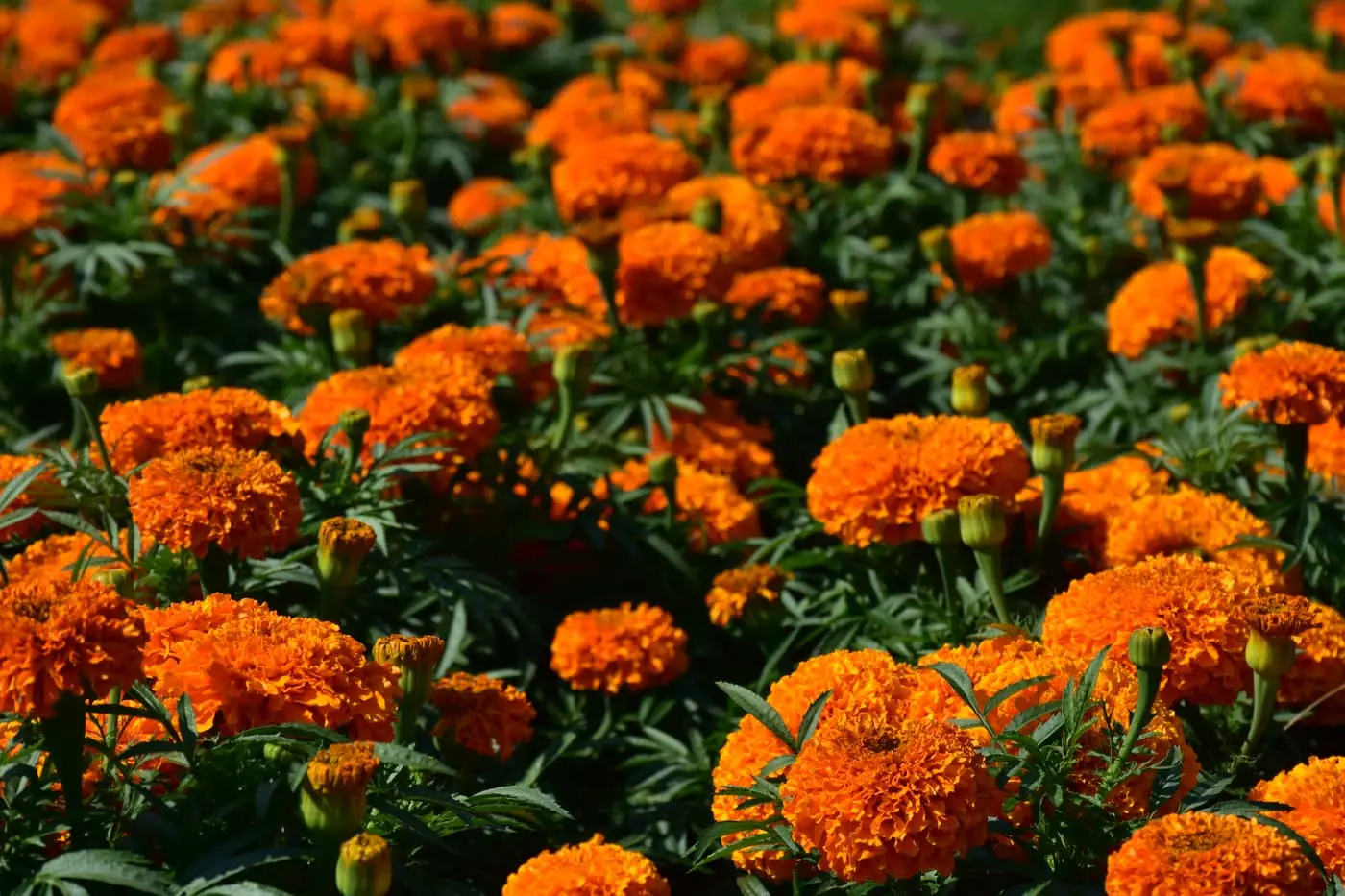
Marigold (Genda)
Tagetes erecta / Tagetes patula
India's everyday festival flower and the easiest commercial flower crop to start with — grown in three staggered seasons so a nursery can be timed to flower straight into a high-demand window (Dussehra, Diwali, weddings), lifted by one simple operation most beginners skip (pinching out the growing tip to turn one stem into many flowering branches), and picked every two or three days for two to three months because a marigold left on the plant one picking too long dries, drops and is wasted.
Quick Summary
The key points from this page in about two minutes — read it or have it read aloud.
Quick Summary
Marigold (genda) is by far the most widely grown loose flower in India and the natural first commercial flower crop for a farmer — hardy, quick, grown in every state, and carried by steady year-round demand for garlands, temple offerings, festival decoration and the wedding trade, with sharp price spikes around Dussehra and Diwali. Two kinds are grown: the tall, large-flowered African marigold (Tagetes erecta), which is the main commercial loose-flower crop, and the dwarf, smaller-flowered French marigold (Tagetes patula), used more for borders, pots and bedding.
It is grown from seed raised in a nursery and transplanted — about three to four weeks in the nursery, then set out in the field — and it can be timed across three overlapping seasons (rainy, winter and summer) so that flowering lands in a high-price festival or wedding window. Getting that timing right is half the profit: a crop that flowers into the Dussehra–Diwali peak earns far more than the same crop flowering into a glut.
The one operation that most separates a good marigold crop from a poor one is pinching — nipping out the growing tip of the young plant about three to four weeks after transplanting. This forces the plant to throw out many side branches instead of one tall stem, and since every branch ends in a flower, pinching roughly multiplies the flower count. Beyond that, marigold wants a sunny, well-drained plot, a balanced feed, steady moisture through flowering, and watching for the flower bud borer (a Helicoverpa caterpillar that eats into the buds) and, in dry spells, red spider mite.
Harvesting is frequent and hands-on: flowers are picked fully open, in the cool of the morning, every two to three days through a picking season of two to three months. A marigold left even one picking too long dries on the plant and is lost, so steady, timely picking — not a single harvest — is what keeps the crop paying. Besides the fresh-flower trade, marigold has a real industrial market as a source of the natural pigment (xanthophyll/lutein) used in poultry feed, and it is widely used as a trap and border crop against nematodes and the fruit borer in tomato and other vegetables.
- Crop type
- Annual flower crop (loose flower), nursery-transplanted
- Season
- Three seasons — rainy (Jun–Jul), winter (Sep–Oct), summer (Jan–Feb)
- Suitable states
- Karnataka, Tamil Nadu, Maharashtra, Andhra Pradesh, West Bengal, Madhya Pradesh, Gujarat
- Growing duration
- First flowers ~60–75 days after transplant; picking over 2–3 months
- Water requirement
- Moderate; steady moisture through flowering, no waterlogging
- Temperature
- Mild, ~18–30°C best; extreme heat shortens flowering and fades colour
- Soil type
- Well-drained sandy loam to loam, rich in organic matter, pH ~6.5–7.5
- Difficulty level
- Easy–moderate — timing, pinching and frequent picking decide profit
- Expected yield
- 8–12 t/ha loose flowers (African); hybrids higher under good management
- Key risk
- Flowering into a glut instead of a festival window; skipping pinching
Overview
Marigold (genda, Tagetes species) is the most widely grown loose flower in India, valued for its hardiness, quick cropping and year-round demand for garlands, religious offerings, festival and wedding decoration. The tall African marigold (Tagetes erecta) is the main commercial loose-flower type; the dwarf French marigold (Tagetes patula) is grown more for bedding, borders and pots.
It is grown in nearly every state and across three overlapping seasons — a rainy-season crop, a winter (rabi) crop and a summer crop — so growers can plan flowering to hit a high-demand window such as Dussehra, Diwali or the wedding season. Karnataka, Tamil Nadu, Maharashtra, Andhra Pradesh, West Bengal, Madhya Pradesh and Gujarat are among the leading producers, and marigold trades genuinely on APMC markets as a priced commodity.
Raised from seed in a nursery and transplanted, the crop turns on three things: timing the planting so flowering lands in a profitable window, pinching the young plant to multiply flowering branches, and picking frequently and on time through a two-to-three-month season. It also carries a real industrial value as a source of the natural pigment xanthophyll (lutein) for poultry feed, and is widely used as a trap/border crop against nematodes and fruit borers in vegetable fields.
Crop timeline, sowing to harvest
A quick visual map of the season — jump to any section below for the detail behind each stage.
- Day 0
Nursery sowing
Seed is sown in raised nursery beds or trays; it germinates in 4–7 days, and seedlings are raised for about 3–4 weeks before transplanting.
- Day ~25
Transplanting
Healthy 20–25-day seedlings are transplanted to the field on a well-prepared bed at the spacing for the type, and watered in.
- Day ~40 (≈15 days after transplant)
Pinching
The growing tip of each plant is nipped out to force side branching — the single operation that most increases flower number, since every branch ends in a flower.
- Day 45–55
Vegetative growth & bud formation
The pinched plant bushes out and begins forming flower buds; a nitrogen top-dress and steady moisture now build the frame that carries the flowers.
- Day 60–75
Flowering begins
The first flowers open about 60–75 days after transplanting (sooner for French types); picking begins as flowers reach full open size.
- Through ~2–3 months
Repeated picking
Fully-open flowers are picked every 2–3 days in the cool morning across a two-to-three-month season; flowers left too long dry on the plant and are lost.
Suitable states
States where this crop is grown at scale, highlighted below. Your local Krishi Vigyan Kendra is still the final word for your specific block.
- Jammu and Kashmir
- Himachal Pradesh
- Punjab
- Uttarakhand
- Haryana
- Delhi
- Uttar Pradesh
- Rajasthan
- Bihar
- Jharkhand
- West Bengal
- Sikkim
- Assam
- Arunachal Pradesh
- Meghalaya
- Nagaland
- Manipur
- Mizoram
- Tripura
- Gujarat
- Madhya Pradesh
- Chhattisgarh
- Maharashtra
- Odisha
- Goa
- Telangana
- Andhra Pradesh
- Karnataka
- Kerala
- Tamil Nadu
- Puducherry
- Ladakh
- Chandigarh
- Lakshadweep
- Andaman and Nicobar Islands
- Dadra and Nagar Haveli and Daman and Diu
Grown here
Climate requirements
The crop's profitability is decided as much by the calendar as by the agronomy: plan the nursery date so flowering lands in a festival or wedding window (Dussehra, Diwali, Sankranti, the wedding season) rather than into an off-peak glut, when prices can collapse.
Ideal temperature
A mild-weather crop that flowers best at about 18–30°C. Moderate winter weather gives the biggest, best-coloured flowers (which is why the winter crop targeting Dussehra–Diwali is the most important). Very high summer heat shortens the flowering period, fades the colour and reduces flower size, while hard frost damages the crop in the coldest tracts.
Rainfall
Grown largely under irrigation; it needs steady moisture but not waterlogging. Heavy continuous rain during flowering causes flower rot and splashes soil-borne disease onto the plants, so the rainy-season crop needs good drainage above all.
Humidity
Moderate humidity is fine; prolonged wet, humid weather raises the risk of leaf spot and flower-bud rot, so airflow and drainage matter in the rainy crop.
Sunlight
A full-sun crop — strong sunlight gives the most flowers and the best colour. Shaded or crowded plants grow leafy and flower poorly.
Soil requirements
A fertile, well-drained, sunny plot with plenty of organic matter is the ideal; on heavier land, raised beds or ridges improve drainage and reduce flower and root rot in the rainy crop.
Suitable soil
Grows on a wide range of soils but does best on a fertile, well-drained sandy loam to loam rich in organic matter. Heavy, waterlogging-prone clay gives root and flower rot; very poor sandy soil needs generous manuring to crop well.
pH range
Prefers a near-neutral soil, roughly pH 6.5–7.5; it tolerates a fair range but strongly acidic or alkaline soils reduce growth and flowering.
Drainage
Good drainage is important, especially for the rainy-season crop — standing water around the roots causes collar and root rot and spoils the flowers.
Organic matter
Responds strongly to well-rotted farmyard manure or compost worked into the bed before transplanting, which improves both flower number and size.
Land preparation
Same four steps whichever region you are in — only the timing shifts with the sowing window.
- 1
Prepare a fine, manured field bed
Plough two to three times to a fine tilth and work in 20–25 t/ha of well-rotted FYM or compost along with the basal fertiliser dose before transplanting.
- 2
Raise a healthy nursery
Sow seed thinly in raised nursery beds or pro-trays about three to four weeks ahead of transplanting, treating against damping-off and keeping the bed evenly moist; a strong, stocky seedling transplants best.
- 3
Form beds or ridges for drainage
Lay out flat beds or ridges-and-furrows with clear drainage channels, especially for the rainy-season crop, so excess water never pools around the plants.
Seed information
How the main varieties compare, so you can pick by duration, yield, disease pressure or what you are growing for.
| Variety | Duration | Yield | Disease resistance | Best state | Suitable for |
|---|---|---|---|---|---|
A classic IARI African marigold (Tagetes erecta) with deep-orange, fully double, ruffled flowers on a tall, high-yielding plant — one of the most widely grown commercial loose-flower varieties in northern India, flowering about 125–135 days from sowing. | ~125–135 days from sowing; flowers ~60–75 days after transplant | High loose-flower yield; large deep-orange double flowers | No special resistance widely documented | Uttar Pradesh, Punjab, Haryana, Delhi and across the plains | Commercial loose-flower and garland market, festival timing |
An IARI African marigold companion to Pusa Narangi with bright yellow, double flowers, grown for the yellow end of the garland and festival trade on a tall, productive plant. | ~125–135 days from sowing | High; large bright-yellow double flowers | No special resistance widely documented | Northern plains and widely across India | Commercial loose-flower market where yellow is wanted |
An ICAR-IIHR French marigold (Tagetes patula) with orange-red, double flowers, a compact plant and a long flowering span, valued for loose-flower and border use in the southern states. | Early and long-flowering; first flowers ~55–65 days after transplant | High number of smaller orange-red flowers over a long season | No special resistance widely documented | Karnataka, Tamil Nadu, Andhra Pradesh | Loose-flower market, borders and long-season picking |
An ICAR-IIHR African marigold with large, golden-orange double flowers on a vigorous plant, bred as an improved high-yielding commercial loose-flower variety for the southern belt. | ~120–135 days from sowing | High loose-flower yield; large golden-orange flowers | Improved field tolerance in its target region | Karnataka and southern India | Commercial loose-flower plantings |
An ICAR-IIHR African marigold notable for its very high flower-carotenoid (xanthophyll) content, making it the standout choice for the industrial pigment-extraction market (lutein for poultry feed) as well as a good loose-flower crop. | ~120–135 days from sowing | High flower yield with exceptionally high carotenoid content | No special resistance widely documented | Karnataka, Andhra Pradesh, Tamil Nadu | Pigment (xanthophyll/lutein) extraction and loose-flower market |
Dwarf French marigold (Tagetes patula) open-pollinated types in red, yellow, orange and bicolour, sold widely by Indian seed companies for borders, pots, bedding and short-stem loose flowers — compact, early and very free-flowering. | Early; first flowers ~50–60 days after transplant | Many small flowers on a compact plant | No special resistance widely documented | Grown across India for bedding and local markets | Borders, pots, bedding, small-scale loose flowers and nematode trap-cropping |
African marigold F1 hybrids (private) F1 hybrid African marigolds from private seed companies (such as the Inca and Maxima types), bred for uniform, large, dense double flowers and heavy, even yields — a higher-cost seed that rewards well-managed commercial plantings aiming at a premium garland market. | ~110–130 days from sowing | Very high and uniform under good management | Variety-dependent; check the company's claims | Commercial belts across India | High-input commercial plantings targeting a premium market |
- Seed rate
- About 600–800 g of seed per hectare raised in a nursery to transplant roughly 1 hectare (French and hybrid rates differ; hybrids use much less seed). Seedlings are raised in a nursery and transplanted, not sown direct in the field.
- Certified seed
- Buy fresh seed of a named variety each season from an ICAR institute (IARI, IIHR), a state seed agency or a reputable seed company, and match the type — tall African for commercial loose flowers, dwarf French for borders and bedding. Open-pollinated varieties can be seed-saved from true-to-type plants, but F1 hybrids must be bought fresh each year.
- Spacing
- African marigold about 45 × 30 cm; French marigold about 30 × 30 cm. Closer spacing for dwarf types, wider for tall vigorous hybrids.
- Seed treatment
- Treat nursery seed and drench the nursery bed against damping-off (with thiram, captan or a Trichoderma product), which can wipe out a seedbed in warm, humid weather.
Sowing guide
Do not transplant over-aged, leggy seedlings or skip the pinching — an unpinched plant puts up one tall stem with far fewer flowers, directly cutting the marketable yield.
- Best time
- Marigold is grown in three overlapping seasons: a rainy-season crop (nursery June–July, flowering around the autumn festivals), a winter/rabi crop (nursery September–October, flowering in winter — the biggest and best-quality crop, targeting Dussehra–Diwali and the wedding season), and a summer crop (nursery January–February). Time the nursery so flowering lands in your target high-demand window.
- Row spacing
- 45 cm (African); 30 cm (French)
- Plant spacing
- 30 cm (African); 30 cm (French)
- Sowing depth
- Nursery seed sown shallow (about 1 cm); seedlings transplanted to the collar
- Method
- Raise seedlings in a nursery for about 3–4 weeks, then transplant 20–25-day seedlings to a well-prepared, manured bed in the cool of the evening and water in immediately; pinch the growing tip about two weeks after transplanting to multiply flowering branches.
Fertilizer schedule
A split dose beats one large dose applied at sowing — nitrogen especially is lost to the air and to leaching if it all goes in on day one.
- 1
Basal (before transplanting)
At field preparation
Work in 20–25 t/ha well-rotted FYM plus a basal dose of roughly half the nitrogen and the full phosphorus and potassium — commonly around 40 kg N, 40 kg P₂O₅ and 40 kg K₂O/ha as the basal share.
- 2
First top-dressing
~20–25 days after transplant (around pinching)
A top-dress of nitrogen along the rows as the plant starts to branch, to build a strong, well-branched frame.
- 3
Second top-dressing
At bud initiation
The remaining nitrogen as flower buds begin to form, supporting flower number and size; avoid excess nitrogen, which gives leafy growth and delays flowering.
Irrigation schedule
1. After transplanting
Light, frequent until established
Water immediately after transplanting and keep the bed moist with light, frequent irrigation until the seedlings establish.
2. Vegetative growth
Every 5–8 days
Regular irrigation through branching and bud formation; even moisture builds a strong, free-flowering plant.
3. Flowering and picking
Steady, through the picking season
Keep the soil evenly moist through the flowering and picking season — water stress at flowering reduces flower size and number. Avoid wetting the open flowers, which encourages rot.
Critical stages
- Establishment after transplanting
- Bud formation and flowering
Water-saving tips
- Drip irrigation delivers steady moisture to the root zone without wetting the flowers (which reduces flower rot) and saves water over flood irrigation.
- A straw or organic mulch between rows conserves moisture and suppresses weeds through the crop.
- Keep moisture even and steady through flowering rather than alternating dry spells and heavy watering, which drops buds and splits flowers.
Weed management
Common weeds
Organic control
- One or two hand-weedings or inter-row hoeings in the first six weeks, timed with top-dressing and earthing-up.
- A mulch between the rows suppresses weeds and conserves moisture.
- Once the pinched plants bush out and the canopy closes, shading suppresses most later weed growth.
Chemical control
- A pre-emergence herbicide cleared for flower crops may be used on larger plantings, followed by one or two hand-weedings; confirm the product with your local KVK.
Nutrient deficiency identification
What a shortage of each nutrient actually looks like on the plant, so you can tell a deficiency apart from a disease before you spray the wrong thing.
Nitrogen
Visible symptom
Pale green, small older leaves, weak branching and fewer, smaller flowers; the most common deficiency and the one that most directly cuts flower yield.
Phosphorus
Visible symptom
Stunted plants with dull, sometimes purplish older leaves and delayed, poor flowering.
Iron
Visible symptom
Yellowing between the veins of the youngest leaves while the veins stay green, mainly on alkaline or waterlogged soils.
Diseases to watch for
Symptoms, likely cause and what actually treats it — not just a spray name.
Damping-off
- Symptoms
- Nursery seedlings collapse and rot at the soil line, either failing to emerge or toppling over soon after, in patches that spread in warm, wet beds.
- Cause
- Soil-borne fungi (Pythium, Rhizoctonia, Fusarium) favoured by over-watering, dense sowing and poor drainage in the nursery.
- Treatment
- Remove affected patches, reduce watering, improve drainage and drench with a recommended fungicide; a badly affected nursery is often best resown.
- Prevention
- Treat seed and drench the bed with thiram/captan or Trichoderma, sow thinly on a raised well-drained bed, and avoid over-watering the nursery.
Leaf spot
- Symptoms
- Brown-to-black spots on the leaves, sometimes with concentric rings, enlarging and merging in humid weather until leaves yellow and die from the lower canopy up.
- Cause
- Alternaria and Cercospora fungi, spread by rain-splash and favoured by warm, humid, overcast weather.
- Treatment
- A protective mancozeb or a copper-based spray at first sign, repeated at 10-day intervals in humid weather; remove badly affected lower leaves.
- Prevention
- Avoid dense, poorly-ventilated planting, keep foliage dry (drip rather than overhead watering), and remove and destroy infected crop residue.
Flower bud rot / Botrytis
- Symptoms
- Soft, brown, water-soaked rotting of flower buds and open flowers, with a grey fuzzy mould in wet weather, especially in the rainy crop and on densely-packed double flowers.
- Cause
- Botrytis and related fungi, favoured by wet, humid conditions and water sitting in the dense flower heads.
- Treatment
- Pick and destroy rotting flowers promptly and apply a recommended fungicide; improve airflow and avoid wetting the flowers.
- Prevention
- Good spacing and drainage, drip rather than overhead irrigation, and prompt removal of spent or rotting flowers to cut the source of infection.
Pests to watch for
What to look for before the damage is visible, and organic options before you reach for a chemical.
Flower bud borer (Helicoverpa)
- Identification
- Caterpillars boring into flower buds and open flowers, with a tell-tale hole and frass at the base of the bud; the flower is hollowed out from inside.
- Damage
- Directly destroys the marketable product — bored buds and flowers cannot be sold, and a heavy infestation at peak flowering is a serious loss.
- Organic control
- Pheromone traps to monitor and mass-trap, Bacillus thuringiensis (Bt) or an NPV spray against young caterpillars, hand-removal of bored buds, and encouraging natural enemies; marigold is itself often used as a trap crop for this pest in tomato.
- Chemical control
- A recommended insecticide timed against young larvae before they bore into the buds; once inside the bud they are hard to reach, so timing and monitoring matter most.
Red spider mite
- Identification
- Fine stippling and yellowing of leaves with fine webbing on the undersides, worst in hot, dry weather; leaves bronze and dry out under heavy infestation.
- Damage
- Sap-sucking weakens the plant, reduces flowering and, when severe, dries out the foliage — a major pest of the summer crop.
- Organic control
- A strong water spray to knock back colonies, neem or other botanical sprays, keeping the crop unstressed and well-watered, and conserving predatory mites.
- Chemical control
- A recommended acaricide where infestation is heavy; rotate products to avoid resistance, and treat early before webbing builds up.
Leafhoppers and thrips
- Identification
- Tiny hopping or slender insects on the leaves and in the flowers; leafhoppers cause yellow leaf-margin "hopper burn", thrips cause silvery flecking and distorted, discoloured flowers.
- Damage
- Sap-feeding reduces vigour and flower quality, and thrips directly scar and discolour the flowers, downgrading them.
- Organic control
- Blue/yellow sticky traps, neem sprays, and conserving natural predators; keep the crop vigorous and weed-free.
- Chemical control
- A recommended insecticide where populations are high, observing the interval before picking on a crop harvested so frequently.
Common mistakes to avoid
The mistakes that cost growers the most, ranked by how often they show up in the field — not in the order you might expect.
- 1
Timing the crop so it flowers into a glut instead of a festival window.
Why it hurts
Marigold prices swing hugely with festival and wedding demand; a crop flowering into the Dussehra–Diwali peak can earn several times one flowering into an off-peak glut. Plan the nursery date backwards from the window you are targeting.
- 2
Skipping pinching.
Why it hurts
An unpinched plant grows one tall stem and far fewer flowers. Nipping out the growing tip about two weeks after transplanting forces many side branches, and since each branch flowers, it roughly multiplies the yield — the cheapest big gain in the crop.
- 3
Over-feeding nitrogen.
Why it hurts
Too much nitrogen gives lush, leafy plants that flower late and poorly. Use a balanced feed with adequate phosphorus and potassium and split the nitrogen, rather than pushing nitrogen alone.
- 4
Picking too infrequently or too late.
Why it hurts
A marigold left one picking too long dries, fades and drops, and is wasted; it also signals the plant to stop producing. Pick fully-open flowers every two to three days in the cool morning right through the season.
- 5
Growing the rainy crop on poorly-drained land.
Why it hurts
Standing water and wet, dense flower heads invite root rot and flower-bud rot that can ruin the crop. Use raised beds or ridges and good drainage for the rainy-season crop, and drip rather than overhead watering.
Harvesting
Pick flowers when they are fully open and have reached full size and colour for the variety, in the cool of the early morning when they are turgid and last longest. Harvest every two to three days throughout the flowering season — a flower left on the plant one picking too long dries, fades and is lost. Snap or cut the flower with a short stalk for loose-flower sale, or with a longer stem where cut-flower length is wanted.
Signs it is ready
- Flower fully open to its full size and colour for the variety
- Picked in the cool early morning for the longest vase/garland life
- Picked on a 2–3-day rhythm, never left to dry on the plant
- For pigment extraction, flowers fully mature for maximum carotenoid content
Tools
- Baskets or crates kept in the shade to hold picked flowers
- Secateurs where a stem length is wanted; otherwise hand-picking
- A shaded collection point to keep flowers cool until dispatch
Expected yield
About 8–12 tonnes per hectare of loose flowers for a well-grown African marigold crop, with F1 hybrids and well-managed plantings going higher; French types give many smaller flowers on a shorter plant.
Post-harvest & storage
Storage
Loose flowers are highly perishable and are normally sold within a day or two — kept cool and shaded, lightly moist but not wet, they hold a day or two; cool storage extends this only modestly. The trade runs on daily fresh dispatch, not storage.
Packaging
Pack loosely in ventilated bamboo baskets or crates lined with a little moist cloth or leaves; never pack tightly or in sealed bags, which heat up and rot the flowers.
Transportation
Move to market quickly in the cool of the morning or evening; flowers destined for pigment extraction are dried and can then be handled and stored far more robustly than fresh flowers.
Shelf life
A day or two for fresh loose flowers kept cool; much longer once dried for pigment extraction.
Market prices
Today's mandi price near you, pulled live from the government's own Agmarknet data.
Live daily mandi prices from the government Agmarknet dataset.
Synced from data.gov.in (Agmarknet). Rates are ₹ per quintal.
Weather
Current conditions and a 5-day outlook for your selected location, with one line of stage-aware advice.
Pick your state for current conditions and a 5-day outlook.
Live data from Open-Meteo
Profit calculator
Your own cost sheet, expected yield and selling price — not ours.
Where the money goes
Share of the total cost per acre, using the calculator’s own default cost sheet below — adjust the numbers there to match your field and this picture will no longer apply to you exactly, but the ranking rarely changes.
- Labour38% (₹15,000)
- Land rent21% (₹8,000)
- Fertiliser10% (₹4,000)
- Pesticide & weedicide8% (₹3,000)
- Irrigation8% (₹3,000)
- Seed6% (₹2,500)
- Interest5% (₹2,000)
- Machinery4% (₹1,500)
Official downloads
Government and ICAR documents only — everything below is hosted on an official server.
ICAR-IIHR, Bengaluru
Arka Agni, Arka Bangara 2, Arka Shubha and marigold package of practices
ICAR-IARI, New Delhi — Division of Floriculture
Pusa Narangi Gainda, Pusa Basanti Gainda and floriculture guidance
National Horticulture Board (NHB)
Floriculture cultivation and marketing guidance
Kisan Call Centre — 1800-180-1551
Free crop advice in your language
Frequently asked questions
What is pinching in marigold, and why does it matter so much?
Pinching is nipping out the growing tip of the young plant about two weeks after transplanting. It stops the plant from running up as one tall stem and forces it to throw out many side branches instead — and since every branch ends in a flower, pinching roughly multiplies the flower count. It is the single cheapest, biggest yield gain in the crop, and skipping it is the most common beginner mistake.
When should I plant marigold to get the best price?
Plan the nursery backwards from the demand window you are targeting. The winter crop (nursery September–October) flowering into Dussehra, Diwali and the wedding season gives the biggest, best-quality flowers and usually the best prices. Marigold is also grown as a rainy-season and a summer crop, but timing flowering into a festival or wedding window rather than an off-peak glut is half the profit.
What is the difference between African and French marigold?
African marigold (Tagetes erecta) is tall with large, dense double flowers and is the main commercial loose-flower crop for garlands and festivals. French marigold (Tagetes patula) is dwarf and compact with smaller flowers, grown more for borders, pots, bedding and short-stem use. For a commercial loose-flower crop, choose a tall African variety; French types suit borders and nematode trap-cropping.
How often do I pick marigold flowers?
Every two to three days throughout the two-to-three-month flowering season, in the cool of the early morning. Flowers are picked fully open; one left on the plant a picking too long dries, fades and is wasted, and leaving spent flowers also slows new flowering. Steady, timely picking is what keeps the crop paying.
Can marigold be used for anything besides fresh flowers?
Yes. Marigold flowers are a major commercial source of the natural pigment xanthophyll (lutein), extracted and used to colour poultry (egg yolks and broiler skin) — varieties like Arka Shubha are bred specifically for high carotenoid content for this market. Marigold is also widely used as a trap and border crop against root-knot nematodes and the fruit borer in tomato and other vegetables.
Does marigold have an MSP or a mandi price?
There is no MSP for marigold, but unlike many flowers it genuinely trades as a priced commodity on APMC markets, reported on Agmarknet under "Marigold" in states such as Tamil Nadu, Karnataka and Maharashtra. Prices swing sharply with festival and wedding demand — very high around Dussehra and Diwali, much lower in the off-peak — so check your nearest flower market for the current rate before planning a crop.
Still have questions?
The FAQs above cover the common ones. For anything specific to your field and soil, your nearest Krishi Vigyan Kendra is the authoritative answer.