
Mahogany
Swietenia macrophylla
An introduced tropical hardwood from Central America, planted across peninsular India for its prized, reddish-brown furniture timber — the tree grows fast and straight on the right site, but the mahogany shoot borer (Hypsipyla robusta) attacks the leading shoot and forks the trunk, making it the single biggest challenge in mahogany growing anywhere in the world.
Quick Summary
The key points from this page in about two minutes — read it or have it read aloud.
Quick Summary
Mahogany (Swietenia macrophylla), originally from Central and South America, is one of the world's most valuable furniture timbers — known for its rich reddish-brown colour, easy workability, dimensional stability and natural resistance to decay. It was introduced to India during the British era and is now widely planted as a farm-forestry and roadside timber tree across Kerala, Karnataka, Tamil Nadu, Andhra Pradesh, parts of Maharashtra and Odisha, where it thrives in the warm, wet, tropical climate of the Western Ghats and the eastern coastal belt.
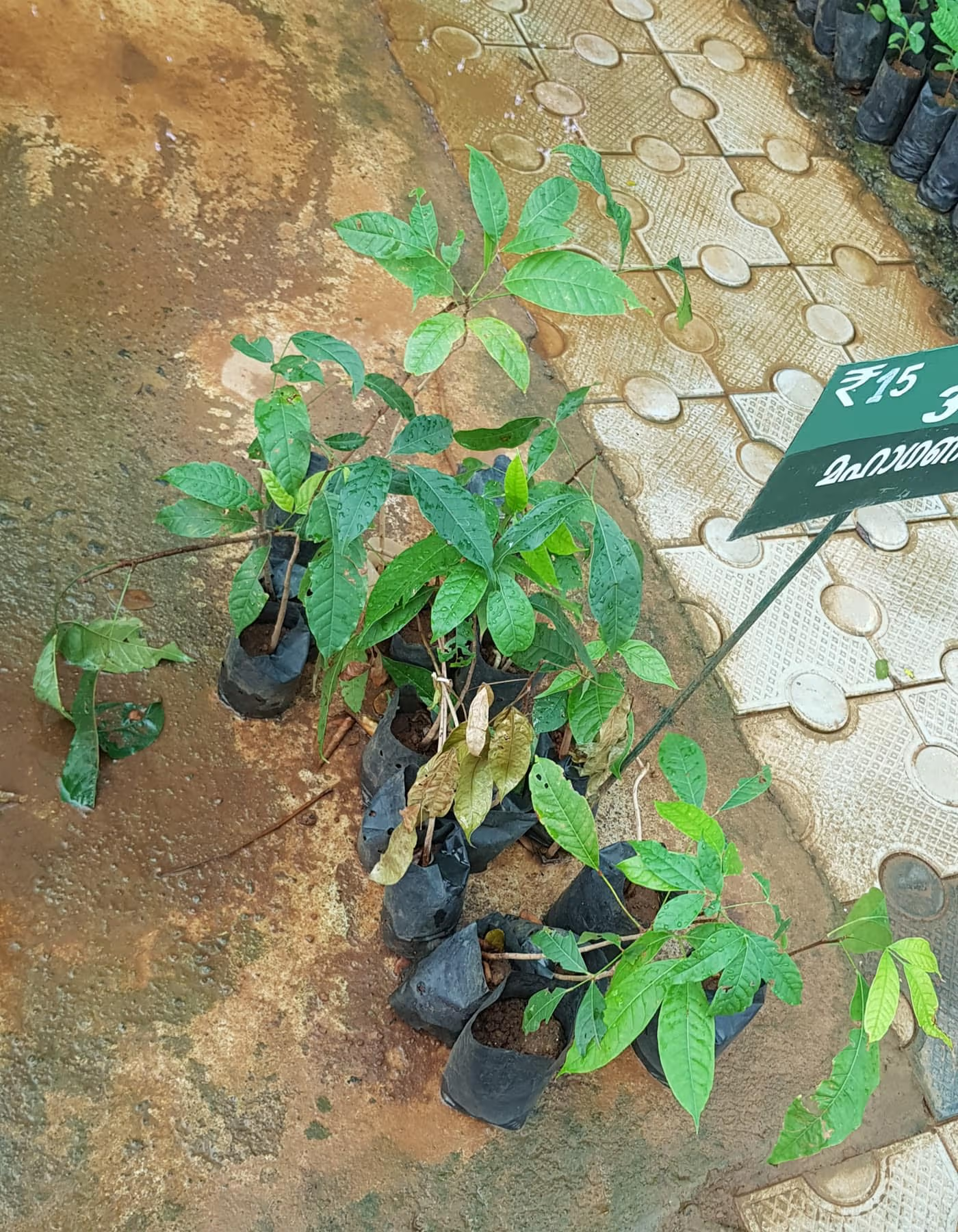
The tree is raised from seed — fresh winged samaras collected from a well-formed mother tree, sown in a polybag nursery, and planted out as a 6–12 month old seedling at the start of the monsoon. It grows fast on deep, well-drained soil with good rainfall (1,500–3,000 mm) and can put on 2–3 m of height per year in the first few years on a favourable site. Spacing is typically 3 × 3 m to 5 × 5 m depending on whether the block will be thinned for poles or grown straight through for sawtimber, with a full rotation of 15–25 years to marketable girth.
What makes mahogany genuinely difficult is not the tree's biology but one insect: the mahogany shoot borer, Hypsipyla robusta. The larva bores into the growing tip of the leading shoot, killing it and forcing the tree to fork from a side branch — and a forked trunk produces far less usable timber than a straight one. No chemical or biological control has reliably solved the shoot-borer problem anywhere in the world; the most practical Indian approach is to plant mahogany mixed with a taller, fast-growing nurse tree (like Ailanthus or eucalyptus) that shades the leading shoot just enough to reduce attack, combined with prompt pruning of any fork that does form.
Like teak, mahogany has no MSP and no Agmarknet mandi trade — timber is sold as logs or standing trees through registered timber depots and sawmills, valued by girth, length and grain quality. Felling on private farmland is regulated in most states, though less tightly than teak in some; the exact permit requirement varies by state and should be confirmed with the local forest range office or the NTMS portal before any cutting begins.
- Crop type
- Semi-deciduous long-rotation hardwood timber tree (introduced)
- Season
- Planted at monsoon onset (June–July)
- Suitable states
- Kerala, Karnataka, Tamil Nadu, Andhra Pradesh, Maharashtra, Odisha
- Rotation length
- 15–25 years to full-value timber
- Water requirement
- High; needs 1,500–3,000 mm rainfall, no waterlogging
- Temperature
- Tropical; 25–35°C growing range, frost-sensitive
- Soil type
- Deep, well-drained laterite or red loam; pH 6.0–7.5
- Difficulty level
- Moderate (shoot-borer management, not basic agronomy)
- Expected yield
- Timber volume builds over 15–25 years; value by girth and grain, not weight
- Key risk
- Mahogany shoot borer (Hypsipyla robusta) forking the trunk
Overview
Mahogany (Swietenia macrophylla), known simply as "mahogany" across India, is a large evergreen-to-semi-deciduous tropical timber tree introduced from Central America and now one of the most widely planted exotic hardwoods in peninsular India. Its timber — reddish-brown, straight-grained, easy to work, naturally resistant to termites and decay — commands a premium in the furniture, panelling and interior woodwork market, and the tree's fast early growth on wet tropical sites has made it popular with farmers in Kerala, Karnataka, Tamil Nadu, Andhra Pradesh, parts of Maharashtra and Odisha.
The tree is propagated from seed. The fruit is a large woody capsule that splits open to release flat, winged samaras, which must be sown fresh (within a few weeks of collection) for good germination. Seedlings are raised in polybag nurseries for about 6–12 months and planted out at the start of the monsoon into pre-dug pits, at a spacing of 3 × 3 m to 5 × 5 m depending on the thinning plan and end use. The tree grows rapidly on deep, well-drained soil with 1,500–3,000 mm of annual rainfall and is frost-sensitive, which is why it is limited to tropical and warm-subtropical India.
The one problem that defines mahogany growing worldwide — not just in India — is the mahogany shoot borer (Hypsipyla robusta in Asia and Africa, H. grandella in the Americas). The larva tunnels into the leading shoot, killing the tip and forcing the tree to fork; repeated attacks in the early years can turn a potentially straight, single-stemmed tree into a multi-branched, low-value form. No silver-bullet chemical or biological control exists despite decades of global research. The most effective practical approach in India is mixed planting with a taller nurse species (Ailanthus triphysa or eucalyptus) that provides partial overhead shade to the mahogany canopy — the borer attacks the unshaded leading shoot, so shading reduces incidence — combined with prompt pruning of any fork that does develop, to maintain a single straight stem.
Crop timeline, sowing to harvest
A quick visual map of the season — jump to any section below for the detail behind each stage.
- Month 0 (March–April)
Seed collection & sowing
Fresh winged samaras are collected from a mature, well-formed mother tree as the capsules split open (typically March–April in south India) and sown immediately in polybag nurseries — germination drops sharply if seed is stored for more than a few weeks.
- Month 6–12 (June–July)
Planting out
Six- to twelve-month-old polybag seedlings, about 30–50 cm tall, are planted into pre-dug pits at the start of the monsoon; a nurse tree (Ailanthus, eucalyptus) is planted in alternate rows or as every other tree in the row to shade the mahogany canopy and reduce shoot-borer attack.
- Year 1–5
Establishment & shoot-borer watch
The young trees put on rapid height growth (2–3 m per year on a good site); the shoot borer is most damaging in these early years, so the block is inspected monthly during the growing season, and any forked tip is pruned back to a single leader immediately.
- Year 5–10
First thinning & canopy management
Overcrowded, poorly-formed or heavily-borer-damaged trees are thinned out for poles or fuelwood; the nurse-tree component may also be harvested if it has served its shading purpose and is now competing for light.
- Year 15–25
Final felling
The remaining, best-formed trees are felled for full-value sawtimber once girth, heartwood colour and grain have matured — a well-grown, straight-stemmed mahogany log commands a premium over most other plantation timbers in the Indian market.
Suitable states
States where this crop is grown at scale, highlighted below. Your local Krishi Vigyan Kendra is still the final word for your specific block.
- Jammu and Kashmir
- Himachal Pradesh
- Punjab
- Uttarakhand
- Haryana
- Delhi
- Uttar Pradesh
- Rajasthan
- Bihar
- Jharkhand
- West Bengal
- Sikkim
- Assam
- Arunachal Pradesh
- Meghalaya
- Nagaland
- Manipur
- Mizoram
- Tripura
- Gujarat
- Madhya Pradesh
- Chhattisgarh
- Maharashtra
- Odisha
- Goa
- Telangana
- Andhra Pradesh
- Karnataka
- Kerala
- Tamil Nadu
- Puducherry
- Ladakh
- Chandigarh
- Lakshadweep
Grown here
Climate requirements
Mahogany's natural range in Central and South America is wet tropical forest, and its best Indian sites — the Western Ghats belt and the eastern coastal wet zone — replicate those conditions closely. Planting it in drier, colder or frost-prone areas is almost always a mistake.
Ideal temperature
Mahogany is a warm-tropical species that grows best between 25°C and 35°C and is killed or severely set back by even a light frost — this is why it is not grown above about 700–800 m elevation in India, and why north-Indian plains with cold winters are unsuitable.
Rainfall
The tree needs high rainfall, ideally 1,500–3,000 mm per year, well-distributed through a monsoon season of at least five to six months. It tolerates a moderate dry season (two to three months) but performs poorly in the semi-arid zones that suit teak.
Humidity
High humidity through the growing season suits mahogany well — it is a tree of the wet tropics. Very low humidity and dry, desiccating winds stress the young foliage and slow growth.
Sunlight
Full sun once the canopy is established, but moderate overhead shade from a nurse tree in the first few years actually helps — it reduces shoot-borer attack on the leading shoot, the single most important practical benefit of mixed-species planting.
Soil requirements
The laterite and red-loam soils of the Western Ghats foothills, where most Indian mahogany is planted, suit it well — but check drainage and depth before planting on flat or low-lying land, where waterlogging can kill young trees.
Suitable soil
Deep, well-drained laterite, red loam or alluvial soil is ideal. Mahogany also grows well on the deep volcanic soils of parts of Karnataka and Maharashtra, as long as drainage is free. It does poorly on shallow, rocky, waterlogged or heavy clay soil.
pH range
Slightly acidic to neutral, pH 6.0–7.5; strongly acidic or alkaline soils both give poor growth.
Drainage
Free drainage is essential — mahogany roots are susceptible to waterlogging and fungal root rot if the soil stays saturated for extended periods.
Organic matter
Responds well to organic matter (well-rotted FYM or compost) mixed into the planting pit, and benefits from its own leaf-litter mulch as the block matures.
Land preparation
Same four steps whichever region you are in — only the timing shifts with the sowing window.
- 1
Mark the planting grid and dig pits
Mark a 3 × 3 m to 5 × 5 m grid (about 160–450 trees/acre) depending on the planned thinning and nurse-tree regime; dig pits about 45 cm × 45 cm × 45 cm at least two to three weeks before the monsoon so the soil weathers.
- 2
Refill with topsoil and organic matter
Refill each pit with topsoil mixed with about 2–3 kg of well-rotted farmyard manure or compost; in termite-prone areas, mix a recommended soil insecticide or a Metarhizium bio-formulation into the pit.
- 3
Plan the nurse-tree layout
If planting a mixed block to reduce shoot-borer damage, alternate rows of mahogany with rows of a fast-growing, taller nurse tree (Ailanthus triphysa is the most-used in Kerala and Karnataka; eucalyptus is an alternative) that will provide overhead shade to the mahogany canopy within 2–3 years.
Seed information
How the main varieties compare, so you can pick by duration, yield, disease pressure or what you are growing for.
| Variety | Duration | Yield | Disease resistance | Best state | Suitable for |
|---|---|---|---|---|---|
Kerala Forest Department Seed Source Seed collected from mature, well-formed mother trees in Kerala's established mahogany plantations (Nilambur, Chalakudy, Konni divisions) — the most widely available quality seed source for farm planting in south India, supplied through KFD divisional nurseries and the KFRI seed centre. | 15–25 years to full-value timber | Good; Kerala's older plantations show some of the best mahogany growth in India | Not separately documented; standard shoot-borer watch applies | Kerala | General farm-forestry and roadside planting in Kerala and adjoining wet-zone districts |
Seedlings raised from seed collected from KFRI's (Kerala Forest Research Institute) selected plus trees — trees individually identified for superior stem form, height, girth and branch angle — giving a higher proportion of straight-stemmed progeny than unselected open-pollinated seed. Available through KFRI's seed supply programme. | 15–25 years to full-value timber; slightly faster early growth than unselected stock on comparable sites | High; improved stem form raises sawn-timber recovery per tree | Not separately documented; shoot-borer susceptibility is a species-wide trait, not a seedlot difference | Kerala | Farm-forestry blocks prioritising timber quality over lowest seedling cost |
Tamil Nadu Forest Department Nursery Stock Seedlings raised in Tamil Nadu Forest Department nurseries from seed collected within the state's established mahogany plantations — the main channel through which farmers in Tamil Nadu source mahogany planting material, typically available for monsoon planting through divisional forest offices and KVK linkages. | 15–25 years to full-value timber | Good; Tamil Nadu's laterite-belt plantations perform well | Not separately documented | Tamil Nadu | Farm-forestry planting across the Tamil Nadu laterite and red-loam belt |
Private Tissue-Culture / Clonal Mahogany Clonal plantlets produced by a small number of private tissue-culture laboratories, selected from straight-stemmed, fast-growing mother trees and marketed to farmers as premium planting stock — an emerging route, not yet as widely used as for teak or eucalyptus, but offered by a growing number of nurseries in Kerala, Karnataka and Tamil Nadu. | Faster early growth than seedling stock; full rotation still 15–25 years | Potentially higher; more uniform stem form if the mother-tree selection is genuine | Not separately documented; shoot-borer susceptibility remains a species-wide trait regardless of propagation method | Kerala, Karnataka, Tamil Nadu | Farm-forestry blocks where a higher per-plant cost is justified by more uniform timber quality |
Tamil Nadu Forest Department Seed Source Seedlings raised from seed collected from Tamil Nadu Forest Department's established mahogany plantations in the Nilgiris and Western Ghats foothills — available through government nurseries and social forestry schemes. | 15–25 year rotation | Standard timber yield; seed from established TN plantations with known performance | Standard shoot-borer susceptibility; nurse-tree planting recommended | Tamil Nadu | — |
Private Clonal / Tissue-Culture Stock Clonal or tissue-culture mahogany seedlings from private nurseries — selected from straight-stemmed, fast-growing mother trees for better form and timber yield, though the shoot-borer problem remains unsolved by genetics. | 15–20 year rotation; faster initial growth than seed-origin stock | Potentially higher — clonal selection from straight-stemmed, fast-growing mother trees | Shoot-borer susceptibility unchanged; no clone proven resistant to Hypsipyla | Kerala | — |
- Seed rate
- Mahogany is raised from seed (winged samaras), not from stumps or cuttings like teak. About 400–1,000 seeds are needed to raise enough seedlings for one acre (depending on germination rate and spacing), sown in polybag nurseries and planted out as 6–12 month old seedlings. Seed must be fresh — viability drops sharply after a few weeks of storage.
- Certified seed
- Source seed or seedlings from a state forest department nursery, KFRI's seed supply programme, or a reputed private nursery working from identified plus trees. Reject seedlings that are spindly, root-bound in the polybag, or show signs of shoot-borer damage (a dead or forked tip) — a seedling planted with an already-forked stem will never make straight timber.
- Spacing
- 3 × 3 m (about 450 trees/acre) for a dense block with planned thinning, to 5 × 5 m (about 160 trees/acre) for wider spacing with fewer thinnings. In a mixed block with a nurse tree, the mahogany rows are typically 4–5 m apart with the nurse tree in alternate rows.
- Seed treatment
- Fresh samaras are sown directly in polybags filled with a soil-sand-compost mix, pointed end down, about 1–2 cm deep. No elaborate pre-treatment is needed if the seed is genuinely fresh (within 2–3 weeks of collection); older seed can be soaked in water for 12–24 hours to soften the seed coat, but germination will still be lower.
Sowing guide
A seedling planted too deep or with a broken root ball establishes slowly and is more vulnerable to shoot-borer attack in its first year — handle carefully.
- Best time
- Plant seedlings at the start of the monsoon (June–July), once the soil has been wetted by the first good rains — the seedling needs several months of continuous moisture to establish its root system before the following dry season.
- Row spacing
- 3–5 m between rows, depending on the block design and nurse-tree plan
- Plant spacing
- 3–5 m within the row, matching the row spacing for a square or near-square grid
- Sowing depth
- Set the seedling at the same depth it was growing in the polybag — the root collar should sit at ground level, not buried or exposed.
- Method
- Carefully cut and remove the polybag, keeping the root ball intact; place the seedling in the pit, fill around the root ball with the topsoil-compost mix, firm it in by hand, and water immediately if the soil is not already saturated.
Fertilizer schedule
A split dose beats one large dose applied at sowing — nitrogen especially is lost to the air and to leaching if it all goes in on day one.
- 1
At planting (basal)
Year 0
Well-rotted farmyard manure or compost mixed into the pit (about 2–3 kg per pit). Mahogany establishes well on organic matter alone on a reasonable laterite or red-loam soil.
- 2
Young trees
Years 1–3
A modest dose of NPK (roughly 50–100 g urea, 50 g SSP, 25 g MOP per tree per year, applied in a ring around the base at the start of the monsoon) helps on poorer or sandier soils. Skip on naturally rich alluvial or volcanic soil where growth is already strong.
- 3
Established block
Year 4 onward
Most established mahogany blocks are not routinely fertilised beyond their own leaf-litter return. A thin layer of compost around the base on lighter soils is the usual practice where extra input is judged worthwhile.
Irrigation schedule
1. Establishment
First 1–2 dry seasons
A young seedling benefits from watering through its first one or two dry seasons if rainfall has been poor — especially on lighter soils or at sites below 1,500 mm annual rainfall.
2. Established block
Year 3 onward
Mahogany on a wet-zone site with 1,500+ mm rainfall is normally rainfed once established and does not need routine irrigation.
Critical stages
- First dry season after planting
- Any unusually long dry spell in years 1–2
Water-saving tips
- Plant at the true start of the monsoon, not before it, so the young root system has the maximum run of wet-season moisture.
- A shallow basin around each seedling in year 1 concentrates any supplemental watering over the root zone.
- Leave the tree's own leaf-litter as mulch — it holds soil moisture and builds organic matter over time.
Weed management
Common weeds
Organic control
- Two or three slashings a year in a 1–1.5 m radius around each seedling for the first two to three years is standard — after that the closing canopy shades most weeds out.
- Growing a short intercrop (banana, pineapple, ginger, turmeric) between the rows for the first 2–3 years both earns income and keeps the ground worked and largely weed-free.
- Slash Chromolaena and Lantana before they seed and flower, and leave the slashings as mulch.
Chemical control
- Weed control in the first two to three years is primarily by manual slashing or hoeing in a ring around each seedling — routine herbicide use is uncommon in farm-forestry mahogany blocks.
- A directed pre-emergence glyphosate strip along the planting row can be used in a large block, kept well off young bark and foliage; confirm the current product and dose with your state forest department or KVK.
Nutrient deficiency identification
What a shortage of each nutrient actually looks like on the plant, so you can tell a deficiency apart from a disease before you spray the wrong thing.
Nitrogen
Visible symptom
Pale, yellow-green older leaves and thin annual height growth — usually only on poor, leached laterite or sandy soils.
Phosphorus
Visible symptom
Slow early establishment, poor root development and a dull, dark-green or purplish cast on older leaves of a young tree.
Potassium
Visible symptom
Marginal leaf scorching (browning of leaf edges) on older leaves, and a general reduction in stem girth increment on potassium-deficient soils.
Diseases to watch for
Symptoms, likely cause and what actually treats it — not just a spray name.
Pests to watch for
What to look for before the damage is visible, and organic options before you reach for a chemical.
Mahogany shoot borer (Hypsipyla robusta)
- Identification
- A small greyish-brown moth whose caterpillar bores into the growing tip (terminal shoot) of the mahogany tree, killing the leader and causing the trunk to fork from a side branch. Frass (sawdust-like droppings) at the tip, a wilting or dead leader, and a side branch taking over as the new main stem are the classic signs. Most damaging in the first 5–8 years when the tree is putting on height.
- Damage
- The single most important pest of mahogany worldwide. Repeated shoot-borer attacks in the early years turn a potentially straight, single-stemmed tree into a multi-branched, low-value form — the forked trunk produces far less usable sawtimber than a straight one, and the price difference is large.
- Organic control
- Mixed planting with a taller nurse tree (Ailanthus triphysa or eucalyptus in alternate rows) that shades the mahogany canopy from above is the most effective practical approach — the borer preferentially attacks unshaded, fully-exposed leaders. Conserve natural enemies (parasitoid wasps, predatory birds). Prompt pruning of any fork back to a single leader, done as soon as the damage is noticed, keeps the stem straight even after an attack.
- Chemical control
- No chemical spray has reliably controlled the shoot borer in any country — the larva feeds inside the shoot, protected from contact insecticides, and systemic treatments have not shown consistent field results. A stem-injection of a registered systemic insecticide (monocrotophos was historically used but is now restricted) has been tried experimentally, but this is not a routine recommendation — confirm any current registered option with your state forest department or ICFRE institute.
Leaf-eating caterpillars
- Identification
- Various moth caterpillars feeding on the leaves of young mahogany trees during the monsoon flush, sometimes in localised outbreaks that strip the canopy — less economically damaging than the shoot borer but can slow growth in the year of attack.
- Damage
- Repeated defoliation slows height and girth growth, especially in young trees; usually a transient problem that resolves without intervention once natural parasitoids build up.
- Organic control
- Hand-pick caterpillars from young trees where the outbreak is small and localised; conserve parasitoid wasps and predatory birds. The closing canopy in a maturing block tends to deter heavy outbreak years.
- Chemical control
- Spot-spray with a CIB&RC-registered contact insecticide only on high-value young blocks where a heavy, persistent outbreak is measurably slowing growth — confirm the current product with your local KVK or forest department.
Termites
- Identification
- Mud sheeting on the stem of freshly planted seedlings and young trees, with the soft bark and root collar eaten away underneath; worst on sandy soils and where fresh organic matter has been mixed into the pit.
- Damage
- Can kill a freshly planted seedling before it roots properly, or girdle a young tree at the collar.
- Organic control
- Use only well-decomposed manure in the planting pit (fresh manure attracts termites); drench the pit with a Metarhizium bio-insecticide in known termite-prone areas.
- Chemical control
- Mix a recommended soil insecticide into the pit at planting in termite-prone areas; confirm the current product with your local KVK or forest department.
Common mistakes to avoid
The mistakes that cost growers the most, ranked by how often they show up in the field — not in the order you might expect.
- 1
Planting mahogany in pure, unshaded blocks without a nurse tree.
Why it hurts
An open, fully sun-exposed block suffers the heaviest shoot-borer attack — every leading shoot is visible and accessible to the moth. Mixed planting with a taller nurse species that shades the mahogany canopy is the single most effective way to reduce attack, and skipping it almost guarantees heavy forking in the early years.
- 2
Ignoring a forked leader instead of pruning it back to a single stem immediately.
Why it hurts
A fork left unattended becomes a permanent feature of the trunk — two co-dominant stems compete for dominance, neither grows straight, and the resulting forked log is worth a fraction of a single straight stem at felling.
- 3
Planting on waterlogged, poorly-drained or heavy clay soil.
Why it hurts
Mahogany roots are susceptible to root rot on saturated soil. A block planted in a low-lying, water-collecting area will lose trees to root rot in the first few rainy seasons and underperform for its entire life.
- 4
Using old, stored seed instead of fresh samaras for the nursery.
Why it hurts
Mahogany seed viability drops sharply within weeks of collection — sowing stored seed gives patchy, poor germination and a weak nursery batch. Always sow within 2–3 weeks of collection.
- 5
Expecting teak-like permit exemptions for mahogany in every state.
Why it hurts
Although mahogany is an introduced (exotic) species, not all states have fully de-regulated its felling on private land. Check with the local forest range office or the NTMS portal before any felling or transport — the rules vary by state and by the number of trees involved.
- 6
Planting in a frost-prone or dry area on the assumption "it's a tropical tree, it'll manage".
Why it hurts
Mahogany needs genuine tropical warmth and high rainfall (1,500–3,000 mm). It does not tolerate frost, and it grows poorly in semi-arid areas with less than 1,000 mm of rain — these sites suit teak, not mahogany.
Harvesting
Mahogany is thinned in stages — poorly-formed, borer-damaged or overcrowded trees are removed for poles and fuelwood from about year 5–8, and the final, best-formed straight-stemmed trees are felled for full-value sawtimber from year 15–25 onward, once girth and heartwood have matured. Many owners stagger the final felling over several years rather than clear-felling the whole block.
Signs it is ready
- Heartwood has developed the characteristic reddish-brown colour and hardened grain
- Girth has reached the class the local sawmill or timber depot is paying a premium for
- A valid felling permit has been obtained from the state forest department or NTMS portal (where required) before any cutting begins
Tools
- Chainsaw or crosscut saw for felling and cross-cutting
- Tractor-trolley or truck for transporting logs, only after transit documentation is in order
- A registered timber depot or sawmill for grading and sale
Expected yield
Timber volume and value both build with age — a well-grown, straight-stemmed mahogany log from a 20-year rotation is a high-value product. The actual price varies sharply by stem straightness, girth, heartwood proportion and grain quality — a forked or poorly-formed tree is worth a fraction of a straight one.
Post-harvest & storage
Storage
Mahogany logs are naturally resistant to termites and fungal decay and can be stored for a moderate period, but should still be stacked off the ground on cross-battens under cover to prevent end-splitting, sun-checking and surface staining.
Packaging
Logs are graded and sold by measured girth, length and visible grain/heartwood quality — usually through a registered timber depot, sawmill or local timber trader.
Transportation
Check the felling and transit permit requirement for mahogany in your state before moving any logs. Although mahogany is an introduced (exotic) species, some states still regulate it under their private-land tree-felling rules — the National Timber Management System (NTMS) portal is the current central channel for permit applications, but the actual exemption status for exotics varies by state. Confirm with your local forest range office well before the trees are ready to fell.
Shelf life
Sawn mahogany timber, once seasoned, is long-lasting and does not need special storage — its natural durability, dimensional stability and resistance to decay are the basis of its value in furniture and interior woodwork.
Market prices
Today's mandi price near you, pulled live from the government's own Agmarknet data.
Live daily mandi prices from the government Agmarknet dataset.
Government mandi price not available for this crop
This crop is not traded through APMC mandis covered by the government’s Agmarknet system, so there is no mandi price to show here.
Weather
Current conditions and a 5-day outlook for your selected location, with one line of stage-aware advice.
Pick your state for current conditions and a 5-day outlook.
Live data from Open-Meteo
Profit calculator
Your own cost sheet, expected yield and selling price — not ours.
Where the money goes
Share of the total cost per acre, using the calculator’s own default cost sheet below — adjust the numbers there to match your field and this picture will no longer apply to you exactly, but the ranking rarely changes.
- Land rent37% (₹9,000)
- Labour20% (₹5,000)
- Seed16% (₹4,000)
- Fertiliser6% (₹1,500)
- Pesticide & weedicide6% (₹1,500)
- Irrigation6% (₹1,500)
- Machinery4% (₹1,000)
- Interest4% (₹1,000)
Official downloads
Government and ICAR documents only — everything below is hosted on an official server.
Kerala Forest Research Institute (KFRI)
Research on mahogany growth, shoot borer and mixed-planting trials in Kerala
Institute of Wood Science & Technology (IWST), Bengaluru
ICFRE institute for wood quality, timber testing and plantation forestry
National Timber Management System (NTMS)
Central portal for registering farm-tree plantations and applying for felling/transit permits
Kisan Call Centre — 1800-180-1551
Free crop advice in your language
Frequently asked questions
Is mahogany native to India?
No. Swietenia macrophylla is native to Central and South America and was introduced to India during the British colonial era. It has been widely planted across the wet tropics of peninsular India — Kerala, Karnataka, Tamil Nadu, Andhra Pradesh, parts of Maharashtra and Odisha — but it is not a native Indian species.
What is the mahogany shoot borer and can it be controlled?
The mahogany shoot borer (Hypsipyla robusta) is a moth whose caterpillar bores into the growing tip of the leading shoot, killing it and forcing the trunk to fork. No chemical spray reliably controls it anywhere in the world. The most effective practical approach in India is mixed planting with a taller nurse tree (Ailanthus triphysa or eucalyptus) that shades the mahogany canopy from above — the borer attacks exposed, unshaded leaders — combined with prompt pruning of any fork to maintain a single straight stem.
Do I need a permit to fell mahogany on my own farmland?
It depends on your state. Mahogany is an introduced (exotic) species, and some states have exempted exotics from the stricter felling rules that apply to native high-value species like teak. However, not all states have the same exemptions, and the rules can change. Always confirm the current requirement with your local forest range office or through the NTMS portal before felling or transporting any mahogany logs.
How long before a mahogany block gives returns?
Mahogany is a long-term investment, though shorter than teak. Some intermediate income comes from thinning poles and fuelwood from about year 5–8. The main crop of full-value sawtimber is usually felled from year 15–25 onward, depending on girth and wood quality. A straight-stemmed tree commands a substantially higher price than a forked one, which is why shoot-borer management in the early years is so important to the final return.
Can I grow mahogany in north India?
Mahogany is frost-sensitive and needs high rainfall (1,500–3,000 mm). Most of north India — the Indo-Gangetic plains, Punjab, Haryana, western UP, Rajasthan — is either too cold in winter, too dry, or both. Mahogany is best suited to the warm, wet tropics: the Western Ghats belt, the eastern coastal wet zone, and parts of Odisha and Chhattisgarh. If your site regularly gets even a light frost, choose teak, poplar or sheesham instead.
What can I grow between the mahogany rows while the trees are young?
Short intercrops are common and recommended for the first 2–3 years while the canopy is still open — banana, pineapple, ginger, turmeric and vegetables all work well in the wet-zone climate where mahogany grows. From about year 3–4 the closing canopy and the nurse tree together shade out most intercrops, and the block is left to the trees.
Still have questions?
The FAQs above cover the common ones. For anything specific to your field and soil, your nearest Krishi Vigyan Kendra is the authoritative answer.